
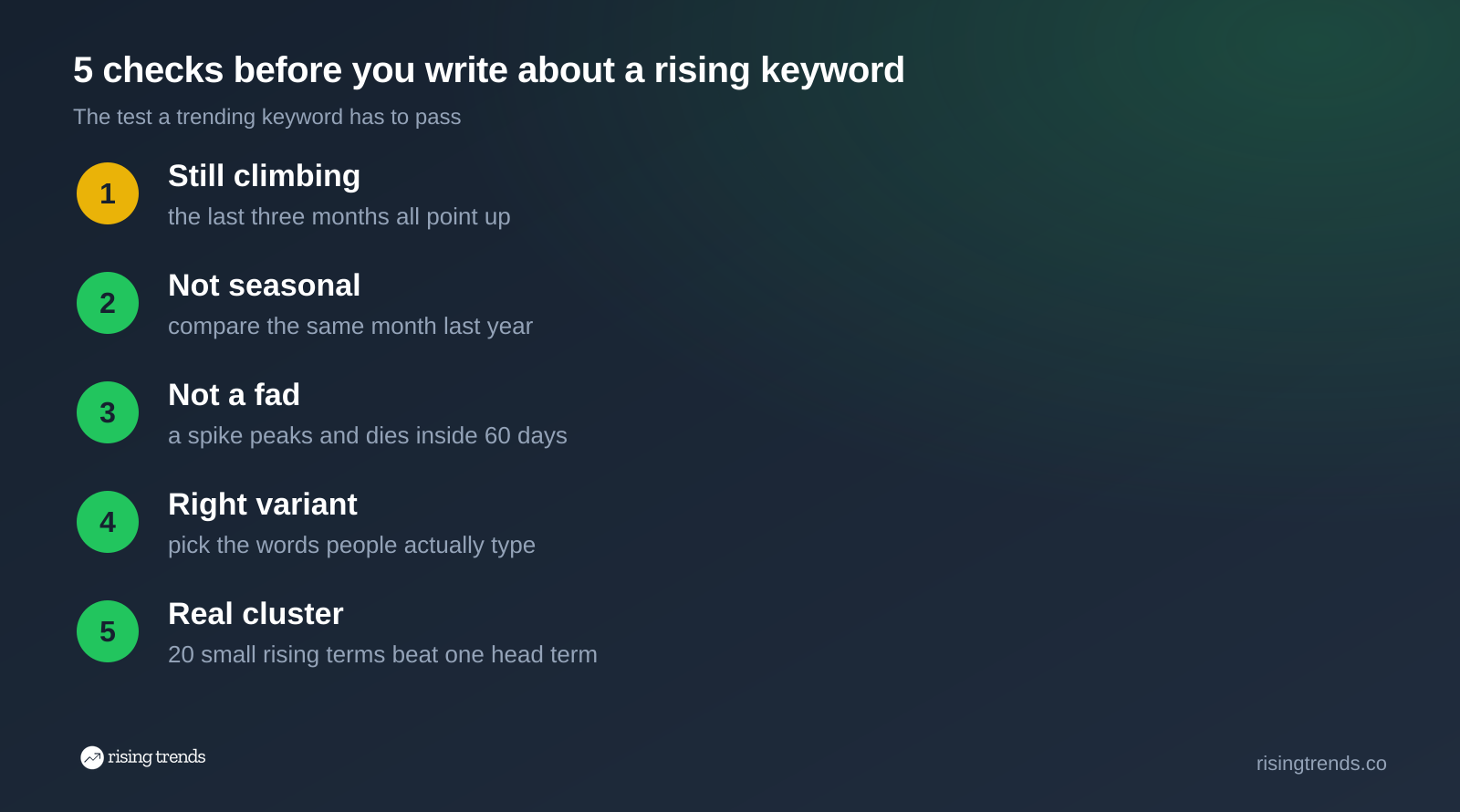
To find rising keywords before they peak, stop looking at one number. A keyword worth writing about has to pass five checks: it is still climbing in the last three months, it is not seasonal, it is not a two-month spike, it is the variant people actually type, and it sits in a cluster of other rising terms. Connect an AI assistant to real search volume and it can run all five in one conversation and hand you a brief at the end.
Key takeaways:
- One growth number is not a signal. "Beauty advent calendar" grew 3,950% in three months and is worthless in January. Seasonality and the shape of the curve decide, not the percentage.
- The five checks: still climbing, not seasonal, not a fad, right variant, real cluster. A keyword has to pass all five.
- Small is the point. "Data center moratoriums" went from 210 searches in July 2026 to 6,600 in October 2026, while "data centers" sat flat at 450,000 all summer. The small one is the one you can rank for.
- Google Trends will not tell you how big a term is. Its numbers are a 0 to 100 index, not searches. You need absolute monthly volume to decide whether 3,000% growth means anything.
- Fads die in 60 days. "AI receptionist" went 5,400 to 450,000 and back to 49,500 in five months. The curve tells you; the growth percentage hides it.
- The cluster beats the keyword. The 21 terms in the data center backlash add up to 22,540 searches a month, up from 2,950 a year ago.
Let's get into it.
Why "trending keywords" lists are useless on their own
Every guide to finding trending keywords sends you to the same places: the rising queries tab in Google Trends, a trending topics database, TikTok, Reddit, a competitor's content. That part is easy. Nobody tells you what to do with the list once you have it.
The problem is that four completely different things look identical when you sort by growth:
- A keyword that is genuinely taking off.
- A keyword that does this every November and dies in January.
- A keyword that spiked for six weeks because of one news cycle.
- A keyword that already peaked two months ago and is on the way down.
Sorting by growth puts all four at the top. If you pick wrong, you spend a week writing a page for traffic that never arrives, or arrives and leaves.
Google Trends does not settle it either. Google's own Trends help page says the numbers are "scaled on a range of 0 to 100 based on a topic's proportion to all searches on all topics", and that terms with very little volume simply show as 0. A line going up and to the right tells you nothing about whether the term gets 200 searches a month or 200,000. Our guide to using Google Trends for SEO keyword research covers what the tool is good for, which is relative comparison and the last few days. Sizing a term is not on the list.
That gap is why Rising Trends exists. We track absolute US monthly search volume for every term in the database, with five years of monthly history, growth over three months to five years, and a seasonality label. You get a number you can decide with, not a shape.
The five checks
Here is the whole method before the detail. Run every candidate keyword through these in order and stop at the first one it fails.
| Check | What you look at | It fails when |
|---|---|---|
| 1. Still climbing | The last three months of monthly volume | The latest month is below the month before it |
| 2. Not seasonal | The same month in each of the last two years | The curve resets to near zero every year |
| 3. Not a fad | How long the rise has lasted | It went up and came down inside two months |
| 4. Right variant | Which spelling or phrasing carries the volume | You picked the version nobody types |
| 5. Real cluster | How many related terms are rising with it | It is one term on its own |
The rest of this guide runs a real niche through all five, as a conversation with an AI assistant, with the numbers it actually returns.
Set up the connector first (2 minutes)
An AI assistant cannot do any of this from memory. It has no idea how many people searched for something last month, and it will cheerfully invent a number if you ask. You have to give it a data source.
The Model Context Protocol is the open standard that connects AI apps to outside tools and data. Rising Trends runs an MCP server, so Claude and ChatGPT can query our database directly.
In Claude: open Settings, then Connectors, then Add custom connector, and paste https://mcp.risingtrends.co/mcp. Sign in to Rising Trends and press Allow. Claude's help centre explains custom connectors using remote MCP and which plans support them. Setup details for both assistants are on the Rising Trends MCP page.
You need a Pro account. As of November 20, 2026, Pro is a one-time $97 payment for lifetime access, which includes the connector, the REST API and tracking for up to 100 trends. If you would rather compare servers before you pick one, we rank them in the best trends MCPs and Claude skills.
Check 1: Is it still climbing?
Start wide, then narrow. Ask for the fastest-growing terms in your niche with a volume floor, because a term doing 40 searches a month is noise no matter how fast it grew.
Example conversation
You
I write about energy and infrastructure. Show me what is growing fastest in that category over the last three months, then pull every data center keyword you track with at least 1,000 US monthly searches.
Claude sweeps the category, then looks up the family by name, because these terms are filed under Energy, Real Estate, Construction and AI:
find_trends { "category": "Energy", "timeframe": "3m", "min_volume": 1000, "sort": "growth", "limit": 30 }
search_trends { "q": "data center", "limit": 10 }
Claude
The Energy sweep put data center moratoriums, data center noise and ai data centers at the top. Here is the whole family, data through October 2026, US monthly searches with growth over three months:
- data center moratoriums: 6,600, +3,043%
- data center jobs: 165,000, +643%
- data center construction: 6,600, +83%
- data centers: 450,000, +22%
- data center noise: 4,400, 0%
- ai data centers: 60,500, 0%
- hyperscale data centers: 6,600, -64%
Seven terms in one niche, pointing in three different directions. That spread is the useful part, and it is the part a 0 to 100 index cannot show you.
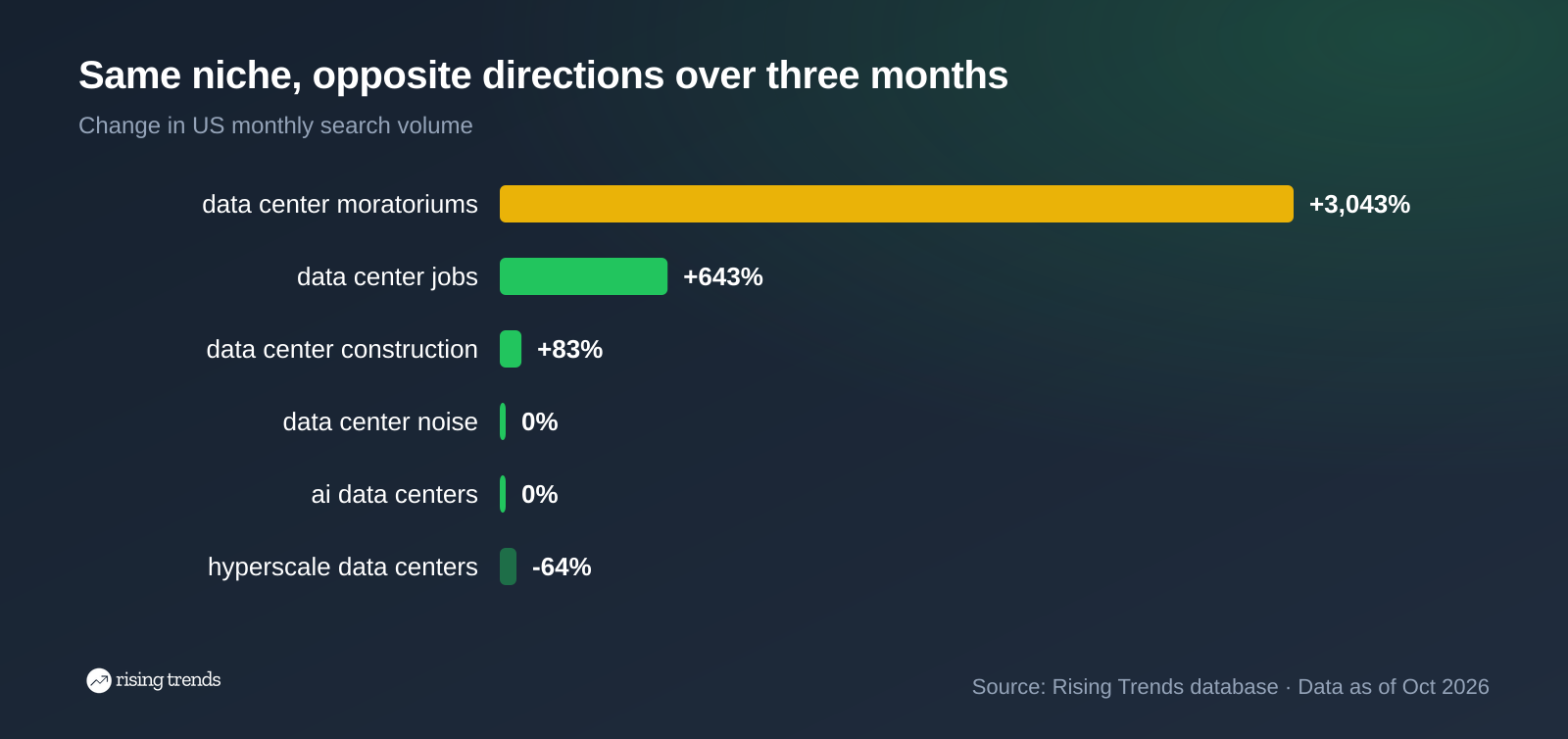
"Hyperscale data centers" is already out: it peaked at 18,100 searches in July 2026 and has fallen every month since. "Data centers" and "ai data centers" are flat, which is not a failure, just not an opening. "Data center moratoriums" at +3,043% is the one to look at next.
Check 2: Is it seasonal?
This is the check that saves the most wasted work, and the one no ranking page gives you a rule for.
Seasonal keywords produce the biggest growth percentages you will ever see, at exactly the wrong moment. Our database labels each term's seasonality as none, medium or high, which settles it in one field. If you want to see it for yourself, compare the same month across two years.
Example conversation
You
Is data center moratoriums seasonal? Compare it with beauty advent calendar, which I think is.
get_trends { "slugs": ["data-center-moratoriums", "beauty-advent-calendar"] }
Claude
data center moratoriums, seasonality: none. 0 searches a month until January 2026, then 50 in February, 140 in April, 170 in June, 210 in July, 320 in August, 3,600 in September, 6,600 in October. It has never had a down month.
beauty advent calendar, seasonality: high. 40,500 in October 2026 and three-month growth of +3,950%, which looks identical to a breakout. The history says otherwise: 74,000 in November 2025, 33,100 in December, 2,900 by January 2026, 590 by June. It does this every year.
Both terms show enormous three-month growth. One of them is a trend and one of them is a calendar. The percentage is the same; the curve is the difference. Write the advent calendar page if you want, but write it in August, and know that the traffic is gone by Christmas Day.
Check 3: Is it a fad?
A fad looks better than a trend while it is happening. It goes up faster, it hits a bigger number, and by the time your page is indexed it is over. Google says crawling a new page can take anywhere from a few days to a few weeks, so a spike that lasts six weeks is a spike you cannot catch.
Two real ones from the last few months, both of which would have topped any "trending keywords" list in August 2026:
| Month | ai receptionist | local llm |
|---|---|---|
| June 2026 | 5,400 | 8,100 |
| July 2026 | 90,500 | 74,000 |
| August 2026 | 450,000 | 246,000 |
| September 2026 | 301,000 | 165,000 |
| October 2026 | 49,500 | 27,100 |
Three months up, two months down. Anyone who started writing in August published into the decline.
The test is duration, not height. Ahrefs' research on the search demand lifecycle puts it well: a topic that has been growing for twelve months or more has far better odds of becoming sustained demand than one that spiked for a handful of months, and the best SEOs invest before the surge rather than during it. So the rule is simple. A rise that has run for three months or less is a bet. A rise that has run for nine months or more is a trend.
"Data center moratoriums" has risen every month since February 2026. That is nine months of climbing, and it passes.
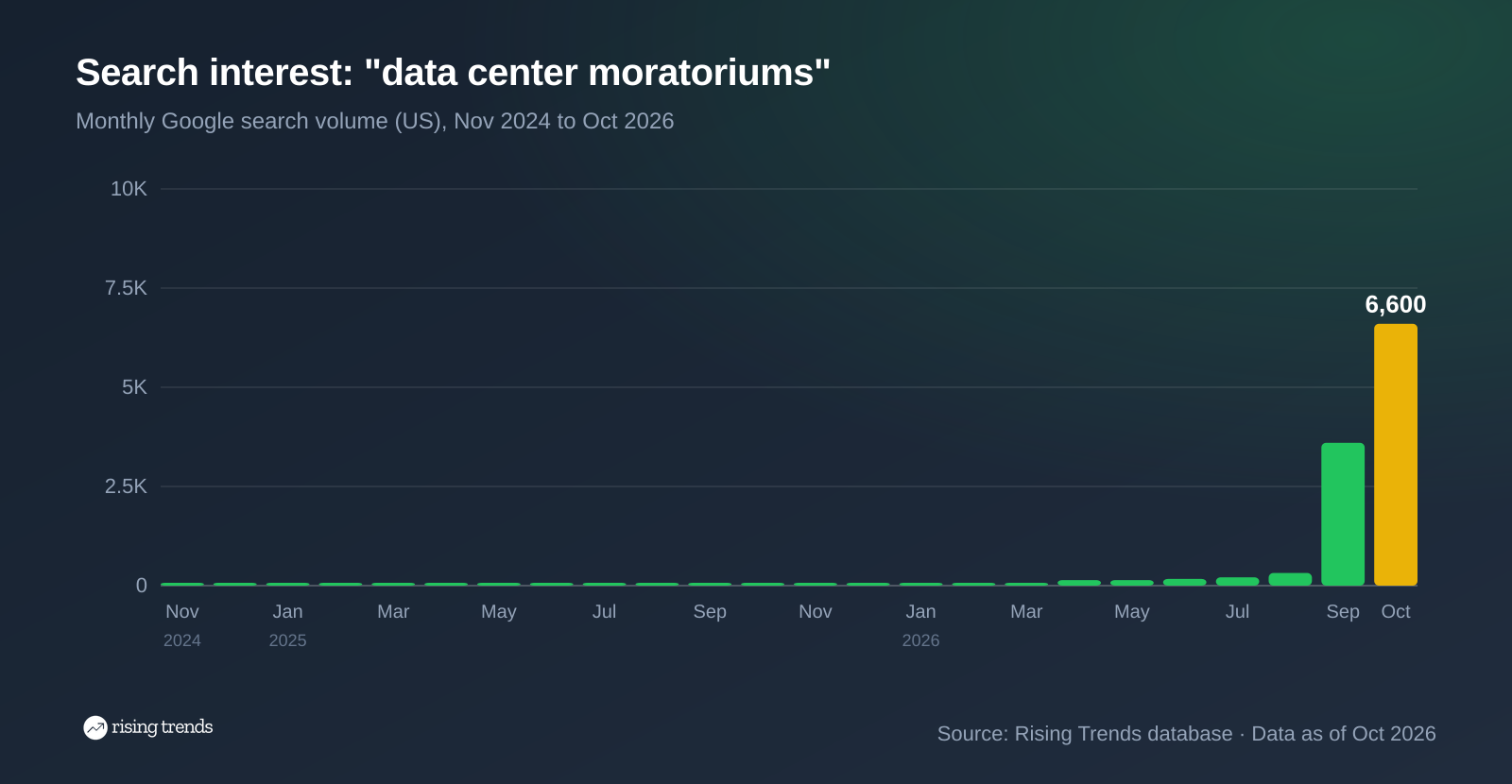
Notice how boring the first eighteen months of that chart are. That is what early looks like. We added this term to the database on July 23, 2026, when it was getting 210 searches a month, which is the whole point of tracking terms while they are small.
Check 4: Are you using the variant people type?
A single idea gets typed five ways, and the volume is rarely spread evenly. Pick the wrong phrasing and you optimise a page for a keyword with a tenth of the demand.
Our database folds the variants of one idea into a single trend with aliases, so you can see which phrasing carries the searches. "Data centers" at 450,000 a month also absorbs "data centre", the British spelling, and "build data centers". One page covers all of it.
Where variants are genuinely different searches, they stay separate, and the gaps are large:
- no data centers: 1,600 a month
- data center ban: 480
- ban data centers: 480
- anti data center: 480
Example conversation
You
Which phrasing should the page target? Show me the aliases folded into the main term.
get_trend { "name_or_slug": "data center moratoriums" }
Claude
The trend is listed under "data center moratoriums" and also folds in "ban data centers". Separate but overlapping terms in the same niche are "no data centers" (1,600 a month), "data center ban" (480), "anti data center" (480) and "data center zoning" (260).
Target "data center moratoriums" as the primary. The other four are H2s and FAQ questions in the same page, not pages of their own.
That last sentence is the real output of this check: which terms are one page and which are four.
Check 5: Is there a cluster behind it?
One rising keyword is a blog post. Twenty rising keywords are a content plan, and a much safer bet, because a whole cluster moving together is far harder to fake than one term.
Our mega trends group related terms into a theme with a combined volume, which answers this in one call.
Example conversation
You
Is there a wider theme around this? Give me the combined volume and every term in it.
list_mega_trends { "timeframe": "1y", "sort": "growth", "limit": 50 }
get_mega_trend { "slug": "theme-data-center-backlash" }
Claude
Data Center Backlash: 21 trends, 22,540 combined US monthly searches in October 2026, up from 2,950 in September 2025. That is 7.6x in thirteen months, and the combined curve has risen in all but two months.
The terms: data center moratoriums 6,600, data center noise 4,400, data center pollution 2,400, data center protest 1,600, data center backlash 1,600, no data centers 1,600, data center impacts 720, data center opposition 590, anti data center 480, ban data centers 480, data center ban 480, data center emissions 320, data center zoning 260, data center heat 210, data center permits 170, data center permitting 170, data center resistance 140, data center waste 110, data center pause 90, data center siting 70, data center nimby 50.
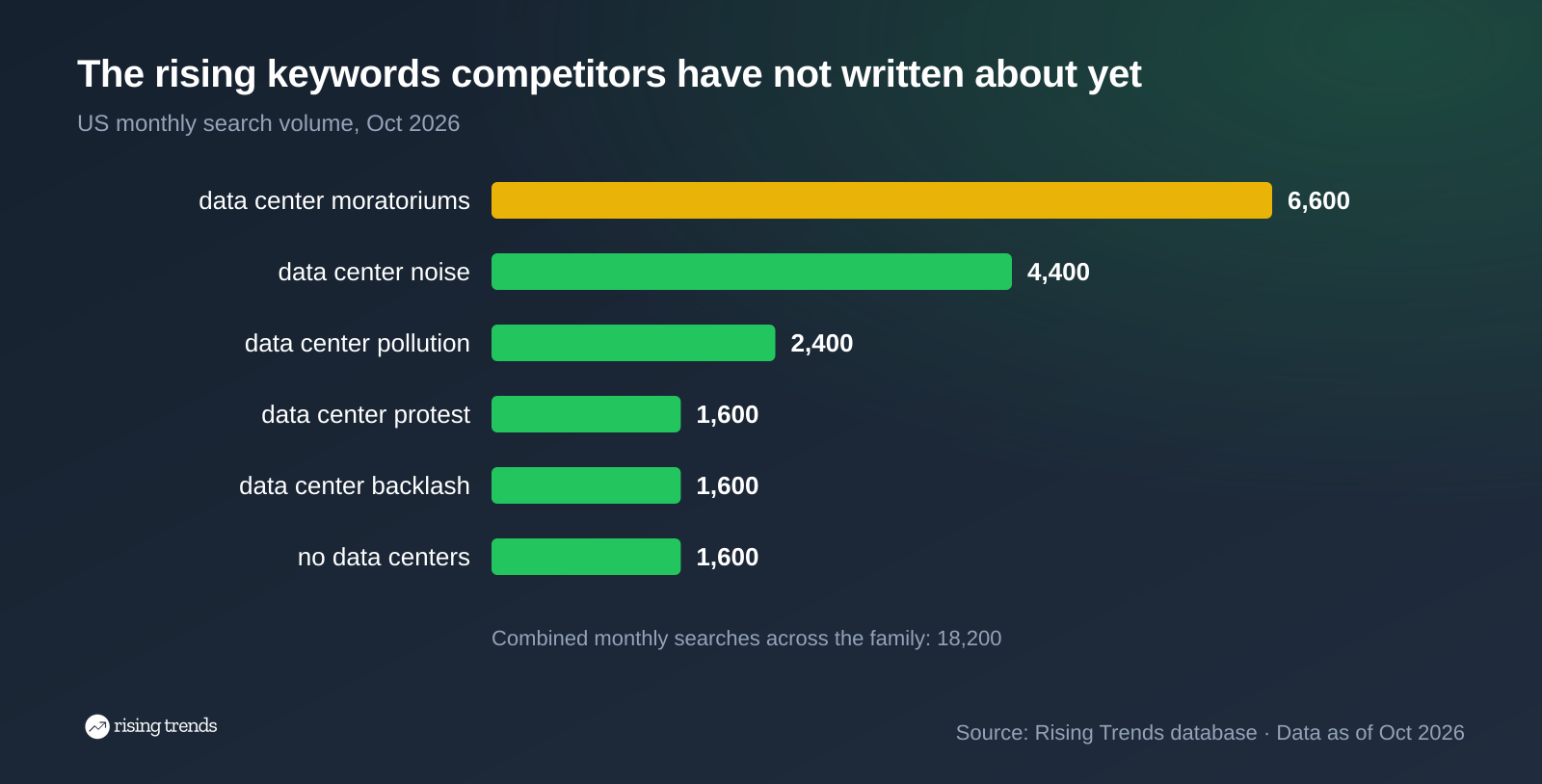
Fifteen of those twenty-one terms get under 1,000 searches a month. A keyword tool will tell you they are not worth your time. A year ago the whole cluster was 2,950 searches a month, and now it is 22,540. The small terms are where the cluster was a year ago, which is exactly where you want to be writing.
This is the step where our data earns its place in the workflow. Google Trends can show you that interest in one term is rising. It cannot tell you that twenty-one related terms are rising together and add up to 22,540 searches a month, because it does not report volume at all. That number, and the list behind it, is what Rising Trends gives the assistant to work with.
Turn the survivors into a brief
The point of the five checks is not a list of keywords. It is a decision about what to write.
Example conversation
You
Write a brief for one page covering this cluster. Primary keyword, the questions it has to answer, and which terms are separate pages later.
Claude
Primary keyword: data center moratoriums, 6,600 a month as of October 2026, up from 210 in July.
Covered on the same page: ban data centers, no data centers (1,600), data center ban (480), anti data center (480), data center zoning (260), data center permitting (170).
Questions to answer: which towns have passed moratoriums, what a moratorium actually stops, how long they last, what the legal basis is, what happens when one expires.
Separate pages, next quarter: data center noise (4,400, flat since May, steady demand rather than rising) and data center pollution (2,400).
Not now: hyperscale data centers, down 64% in three months.
That is a brief built from numbers rather than a hunch, and it took one conversation.
How early is early enough?
Pick your moment with the curve, not the calendar.
Google says a new page takes days to weeks to be crawled and indexed, as quoted above, and ranking takes longer than indexing. So you want to publish while a term is still climbing and still small enough that the SERP is weak.
In practice, three states:
- Under 1,000 searches and climbing every month. The best entry point and the hardest to justify to anyone looking at a spreadsheet. "Data center moratoriums" in June 2026, at 170 searches.
- A few thousand searches, rising for six months or more. Still a good entry, with evidence behind it. "Data center moratoriums" today.
- Flat for six months at a large number. You are competing on quality against pages that have had a year to earn links. "Data centers" at 450,000.
Ahrefs' lifecycle work makes the same point from the other end: a plateau only counts as stable demand once it has held for roughly six months, and a surge that has already peaked is a race you joined late. Our guide to trend forecasting goes deeper on reading the curve, and how to identify market trends covers the signals outside search data.
Run it again every week
A keyword check you do once is a keyword check you will stop doing. The repeatable version is one request.
The Rising Trends API returns the same data the assistant uses, so you can put the first check on a schedule and only open the conversation when something new appears. One request returns the category sorted by three-month growth:
curl -H "Authorization: Bearer rt_live_..." \
  "https://www.risingtrends.co/api/v1/trends?category=Energy&timeframe=3m&min_volume=1000&sort=growth"
Full parameters are in the API docs. The API is included in Pro, same account as the connector.
What this will not do for you
Honest limits, because a method you trust blindly is worse than no method:
- No keyword difficulty and no SERP data. We tell you demand and direction, not how hard the first page is. Keep your keyword tool for that.
- Monthly data, not daily. For a term that broke out this week, Google Trends is still the right tool, and the alternatives we rank here cover the rest.
- No social listening. If a term is moving on TikTok before it moves on Google, we will show it after the search volume follows, not before.
- The assistant still needs you. It can run the checks. Deciding whether your site has any business ranking for the topic is your call.
Copy-paste prompts
Three prompts that run the whole method. Swap the niche for yours and paste them in order.
1. Find the candidates
Show me trends in [your category] with at least 1,000 US monthly searches, sorted by growth over the last three months. Give me the monthly volume and the three-month growth for each.
2. Run the five checks
For the top five, pull the full history. For each one tell me: is the latest month higher than the month before, what is the seasonality label, how many months has the rise lasted, which keyword variants fold into it, and what else is rising alongside it. Drop anything seasonal or already past its peak.
3. Turn the survivors into a brief
For the ones that passed, write a content brief: the primary keyword with its volume and as-of month, the related terms that belong on the same page, the questions the page has to answer, and which terms deserve their own page later.
The second prompt is the one that matters. It is the part every other guide leaves to your judgement.
FAQ
What is the best way to find keywords?
Start with a growth-sorted list in your niche with a volume floor, then run every candidate through the five checks above: still climbing, not seasonal, not a fad, right variant, real cluster. The first part takes a tool. The second part is where the decision actually happens, and it is the part most guides skip.
Does Google Trends show search volume?
No. Google scales Trends data from 0 to 100 against a topic's share of all searches, so a term at 100 could be 500 searches or 5 million. Low-volume terms show as 0. You need a source of absolute monthly volume to size anything, and our guide to the Google Trends API covers what you can and cannot pull out of Google directly.
How do I tell a rising keyword from a seasonal one?
Look at the same month in each of the last two years. If the curve collapses to near zero in the off season and climbs back on schedule, it is seasonal, however big the three-month growth looks. "Beauty advent calendar" grew 3,950% in three months and will be back under 1,000 searches by February.
How early should I publish before a keyword peaks?
While it is still climbing and before the SERP fills up, which usually means while volume is in the hundreds or low thousands. Google takes days to weeks to crawl a new page and longer to rank it, so publishing at the peak means arriving after it.
Are low-volume keywords worth writing about?
Yes, when they are part of a cluster that is growing. Fifteen of the twenty-one terms in the data center backlash get under 1,000 searches a month each, but together the theme went from 2,950 to 22,540 searches a month in thirteen months. One 200-search keyword is not a business case. Twenty of them moving in the same direction is.
Can AI find keywords for me?
Only if you connect it to data. On its own an assistant answers from training data, which has no idea what happened to search volume last month. With a connector it queries a live database and the numbers are real. The same approach works for market research with Claude and for finding business ideas with AI.
What is trending right now?
Our trending topics list and the AI trends page are updated as new terms enter the database, and trend analysis explains how to work through one properly.
Want to spot the next shift before everyone else? Read our guide on how to identify market trends, or browse what is breaking out right now in our trending topics list.
Never miss a trend again
- One trend broken down with the numbers
- Who's making money, and what to build
- A website on the rise
- A breakout app
Join 5,000+ founders