
To find business ideas with AI, don't ask ChatGPT or Claude to invent them. Connect the assistant to real search data, ask it for niches that are growing, make it check monthly volume and two-year growth, cut anything seasonal, declining or tied to one brand, then look at the bigger trend behind what is left. Five steps, about 20 minutes, and every idea you end with has a number and a month attached.
Key takeaways:
- An AI chatbot on its own gives you ideas from memory, with no way to tell a growing market from a dead one. Give it a data source first.
- The method is five steps: ask for growing niches, check volume and 2-year growth, cut fads, zoom out to the mega trend, decide.
- "AI answering service" searches grew from 720 to 12,100 a month between September 2024 and September 2026 (Rising Trends data), with no seasonality.
- Big growth numbers lie often. "Interior decorators" shows +8,950% in a year, but it is one-month spikes on a baseline of about 1,300 searches.
- The mega trend tells you how much room there is. AI Search Optimization adds up to 336,870 monthly searches, up 324% in two years.
Let's get into it.
Why asking ChatGPT for business ideas is not enough
Ask a chatbot "give me 10 business ideas" and you get a tidy list. The problem is where it comes from. The model is drawing on its training data, so it cannot tell you whether people searched for that thing more this year than last year. It also can't tell a steady market from a one-week TikTok spike.
Most pages ranking for this question are "AI business idea generators": you type your interests and skills, and a model returns ideas. Useful for brainstorming, but none of them checks demand.
The fix is to give the assistant a data source. The Model Context Protocol (MCP) is an open standard that lets AI apps like Claude and ChatGPT connect to outside tools and data. The MCP documentation calls it a USB-C port for AI applications. Anthropic introduced it in 2024, and both assistants now support remote MCP servers.
Rising Trends runs one. Once you connect the Rising Trends MCP for Claude and ChatGPT, the assistant can pull absolute US monthly search volume, five years of history and growth over 3 months to 5 years for 65,000+ tracked trends, instead of guessing. That is the whole trick: the model does the thinking, our database supplies the numbers. Other trend data servers exist too, and our ranking of the best trends MCPs and Claude skills compares them, including what each one does that we don't.
Set up the Rising Trends MCP (2 minutes)
You need a Rising Trends Pro account. As of November 5, 2026, Pro on the pricing page is a one-time $97 payment for lifetime access, and it includes the REST API and the Claude and ChatGPT connector.
In Claude:
- Open Settings, then Connectors, then Add custom connector.
- Paste
https://mcp.risingtrends.co/mcp. - Click Connect, sign in to Rising Trends and press Allow.
Claude's help center says custom connectors using remote MCP work on Free, Pro, Max, Ultra, Team and Enterprise plans, with Free users limited to one custom connector.
In ChatGPT: add a custom MCP server, paste the same URL, choose OAuth, sign in and press Allow. Then mention @Rising Trends in your message.
In Cursor or Claude Code: create an API key in your account and send it as Authorization: Bearer rt_live_... with the same URL.
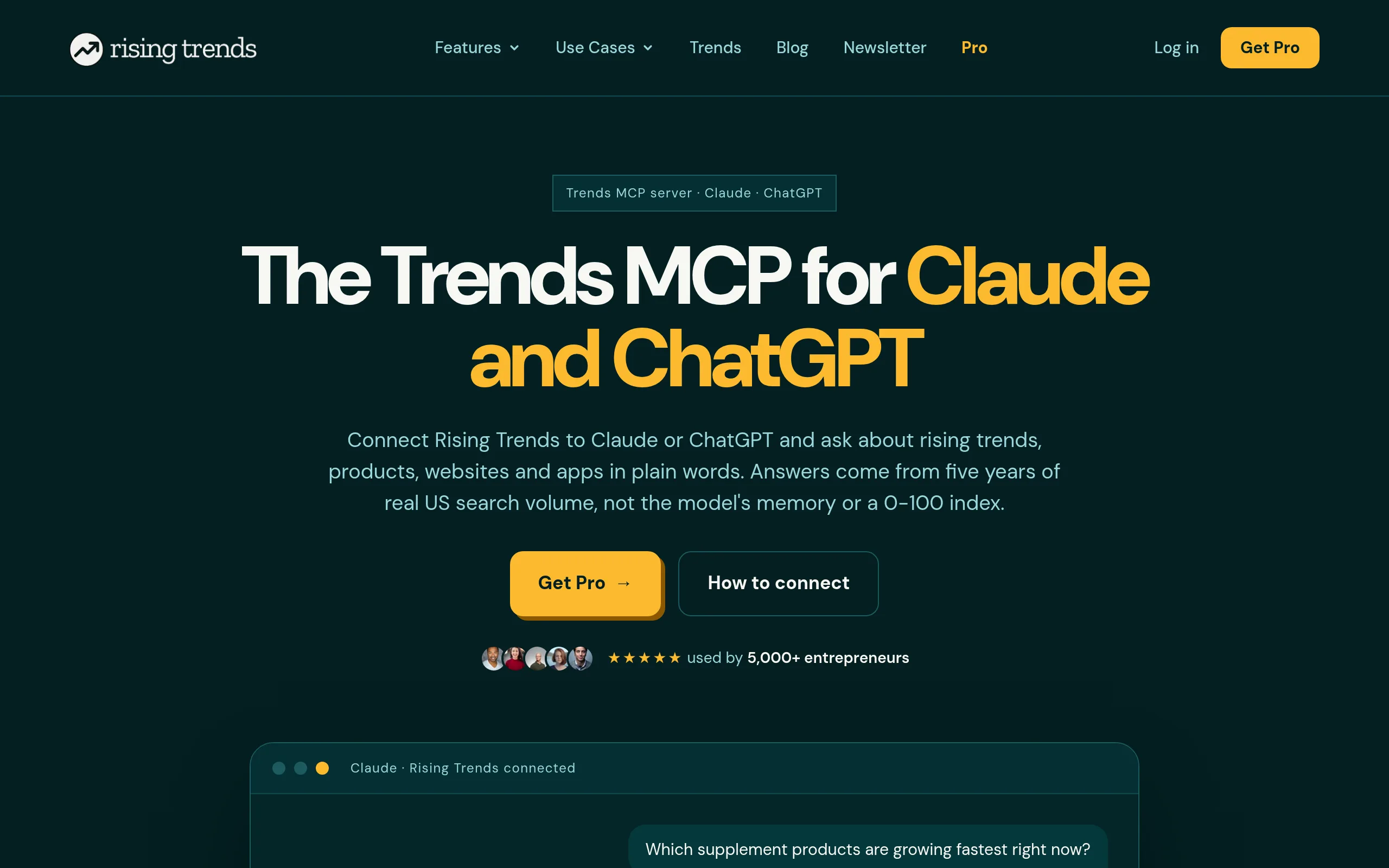
Here is the setup page, with the steps for each app:
Once the connector shows as connected, ask your first question. Everything below is a real session: real prompts, the real tool calls with their arguments, and answers built from what our database returned on November 5, 2026. The data runs through September 2026, and every volume is US monthly Google searches.
This card sums up the method:
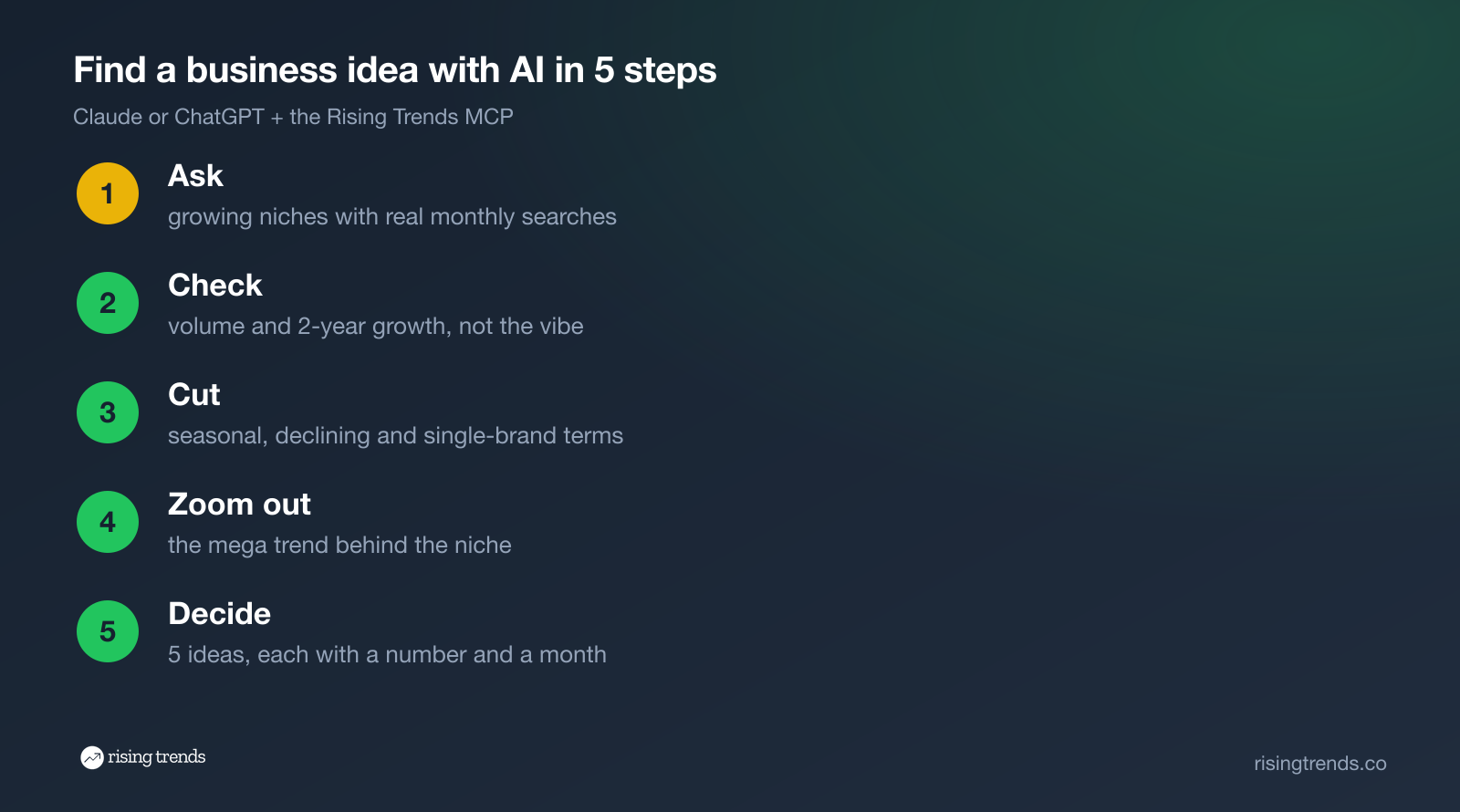
Each step below follows the card in order.
Step 1: Ask for growing niches, with filters
Start wide but give the assistant hard filters. "Growing" means nothing without a window, and tiny keywords are noise. A floor of 2,000 monthly searches keeps the list to things real people look for.
Example conversation
You
I want to start a small business I can run alone. Find services with at least 2,000 US monthly searches that grew fastest over the past year. Then do the same for home products over two years.
Claude calls the find_trends tool twice:
find_trends { "type": "services", "timeframe": "1y", "min_volume": 2000, "sort": "growth", "limit": 40 }
find_trends { "category": "Home", "timeframe": "2y", "min_volume": 3000, "sort": "growth", "limit": 30, "page": 2 }
Claude
Here are the fastest-growing services (US monthly searches, September 2026, growth over 12 months):
- gpu repair: 450,000, +8,233%
- interior decorators: 90,500, +8,950%
- ai call centers: 165,000, new in the window
- technical seo agency: 14,800, +679%
- hut builders: 5,400, +650%
- longevity clinics: 5,400, +440%
- ai answering service: 12,100, +404%
- split pay rent: 14,800, +1,038%
From the home products, three are not brands: terracotta water filter (14,800), bed japan (22,200) and coloring blanket (18,100), all flagged as new over the two-year window.
That is a list, not a decision. Several of those numbers will not survive the next step.
Step 2: Check monthly volume and 2-year growth
A one-year growth figure can come from a single month. So ask for the full history and the 2-year number, which is harder to fake. The get_trends tool returns up to 10 trends in one call, each with five years of monthly volume, growth over 3m, 6m, 1y, 2y and 5y, a seasonality label, momentum and whether it is a brand.
Example conversation
You
Pull the full history for the services and the three home products. For each, give me 2-year growth and tell me in one line what the monthly curve actually looks like.
get_trends { "slugs": ["ai-answering-service", "technical-seo-agency", "hut-builders", "longevity-clinics", "gpu-repair", "interior-decorators", "cowork", "ai-call-centers", "privacy-email", "split-pay-rent"] }
get_trends { "slugs": ["terracotta-water-filter", "coloring-blanket", "bed-japan"] }
Claude
Data through September 2026:
- ai answering service: 12,100, +1,581% in 2 years. Steady climb from 720 in September 2024 to 2,400 in spring 2026, then 5,400 and 18,100 over the summer. No seasonality.
- split pay rent: 14,800, +8,606%. Steady climb from 110 in August 2024.
- technical seo agency: 14,800, +2,408%. Around 880 a month for most of 2026, then 14,800 in September alone.
- interior decorators: 90,500, +5,556%. Baseline near 1,300, with one-month spikes to 110,000 and 135,000.
- gpu repair: 450,000. Went from 5,400 to 450,000 in two months, then bounced between 135,000 and 450,000.
- ai call centers: 165,000. From 720 in June 2026 to 301,000 in August.
- privacy email: 27,100. From 390 to 33,100 in one month.
- longevity clinics: 5,400. One month at 246,000 in January 2026, down 45% over the last 3 months.
- hut builders: 5,400, +1,588%, but labelled high seasonality.
- cowork: 18,100. One step up in January 2026, now slowing.
- coloring blanket: 18,100. Climbed from 140 in September 2024, +524% in a year, and between 14,800 and 22,200 every month since May 2026.
- terracotta water filter: 14,800. From 170 to 14,800 in September alone.
- bed japan: 22,200. Near 30 a month, apart from two separate bursts.
Read that list again. Only three climbed month after month. The chart for "ai answering service" shows what a real climb looks like:
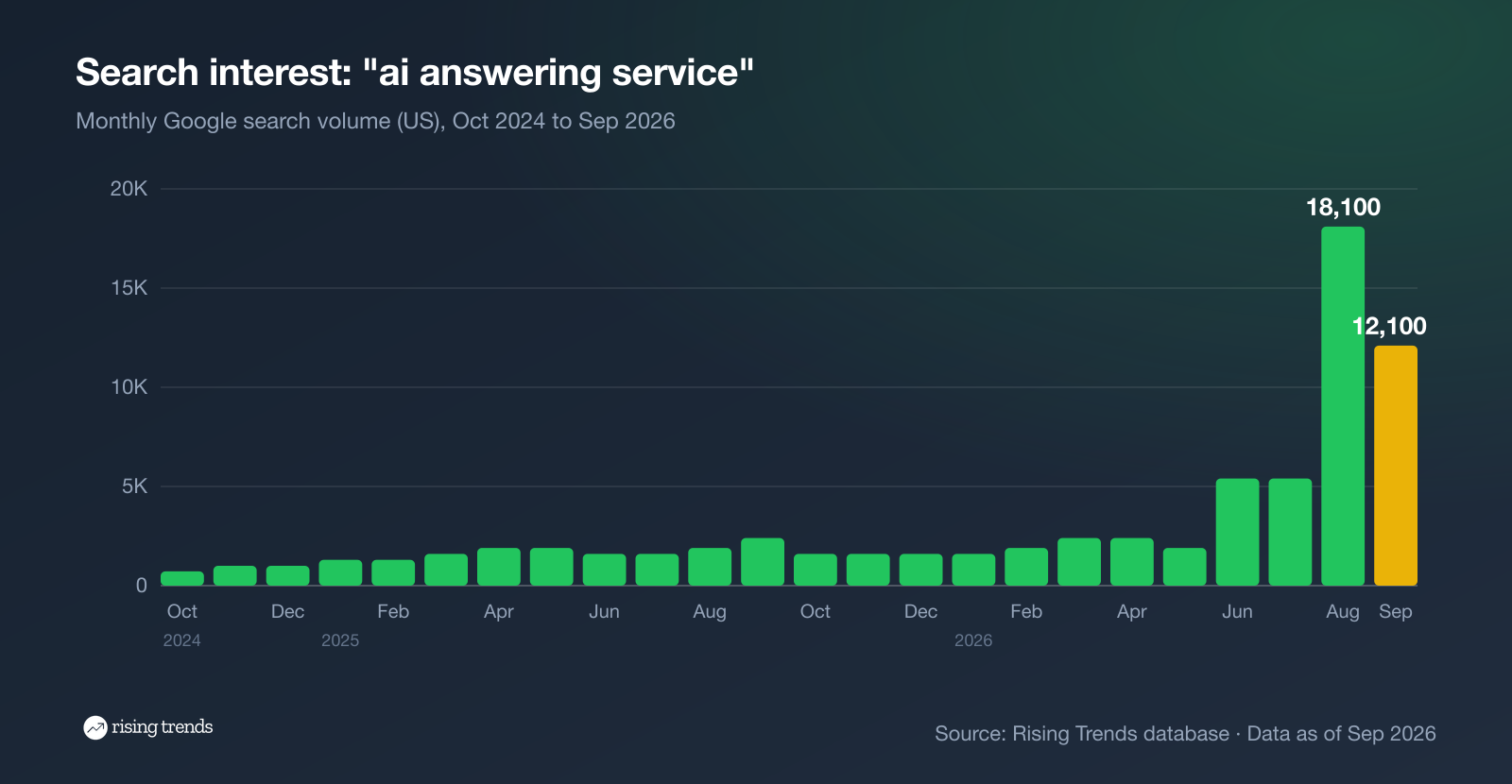
Even if you ignore the August peak, the floor rose from 720 to around 2,000 over 18 months. That slow floor is what you want to see before you build anything. It is the same rule we use in our guide to trend forecasting: the baseline matters more than the peak.
Step 3: Cut seasonal, declining and single-brand terms
Now the cuts. Ask the assistant to apply them using the fields it already has, so you don't argue with a chart by eye.
- Seasonal: the
seasonalityfield is medium or high, or the curve peaks in the same months every year. - Declining: 3-month growth is negative and momentum is "slowing" or "peaked".
- Single brand:
is_brandis true. You can't start a business selling someone else's product name. - Spikes: one or two months carry the whole growth number.
- Not a solo business: regulated or capital-heavy, whatever the curve says.
Example conversation
You
Apply these cuts: seasonal, declining over 3 months, single brand, one-month spikes, and anything a solo founder can't legally or cheaply start. Also check a few pet products I like: catio, dog water fountain, cat feeder, dog friendly ice cream, litter robot 5.
get_trends { "slugs": ["catio", "dog-water-fountain", "cat-feeder", "dog-friendly-ice-cream", "litter-robot-5"] }
Claude
Cut:
- catio (1,000,000): medium seasonality. Peaks every spring at 110,000 to 165,000, then September 2026 alone jumped to 1,000,000. Wait a few months before trusting it.
- dog friendly ice cream (5,400): a summer product, 27,100 in June 2025, down 45% in a year and 64% in 3 months.
- litter robot 5 (18,100): a single brand.
- interior decorators, gpu repair, ai call centers, privacy email, technical seo agency, longevity clinics, terracotta water filter, bed japan: one or two months carry the growth.
- hut builders: high seasonality.
- split pay rent: a steady curve, but it is a payments product. That means licences and bank partners, not a solo launch.
Hold: dog water fountain (22,200, +50% in a year) has only 19 months of history.
Keep: ai answering service (12,100) and coloring blanket (18,100).
The chart below is why the spike rule exists. "Interior decorators" looks like the best idea on the list if you only read the growth column:
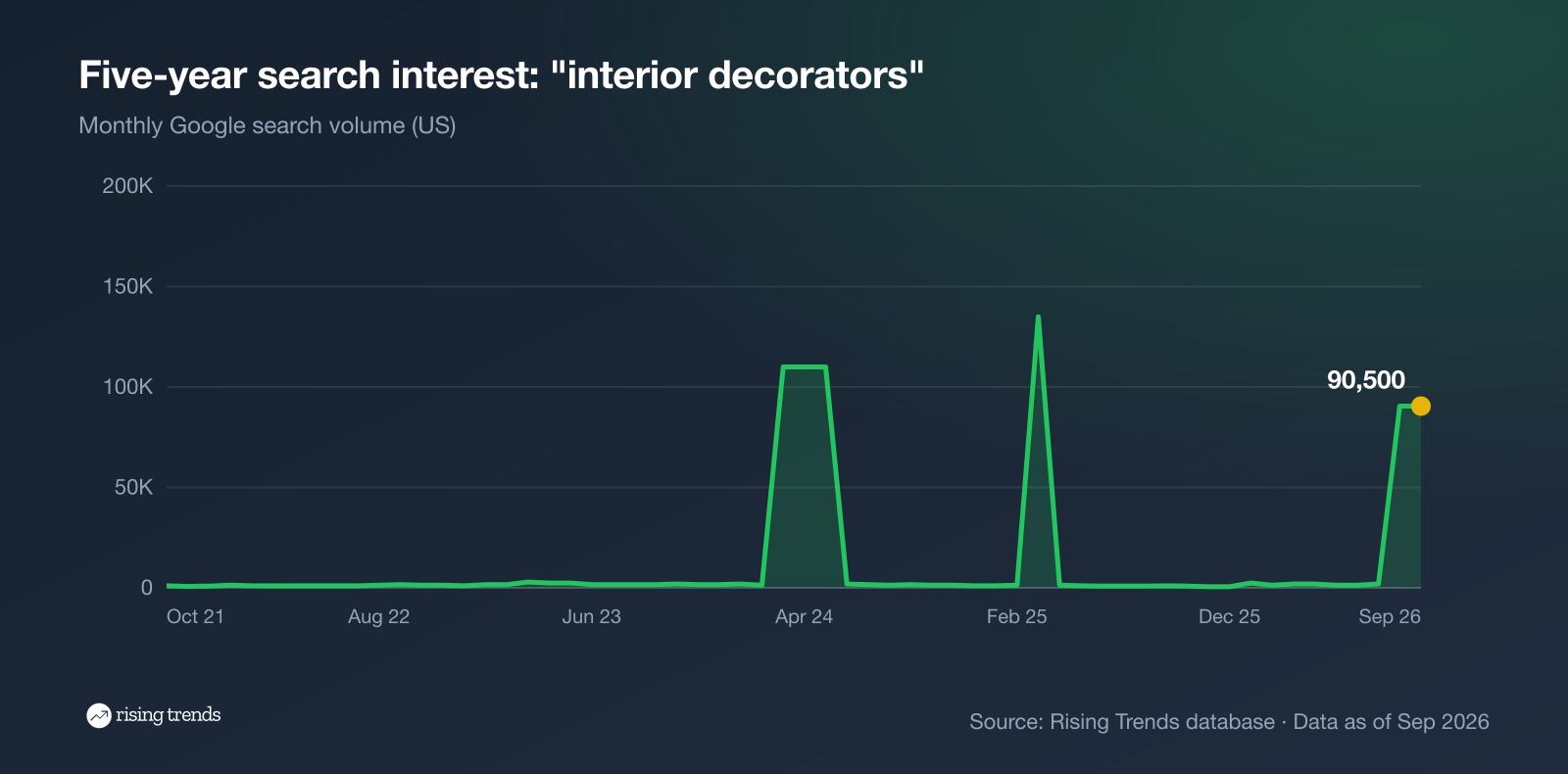
Three flat stretches near 1,300 searches, three walls. Whatever caused those walls, it is not a market you can plan around. For a deeper version of this check, see our walkthrough of trend analysis.
Step 4: Look at the mega trend behind the niche
Two survivors is too few, and a single keyword is fragile. The next move is to zoom out. Rising Trends groups related trends into mega trends: 70+ shifts in behaviour, each with combined search volume, sub-trends, and the websites and apps riding them. A niche that sits inside a growing mega trend has room around it if your first angle doesn't work.
Example conversation
You
Which mega trends grew most over two years? Pick two where a solo founder could sell a service or a small product, and show me the smaller trends inside them.
list_mega_trends { "timeframe": "2y", "sort": "growth", "limit": 40 }
get_mega_trend { "slug": "ai-search-optimization" }
get_mega_trend { "slug": "trading-card-asset-management" }
Claude
Two fit a solo founder:
AI Search Optimization: 336,870 combined monthly searches, +324% in 2 years, 60 trends. Brands rework content so AI answers cite them.
- overview ai (Google's AI Overviews): 246,000, +808% in 2 years
- aeo: 33,100, +124% in 2 years
- ai visibility audit: 480, +1,100% in a year, from 30 in June 2025
Trading Card Asset Management: 441,670 combined, +197% in 2 years, 24 trends. Collectors now treat cards as assets: scanning, pricing, grading, vaulting.
- card vaulting: 12,100, +175% in 2 years
- pokemon scanner: 6,600, +408% in 2 years, momentum slowing
- getcollectr.com, a card portfolio app, gets 143,862 monthly visits, up 53% in a year
This is where new ideas show up that a keyword list would never surface. "AI visibility audit" has only 480 searches, but it sits on top of a 246,000-search behaviour. Google rolled AI Overviews out to everyone in the US in May 2024, and the curve has climbed since. Small businesses now want to know if AI answers mention them. Our AI trends report tracks the wider category.
Step 5: Decide on 5 ideas backed by numbers
Last prompt. Ask for a short brief per idea, with the number, the month and the risk. Make the assistant say what would kill each one.
Example conversation
You
Give me 5 business ideas from everything that survived. For each: the offer in one line, the search number with its month, 2-year growth, the mega trend if any, and the biggest risk.
Claude
All numbers are US monthly searches, September 2026.
- AI answering service for local trades. Set up and run AI phone answering for plumbers, HVAC and electricians. 12,100 searches, +1,581% in 2 years, no seasonality. No mega trend yet. Risk: big call-centre software vendors moving down-market.
- AI visibility audits for small brands. A fixed-price report on how ChatGPT, Gemini and Google AI Overviews describe a business, plus fixes. 480 searches, +1,100% in a year. Inside AI Search Optimization (336,870, +324% in 2 years). Risk: the term is tiny today.
- Local card vaulting and consignment. Store, photograph, price and sell cards for collectors near you. 12,100 searches, +175% in 2 years. Inside Trading Card Asset Management (441,670, +197%). Risk: down 33% over the last 3 months after a 22,200 August.
- Pricing and listing service for card shops. Scan, identify and list inventory for shops that are drowning in singles. "pokemon scanner": 6,600, +408% in 2 years. Same mega trend. Risk: dozens of free scanner apps, so sell the labour, not the app.
- Custom coloring blankets, print on demand. 18,100 searches, up from 140 in September 2024 and +524% in a year. Between 14,800 and 22,200 every month since May 2026. Risk: only one year of real demand, and holidays may inflate the next months.
Here are the five side by side:
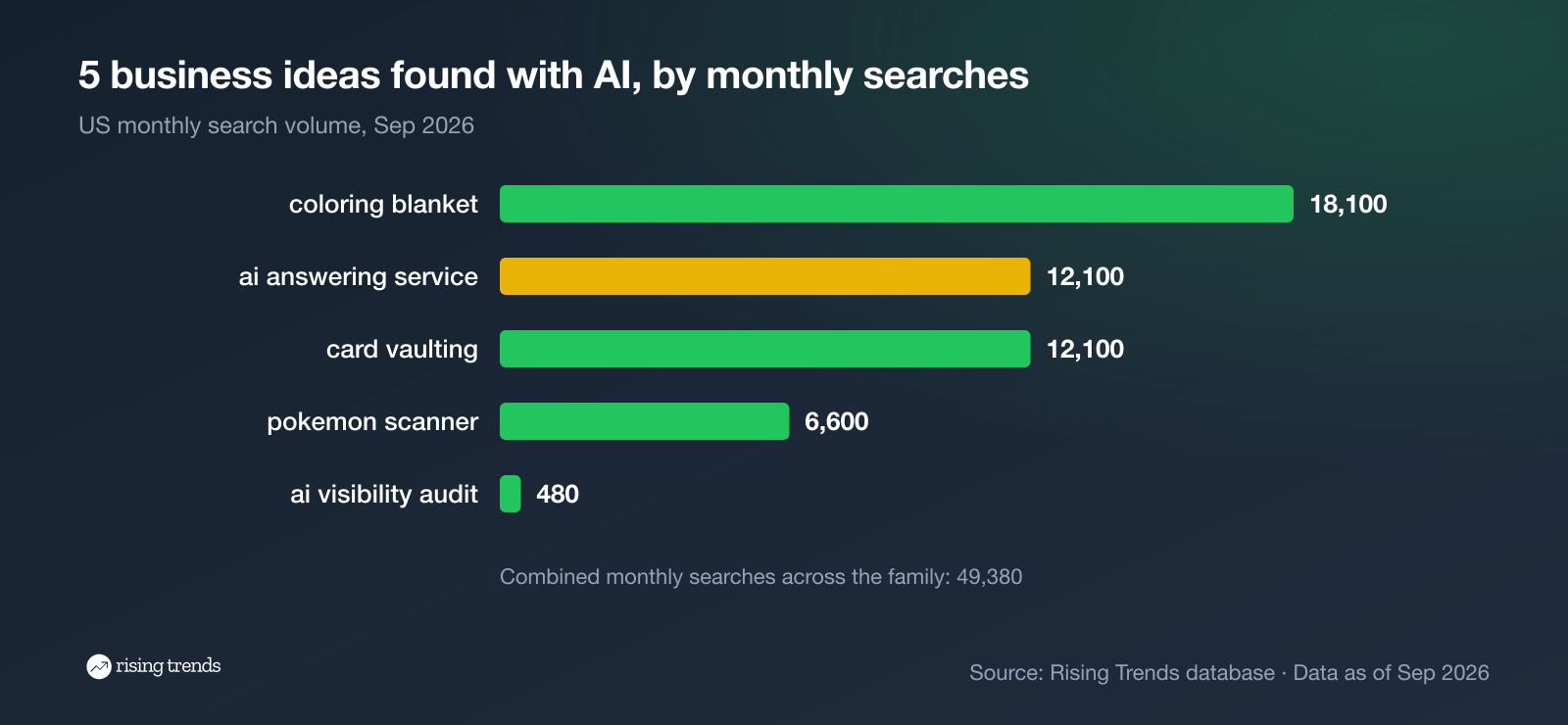
The chart shows that volume and opportunity are different things. The smallest bar, "ai visibility audit", is the fastest grower and has the biggest mega trend behind it. The coloring blanket bar is the biggest, but the history is the shortest. Pick by your skills and your risk appetite, not by bar length.
If idea 1 sounds familiar, it also leads our ranking of 25 AI business ideas by real demand. For more ideas outside AI, see the best businesses to start, ranked by rising demand. For idea 5, our look at which print-on-demand niches are rising covers suppliers and margins.
Copy-paste prompts
Paste these into Claude or ChatGPT once the Rising Trends connector is on. Swap the category for yours.
Prompt 1: the full method
Using Rising Trends, find 30 trends in [category] with at least 2,000 US monthly
searches, sorted by 2-year growth. Pull the full history for the top 10. Remove
anything seasonal, declining over 3 months, tied to one brand, or driven by one or
two spike months. For what is left, find the mega trend each belongs to. End with
5 business ideas: the offer, monthly searches with the month, 2-year growth, the
mega trend, and the biggest risk.
Prompt 2: start from the big shifts
Using Rising Trends, list the 20 mega trends that grew most over 2 years. Pick
3 where a solo founder could sell a service or a small product. For each, show the
5 smallest trends inside it that grew over the last year, and the websites already
serving it.
Prompt 3: check an idea you already have
Using Rising Trends, look up [your idea]. Give me monthly searches, growth over
3 months, 1 year and 2 years, seasonality, momentum, whether it is a brand, and the
mega trend it belongs to. Tell me plainly if the curve is a spike.
What the AI still can't do for you
Search data shows demand. It does not show whether you can win. Three checks stay on your side of the screen:
- Competition. Search the term yourself and look at who ranks. Ask the assistant to run
find_websitesin the category to see which sites are growing. - Willingness to pay. Searches for "ai visibility audit" mean curiosity. Five calls to local businesses tell you if anyone pays.
- Your fit. An idea with great numbers is a bad idea if you hate the work.
The US Small Business Administration's guide to market research and competitive analysis lists free government data sources for checking demand, costs and competition before you commit.
Also, data has a lag. Our numbers are monthly and the latest month is September 2026. That is a good fit for picking a business, where you care about direction over months. It is not a tool for chasing this week's viral moment.
How to repeat this every month
The method only works if you rerun it. Trends that pass the cuts today can stall in three months, and new ones appear. Two ways to keep it going:
- Rerun Prompt 1 at the start of each month for your category and compare it with last month's answer.
- Automate it. The same data is in the Rising Trends API, so a short script can pull your filters every month and flag new names.
You can also track up to 100 trends with Pro and get monthly search-volume alerts, so your shortlist tells you when it moves.
FAQ
Can ChatGPT come up with business ideas?
Yes, but on its own it works from training data, so it cannot tell you if demand is growing now. Connect it to a data source through MCP, like the Rising Trends connector, and ask it to check volume and growth before it suggests anything.
What is the best AI tool to find business ideas?
A general assistant (Claude or ChatGPT) plus a data connector beats a one-click "idea generator". Generators return ideas from the model's memory. With a connector, the same assistant can filter real search data, apply your cuts and explain its reasoning.
How do I validate a business idea with AI?
Ask for the monthly history and 2-year growth, check seasonality and momentum, and look at the mega trend around it. Then validate outside the chat: talk to buyers and check who already ranks. Our guide on how to use Google Trends to find a profitable niche covers the free version of these checks.
Do I need to code to use the Rising Trends MCP?
No. In Claude or ChatGPT you paste one URL and sign in. Only coding tools like Cursor need an API key in a header.
Want to spot the next shift before everyone else? Read our guide on how to identify market trends, or browse what is breaking out right now in our trending topics list.
Never miss a trend again
- One trend broken down with the numbers
- Who's making money, and what to build
- A website on the rise
- A breakout app
Join 5,000+ founders