Guides


The print-on-demand market is worth somewhere between USD 10.8 billion and USD 11.76 billion as of 2025, depending on which research firm you ask, and every forecast has it roughly quadrupling by the early 2030s. That is the headline. The part nobody puts in the headline: US searches for "print on demand" have fallen 45% in two years, to 22,200 a month as of August 2026. The category is growing. The gold rush is over. What matters now is which niche you pick, so this guide ranks the print-on-demand niches that are actually rising, names the ones that are already saturated, and shows the method for telling them apart.
Key takeaways:
Let's get into it.
Three firms, three numbers, one direction.
| Source | 2025 or 2026 size | Forecast | CAGR |
|---|---|---|---|
| Grand View Research | USD 10.8B (2025), USD 13.1B (2026) | USD 57.5B by 2033 | 23.6% |
| Straits Research | USD 11.76B (2025) | USD 84.70B by 2034 | 24.5% |
| Printful (vendor estimate) | not stated | USD 118.85B by 2035 | not stated |
A USD 27 billion gap between two 2033-to-2034 forecasts tells you how soft this kind of modelling is. Treat the market-size number as a mood, not a measurement.
The segment splits are more useful. Grand View Research puts apparel at a 39.5% revenue share in 2025 and names home decor the fastest-growing product segment at a 24.5% CAGR. North America holds 36.0% of global revenue. Straits Research segments the same market slightly differently but lands in the same place: customizable apparel first, decor and drinkware behind it.
So: apparel is where the money is, home decor is where the growth is. Keep that in mind when you read the niche list below, because our search data says the same thing from a completely different angle.
Here is the five-year curve for the term itself.
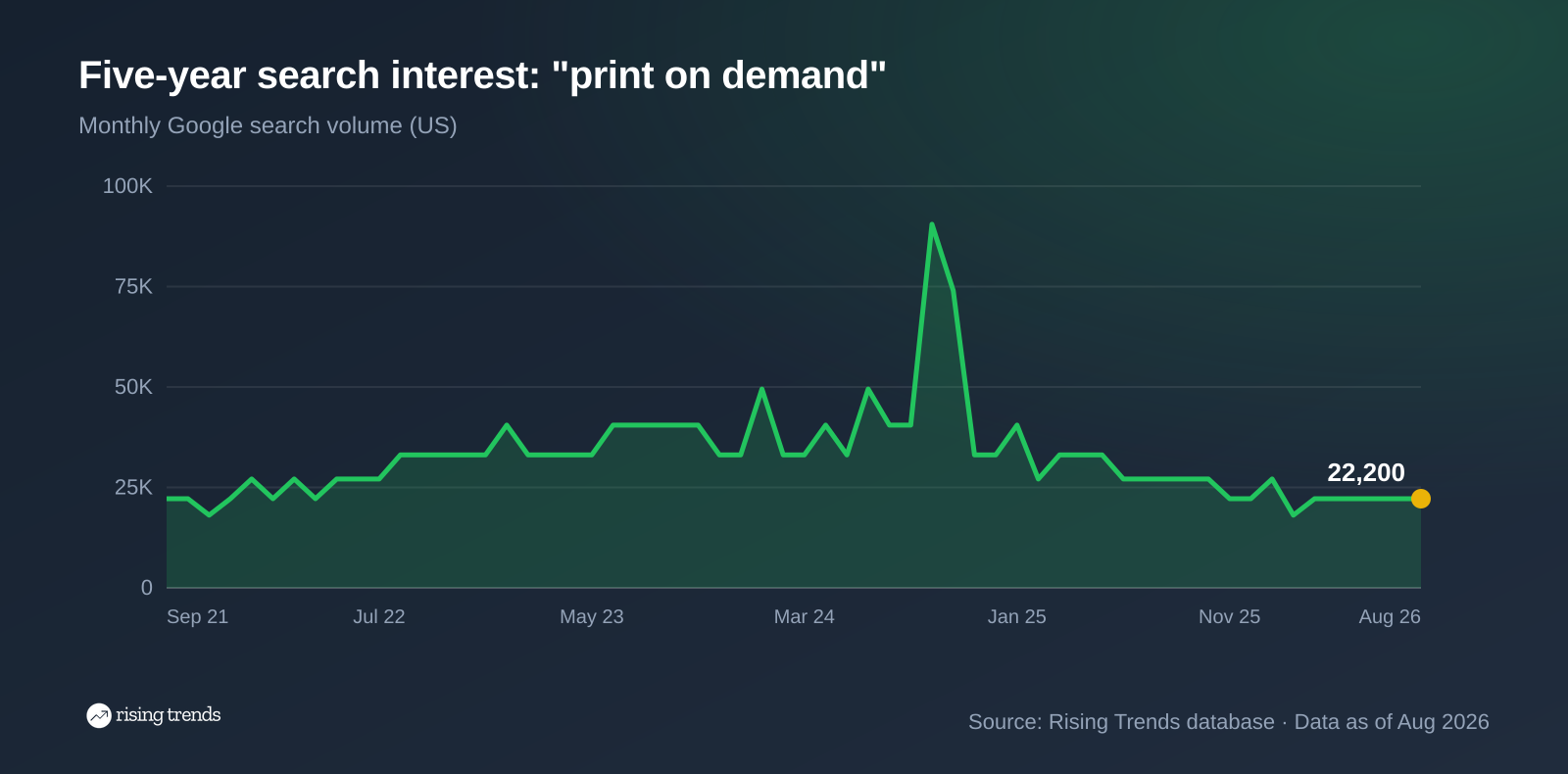
That spike in late 2024 was the peak of the "start a POD side hustle" content wave. It collapsed. The term now does 22,200 US searches a month, down 18% year over year and 45% over two years. The platform names tell the same story: Printify is at 246,000 searches, down 33% in a year. "Merch on demand" is down 62%. "Tshirt designer" is down 33%.
This is interest in starting a print-on-demand business, not print-on-demand sales. Both things can be true at once, and they are: the market reports measure revenue from products that ship, we measure the attention of people thinking about entering. Revenue is up. Entry interest is down from its peak.
For a seller, falling entry interest is good news. Fewer new competitors arrive each month than two years ago, and the reports say buyer demand keeps growing. What you lose is the ability to succeed on effort alone. In 2022 you could print a generic funny slogan on a tee and find buyers. In 2026 you need the niche to be right.
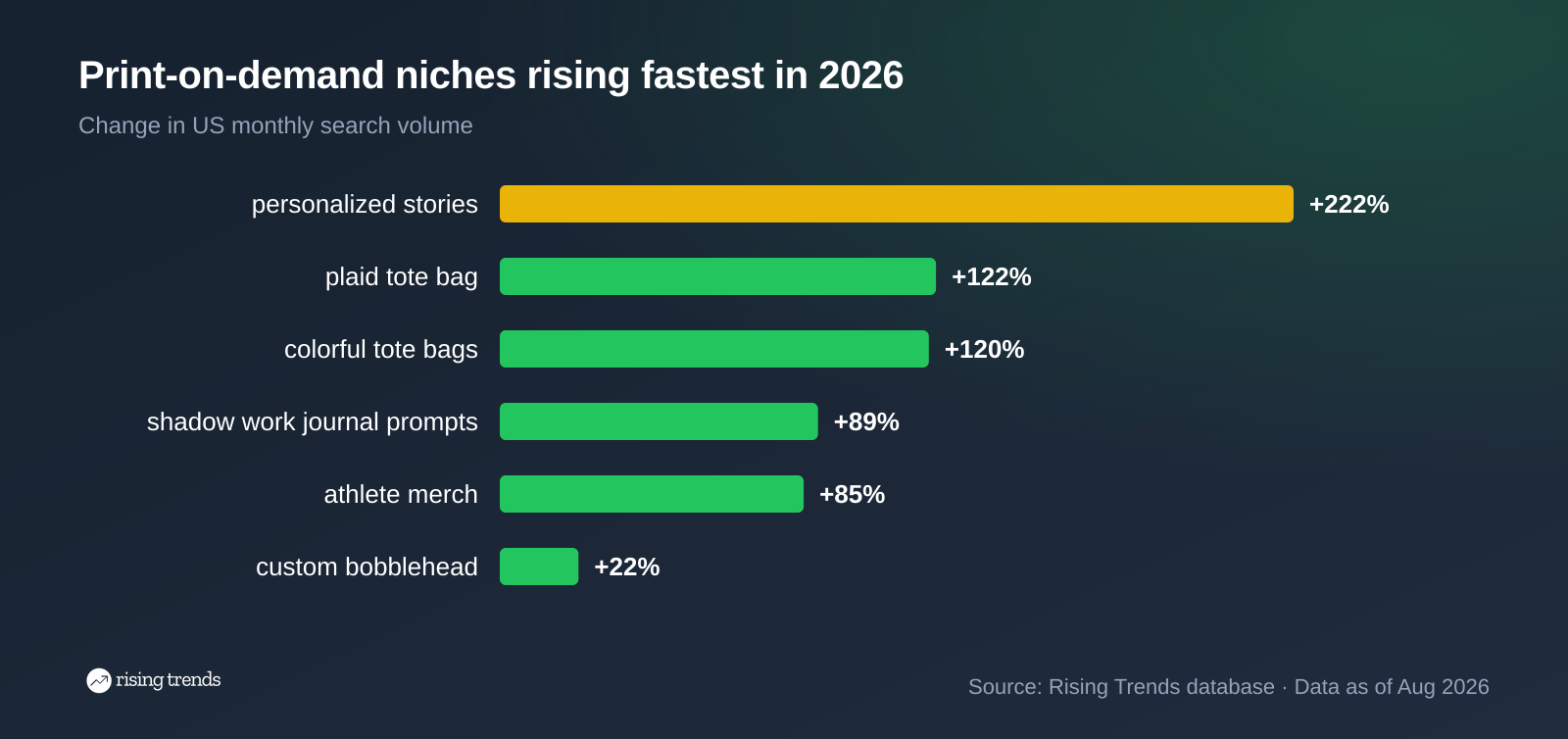
These are real search terms from our database, ranked by year-over-year growth, all with volumes as of August 2026.
Each one below is something a print-on-demand supplier can actually make.
The standout. A blanket printed with a colour-in design, sold with fabric markers. It does 18,100 US searches a month, up 3,671% year over year and 16,355% over two years.
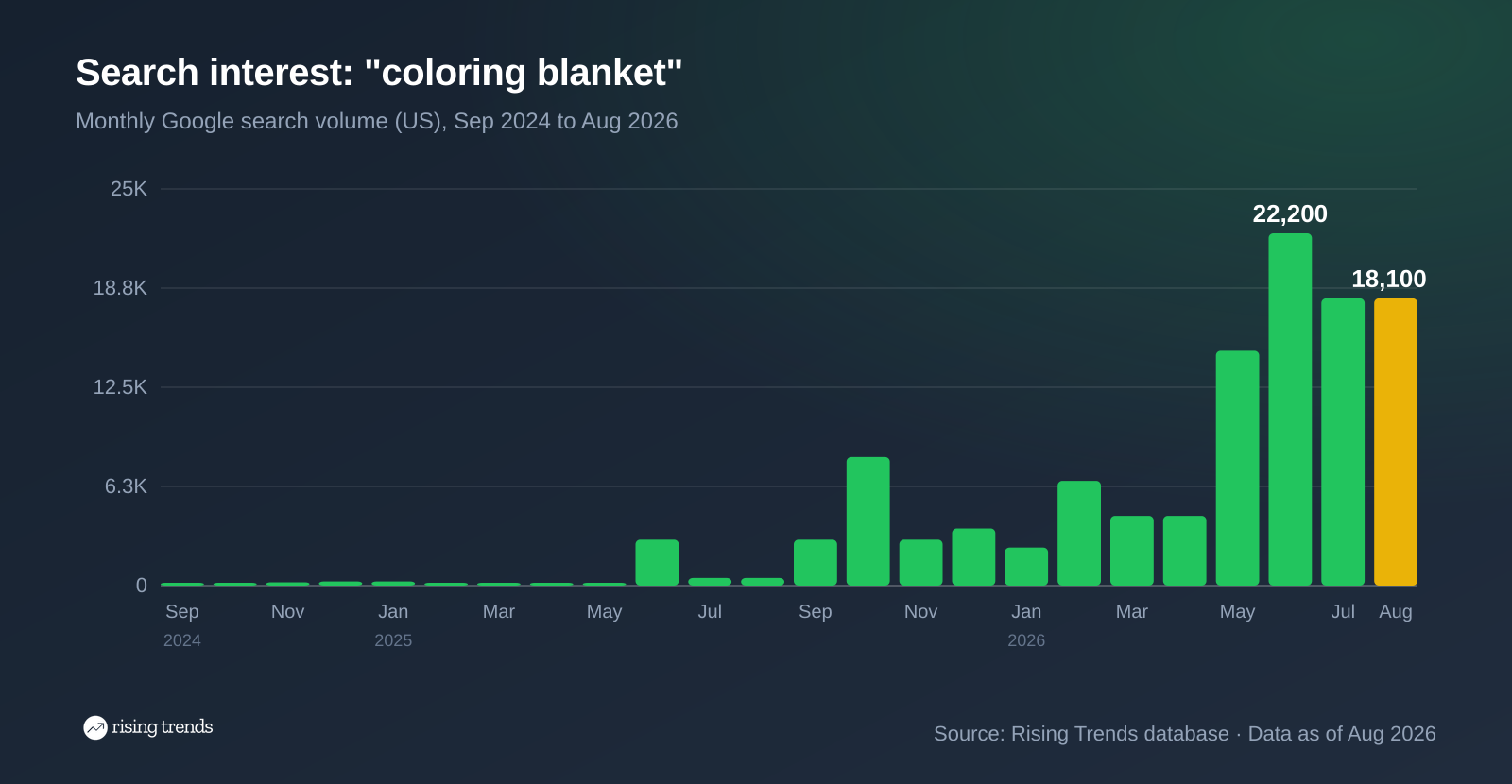
The curve matters as much as the number. It peaked at 22,200 in June 2026 and has settled at 18,100, which is a healthy post-breakout plateau rather than a collapse. The term entered our database in October 2025, when it was doing a few thousand searches a month, so anyone watching the coloring blanket trend page had roughly eight months of warning before it went mainstream.
It also sits at the intersection the market reports keep pointing at: it is home decor, the fastest-growing segment, and it is a design-led product where the print is the entire value.
1,900 searches a month, up 222% year over year and 116% in the last three months. The three-month number is the interesting one: this is still accelerating, not coasting.
Personalized children's books and story products are a natural print-on-demand fit because the personalization is the product, which is exactly where the margin lives. Printful's own numbers put commodity basics as low as 10% margin and personalized or niche items at 50% or more.
3,600 searches a month, up 89% year over year and 125% in three months. Low-content books (journals, planners, prompt books) have the lowest design cost in print-on-demand and the fewest sizing headaches. The shadow work angle is the one with momentum right now.
Two terms moving together: plaid tote bag at 1,600 searches, up 122%, and colorful tote bags at 1,300 searches, up 120%. Both accelerated in the last three months.
Note what is rising here is the pattern, not the personalization. More on that below, because the generic "personalized tote bag" term is going the other way.
480 searches a month, up 85% year over year and 129% over two years. Small volume, but it names a real shift: merch is moving from brands to individuals. Creator and athlete stores are print-on-demand by default, because nobody is holding inventory for a 2,000-person fanbase.
12,100 searches a month, up 22%. Not explosive, but it is a high-ticket personalized gift with real volume and a production method that keeps most sellers out. Worth a look if you can source it.
The mistake sellers make is picking a niche because it is visible. Visibility and growth are different things. Every term below has real volume and a falling curve.
| Niche | Monthly US searches | 1-year change | 2-year change |
|---|---|---|---|
| Adult coloring books | 49,500 | -18% | -18% |
| Personalized tote bag | 18,100 | 0% | -76% |
| Pet portrait | 9,900 | -18% | -18% |
| Custom pet portrait | 3,600 | -33% | +24% |
| Custom wall art | 2,400 | -33% | 0% |
| Anime gifts | 1,900 | -21% | -47% |
| Pickleball apparel | 1,600 | -70% | -84% |
Pickleball apparel is the one to study. The sport is enormous: "pickleball" does 673,000 US searches a month. The apparel niche built on top of it is down 70% in a year and 84% in two. Sport demand and merch demand are not the same curve, and a huge parent category tells you nothing about the sub-niche you are actually selling into.
The tote bag pair is the second lesson. Personalized tote bags are flat year over year and down 76% over two, while plaid and colorful totes are both up over 120%. Same product, different design hook. The format is fine. The angle is what expired.
Two terms in our database make the clearest possible case for checking the three-month number before you commit.
| Term | Monthly US searches | 1-year change | 3-month change |
|---|---|---|---|
| World Cup stickers | 14,800 | +8,606% | -87% |
| World Cup merch | 1,900 | +805% | -81% |
Look only at the year-over-year column and these are the two best opportunities on this page. Look at the three-month column and they are already over. The tournament ran in June and July 2026. The spike and the collapse are the same event seen from two different windows.
Event merch is a real business, but it is a calendar business, not a niche business. If you are in it, you are buying stock of designs against a date, and licensing rules usually stop you using the official marks anyway. Decide which business you are in before the design work starts.
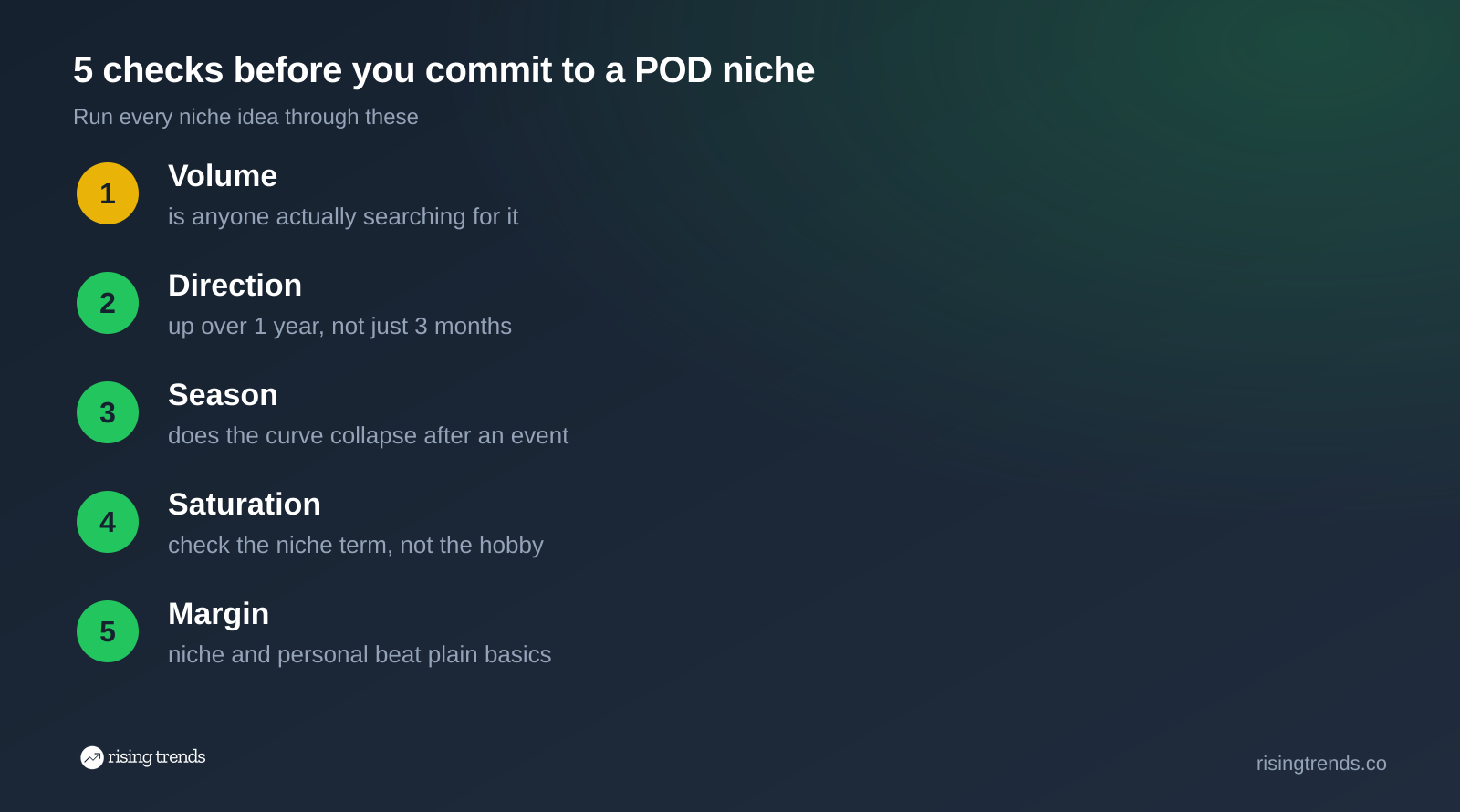
Here is the method behind that card.
1. Get an absolute volume, not an index. Google Trends gives you a 0 to 100 relative index, which cannot tell you whether a perfect score means 500 searches or 500,000. That distinction decides whether a niche can support a business. Rising Trends gives absolute US monthly search volume per term plus 3-month, 1-year and 2-year growth, which is the gap this whole exercise depends on. If you want to work the free route first, our guide on how to use Google Trends to find profitable niches covers the index method and its limits.
2. Check direction over a year, not a quarter. A three-month rise can be a holiday or a single viral video. A one-year rise with a three-month rise behind it, like personalized stories above, is the pattern you want.
3. Rule out the season. Pull the monthly curve and look for a repeating annual shape or a single event spike. The World Cup pair above shows what an event looks like from the inside.
4. Check the niche term, not the hobby. Search the exact phrase a buyer would type for the product, not the activity it belongs to. Pickleball is huge and pickleball apparel is dying.
5. Favour personalization and specificity. The margin data is unambiguous. Generic basics compete on price with every other seller using the same supplier.
To run that check across a whole category rather than one term at a time, the Trends API returns a filtered scan in a single request:
curl -H "Authorization: Bearer rt_live_..." \
  "https://www.risingtrends.co/api/v1/trends?category=Clothing&is_ecom=true&is_brand=false&min_growth_pct=100&timeframe=1y&min_search_volume=1000&sort=growth"
That returns every apparel term doing at least 1,000 searches a month that grew 100% or more in a year, brands excluded, ranked by growth. Swap the category to run the same scan on home decor or accessories. The same lists are browsable without code on the clothing trends page and the rest of the category hubs.
What this does not tell you is anything about print quality, shipping times or supplier reliability. Search data picks the niche. It cannot pick the supplier, and no amount of demand rescues a product that arrives faded. For the step after the niche, our walkthrough on finding trending ecommerce products goes further into turning a rising term into a product decision, and validating market demand covers the sanity checks before you spend money.
Print-on-demand platforms are cheap to join and take their cut on fulfilment. Printify runs a free plan at USD 0 a month and a Premium plan at USD 39 a month, or USD 24.99 a month billed yearly, as of October 2026. It states that more than 10 million people now sell through the platform, which is both the appeal and the problem.
On margins, Printful's own statistics roundup says most sellers target 20% to 40%, with competitive basics as low as 10% and niche, premium or personalized products reaching 50% or more. It is a vendor publishing numbers about its own category, so weigh it accordingly, but the spread matches what the niche data shows: specificity is the margin.
Marketplace conditions are worth watching too. Etsy announced a restructuring plan and completed the sale of Depop in its second quarter 2026 results, published in August 2026. If Etsy is your only channel, that is a concentration risk worth planning around.
Yes, with a narrower definition of "it" than the 2022 version.
What has stopped working: entering with no niche, printing generic slogans on basics, and competing on volume with 10 million other sellers on the same supplier network. The falling search curve for the model itself is the sound of that approach losing its audience.
What still works: a specific, currently rising niche where the design or the personalization is the product, sold at a price that reflects it. Coloring blankets did not exist as a search term three years ago and now do 18,100 searches a month. Something will be in that position next year too.
The difference between the sellers who find it and the ones who do not is not instinct. It is whether they check the number before they commit. That is the whole discipline, and it is the same one behind spotting trends before they peak in any category, not just printed goods.
Yes, but the range is wide. Printful reports that most sellers target 20% to 40% margins, that commodity basics can fall to 10%, and that niche or personalized products reach 50% or more. Profitability is decided by what you choose to sell, not by the fulfilment model.
There is no permanent answer, which is the point. As of August 2026 the fastest-rising printable niches in our data are coloring blankets, personalized stories, shadow work journals and statement tote bags. Check the numbers again before you commit, because that list looked different a year ago and will look different next year.
Apparel is the largest category by revenue, at a 39.5% share in 2025 per Grand View Research, with home decor the fastest-growing segment. Within apparel, t-shirts, sportswear and leggings lead, per Printful.
No. In the US you can sell as a sole proprietor, and most people start that way. An LLC is about liability separation and tax treatment rather than permission to trade. Talk to an accountant in your state before deciding, because the answer depends on your circumstances and not on the business model.
The generic end of it is. Interest in the model itself has fallen 45% in two years while 10 million people sell through Printify alone. Individual niches are a different question, and several in our database are growing at triple digits. Saturation is a per-niche measurement, not a verdict on the industry.
POD stands for print on demand. A supplier prints and ships each item after a customer orders it, so no stock is produced or held in advance. You supply the design and the storefront, they handle production and fulfilment.
Three things to watch into 2027.
Home decor keeps taking share from apparel. Both the forecast data and our search data point the same way, and coloring blankets are the clearest single example of a decor product that is design-led rather than material-led.
The creator end grows faster than the brand end. Athlete merch is small at 480 searches a month but up 129% over two years, and the economics of print-on-demand fit a 2,000-fan audience far better than they fit a mass-market apparel brand.
And the entry wave keeps shrinking. If "print on demand" keeps shedding searches at its current rate, the people still selling in 2028 will be the ones who picked a niche on evidence. You can watch any of these terms move on the print on demand trend page, or browse what is breaking out in trending products right now.
Want to spot niches like these before everyone else does? Read our guide on how to identify market trends, see the method applied in the best businesses to start in 2026, or browse what is breaking out right now on the Rising Trends dashboard.
Thousands of Emerging Trends
Thousands of Breakout Apps
Mega Trends
Trend Analysis Tool