Trends


Nobody searched for "norton neo" before May 2025. Fourteen straight months of zero in our database, then 210 searches in the month Norton first announced it. As of August 2026 it is 1,300 a month, up 233% in a year, with a record 1,600 in July. In a category where almost every other name is collapsing, an antivirus brand your parents pay for has the only AI browser curve pointing up.
That is the part nobody ranking for the term has noticed. The pages that explain Norton Neo describe the features. None of them show you that searches for Perplexity's Comet are down 89% over the same year, that OpenAI switched ChatGPT Atlas off on August 9, 2026, or that Neo's biggest month had almost nothing to do with security. We have the monthly curve for all of them, so let's use it.
Key takeaways:
Let's get into it.
Here is the whole life of the term, month by month, from our database.
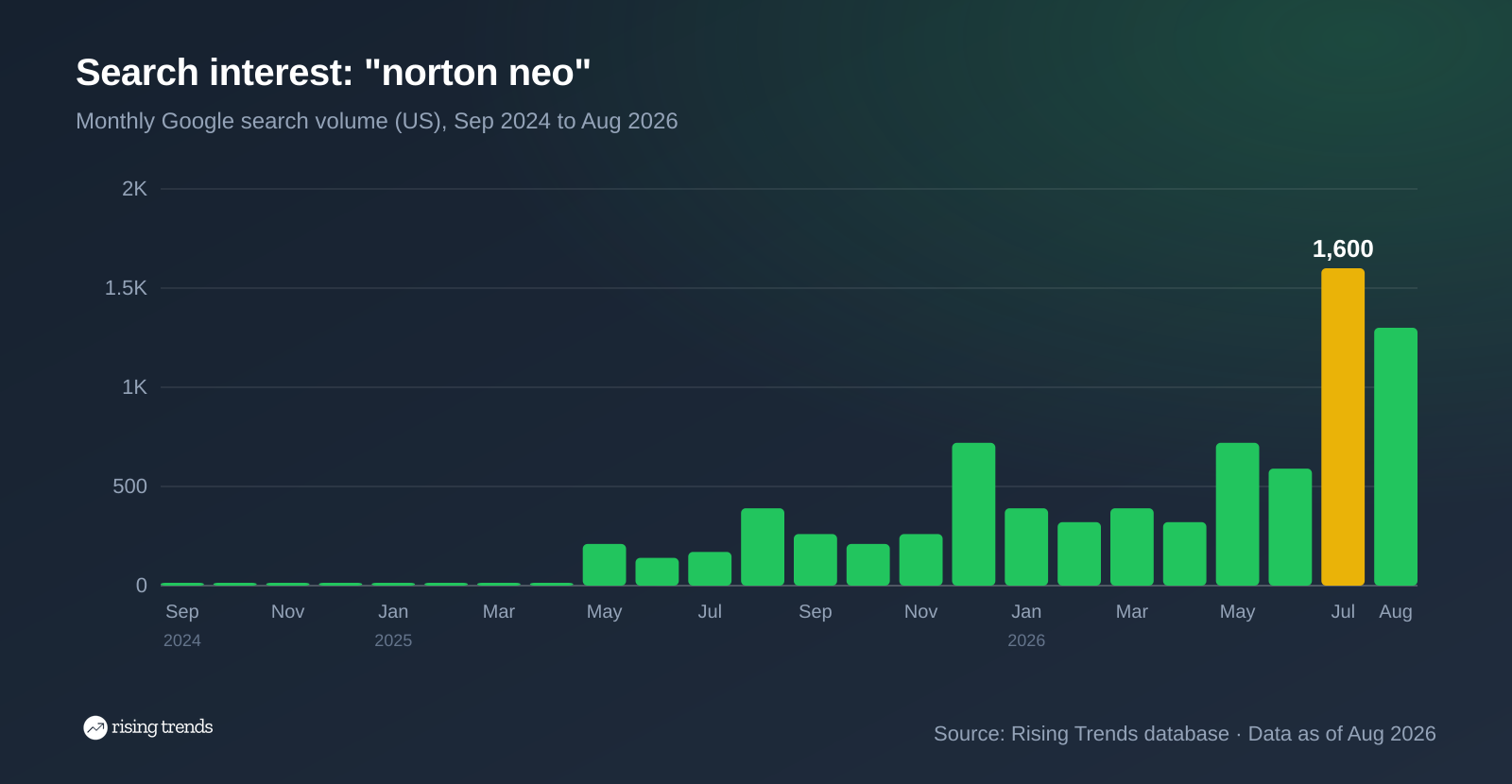
Three things stand out in that shape. The curve starts from nothing in May 2025, the month Norton published its early-access post, and it never goes back to zero. December 2025 is the breakout, when the global free release pushed the month to 720 from 260 in November. Then it flattens for four months before the real jump in the summer of 2026.
Now put it next to the rest of the category. These are year-over-year changes in monthly search volume for the AI browser terms we track, as of August 2026.
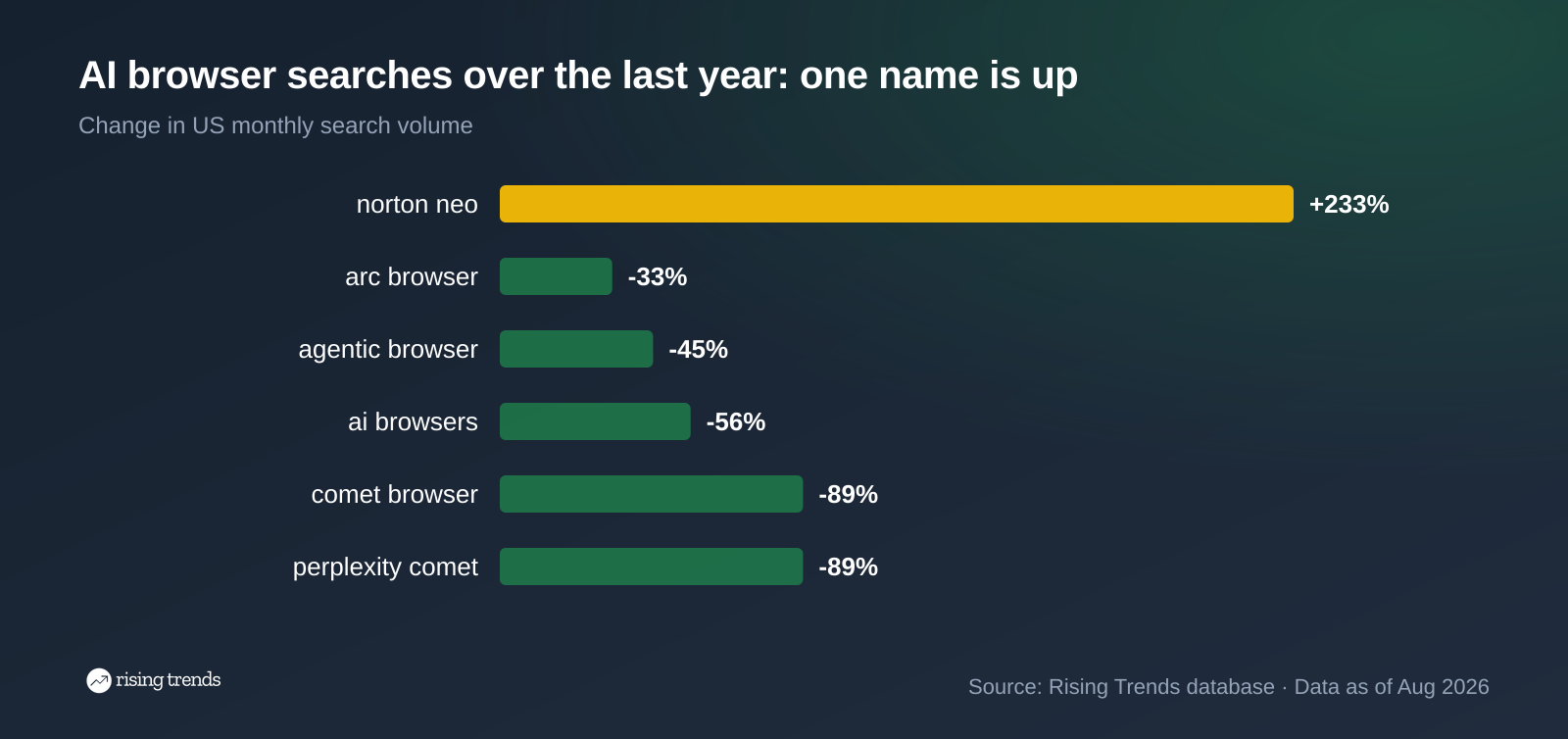
One gold bar and five green ones pointing the wrong way. The category term itself, ai browsers, is down 56%, which tells you the idea peaked before the products did. Comet browser losing 89% of its search demand in twelve months is the sharpest fall in the set, and it belongs to the company that arguably started the modern AI browser race.
Neo is a free AI-native browser from Norton, which is part of Gen Digital (NASDAQ: GEN). The December 2025 investor release lists four features: privacy-first security with ad blocking and in-flow phishing detection, AI assistance, smart tab management that groups tabs by topic, and configurable memory you can inspect or switch off. Howie Xu, Gen's chief AI and innovation officer, framed the pitch in one line: "Many AI browsers promise intelligence, but few deliver safety."
The mobile listings are more specific than the marketing, and they are where the current numbers live.
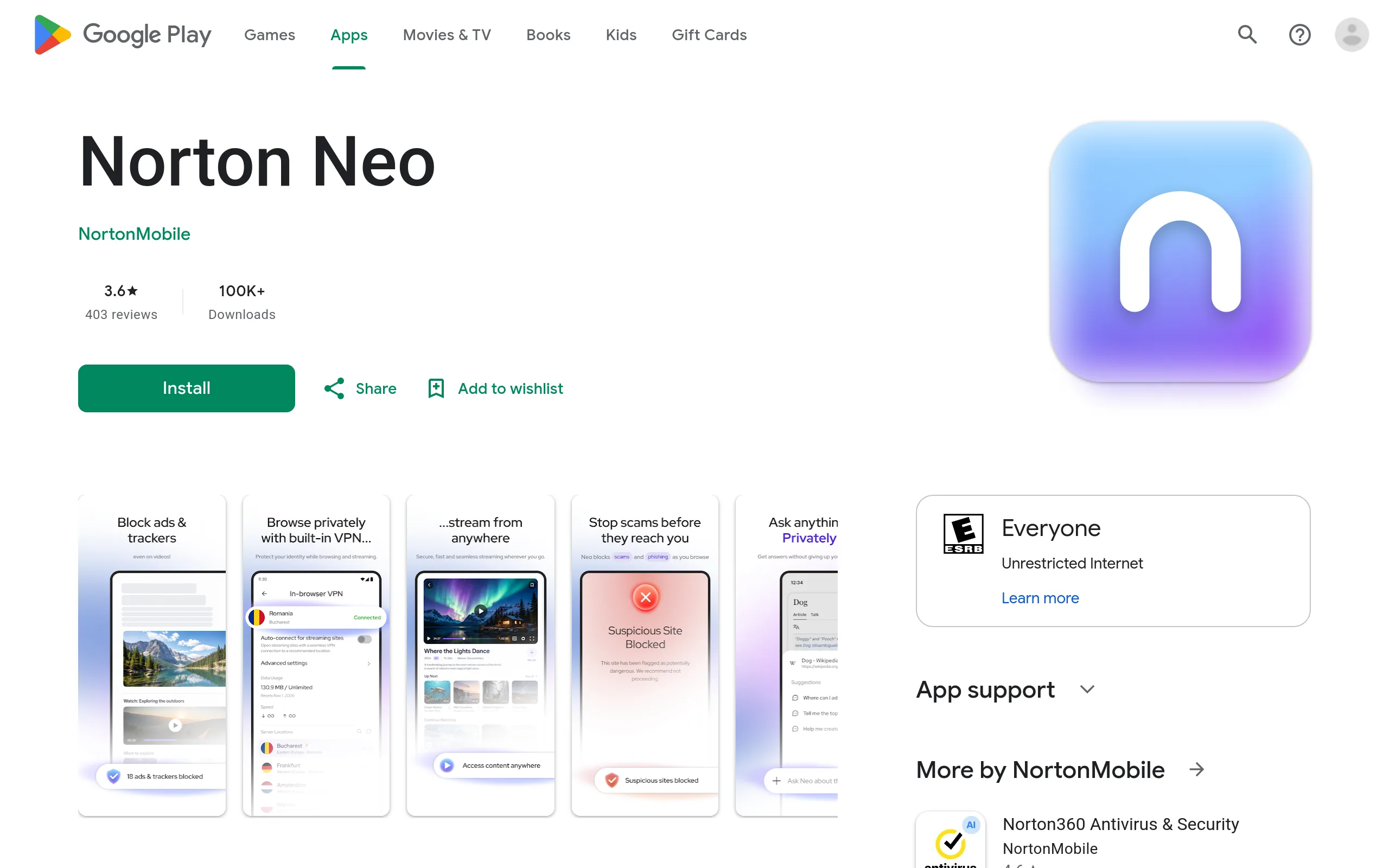
The Google Play listing describes Neo as "a secure, private browser with a built-in VPN" and puts ad blocking on by default, anti-fingerprinting, and "access to powerful AI models for free" in the feature list. It was last updated on September 25, 2026. The App Store listing carries a full version history, and that history is the most useful public document about this product. Version 1.0 landed on April 24, 2026. The VPN arrived on June 8. Setting Neo as your default iPhone browser became possible on August 14. Reading mode came on August 26. A personalised news feed came on September 22.
Read that sequence next to the search curve and the story changes. The December 2025 desktop launch is not what produced the record month.
The trigger is a two-step launch, and each step shows up in our data.
May 22, 2025: early access. Norton published the first Neo post, US only, waitlist only, pitching unified search and chat, smart tabs, and a peek-and-summary feature. Searches went from zero to 210 that month.
December 2, 2025: free, worldwide, no waitlist. Same day, Norton published a second post asking whether Neo can really protect your privacy, which is the question the audience was actually asking. macOS and Windows, English only. Searches nearly tripled to 720.
Summer 2026: the phone. This is the part that is missing everywhere else. The iOS app shipped in April 2026, the built-in VPN in June, and the App Store release notes for versions 1.1.1, 1.3.0 and 1.3.1 describe tournament coverage on the home screen: pick your team, see today's matches, tap to find where to watch, then penalty scores and highlights. The notes never name the tournament. The 2026 World Cup ran from June 11 to July 19. Neo's record search month is July 2026 at 1,600, and a free VPN with streaming-friendly server locations is a very specific thing to want during a football tournament.
That is our reading of the dates rather than something Norton has claimed. But the shape is hard to argue with: a security browser's biggest month arrived when it stopped being only a security browser.
Neo's own account keeps making the safety argument anyway. This post from @neobrowser on July 31, 2026 is the positioning in four lines.
"Other AI browsers ask you to choose: AI power or privacy," it reads. "With Neo, you get both." Whether that is true is a question for a security audit, not a search database. What our data can tell you is that the trade-off framing is landing at a moment when the alternatives are losing attention fast.
Here is the field, by what people actually type.
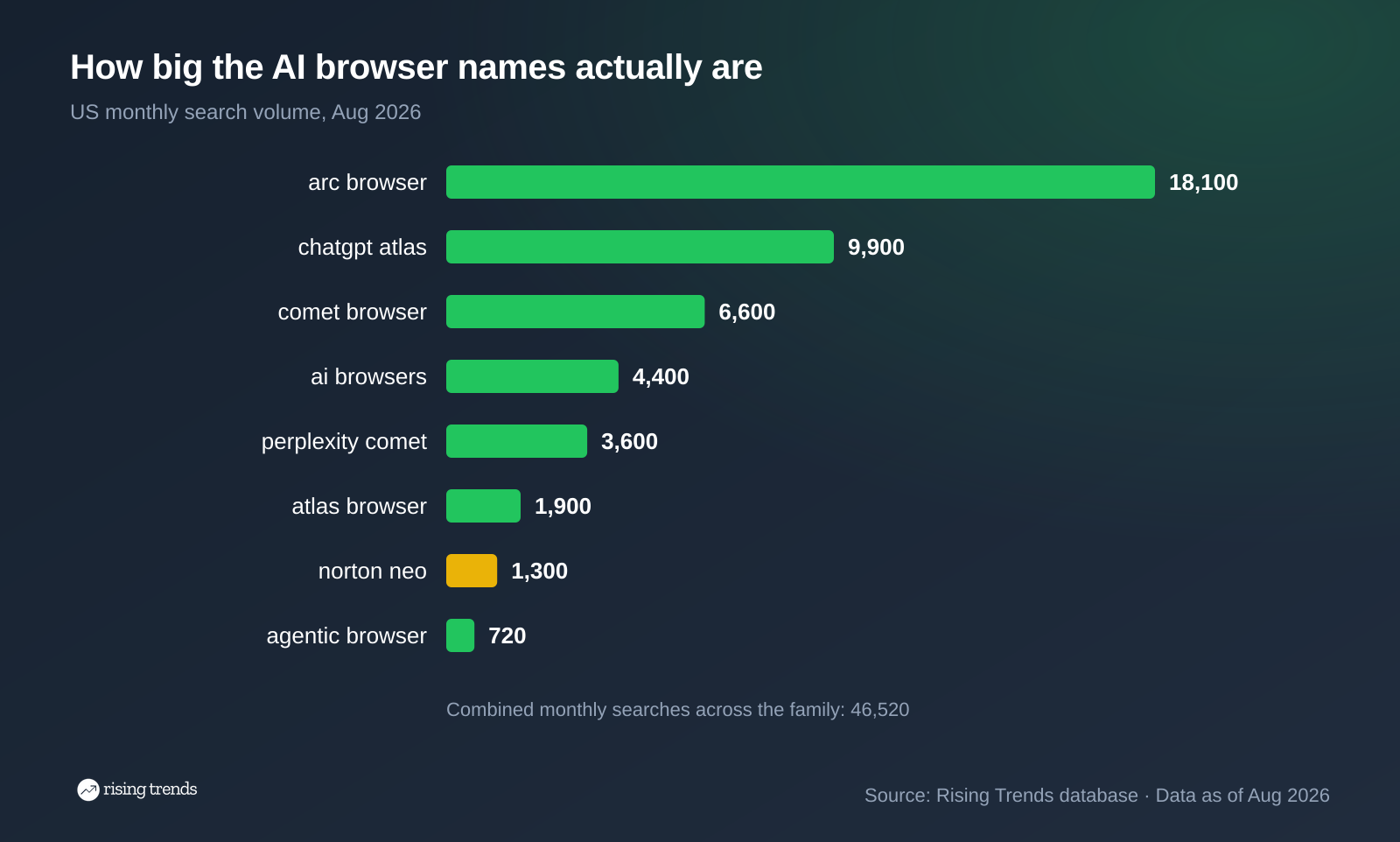
Neo is seventh of eight. The honest framing is that it is the fastest-growing small name in a category whose big names are shrinking, and two of those big names now point at products that are gone or going.
| Browser | Owner | Status as of Sep 2026 | Monthly searches, Aug 2026 | 1y change |
|---|---|---|---|---|
| Arc | The Browser Company, acquired by Atlassian | Superseded by Dia | 18,100 | -33% |
| ChatGPT Atlas | OpenAI | Shut down August 9, 2026 | 9,900 | from a standing start |
| Comet | Perplexity | Shipping | 6,600 | -89% |
| Norton Neo | Gen Digital | Shipping, free, on four platforms | 1,300 | +233% |
Atlas is the cautionary tale. OpenAI's launch post now opens with a banner reading "Atlas has since been deprecated." The help centre article tells former users that Atlas stopped working on August 9, 2026, that bookmarks would not transfer automatically, and that browser-based agent work now lives inside ChatGPT and Codex. Ten months, start to finish. The term chatgpt atlas still pulled 9,900 searches in August 2026, which is what demand for a dead product looks like.
Arc went a gentler way. Atlassian announced the acquisition of The Browser Company on September 4, 2025 and said it would put its weight behind Dia, the successor. Arc browser is still the biggest term in the family at 18,100 a month, fourteen times Neo's volume, for a browser nobody is actively building.
The reviews are the most useful thing about Neo's public record, because there are enough of them to see a pattern. On Google Play it sits at 3.6 from 403 reviews, which is not a rave.
The complaints are boringly practical. "Really good so far, but missing a few things," wrote Adrian Hennen on July 20, 2026. "Namely incognito tabs, the ability to always show the address bar/menu, and ability to close all tabs." Kenshi Lau, on September 2, 2026, listed a rendering bug and the same missing feature: "also incognito tab is missing. need those before recommending to friends." A privacy browser that shipped without private browsing is a strange thing, and it is the single most repeated note in the file.
The AI gets rougher treatment. "I think this app is the very definition of artificial dumbness," wrote a reviewer on August 20, 2026, an opinion eight other people marked as helpful. On the App Store, a reviewer on June 15 said simply that they could not find the AI features at all: "I haven't been able to get any of the AI tools that the app description and images show."
Read together, those say the browser part works and the AI part is not yet the reason anyone stays. That matches the search data, where the growth arrived alongside a VPN and a news feed rather than alongside an assistant.
Distribution beats product in this category, and Gen has distribution. The company's most recent quarterly filing reports 81 million total paid customers for the quarter ended July 3, 2026, up from 76 million a year earlier, on revenue of $1.336 billion. Perplexity and OpenAI had to persuade people to install a browser. Norton can put one in front of an installed base that already renews a subscription every year. That is why a 1,300-search product is worth watching more than a 6,600-search one.
Free is now the floor. Atlas launched with agent mode gated behind Plus, Pro and Business plans. Comet started as a paid perk. Neo shipped free, globally, with no waitlist, and bundled a VPN that competitors charge for. When the incumbent security vendors give away the premium feature, the standalone AI browser has to justify a price that the category no longer supports.
The browser is becoming a security surface, not a productivity one. Atlassian's acquisition post cited Gartner figures that 85% of enterprise workflows happen in a browser while fewer than 10% of organisations use a secure one. Every agent that clicks on your behalf widens that gap, which is the same pressure we mapped in our 2026 cybersecurity report and in the AI agents that now run browsers for consumers. Neo is Norton answering that question with a product rather than a warning.
Consumer agents are arriving from the other direction too. Meta shipped an agent with its own cloud browser to anyone with a phone number, which we covered in Meta Muse. If the agent brings its own browser, the browser stops being the place the user lives, and a browser's only durable pitch becomes trust.
Does the July peak hold or was it the tournament? August already gave back a chunk, from 1,600 to 1,300. If the norton neo curve settles well above the spring plateau through the autumn, the mobile app brought real users. If it drifts back toward 400, the summer was borrowed attention.
Watch for incognito mode. It is the most requested missing feature in the review file, and it is the sort of thing that either ships in a point release or signals that Neo's roadmap is pointed somewhere other than what its users are asking for. Release notes on the App Store page are dated, so the record is public.
Watch whether the category term recovers. "ai browsers" at 4,400 a month and falling 56% a year is the number that decides whether any of this is a market. If the generic term keeps shrinking while brand terms grow, AI browsing becomes a feature inside products people already use, which is exactly the bet Norton made.
The short version: the AI browser hype cycle produced one shutdown, one acquisition, two collapsed search curves, and one quiet riser owned by a decades-old antivirus brand. That is not what anyone predicted in 2025. It is what the data says in 2026.
Want to catch the next product before the category decides who won? Read our guide on how to identify market trends, follow the live Norton Neo trend page, or see what is breaking out right now on the Rising Trends dashboard.
Thousands of Emerging Trends
Thousands of Breakout Apps
Mega Trends
Trend Analysis Tool