Trends


In March 2026, about 140 people a month typed "meta muse" into Google. By July it was 8,100, and the app that everyone is writing about this week had not been released yet. Meta Muse, the personal AI agent Meta launched on September 8, is now the No. 1 free iPhone app in the US. The search curve says the name was already climbing five months before that.
That gap is the story. Every article about Muse right now starts on September 8. Our database starts in April, when a model called Muse Spark shipped, and it shows two distinct spikes that have nothing to do with the agent app. Nobody ranking for this term has the monthly curve, the family comparison or the honest answer to the question people are actually asking, which is whether a Meta product should be allowed to read your email. We do.
Key takeaways:
Let's get into it.
Here is the monthly search volume for "meta muse" over the last two years, straight from our database. It is not a growth curve. It is two events.
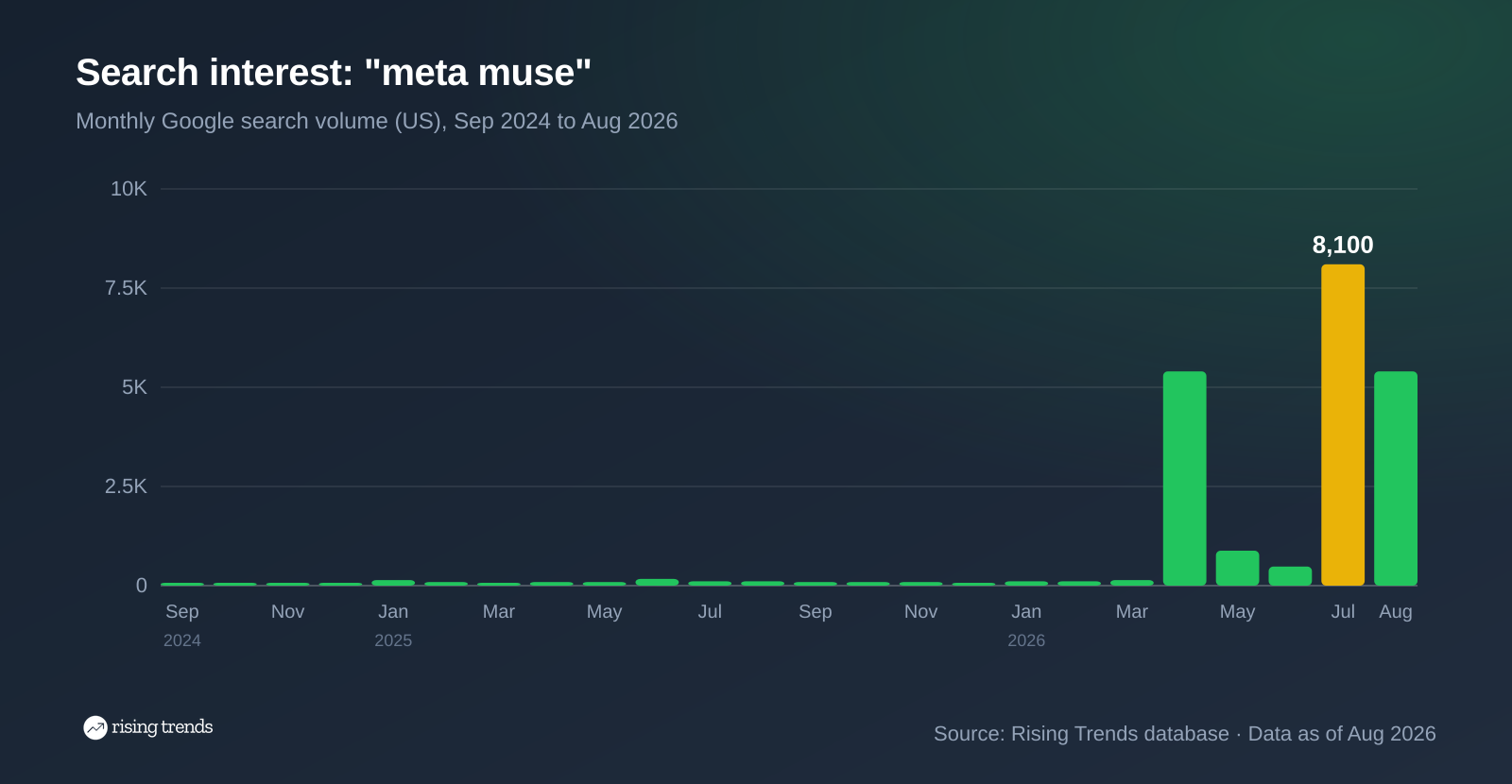
For 19 straight months the term sat between 70 and 140 searches. Then April 2026 took it to 5,400, the month Meta Superintelligence Labs shipped Muse Spark, its first model. May fell back to 880 and June to 480. July took it to 8,100, the month Muse Image arrived. August held at 5,400, which is where our data ends and where the interesting part begins.
Year over year the term is up 4,809%, and over two years 5,900%, as of Aug 2026. The last three months average 55.9 times the same stretch two years earlier. Those are breakout numbers by any measure, and they were all produced before the product most people now mean by "Muse" existed.
The family tells you how far Meta still has to go.
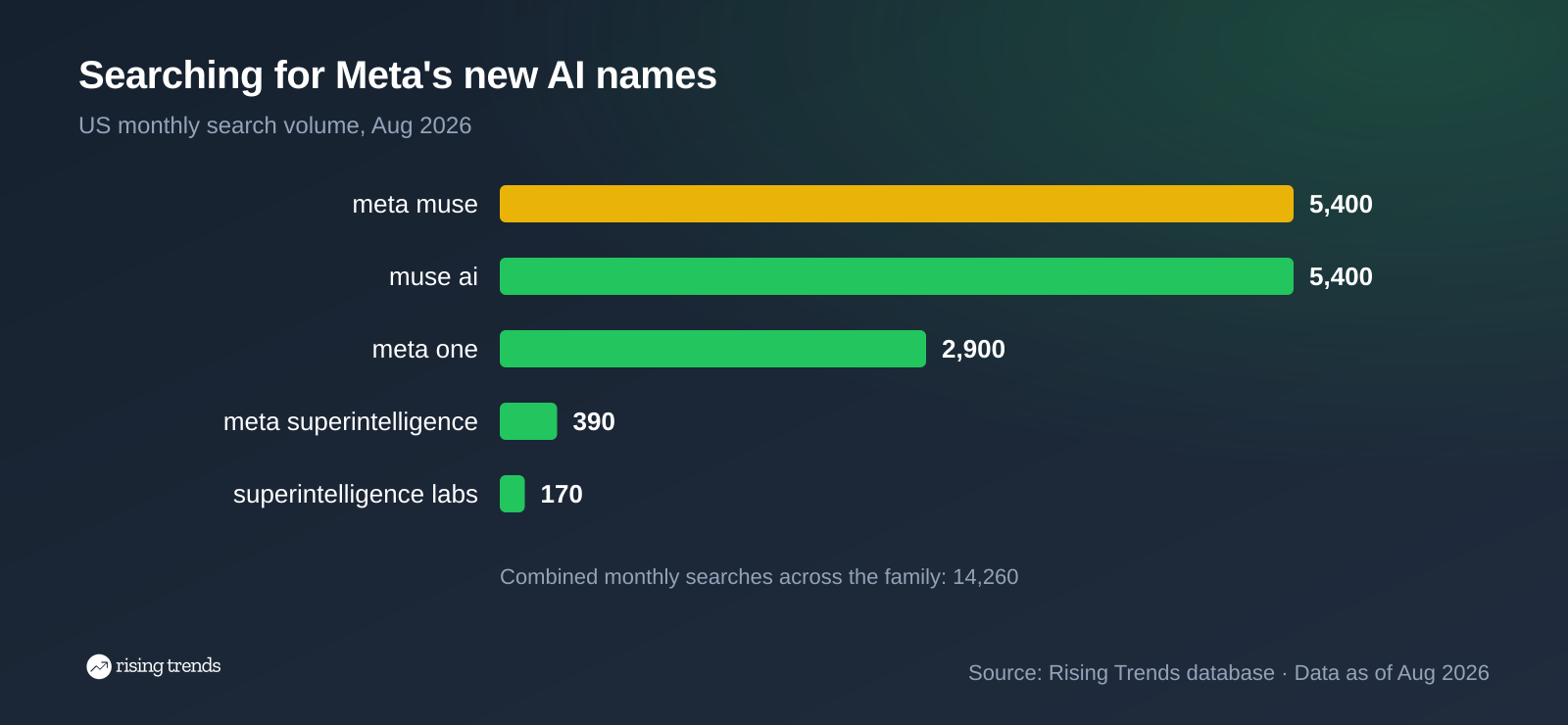
"meta ai" is 246,000 searches a month as of Aug 2026 and flat year over year, which is roughly 45 times Muse. The generic term "muse ai" draws 5,400 as of Aug 2026, the same as the branded one, and Meta's product happens to live at the muse.ai domain. Meta One, the subscription we broke down in our Meta One piece, is at 2,900. The lab's own name, "meta superintelligence", is 390. Meta is very good at launching names and not yet good at making one of them stick the way "meta ai" did.
Muse is a personal agent, which Meta defines by what it does rather than what it answers. You give it a task or a goal, and it works on it, including after you close the app. The launch announcement lists selling a car, lowering a bill and adjusting a training plan as the kind of thing it is for.
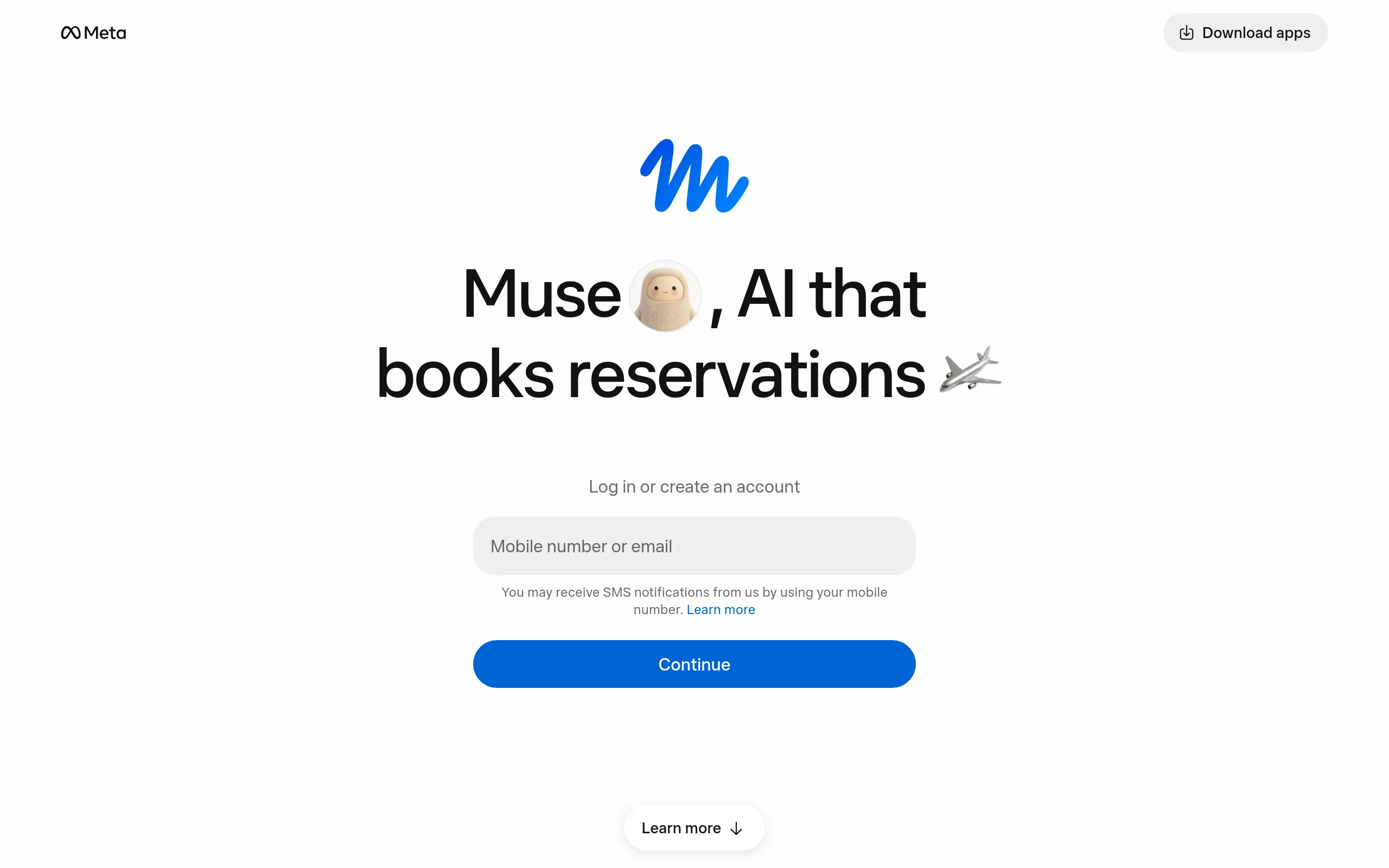
The rotating headline on Muse's own page is the product pitch in six words: sorts your email, books reservations, shops for you, saves you money, manages calendars, builds fitness plans. The architecture underneath is the part worth understanding.
Every user gets their own virtual machine. Meta calls it Muse Secure VM: an isolated Linux box in the cloud with a real browser, storage and CPU, where the agent lives and where the credentials for every service you connect are stored. You can take over that browser yourself at any point. A second agent called Sentinel runs on the same machine, separated at the system level, and nothing Muse does reaches the internet unless Sentinel allows it. Muse never sees your passwords or card numbers; it uses them out of a store it cannot read.
Payment goes through Link by Stripe, which generates a single-use card number so the merchant never sees your real one. Meta says Muse is the first AI agent covered by Link's purchase protections. Shop Pay and 1Password support are listed as coming. Availability is the US on iOS, Android, muse.ai and inside WhatsApp, with AI glasses named as next.
Pricing is the softest part of the public record. Meta's own wording is that Muse is "free for most of what people need, with subscription plans for people who want to do more." CNBC reported the tiers at $20 or $100 a month depending on usage. Meta has not published a pricing page.
| Date | Release | What shipped |
|---|---|---|
| Apr 8, 2026 | Muse Spark | MSL's first model, powering the Meta AI app |
| Jul 7, 2026 | Muse Image | Image generation in Meta AI, Instagram and WhatsApp |
| Jul 9, 2026 | Muse Spark 1.1 | Meta Model API opens to developers |
| Aug 5, 2026 | Muse Code, Spark 1.2 | A terminal coding agent with background subagents |
| Sep 2, 2026 | Muse Spark 1.3 | Max reasoning, 20% fewer tool calls than 1.2 |
| Sep 8, 2026 | Muse | The personal agent, on its own secure VM |
Five months, six releases, one name. Meta built the model, then the image model, then the developer tools, then the consumer agent on top. Muse Spark 1.3 is the version in the field today, and Meta's own engineers measured it using about 20% fewer tool calls and 25% fewer tokens than the version before it.
Because it worked, at least at the top of the funnel. Muse overtook ChatGPT as the No. 1 free iOS app in the US on September 18, ten days after launch. This hands-on review from Alex Finn, posted on September 19, 2026, has drawn about 133,000 views on YouTube and is a fair sample of the reaction in that first fortnight.
The numbers behind the chart position come from Sensor Tower, reported by CNBC on September 21: 730,000 downloads in the first five days, 2.5 million by day 13, split roughly 1.5 million on iOS and 1.1 million on Android. Over the same 13-day post-launch window, CNBC reports, ChatGPT did 3.1 million, Claude 400,000 and Grok 200,000. Meta stock rose more than 11% that Monday.
The other half of the answer is that people search a name when they are not sure they trust it. Meta is asking for your inbox, your calendar and your card. On Apple's US App Store, the Muse app currently holds a 4.9 rating across 33,329 ratings, checked on September 23, 2026, which is the enthusiasm. The scepticism shows up alongside it. "I can envision a world where this technology gets more performant," wrote the creator suhaadada on TikTok on September 19. "But I still cannot envision a world where this product is used by non-tech bros."
The agent race split into two markets this year, and Muse is the first serious attempt at the consumer half. The developer half got there first: OpenClaw, which we covered in the open-source AI agent gold rush, draws 74,000 monthly searches as of Aug 2026 and runs on your own machine with your own API keys. Muse runs on Meta's machine and asks for nothing but a phone number.
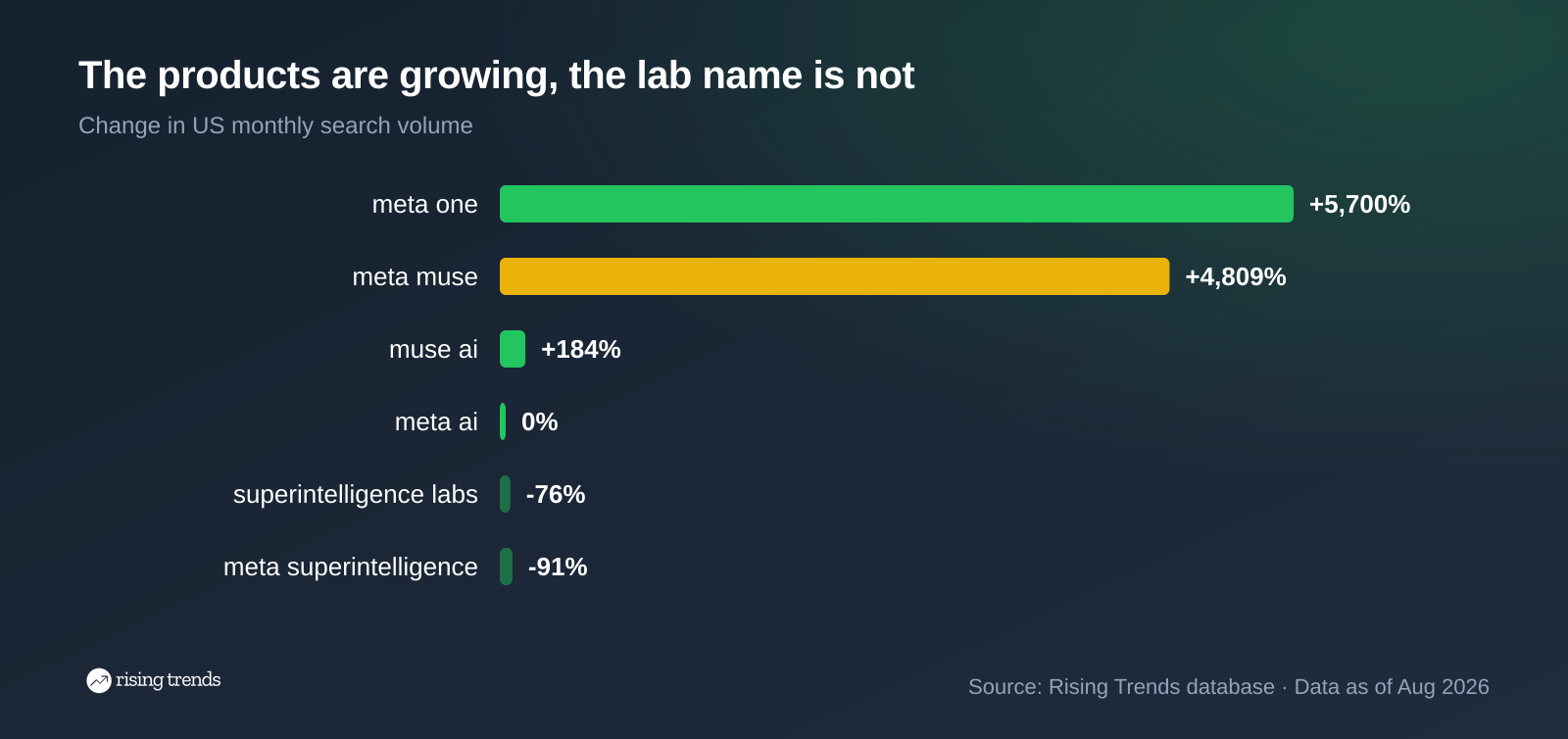
Two things stand out in that ranking. Meta's two new consumer products, Muse and Meta One, are the only names growing. The research brand behind them is shrinking: "meta superintelligence" is down 91% in a year and "superintelligence labs" down 76%, as of Aug 2026. And meta ai is flat at 0%, which is what a mature brand looks like when the growth has moved to the products sitting on top of it. The broader picture is in our AI agent trends report.
Amazon blocked it. On September 20, GeekWire reported that Amazon had cut Muse off from shopping on Amazon.com after failing to get Meta to exclude the site voluntarily. Users now see a popup saying continued access by an unauthorized AI agent violates Amazon's Conditions of Use.
Amazon's complaint is not really about security, though it cites it. "We think it's fairly straightforward that third-party applications that offer to make purchases on behalf of customers from other businesses should operate openly and respect service provider decisions about whether or not to participate," an Amazon spokesperson said. Amazon says Muse does not identify itself as it browses, and appears to capture and store customer credentials. Meta's published position is the opposite: credentials go into storage the agent cannot read.
The awkward part is that the two companies are partners. Amazon products have been purchasable inside Facebook and Instagram since 2023, and Meta signed a multibillion-dollar deal in April 2026 to run agentic AI workloads on Amazon's Graviton chips.
Meta, to its credit, published its own threat model. In How We Built Safety Into Muse, Tarek Sheasha of Meta Superintelligence Labs writes that the team had "handed our inboxes, our calendars, and a shell to a piece of software and let it run unattended, which didn't always work out as planned." The bug bounty is the tell: up to $300,000 for a valid report, including up to $130,000 for a prompt injection affecting a single user. Companies do not price a bounty that high for a risk they consider solved.
Agentic commerce just got its first real fight. Amazon has spent a year keeping outside agents off its site, and the Muse block is the biggest one yet. Whoever wins decides whether an agent is a browser (the user's tool, allowed anywhere) or a bot (a third party that needs permission). The Ninth Circuit leaned toward the first reading in August, so the fight is moving to terms of service. Every retailer watching the dopamine shopping pattern of full carts and no checkout has a new variable: a cart filled by software that never sees an ad.
Distribution is Meta's weapon, not the model. Muse talks to you inside WhatsApp. No download, no new habit, roughly three billion people already there. That is a different go-to-market from every other agent, and it is why the App Store number matters less than it looks.
The free tier is the product, the subscription is the hedge. Meta's ad business needs you browsing. An agent that shops for you removes the browsing. Charging $20 or $100 a month is how that math survives, and it is the same bet behind Meta One. Expect the generative AI pricing conversation to move from per-token to per-outcome.
Does the September spike hold? Our August figure of 5,400 is the pre-launch baseline. If "meta muse" settles above that once September and October data lands, the agent found real users. If it snaps back toward 480, as it did in June, Muse joins Sora and Meta's own Vibes in the category of launches that peaked on day one. The live meta muse trend page is where that resolves first.
Watch which name people search. If the query that grows is "muse app" or "muse ai" rather than "meta muse", Meta has succeeded in separating the product from the parent brand, which given the trust problem may be the point.
Watch the open weights. Meta's 1.3 roadmap names "bigger models, the Muse Spark open weights release." Meta gave away Llama and lost the narrative to closed labs. Muse Code is currently a closed beta. Whether Spark weights actually ship decides if Muse is a product strategy or a platform one.
The honest summary is that we are two weeks into this. A No. 1 app ranking is not retention, 2.5 million downloads is not daily use, and a bounty of $300,000 is a company telling you it expects to be attacked. What the search data adds is perspective: the name was already breaking out in April, the peak so far came in July from an image model, and the agent everyone is arguing about has not yet shown up in a single month of our numbers.
Want to spot the next breakout product before the launch coverage starts? Read our guide on how to identify market trends, follow the live Meta Muse trend page, or browse what is breaking out right now on the Rising Trends dashboard.
Thousands of Emerging Trends
Thousands of Breakout Apps
Mega Trends
Trend Analysis Tool