
More than 10 million people have set up Meta Muse, Meta's personal AI agent, according to Mark Zuckerberg on Meta's October 21, 2026 earnings call. About 25% of them use it on any given day, which puts Muse at roughly 2.5 million daily users. That is the only user number Meta has published. Everything else you will read about Muse, including the 10.9 million downloads, comes from app trackers that estimate it from the outside.
This page puts every Muse number in one place, with its date, its source and whether it is official or an estimate. We added three things nobody else has: the store data we track ourselves, the search demand behind the launch, and a straight answer on where the estimates disagree.
Key takeaways:
- Users: more than 10 million people in the US and Canada set up Muse in its first six weeks (Meta, October 21, 2026).
- Daily users: about 25% of them use it every day, so at least 2.5 million daily users. Sensor Tower separately counted 2.5 million US daily users on October 16.
- Downloads: 10.9 million worldwide by October 20, 10.2 million of them in the US (Sensor Tower). Muse is one of only 12 apps ever to reach 10 million US downloads in 40 days.
- Retention: 30% of September installers were still active after 7 days and 23% after 14 days, against 19% and 16% for ChatGPT, Claude and Grok.
- Search: "meta muse" hit 450,000 US searches in September 2026, up from 5,400 in August, per the Rising Trends database. Google Trends interest has since fallen 82% from its late-September peak.
- Our own count: the Muse Android app showed 8,833,770 installs on Google Play on November 5, and the iPhone app 447,486 ratings, up from 33,329 on September 23.
Let's get into it.
How many people use Meta Muse?
The short answer is more than 10 million. Here is the exact wording from the Meta Q3 2026 earnings call transcript: "more than 10 million people in the US and Canada have set up Muse personal agents." Zuckerberg added that it happened "in just a month and a half."
Note the verb. "Set up" is not the same as "use every week". It counts everyone who created a Muse agent, including people who tried it once. Meta gave one more number to size the active base: about 25% of people who set up Muse use it on any given day. Ten million times 25% is 2.5 million daily users, and since Meta said "more than" 10 million, that is a floor.
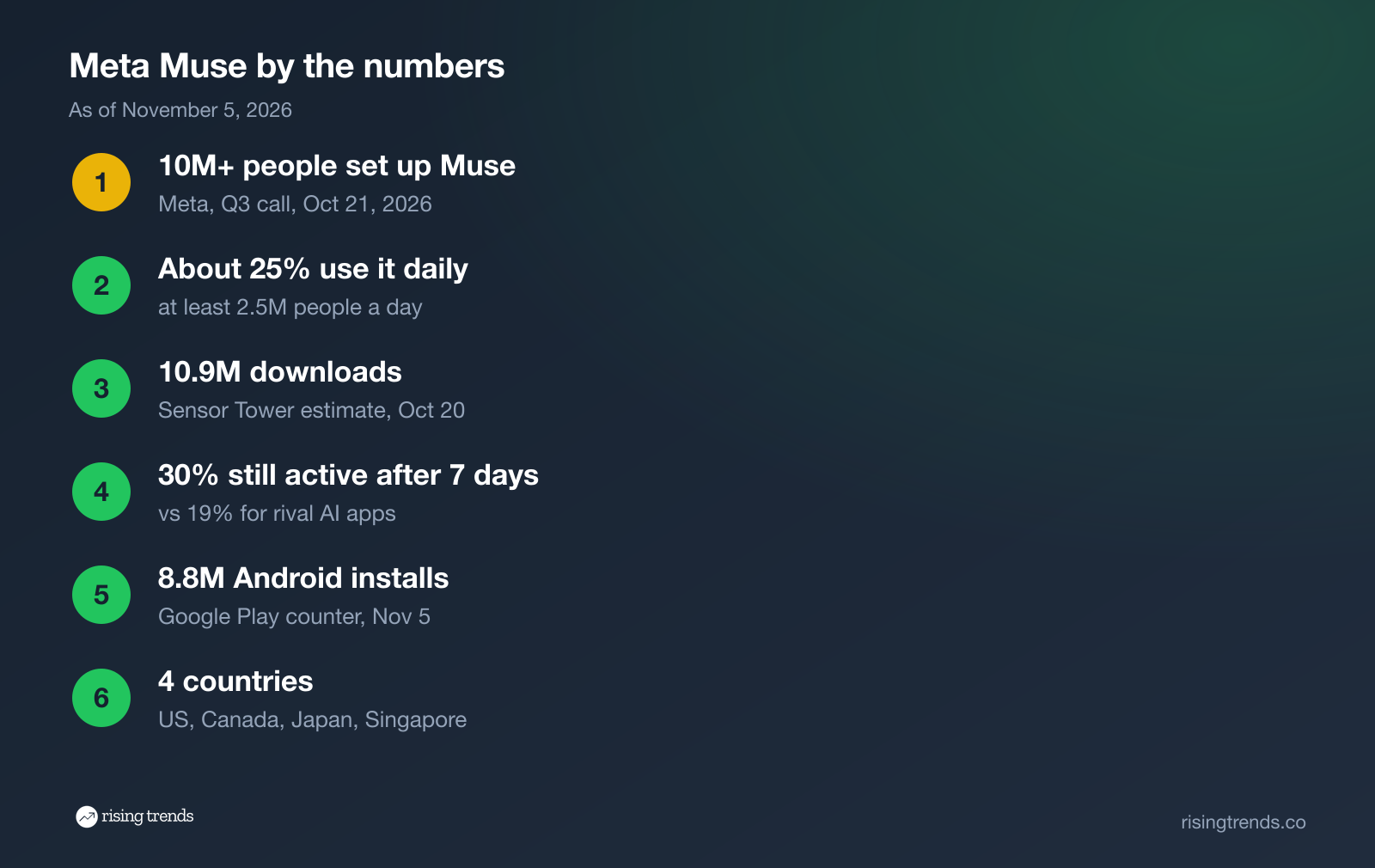
Those six numbers are the core of the story. The rest of this page shows where each one comes from, and what the others say.
For context on what Muse actually is and how it works under the hood, read our earlier explainer, Meta Muse: the personal AI agent that passed ChatGPT. This page sticks to the numbers.
Every Muse number, by source
Muse numbers come from at least seven places, and they measure different things. Downloads are not users, weekly users are not daily users, and US numbers are not global ones. This table lists each figure with its date and whether Meta confirmed it.
| Metric | Value | As of | Source | Type |
|---|---|---|---|---|
| People who set up Muse | 10M+ (US and Canada) | Oct 21, 2026 | Meta Q3 call | Official |
| Share using it daily | About 25% | Oct 21, 2026 | Meta Q3 call | Official |
| Implied daily users | 2.5M+ | Oct 21, 2026 | Rising Trends calculation | Derived |
| Lifetime downloads | 10.9M (10.2M US) | Oct 20, 2026 | Sensor Tower | Estimate |
| US daily active users | 2.5M | Oct 16, 2026 | Sensor Tower | Estimate |
| Daily active users | 2,730,919 | Oct 6, 2026 | TickerTrends | Estimate |
| Daily active users | 2.18M | Oct 5, 2026 | Similarweb | Estimate |
| Weekly users who prompt Muse | 3M+ | Early Oct 2026 | The Information | Leaked internal data |
| First-week users | 500K+ (250K+ daily) | Mid Sep 2026 | The Information | Leaked internal data |
| Day-7 retention | 30% (rivals 19%) | Oct 20, 2026 | Sensor Tower | Estimate |
| Android installs | 8,833,770 | Nov 5, 2026 | Google Play listing | Store counter |
| iPhone ratings | 447,486 (4.85 stars) | Nov 5, 2026 | Apple App Store | Store counter |
Two things jump out. First, the official number and the estimates agree more than the headlines suggest: every daily-user estimate from October sits between 2.2 and 2.7 million. Second, the 10 million figure has two different meanings in the press. Meta's is people who set up an agent. Sensor Tower's is app downloads. They happen to be close, but they are not the same number.
Muse daily active users
Daily users are the number that tells you whether people kept using Muse after the launch week. Here are all the estimates side by side.
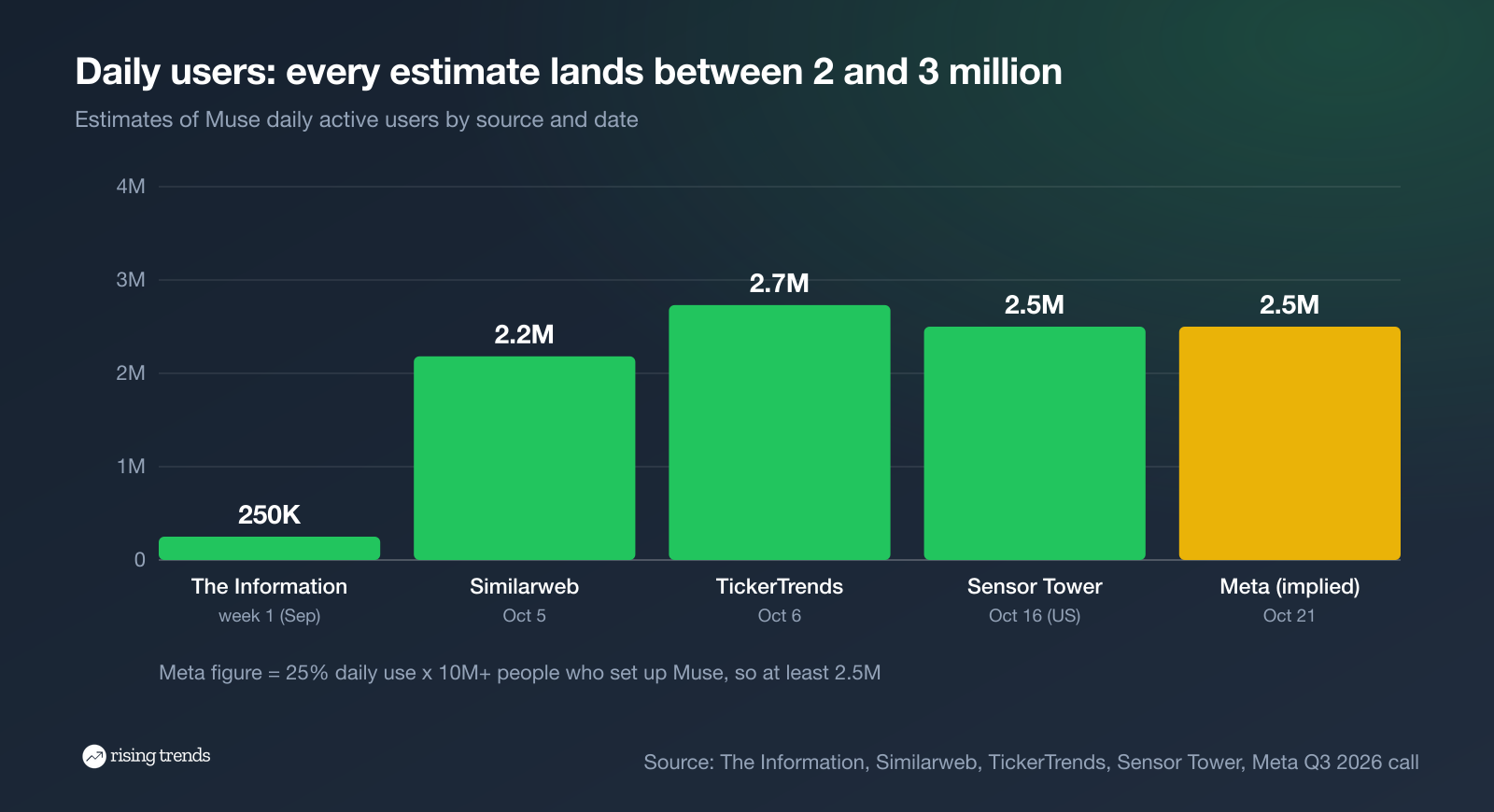
The jump from 250,000 in week one to over 2 million by early October is a 9x increase in about three weeks. The spread between trackers is mostly about scope. Sensor Tower's 2.5 million on October 16 is US only and was up 15% week over week, while Similarweb and TickerTrends count every market.
TickerTrends, published by Hunterbrook on October 9, put Muse at 2,730,919 daily users on October 6. It also reported that net new daily users had slowed to about 74,000 a day, down 62.4% from the late-September surge. Hunterbrook disclosed a short position in Meta, so read that framing with care. The data point itself fits the others.
Muse downloads
Downloads are where the launch looks biggest. Sensor Tower data, reported in stages by CNBC and TechCrunch, shows Muse going from 730,000 downloads in its first five days to 10.9 million by October 20.
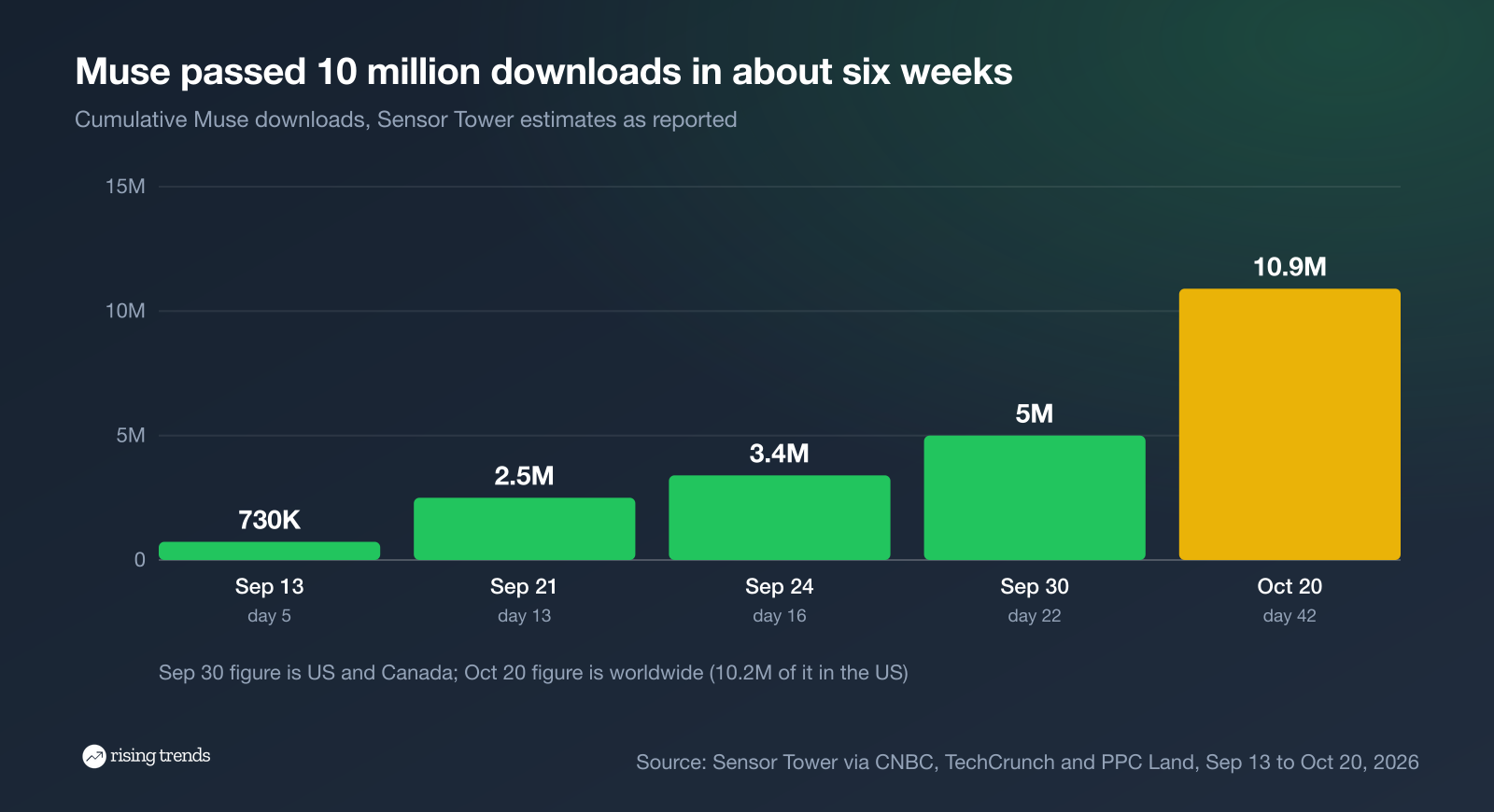
The 5 million mark came on September 30, day 22. Then downloads more than doubled again in the next three weeks. That second half is the part most early coverage missed, and it lines up with Meta pouring its own ad budget into the app (more on that below).
Different trackers counted the same weeks very differently. In late September, as TechCrunch reported on September 25, Sensor Tower had 3.4 million downloads, Apptopia 4.3 million and Appfigures about 2.3 million.
| Tracker | Downloads | As of |
|---|---|---|
| Appfigures | About 2.3M | Sep 24, 2026 |
| Sensor Tower | 3.4M | Sep 24, 2026 |
| Apptopia | 4.3M (2.6M on iOS) | Sep 25, 2026 |
| Sensor Tower | 10.9M | Oct 20, 2026 |
A factor of almost two between trackers is normal for app estimates. That is why we lean on Sensor Tower for the time series: it is the only tracker with numbers across the whole launch.
Downloads per day are slowing
The daily pace peaked early. TickerTrends estimated about 215,000 downloads on September 24, then an average of about 180,000 a day, then 165,000 a day in the week to October 6, a drop of 8.1% week over week.
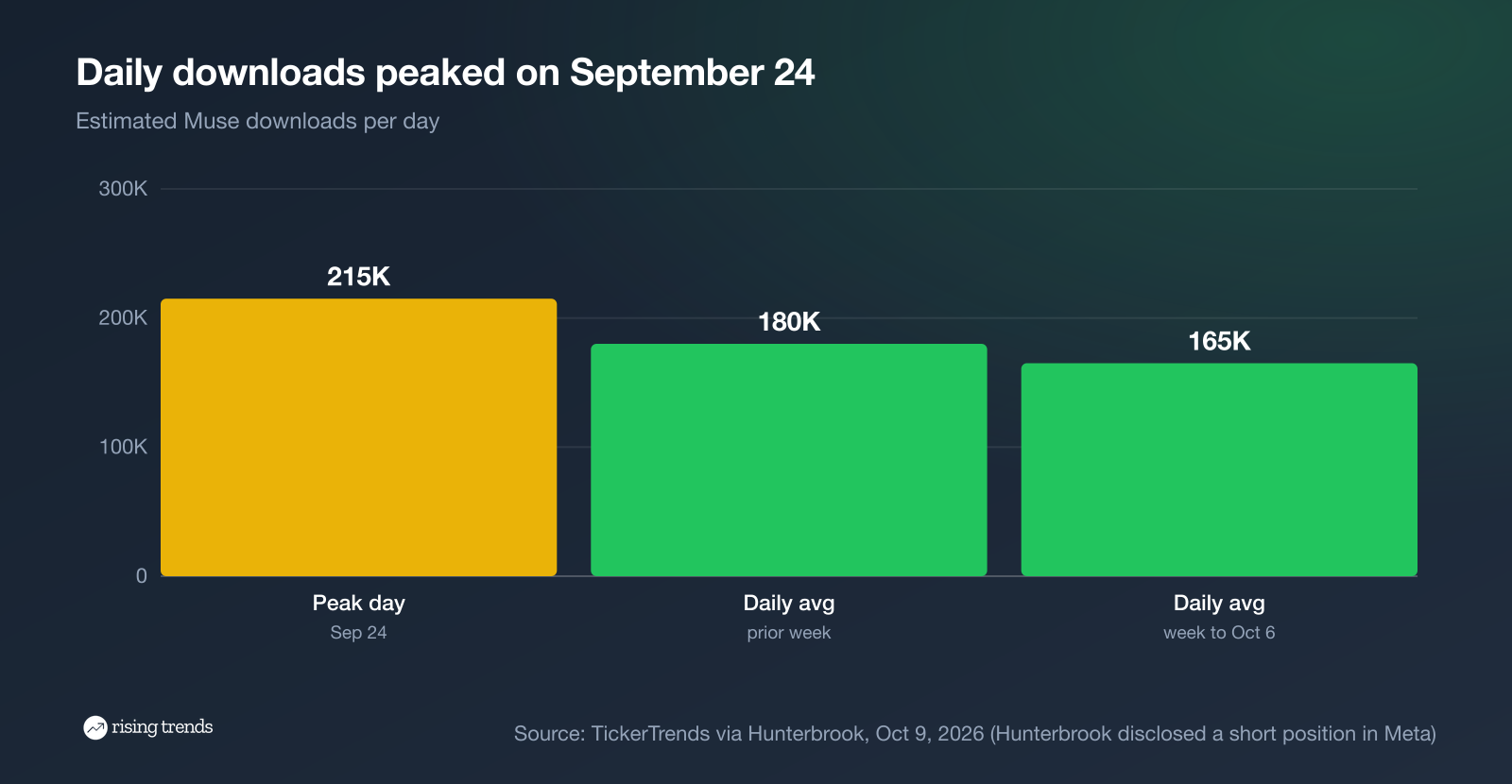
165,000 a day is still a lot. It is what pushed the total past 10 million by late October. But the direction is clear: the launch spike is behind it, and growth now depends on retention and on new countries.
How Muse compares with ChatGPT, Claude and Grok
The comparison everyone wanted was ChatGPT. Over the first 13 days, ChatGPT was actually ahead.
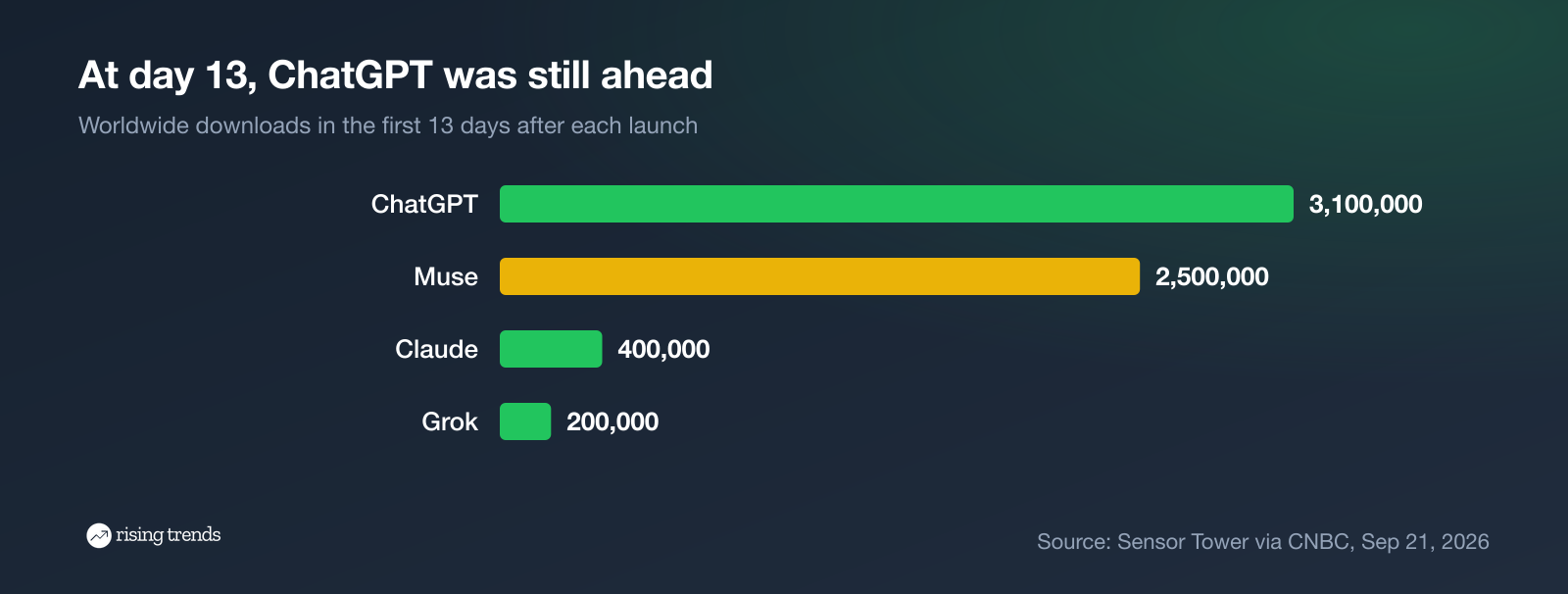
Those figures, first reported by CNBC, show ChatGPT at 3.1 million in its first 13 days against Muse at 2.5 million. Claude and Grok were far behind at 400,000 and 200,000.
By day 40 the picture had flipped completely.
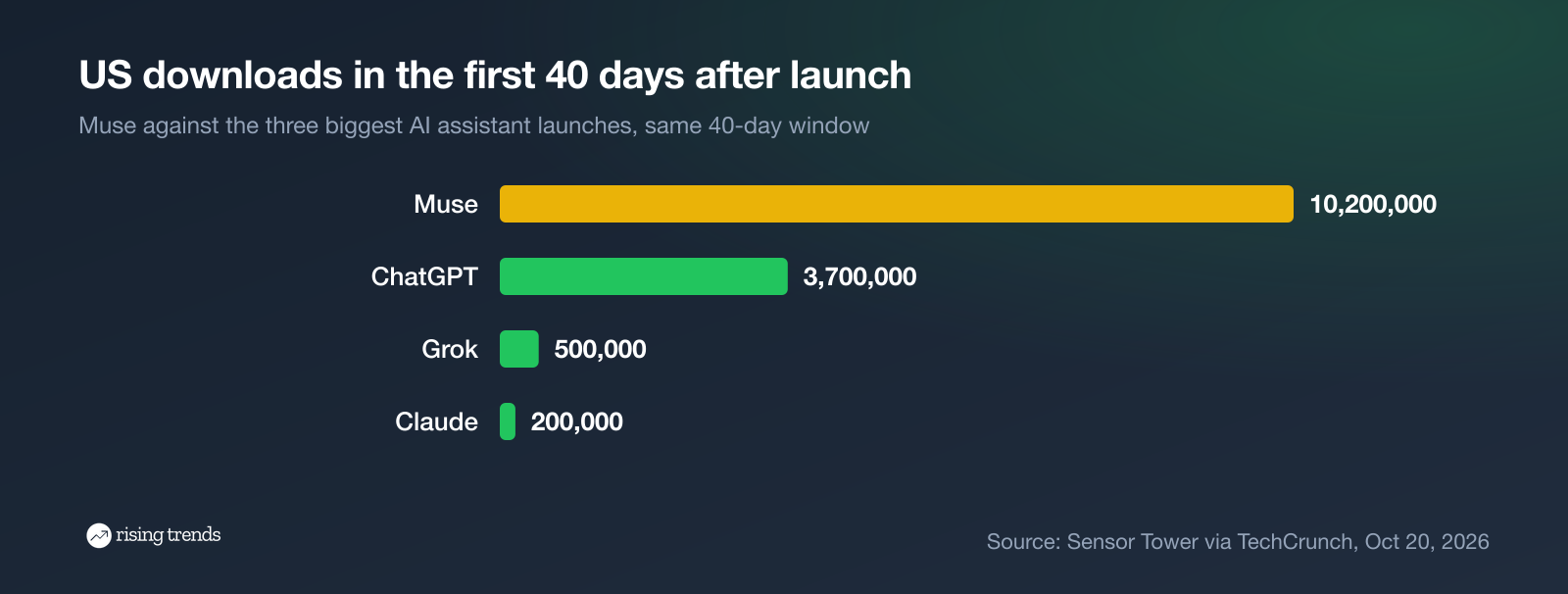
In the US, Muse did 10.2 million downloads in 40 days, against 3.7 million for ChatGPT, 500,000 for Grok and 200,000 for Claude over the same post-launch window. Sensor Tower says only 12 apps have ever reached 10 million US downloads in 40 days. The last one before Muse was Threads in July 2023, also from Meta. Apptopia's early read pointed the same way: Muse had 642,000 US mobile daily users at a point where ChatGPT had 231,000, and more than 95% of Muse users also use Facebook.
Launch speed is one thing. Total scale is another, and there Muse is still tiny.
| Product | Users | Metric | As of |
|---|---|---|---|
| ChatGPT | 1.2 billion | Weekly users | Sep 29, 2026 (OpenAI DevDay) |
| Gemini app | 1 billion+ | Monthly users | Oct 28, 2026 (Alphabet Q3) |
| Meta Muse | 10 million+ | People who set it up | Oct 21, 2026 (Meta Q3) |
The Gemini app passed 1 billion monthly users, Alphabet said in its third-quarter results, and OpenAI cited 1.2 billion weekly users at DevDay. Muse has about 1% of ChatGPT's audience. The bet Meta is making is that an agent which does things (shops, books, files forms) is worth more per user than a chatbot that answers questions. For the wider picture of who is building agents, see our AI agent trends report.
Muse retention: do people keep using it?
This is where Muse looks strongest. Sensor Tower followed people who installed Muse in the US in September and checked who was still active later.
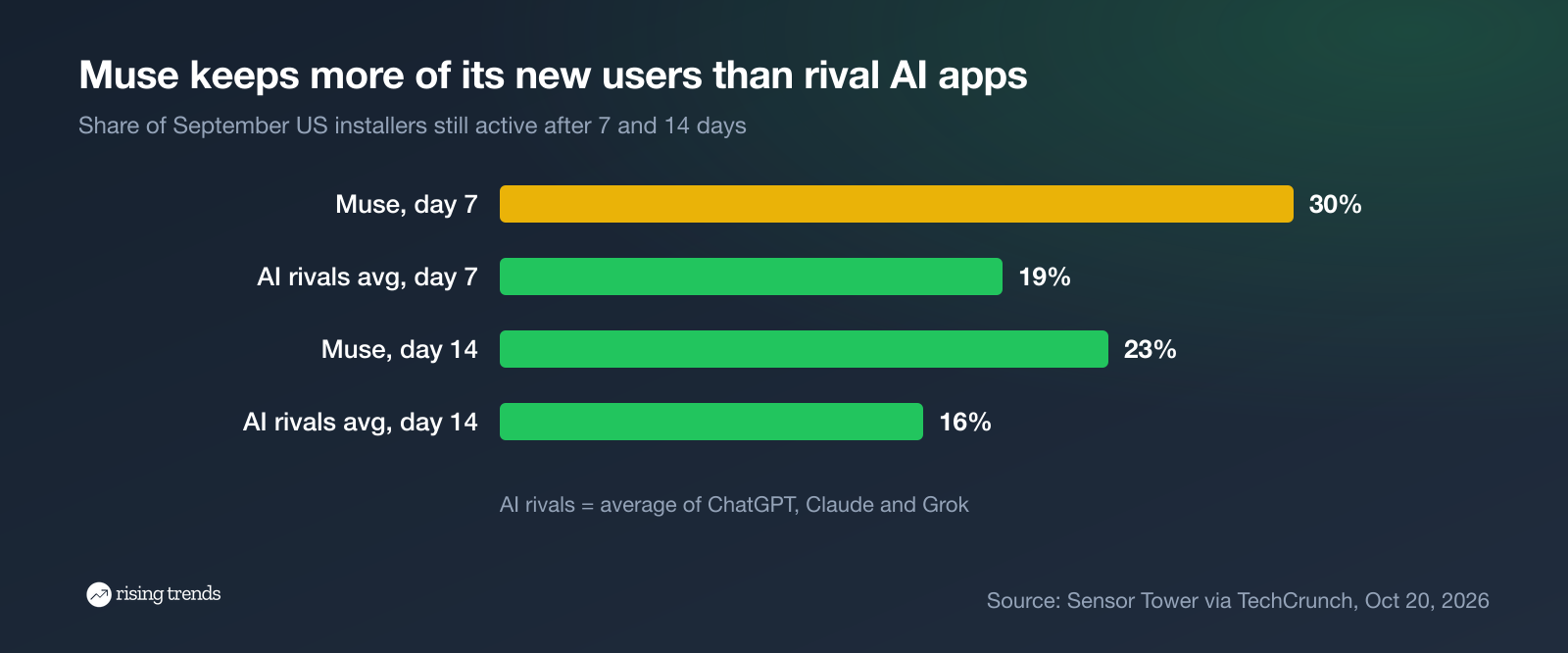
After 7 days, 30% were still active, against an average of 19% for ChatGPT, Claude and Grok. After 14 days it was 23% against 16%. Earlier, Sensor Tower had put Muse's day-one retention at 73%, nearly double ChatGPT's rate.
There is a catch the headlines skip. Most of the drop still happens in week one: from 73% on day one to 30% on day seven. Muse is better than its rivals at keeping people, but more than two in three new users are gone within a week. Meta's 25% daily-use figure is the more flattering version of the same story, since it is measured against people who set up an agent, not everyone who downloaded the app.
How many people search for Muse
This section uses the Rising Trends database and Google Trends, so it covers what nobody else reports: how many people went looking for Muse, and whether that interest is holding.
In September 2026, the launch month, "meta muse" drew 450,000 US searches, up from 5,400 in August. "muse ai" drew 550,000. You can follow both on the meta muse trend page and the muse ai trend page.
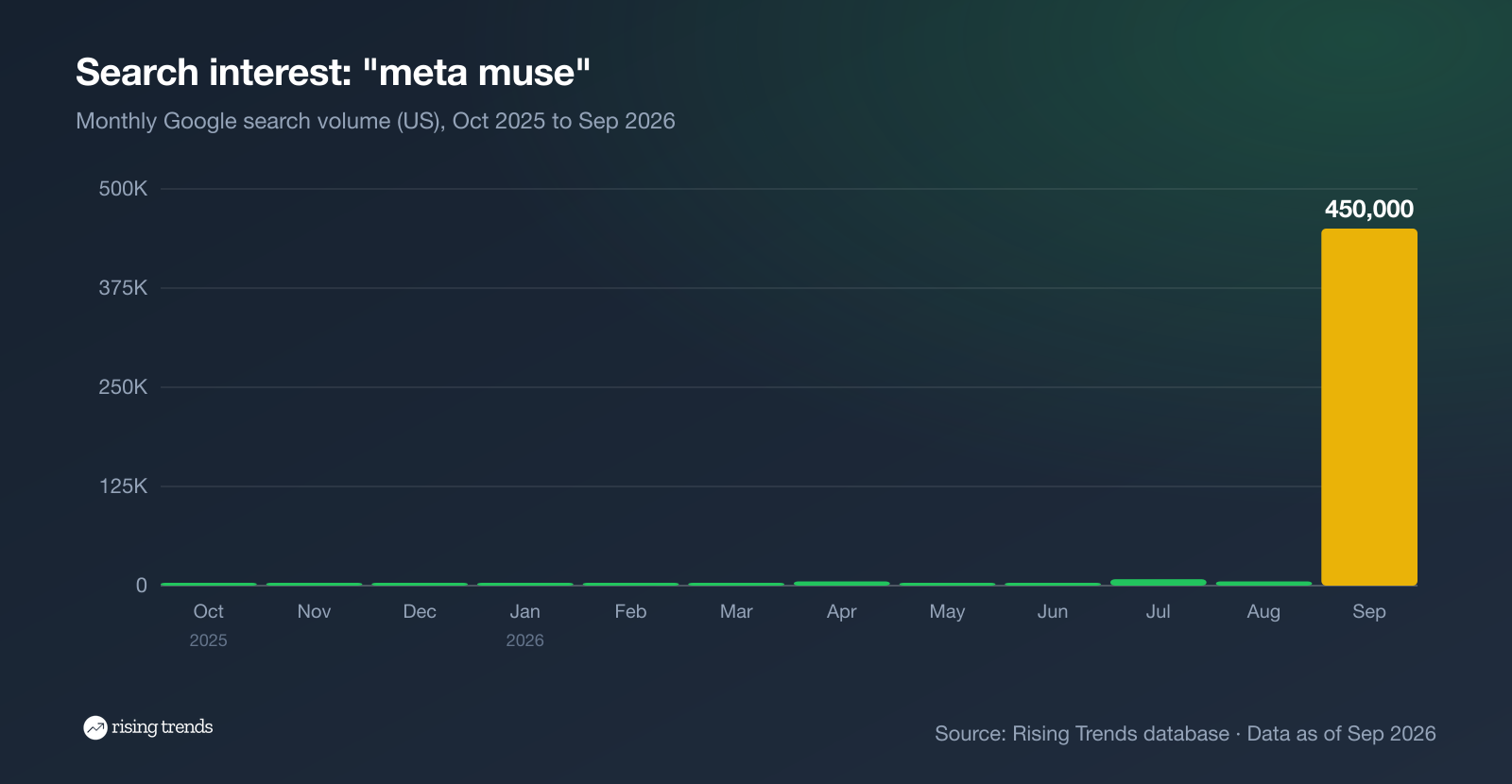
For 11 months the term barely registered next to September. The small bumps in April and July were the Muse Spark and Muse Image model launches, which we covered in our first Muse article when the agent did not exist yet.
The more interesting chart is which name people used.
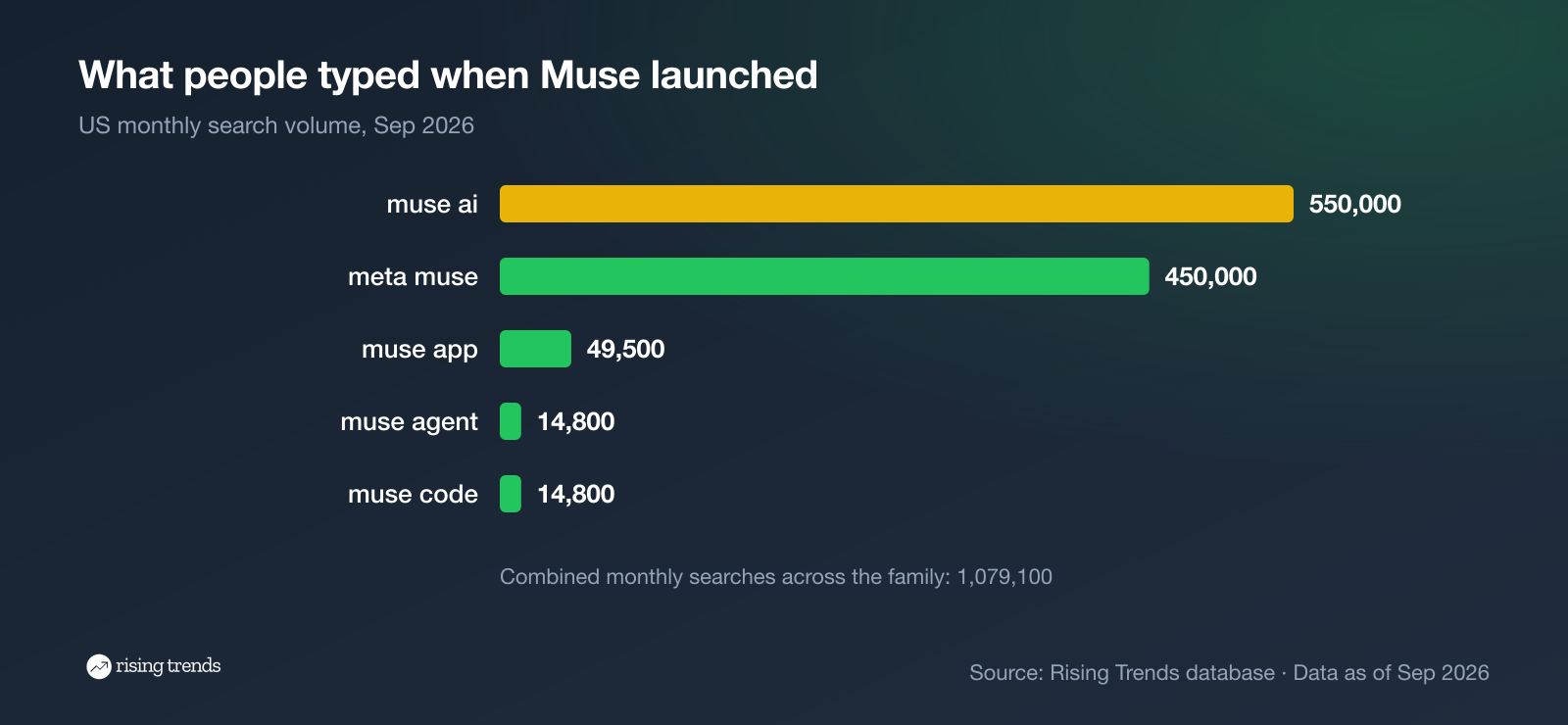
More people typed "muse ai" than "meta muse". Combined, the five Muse terms passed 1 million US searches in September. Muse Code, Meta's coding agent, already draws 14,800 searches a month on its own.
Interest has fallen 82% from the peak
Monthly numbers for October are not out yet, so we pulled Google Trends daily data for the US to see what happened after September.
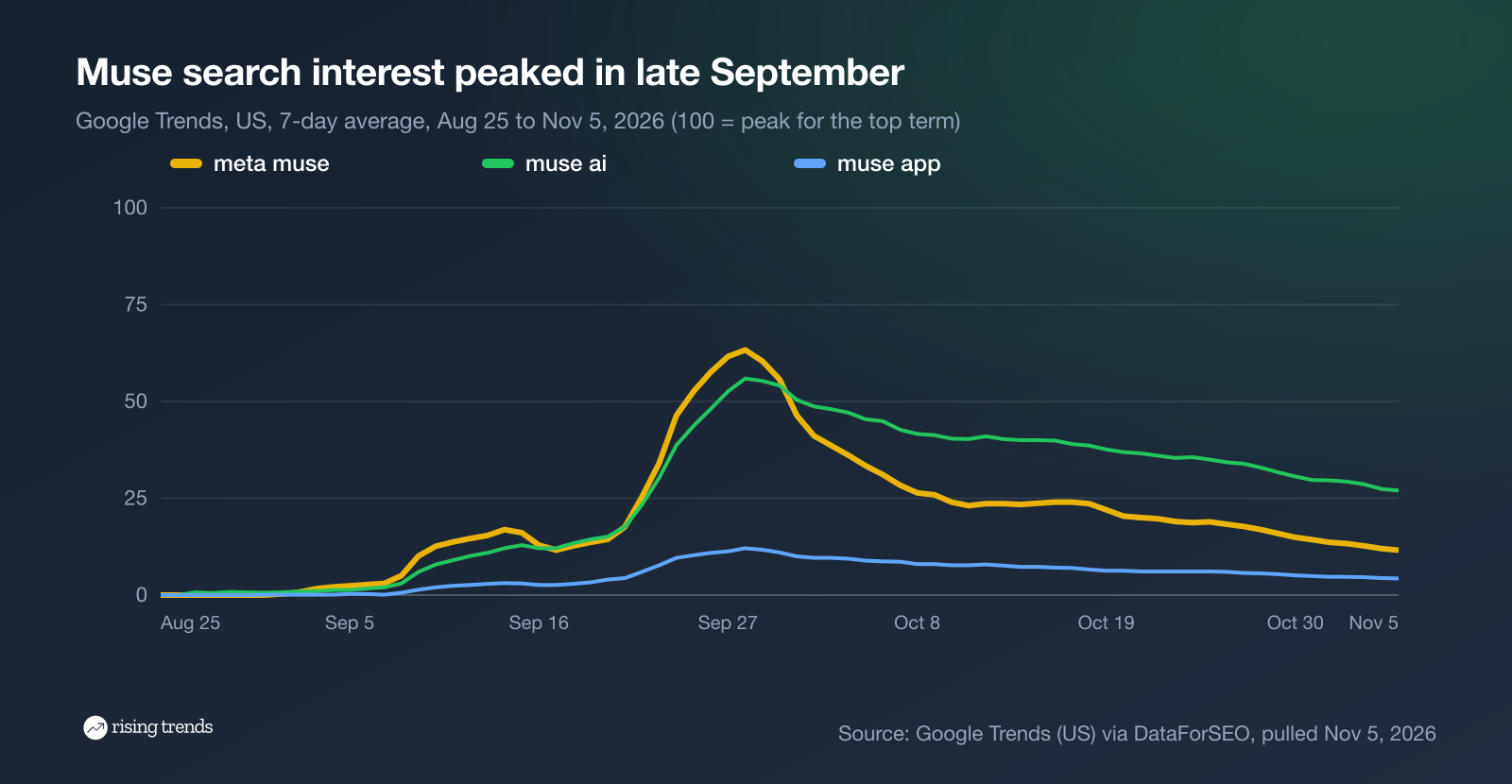
Search interest for "meta muse" peaked in the week to September 28 and has since fallen 82% on a 7-day average. "muse ai" fell only 52%. The product name is holding up better than the brand name, which is exactly what Meta would want, given how many people hesitate to hand Meta their inbox.
A fall from a launch peak is normal. Most viral apps follow the same curve. The useful signal is the floor: if "muse ai" settles well above its August level, Muse has a real audience.
What people ask about Muse
The searches around Muse also show what people want to know before they install it. These are US searches in September 2026.
| Search | US searches, Sep 2026 | What it tells you |
|---|---|---|
| what is meta muse | 40,500 | Most people did not know what it was |
| muse ai agent | 40,500 | "Agent" stuck as the category word |
| what is muse app | 14,800 | Same question, from the app store side |
| muse ai review | 6,600 | People wanted a second opinion |
| meta muse review | 5,400 | Same, with the Meta name |
| is meta muse free | 4,400 | Price was the first objection |
| muse vs chatgpt | 4,400 | The comparison people made |
| muse ai pricing | 3,600 | Paid plans got attention too |
| how many users does muse have | 140 | The question this page answers |
If you track launches like this one, the Rising Trends trending apps list shows which apps are climbing the stores each week, and the AI trends hub tracks the search terms around them.
Muse on the app stores
We check the Muse store listings ourselves. On November 5, 2026, the Google Play listing showed 8,833,770 installs and 142,569 ratings at 4.7 stars. The iPhone app had 447,486 ratings at an average of 4.85.
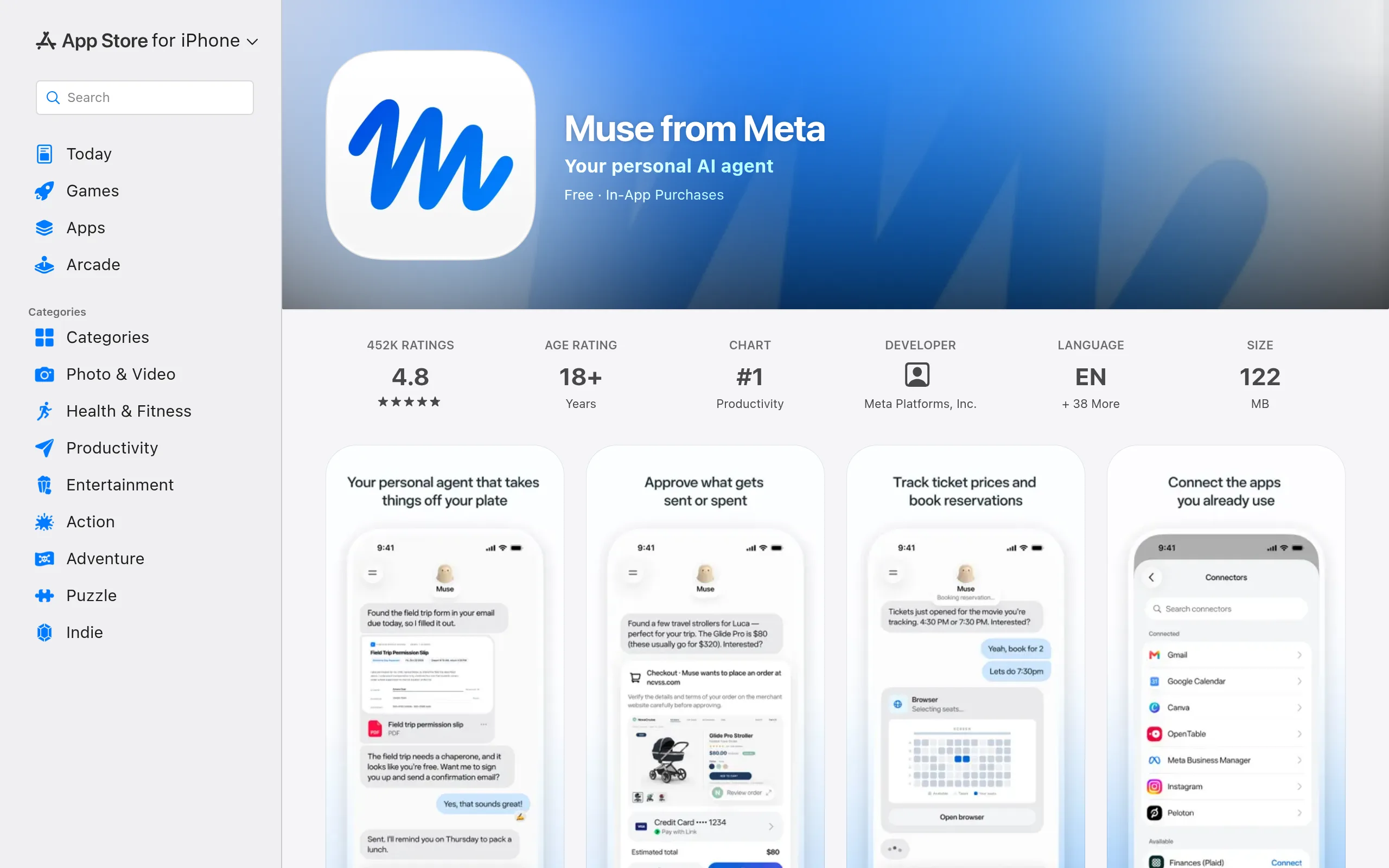
The Muse App Store listing still shows Muse at No. 1 in Productivity, rated 18+. Ratings are a rough proxy for downloads, and the growth is steep.
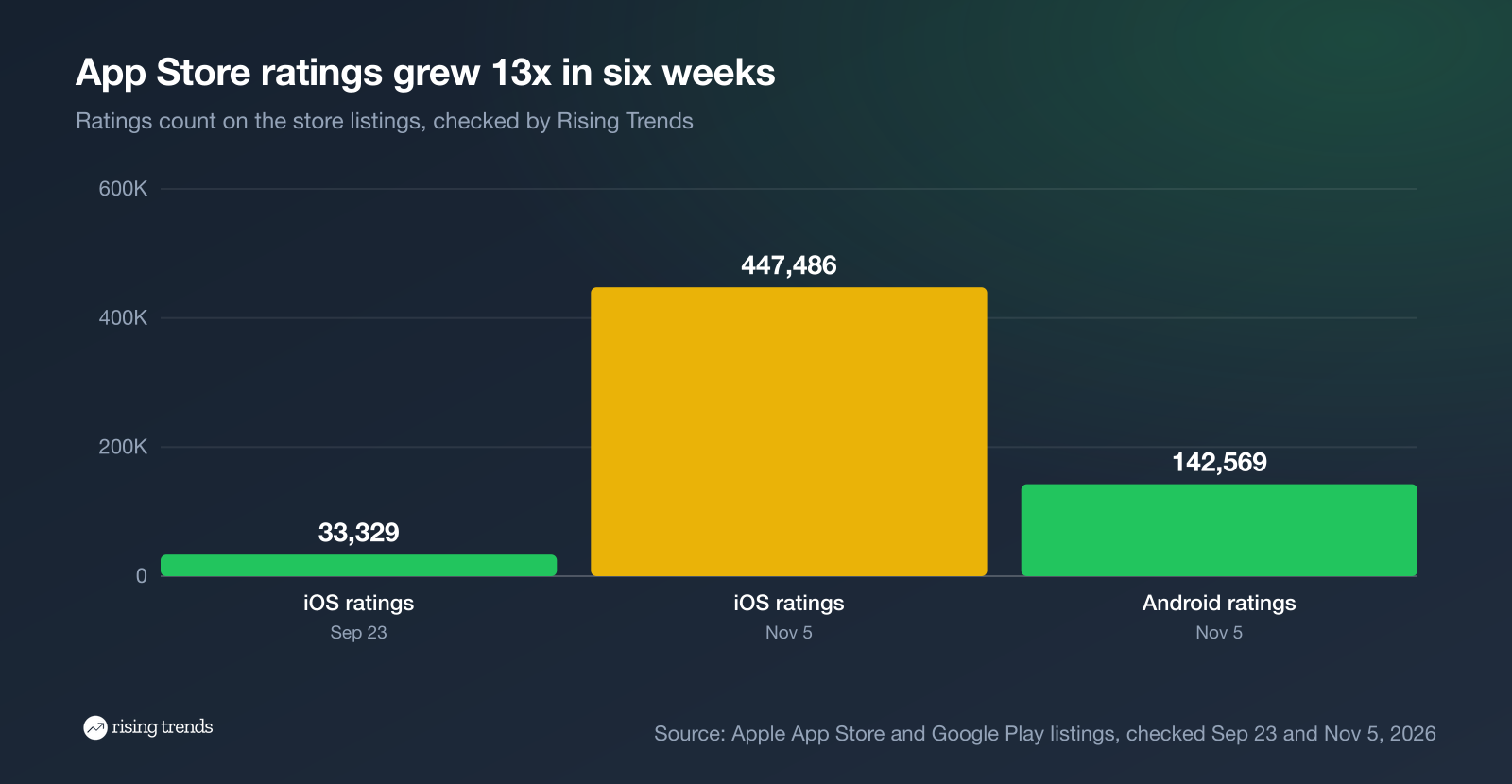
On September 23 the iPhone app had 33,329 ratings. Six weeks later it had 447,486, about 13 times as many. Ratings track volume more than satisfaction, but a 4.85 average across that many ratings is high for an AI app.
The Google Play listing counts installs, not active users, and includes every country where the app is listed. Its 8.8 million installs on Android alone is higher than the Android share of Sensor Tower's estimate would suggest, which is another reminder that store counters and tracker estimates are measured differently.
| Store | Installs | Ratings | Average | Checked |
|---|---|---|---|---|
| Apple App Store (US) | Not published | 447,486 | 4.85 | Nov 5, 2026 |
| Google Play | 8,833,770 | 142,569 | 4.7 | Nov 5, 2026 |
What people use Muse for
Shopping, by a wide margin. On the earnings call, Zuckerberg said more than a quarter of people using Muse shop with it, with "an average purchase size of over $200." Meta's CFO, Susan Li, gave the same 25% figure but measured against weekly active users, so the two numbers are not quite the same.
Zuckerberg also said Meta had to ask Stripe to raise credit limits in the first week, and that Plaid had never seen activity like it. Beyond shopping, people connect Muse to their email and calendar so it can file forms, track tickets and book reservations, the jobs the App Store listing leads with.
Meta is also spending heavily to drive those numbers.
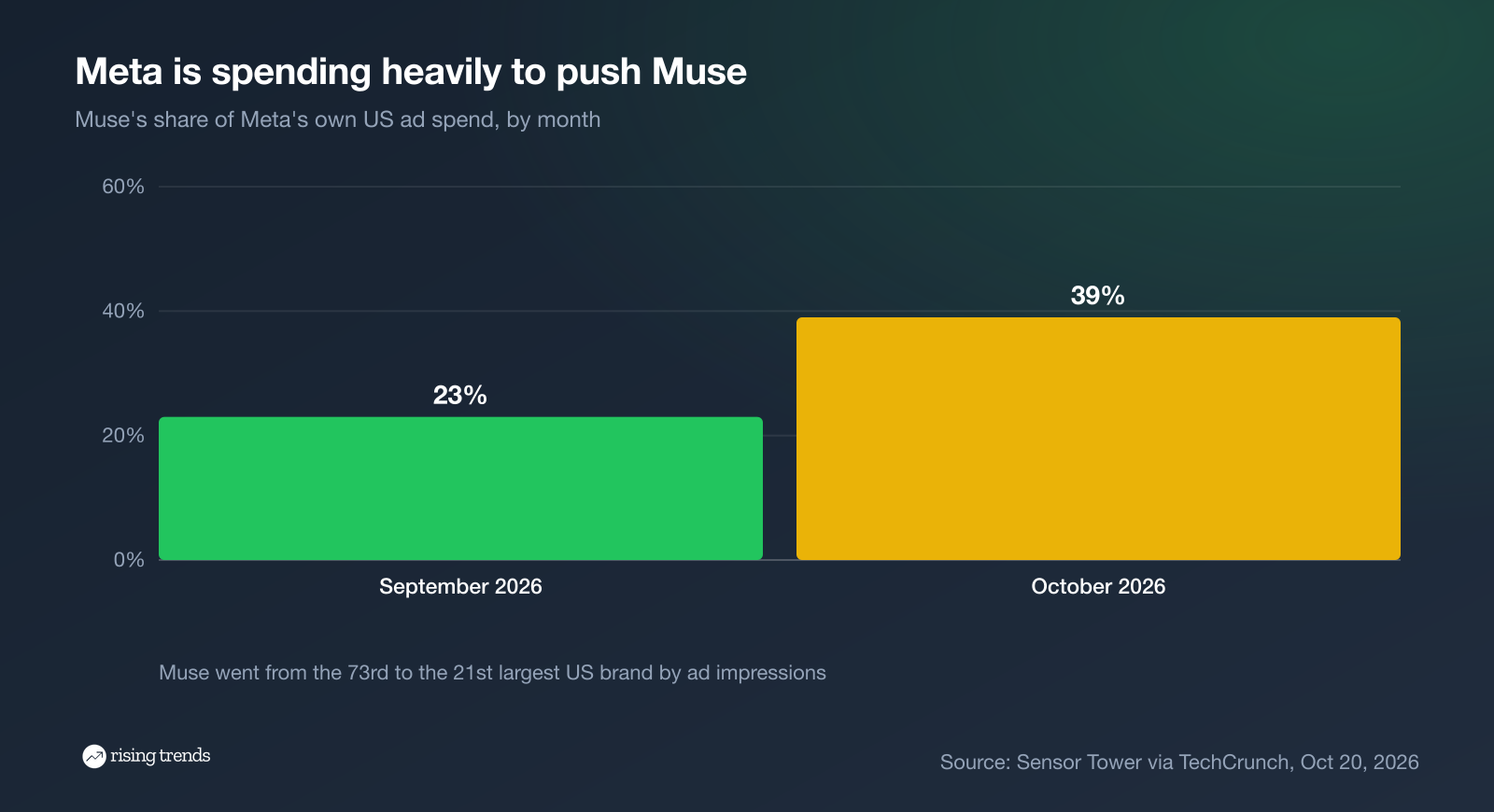
Muse took 39% of Meta's own US ad spend in October, up from 23% in September, per Sensor Tower. It went from the 73rd to the 21st largest US brand by ad impressions in a month. Part of the download growth in October was bought, and that matters when you read the totals.
Where Muse is available
Muse launched on September 8, 2026 in the US, on iOS, Android and the web at muse.ai, and inside WhatsApp. It has since expanded to three more countries.
| Date | Launch |
|---|---|
| Sep 8, 2026 | US: iOS, Android, muse.ai, WhatsApp |
| Sep 17, 2026 | Mac app |
| Sep 18, 2026 | Canada, and the Muse Developer Program opens |
| Oct 7, 2026 | iPad app |
| Oct 23, 2026 | Japan, the first market outside North America |
| Oct 27, 2026 | Singapore |
The Japan launch matters for the user count: Meta's 10 million figure covers the US and Canada only, so Japan and Singapore are not in it yet. On the earnings call Zuckerberg said plainly "we have not launched it globally yet."
Is Meta Muse free? Pricing
Muse is free with a usage limit, and there are two paid plans. These come from Meta's own Muse subscription help page, checked November 5, 2026.
| Plan | Price | Muse tokens |
|---|---|---|
| Free | $0 | Usage limit, amount not published by Meta |
| Power | $20 a month | 500 million per week |
| Maximum | $100 a month | 3 billion per week |
You may see "100 million tokens" quoted as the free allowance. Meta has not published that number, and press reports disagree on whether it is per week or per month, so treat it as unconfirmed. You have to be 18, or the age of majority where you live, to subscribe. The pricing model is close to the one behind Meta One, Meta's paid bundle.
Does Muse make money?
Not yet, and Meta has not disclosed Muse revenue. Zuckerberg said that for most people "the product should be free," with Meta earning a fee on purchases made through Muse, plus subscriptions for people who want the most advanced models or extra tokens. Businesses will be able to pay for Muse Code and the model API.
Running it is expensive. Deutsche Bank analyst Benjamin Black estimates a free Muse user costs Meta about $40 a month to serve. Zuckerberg said Meta expects to improve Muse's cost efficiency "by more than 10x in the next year." Deutsche Bank's revenue forecast for 2030 ranges from $2.4 billion in its low case to about $36 billion, roughly 8% of Meta's revenue.
One number to ignore: some coverage said Muse earns "several hundred dollars" per user a year. Read the transcript and Zuckerberg corrects himself. That figure is what Meta's apps as a whole earn from people who use Muse, not Muse revenue.
What Meta has not disclosed
Knowing what is missing is as useful as the numbers. As of November 5, 2026, Meta has not published:
- Monthly or weekly active users. Only "set up" and the 25% daily share.
- Any user number outside the US and Canada.
- Muse revenue, subscriber counts or the share of users on paid plans.
- Download numbers. All of them come from trackers.
The next official update is likely Meta's fourth-quarter call in early 2027. Until then, the Sensor Tower and store data above are the best guide. If you want to watch numbers like these as they move, the Rising Trends API returns search volumes, trending apps and websites in one call.
FAQ
How many people use Meta Muse?
More than 10 million people in the US and Canada had set up Muse by October 21, 2026, according to Meta. About 25% of them use it on a given day, which means at least 2.5 million daily users.
How many downloads does Muse have?
Sensor Tower estimated 10.9 million worldwide downloads by October 20, 2026, with 10.2 million in the US. Google Play alone showed 8,833,770 Android installs on November 5, 2026.
How many daily active users does Muse have?
Between 2.2 and 2.7 million, depending on the tracker and the date. Sensor Tower counted 2.5 million US daily users on October 16, 2026, and Meta's own numbers imply at least 2.5 million.
Is Muse more popular than ChatGPT?
Not overall. ChatGPT has about 1.2 billion weekly users, roughly 100 times Muse. But Muse's launch was faster: 10.2 million US downloads in its first 40 days against 3.7 million for ChatGPT.
Is Meta Muse free?
Yes, with a usage limit. Paid plans cost $20 a month (Power) and $100 a month (Maximum), according to Meta's help center.
Which countries is Muse available in?
The US (since September 8, 2026), Canada (September 18), Japan (October 23) and Singapore (October 27).
How we put this page together
Official figures come from Meta's launch post, its help center and the Q3 2026 earnings call transcript. App estimates come from Sensor Tower, Apptopia, Appfigures, Similarweb, TickerTrends and The Information, as reported by the outlets linked above, each with its date. Store numbers were read directly from the App Store and Google Play listings on November 5, 2026. Search volumes come from the Rising Trends database (US, monthly, latest month September 2026), and the daily Google Trends curve was pulled on November 5, 2026. We will update this page when Meta or the trackers publish new numbers. If you are curious how other AI launches played out, our pieces on the Grok bot and the open-source AI agent gold rush cover two of them.
Want to spot the next breakout app before the stats pages catch up? Read our guide on how to identify market trends, or browse what is breaking out right now in our trending topics list.
Never miss a trend again
- One trend broken down with the numbers
- Who's making money, and what to build
- A website on the rise
- A breakout app
Join 5,000+ founders