Trends


In July 2026, 90 people a month typed "grok bot" into Google. In August it was 201,000. That is not a ramp, a curve or a slow build. It is a term that had no demand at all, for five straight years, and then had more demand in thirty days than "ai agent" has ever had in a month.
The interesting part is not the spike. It is what you find when you read the product's own documentation. Grok Bot wears the xAI brand and sits on x.ai. Its computers run in Cursor's cloud, its billing is a Cursor meter, its sign-in is a Cursor account, its support address is a cursor.com inbox, and the Android listing's own footer says "© 2026 Anysphere, Inc." None of the pages ranking for this term put the search curve and that ownership question in the same place. We are going to.
Key takeaways:
Let's get into it.
Here is the monthly search volume for "grok bot" over two years, straight from our database. There is nothing to interpret. The term sat in double digits for twenty-three months and then did this.
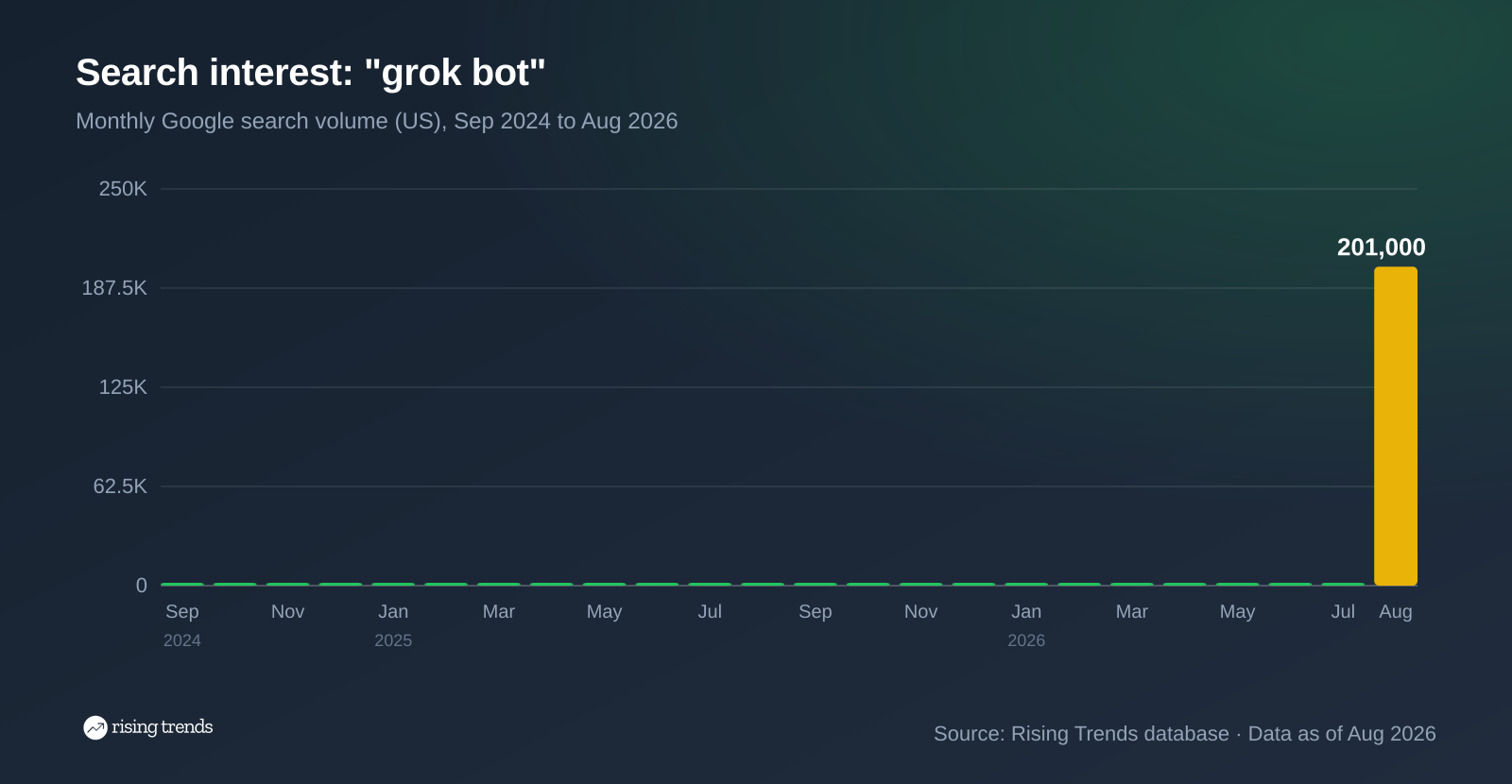
The June 2026 reading was 70. July was 90. August was 201,000, which is a lift of roughly 958 times against the same period two years earlier. Our pace classifier calls it EXPONENTIAL and the trajectory RISING, and the breakout month is August, the first month it ever crossed a quarter of its own peak. You can watch the September reading land on the live grok bot trend page when the month closes.
A spike that vertical is either a launch or a scandal. This one is a launch, and the tell is what it did to the neighbours.
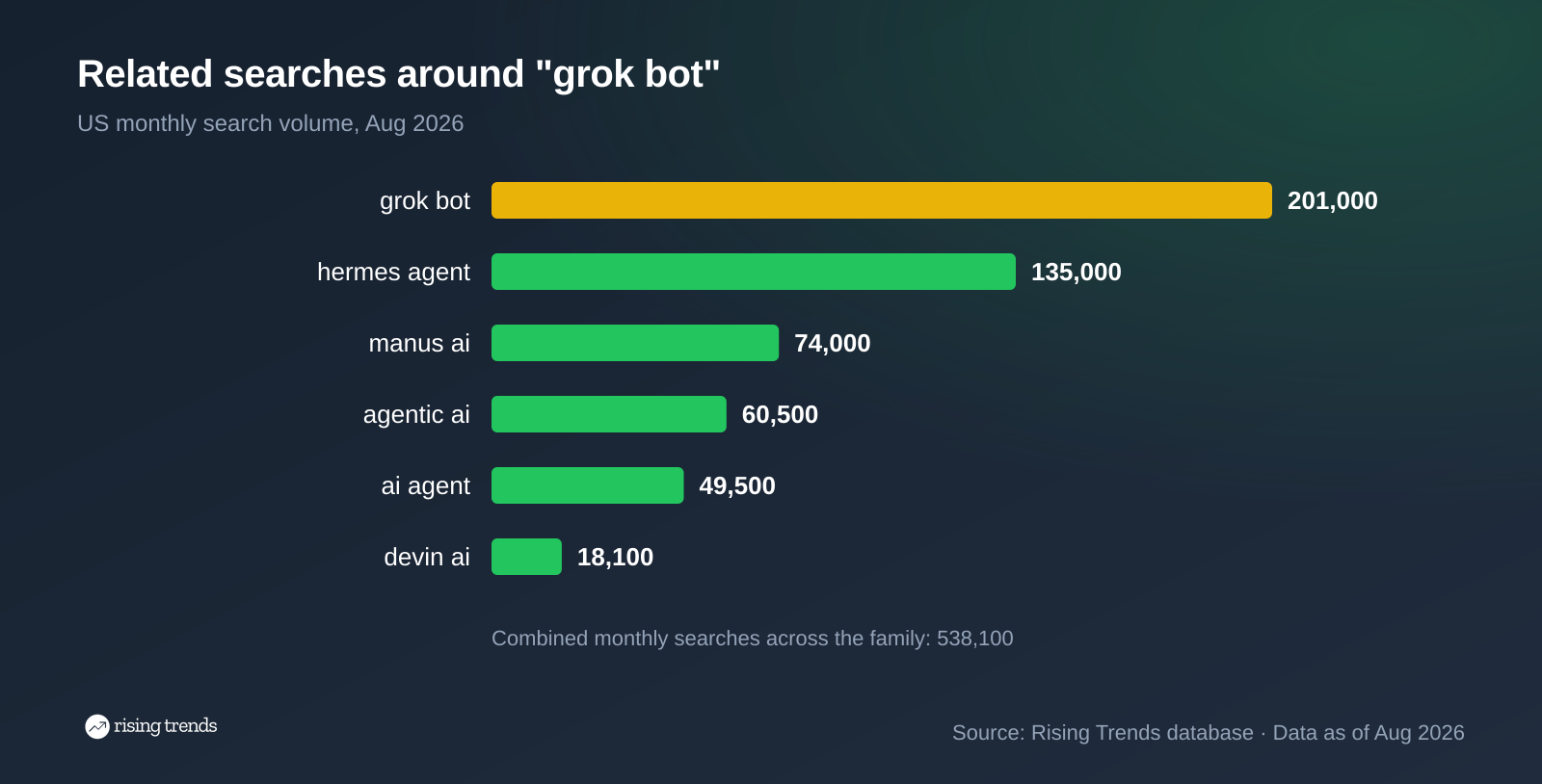
Look at the bottom two bars. Agentic ai is at 60,500 a month and down 45% on the year. Ai agent is at 49,500 and flat. The generic language of the category is in decline while four brand names above it climb. People have stopped searching for the idea. They are searching for a specific thing to install.
The launch page is one sentence long at the top, and it is a good sentence: Grok Bot is "your team of always-on agents."
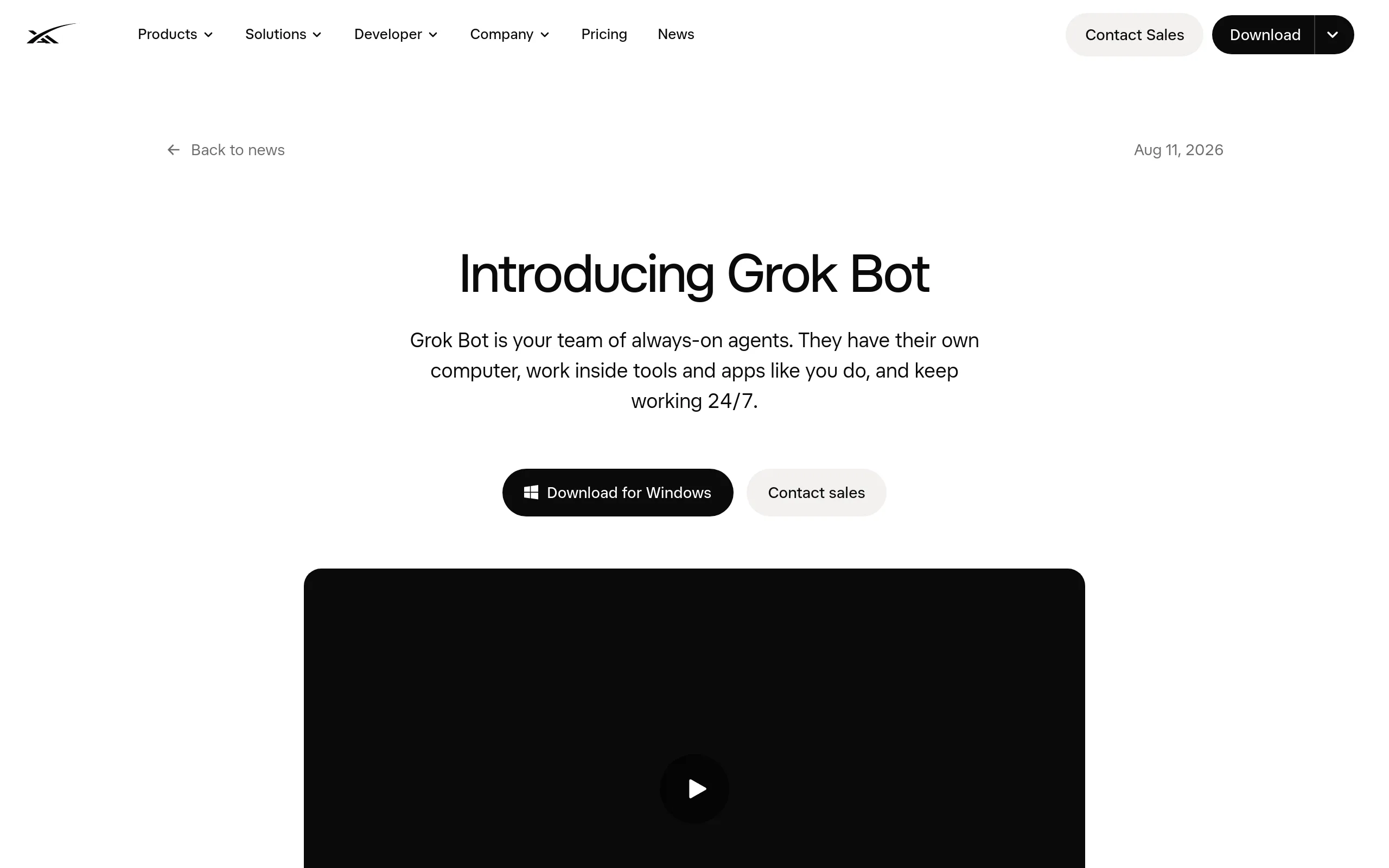
The mechanics sit in the Grok Bot documentation, and they are more specific than the marketing. Each Bot works on a persistent cloud computer with a browser, a filesystem and a terminal. It uses a connector where one exists and drives the browser like a person where one does not, which is how it reaches vendor portals, ad managers and old internal tools that were never given an API. Work runs in that cloud, so closing your laptop does not stop a job.
Four design decisions separate it from a chat window:
The security documentation is where the enterprise reality shows. A Bot has no credentials of its own and acts as the signed-in member, so it can never hold more access than the person it belongs to. Risky actions go through Auto Review, a separate review model that inspects shell commands, connector calls, computer use and delegation before they run. But the controls a security team would actually ask for, network allowlists, audit logs, action recording, SCIM, are all Enterprise only. Teams on the self-serve plan get no destination allowlist at all, and the page says teams without a policy "default to allow-all."
The trigger is dated and unambiguous. On August 11, 2026, SpaceXAI published Introducing Grok Bot, and the search term went from double digits to six figures inside the same calendar month.
The announcement is worth reading for one detail that explains the adoption speed. This was not a roadmap product. It was an internal prototype that spread through the company first, with teams building Bots for sales outbound, marketing campaigns, office operations and bug fixes before anyone outside saw it. The quotes on the page are from named employees rather than launch partners. Roman in Product puts the pitch as well as anyone: "There is a huge difference between 90% done and 100% done. Most AI gets you almost there. Grok Bot can finish the swing, because the work lands where a human would put it, in the actual tool."
The second reason is price, and it is where the Cursor question stops being trivia. There is no Grok Bot subscription to buy. According to the plans and billing page, access "is included on every paid individual Cursor plan and on Cursor Teams," or you can link an individual SuperGrok, SuperGrok Plus, SuperGrok Heavy or X Premium+ account as a usage grant. Cursor's price list puts Individual at $20 a month and Teams at $40 per user, both with Grok Bot access on the feature list. The free Hobby tier does not include it.
Three things on that billing page deserve more attention than they are getting. The grants do not stack, so linking SuperGrok Plus on top of Cursor Pro+ adds nothing. Linking is permanent once created, with no way to unlink or move it to another Cursor account. And the free trial is a credit rather than a window, drawn down by agent steps and tokens, so one long job can consume all of it.
That is a very different purchase from a chatbot subscription, and it explains a good share of the 201,000 searches. A lot of them are people working out what they need to buy.
The four brands in our family chart are attacking the same job from different directions. Combined, the six terms in that chart draw 538,100 US searches a month as of Aug 2026, and Grok Bot alone is 37% of it.
| Product | Where the agent runs | How you get it | Searches, Aug 2026 |
|---|---|---|---|
| Grok Bot (SpaceXAI) | Persistent cloud computer in Cursor's cloud | Bundled with a paid Cursor plan from $20/mo, or a SuperGrok link | 201,000 |
| Hermes agent (Nous Research) | Your own machine or host, open source | Self-hosted, free to run | 135,000 |
| Manus AI | Vendor cloud, task-scoped sessions | Direct subscription | 74,000 |
| Devin AI (Cognition) | Vendor cloud, scoped to a codebase | Direct subscription, engineering teams | 18,100 |
Hermes agent is the one to watch, at 135,000 searches a month and growing faster than anything in the set. It is the open-source answer: a personal assistant with persistent memory and autonomous skill creation that you host yourself. That model has already produced one breakout this year, which we covered in the open-source AI agent gold rush, and the pattern repeats. A closed product defines the category, an open one takes the part of the market that will not send its inbox to someone else's cloud.
Manus AI and Devin AI are the incumbents Grok Bot jumped over in a month, and both are narrower by design: Devin is scoped to software engineering, Manus to task-shaped runs. The comparison inside the same building is sharper. Cursor Origin and Runable are aimed at engineers. Grok Bot is aimed at everyone else in the company, and so is Meta Muse from the other direction.
The sceptical reviews arrived fast. This breakdown from Tech With Tim, published on August 28, 2026, seventeen days after launch, is the one that ranks on page one for the product's own name, and the title tells you where it lands.
A launch review that says "it's not that good" outranking the vendor's own pages is a useful signal about where the category is. People are no longer asking whether agents work. They are asking which one wastes less of their week.
The store numbers are kinder than the reviews. The Google Play listing shows more than 500,000 downloads at 4.8 stars across 4.49 thousand reviews, and the iOS app holds 4.9 across 5,145 ratings. That iOS app was on version 1.11.1 by September 18, eleven point releases in about five weeks, with release notes about voice-chat audio routing. This is a product being rebuilt in public.
The written reviews split cleanly along the same line. Chafic Nawfal, reviewing on Google Play on September 18, uses it daily for "email, calendar, follow-ups, research, and actual work tasks" and says "it feels like a teammate, not just another chatbot." EnDSchultz, the same day, calls it an "interesting concept" and then lists what broke: bot name and instruction fields that do not update as you type, file outputs with no way to save to the device, and a botched conversion that dropped whole sections of a document.
The Reddit picture is the same argument at higher volume, and it is worth noting where it happens. Owners do not gather in an xAI forum. They gather in r/cursor, under thread titles like "Any one tried Grok Bot? Is it garbage or just me?" and "Is Grok Bot Worth it?", whose first line is "Just Hype or is it actually good?" The defence in those threads is consistently architectural rather than about output quality: what people like is that the Bot has a persistent place to work.
The unit of sale is changing from a session to a seat. Every agent product before this one sold runs, tasks or tokens. Grok Bot sells something closer to a headcount: a named worker with a machine, a memory and a job, priced inside a $20 software subscription. Once a vendor frames it that way, the comparison in a buyer's head stops being "what does this cost per query" and becomes "what does this cost compared to a person." That is a much easier sale and a much harder promise to keep.
Distribution beat model quality. Nothing in the documentation claims a better model. It claims a computer, a memory and a place to put finished work. The growth came from bundling the thing into two existing subscriber bases at once, xAI's and Cursor's, and from an internal prototype that had already proven itself on real jobs. The same lesson runs through the ten shifts in our 2026 AI agent report: the winners are the ones already inside the tools.
The brand and the infrastructure have come apart. A buyer reading "Grok Bot" assumes xAI is the vendor. The plans live on cursor.com, the computers run in Cursor's cloud, the support email is a cursor.com address and the Android footer credits Anysphere. For a consumer app that is a curiosity. For a company deciding whether an agent can log into its CRM, it is the first question procurement will ask, and the answer is currently spread across three domains.
Self-serve teams are buying an agent with no network policy. That is the sharpest gap in the documentation. The default for a team without a policy is allow-all, and the ability to set one is Enterprise only. An agent with a browser, a terminal and your logins is a different risk from a chat window, and the control that would contain it is behind a sales call.
Does the curve hold, or was August a look? A 201,000-search month created entirely by a launch is not yet demand, it is attention. The tell is the September and October readings on our grok bot page. A term that holds above six figures for three consecutive months has customers. One that falls back to five figures had an audience.
Watch "hermes agent" against "grok bot." The open-source term is at 135,000 and growing faster than anything else in the family. If it crosses Grok Bot while the generic terms stay flat, the story of 2027 is not which vendor won, it is that teams decided an agent with their inbox open should run on hardware they control.
Watch for a standalone price. Today Grok Bot is a feature of a Cursor plan. The moment it gets its own line item and its own meter, the company has decided the agent is the product and the editor is the accessory. Our software development coverage tracks what happens to tool pricing when that inversion lands, and it is rarely gentle on the incumbent.
The search data and the reviews are telling you two different true things. The curve says a product arrived that hundreds of thousands of people wanted to understand in one month. The reviews say it is on version 1.11.1 and still dropping sections out of documents. Both are what a category looks like the moment it stops being a demo.
Want to catch the next product that goes from 90 searches to 201,000 in a month? Read our guide on how to identify market trends, follow the live grok bot trend page, or see what is breaking out right now on the Rising Trends dashboard.
Thousands of Emerging Trends
Thousands of Breakout Apps
Mega Trends
Trend Analysis Tool