Trends


A year ago, 210 people a month searched for "runable" in the US. As of July 2026 it is 4,400, up 1,995%, and the company behind the name is 15 people who raised 21 million dollars last month.
Here is what makes it worth a closer look. Runable is the smallest brand in its own category and the only one growing. Manus, the name that defined the general-purpose AI agent, draws 74,000 searches a month and has grown 22% in a year. Genspark is down 18%. Flowith is down 56%. In a category where every established name has stalled, one startup is up twentyfold, and its own numbers are harder to square than the funding headline suggests.
Key takeaways:
Let's get into it.
Here is "runable" over the last two years, straight from our database. Everything happens in the last nine bars.
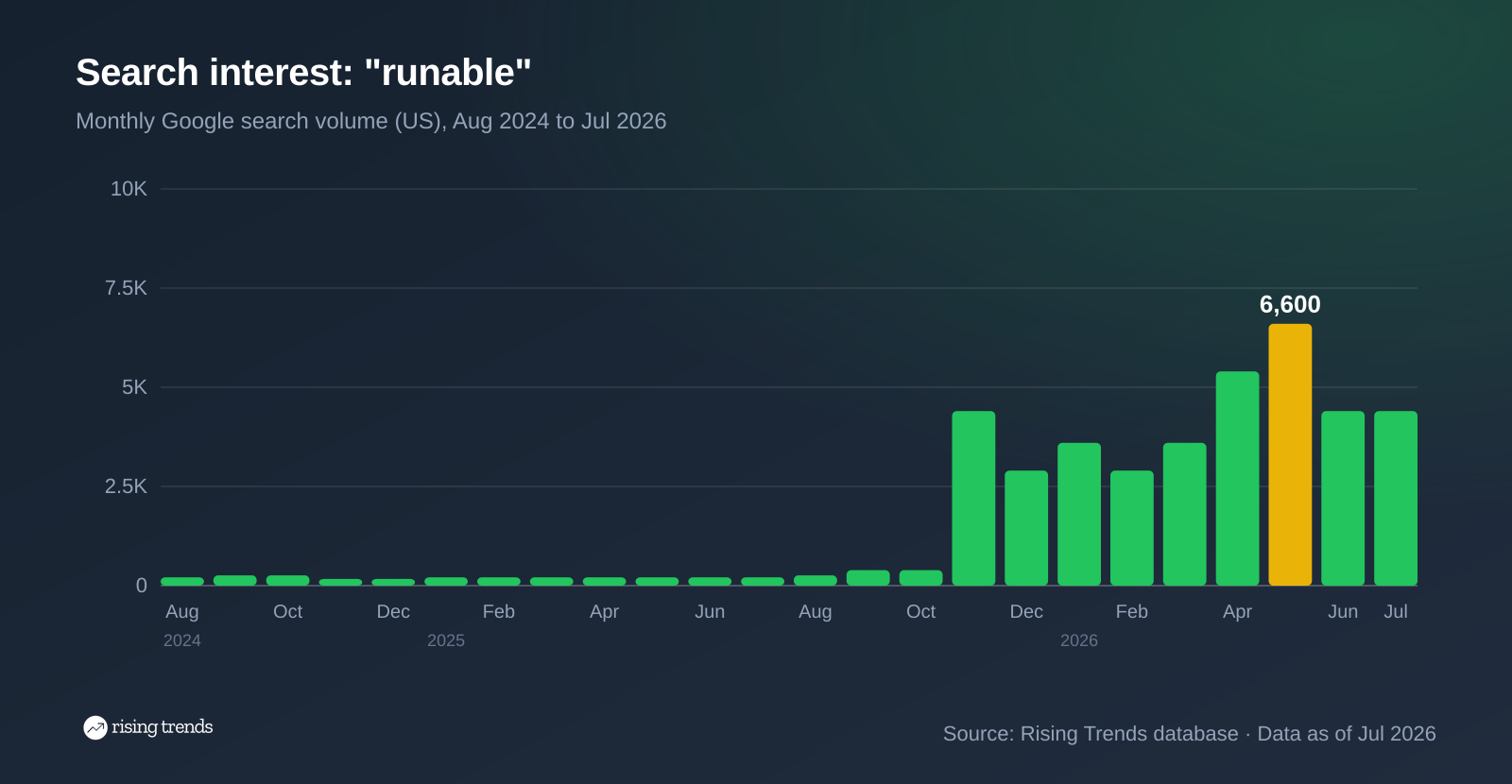
The term sits flat at 210 to 390 for fifteen months. Then November 2025 takes it from 390 to 4,400 in one step, an 11x jump with no funding announcement behind it. That month is creator videos: reviewers building websites on camera and posting the results.
From there it holds between 2,900 and 3,600 through the winter, climbs to 5,400 in April and 6,600 in May 2026, then settles back to 4,400 for June and July. The three-month growth column reads -19%.
That shape matters. The money arrived in August, after the search peak, not before it.
Now put the company next to the category it is trying to enter.
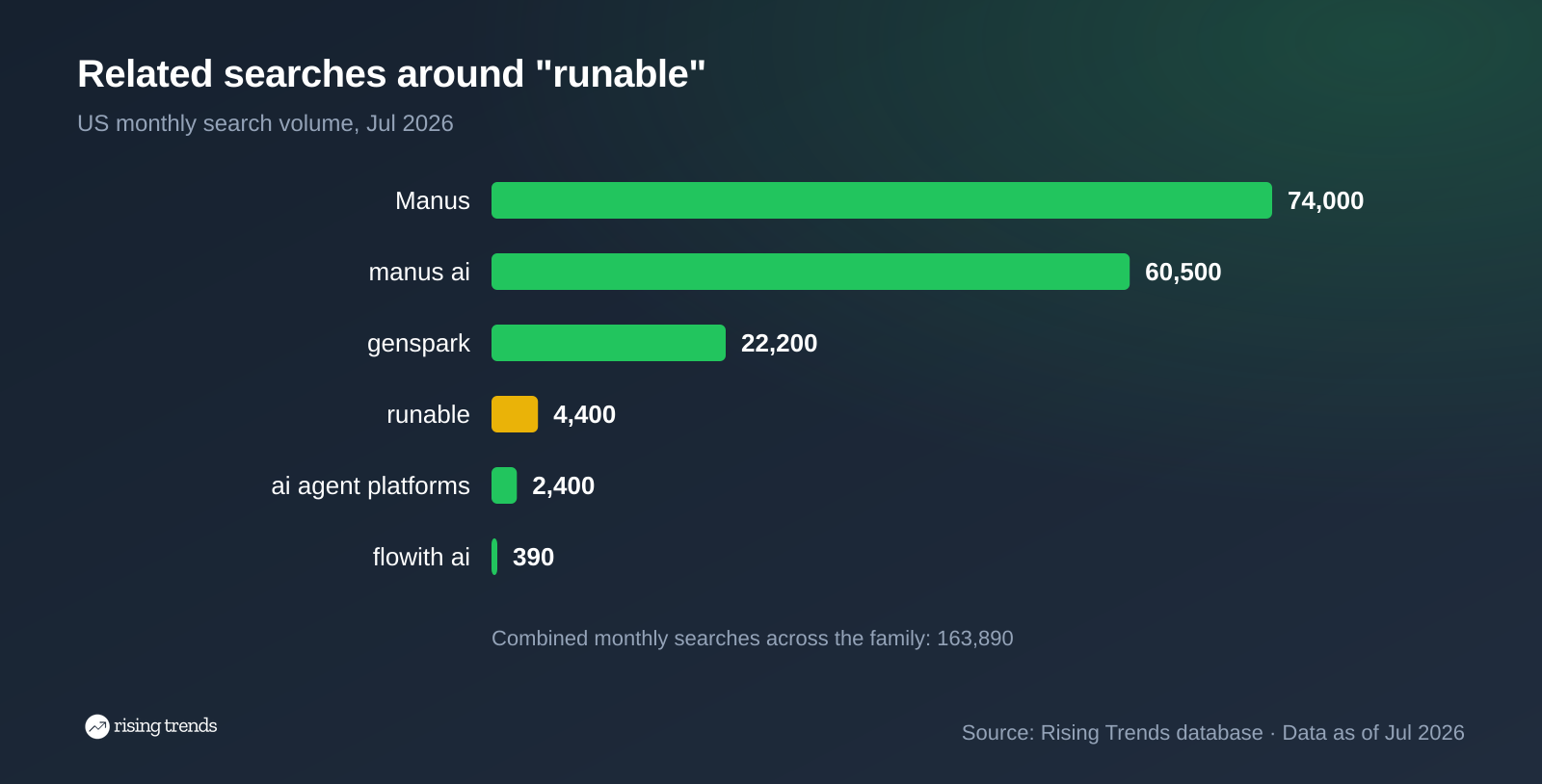
Manus and its second spelling, manus ai, hold 134,500 monthly searches between them as of July 2026. Runable holds 4,400. On raw demand this is not a close contest.
The growth column is where it flips.
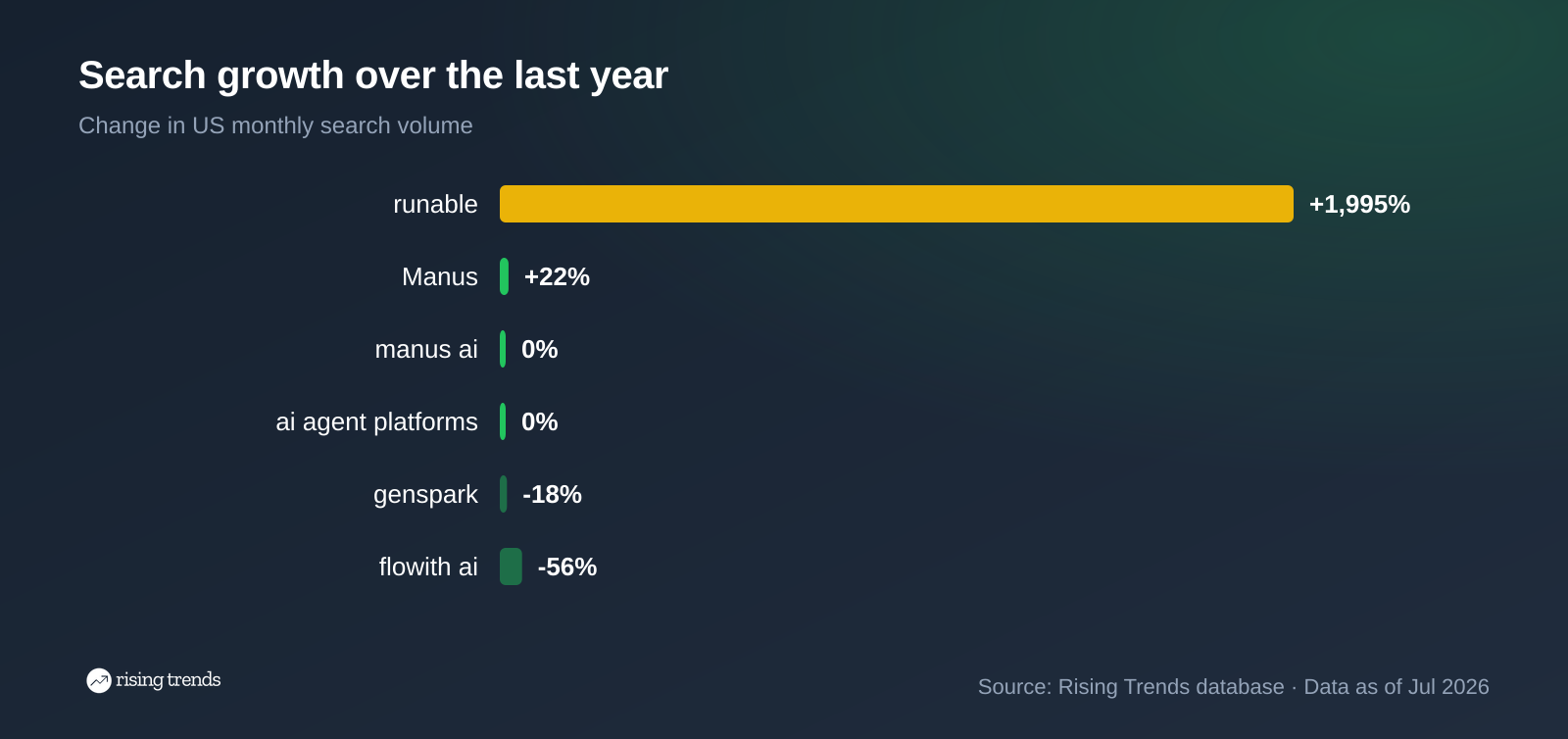
One name up 1,995%, one up 22%, the rest flat or shrinking. Genspark is down 18% and Flowith is down 56%. Even the generic term, ai agent platforms, has not moved in a year.
The general-agent category stopped growing by name in 2026. Runable is the exception, and the exception is small.
Runable is a single agent that produces work in whatever format the job needs: websites, slides, videos, documents, carousels, apps. The homepage pitch is "One AI agent to turn an idea into a business, run the work, and keep it growing."
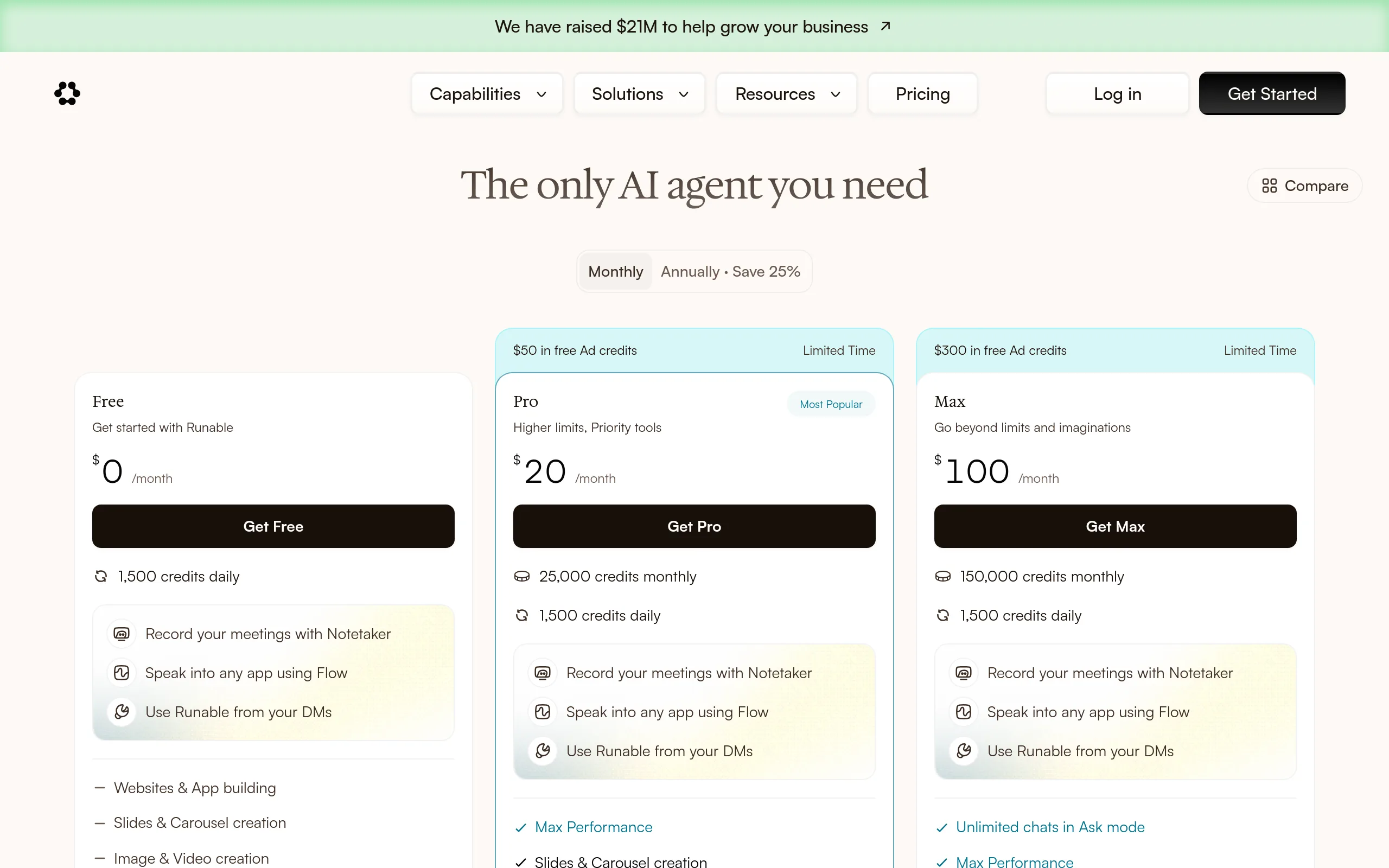
The pricing page shows the shape of the business. Free gets 1,500 credits a day. Pro is 20 dollars a month with 25,000 monthly credits on top of the daily allowance. Max is 100 dollars a month with 150,000. Both paid tiers currently bundle ad credits, 50 dollars on Pro and 300 on Max, which is a tell about where the company wants usage to go.
Credits are the unit, and that matters more than the price. A subscription that meters work by consumption behaves like infrastructure, and the customer's bill moves with how chatty the agent is. Hold that thought, because it comes back in the reviews.
Not the building part. The company was already doing that.
In its funding announcement on August 26, 2026, founder and CEO Umesh Kumar is direct about it: "This is the part we're most excited about and the feature this fundraising round is really about." The part is Grow, and what Grow does is run paid advertising.
From the post: campaigns planned, launched and managed across ChatGPT Ads, Meta, Google, LinkedIn and TikTok, from inside Runable, with no ad account of your own required. The agent handles budget and creative. Alongside it, brand management that writes, schedules and posts across Instagram, LinkedIn, X and TikTok.
Sai Araveti, a partner at Susquehanna VC, put the thesis in the announcement: "AI made starting a business nearly free. Running one is still the expensive part, and that is the gap Runable closes."
That is a real argument. Website builders are a commodity in 2026. Customer acquisition is not.
The numbers Kumar published alongside it are the ones to interrogate: 2 million dollars in ARR three weeks after turning on monetisation, 1.5 million businesses on the platform, a team of 15. The first is a company-reported figure with no filing behind it. The third is checkable and genuinely striking. The second is the one worth pausing on.
Here is what Grow looks like in the hands of someone outside the company, published three days ago.
Note what the tutorial is about: running ChatGPT Ads. Six months ago the videos driving this company's search curve were about building a website in one prompt. The content has followed the product.
1.5 million businesses is a very large number. Here is the other set of numbers, from the company's own Google Play listing: 3.6 stars, 81 reviews, 10,000 or more downloads, last updated September 8, 2026.
Both can be true. Most usage is on the web, and app installs are a poor proxy for a browser product. But 3.6 stars is the part that does not depend on channel, and the reviews are specific.
Garnet Troy Rossi, August 30, 2026: "It burns thru credits by going off on unrequested coding, and engaging in wayyy too long thinking beltings." That is the credit model biting. When the meter runs on the agent's verbosity rather than your instruction, a long detour is billed to you.
WALLACE E, August 25, 2026: "I put a hell of a lot of time building, refing, working out bugs. at the end NOTHING, my projects wouldn't even load blank screen." Nipun Sharma the same week reported UI bugs around model selection.
The company's homepage carries the other side, testimonials from named small-business owners like Nadia, a yoga studio owner: "It's the first tool that didn't make me change how I work." Those are marketing copy on the vendor's own site, and should be read that way.
The honest summary is a fast-moving product with a rough edge on reliability and a billing model that punishes the agent's own indecision.
The build layer is finished as a business. Hundreds of tools generate a website from a prompt, and Kumar says so himself in the announcement. When a capability is free and universal, the money moves one step down the workflow. That is why a company that could have raised on app building instead raised on advertising.
Agents are being sold as staff, not software. The pitch is not a tool that helps you make a landing page, it is the work a small team would otherwise do. The same repositioning is running through the whole AI agents category, and it is what moves the budget from a software line to a headcount line.
Credit pricing is the friction point. Reviewers are not complaining about capability, they are complaining about spend they did not authorise. Any agent business metering by consumption inherits that problem, which is the same cost pressure we traced through prompt caching on the developer side.
Distribution is the moat, and Runable does not have it yet. Manus has 17 times the search demand. What Runable has is momentum and a feature nobody else is selling.
Whether the curve retakes 6,600. Our series ends at 4,400 for July 2026 with a May peak of 6,600 and a three-month decline. A funded launch of Grow should show up as new search demand within a quarter. If August and September come in under 4,400, the money arrived after the interest did. The live Runable trend page is where that settles.
The app rating. 3.6 from 81 reviews is a small sample and a fixable score. If it climbs while downloads grow, the reliability complaints were launch bugs. If it falls, the credit model is the problem and pricing has to change.
Whether ChatGPT Ads becomes a channel worth automating. Runable is betting real money that advertising inside an assistant is a place small businesses will spend. That is a bet on someone else's marketplace, and it is the single largest risk in the plan.
The thing to hold onto is the sequence. The searches came first, in November 2025, from people watching creators build things on camera. The revenue claim came ten months later, the funding after that. A company whose demand curve outran its business is an unusual thing to see this clearly, and the next two months of data will say which one was real.
Want to spot the next breakout company before the funding headline? Read our guide on how to identify market trends, follow the live Runable trend data, or browse what is breaking out right now on the Rising Trends dashboard.
Thousands of Emerging Trends
Thousands of Breakout Apps
Mega Trends
Trend Analysis Tool