
Trends


Two years ago, about 10 people a month searched for "seestar s50 pro" in the US. As of July 2026 it is 2,400, and the odd part is when the curve topped out. The peak came in April 2026. The telescope did not go on sale until August 25.
That is a product whose demand was fully formed four months before anyone could buy one, and it is happening inside a category that is otherwise shrinking. Celestron's smart telescope is down 45% in a year. Vaonis is flat or falling. The only two names in our database going up are both made by ZWO. Nobody ranking for this term shows you that curve, so here it is.
Key takeaways:
Let's get into it.
Here is the monthly search volume for "seestar s50 pro" over the last two years, straight from our database. Read it right to left and you can see the launch was the quiet part.
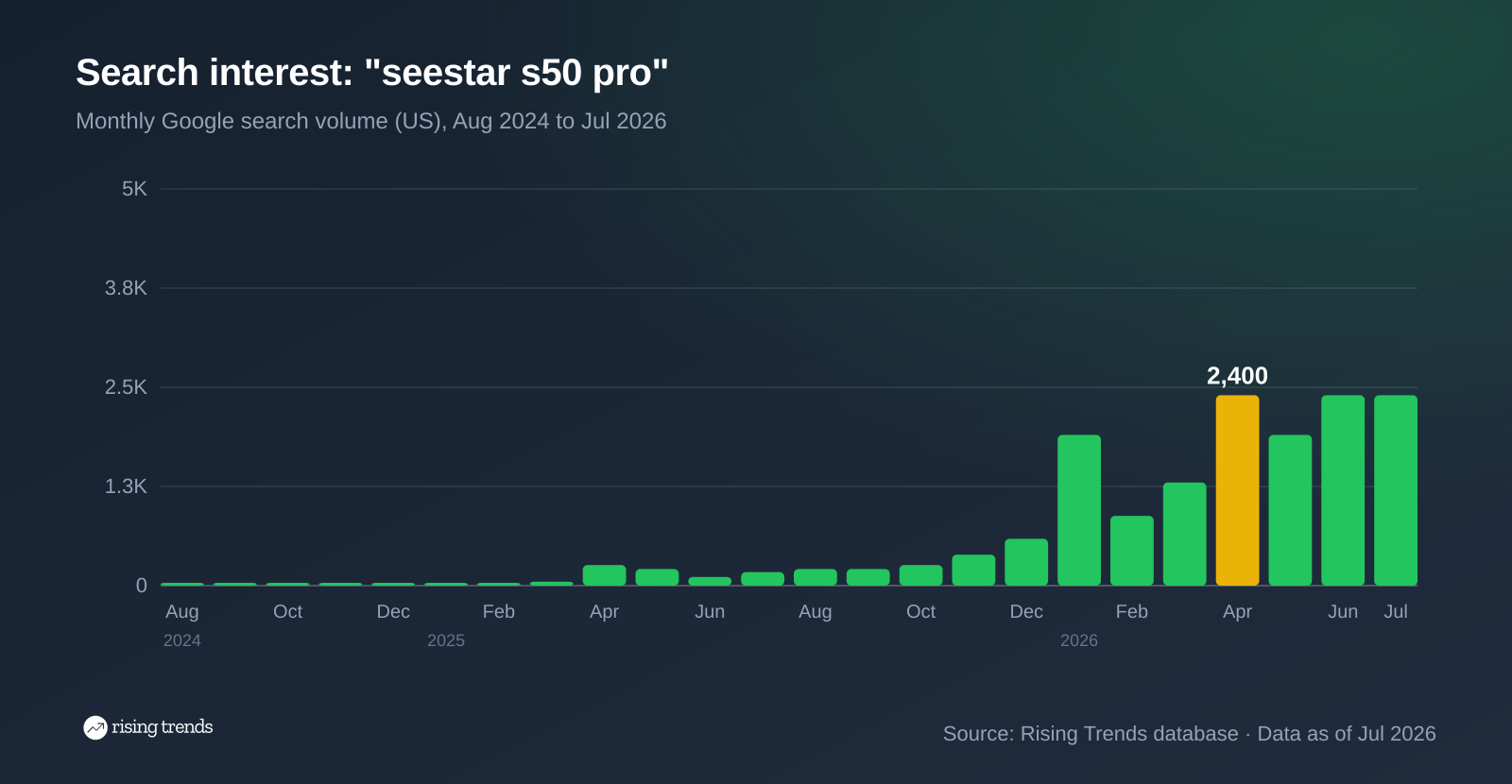
The breakout month is January 2026, when volume jumped from 590 to 1,900. April 2026 took it to 2,400, which is still the peak in our series. June and July matched that number without beating it. The product itself was not available anywhere in that window. People were searching a name they had seen in forum threads and at the spring trade shows, and they kept searching it through a five-month wait.
That is the same pre-announcement pattern we tracked on the Garmin fenix 9, where the curve ran ahead of the launch and the manufacturer's own quarterly numbers showed buyers holding off. Hardware categories with predictable cycles produce this shape. What makes the Seestar version unusual is that the rest of its category is not rising at all.
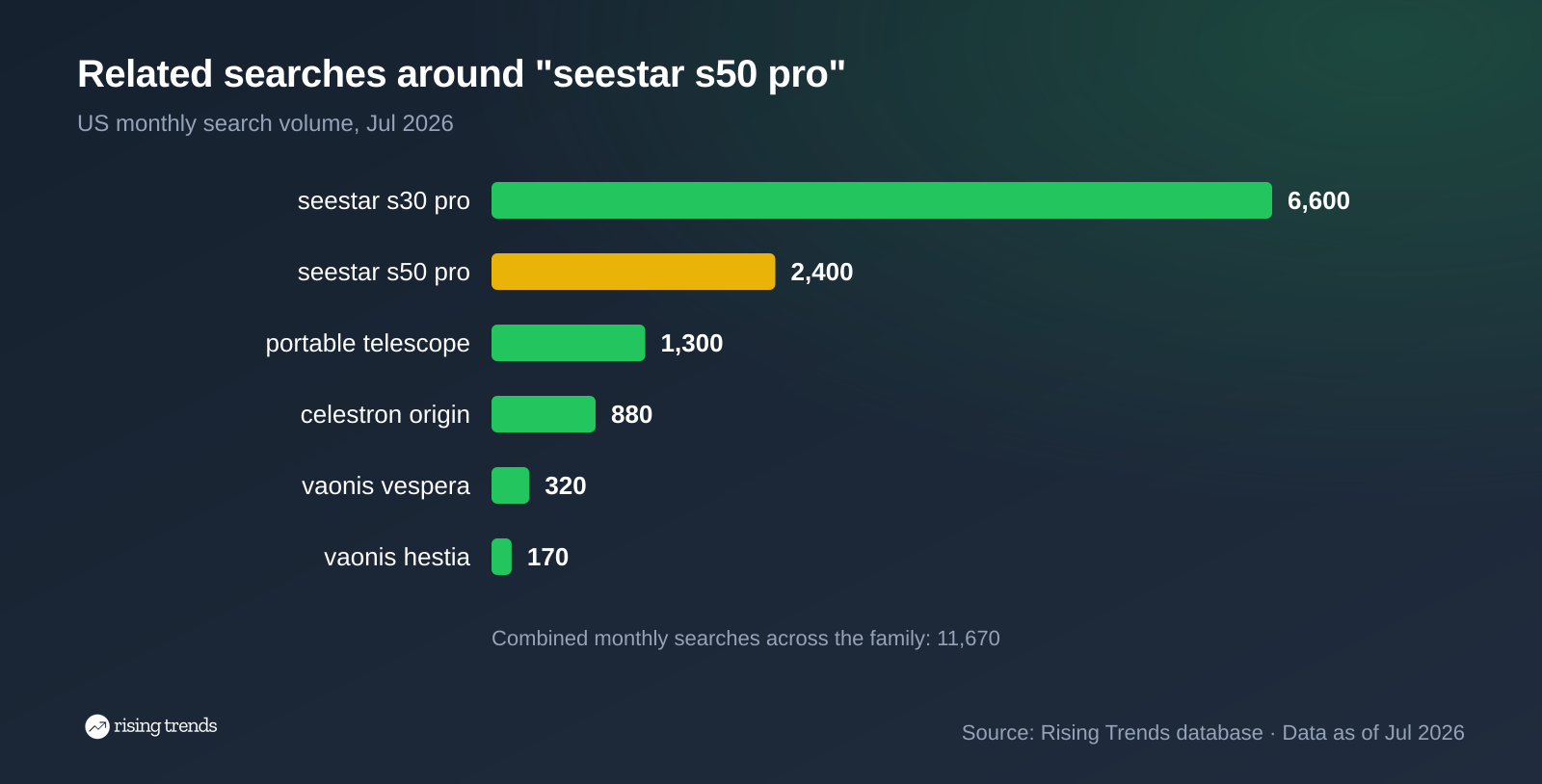
Add those six terms up and the entire smart telescope conversation is 11,670 monthly searches as of July 2026. It is a small category. Two ZWO products own 9,000 of that, or 77%. The generic term people used to search, portable telescope, sits at 1,300 and is down 19% in a year. The brands have outgrown the category word, which is usually the sign that a market has picked a default.
It is an all-in-one telescope that runs from a phone. You put it on a tripod, tap a target in the app, and it finds, tracks, stacks and processes the image while you stand there. No mount alignment, no laptop, no separate camera.
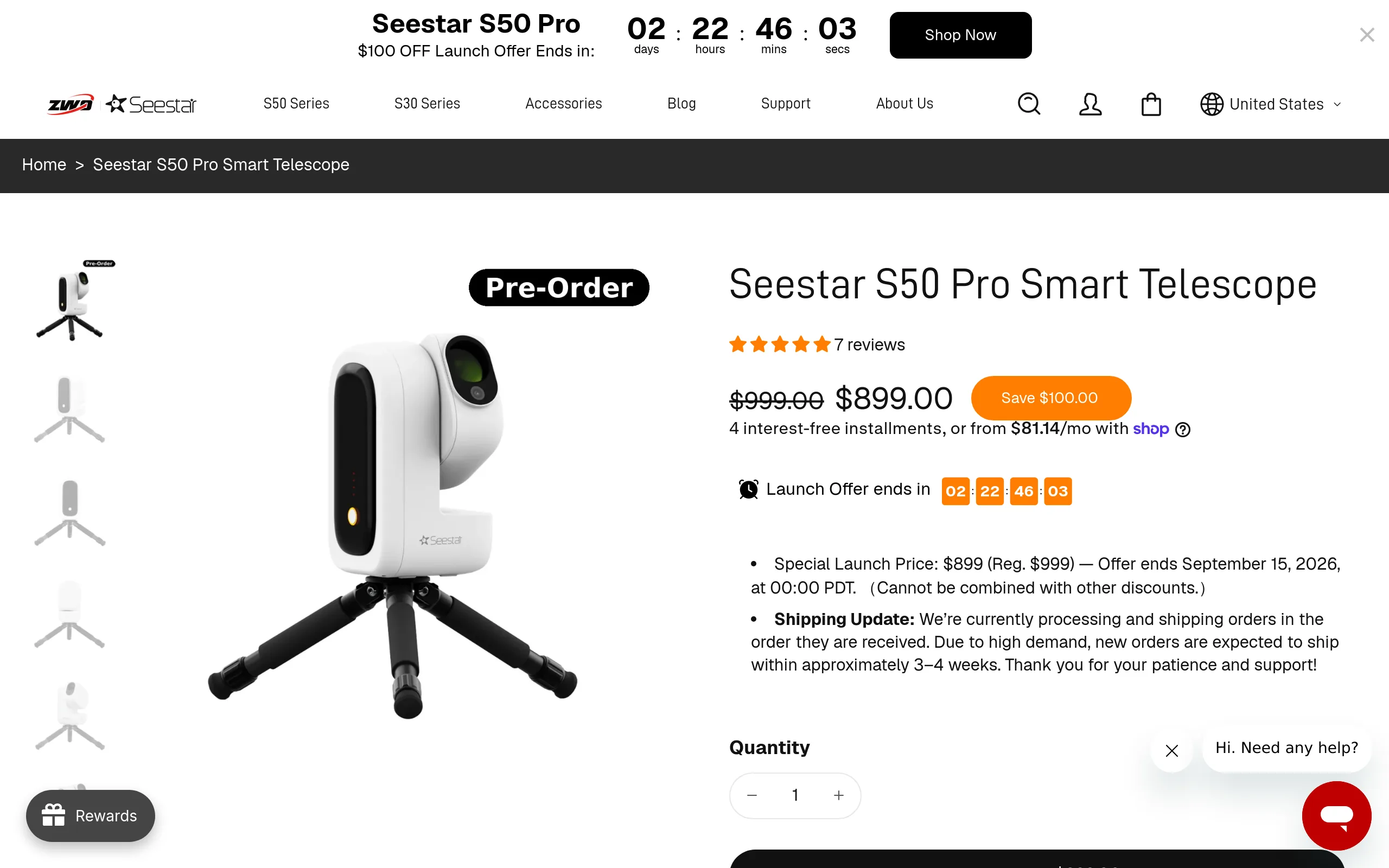
The specifications that matter, from the official product page: a 50 mm telephoto aperture at 260 mm focal length and f/5.2, a four-element apochromatic lens with ED glass, a 1/1.2 inch 8.3 MP telephoto sensor and a second 8.3 MP wide-angle camera, both shooting 4K. Storage is 128 GB, of which about 100 GB is usable. The battery is 10,000 mAh, rated at up to 9 hours by ZWO's own lab. The whole thing weighs 2.8 kg and folds to 140 by 149 by 268 mm.
Two features explain most of the upgrade talk. The dual-camera setup gives roughly four times the field of view of the original S50, according to ZWO's launch announcement. And Starry Sky Mode does one-tap 8K Milky Way arch stitching, which moves the product out of deep-sky imaging and into landscape astrophotography, a much larger hobby.
The price is the other half of the pitch. 899 dollars at launch, 999 list, with the discount ending September 15, 2026.
The short answer is that this is the upgrade the existing Seestar owners have been waiting three years for. ZWO's announcement says so directly: the S50 Pro arrives "three years after the original Seestar S50".
The longer answer is that the original S50 created a user base big enough to generate its own launch cycle. The Seestar app on the App Store holds a 4.2 rating across 334 ratings, with version 3.3.2 shipping on September 4. That is a real installed base of people who already own the hardware, already use the app every clear night, and will search a product name the moment it leaks.
Here is The Space Koala's full run-through of the modes, published on August 25, 2026, the day the telescope went on sale.
Note the format. It is a two-month hands-on published on day one, not a first-look. Reviewers had units well before the announcement, which is how a launch-day search curve gets fed.
The interesting comparison is not against other smart telescopes. It is against the two products in ZWO's own line, because that is the decision most buyers are actually making. These figures come from the official Seestar comparison post written by astrophotographer Claudio Girleanu.
| S50 Pro | S30 Pro | S50 (2023) | |
|---|---|---|---|
| Retail price (US) | $999 | $699 | $549 |
| Optics | 50mm / 260mm | 30mm / 160mm | 50mm / 250mm |
| Telephoto resolution | 3840 x 2160 | 3840 x 2160 | 1920 x 1080 |
| Storage | 128 GB | 128 GB | 64 GB |
| Battery | 10,000 mAh | 6,000 mAh | 6,000 mAh |
| Nightscape photography | Supported | Supported | Not supported |
| US monthly searches (Jul 2026) | 2,400 | 6,600 | n/a |
The S50 Pro and the three-year-old S50 have the same 50 mm aperture, so their theoretical resolving power is identical. The gain is in the optics and the sensor, not the glass diameter. Girleanu's verdict is that the Pro "delivers a crisper image with better micro-contrast and the absence of the purplish color cast".
Against the incumbent the gap is money. Celestron's Origin lists the Mark II at 4,299 dollars with a 152 mm aperture. It gathers far more light. It also costs 4.8 times as much, and its search demand has fallen 45% in a year while Celestron Origin sits at 880 searches a month. The premium end of this category is losing the argument in public.
Put the year-over-year change side by side and the split is total.
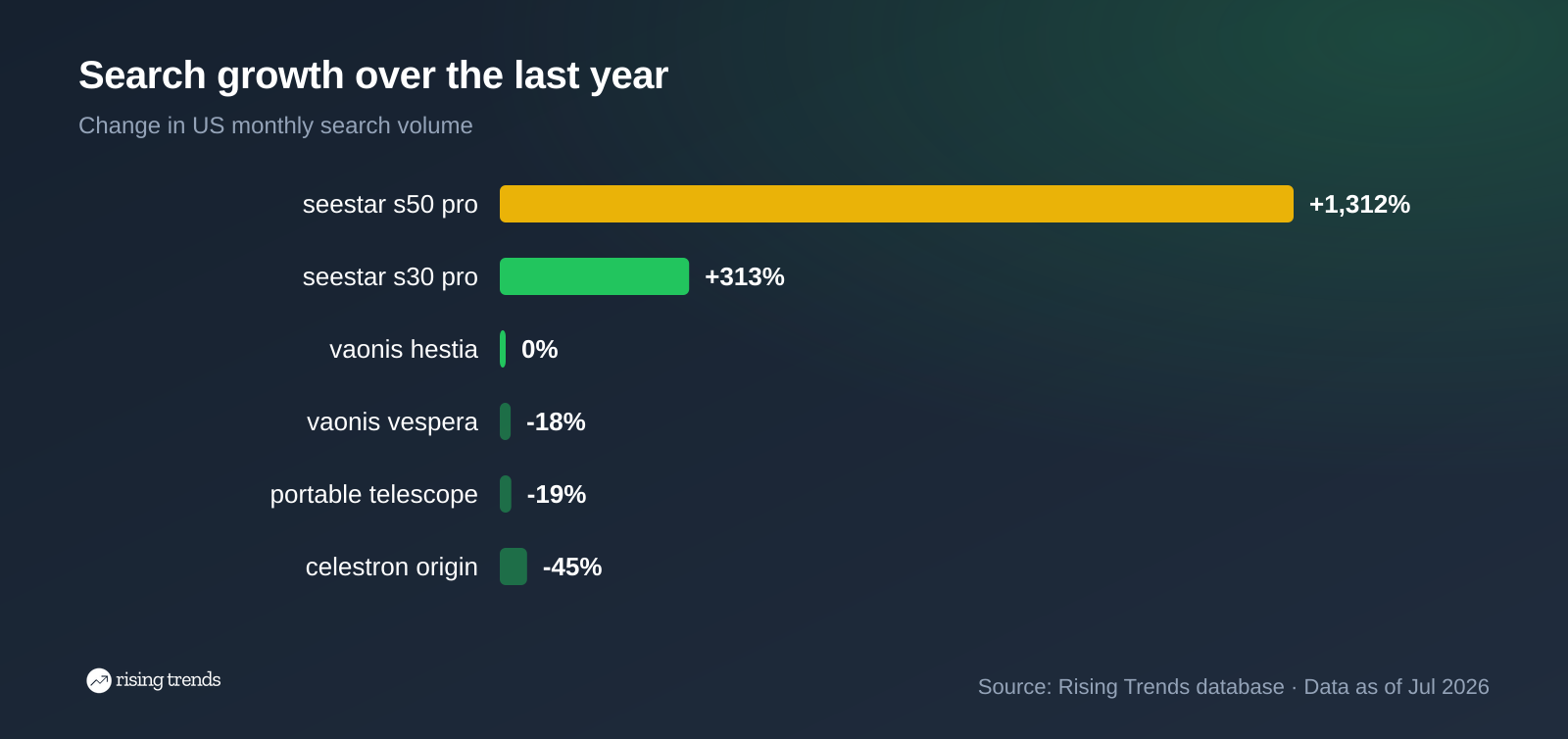
Two products up, four flat or down. Every rising term in this category has ZWO's name on it.
The official store shows 7 reviews, all five stars, which is an early-buyer sample and should be read as one. These are the people who pre-ordered. What is useful is the consistency of what they mention.
Art Braun, who upgraded from an S50 he had used for two years: "The S50 Pro tracks better with few to no rejected frames. The images show much less noise. I appreciate the wider FOV." Tom Meyer, after one clouded night: "What really got me is how noise free the image was." A reviewer posting as Szortis: "Much sharper photos, better colours, more details and less noise."
Three separate buyers led with noise, not aperture. That matches what the product changed: the sensor and the optical design, not the light-gathering area.
The gap in the record is the sceptical side. Reddit's seestar community and the Cloud Nights forums both block automated reading, so the critical threads are not quoted here. Treat a seven-review, all-five-star page as marketing-adjacent until the sample grows.
The default price of this hobby just moved to under a thousand dollars. Astrophotography used to mean a mount, an optical tube, a camera, a guide scope and a laptop. The S50 Pro is one object at 899 dollars that produces a stacked image in minutes. Every incumbent priced above it now has to explain the difference in a language beginners understand.
The volume is in the smaller model. Seestar S30 Pro pulls 6,600 monthly searches, nearly three times the S50 Pro, at 699 dollars. The company's own comparison calls it "a portable all-rounder". The Pro badge sells to upgraders; the cheap one sells to the category.
App-first hardware wins the second sale. The reason ZWO could generate a launch curve without a launch is that it already owned the app on its buyers' phones. That is the same dynamic running through the connected gear we cover in science trends and in consumer hardware generally, from backyard devices to wearables. The install base is the marketing channel.
Whether August and September beat 2,400. Our series ends at 2,400 for July 2026, matched three times without being exceeded. If the shipping months come in higher, the product created new demand beyond the people who were already waiting. If they flatten, this was an upgrade cycle and the ceiling is the existing owner base. The live Seestar S50 Pro trend page is where that resolves first.
The 3 to 4 week shipping note. The official store still carries a pre-order badge and a demand warning weeks after launch. Supply that stays tight into the autumn observing season would be the first real evidence that this is bigger than an upgrade.
Whether anyone answers at the price. Celestron and Vaonis both sell above this product and both are shrinking in search. The obvious response is a sub-1,000 dollar model with the same app-first workflow. Watch the celestron origin and vaonis vespera terms in our database: a competitor launch shows up there before it shows up in the reviews.
The thing worth remembering is what the curve did before the product existed. A four-month gap between peak demand and first shipment is not a marketing achievement, it is a supply decision, and it is the clearest sign we have that this category is now driven by one company's release calendar.
Want to spot the next breakout product before it ships? Read our guide on how to identify market trends, follow the live Seestar S50 Pro trend data, or browse what is breaking out right now on the Rising Trends dashboard.
Thousands of Emerging Trends
Thousands of Breakout Apps
Mega Trends
Trend Analysis Tool