
In July 2026, 8,100 people a month typed "fenix 9" into Google in the US. Add the four other ways people write the name in our database, including "garmin fenix 9 rumors", and the figure for that month is 41,990 monthly searches. Garmin had announced nothing. There was no press release, no product page, no price. The watch did not exist yet.
It exists now. Garmin unveiled the fenix 9 and fenix 9 Pro on August 25, 2026, at $999.99 and $1,099.99. That makes this launch unusual, and worth pulling apart: the demand curve was fully formed a month before the supply, and it was pointed at a product category Garmin had just told investors was shrinking. Nobody ranking for this watch has that curve. We do.
Key takeaways:
- "fenix 9" grew from 40 to 8,100 US monthly searches in two years, a 173.6x lift, classified as EXPONENTIAL in the Rising Trends database (data as of July 2026).
- The five fenix 9 search terms we track added up to 41,990 monthly searches in July 2026, one month before Garmin announced the watch. The shipping fenix 8 drew 74,000 in the same month.
- Garmin announced fenix 9 and fenix 9 Pro on August 25, 2026, at $999.99 and $1,099.99, in 43mm, 47mm and 51mm.
- Six days earlier, in its Q2 results, Garmin reported outdoor segment revenue of $482.7 million, down 2%, blamed partly on "the adventure watch product categories". Fitness was up 25%.
- fenix 8 launched on August 27, 2024, also from $999.99, also with 29 days of battery on the largest size. Two years apart, same headline numbers.
- Nearly every new fenix 9 software feature is being pushed back to the fenix 8 and other current Garmin watches, which leaves hardware as the only reason to upgrade.
Let's get into it.
The search spike, in numbers
Here is the monthly search volume for "fenix 9" over the last two years, straight from our database.
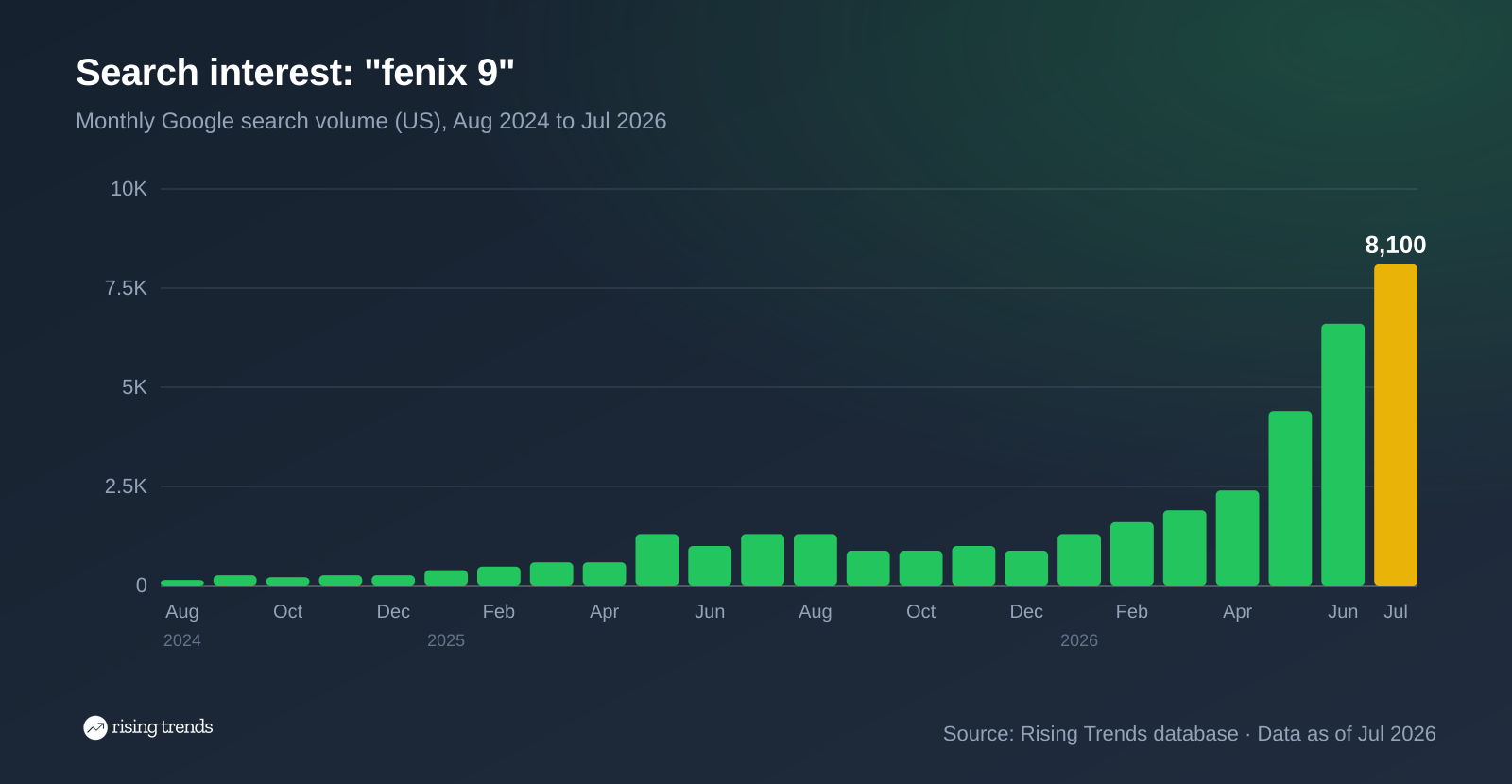
The shape is the story. For eighteen months the term sits flat in the hundreds and low thousands. The breakout month, the first time volume crossed a quarter of its eventual peak, is April 2026. From there it doubles roughly every two months: April, then May, then June, then 8,100 in July 2026, up 523% year over year and 238% in three months alone. The last three months average 173.6 times the level of two years earlier.
Nothing had shipped. The acceleration is people trying to find out whether a watch was coming.
The rest of the family says the same thing louder.
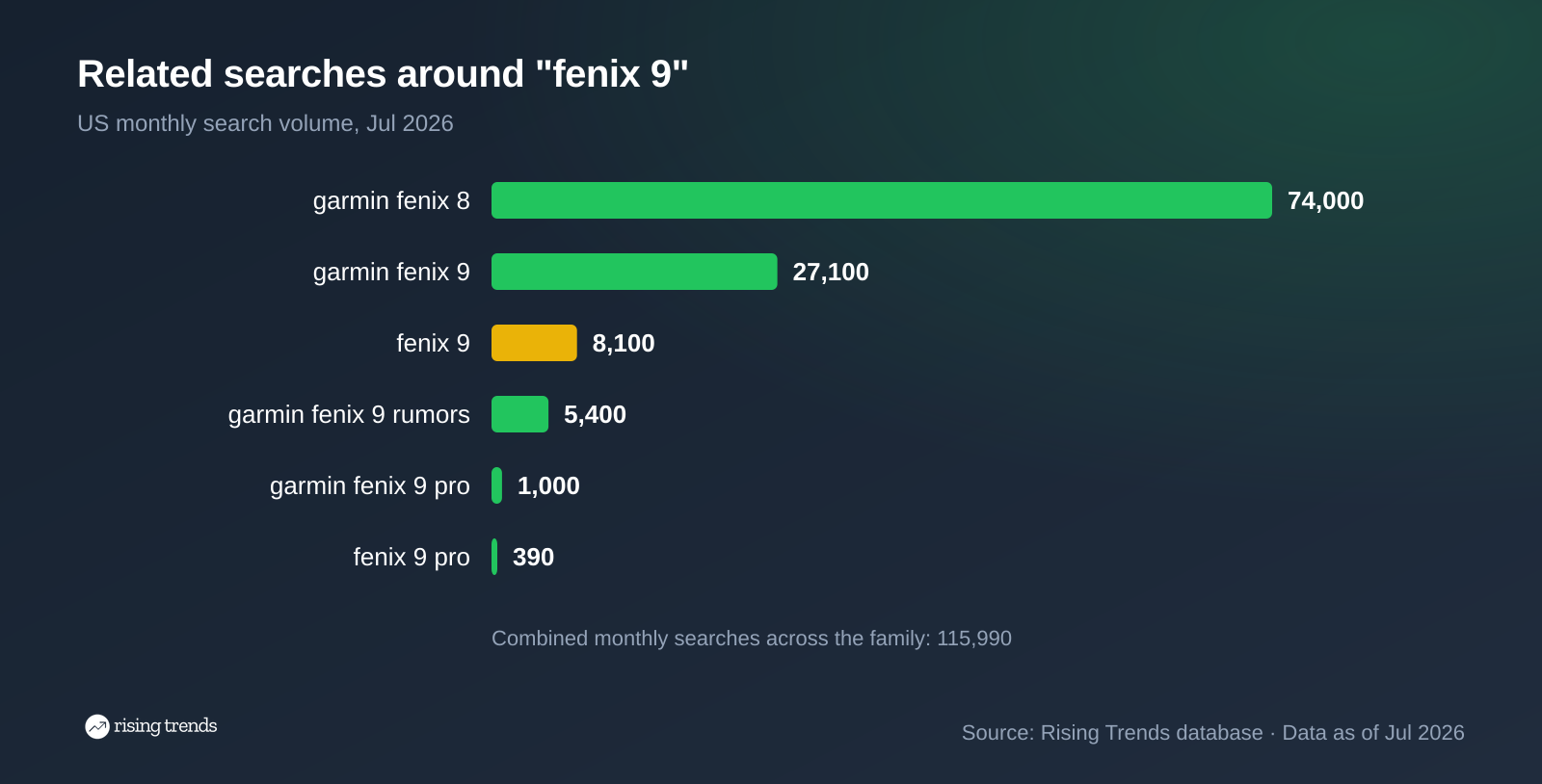
"garmin fenix 9" was already at 27,100 searches a month as of July 2026, more than three times the short form. "garmin fenix 9 rumors" was at 5,400, which is a remarkable number for a query whose entire purpose is to admit that the searcher has no information. The two Pro variants, at 1,000 and 390, were small because almost nobody knew a Pro model was planned.
Put the five fenix 9 terms next to garmin fenix 8 at 74,000 and you get the ratio that matters: the unannounced successor had already reached well over half the demand of the flagship Garmin was actually selling.
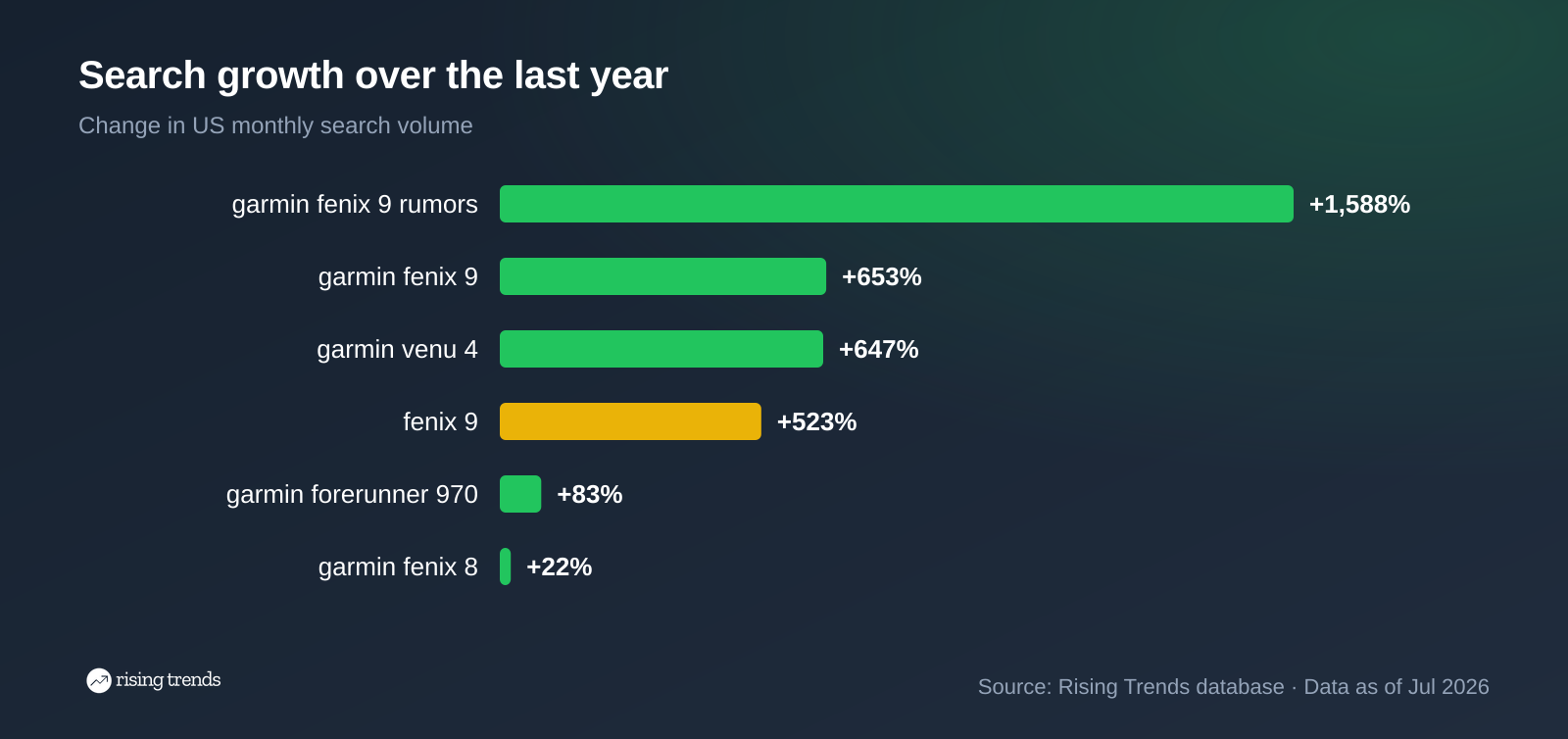
Growth splits the lineup cleanly. The fenix 9 terms are up between 523% and 1,588% in a year. garmin fenix 8 is up 22%, and garmin forerunner 970 is up 83%. The one non-fenix watch keeping pace is the Venu 4 at 647% on 60,500 searches, and it sits in the segment that is growing.
What the fenix 9 actually is
Garmin's fenix 9 announcement on August 25, 2026 covers two watches.
The base fenix 9 gets an AMOLED display Garmin describes as twice as bright as the fenix 8, a scratch-resistant sapphire lens, leakproof buttons and a 40 metre dive rating. Inside, 64 GB of storage doubles the map and music capacity, and 50% more RAM than the fenix 8 feeds a rewritten map engine that Garmin says pans up to 30% faster. It comes in 43mm, 47mm and 51mm, starts at $999.99, and gets up to 29 days in smartwatch mode on the largest size.
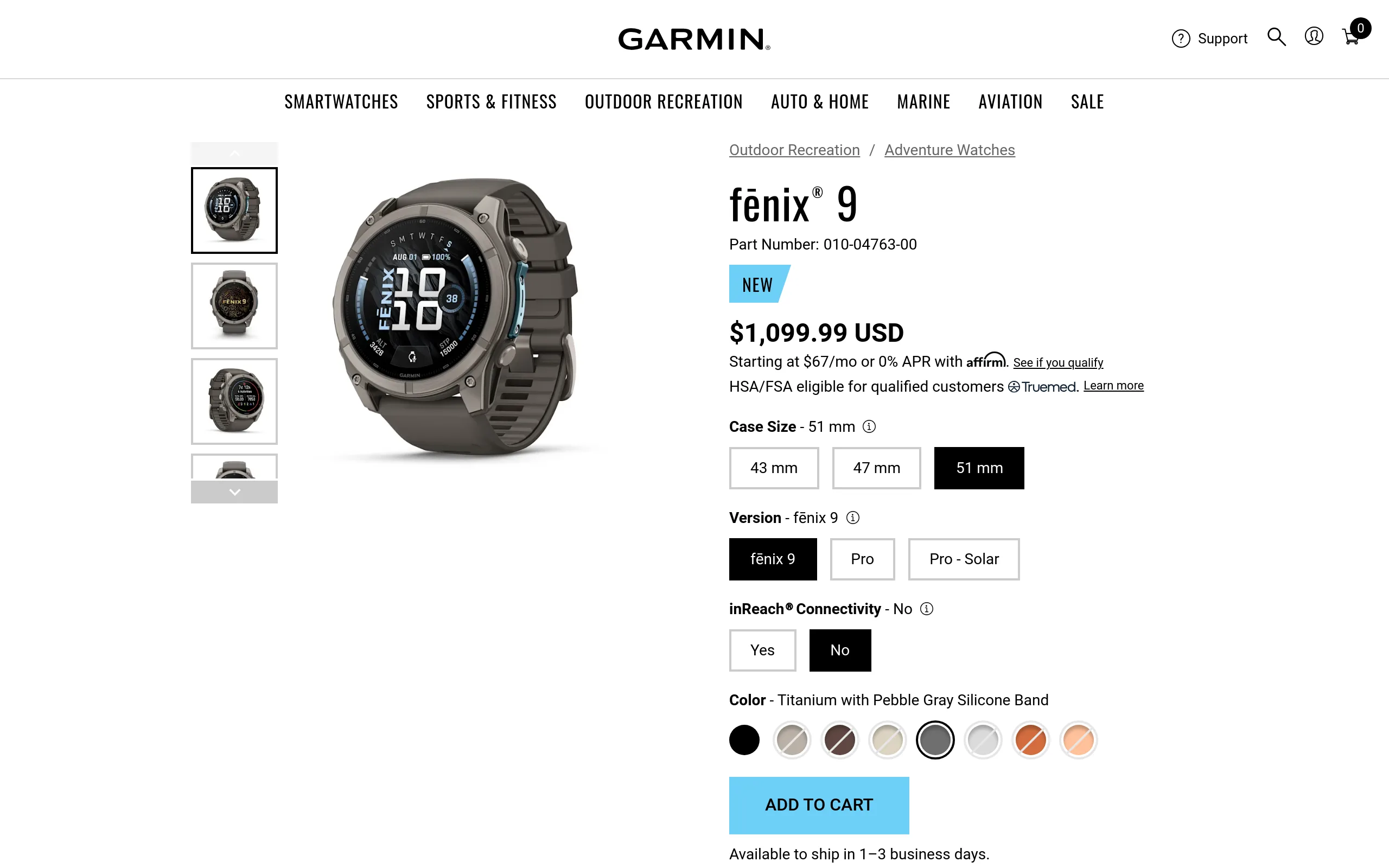
That is the page 41,990 people a month were looking for before it went live. Note the price on it. The $999.99 headline is the 43mm and 47mm entry point; the 51mm fenix 9 is $1,099.99, and it ships in one to three business days.
The fenix 9 Pro is where the hardware changes. It is the first fenix with a titanium case, made with a nano-molding process that bonds metal and plastic to cut thickness. Its display reaches up to 3,000 nits, the 51mm model carries Garmin's first 1.5 inch AMOLED panel, and solar versions stretch battery life to 57 days. Every Pro size now includes inReach satellite and LTE connectivity, so calls, texts and SOS work with the phone left at home. Pro pricing starts at $1,099.99.
On the software side both models get Garmin Epic, which stitches activities recorded over days or months into one shareable story, plus stamina zones and a stamina curve, indoor rowing VO2 Max, and rucking support up to 100kg packs.
Why people were searching before there was anything to search for
Two things drove the pre-launch curve, and both are visible in our data.
The first is the calendar. Garmin has run this cadence for years, and the fenix 8 arrived on August 27, 2024, according to Garmin's own fenix 8 announcement. A two-year-old flagship in a category with a two-year cycle produces exactly the kind of query our database logs as "garmin fenix 9 rumors", up 1,588% in a year as of July 2026.
The second is that buyers stopped buying while they waited. This is the part Garmin put in writing. In its second quarter 2026 results, published on July 29, 2026, the company reported revenue of $2.022 billion, up 11%, with the fitness segment up 25% to $756.8 million. The outdoor segment, where fenix lives, fell 2% to $482.7 million, which Garmin attributed primarily to "the consumer auto and adventure watch product categories". Cliff Pemble, president and CEO, still called it "another quarter of outstanding financial results".
Both statements are true at once. The company was setting records while the product line with the most anticipated successor in its catalogue went backwards. That is what a pre-announcement demand curve does to a hardware business, and it is not unique to watches: searches for the Seestar S50 Pro smart telescope peaked four full months before ZWO shipped it.
Here is the launch-week comparison video from DesFit, which runs through every difference between the fenix 9 and the watches it replaces.
The comparison format is the tell. When a launch is obvious, reviewers make first-look videos. When the upgrade case is arguable, they make spreadsheets.
fenix 9 versus fenix 8: what actually changed
| Spec | fenix 8 (Aug 2024) | fenix 9 (Aug 2026) |
|---|---|---|
| Starting price | $999.99 | $999.99 |
| Battery, largest size, smartwatch mode | Up to 29 days | Up to 29 days |
| Sizes | 43mm, 47mm, 51mm | 43mm, 47mm, 51mm |
| Storage | Half the fenix 9 capacity, per Garmin | 64 GB |
| Case material, top model | No titanium case | First titanium fenix case, on Pro |
| Satellite messaging | Separate inReach device | Built in on all Pro sizes |
Two of the numbers a shopper checks first, price and battery life, did not move in two years. Storage doubled, the display got brighter, the maps got faster, and the Pro got a titanium case and satellite connectivity. Every row above comes from Garmin's two launch releases, including the storage line: the company frames the fenix 9's 64 GB as twice the map capacity of the fenix 8 rather than giving the older figure.
The other change is the one Garmin did not headline. Ray Maker of DC Rainmaker, who has covered every fenix generation, reported on launch day that virtually all of the new fenix 9 software features are going to the fenix 8, Enduro 3, tactix 8, Forerunner 970 and 570, fenix E and Venu X1, with only the new mapping engine, the renamed satellite battery modes and the archery feature held back. He calls it a massive change from a company that historically stranded the previous generation. If you own a fenix 8, most of what was announced arrives on your wrist for free.
What owners are saying
Garmin's own forum is the fastest read on this. The thread titled "Where is the innovation???" in the fenix 9 series forum had drawn 81 replies and 6,866 views by early September 2026, and the split in it is clean.
The buyers are specific about what they got. "I got 2 of the biggest upgrades that have been on my wishlist for the last 7 years, so personally I'm pretty excited," wrote a poster called C.sco, listing the 64 GB storage and the 1.5 inch screen. "Is it 'innovative'? No, not really. But it's enough to make me finally upgrade my epix pro."
The critics are equally specific, and they aim at the silicon. "Still cannot believe... that they opted to go with the same SoC for 4 years straight," wrote a poster called xyan, adding that "truly it is unacceptable for 1300 eu device". A separate thread on the processor ran to 68 replies. Asked what he had wanted, a poster called runningfan97 listed three items: real cellular with an eSIM, a new system on chip, and new sensors.
The most useful comment is the one that sorts the audience. "If you have an 8 you can relax and wait for the 10," wrote a poster called clonetrooper, who went on to say that anyone on an older device should take the 9 for the case, the connectivity and the bigger screen. That is the upgrade logic in one line, and it matches the software backport exactly.
What it means for the category
Search demand is not sales demand, and this launch shows the gap. A 41,990-per-month search cluster in July 2026 is a queue of people deciding whether to buy. Some of them were holding off on a fenix 8 while they waited, which is visible in the outdoor segment's 2% decline in the same quarter. Anticipation is a cost, and hardware companies pay it in the quarter before the launch, not after.
The upgrade cycle is moving from hardware to software, and Garmin just conceded it. Sending nearly the whole feature list back to two-year-old watches is how phones and cars now work. It builds loyalty and it kills the annual upgrade. The same pattern runs through the rest of the wearable technology trends we track: the hardware differentiates less each cycle, and the platform holds the customer.
The premium end is being squeezed from both sides. At $999.99 the fenix 9 sits above every mainstream smartwatch and below nothing. Below it, Garmin's own Venu 4 is growing at 647% a year in a fitness segment that grew 25% last quarter. Beside it, the screenless wearables category is taking the buyers who want the data without the watch. The rugged flagship keeps its niche, but it is a narrower niche than it was.
Satellite messaging is now a watch feature. Putting inReach on all three fenix 9 Pro sizes turns a separate purchase into a subscription line attached to a device someone already wears. That is the fenix 9's most durable advantage, and it is the piece competitors cannot copy with a firmware update.
What to watch next
Whether the curve holds after launch. Pre-announcement demand is curiosity. Post-launch demand is intent. The number to follow is search volume for "fenix 9": if it keeps climbing through the autumn instead of decaying, the launch converted.
Whether "garmin fenix 9 rumors" collapses. That term was at 5,400 searches a month as of July 2026 and has no reason to exist now that the watch is on sale. If it stays elevated, people are still looking for information Garmin has not published, which usually means a variant is missing.
Whether the fenix 8 falls. At 74,000 monthly searches it is still the most searched watch in this family, and it is about to become the discounted option that gets most of the fenix 9's software. Watch the two curves together through the holiday quarter. If fenix 8 volume holds while fenix 9 climbs, Garmin has widened its market rather than replaced a product, and the outdoor segment gets its recovery from the older watch as much as the new one. That is the kind of divergence our fitness trends tracking is built to catch.
The broader lesson has nothing to do with watches. Search data showed a product with 41,990 monthly searchers and a company with a 2% revenue decline in the same segment, in the same month, before any of it was public. The launch was the last thing to happen, not the first.
Want to see demand build before the announcement? Read our guide on how to identify market trends, or browse what is breaking out right now in our trending topics list.
Never miss a trend again
- One trend broken down with the numbers
- Who's making money, and what to build
- A website on the rise
- A breakout app
Join 5,000+ founders