

Two years ago, nobody searched for "cursor origin." Through the first quarter of 2026 the term sat at 10 searches a month, which is our database's way of saying noise. Then in June 2026 it hit 12,100, and the product it names did not exist yet. Cursor shipped Origin, its own Git hosting service, on August 17, 2026.
That gap is the story. Every write-up of the launch treats Origin as a product that arrived and got attention. Our curve says the attention arrived first, in a month when there was nothing to sign up for, and that by July 2026 the term was still running at 2,400 searches a month against a total of 260 for "git forge," the category it belongs to. Nobody ranking for this term has the monthly series. Here it is, along with what Origin actually ships, what it does not, and the number GitHub is defending.
Key takeaways:
- "cursor origin" went from 10 to 2,400 US monthly searches in a year, up 23,900%, classified as EXPONENTIAL in the Rising Trends database (data as of July 2026).
- The peak was 12,100 in June 2026, two months before Cursor made Origin public on August 17, 2026. Our series ends in July, so the launch spike itself has not landed in the data yet.
- Origin is an early beta on paid plans only. It does repos, pull requests, code browsing and two-way GitHub sync. It has no public repositories, no native CI, no Issues, Projects, Releases or Packages.
- The engineering claim is throughput. Cursor's storage layer sustains 120 pushes a second on S3 Standard and more than 300 on S3 Express One Zone, with linear read scaling tested to 100 replicas.
- The scale gap is enormous. GitHub draws 1,500,000 monthly searches as of July 2026, 625 times the demand for the product being called its alternative.
- On Hacker News the launch drew 597 points and 454 comments, and an Origin developer answered the "what is different from GitHub" question with two words: "Today, very little."
Let's get into it.
The search spike, in numbers
Here is the monthly curve for "cursor origin" from our database. Read the x-axis before you read the bars, because the shape is not what a product launch usually looks like.
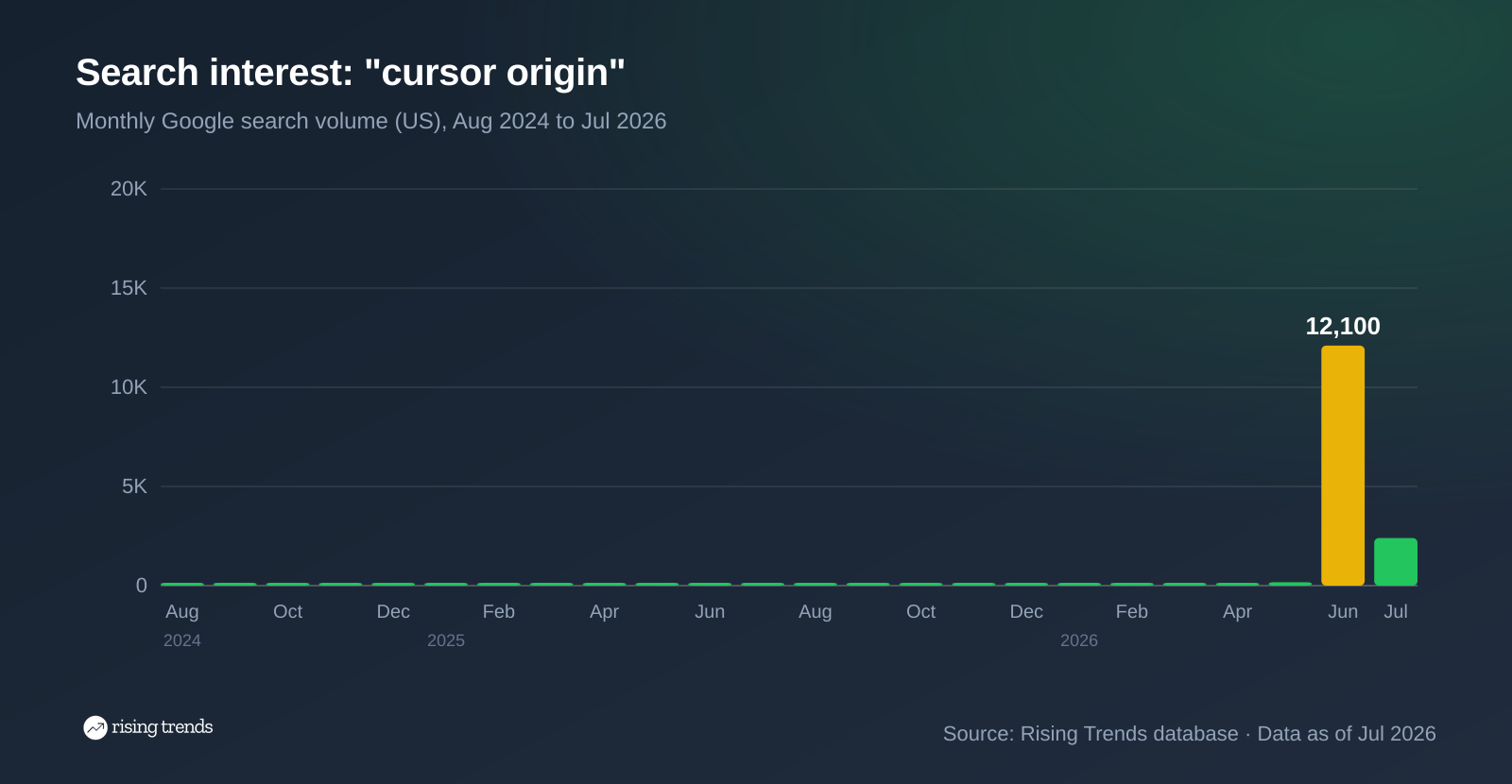
Flat at 10 a month for a year and a half. Then 20 in April 2026, 170 in May, 12,100 in June, and 2,400 in July. Origin went public on August 17. Our volume data runs through July 2026, so the entire curve above is pre-launch demand, and the post-launch months will not appear until the next refresh. What the June spike measures is people going looking for a Cursor git product before Cursor had one, which is a rare thing to see in a brand term.
Some of that June volume is ambiguity. "Cursor origin" also reads as the git remote named origin inside the Cursor editor, and as a question about where the company came from. Google's own People Also Ask box for the term still carries "Which country is cursor from?" alongside "Is cursor Origin a competitor of GitHub?" The July figure of 2,400 is the cleaner number, and it is the one worth tracking as the August and September data lands.
Now put it next to the neighbours.
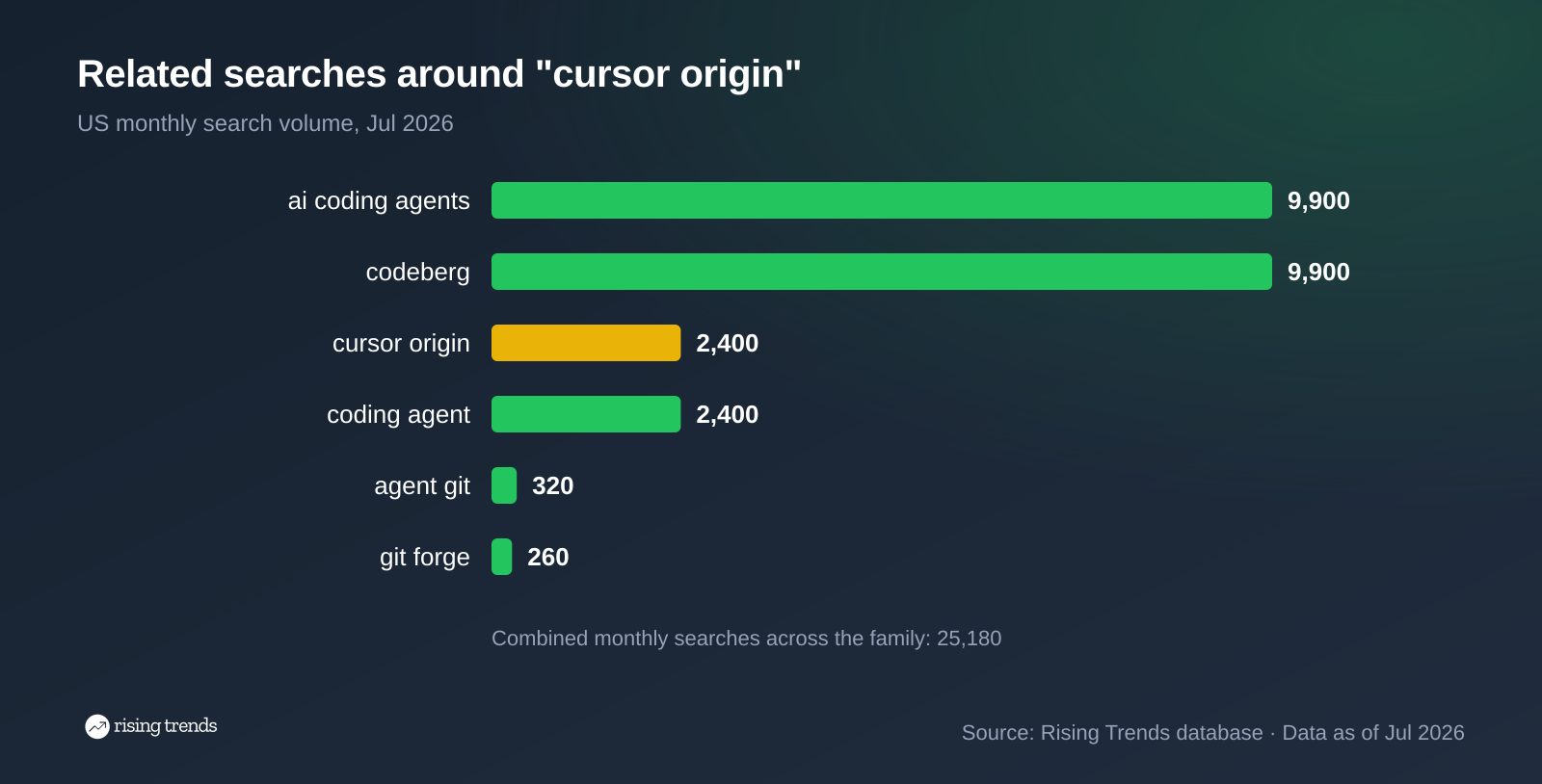
Two things stand out. The category label barely exists: "git forge" is 260 searches a month, and "agent git" is 320. Nobody is searching for the abstraction. They are searching for brands. And the fastest-growing forge in our data is not Cursor's. Codeberg, the non-commercial European alternative, sits at 9,900 a month and is up 662% in a year, matching ai coding agents exactly. People are leaving GitHub in two directions at once, and only one of them involves agents.
Then there is the number that frames everything else. GitHub itself draws 1,500,000 monthly searches as of July 2026, up 50% year over year. That is 625 times "cursor origin." Whatever Origin is, it is not yet a dent.
What Cursor Origin actually is
Cursor's own one-line pitch on the Origin product page is "a git forge for the agentic era." Underneath the phrasing it is a straightforward code host: you claim a codebase namespace, install a CLI, authenticate once, and then standard git works over HTTPS.
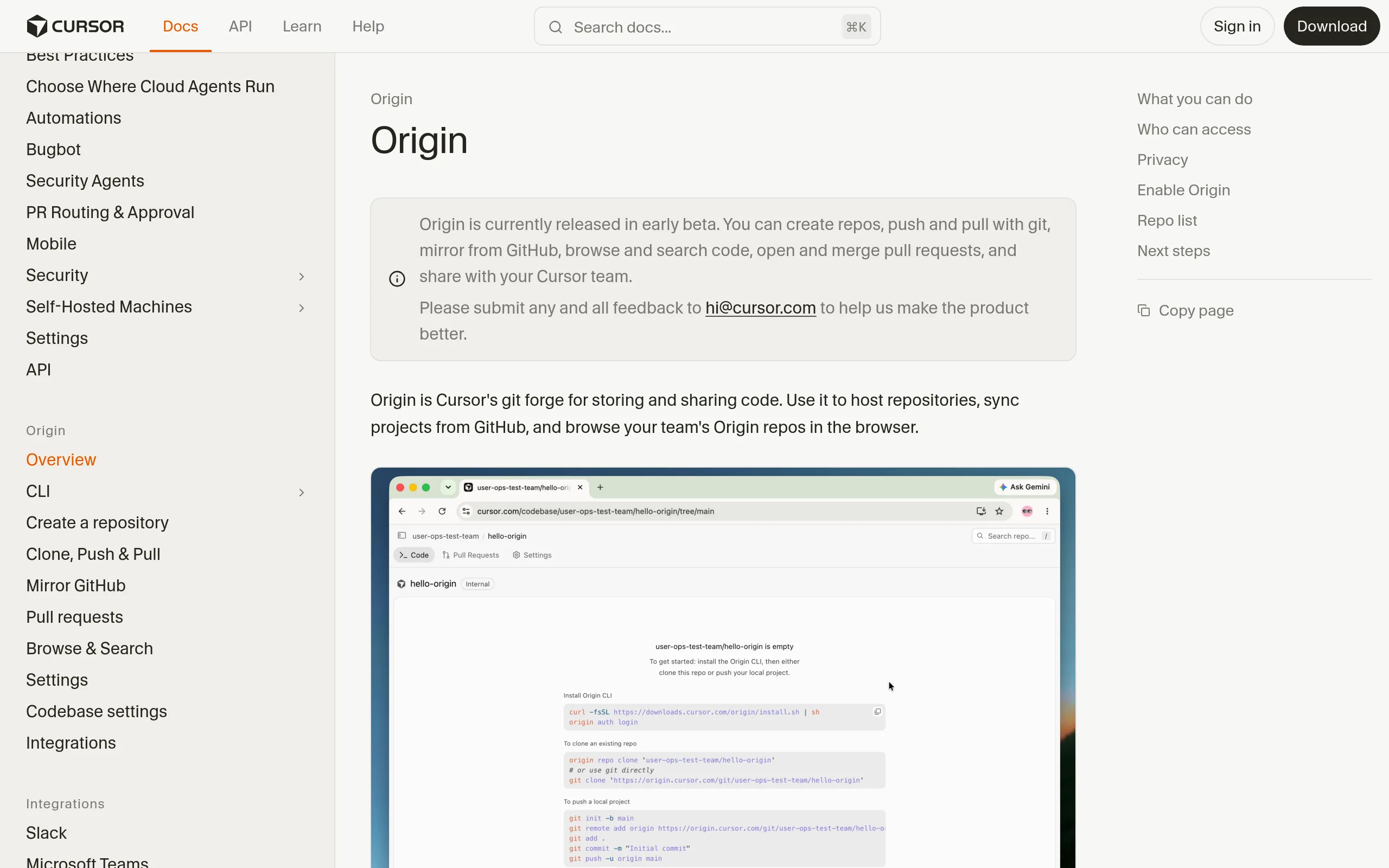
The Origin docs are unusually blunt about the boundaries. Origin is on Pro, Teams and Enterprise plans, and not on free. Access opens in stages. Your namespace becomes part of every repository URL, and during the beta you cannot change it after you claim it. Privacy follows the Privacy Mode of whoever owns the namespace, and teams on legacy privacy mode cannot enable Origin at all.
Two hosting modes matter more than any feature. For Origin-hosted repos, Origin is the source of truth and GitHub is not in the path. For repos you sync in from GitHub, GitHub stays the source of truth and Origin is a live mirror: pushes keep going to GitHub, and pull request comments move both ways within seconds. The launch changelog is explicit that this mirroring covers code and pull requests. Issues, Actions and secrets are not synced.
The launch integrations are Vercel for preview deployments on every pull request, plus Depot and Buildkite for CI. Both CI options run existing GitHub Actions workflows, which is the tell: Origin has no CI system of its own and is not pretending to.
Why people are searching for it
The reason a code host got a 597-point Hacker News thread is the engineering post that landed the day after launch. In Git at any scale, Cursor engineer Vicent Martí walks through why hosting git is hard and how GitHub solved it in 2013 with a system called Spokes, which replicates repositories across servers and uses three-phase commit to keep them consistent.
His argument is that Spokes has a floor and a ceiling, and agents break both. Three replicas per repository was the sweet spot in 2013. Today an enterprise monorepo needs far more than three to serve CI, and every replica you add makes push throughput worse, because consensus moves at the speed of the slowest node. At the other end, agents create huge numbers of tiny throwaway repositories, and Spokes still insists on three replicas for each one.
Cursor's replacement, Continuity, throws out consensus and puts a write-ahead log in S3-compatible object storage instead. A push is not acknowledged until it is persisted, all pushes are linearised, and replicas catch up from S3 rather than from each other. The numbers Cursor publishes: 120 pushes a second sustained on S3 Standard, more than 300 a second on S3 Express One Zone, and linear read scaling in synthetic tests with up to 100 replicas. Those are Cursor's own measurements on its own monorepo, not independent benchmarks, but they are specific enough to be checked later.
This clip walking through the launch is titled "Cursor Just KILLED GitHub?!" which tells you the register the whole conversation is in.
The video is a feature walkthrough, and it is a fair summary of what shipped. The headline is not.
How it compares to GitHub
Here is the honest side by side, built from Cursor's own docs and changelog rather than from marketing pages.
| Capability | Cursor Origin, Sep 2026 | GitHub |
|---|---|---|
| Repos, clone, push, pull | Yes, over HTTPS after CLI auth | Yes |
| Pull requests | Yes, with two-way sync on mirrored repos | Yes |
| Public repositories | No, all repos are private in beta | Yes |
| Native CI | No, brings Depot or Buildkite | Actions |
| Issues, Projects, Releases, Packages | Not in the product | Yes |
| Agents operating on the repo | Native, including opening and updating PRs | Via app integrations |
| Availability | Paid plans, staged rollout | Free tier upward |
The missing row is the one that decides adoption for most teams: there is no public repository option, so no open source project can make Origin its home. A forge without public repos is an internal tool with a forge's interface.
What the early reaction says
The most useful review so far is from Appwrite engineering lead Matej Bačo, who used the beta and wrote it up on August 18. His Cursor Origin review is not a takedown, which makes the specifics land harder: account switching hit rate limits, repository creation flows left stale modals behind, and basic tasks like adding a README or deleting a branch push you back to the CLI, an agent or plain git. The pull request list defaults to your own PRs, which means the agent-opened PRs, the ones Origin exists for, are hidden until you change the filter. His verdict is to try it solo, mirror but not move if you have real GitHub automation, and wait if you depend on CODEOWNERS or merge queues.
The Hacker News launch thread ran to 454 comments and split three ways. Some want the reliability: one commenter wrote that the pitch is "like Github but it stays up even as your commit/CI frequency increases," and said he was looking forward to switching. Some want the throughput and doubt anyone can deliver it, noting that agents act far faster than humans while SaaS rate limits are still sized for people. And a large share of the thread was not about the product at all but about trust and ownership of the company, with one commenter flatly saying he would never put his data on a host owned by Elon Musk. Those are opinions from a public forum, not findings, and Cursor's only on-record answer is the docs line that Origin inherits the Privacy Mode of the namespace owner. For teams weighing this, the questions are the same ones we flagged in our cybersecurity trends for 2026: who holds the data, under what terms, and what happens on exit.
The most quotable answer came from Origin developer Tomas Reimers, a Graphite co-founder, replying to someone asking what is actually different from GitHub. "Today, very little," he wrote, adding that Cursor is deliberately meeting GitHub toe to toe on functionality first, with agent integrations, tooling that reads agent-written code without a human reading all of it, and automatic work to get pull requests to a mergeable state coming next. He also confirmed the lineage: Origin is built on Graphite technology, the stacked-PR company Cursor acquired.
What it means for code hosting
The unit of work is changing, and billing will follow. GitHub's economics assume humans open pull requests. When agents open them, the cost driver becomes CI minutes and push throughput, not seats. That is the same pressure we described in the SaaS apocalypse, showing up in the least glamorous layer of the stack.
Bundling is the actual weapon. Origin does not need to beat GitHub on features. It needs the agent, the repository and the review surface to sit in one place so there is no integration plumbing between them. Cursor already sells the agents. This is the distribution move the 2026 AI agent trends pointed at: whoever owns the agent tries to own everything the agent touches. The same bundling logic shows up one layer higher in Grok Bot, the xAI-branded agent team whose computers and billing both run on Cursor.
Exit cost is the counterweight. No public repos, no Issues, no Actions and no GitHub-compatible API means a migration is not a mirror flip. The rational play right now is exactly what the Appwrite review recommends: mirror one repo, keep GitHub as the source of truth, and find out whether the agent workflow is worth the missing surface.
What to watch next
Whether the launch spike beats the pre-launch one. June 2026 hit 12,100 without a product. If the August and September data comes in under that, the term peaked on curiosity rather than adoption. Search volume for "cursor origin" is where that resolves first.
Public repositories, or a GitHub-compatible API. Either one would change who can move. Neither is announced. Watch agent git, up 129% in a year, as the leading indicator that agent-native source control is becoming a category rather than one vendor's feature.
Whether the throughput claim survives contact with customers. 120 pushes a second is a lab number on Cursor's own monorepo. The first large team to run a real CI fleet against Origin will produce the number that matters, and the answer will show up in support threads before it shows up in a blog post.
Which model the agents run on, and what it costs. Origin only matters if the agents pushing to it are good enough to trust, and that supply is less stable than it looks. Agent-native infrastructure inherits whatever happens upstream, from pricing changes to availability. The cost side is the one teams underrate: an agent resends its whole context every turn, which is why cache hit rate has become the biggest lever on what these products cost to run, as we work through in prompt caching, explained.
The honest read on Origin today is that the demand is real and the product is early. Cursor shipped a competent code host, published a genuinely good explanation of why the incumbent's architecture is showing its age, and left out most of what makes a forge a home. The search data is the tell in both directions: 23,900% growth in a year, and still 625 times smaller than the thing it wants to replace.
Want to catch the next product while it is still a search curve? Read our guide on how to identify market trends, or browse what is breaking out right now in our trending topics list.
Never miss a trend again
- One trend broken down with the numbers
- Who's making money, and what to build
- A website on the rise
- A breakout app
Join 5,000+ founders