
Trends


In July 2026, about 70 people a month typed "microduck" into Google. In August it was 27,100. That is not a trend line, it is a cliff, and our database has nothing else in consumer robotics that looks like it. The thing on the other side of the cliff is a 25 cm robot duck that costs $399, walks with a waddle, picks things up with its beak, and is designed around the assumption that it will spend a lot of its life on its back.
The useful part is not the duck. It is what the duck is standing on. Microduck is the first product from Pollen Robotics since Hugging Face bought the company, and it ships a complete reinforcement-learning pipeline with the hardware: train a walking policy in simulation on your own machine, export it, run it on a robot that costs less than a laptop. Nobody ranking for the term has the search curve, and nobody has put it next to the rest of the category. We have both, and the comparison is not what you would guess.
Key takeaways:
Let's get into it.
Here is the monthly volume for "microduck" over the last two years, straight from our database. There is no ramp, no early-adopter hum, nothing to extrapolate from. There is one bar.
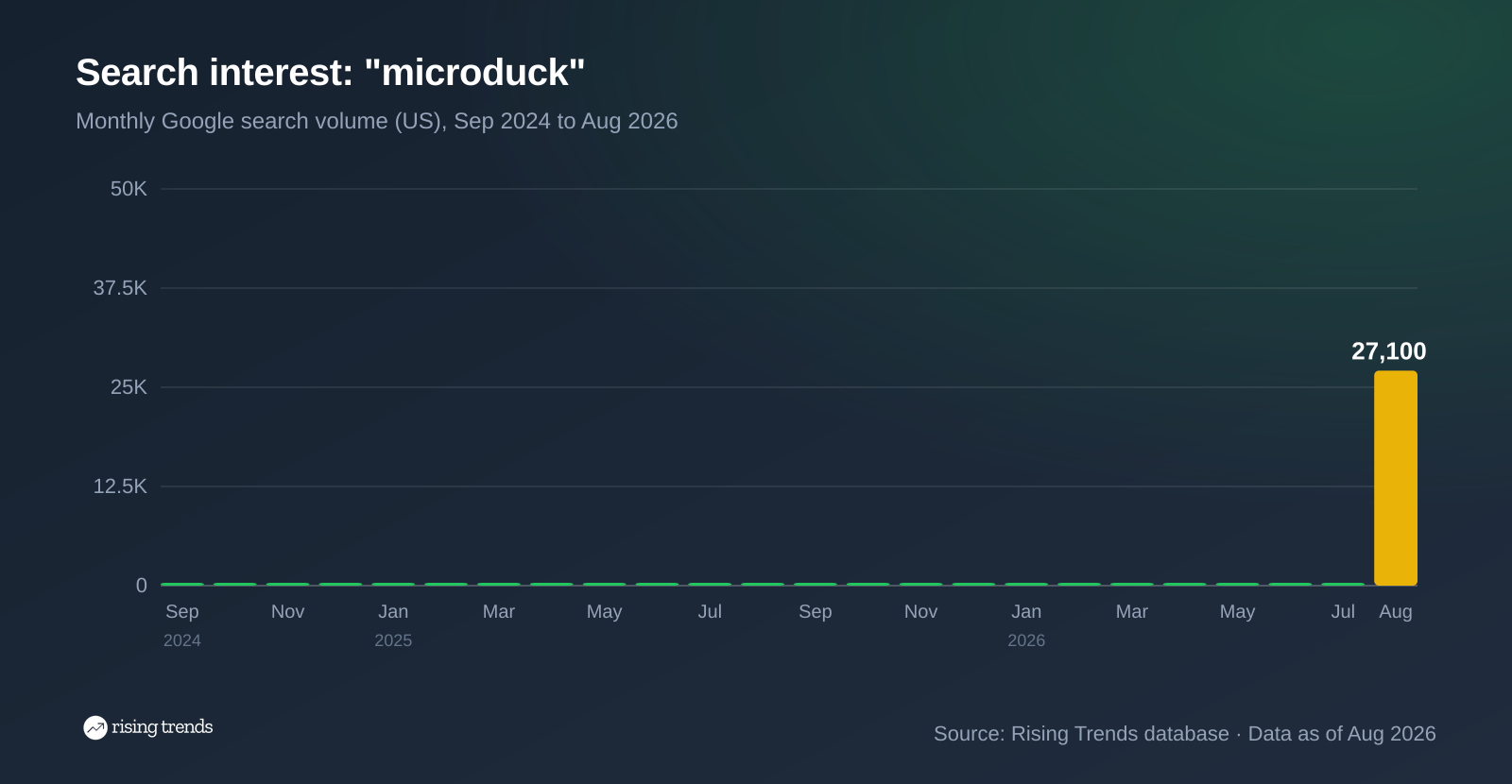
Twelve months before the launch the term sat at 50 searches a month. Two years before, 30. The whole of the last twelve months, from September 2025 through July 2026, never broke 90. Then August 2026 delivered 27,100, which is 454 times the level of two years earlier and the single largest one-month step we have recorded in consumer robotics this year. The three-month average that includes it, 9,080, is already above most established hardware brands we track.
That is what a launch looks like when the product name is new. The more interesting question is where 27,100 sits inside the category it just walked into.
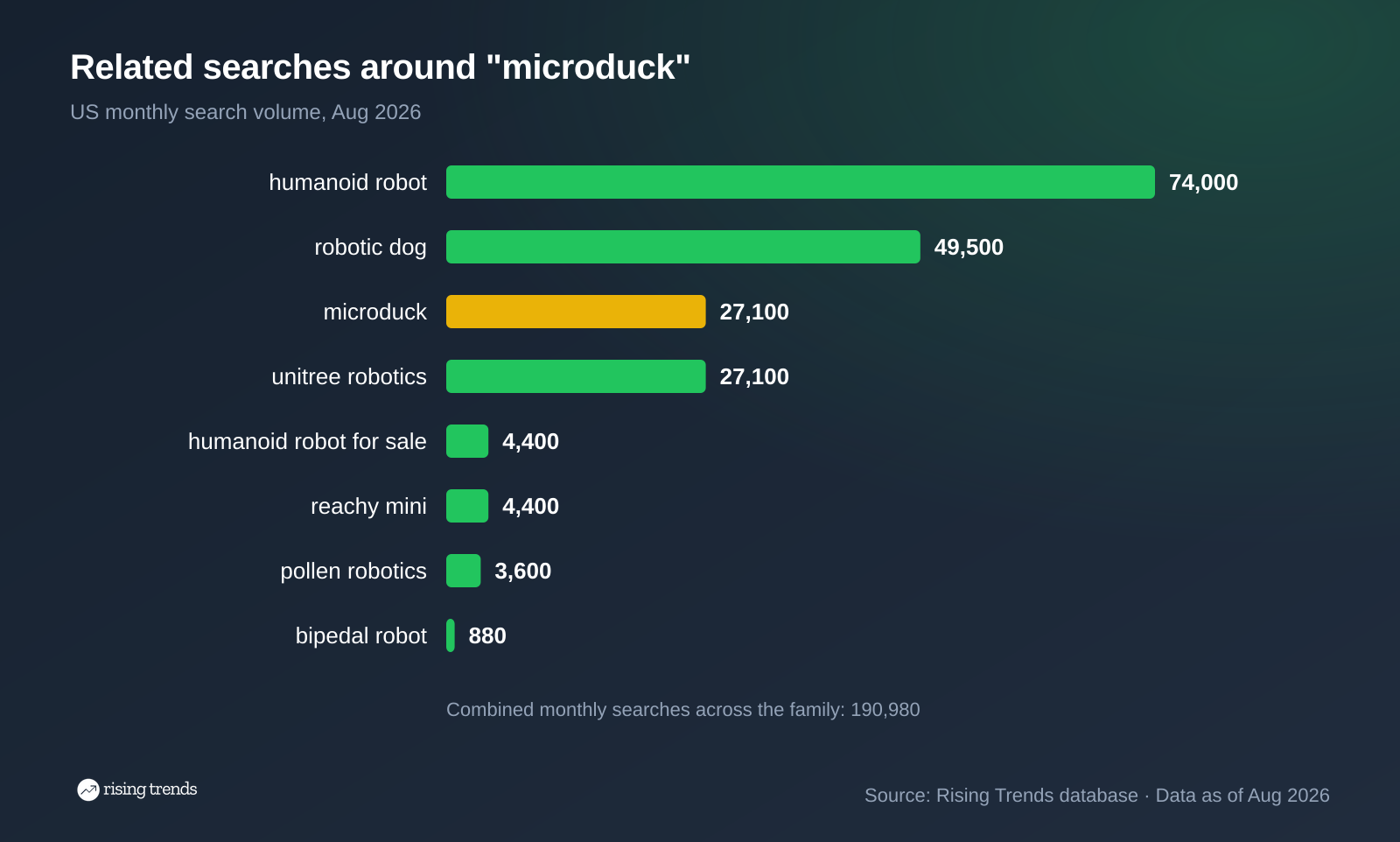
One month in, Microduck already draws the same monthly search volume as Unitree Robotics, at 27,100 each, and more than half of what robotic dog draws at 49,500. Only humanoid robot, the generic category term at 74,000, is meaningfully bigger. The specific term "bipedal robot", which is literally what Microduck is, gets 880 searches a month. People are not searching for the category. They are searching for the duck.
A 25 cm biped, 780 g, 15 motors across articulated legs, head and neck. A front camera, an 8x8 time-of-flight LiDAR matrix, two IMUs, microphones and a speaker, and an articulated beak that works as a hand. Compute is a Rockchip RK3566 with an AI accelerator, 1 GB of RAM and 32 GB of storage, running a 50 Hz onboard policy loop. Power is a removable NP-F550 camera battery, good for about an hour. Those numbers come from Pollen's own Microduck press kit, which is unusually blunt about what is still provisional.
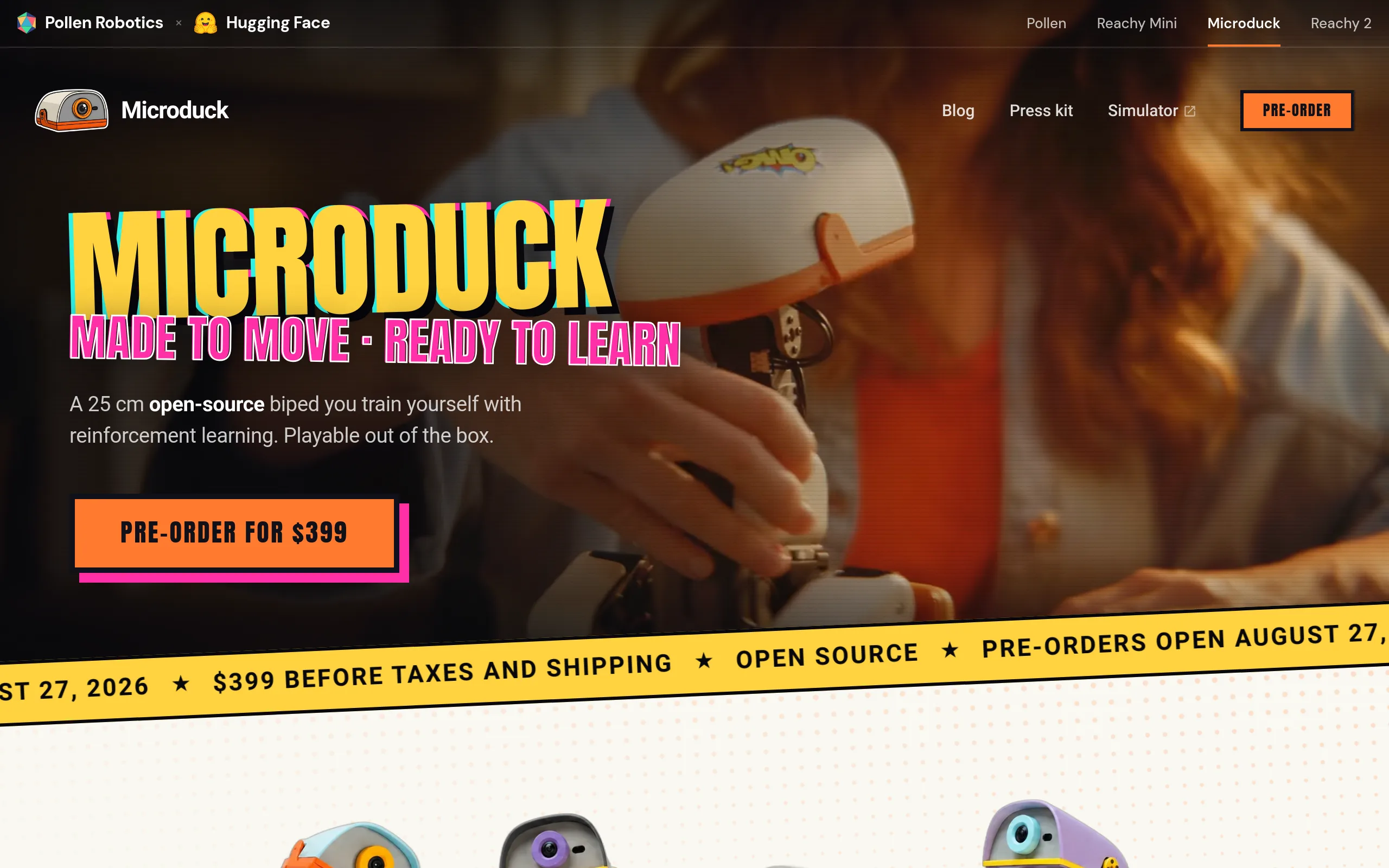
The product page leads with "made to move, ready to learn", and seven trained behaviours ship in the box: walk, sit and stand, kick, grab, roller skate, spin, and get back up off the floor by itself. A gamepad is included, so the first session needs no code at all. That last behaviour is the design thesis. In the launch post, the team writes that learning movement "is messy. A robot has to try things, fail, and try again", and that on a large humanoid every bad attempt "can be expensive, difficult to reset, or simply unsafe". Making it small means "a failed behavior usually ends with a little robot on the floor, not a major incident".
Underneath, two repositories do the work. The robot software is Rust, one workspace, a set of daemons talking over a single JSON-RPC contract, with signed updates that roll themselves back if a robot boots unhealthy. It has 9.3k stars and 1.2k forks. The RL training stack is where the behaviours come from: mjlab on MuJoCo Warp, PPO, policies trained at 50 Hz and exported to ONNX, with 13 task environments covering everything from ball kicking to gliding down slopes on rollers. The README says a usable gait takes one to two hours on a CUDA GPU at 4,096 parallel environments, and if you have no GPU, one flag ships the training job to Hugging Face instead.
That is the part that makes the price interesting. You are not buying a toy with an SDK bolted on. You are buying the cheapest complete sim-to-real loop that currently exists, and you can run the simulator in a browser before you buy anything.
Pre-orders opened on August 27, 2026, and the launch hit three audiences at once: the robotics crowd, the open-source crowd, and everyone who saw a video of a duck roller-skating. The Hacker News thread on the product page ran to 784 points and 252 comments the same day. Creator videos followed within 48 hours, and that is where most of the 27,100 came from.
This clip from @benmouad.ai, posted on August 29, 2026, is the version most people met first: the robot, the price, and the claim that you can train it yourself.
Then the ground moved under the company. On September 3, 2026, Jensen Huang announced that Nvidia had agreed to acquire Hugging Face for $12,930,300,000. Pollen Robotics, a 2016 Bordeaux startup that joined Hugging Face in April 2025, went from being the robotics arm of an open-model platform to being the robotics arm of a chip company, one week into taking money for a robot it had not built yet. Huang's post promises the platform stays open and that "NVIDIA compute will not be required". Buyers noticed anyway.
Pollen now sells two consumer robots at almost the same price, and they are deliberately not the same product.
| Product | Price | What it does | Searches a month (Aug 2026) | 1y growth |
|---|---|---|---|---|
| Microduck | $399 | Biped that walks, grabs, skates, recovers from falls. Built for RL and sim-to-real | 27,100 | +54,100% |
| Reachy Mini Lite | $399 | Desktop robot for conversation and vision. Runs on your computer | 4,400 | +340% |
| Reachy Mini Wireless | $499 | Same robot, onboard compute, no cable | 4,400 | +340% |
| Unitree Robotics | Research and prosumer tier | Legged platforms, quadruped and humanoid | 27,100 | +124% |
Pollen's own framing is the cleanest version: Reachy Mini is a platform for AI that interacts, Microduck is a platform for AI that acts. The first one talks to you from a desk. The second one leaves the desk, carries something, falls over, and gets up. Reachy Mini has shipped more than 10,000 units since launch, which is the number that made a second consumer robot possible at all.
Now the comparison nobody else is making. Here is the same group ranked by growth instead of size.
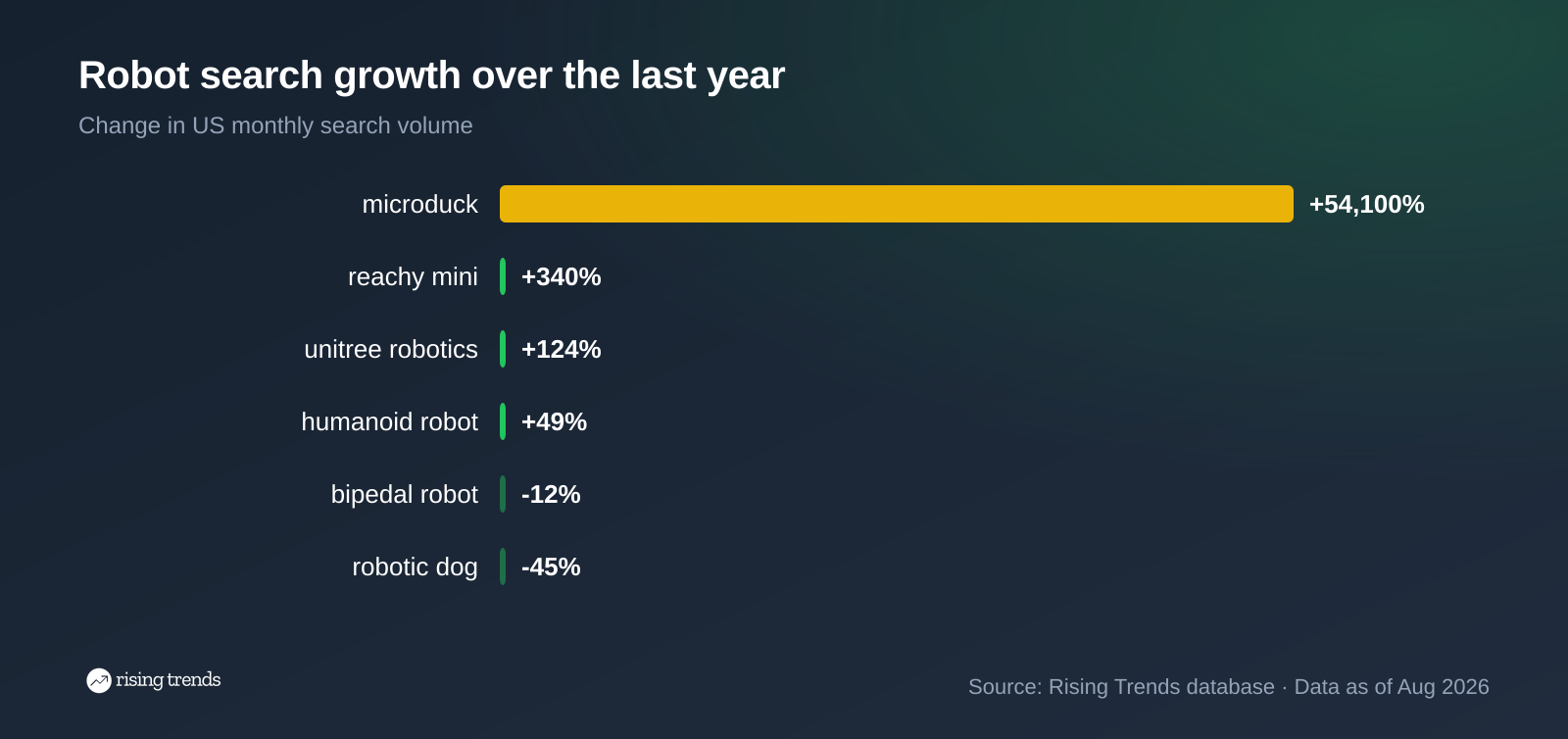
Robot dogs are in decline, down 45% in a year. The generic bipedal robot term is down 12%. Humanoid robot, the headline category everyone writes about, grew 49%, which is healthy and nothing more. The two terms accelerating are both Pollen products. A twenty-person team in Bordeaux is generating more search growth in consumer robotics than the entire humanoid category, and it is doing it at $399 a unit.
The optimistic read is about the platform, not the product. "I can see some parallel between how arduino gave hobbyist a mini computer they can use in any way imaginable", wrote one commenter on the Hacker News launch thread, "I can see this kind of thing being used to solve unimaginable problems by hobbyist or RL computer scientist". Another drew the line against cheaper camera robots bluntly: "The Microduck is meant to be a hacker toy. Train it yourself, write software, hack it."
The scepticism splits into two piles, and both are fair. The first is delivery. "Hardware projects are notorious for delivering late, with fewer features, or not at all", one commenter wrote in the same thread. "Microduck looks amazing, but the 'Ships before Christmas 2026' is begging to be blown past. That's why I'm not pre-ordering." Pollen's answer came on September 30, when the company posted its production schedule: 10,950 units between December 10 and January 10, weekly batches, earliest orders first. That is a specific, checkable promise, and it is the number to hold them to.
The second is the open-source claim. "I couldn't find hardware open source", wrote another. "If only I could 3d print and build it myself, that would be hell of a project." Pollen agrees, and says so in the press kit: the open-source statement covers the software stack, and reporters are asked not to call the robot open-source hardware. Apache-2.0 gets you every policy, the simulator and the full training pipeline. It does not get you the CAD.
The last doubt is the one a hobby forum put best. "Unsure if it is capable of being an autonomous pet that seamlessly integrates into your environment", wrote the admin of Robots Around The House on launch day, "or more a toy for developers to tinker with". After six weeks of coverage, the honest answer is the second one, and Pollen has never claimed otherwise.
Price is now the product feature. A $399 biped with a published RL stack makes the research-tier platform a harder sell for anyone who is learning rather than publishing. The relevant comparison is not another toy, it is the opportunity cost of a graduate student's first six months. Consumer robot hardware has been creeping toward this for two years, visible in the Beni camera robot at $549 and in the service plays like Tau Robotics at $60 an hour, but Microduck is the first one where the training infrastructure is the pitch.
Open weights are becoming open behaviours. Pollen's stated ambition is that a walking policy gets shared the way a model does, with the environment and the training recipe attached. If that works, the moat in consumer robotics stops being the hardware and starts being the policy library, which is exactly the dynamic that played out in software. The same shift is why Nvidia paid $12.93 billion for the place those files live, and why the Nvidia hardware line keeps showing up in searches next to developer tools rather than next to GPUs.
Falling over is a product category. Every spec here follows from the decision to make failure cheap: 780 g so it does not break itself, a beak instead of an arm, a stand-up policy in the box, spare motors sold as a $119 pack. That is a different engineering target from the humanoid race, and the search data says it is the one buyers are responding to.
December 10. The production window Pollen published is the first falsifiable claim in this story. If units ship on schedule, expect a second spike in "microduck" as reviews and unboxings land on real hardware. If they slip, the tell will show up first in our microduck trend page as queries shift toward shipping and refund language.
The parent company. The Nvidia deal is announced, not closed. Watch whether Pollen keeps publishing Apache-2.0 training code at the current pace through the regulatory process. The repository commit history is a better signal than any statement.
Whether the category follows. The clearest test of the thesis is bipedal robot and the generic terms around it. Right now Microduck is pulling demand to itself without lifting the category, which is what a product fad looks like. If the generic terms start climbing in the next two quarters, the cheap end genuinely opened a market. If they stay flat while Microduck holds, Pollen built a brand, not a category.
Either way, the number to remember is the one at the top. Seventy searches in July, 27,100 in August, from a company most people had never heard of, for a robot whose main skill is getting back up. The expensive end of robotics spent 2026 arguing about humanoids. The cheap end shipped.
Want to spot the next breakout product before the reviews land? Read our guide on how to identify market trends, follow the live microduck trend page, or browse what is breaking out right now on the Rising Trends dashboard.
Thousands of Emerging Trends
Thousands of Breakout Apps
Mega Trends
Trend Analysis Tool