Trends


In June 2026, searches for "nvidia spark" hit 40,500 in the US, more than four times the month before. Two years earlier the term was doing 50 searches a month. Something happened on May 31, and it was not a product launch in the normal sense.
NVIDIA announced a second, completely different machine and gave it the same first name. There is now DGX Spark, a 1.2 kg box that sits on a developer's desk, and RTX Spark, a superchip going into Windows laptops from Dell, Lenovo and Microsoft. Our search data shows people cannot tell them apart, and that confusion is worth about 119,600 searches a month.
Key takeaways:
Let's get into it.
Here is "nvidia spark" over the last two years, straight from our database. One bar does most of the work.
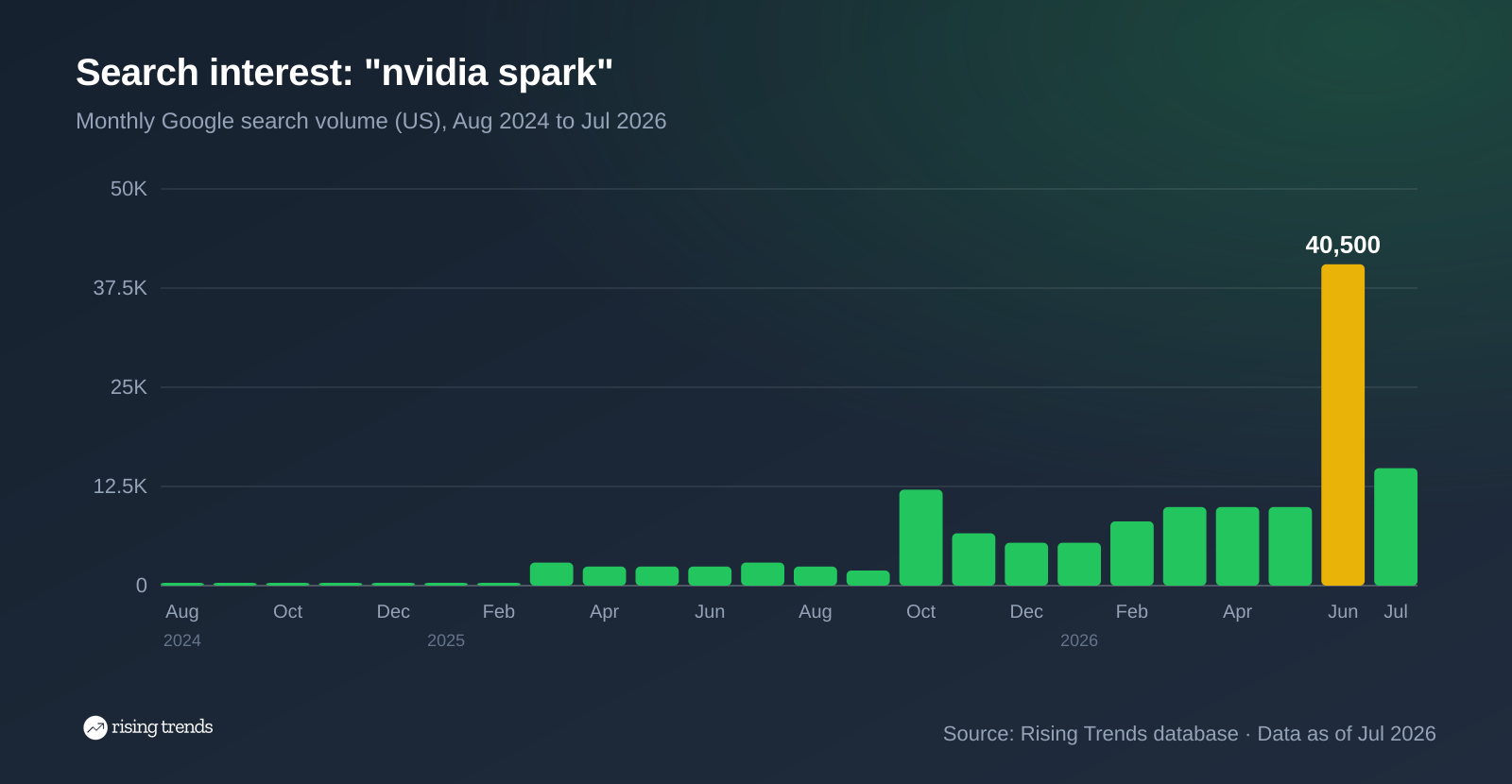
The breakout month is October 2025, when the term jumped from 1,900 to 12,100 as the first DGX Spark units reached buyers. Then it settles into a band between 5,400 and 9,900 for seven months. June 2026 breaks it: 40,500 searches, a 4.1x jump in a single month, following NVIDIA's May 31 announcement of RTX Spark at GTC Taipei.
July came in at 14,800. That fall is the honest part of the story. Two thirds of the June number was one announcement cycle, and what stayed behind is still 410% up year over year. Announcement spikes usually give everything back. This one did not.
The wider family is where the naming problem shows up.
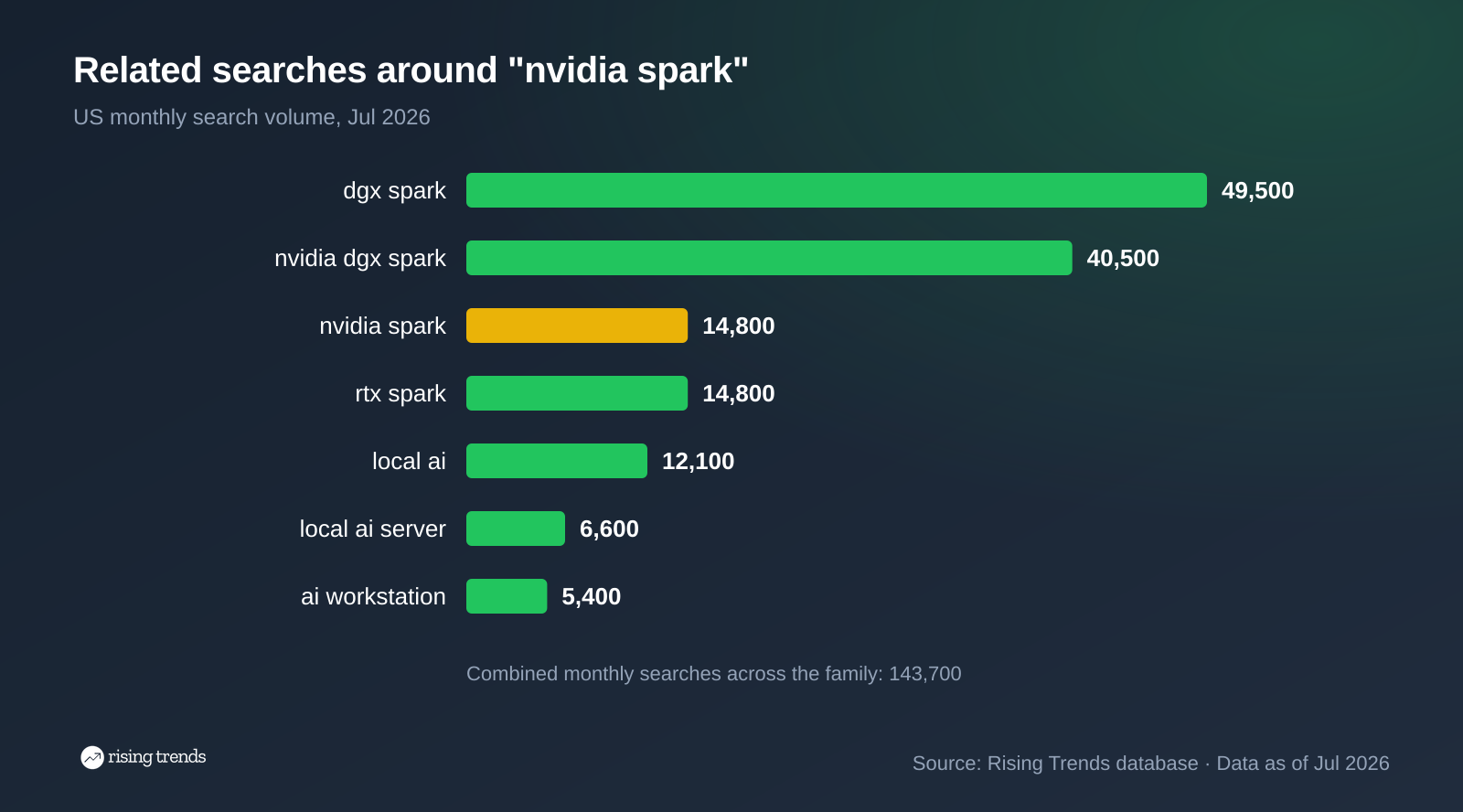
Add the four Spark terms and you get 119,600 monthly searches as of July 2026. Now look at the split. The two DGX Spark terms hold 90,000 of that. rtx spark, the brand-new consumer product, holds 14,800.
The developer box announced a year earlier is absorbing most of the demand created by the consumer launch. That is what happens when two products share a name: the older one has the search history, so it collects the traffic.
Underneath both sits the thing they are actually selling into. local ai is at 12,100 searches and up 537% in a year, "local ai server" is up 9,329%, and ai workstation is up 514%. People want models running on hardware they own, and the Spark line is the first mainstream answer.
It is a personal AI supercomputer in a box the size of a hardback book.
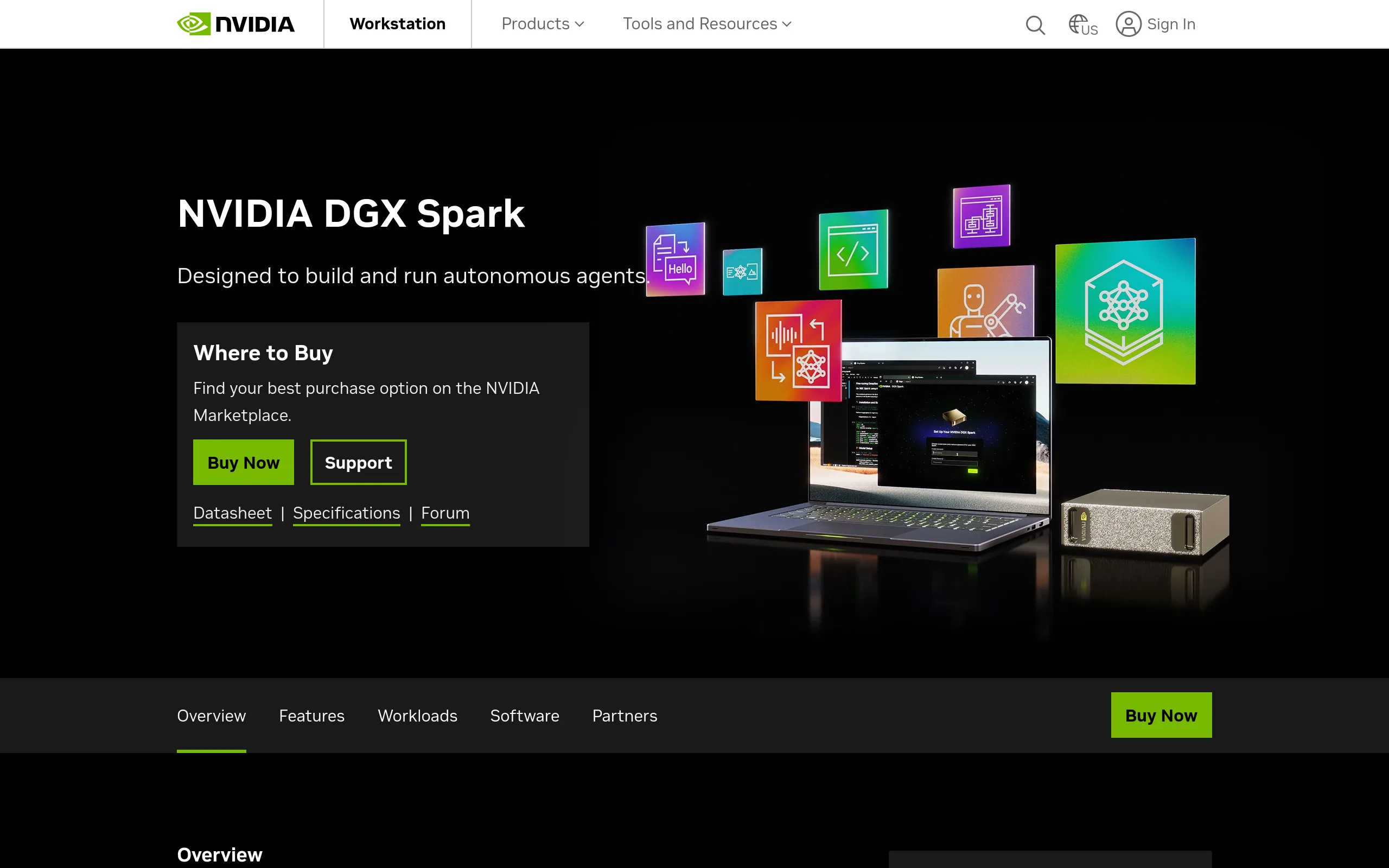
From NVIDIA's specification table: a GB10 Grace Blackwell Superchip pairing a Blackwell GPU with a 20-core Arm CPU, up to 1 petaFLOP of FP4 performance, 128 GB of coherent unified system memory at 273 GB/s, 4 TB of self-encrypting NVMe, and a ConnectX-7 NIC running at 200 Gbps so two units can be linked. It draws 240 watts, measures 150 by 150 by 50.5 mm, weighs 1.2 kg and runs NVIDIA's own DGX OS.
The numbers that matter to a buyer are the model ceilings. NVIDIA says it inferences models up to 200 billion parameters and fine-tunes up to 70 billion. That is the entire pitch: the class of model you would otherwise rent by the token.
One detail from the spec sheet is easy to miss. Declared noise is 35 dB operating and 19 dB idle. This is a machine designed to sit on a desk in a room with a person in it, which is not something you can say about the rest of the DGX line.
Note what the page does not have. There is no price anywhere on it. The "Where to Buy" box says "Find your best purchase option on the NVIDIA Marketplace" and sends you off-site. For a product with 90,000 monthly searches on its name, that is a deliberate choice.
RTX Spark is a chip, not a box. NVIDIA announced it on May 31, 2026 in a joint release with Microsoft, and the framing is a Windows PC that runs agents locally rather than a developer appliance.
The silicon: a Blackwell RTX GPU with 6,144 CUDA cores and fifth-generation Tensor Cores with FP4, connected over NVLink-C2C to a 20-core Grace CPU that MediaTek helped design. Up to 1 petaflop of AI compute and up to 128 GB of unified memory, which on paper puts it in the same league as the DGX box.
What it is meant to do is different. NVIDIA's list: run 120-billion-parameter models with up to 1 million tokens of context, render 90 GB 3D scenes, edit 12K video, and play AAA games at 1440p over 100 frames per second. It is a creator and gamer machine that happens to run agents.
Jensen Huang's line in the release is the clearest statement of intent anyone at NVIDIA has made about the PC: "For forty years, you launched apps. Click. Type. With RTX Spark and Microsoft Windows, you ask, and the PC does the work." Satya Nadella's contribution was the phrase "unmetered intelligence to every home and every desk with Windows".
Treat both as what they are, which is marketing from an announcement. The checkable part is the partner list: ASUS, Dell, HP, Lenovo, Microsoft Surface and MSI at launch, Acer and GIGABYTE to follow, with Adobe rebuilding Photoshop and Premiere for the platform.
Here is the argument driving the searches, made by a reviewer rather than by NVIDIA, published August 9, 2026.
The title is the thesis in six words: buy the hardware once, stop paying per token. Whether that arithmetic works depends on a price NVIDIA has not published.
| DGX Spark | RTX Spark | |
|---|---|---|
| What it is | A complete desktop system | A superchip inside other companies' PCs |
| Chip | GB10 Grace Blackwell Superchip | RTX Spark: Blackwell RTX GPU plus 20-core Grace CPU |
| AI compute | Up to 1 petaFLOP FP4 | Up to 1 petaflop |
| Memory | 128 GB unified, 273 GB/s | Up to 128 GB unified |
| Model ceiling | 200B inference, 70B fine-tune | 120B with 1M tokens context |
| Operating system | NVIDIA DGX OS | Windows |
| Gaming | Not a stated use | 1440p above 100 fps with ray tracing |
| US monthly searches (Jul 2026) | 90,000 across two terms | 14,800 |
The practical difference is who the machine belongs to. DGX Spark is a second computer you buy to run models. RTX Spark is meant to be your only computer, which is why the Windows security work matters more than the chip specification. NVIDIA and Microsoft added new Windows security primitives and a runtime called OpenShell that decides what an agent may touch and whether a query goes to a local model or the cloud.
That is the part the AI agents story has been missing. Agents that can act on your machine are only as acceptable as the sandbox around them.
Local inference stops being a hobby. The whole family of local AI terms in our database is growing at triple digits, and the reason is arithmetic: a fixed hardware cost against a per-token bill that scales with how much you use it. The same tension runs through everything we cover in generative AI, where the cost of running models has become the product decision.
The PC refresh cycle now has an AI reason. Windows machines have needed a reason to upgrade for a decade. A chip that runs a 120-billion-parameter model on battery is the first one that is not a faster version of what you already own.
NVIDIA is selling the same idea twice. DGX Spark reaches developers, RTX Spark reaches everyone else, and both are arguments for buying compute rather than renting it. The company that sells the cloud its chips is now selling you the reason not to use the cloud.
The naming will cost them. Our data shows "dgx spark" outdrawing "rtx spark" six to one after the consumer launch. People searching for the laptop are landing on the developer box. That is a self-inflicted wound, and it is measurable.
October, and whether the curve moves again. NVIDIA said on September 3 that RTX Spark Windows PCs arrive in October, starting with Lenovo and Acer. If shipping hardware pushes "rtx spark" past its 14,800 and the DGX terms stay flat, the names have separated in people's heads. If DGX keeps climbing instead, the confusion is permanent. The live NVIDIA Spark trend page is where that shows first.
A published price. As long as neither product page carries one, the subscription-versus-hardware comparison that reviewers are making is guesswork. The moment NVIDIA publishes, the comparison gets real and so does the buying decision.
Whether the local-AI terms keep compounding. "local ai server" is up 9,329% in a year from a small base. That is the leading indicator for this whole category, more than any single product name, and it is the one to watch alongside the cybersecurity angle that decides whether businesses let agents run on employee machines at all.
The thing to hold onto is the shape of that June bar. A single announcement moved a search term by 30,000 in a month, and two thirds of it went away by July. What is left, a term running four times higher than a year ago with no product yet in stores, is the demand that was already there for something NVIDIA has not quite shipped.
Want to catch the next hardware shift while it is still a search curve? Read our guide on how to identify market trends, follow the live NVIDIA Spark trend data, or browse what is breaking out right now on the Rising Trends dashboard.
Thousands of Emerging Trends
Thousands of Breakout Apps
Mega Trends
Trend Analysis Tool