
Trends


Two years ago about 2,900 people a month typed "meshy" into Google. As of August 2026 it is 49,500, and the curve has not given back a month since February. Add the second spelling, "meshy ai", and the company pulls 110,000 searches a month, more than every generic phrase for the thing it sells combined.
Meshy turns a photo or a line of text into a 3D model in about a minute. In July it raised nearly $400 million at a $1.5 billion valuation, in September it said annual recurring revenue had passed $100 million, and nothing ranking for its name has the search curve or the comparison that explains it. Here is the part nobody is writing down: the AI 3D category is not rising together. It is splitting, and the money is moving from capture to generation.
Key takeaways:
Let's get into it.
Here is the monthly search volume for "meshy" over the last two years, straight from our database.
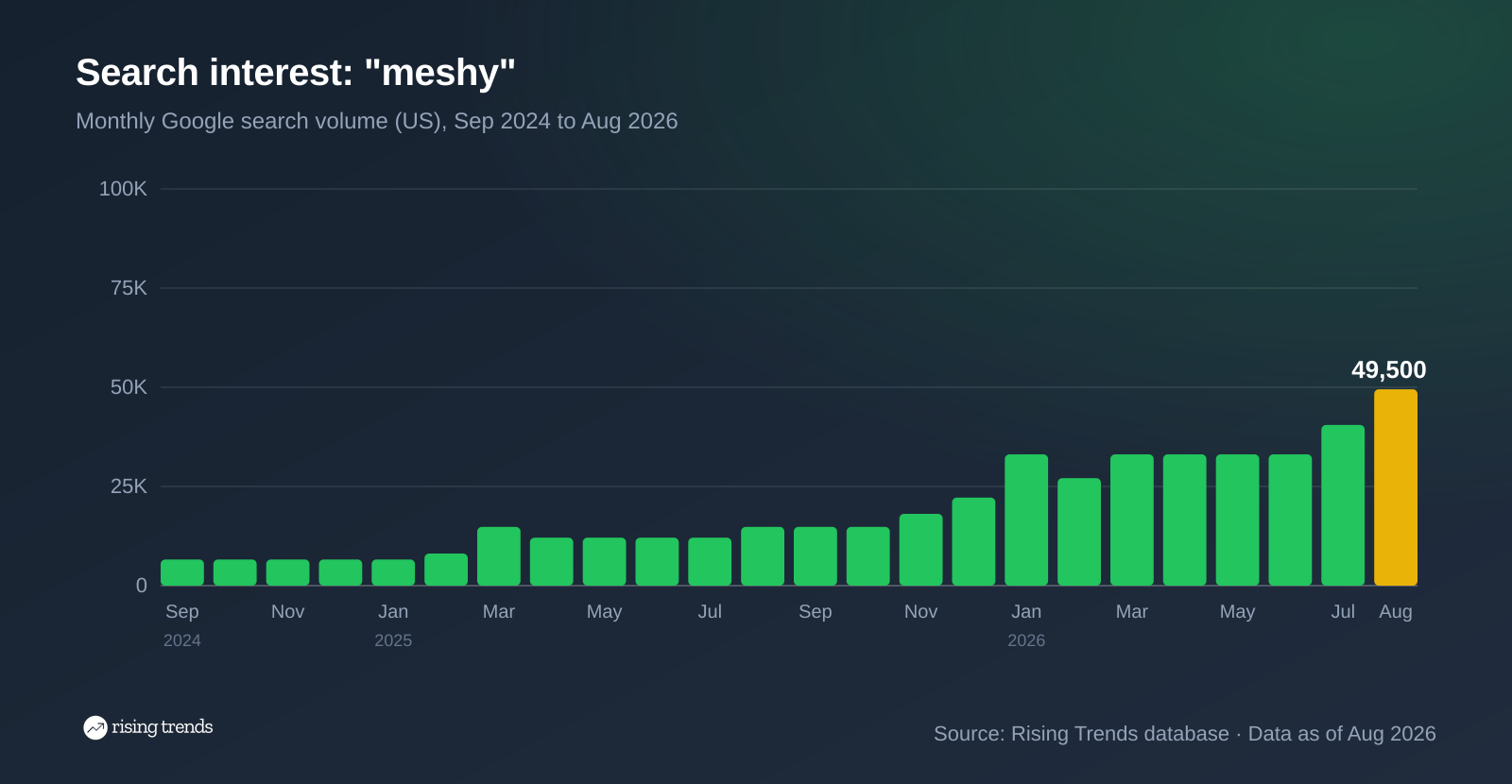
The shape is a staircase with one long plateau. The breakout month is March 2025, the first month the term crossed a quarter of its eventual peak. January 2026 jumps to 33,100 and sits there for five months. July takes it to 40,500 and August to 49,500, the peak. A year earlier it was 14,800. Our pace classification is EXPONENTIAL, as of August 2026.
What matters more than the curve is who is climbing it with them, and who is not.
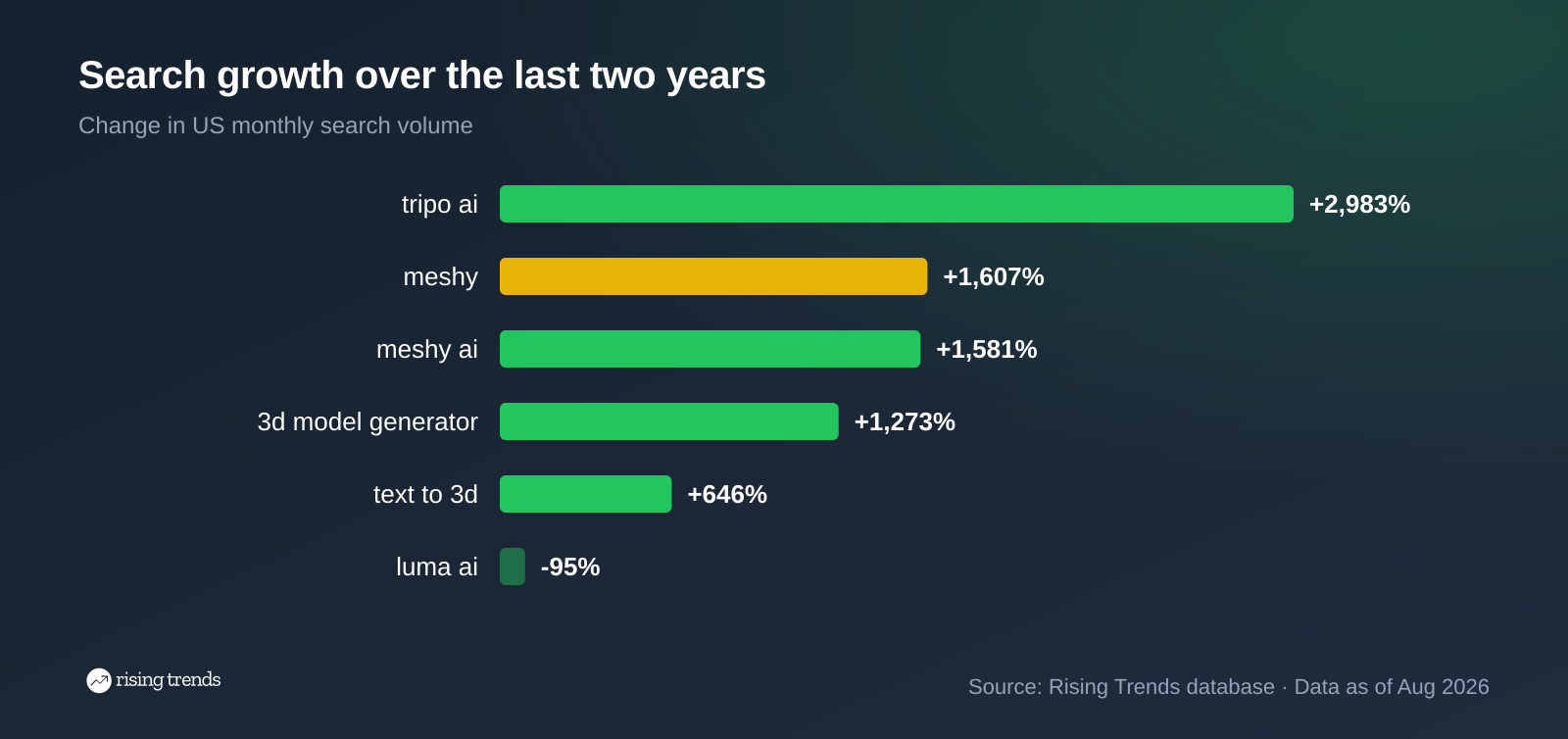
Read it from the bottom. Luma AI is down 95% in two years and down 18% in the last year, at 22,200 searches a month as of August 2026. Its sister terms fell further: luma labs down 84%, lumalabs ai down 99%. Luma made its name on capture and video. Meanwhile Tripo AI is up 2,983%, Meshy is up 1,607% and text to 3d is up 646%. Everything rising is generation. The thing falling is capture.
That is the comparison none of the pages ranking for "meshy" will give you. The third chart is the other half of it.
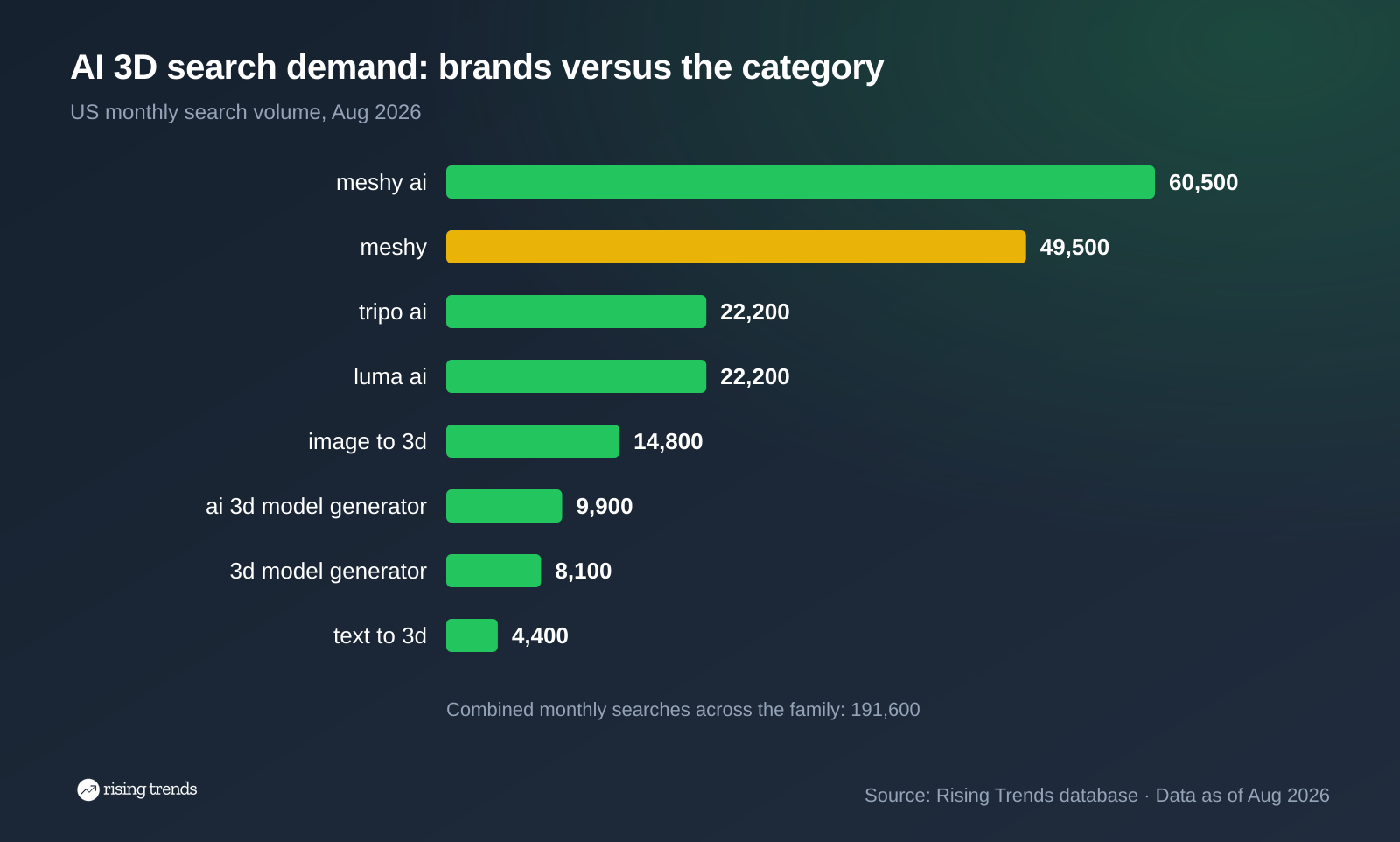
Add up the family and you get 191,600 monthly searches for AI 3D generation as of August 2026. The two Meshy spellings are 110,000 of it. The five generic phrases, the ones you type when you do not know which tool to use, total 39,600. People have stopped searching for a category and started searching for a company, the same pattern we saw when generative AI stopped being a technique and became a shortlist of names.
You give it a photo, a sketch or a sentence. About a minute later you get a textured 3D model you can download as FBX, OBJ, GLB, STL, USDZ or 3MF. That is the whole pitch, and the homepage makes no attempt to dress it up.
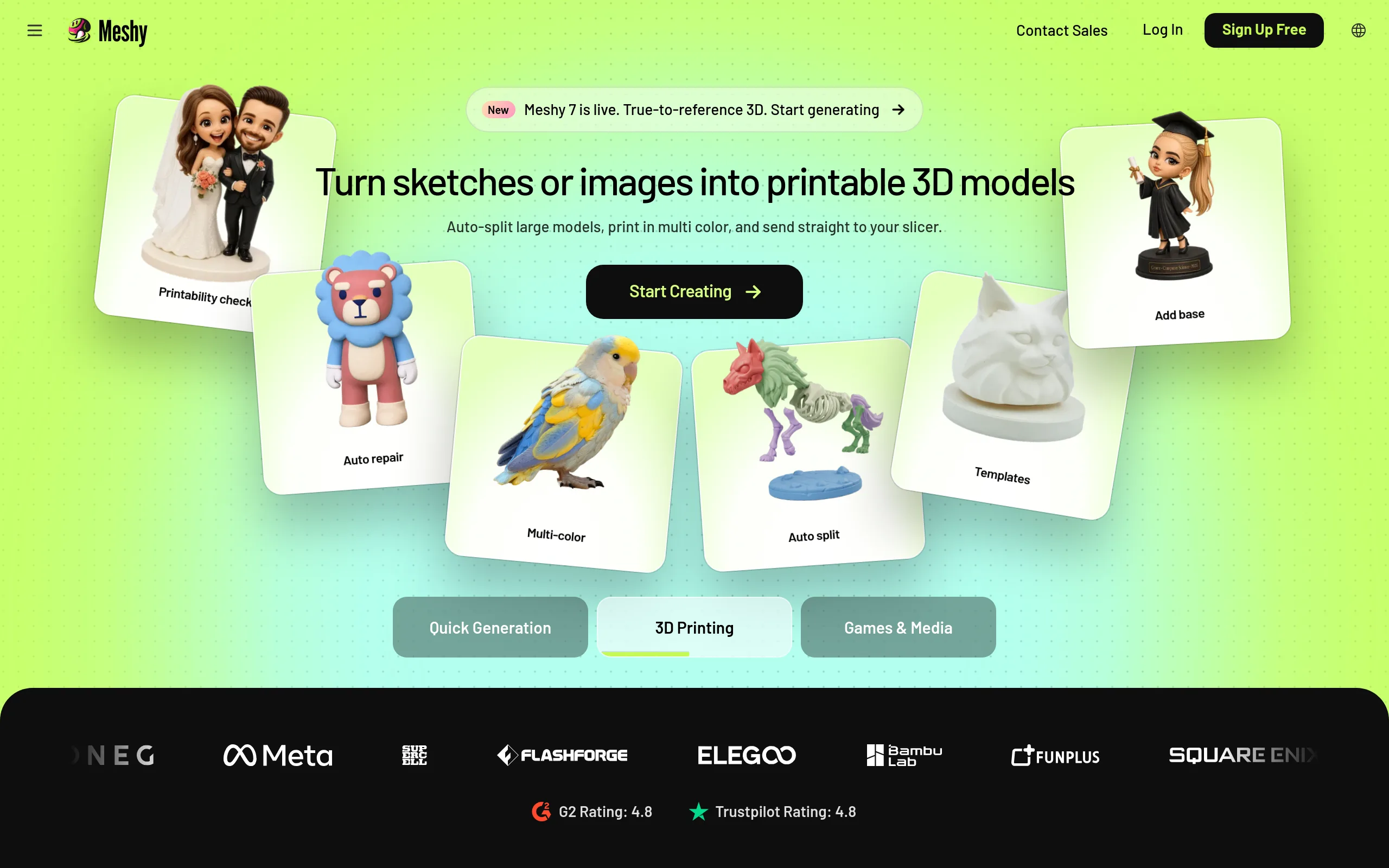
Look at which tab is open. Meshy launched in 2023 aimed at game developers, and games are still its core business, with auto-rigging, animation presets and plugins for Unity, Unreal, Godot, Roblox and Blender. But the default tab on its own front door is now 3D Printing, and the headline says "printable" rather than "game-ready". A company that started selling props to studios now leads with the hobbyist at a Bambu Lab printer.
The business model is credits on a subscription. The free plan gives 100 credits a month with no card, but your outputs come back under a CC BY 4.0 licence, so they are public and you must credit Meshy. Pro buys privacy and speed: 1,000 credits, API access, private ownership, 10 concurrent tasks. Credits do not roll over, and in the lab test below one high-detail generation cost 25 credits plus 10 for the texture. Call it 30 finished models a month before retries.
The models have moved fast. Meshy 7 shipped on August 12, 2026 with a published benchmark, which is unusual here. From a single image it scores 81.0% on overall proportion, 79.7% on spatial distribution and 59.8% on surface details, against four rival foundation models on reference meshes held out of training, where 100% is the reference measured against itself. The company's point is the last column: no model tested reaches 60% on surface detail, and Meshy 7 leads it by 5.3 points.
Then on September 16 came Meshy 7.1, with an Ultra 4K mode that generates geometry at 4096 cubed voxel resolution. The company says that makes it the first generative 3D model to reach it. Stitching and woven fabric come out as geometry rather than texture painted on top.
Three dated events sit under the three steps in the curve.
July 21, 2026: the money. Meshy announced a Series B of nearly $400 million at a $1.5 billion valuation, its first publicly disclosed price. The release describes it as the largest round to date for a company built specifically for AI 3D. Worth noting what the announcement does not say: it names no investors, only "a group of leading global investors, with participation from all existing investors." The investor list that circulated afterwards, led by IDG Capital, Matrix Partners China and Monolith with HongShan and Source Code Capital joining, comes from 3Dnatives, not from the company.
September 8, 2026: the research hire. Dr. Xin Tong joined as Chief Scientist after 25 years at Microsoft Research Asia, with more than 190 papers and over 21,000 citations as of September 2026. "Computer graphics is entering a new chapter," he said.
September 30, 2026: the revenue. The company said ARR had passed $100 million, up 100x from $1 million in under two years, the first AI 3D company there by its own account. Same release: more than 15 million registered users, over 3,000 companies and schools, 100 million models generated, and teams at 200 of the Fortune Global 500.
The creator reaction is where the search demand comes from. This September 2026 test from the YouTube channel Trainer1300 is the kind of video people watch before they type the name into Google: a third-party comparison of Meshy 7 against the other generators.
The makers are more divided than the headlines. On the Bambu Lab community forum in January 2026, a user posting as kartzy wrote that Meshy "helps create the base model for you to work on top of it; it already gives you 60-90% of the final product. You just need to polish things in the end." Two days later another, Zhalindor, put it this way: "Meshy is a great tool for converting imagest to printable files, but just as Firefly is a great addition to photoshop, it just doesn't do things for you, but rather with you." In the same thread, JamesDa3dWiz was blunter: "I use Meshyai, but in my opinion, it always gets what I want wrong."
This is the part the ranking pages skip, and the company does not.
Meshy's own help centre published a page in August 2026 titled When Is Meshy the Right Tool for Your 3D Workflow. It says Meshy is "less suited to jobs that require exact, pre-specified dimensions to the millimeter, hard-surface parts that must mate precisely with existing hardware, or production-final assets where a fully hand-authored, clean topology is a hard requirement." It adds that generated meshes "usually benefit from some retopology, UV cleanup, or manual texture touch-ups." That is a vendor telling you to budget for cleanup.
An independent lab test published on September 23, 2026 put numbers on it. 3Dnatives generated nine models with Meshy 7.1 and measured the exported files rather than the prints. The findings:
| What they measured | What they found |
|---|---|
| Open edges (holes) across 9 files | Zero |
| Files that were one clean closed solid | 2 of 9 |
| Separate bodies in the other seven files | Between 8 and 51 per file |
| Non-manifold junctions per file | Between 16 and 99 |
| Triangle count range | 385,000 to 2.97 million |
| Real-world scale in the exported 3MF | None. Every file arrived exactly 50 mm tall |
Two failures are structural, not bugs. First, the unseen side of every object is invented. A cathedral photographed from one side came out round at both ends instead of cross-shaped. A watch photographed on a wrist produced a forearm, hand and knuckles with a small watch on it. Second, texturing does not give you a colour print file: the geometry is identical before and after, and the texture stays in a separate format.
Meshy's own marketing figure is that around 97% of figurine-type models pass slicer validation, from a May 2026 test of 75 models across five generators. 3Dnatives noted the obvious: that is 15 models per tool, and 97% of 15 is not a whole number. The 97% claim is real but thin.
The honest version is the one HenriqueGibi gave on an itch.io 3D art thread in September 2024, which has held up through four model generations: "The models aren't perfect, but you can import them into Blender, make the necessary small adjustments, and fine-tune them your way." He also priced the alternative: that set of characters would have cost him about $450 from a freelancer.
The competitive picture in our data is not a race between near-equals. It is one group compounding and one group collapsing.
Tripo AI is the closest rival by trajectory: 22,200 searches a month as of August 2026, up 2,983% in two years, faster than Meshy's own. It shows up in the same forum threads as the thing people test next. Luma AI is the cautionary tale at the same 22,200 volume, down 95% over two years. Its strength was capture and video; when demand moved to prompt-to-asset, the brand did not move with it. Tencent Hunyuan 3D is up 20,900% but from almost nothing, at 210 searches a month.
The category terms tell you where the beginners are. 3d model generator is up 406% in a year at 8,100 and image to 3d is up 410% at 14,800, but "ai 3d model generator", the oldest generic phrase, has slowed to 50% a year. New demand goes to newer phrasings and to brand names.
3D printing turned out to be the consumer market, not games. Meshy started with game studios and still serves Nexon and NetEase Games, but the breakout customers in its own announcements are printer brands: Bambu Lab, Creality, Elegoo, FlashForge, xTool. A studio has artists and a pipeline. A person with a $300 printer has neither, and the gap between "I want a thing" and "I have a file" was the whole bottleneck.
Published benchmarks are becoming a competitive weapon. Meshy published its alignment benchmark method with the results and open-sourced the suite. In a category where every vendor claims the best quality, a number rivals can reproduce is a moat made of credibility. Expect answering benchmarks.
Generation beat capture, and that resets the 3D content pipeline. The collapse in Luma AI's search demand next to the compounding in Meshy and Tripo is the clearest signal in our data. Scanning the world was the obvious way to get 3D content and it lost to describing it. The same shift shows up on our VR and AR trends page, where the AI tools filling virtual worlds are outgrowing the devices that display them.
The training-data question is unresolved. 3Dnatives found Meshy's Terms of Use allow it to use images non-Enterprise customers upload, and the models they generate, to improve its services, while the FAQ on its own pricing page says data will not be used for training without consent. Enterprise is excluded by contract. Read both before you upload client work.
Worlds, not objects. The next step is Mora, short for Multimodal Open-world Real-time Architecture, which hands game logic to coding agents, spatial structure to Meshy's 3D generation and final imagery to a real-time video model. A playable demonstration is public. That is the bet we unpacked in world modeling, explained, approached from the asset end rather than the renderer end. Watch whether Meshy's volume keeps stepping up in months with no funding headline. If it does, the consumer products are carrying it.
The cleanup gap closes or it does not. Every real criticism, from the help centre to the lab test to the forum posts, lands on the same point: the file needs work before it is production-final. Ultra 4K made geometry richer, which makes files heavier and cleanup harder. The company that automates the step after generation wins the professional market.
Price is the pressure point. Credits that do not roll over, retries that cost the same as first attempts and a free tier that takes a CC BY 4.0 licence on your output are all friction a rival can attack. Tripo's 2,983% two-year growth says somebody is trying. Watch the gap: Meshy is 2.2x Tripo on volume as of August 2026, and Tripo is growing faster.
The search data makes the signal plain. Two years ago "make me a 3D model" was a prompt you typed into a research demo. Today it is a $100 million revenue line, a $1.5 billion valuation and 191,600 people a month looking for how to do it. The output still needs a pass in Blender. Fewer of them care than you would think.
Want to spot the next breakout company before it makes the funding headlines? Read our guide on how to identify market trends, follow the live Meshy trend page, or browse what is breaking out right now on the Rising Trends dashboard.
Thousands of Emerging Trends
Thousands of Breakout Apps
Mega Trends
Trend Analysis Tool