
Trends


Two years ago "ai mods" was a rounding error in our database: 140 monthly searches. As of August 2026 it is 18,100, and the climb has no flat stretch in it. The searches are from people who want to install a mod that an AI wrote, or write one themselves, or find out why half the mods on their favourite game suddenly look the same.
Most coverage is a highlight reel of Minecraft inside Elden Ring. That is the fun part, not the story. The story is that two of the biggest mod hosts rewrote their rules ten weeks apart, a ten-year overhaul project sabotaged its own files in protest, and our data says the demand is not sitting with the hosts at all.
Key takeaways:
Let's get into it.
Here is the monthly search volume for "ai mods" over the last two years, straight from our database. For the first nine months it sits under 400 a month, a flat line at the bottom of the chart.
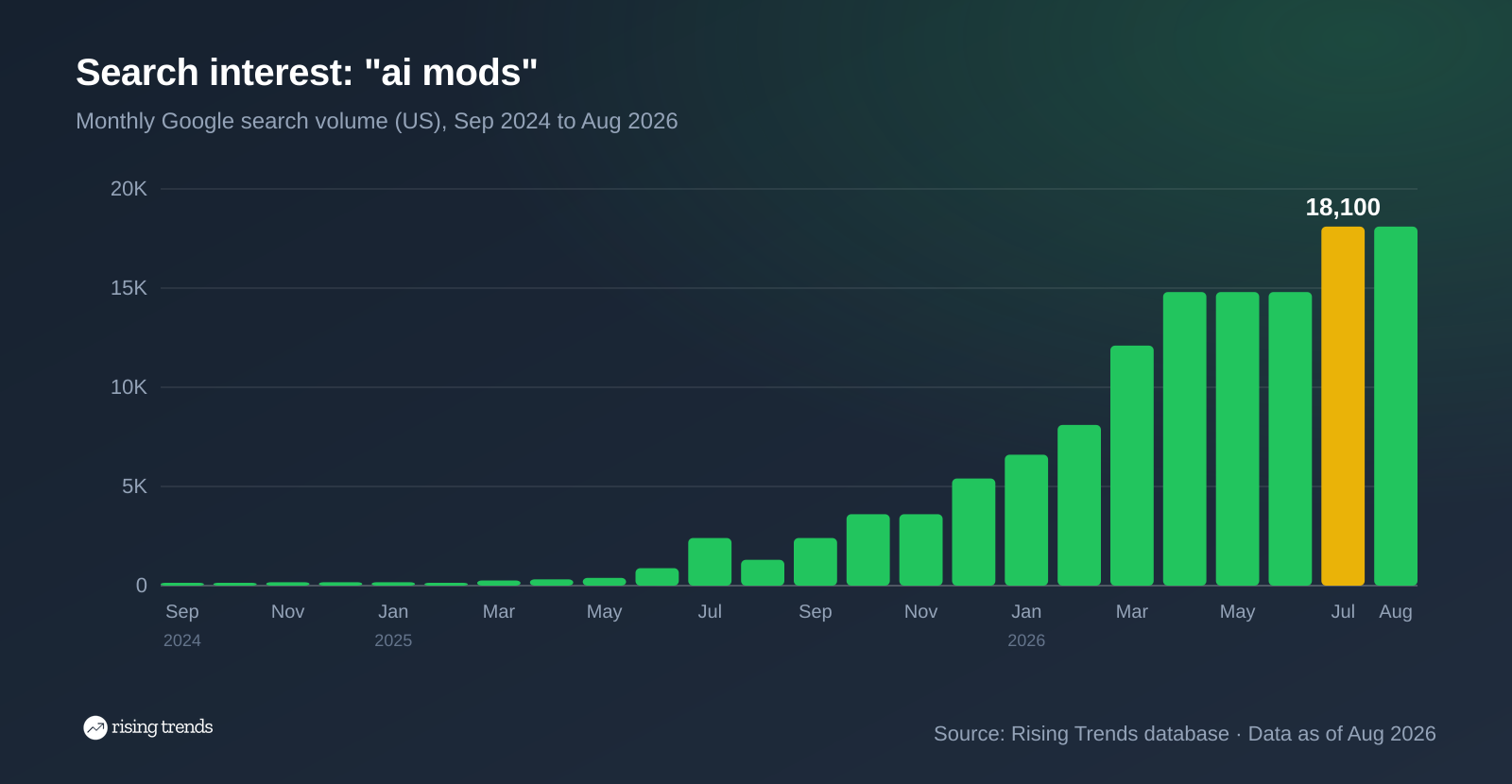
The breakout month is December 2025, when the term first crossed a quarter of its eventual peak. From there it never gives a month back. It hit 18,100 in July 2026 and held 18,100 in August, 129 times the level of two years earlier and up 1,292% on the year. The shape matters as much as the number: no spike, no comedown, twelve straight months of gains. That is a behaviour being adopted, not a news cycle.
The more useful question is what the term is growing against. We pulled every modding-adjacent search in our database and ranked them by one year of growth.
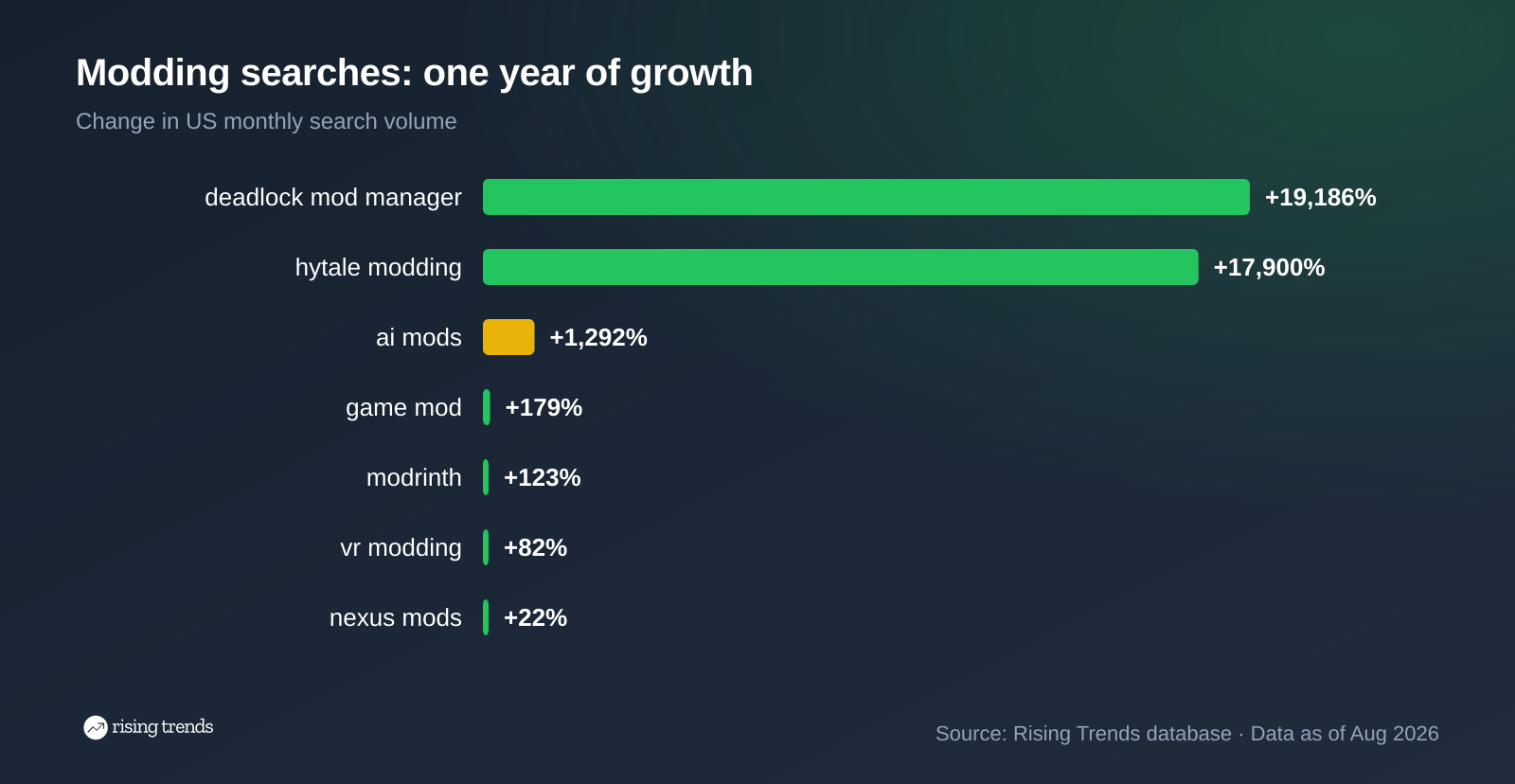
This is the comparison that reframes everything else in this article. "Nexus mods" grew 22% in a year and is still by far the biggest term in the family. "Modrinth" grew 123%. Meanwhile the layer above the hosts, the tools and the per-game tribes, compounds: ai mods up 1,292%, hytale modding up 17,900%, deadlock mod manager up 19,186%.
The platforms writing the AI rules are flat. The population those rules apply to is arriving through software the platforms do not control.
Three different things wear the same label, which is why the arguments go nowhere.
The first is generated content inside a conventional mod: AI voice lines, textures, concept art, translations. The oldest category, and the one that upset voice actors first.
The second is live AI in the game loop. Mantella, a Skyrim mod by a developer who goes by Art from the Machine, pipes an LLM into NPC dialogue so characters answer what you actually say. First uploaded in August 2023, its version 0.14 added group conversations of up to five NPCs and seventeen actions the model can trigger in-game, including Barter, Brawl, Flee and ReportCrime. The Mantella mod page carries 3,380 endorsements and more than 3,000 hand-written NPC background descriptions.
The third went viral: an agent writing the mod itself. You point a coding agent at a game you own, it works out the engine, reads the decompiled code, writes the patch, generates the assets and tests the result in the running game. The toolkit behind most of the October clips is universal-modder.
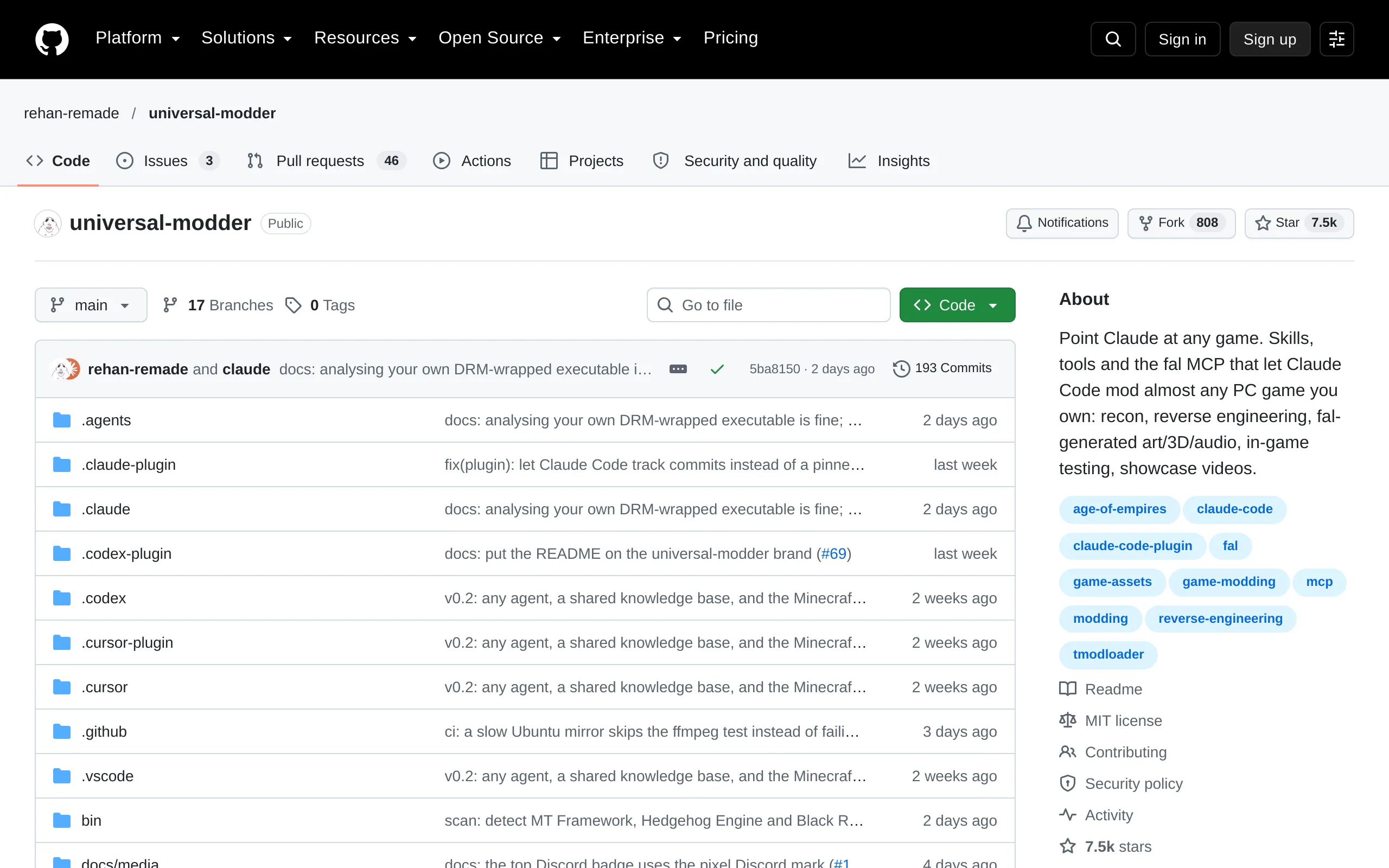
It is MIT licensed and it is not an app. It is a set of agent skills, a command-line tool and a shared knowledge base, installed into Claude Code, Codex, Cursor, Gemini CLI or Copilot. The universal-modder repository ships engine playbooks for Unity, Unreal, Godot, Bethesda, FromSoft, GTA and a dozen more, and its own example prompts read "Put real Minecraft inside GTA V story mode" and "Port the Warthog from my Halo install into Minecraft". Every agent that finishes a mod is asked to open a pull request with a field note, so the next one starts from what the last one learned. The knowledge base is written by machines, for machines.
The mashups use a trick called a passthrough mod. Rather than porting one game into another, it runs both at once: one title hosts the world, the other supplies movement and combat, and the mod synchronises the cameras and passes events across. It is closer to the ingenuity behind PS5 emulators than to an asset swap.
The search curve was already climbing before anything went viral. What the last three months added was a fight.
On 29 July 2026 Nexus Mods posted an update on generative AI categorisation and tagging. Its community manager wrote that the single "AI-Generated Content" tag "does not allow for nuance", and split it into three: AI-Generated Content for code, voices, dialogue, music and in-game assets; AI Media for promo art, thumbnails and page descriptions; and AI Assisted for developer-led work with limited AI involvement. That last tag has to be earned. A modder claiming it may be asked to produce commit history, project file history and an explanation of their own code in a moderation dispute. The File Submission Guidelines gained one blunt line: failure to correctly tag mods, including undisclosed generative AI usage, may be subject to moderation action. Nexus still does not ban AI mods. It bans lying about them.
On 13 August 2026 Modrinth drew a harder line. Its new AI rules and project disclosures post opens with the number that explains the urgency: project submissions had gone from about 2,500 a week at the start of the year to over 5,000 a week. The new Section 6 of its content rules bars projects that are entirely or primarily AI output from being published publicly, bans AI images as icons, banners, gallery shots or in descriptions, and requires a "Contains AI-generated content" disclosure for anything substantially AI-made. The help centre article spells out what happens to a fully AI project: it can stay unlisted, but it is out of public search. A 45-day grace period ended on 27 September.
The mashup clips started the very same day: Skate inside Call of Duty on 27 September, Minecraft inside Elden Ring on 29 September, Mario Kart in World at War zombies on 30 September, Spider-Man swinging through Batman's Gotham on 2 October. The reaction was less "how does that work" than "where did all of this come from".
That clip from @haydncomley_, posted on 7 October 2026, asks it directly: how are all these AI mods being made, and where did they come from so quickly. The answer is that the toolkit was published, the agents got good enough at reverse engineering to use it, and the first people to try filmed the results.
Hours, not months. The guide behind the Spider-Man and Elden Ring merge claims three to four hours of agent time, with the caveat that first results are rough. SFO: Grimhammer III, the Total War overhaul at the centre of the backlash below, took a team nearly ten years.
That ratio is the whole behaviour change. Modding used to be gated by an unusual skill: reading a decompiled binary, knowing an engine's quirks, writing the glue. The gate is now a prompt and a weekend.
Not that AI mods exist. That they do not work, and that they are hard to tell apart from mods that do. On the Mantella comment thread, where thousands of players run an LLM in their game daily, the complaints are operational rather than ideological. "Most problems happen when using a small AI model," wrote opaqueman on 5 October. "Don't go under 12b at q4. Anything smaller and its to dumb to understand." Another player, JustbLoWsMokE, described the lag: "This I think is just a limitation of this new tech... it takes around 10-15 seconds before the conversation initializes."
That is the good end of the behaviour: people tuning models and trading quantisation advice on a mod page. The bad end is a flood of submissions nobody ever ran.
Modding scenes run on attribution. There is no money in most of them, so reputation is the currency, and taking someone's work without permission is the unforgivable act.
On 3 October the creator of SFO: Grimhammer III, who goes by Venris, broke his own mod on purpose. His statement: "Due to the growing number of unauthorized reuploads of SFO: Grimhammer III, and more importantly, the use of AI in the process, I have deliberately corrupted the mod to prevent it from functioning with such unauthorized uploads. If this situation continues to escalate, I will make SFO: Grimhammer III private." He added that the project "is the result of nearly ten years of passion and love for this community", and signed off: "Support modders, not AI."
The SFO Grimhammer III workshop page claims 500,000 subscribers across the team's mods and more than 20,000 people in its Discord, all of it free with no paywall. He restored a working version days later after the response. The point had landed.
The ecosystem splits cleanly into three layers, and only one of them is growing fast.
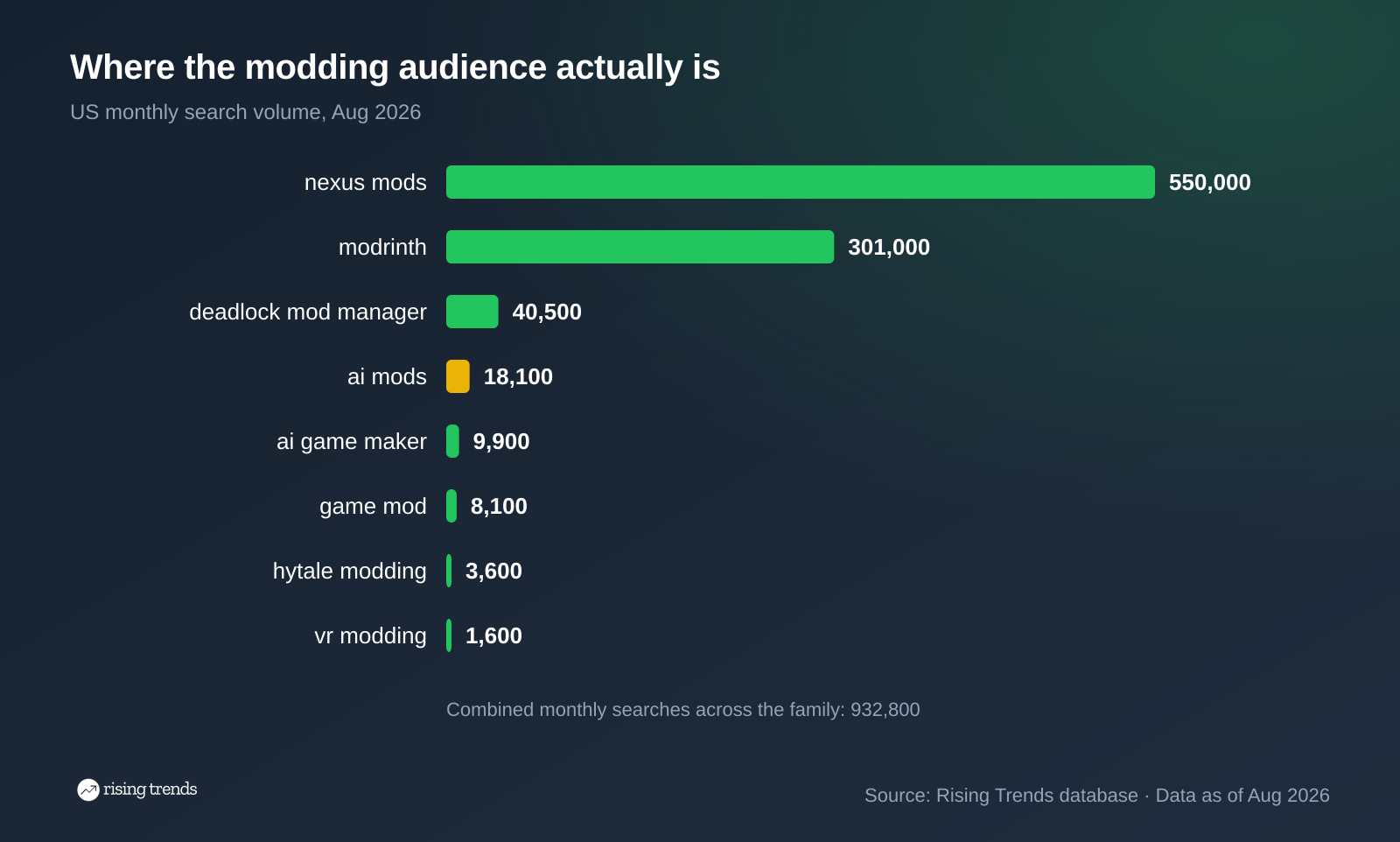
The hosts, Nexus Mods and Modrinth, hold the audience: more than 850,000 monthly searches between them as of August 2026. They also carry all of the moderation cost and none of the upside from the tooling boom.
The tool layer is where the growth is. universal-modder is the loud one, but it rides on general-purpose coding agents, which is why it supports six of them rather than shipping its own. The same capability that lets an agent run a git forge, as we covered in Cursor Origin, lets it read a stripped game binary. Asset generation is a separate business: Meshy passed $100M ARR selling text-to-3D, and a modder generating a vehicle for Minecraft is the exact customer.
The in-game AI layer is the oldest and quietest. Mantella and its peers have shipped for three years. They are not what went viral, but they are what people keep installed.
Notice who is missing. No studio has shipped an official AI modding surface. The tooling, the knowledge base and the distribution all sit outside the companies that own the games.
The moderation bill lands on the hosts. Modrinth's submissions doubled in a year and its answer was a grace period and a disclosure system, because an outright ban is unenforceable without detection it does not have. Nexus chose tagging for the same reason. Any platform accepting user-generated binaries now needs provenance tooling it never budgeted for, and the honest version of that is a checkbox plus a moderation queue.
Attribution is the new licence. The SFO episode is a preview. When reproducing someone's ten-year project takes an afternoon of agent time, the protection modders have always relied on, difficulty, is gone. What replaces it is either disclosure rules with teeth, deliberate technical sabotage, or going private. All three are bad for distribution, which is bad for the hosts.
Rights holders have not moved yet, and that is the live risk. One viral clip put Marvel's Spider-Man in a DC city, and its creator joked about waiting for the takedown. Publishers have tolerated modding for decades on the understanding that it is small, non-commercial and slow. Two of those three just changed, which raises the same ownership questions running through Xbox disc to digital.
For anyone selling into gaming, the opportunity is provenance and assets, not mods. Signing and content-origin tooling are unbuilt; asset generation already has buyers; mod hosting is a flat, 22%-a-year business with a rising cost base.
Three calls, each with a term in our database to watch.
A platform will ban first and apologise later. Modrinth's rule covers public search, not existence, and Nexus still relies on self-declaration. The first host burned by an AI mod shipping malware will skip to a ban, and the tagging era will look naive. Watch whether nexus mods stays flat while the tool terms climb: that gap measures how little leverage the hosts have.
The per-game tribes will keep outgrowing the category. Deadlock Mod Manager grew 19,186% and Hytale modding 17,900% in a year, both from tiny bases, both attached to a single title. The pattern is the same one that made open-source agent distribution explode, which we traced in the open-source AI agent gold rush: the tool that does one specific thing well beats the general platform. Expect more single-game managers, each with its own AI route.
A studio will ship the thing itself. Official, sandboxed, agent-assisted modding with a revenue share is an obvious product, and the first publisher to do it turns a legal headache into a storefront. The signal would be ai mods splitting into branded terms, the way every maturing category does. Our gaming trends and AI trends data shows that pattern repeatedly: generic interest peaks, then brands eat it.
The number we keep coming back to is the 22%. A category does not grow 1,292% in a year while its largest platform grows 22% unless the value has moved somewhere else. In this case it moved into a repository with an MIT licence, and nobody who owns a game or hosts a mod has a say in it.
Want to catch shifts like this while they are still a search curve? Read our guide on how to identify market trends, follow the live ai mods trend page, or browse what is breaking out right now on the Rising Trends dashboard.
Join 5,000+ founders · Free