Trends


Two years ago, about 590 people a month typed "netshort" into Google. As of August 2026 it is 14,800, a 26.6x increase, and the app behind the name did not exist before July 2024. NetShort sells vertical dramas in 60 to 90 second episodes, dozens of them per series, and it charges for most of them one unlock at a time.
That pricing model is the story. Every page ranking for "netshort" today is a store listing, a clipped scene or a complaint about a charge. None of them shows you the demand curve, and none of them puts NetShort next to the rest of the category, where the picture gets stranger: the app is already third in the world by downloads, but in US search demand it is a tenth the size of DramaBox. We have the whole category in our database, so let's look at both numbers at once.
Key takeaways:
Let's get into it.
Here is the monthly search volume for "netshort" over the last two years, straight from our database.
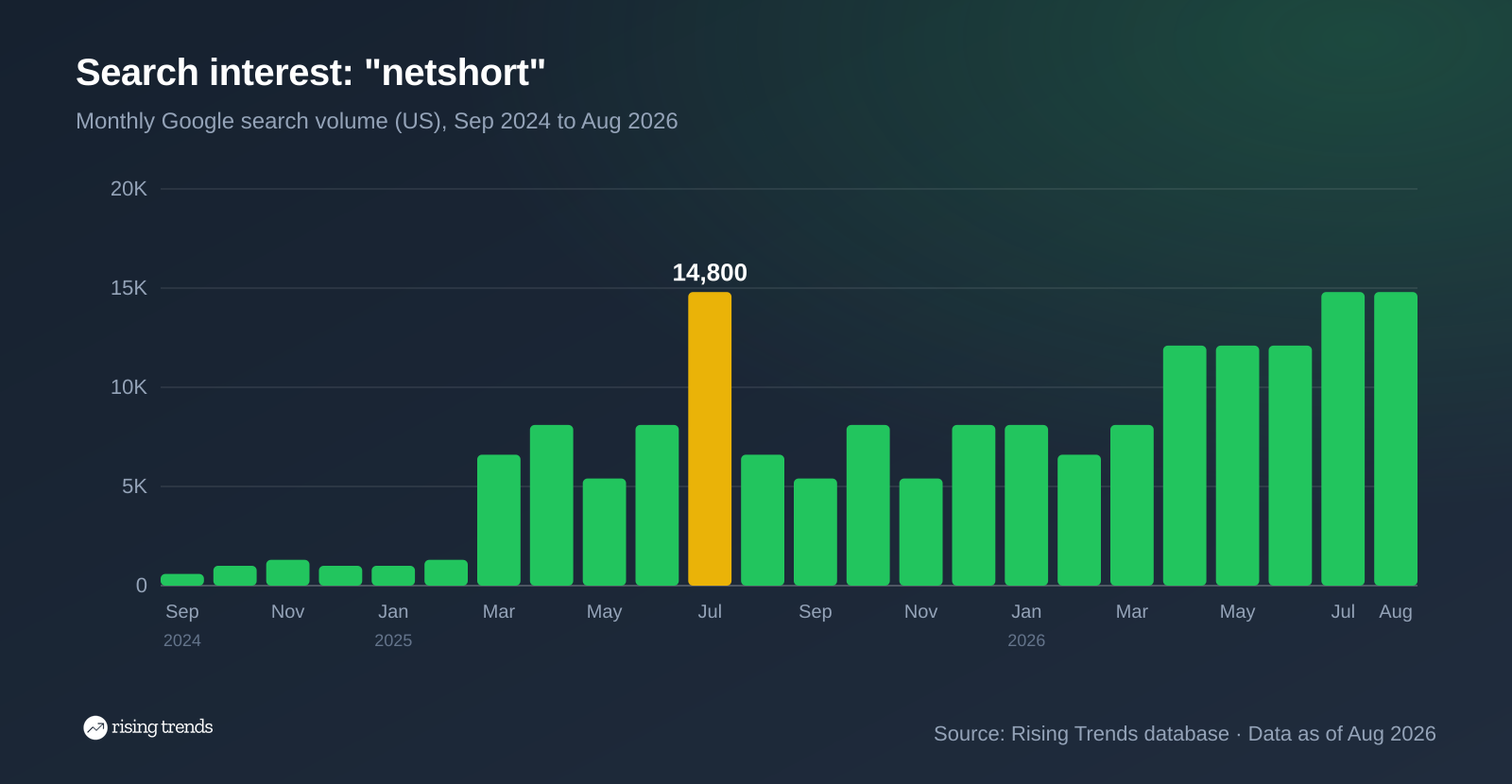
It is two curves, not one. The first runs from the launch through a spike to 14,800 in July 2025, then gives most of it back. For the rest of 2025 the term sits in a 5,400 to 8,100 band, which is what a one-off burst of ad spend looks like after the ads stop. The second curve starts in April 2026, when volume steps to 12,100 and stays there for three straight months before moving to 14,800 in both July and August 2026. That is the difference between a campaign and a habit. Our data classifies the term as EXPONENTIAL with a rising trajectory, up 124% in a year and 2,408% in two.
Now put it next to its neighbours. This is where the search story stops being flattering.
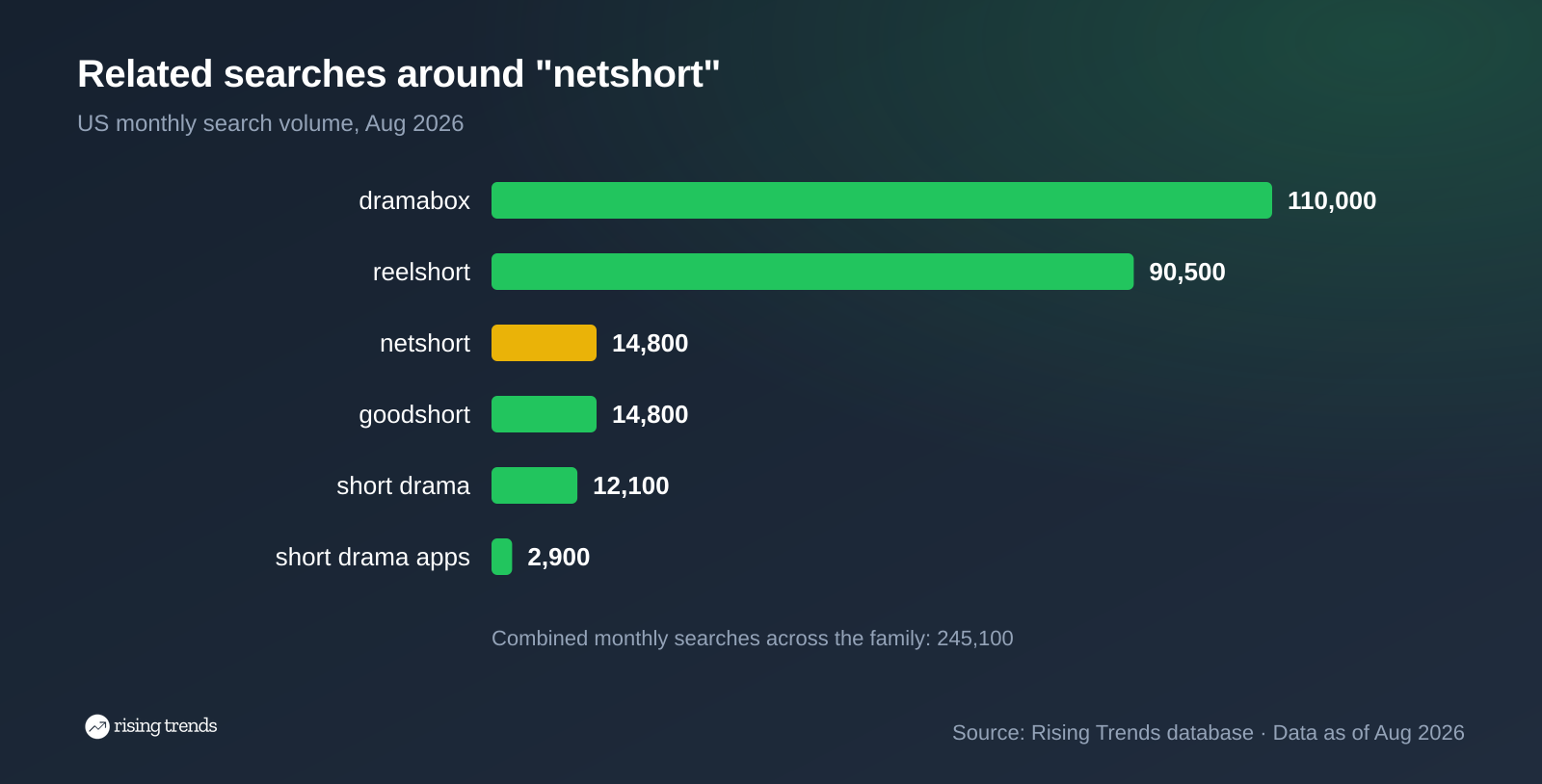
DramaBox draws 110,000 US searches a month and ReelShort 90,500, both as of August 2026. NetShort is on 14,800, exactly level with GoodShort. Add the family up and the category is worth 245,100 US searches a month, of which NetShort holds about one in sixteen. People are installing this app far faster than they are typing its name, which usually means the installs are coming from somewhere other than search.
It is a free app with a coin economy bolted to a drama catalogue. The App Store listing gives the hard facts: published by NETSTORY PTE. LTD., 173.8 MB, iOS 15 or later, rated 13+, and available in English plus 16 other languages including Hindi, Indonesian, Portuguese, Spanish, Thai and Vietnamese.
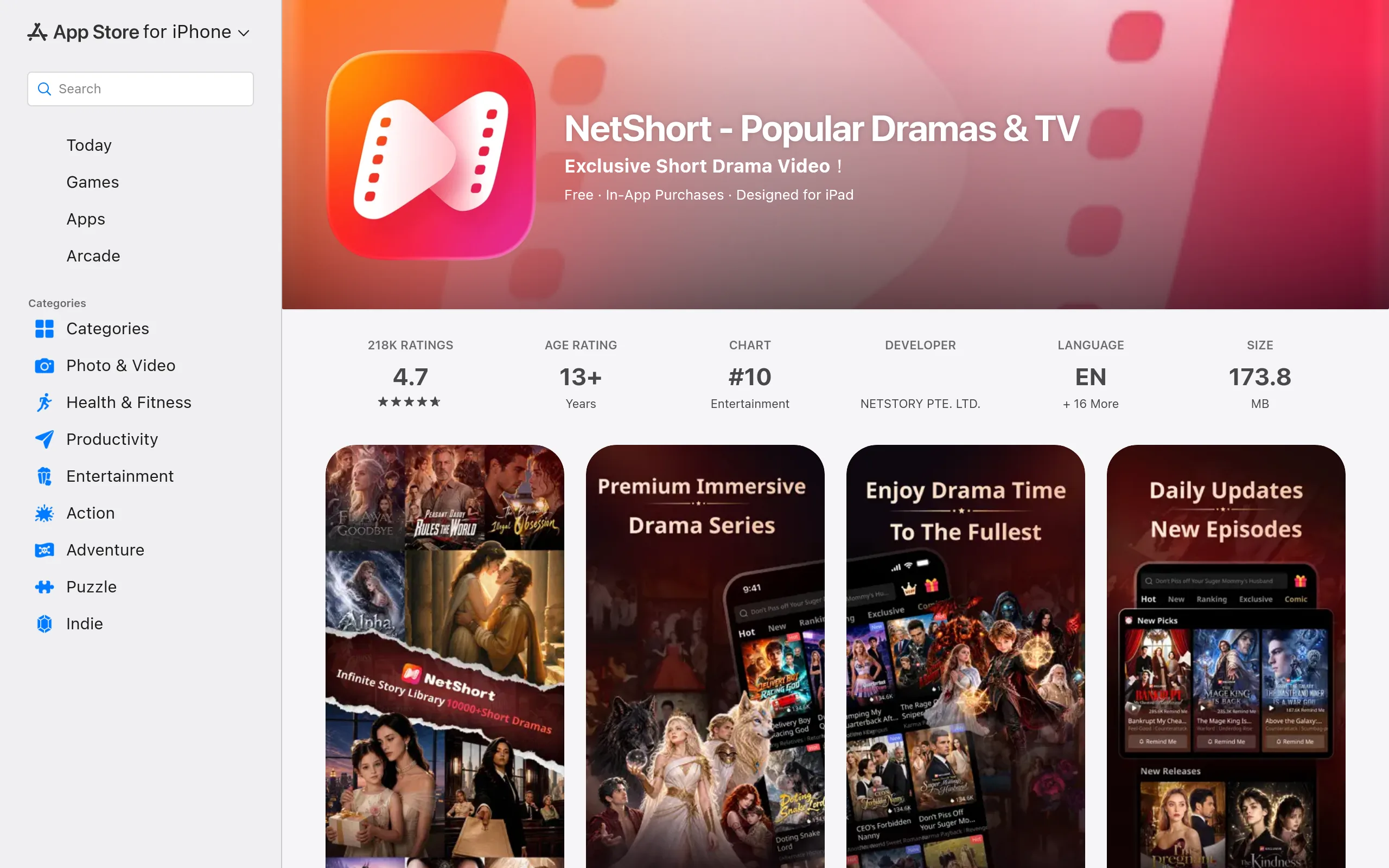
That seventeen-language spread is the whole business model in one line. A vertical drama is cheap to shoot, has almost no dialogue that depends on cultural context, and can be dubbed and re-subtitled into a dozen markets in days, which is exactly the economics we traced in our piece on how auto-dubbing went from novelty to default. NetShort's own site advertises 45,000 short dramas in the library.
The catalogue is as formulaic as the pricing. Current titles include "Mafia Heiress Marries a Cripple, Actually a Hidden Boss" and "Oops, My Fake-Dead Husband is the Underworld King". Every series opens with a betrayal, a secret identity or a rebirth, and every episode ends on a cliffhanger roughly 60 to 90 seconds after it started. The Google Play listing lists the themes outright: billionaire romance, werewolf bonds, revenge and comeback, time travel and rebirth. It carries 4.7 stars from 1.93 million reviews and sits at number nine among free entertainment apps.
Ownership is slightly layered. The store listings name NETSTORY PTE. LTD., a Singapore entity. NetShort's ad partner BidMachine describes the app as sitting under Maiya Culture and dates the launch to October 2024, three months after Apple's recorded release date, which is probably the global marketing push rather than the store listing going live.
Because the clips find them first. NetShort's growth channel is paid social, not the App Store search bar, and the company runs its own accounts on Instagram, Facebook and YouTube that post trailer cuts daily. This reel from the official @netshortdrama account, trailing a series that premiered on September 7, 2026, is typical of the format: a 30 second hook, a premiere time, and an instruction to download.
A viewer watches that on Instagram or TikTok, wants to know how the story ends, and searches the app name to find it. That is why the search curve and the install curve are so far apart, and it is the same acquisition loop we described in the dopamine shopping trend: the hook is free, the resolution costs money, and the gap between them is the product.
Apple publishes NetShort's price list, so the top of the funnel is not in dispute. Here is what the app sells, from the listing itself.
| What you buy | Price | What it gets you |
|---|---|---|
| The first few episodes | Free | Roughly 3 minutes, per App Store reviewers |
| One-time coin packs | $6.99, $9.99, $14.99, $19.99 | Coins, spent per episode unlock |
| Weekly VIP | $19.99, $24.99 or $29.99 | One week of unlocked viewing |
| Watching ads | Free | A partial episode's worth of coins |
Now do the arithmetic the store page does not. Reviewers consistently report an episode costing 78 coins, with 1,000 coins at about $10 and 1,500 coins at $15. That puts a coin at roughly a cent and an episode at roughly 78 cents. A 76-episode series therefore runs to about $59. One App Store reviewer gets there independently: "when a movie is 76 clips, that means you'll pay $60 for just 1 movie, or $20 A WEEK to get everything free for the week."
Two things follow. First, Weekly VIP only beats coins if you burn through more than about 25 episodes in the week, which the 60 second episode length is engineered to make easy. Second, there is no monthly or annual tier anywhere on Apple's list. The cheapest subscription NetShort sells is $19.99 a week, which annualises past $1,000. Netflix's standard US plan is a rounding error next to that, and NetShort knows it, which is why the pitch is always one more episode rather than one more month.
The refund path is correspondingly narrow. NetShort's own recharge agreement states that "once a recharge is successful, it's deemed complete" and that the company "does not offer returns or exchanges for virtual products", though it also commits to reviewing refund requests directly within 24 hours.
On growth, NetShort is beating the incumbents and losing to the category.
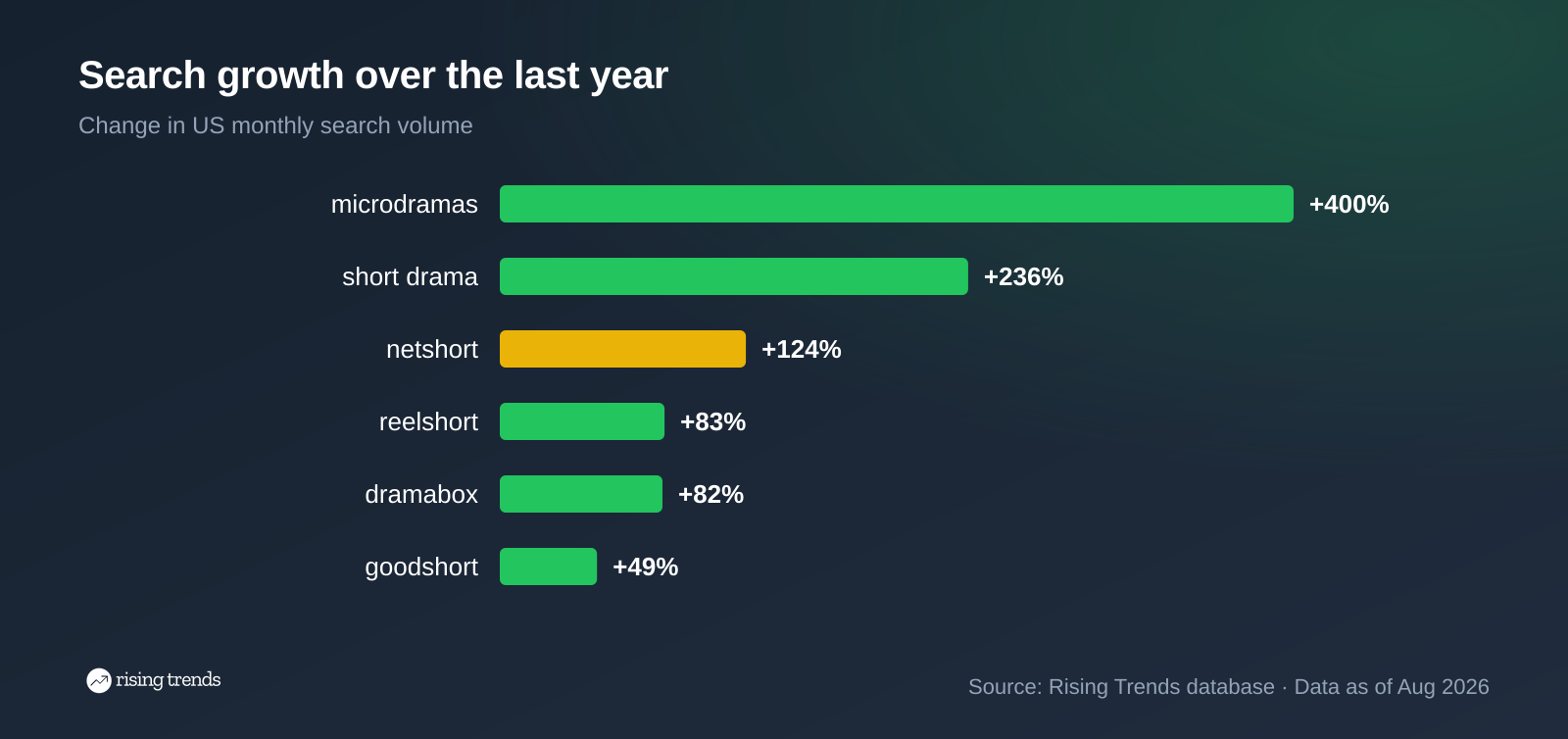
NetShort is up 124% in a year, against 83% for ReelShort, 82% for DramaBox and 49% for GoodShort, all as of August 2026. It is growing faster than every established brand in the set. But the two generic terms are growing faster still: "short drama" is up 236% and microdramas is up 400% in a year and 15,900% in two. When category terms outrun brand terms, the audience has not picked a side yet.
Sensor Tower's State of Short Drama Apps 2026 fills in the money. Global short drama passed 850 million downloads in Q1 2026, up 140% year on year, and roughly $750 million of in-app revenue, up 20%. Southeast Asia, Latin America and India together took more than three quarters of the downloads. NetShort rose 196% quarter on quarter to rank third by downloads. On revenue it grew 10% year on year and is, in Sensor Tower's words, narrowing the gap with DramaWave and GoodShort, while DramaBox and ReelShort each banked close to $140 million for the quarter.
So the honest summary is this. NetShort is third in the world at getting installed and roughly fifth at getting paid. Downloads are the cheap half of this business.
The 4.7 average hides a split, and the split is always about the same thing. Positive reviews praise the catalogue. Negative ones describe the meter running.
"There's no point in watching two minutes of ads for 30 coins when one 45s episode is 78," wrote one App Store reviewer, who got a developer response in July 2025. Another described spending $15 for 1,500 coins and finding that "by the time I got to the last of my coins, the episodes were as short as 60 seconds, sometimes repeating parts from previous episodes."
On Google Play the complaint is the ad load. A review from July 5, 2025 that 1,393 people marked helpful reads: "it said you had to watch TWO ads in order to watch the next episode, however, each one of the ads played Three ads each. So I had to watch SIX ADS for a short episode." A second, from April 2025 and marked helpful by 1,297 people, says simply: "I have watched over 20 ads today and got no where near watching a full series."
The sharper complaints are about charges nobody meant to authorise. On the consumer complaint site Sikayetvar, a user posting as Gonul writes, under a complaint dated July 21, that a one-year subscription appeared on their account shortly after installing: "I do not want to pay $73 for an app I barely used. I do not believe I knowingly approved starting a paid subscription." These are individual accounts rather than established facts, but they are the recurring theme in the one-star tail of an app with nearly two million Play reviews, and they are the kind of friction that eventually attracts a regulator.
Downloads got cheap and attention got expensive. Sensor Tower reports users now spend nearly six times more time in short drama apps than a year ago, and the ad load above is how that time gets monetised when the coin purchase does not happen. NetShort's own monetisation lead told BidMachine that switching to in-app bidding more than doubled ad revenue from that partner and lifted ARPU by over 5%. That is the quiet pivot across the whole category: from selling unlocks to selling impressions, the same shift reshaping advertising in 2026.
The paywall is the product, and it is fragile. A 78 cent episode works because no single decision feels expensive. It is the same compulsion loop we unpacked in the AI addiction trend, applied to plot instead of chat. It also depends entirely on Apple and Google leaving the mechanic alone. A rule change on in-app virtual currency disclosure, or a wave of chargebacks like the ones in those complaints, hits revenue before it hits downloads.
Nobody has won. Four apps are within shouting distance of each other on revenue, a fifth (FreeReels) is the download leader and does not yet register as a US search term at all, and the generic terms are outgrowing all of them. Markets that consolidate stop adding challengers. This one is still adding them.
Whether 14,800 holds a third month. The July 2025 spike looked like this one and then collapsed. Two flat months at the peak is a plateau, three is a floor. The live netshort trend page is where the September and October readings will land first.
Whether the search gap closes. NetShort is third by installs and sixth by US search volume. If paid social is doing all the work, the brand term stays small and the business stays dependent on ad spend. If "netshort" starts closing on GoodShort and then DramaBox, the brand has stuck.
Whether "microdramas" keeps outrunning the brands. A category term growing 400% a year while every app in it grows under 125% means new entrants are still finding daylight. Watch for the moment that flips, because that is when the consolidation everyone keeps predicting actually starts.
The broad signal is simple enough. Two years ago, 590 Americans a month looked up a vertical drama app that had just launched. Today it is 14,800, the category clears three quarters of a billion dollars a quarter, and the unit of sale is a 78 cent cliffhanger. Whether that holds depends less on the stories than on how long people are willing to buy them one minute at a time.
Want to spot the next breakout app before the download charts catch up? Read our guide on how to identify market trends, follow the live netshort dashboard page, or browse what is breaking out right now on the Rising Trends dashboard.
Thousands of Emerging Trends
Thousands of Breakout Apps
Mega Trends
Trend Analysis Tool