Trends


Two years ago, about 9,900 people a month typed "onepay" into Google. As of August 2026 it is 135,000, and the term has sat at its all-time high for three months straight. The company behind it was assembled by Walmart and Ribbit Capital in 2021, does not hold a banking licence, and is majority owned by the largest retailer in the United States.
That last part is the whole story. OnePay is not winning search because it outspent anyone on marketing. It is winning because Walmart put a money app next to the checkout lane of 100 million-plus weekly shoppers. Meanwhile the brand that defined the category, Chime, is going the other way: 823,000 searches a month and falling 18% year over year, even though its business is growing. Nobody ranking for "onepay" today, not the app stores, not the card-review sites, has the curve that shows this happening.
Key takeaways:
Let's get into it.
Here is the monthly search volume for "onepay" over the last two years, straight from our database. It is not a spike. It is a staircase that climbed through the first half of 2025 and then stopped climbing, which is its own kind of signal.
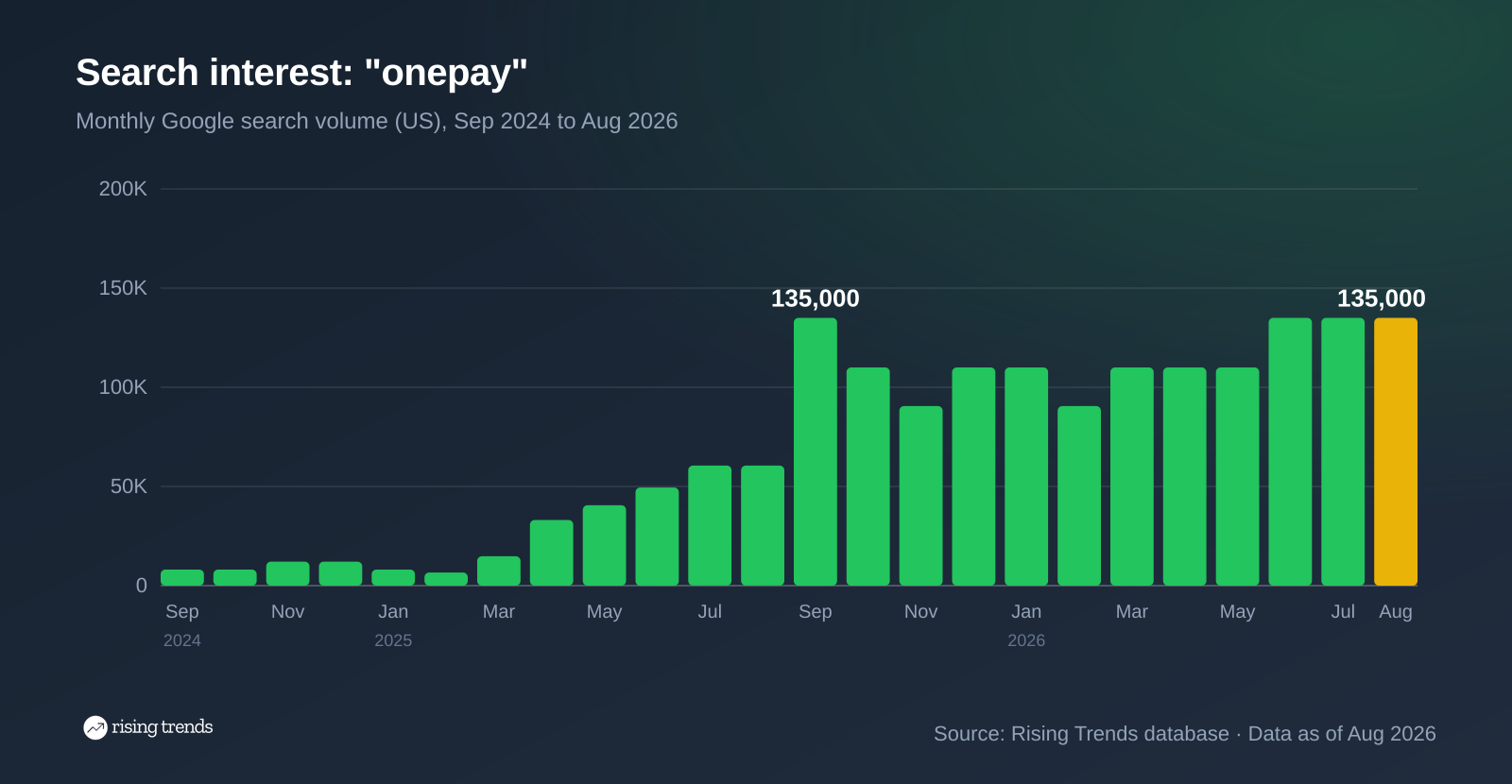
March 2025 was 14,800. Then came 33,100, 40,500, 49,500, 60,500, 60,500, and a jump to 135,000 in September 2025, with May 2025 the month the term first crossed a quarter of today's level. It gave some back over the winter, bottoming at 90,500 in November 2025 and again in February 2026, then returned to 135,000 in June 2026 and has held there since. Our database flags the term RISING with HIGH seasonality, which is what a retail-attached brand looks like: the curve breathes with the shopping calendar.
The comparison that matters is not OnePay against its own past. It is OnePay against everything else people search when they are looking for a place to keep money.
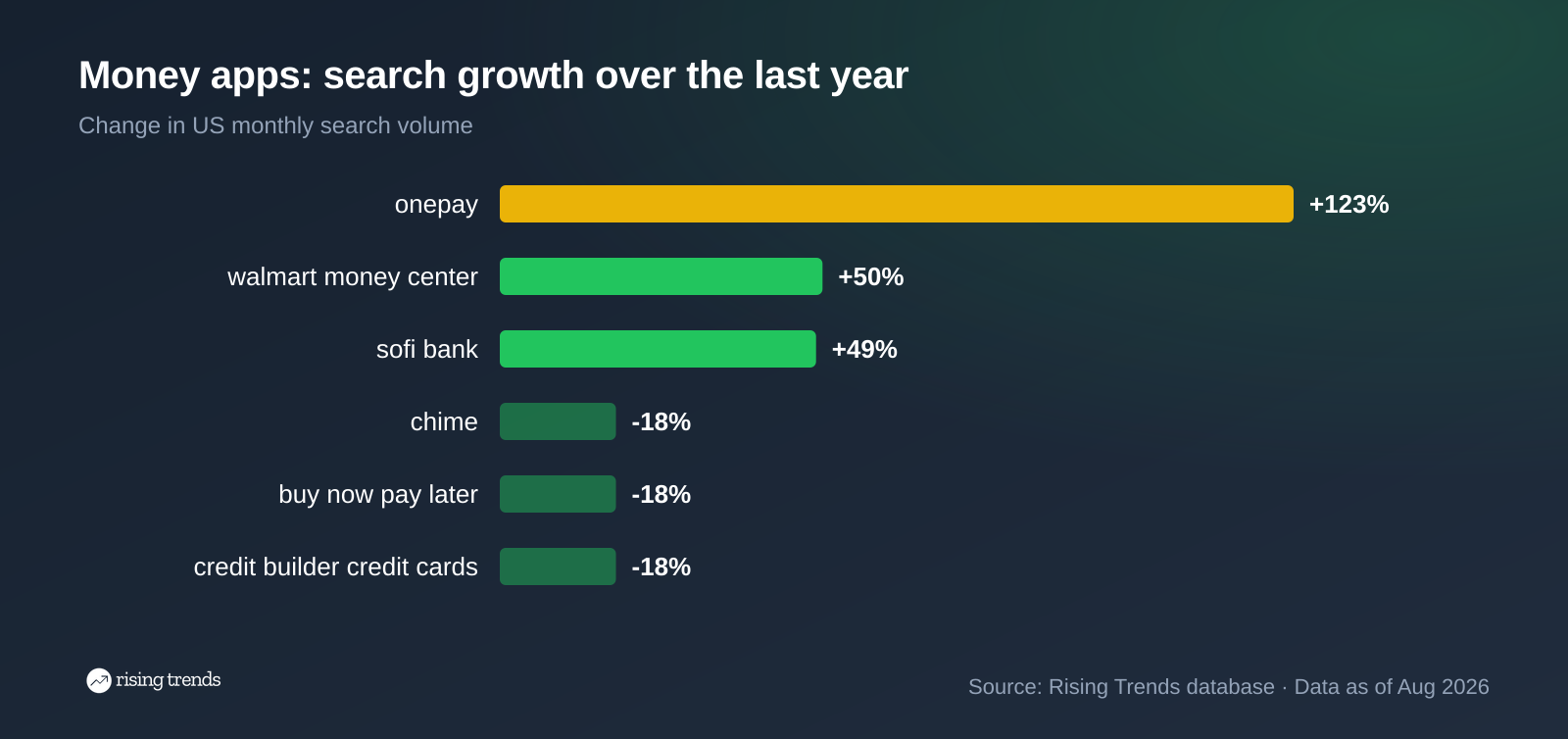
OnePay is the only name in that set growing in triple digits. Chime, buy now pay later and credit builder credit cards are all down 18%. The two terms rising behind OnePay are both Walmart's: walmart money center at 450,000 searches and up 50%, and walmart pay at 135,000 and up 123%, exactly matching OnePay's own rate. That is not a coincidence, and we will come back to it.
OnePay calls itself a money super app, and the product list is long enough that the phrase is doing real work. The homepage leads with banking, then investing from $1, then crypto, then a credit card, then pay later.
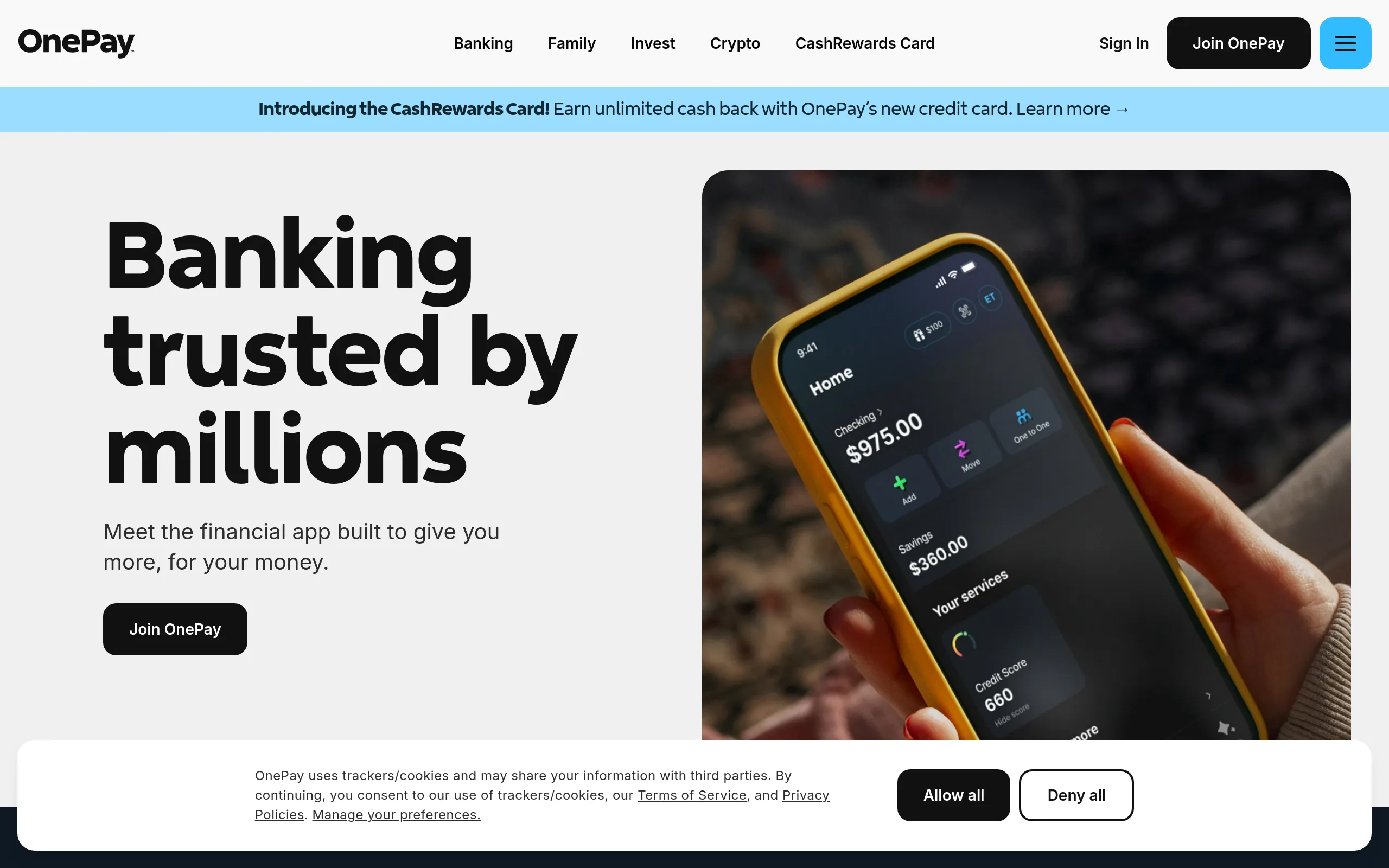
Underneath, almost none of it is OnePay's own balance sheet. The company states plainly on every page that it is a financial technology company, not a bank. Deposits are held by Coastal Community Bank or Lead Bank. The CashRewards Mastercard is issued by Synchrony Bank. OnePay Later loans are powered by Klarna. Crypto runs through Zero Hash, brokerage through One Growth Securities with DriveWealth clearing, and the personal loans launched in July 2026 are powered by Upgrade. OnePay is an interface and a distribution deal stacked on other people's licences.
The economics are in the disclosures. Savings pays up to 3.35% APY, which the company dates to 27 July 2026. Cash back is 3% at Walmart, 5% for Walmart+ members, 1.5% elsewhere, no annual fee. Fee-free overdraft is real but requires $500 or more in direct deposits in the current or previous month, which is the hook: it only works if OnePay gets the paycheck. The lending side is ordinary subprime. The CashRewards card carries a variable purchase APR of 20.24% or 30.74%, the Walmart Spend Card 30.74%, and OnePay Later runs 9.99% to 35.99%.
The one genuinely unusual product is the Builder Card, launched 23 April 2026. It has no upfront security deposit, no credit check, no interest and no late fees. You spend from your own checking balance, OnePay sets the money aside automatically, and it reports positive payment activity to all three bureaus every month. It is a debit card wearing a credit card's reporting pipe, aimed squarely at people who would be declined for a secured card.
The search curve has three pushes behind it, and all three are Walmart.
The distribution. When the venture emerged from stealth in January 2022, merging Even and ONE under Walmart and Ribbit Capital, the pitch named the asset directly: access to Walmart's 1.6 million US associates and 100 million-plus weekly shoppers. Omer Ismail, the former Goldman Sachs executive who built Marcus, was named CEO. The combined business started with more than 200 employees and over $250 million in cash.
The card. The jump to 135,000 searches lands in September 2025, when the CashRewards card began showing up in creator reviews and comparison videos. A credit card is a search event in a way that a checking account is not: people look up the APR, the cash back cap, and whether it is worth applying.
The checkout. In August 2026 Walmart announced Tap to Pay across all US stores and clubs by the end of 2026, with eligible Walmart, Sam's Club and OnePay cards going into digital wallets. That is the physical end of the funnel finally matching the app.
Many of the people searching are not shoppers at all. They are workers. Walmart's Spark delivery drivers get paid into OnePay, and the app-store reviews read like it. "I originally opened the ONE account because I deliver for Spark in my spare time and they offered cash out after each successful delivery," wrote djboyd94 in a review on the App Store. The same reviewer named the friction too: Walmart discounts "always pop up after I've already made a purchase and almost NEVER before."
On TikTok the demand is about the credit line, not the bank account. This clip from @moneytalk.with.shae, posted on 2 August 2026, is a personal-finance creator telling her audience to open the app and check their OnePay Later limit.
The platform numbers back the volume up. Google Play lists 5 million-plus downloads and a 4.8 rating across 218,000 reviews, with the app ranked sixth among free finance apps. Apple shows 4.9 across 453,000 ratings and ninth in Finance. Trustpilot is lower and more informative: 4.6 across 18,231 reviews, 81% five stars and 9% one star, a ratio that says most people are happy and a real minority is not.
OnePay is privately held, so there is no filing to read. What is on the record:
| Date | Event | Figure | Source |
|---|---|---|---|
| Jan 11, 2021 | Walmart announces a fintech startup with Ribbit Capital | Stake not disclosed | Walmart |
| Jan 26, 2022 | Merger with Even and ONE, Omer Ismail named CEO | 200+ staff, $250M+ cash | Walmart |
| Dec 2024 | Funding round led by Ribbit Capital and Walmart | $300M at a $2.5B valuation | Reported, not confirmed |
| Jan 2026 | Employee share repurchase repriced the company | Above $4B, OnePay declined to comment | Reported, not confirmed |
Two caveats belong on that table. Both the December 2024 round and the January 2026 valuation come from press reporting rather than an announcement or a filing, and OnePay has confirmed neither. A share buyback is also not a priced round: it sets a number for employees selling stock, a weaker signal than an outside investor writing a cheque.
What is confirmed is the shape. Walmart holds the majority stake. Ribbit Capital, whose managing partner Micky Malka sits on the board, is the other strategic investor, and John Furner, CEO of Walmart US, joined the board at formation. This is a retailer's financial services arm with a startup's cap table, which is why it ships like a startup and acquires customers like a retailer.
And it does ship. In 2026 alone OnePay launched the Builder Card and partnered with Tempo, the Stripe and Paradigm backed payments blockchain, on stablecoin payouts in April, shipped an agent integration in June, launched personal loans and made CNBC's World's Top Fintech Companies list in July, expanded Apple Pay in August, put vehicle equity in the app in September, and opened teen banking for ages 13 to 17 on 28 September.
The teen launch is the most revealing. Nothing is reported to the credit bureaus while a teen is under 18; at 18, OnePay reports the eligible history, so the user arrives at adulthood with a credit file instead of a blank one. "Most teen banking products are dead ends," Harsh Gupta, a general manager at OnePay, said in the announcement. "A 13-year-old's account can be the same one they'll have at 30." That is a 20-year customer acquisition strategy aimed at the roughly 42 million teenagers the company counts in the US.
Search volume puts OnePay's position in perspective. It is growing fastest and it is still third in the set.
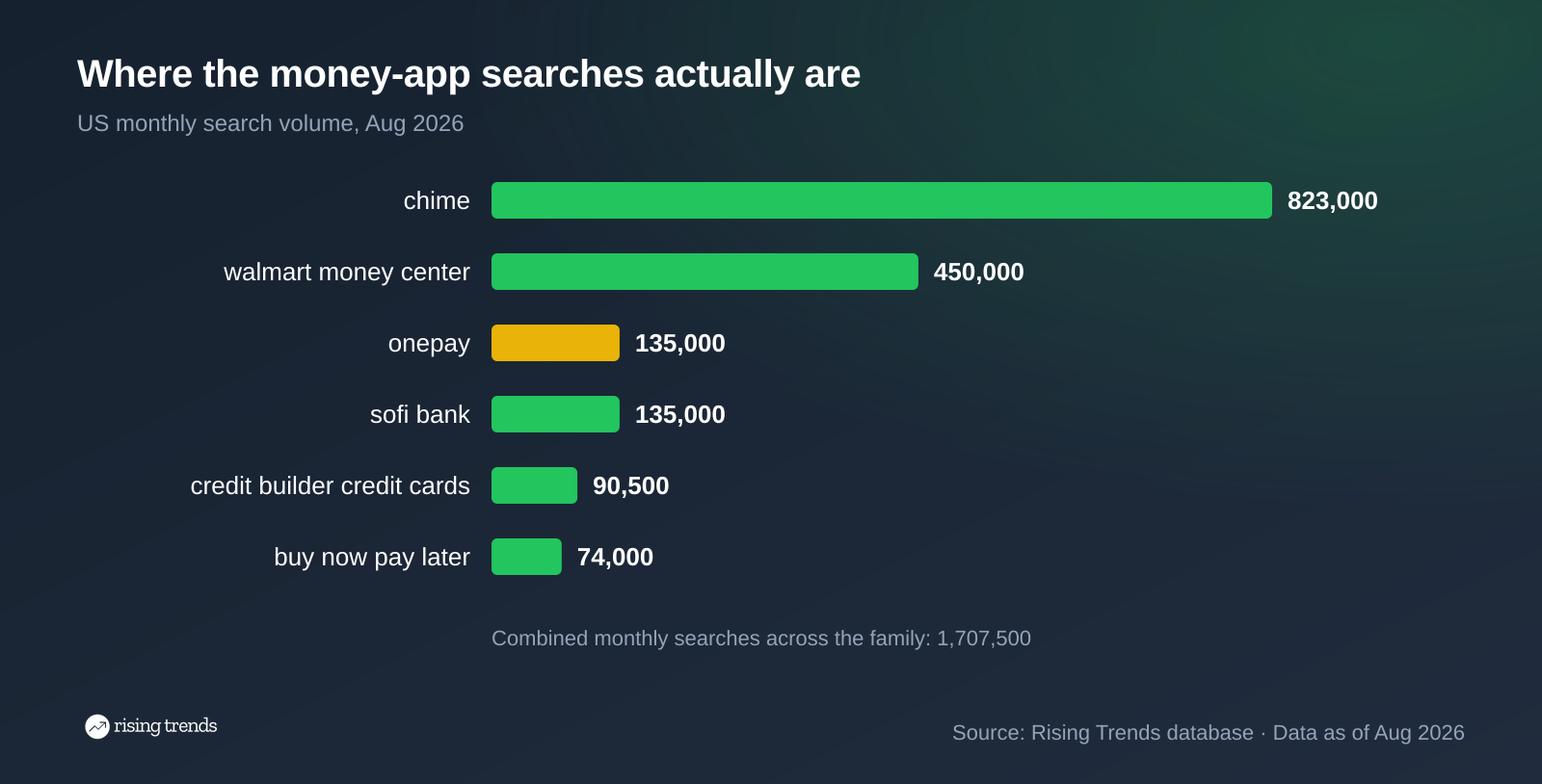
Chime is the incumbent and the interesting case. Its search volume is 823,000 a month and down 18% year over year, which reads like decline until you open the filings. Chime's second quarter 2026 results, filed 5 August 2026, report 10.4 million Active Members, up 20%, revenue of $670 million, up 27%, and a second straight quarter of GAAP profit. A company growing members 20% while its brand search falls 18% has stopped acquiring through Google. Chime buys attention; OnePay gets it from a store aisle.
SoFi is the closest peer by volume, at 135,000 searches for "sofi bank" and up 49%. It went the opposite way on licences: SoFi holds a national bank charter, which OnePay does not. That is a real margin difference, since a chartered bank keeps the net interest income OnePay has to share with Coastal and Lead.
Walmart Money Center, at 450,000 searches and up 50% in a year, is not a competitor. It is the top of OnePay's funnel: people searching for the physical money counter in a store are the people who get shown the app.
The categories are the losers here. Generic "neobank" has sat flat at 2,900 searches for two years. Buy now pay later is down 18%, and credit builder credit cards are down 18% even though the Builder Card exists. People have stopped searching for the product category and started searching for a brand, which is the clearest sign a category has consolidated. We saw the same pattern across the fintech trends we track, where the super app fight is explicitly a fight to be the first app someone opens.
Distribution beat product, again. OnePay's feature list is not obviously better than Chime's or SoFi's. What it has is a retailer with 100 million-plus weekly shoppers, 1.6 million employees paid through it, and a gig workforce that needs same-day cash out. Acquisition cost near zero beats a better interest rate, and the growth chart is what that looks like in search data.
The orchestration model is now the default. Synchrony takes the card risk, Klarna takes the instalment risk, Coastal and Lead hold the deposits, Zero Hash holds the crypto, Upgrade writes the loans. OnePay owns the app, the data and the customer. It is the same unbundling we have tracked across personal finance, and it means the fastest-growing consumer finance brand in our database is, strictly speaking, a front end.
The buyer is the paycheck-to-paycheck customer, and that cuts both ways. Overdraft gated at $500 of direct deposit, a credit-builder card with no credit check, pay later at up to 35.99% APR, and 3% back on groceries describe one customer precisely. That customer is enormous and underserved, and also the most exposed when credit tightens. The "is OnePay legit" and "is OnePay a real bank" questions Google surfaces next to the brand are what that exposure sounds like before it becomes a complaint.
Retail media has a financial sibling. Retailers learned to sell ads against their own traffic. Selling deposits and credit against that traffic is the next line item, and it is higher margin. The money layer follows the attention, which is what we found tracking the dopamine shopping trend.
Watch the Walmart terms, not the OnePay term. Walmart money center is up 50% and walmart pay up 123% year over year, in step with OnePay. If OnePay's curve climbs while those flatten, the brand has built demand of its own. If they move together, the store is still doing the work. The live OnePay trend page is where that split shows up first.
Stablecoins are the quiet bet. The Tempo partnership includes OnePay running a validator, a stranger commitment than it sounds for a consumer app. Instant payouts to Spark drivers are the obvious use case, and the one where a few cents saved per transfer, at Walmart's scale, is real money.
The chartered-bank question will not stay open forever. Every product OnePay adds makes the revenue share with its partner banks more expensive. SoFi solved this by getting a charter. OnePay has Walmart's balance sheet and a regulatory environment that has grown friendlier to bank applications. A charter application would be the single biggest event in this company's history and would reprice everything in that chart above.
The broader read is simple. Five years ago the question was whether a retailer could run a bank. It turns out it does not have to. It only has to own the app people open on payday, and 135,000 searches a month say many now open this one. Whether that holds depends on something no search curve can answer yet: what happens the first time those customers cannot pay.
Want to spot the next breakout company before the funding headlines? Read our guide on how to identify market trends, follow the live OnePay trend page, or browse what is breaking out right now on the Rising Trends dashboard.
Thousands of Emerging Trends
Thousands of Breakout Apps
Mega Trends
Trend Analysis Tool
