
Something odd showed up in the Rising Trends database this summer. "Dopamine shopping" had sat at roughly 110 monthly searches for two years. Then in June 2026 it hit 5,400, a 49x jump in a single month, and it is still running at 1,900 a month as of July 2026. The searches are for websites where you browse products, fill a cart, enter a shipping address, check out, and track a courier. Nothing ships. Nothing is charged. That is the product.
Most coverage of this has been either "look at this weird Korean thing" or a quick dopamine explainer. Neither tells you where the sites came from, how many people are actually using them, or what the behaviour says about how a generation now relates to buying things. So we pulled the numbers, read the interviews with the people who built the sites, and looked at what is rising and falling around it in our own data.
Key takeaways:
- "Dopamine shopping" went from 110 to 5,400 US monthly searches between May and June 2026, up 1,257% year over year and classified as EXPONENTIAL in the Rising Trends database (data as of July 2026).
- The trend started in South Korea with a fake food-delivery app built by a developer known as Malhee, who says it began as a joke about opening delivery apps out of boredom.
- The most-visited English clone, FoodNeverComes.com, was built by two 26-year-old developers in Udaipur, India. They told CBC it drew about 92,000 active users in 90 days and 1.1 million interactions, with the US as its biggest market.
- Earth Day Canada turned the format into an anti-consumption campaign. Its fake store Imaginair drew about 30,000 visitors, and roughly half of the 7,000 who stayed more than a minute completed a mock purchase.
- The science is 29 years old: dopamine neurons fire on the anticipation of a reward, not the reward itself, which is why a fake checkout can feel like a real one.
- In our data the same money-pressure cohort is searching for "dupe of" (up 17,186% in a year) while "budgeting app" searches fell 63%. People are not budgeting harder. They are finding cheaper ways to feel the buy.
Let's get into it.
What we're seeing in the Rising Trends data
Here is the monthly search volume for "dopamine shopping" over the last two years, pulled directly from our database. For 22 of those 24 months the line barely moves. Then June 2026 happens.
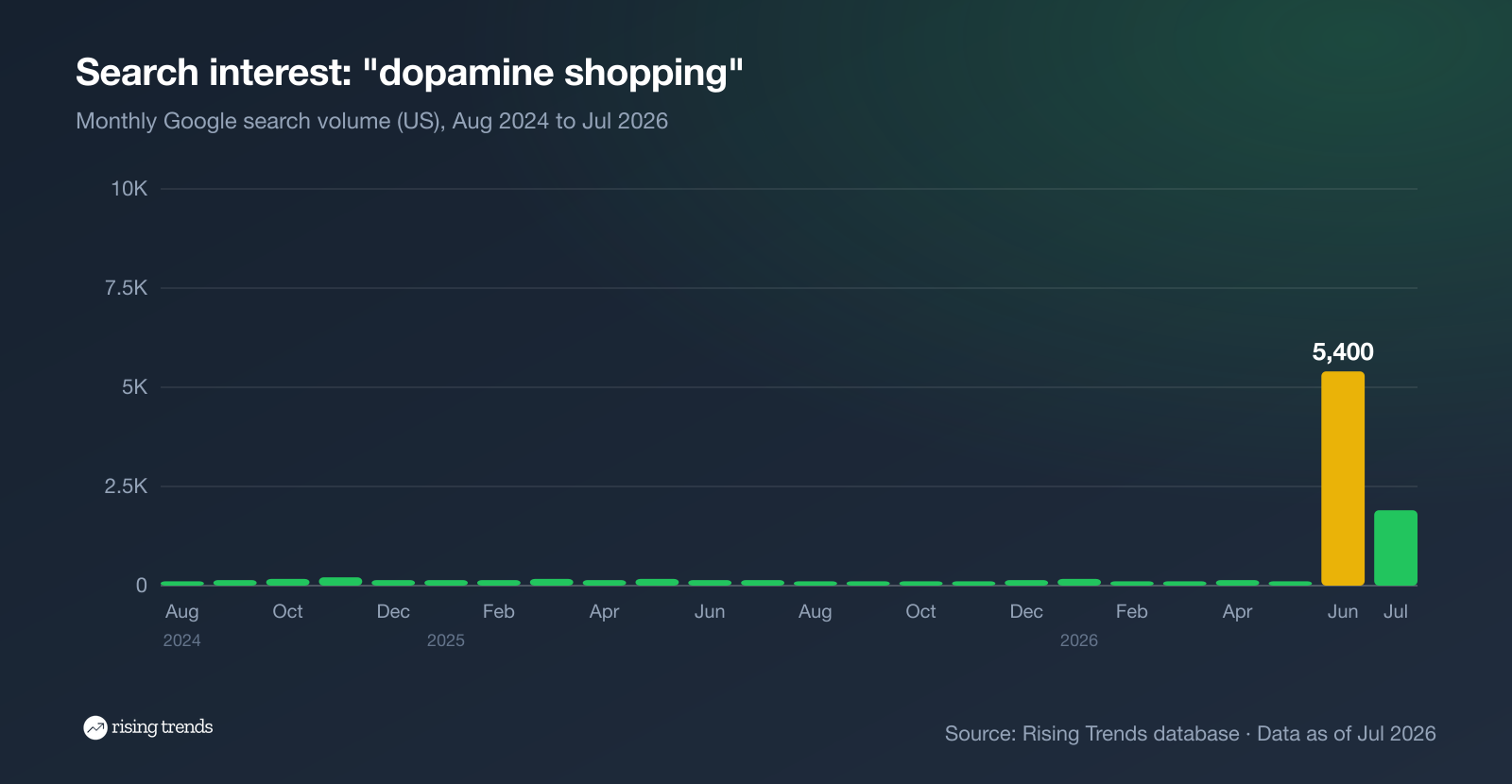
The shape matters. This is not a slow build. It is a from-nothing breakout tied to a specific moment: the week in mid-June when screenshots of a Korean app that lets you order food that never arrives went viral, and Fast Company, Vice, Mashable and Digital Trends all wrote it up within days of each other. July's 1,900 is a comedown from the spike, but it is still 17x the level of a year earlier, and the related terms Google now shows next to it ("dopamine shopping websites", "dopamine shopping app", "fake shopping dopamine", "dopamine shopping simulator") are the vocabulary of a behaviour, not a meme.
The more useful comparison is what is happening around it. We looked at the other searches people under financial pressure make, and they do not all move the same way.
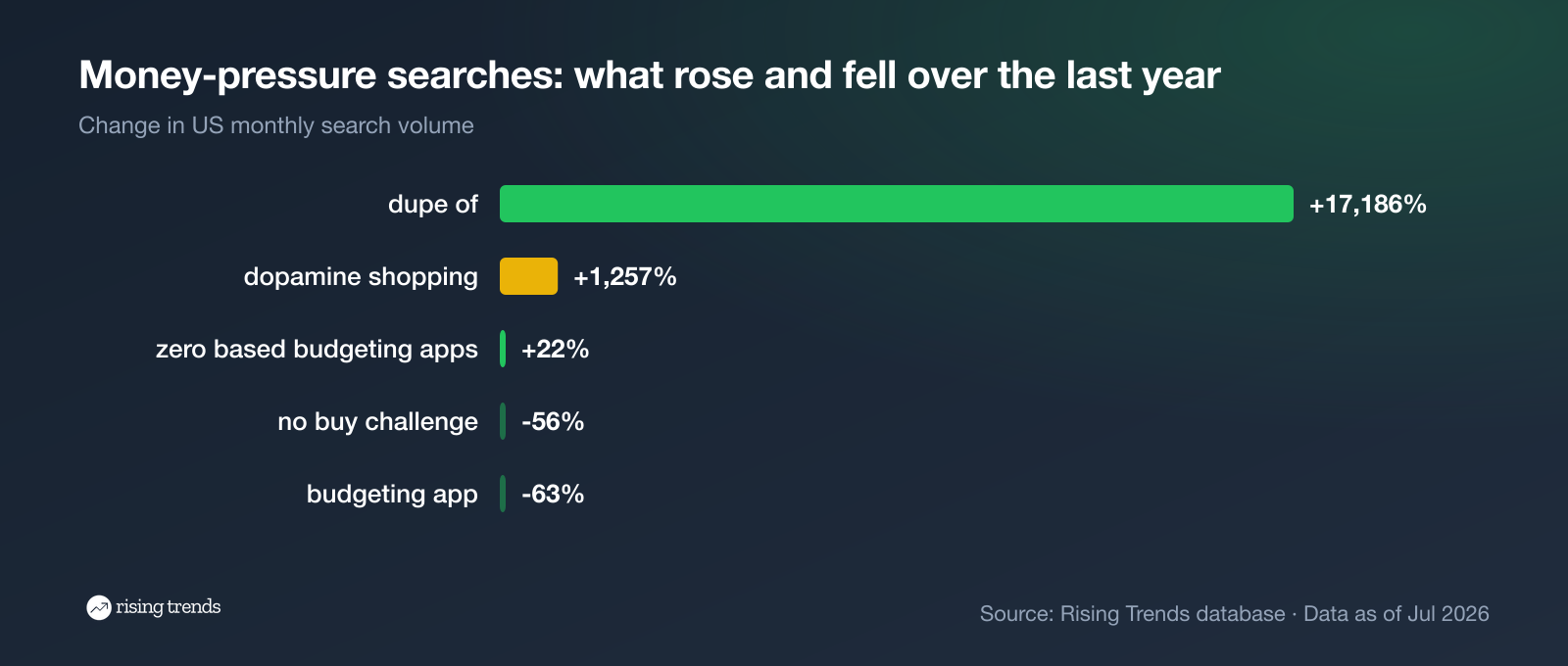
Two things stand out. First, "dupe of" is up 17,186% in a year, to 12,100 monthly searches: the same impulse, a cheaper way to get the thing. Second, the tools of restraint are losing ground. "Budgeting app" is down 63% to 60,500 searches, and "no buy challenge" is down 56%. The cohort that a year ago was searching for ways to spend less is now searching for ways to feel like it spent. That is the shift this article is about.
What dopamine shopping actually is
A dopamine site is a fully working e-commerce front end with the last step removed. You get product pages, reviews, filters, a cart, a checkout form and a delivery tracker. The only thing missing is the transaction. The FoodNeverComes homepage puts it in one line: "Order the food. Skip the bill."
The format began in South Korea. According to the developer's own account, given to Fast Company and quoted widely since, a developer known as Malhee built the original fake delivery app during "one of those nights when I kept opening and closing delivery apps." Malhee said it "started as a joke at first, but surprisingly, just satisfying that urge to 'order something' made it weirdly fulfilling without actually ordering." The stated purpose was narrow: "Not because you're hungry, but out of habit, boredom, your hand just opens the delivery app first. This app's made to break that pattern, just once."
Within weeks the idea had been cloned in every direction. CBC's August reporting lists DopamineCart, which mimics Amazon, plus FakeEats, DopaHaul and FakeHaul. Rest of World's coverage names Dopamine Shop. In Google's results for the term, the third-ranked page is dopamineshopping.com, "the store where you shop without spending," which promises "one-tap checkout that pays itself" and an invoice that "never arrives."
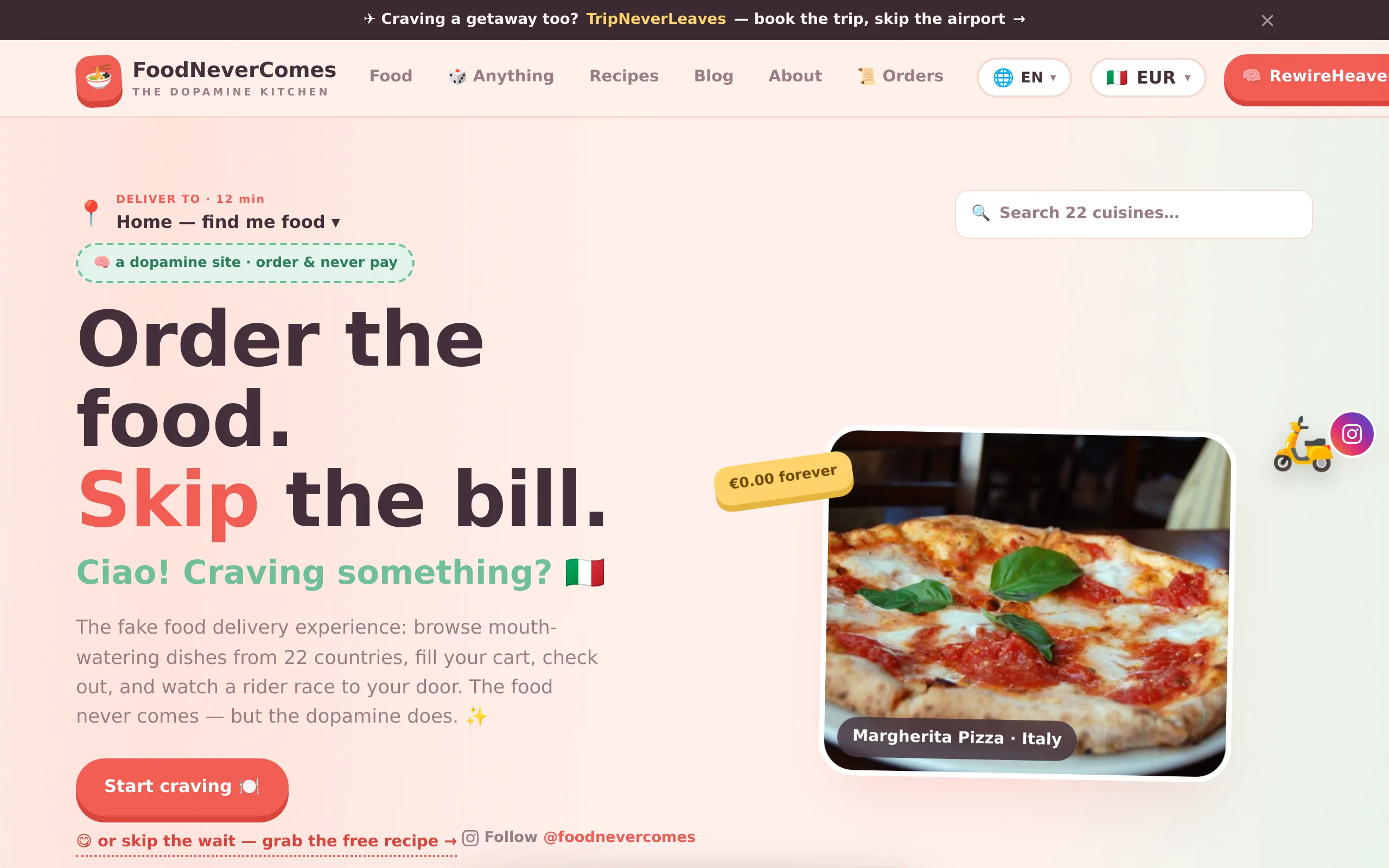
The site in that screenshot is the one with numbers behind it. FoodNeverComes.com is not Malhee's original. It was built by Anshul Sharma and Purvansh Parmar, two 26-year-old software developers in Udaipur, India, who launched it in late June and told CBC Radio it had reached about 92,000 active users in its first 90 days and roughly 1.1 million interactions. It is self-funded and carries no ads. The United States is its largest user base, followed by China, the UK and Vietnam. The site now lists 22 cuisines, 327 dishes and drinks, a fake pre-filled payment card, a rider you can watch on a map, and a final phone call explaining that the food is not coming. It also cross-promotes a sibling, TripNeverLeaves, for booking holidays you will never take.
Why it's trending now
The trigger was the June screenshots, but the reason they landed is older. The people building these sites describe the same loop: opening a delivery or shopping app dozens of times a day out of habit, not need. Parmar told CBC he had been spending up to 20,000 rupees a week (about $200) on food delivery before he noticed the pattern. "I guess it was so easy, you just 'click-click-click,' get the food," he said. "You think you like the food, but in the end, it isn't actually the reason."
That is what the clip below is about. When Australia's 7News covered the Korean app at the end of June, the reaction in the comments was less "how strange" and more "I do this already, I just never click buy."
The neuroscience is not new either. In 1997, Wolfram Schultz, Peter Dayan and Read Montague published the paper in Science that established what dopamine neurons actually do: they fire on the prediction of a reward, and they go quiet once the reward is fully expected. The hit comes from anticipating the parcel, not from opening it. A checkout page that never charges you keeps you permanently in the anticipation phase, which is the part the brain was paying for anyway.
Rhia Catapano, an assistant professor at the University of Toronto who studies consumer psychology, told CBC that shopping simulators can activate "the same parts of our brain that doing the actual activity would," comparing it to playing a video game or planning a holiday you will never take. Her caveat is the important one: the sites may help someone replacing purchases they cannot afford or do not want, and they will not help someone using them to escape a bad mood.
The new behaviour: what people are doing differently
Strip away the novelty and three changes in behaviour are visible.
The cart is the product. Consumer anthropologist Helen Jambunathan of the research consultancy Canvas8 told Rest of World that people are "prioritizing anticipation, choice, and curation over ownership." Shriram Venkatraman, an assistant professor at the Danish Institute for Advanced Study, made the point that the behaviour is universal: people have always window-shopped and abandoned carts. What is new is that someone built a store for it, and that the store is the point.
The habit is being treated like an addiction. The most revealing discussion of the trend happened in a Reddit community for shopping addiction, where members debated whether the sites help. One member, quoted by Malay Mail, compared them to non-alcoholic beer in early recovery: it "scratches the itch, especially in the beginning," and "can be a really helpful stepping stone." Another was blunt: "It would just piss me off knowing nothing is actually coming." A third called it "playing pretend for adults." Those are the three camps, and they map onto Catapano's caveat exactly.
It is not a poverty story, or not only one. The easy read is that young Koreans, and now young Americans, cannot afford to buy, so they pretend. The Bank of Korea's own Consumer Tendency Survey for June 2026 puts its composite consumer sentiment index at 106.6, up for a second month, which is not a picture of collapse. The sites are a response to the habit loop as much as to the bank balance. That is why the same cohort is also driving "dupe of" up 17,186%: they still want the thing, and they still buy, but they have learned to separate the feeling of buying from the price of it.
Who's building on it
For a behaviour that is barely three months old, the ecosystem is already surprisingly wide.
Independent developers built the first wave. Malhee's Korean original, then FoodNeverComes in India, then a long tail of clones. None of them charge money, which is unusual for a viral consumer format, and it is why the number worth watching is users rather than revenue. FoodNeverComes' 92,000 active users in a quarter, unfunded and without ads, is the benchmark.
Advocacy groups got there fast. Earth Day Canada launched Imaginair at the end of March, before the June spike, as "an online shop that sells nothing" built to make people notice their fast-fashion habits. Product descriptions carry the message: a leather belt to "reduce consumption, just tighten your belt." Yves Gauthier, its operations and mobilization manager, told CBC the store drew about 30,000 visitors, about 7,000 of whom spent more than a minute clicking through, and about half of those completed the mock checkout. A conversion rate on a store that sells nothing tells you how deep the ritual runs.
Publishers and creators supply the distribution. The trend's search curve is a media curve: the mid-June news cycle, then a TikTok and Instagram cycle of people filming themselves filling fake carts. Real Simple and Digital Trends both ran first-person "I tried it" pieces within a month.
What is missing, so far, is any retailer. No brand has built a "browse and pretend" mode, and that gap is the interesting one.
The retailers are busy at the other end of the cart instead, building the money layer that catches the purchases people do make: Walmart's OnePay now takes 135,000 searches a month selling cash back and pay-later on the same trip.
What it means for business
The uncomfortable implication for retailers is that a measurable share of their traffic never intended to buy and now has somewhere else to go. Abandoned carts have always been treated as a conversion problem to be fixed with retargeting and countdown timers. Dopamine sites suggest a portion of that abandonment is the whole point of the visit. The customer got what they came for at the cart page.
Three practical consequences follow.
Delivery apps are the most exposed. The original app was built specifically to break the reflex of opening a delivery app out of boredom, and its creator in India was a heavy user who spent about $200 a week. If even a small share of impulse orders are habit rather than hunger, the apps' late-night order volume is more fragile than it looks. The retail trends we track already show convenience commerce competing on speed; this competes on the urge itself.
Someone will monetise the ritual without the transaction. The clearest proof that this is a real business model sits one category over, where Kalshi turned a yes-or-no tap into a $22 billion exchange by making the ritual itself the product. A fake store with 92,000 users and a cart-completion rate around 50% is an audience. Affiliate links, "buy it for real" buttons, brand-sponsored fake catalogues, and data on what people pretend to buy are all obvious next steps. Ajay Shrestha, a professor at Vancouver Island University who studies internet safety, warned CBC about exactly this: people lower their guard on sites that feel consequence-free, and some of these sites ask for a shipping address.
The dupe economy is the same customer. The growth chart above is one cohort, not five. The person filling a fake cart on Tuesday is searching "dupe of" on Thursday and buying the dupe on Friday. Brands that read dopamine shopping as a threat are missing that it is a demand signal: the want is intact, the willingness to pay full price is not. This is the same dynamic we saw in the collectible toy boom, where searches for Labubu are now down 97% year over year as the price of the feeling caught up with the price of the object. It also runs the other way: when buyers start doubting they own what they paid for, the checkout itself gets scrutinised, which is what drove 14,800 people a month to look up Xbox Disc to Digital. The gap shows up on the seller's side too: Kai Cenat's Vivet drew 368,000 searches in January 2026 and had nothing to sell for another eight months, by which point 84% of that demand was gone.
Where this is heading
Three calls, each with a signal in our data to watch.
The same cohort has since found a word for the thing it distrusts. Searches behind the polyester slang trend went from 10 to 1,600 a month in August 2026, and the target is manufactured wanting: the staged haul, the assembled lifestyle, the cart filled for the camera.
The behaviour will outlive the sites. "Dopamine shopping" will probably not hold 5,400 monthly searches; June was a news spike. But the underlying behaviour, curated wanting without buying, is what sensory and self-regulation products have been telling us for a year: young consumers are buying tools for managing their own impulses. Watch whether "dopamine shopping" settles above 1,000 a month through the autumn. Above that, it is a category.
A retailer will ship a pretend mode. The first mainstream shopping app to add a no-charge "wishlist checkout" that simulates delivery will get the press cycle Malhee got, plus the data. The signals to watch in our database are the retail-side terms: budgeting app falling further and dupe of holding above 10,000 would confirm that restraint is losing to substitution.
Regulators will notice the data. Sites that collect shipping addresses, card-form entries and purchase intent from people who believe nothing is real are a privacy problem waiting for a headline. The mental health trends we track show how quickly "self-regulation" products attract clinical scrutiny once they scale; expect the same here, probably starting in Korea.
The same shape shows up wherever a small, repeatable hit of novelty is on offer: Songless Unlimited went from 4,400 to 33,100 monthly searches in a month, and the word doing the work there is "unlimited".
The signal we trust most is the one we opened with. A term that spent two years at 110 searches a month does not go to 5,400 because of one news cycle unless the behaviour was already there, unnamed. Dopamine shopping gave it a name. The sites are the least interesting part.
Want to spot behaviour shifts like this before they get a name? Read our guide on how to identify market trends, or browse what is breaking out right now in our trending topics list.
Never miss a trend again
- One trend broken down with the numbers
- Who's making money, and what to build
- A website on the rise
- A breakout app
Join 5,000+ founders