
In June 2026, forty people a month searched Google for "xbox disc to digital." In July it was 14,800. That is a 147,900% jump in a year, and it happened a full month before Microsoft announced the feature existed.
That timing is the story. Every article ranking for this term was written off the August 26 announcement. Our database says the demand showed up in July, the same month Sony told players it would stop pressing discs for new games and a leak said Xbox was testing a way to turn the discs you already own into digital licenses. By the time Microsoft published its blog post, the question had already been asked 14,800 times. And the answer most of those searchers want is not "how do I do it." It is "what happens to my disc afterwards." Microsoft's announcement does not say. Its support page does.
Key takeaways:
- "xbox disc to digital" went from 40 searches in June 2026 to 14,800 in July 2026, classified as EXPONENTIAL in the Rising Trends database (data as of July 2026). The spike predates Microsoft's announcement by a month.
- Microsoft announced the feature on August 26, 2026 and opened testing to Xbox Insiders on August 31. It covers "thousands" of Xbox One and Xbox Series X disc titles, not Xbox 360 or original Xbox.
- The Xbox Wire post frames it as game preservation. The Xbox support page says access "may be limited or revoked" if you lose, sell or give away the disc. Both sentences are Microsoft's.
- Sony set the deadline the industry is now answering: physical disc production for new PlayStation games ends in January 2028.
- Microsoft has the least to lose. Circana puts Nintendo at 63% of US spending on new physical software so far in 2026 and PlayStation at 32%, which leaves everything else, Xbox included, sharing roughly 5%.
- One Insider reported claiming licenses on 13 of 17 discs in a real library. The four failures were older Xbox One titles.
Let's get into it.
The search spike, in numbers
Here is the monthly curve from our database. It is not a ramp. It is a wall.
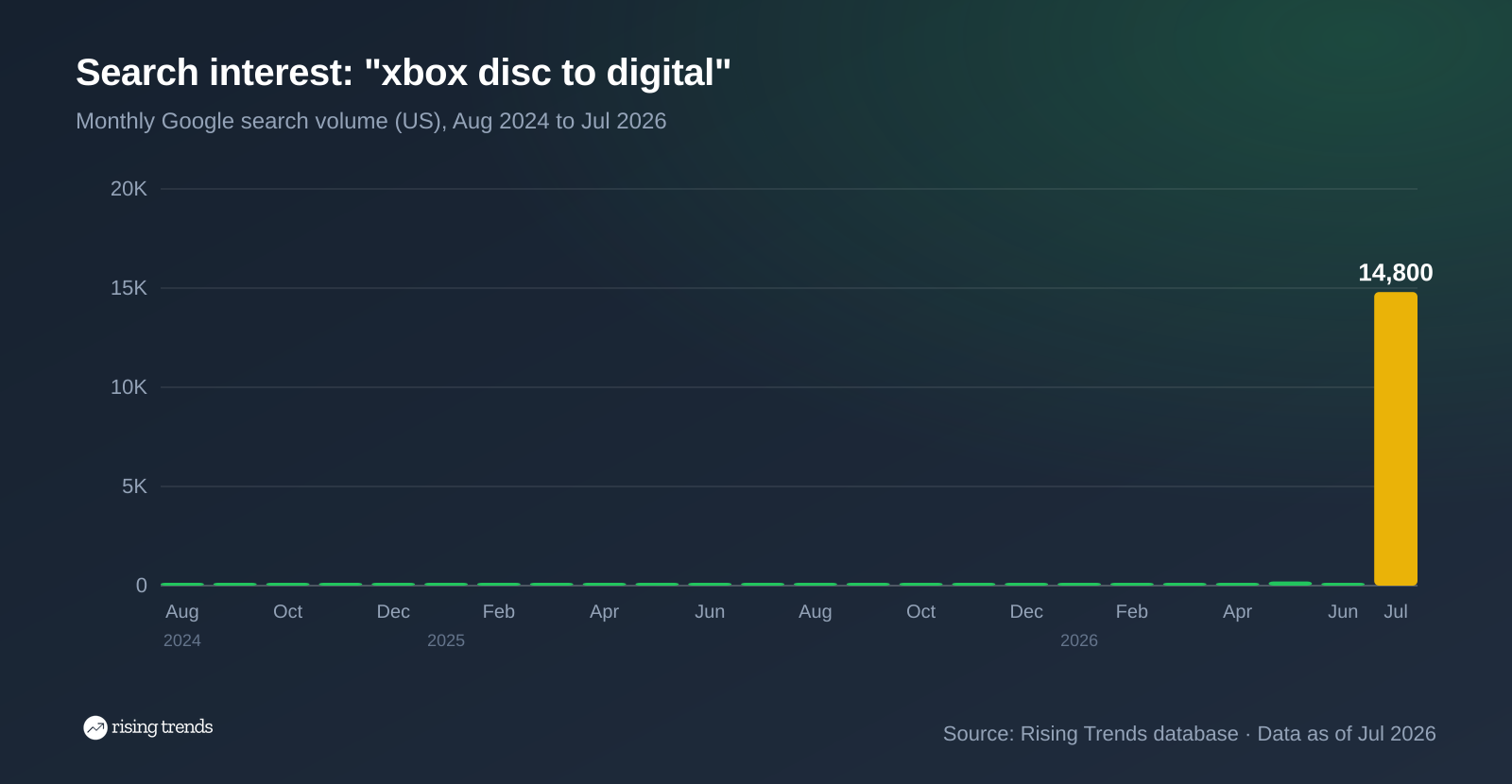
For twenty-two straight months the term sat at 10 to 30 searches. In May 2026 it twitched to 210. In June it fell back to 40. Then July hit 14,800, the peak, and the term went from a phrase nobody used to one of the fastest-moving queries in gaming. Our classifier reads it as EXPONENTIAL with a RISING trajectory, and the last three months average 188.1 times the same window two years earlier.
Two things happened in that window. On July 1, Sony said it would stop producing discs for new PlayStation games in January 2028. On July 2, Tom Warren at The Verge reported that Xbox staff were testing a disc-to-digital entitlement system. Players did the arithmetic immediately: if the discs stop, what happens to the shelf?
That question is bigger than the feature, and our data shows how lopsided the conversation is.
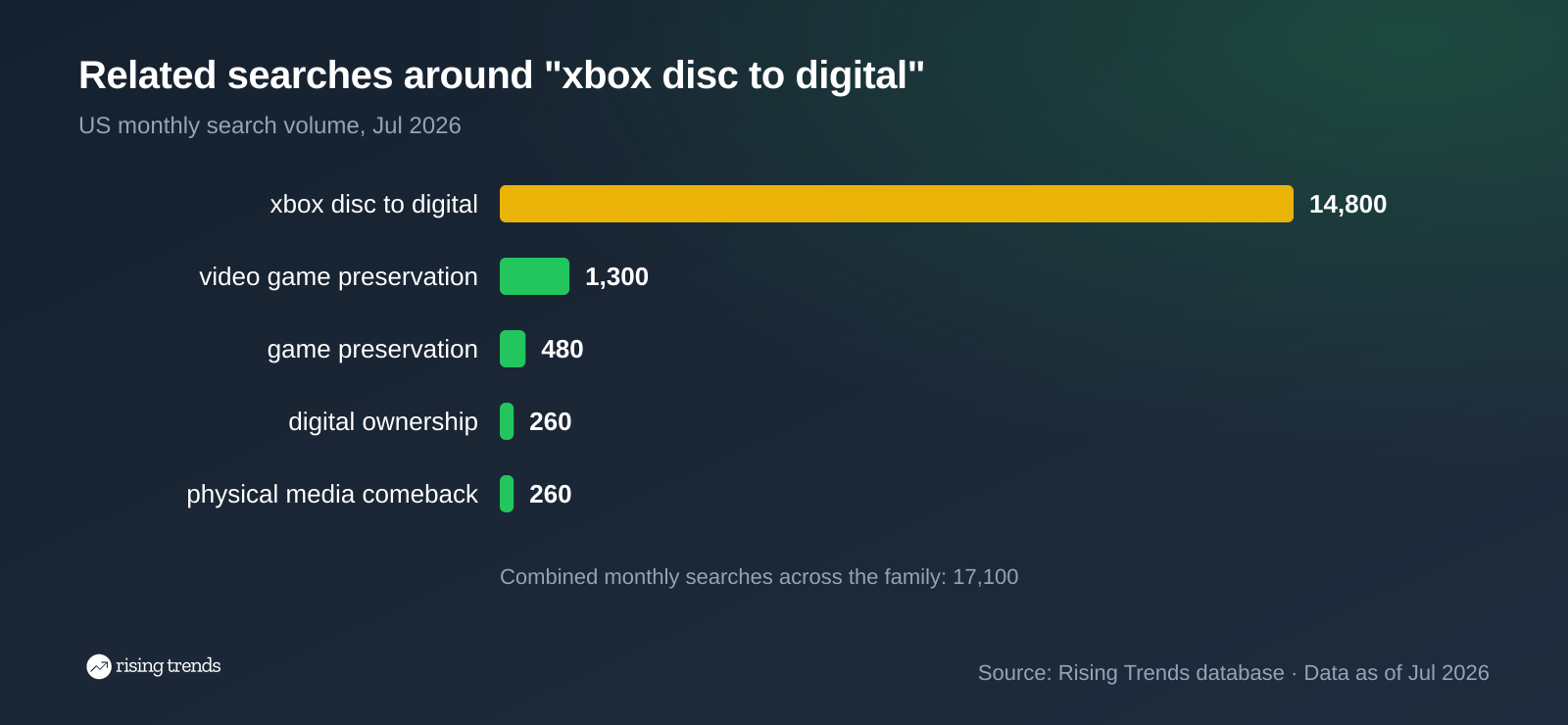
One Microsoft feature out-searches video game preservation by more than eleven times and digital ownership by fifty-seven times, as of July 2026. People are not searching for a principle. They are searching for a button. That is worth remembering when you read the marketing, because the principle is where the fine print lives.
What Xbox Disc to Digital actually does
The mechanic is simple. Put a supported Xbox One or Xbox Series X disc into a console with a disc drive, launch the game or open its tile, and claim the digital license. The disc keeps working exactly as before. The account now also holds an entitlement that unlocks Xbox Play Anywhere on PC and Xbox Cloud Gaming where the title supports it.
Jason Ronald, VP Next Generation, put it this way in the announcement: "Players can claim a digital entitlement by inserting a supported disc into an XBOX One or XBOX Series X console and launching the game." He framed the whole thing as preservation work, calling it "an important step toward a future where players can have greater confidence that the games they buy remain with them for years to come."
The support page is where the conditions live, and it is worth reading in full before you convert anything.
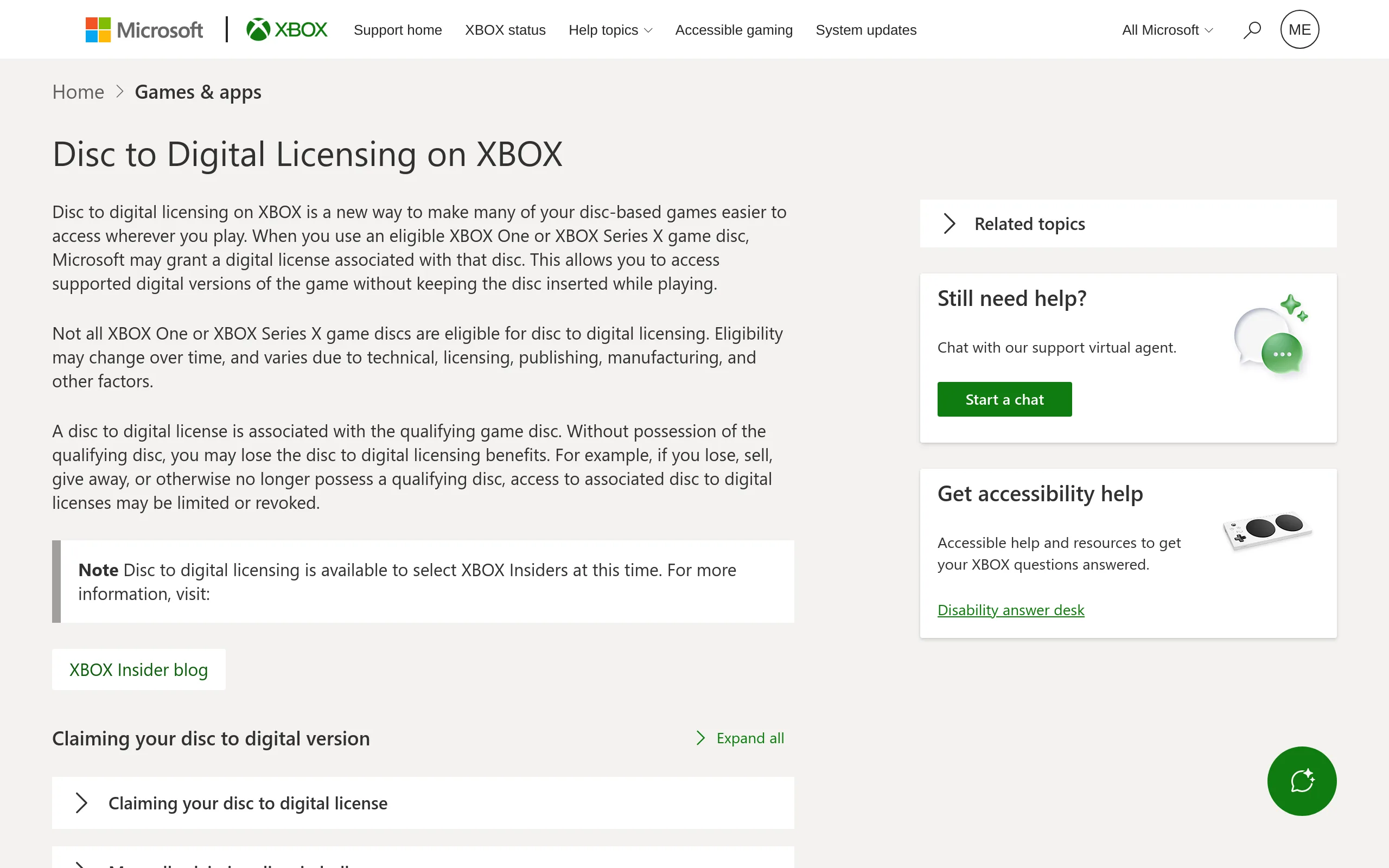
Three sentences on that page do most of the work. Microsoft "may grant a digital license associated with that disc," not will. Eligibility "may change over time, and varies due to technical, licensing, publishing, manufacturing, and other factors." And the one that matters most: "if you lose, sell, give away, or otherwise no longer possess a qualifying disc, access to associated disc to digital licenses may be limited or revoked."
The sentence that changes the deal
Read those two Microsoft documents side by side and you get two different products.
The blog post describes a library that follows you. The support page describes a license that is stapled to a piece of plastic you have to keep in a drawer. Both are true. The digital copy is real and it works without the disc in the tray, but the disc is the receipt, and the receipt is transferable. The reporting behind the July leak said the entitlement moves to whoever inserts the disc next, and the support terms are written to allow exactly that.
So the feature does not convert a disc into a digital game. It attaches a digital convenience to a disc you still own. Sell the disc and you sold the game, same as always. What you gained is that you no longer have to get up and swap it.
That is genuinely good. It is just not what "your discs, now also digital" sounds like.
Why Microsoft can afford this and Sony cannot
The generosity here is real, and so is the fact that it costs Microsoft almost nothing. Circana's monthly US market summary, published September 1, 2026, has the numbers.
| Metric | Figure | Period |
|---|---|---|
| Nintendo share of US new physical software spending | 63% | 2026 year to date |
| PlayStation share of US new physical software spending | 32% | 2026 year to date |
| Everything else, Xbox included | roughly 5% | 2026 year to date |
| US new physical software sales, July | $85 million, an all-time July low since tracking began in 1995 | July 2026 |
| Subscription spending | up 6%, the only growing category | July 2026 vs July 2025 |
A publisher with 5% of a shrinking physical market has no used-game business to protect. Microsoft can hand out digital licenses for discs because the discs were barely selling. Nintendo, sitting on 63% of that market, has the opposite incentive, and has shipped game-key cards that do the reverse: a physical box holding a download.
Sony is the one under real pressure. It set the January 2028 deadline itself, and its blog post attracted more than nine thousand comments, which is not what a routine supply-chain note looks like. The read across the industry is that disc drives are becoming an accessory, and the next consoles will treat them that way. One side effect showed up in our search data within weeks: interest in PS5 emulators went from 4,400 searches a month to 22,200 the month Sony made the announcement. Our gaming trends for 2026 show the same drift on the hardware side, where handhelds and cloud-first devices ship without optical drives at all.
What the first week of testing found
Insiders got the feature on August 31 and started running their shelves through it. Austin Evans bought used games specifically to test what happens at the point of resale, which is the question everyone actually has.
The community threads tell you the hit rate. In one r/xbox thread, the poster ran their whole collection: "out of my 17 physical games (yeah I know it's not much, I mainly use a PC) only 4 didn't allow me to claim the digital license." The four that failed were Starlink Battle For Atlas, Ryse Son of Rome, Wolfenstein The New Order and Dragonball Xenoverse 2, all older Xbox One pressings, which matches Microsoft's warning that manufacturing details decide eligibility.
The top replies are not celebrations. They are people working out the catch in real time. "You have to keep the disc though," one wrote. Another laid out the exact use case the feature breaks: "For a while I was trying to digitize my games collection and was buying digital versions of titles I already owned whenever I found them on deep sales, then I'd sell my disc copy. This wouldnt really help me on the latter point since you have to keep (or destroy?) the disc after, else the license will get yanked when someone else loads it."
Polygon found the upside nobody advertised. Testers discovered that an Xbox One will recognise a Series X disc it cannot actually read, throw a compatibility warning, and still let you claim the digital license from the options menu. That gives Series S owners a route to buy discounted physical current-gen games and play them on a console with no drive. Testers also reported claiming licenses for delisted titles that are no longer sold on the store at all, which is the closest thing to preservation in the whole feature.
What it means for the used-game market
Nothing breaks, and that is the interesting part.
Because the license travels with the disc, the secondhand market keeps working the way it always did. A traded disc still carries a claimable license to its next owner, so a used copy is now worth slightly more than it was: the buyer gets the game plus the digital convenience. GameStop and eBay sellers are not cut out of the loop the way they would have been if Microsoft had made the entitlement permanent and account-bound.
The trade the buyer is making is different, though. Under the old model, a disc was an object. Under this one, it is a key that a platform validates, and platforms change their terms. The support page already reserves the right to change eligibility. Anyone who has watched a storefront close knows what "may be limited or revoked" turns into eventually.
That anxiety is why game preservation is trending at all, and why 1,294,188 Europeans signed the Stop Destroying Videogames initiative. In June 2026 the European Commission answered them: it will not propose a legal obligation to keep games playable after publishers end support, and will instead try to get the industry to write a code of conduct on end of life by the end of 2026. Translated: there is no legal floor under any of this. A platform's support page is the whole contract.
Consumer patience for that is thinner than it used to be. We saw the same reflex in the dopamine shopping trend, where people fill carts they never check out, and in screenless wearables, where buyers started rejecting devices that felt rented rather than owned. Ownership is becoming a feature people shop for.
What to watch next
Does Xbox stop pressing discs? The July report said Microsoft was "likely" to follow Sony. Disc-to-digital is exactly the bridge you would build first if you planned to. Watch whether the next Xbox ships a drive.
Does the eligibility list grow or shrink? Microsoft says thousands of titles now, more over time, and publisher participation decides the rest. If the Insider hit rate stays near the 13-of-17 that early testers report, this is a real feature. If publishers opt out, it becomes a footnote.
Does the search demand hold? A launch spike that fades was a news cycle. One that holds is a behaviour change. The same test is running on a much smaller game right now: Songless Unlimited jumped from 4,400 to 33,100 monthly searches in one month, off a falling base. The August and September numbers for "xbox disc to digital" will answer that, and the terms to watch alongside it are game preservation and digital ownership. If those climb too, the story stops being about a convenience feature and starts being about what people think they are buying.
The honest summary is that Microsoft built something useful and described it in a way that oversells it. Your discs are now also digital, for as long as you keep the disc. That is a better deal than Sony's version of the future, which is no disc at all. It is not the same as owning the game.
Want to catch the next feature launch while it is still a search curve? Read our guide on how to identify market trends, or see what is breaking out right now in our trending topics list.
Never miss a trend again
- One trend broken down with the numbers
- Who's making money, and what to build
- A website on the rise
- A breakout app
Join 5,000+ founders