Trends


For two years, "ox alpha" was a dead term in our database. Ten searches a month, every month, the floor value we record when almost nobody is looking. Then August 2026 happened and it hit 74,000 monthly searches, its highest reading on record and a 739,900% move year over year, which our database classifies as EXPONENTIAL. The thing people were searching for did not have an owner, a price, a paper or a company behind it. It was a name on a dropdown menu.
Ox Alpha was a stealth model: an anonymous endpoint that a lab nobody could identify put on OpenRouter on 20 August 2026, free, with a million tokens of context. Six days later it was revealed as GLM-5.3-Flash from Z.ai. The interesting part is not the whodunnit. It is what the search curve did afterwards. The codename is still pulling more demand than the product it belongs to, by a factor nobody ranking for this term has bothered to measure. We did.
Key takeaways:
Let's get into it.
Here is the full two-year curve for "ox alpha" from our database. There is no ramp, no early-adopter shoulder, no build-up. One month of nothing, then a wall.
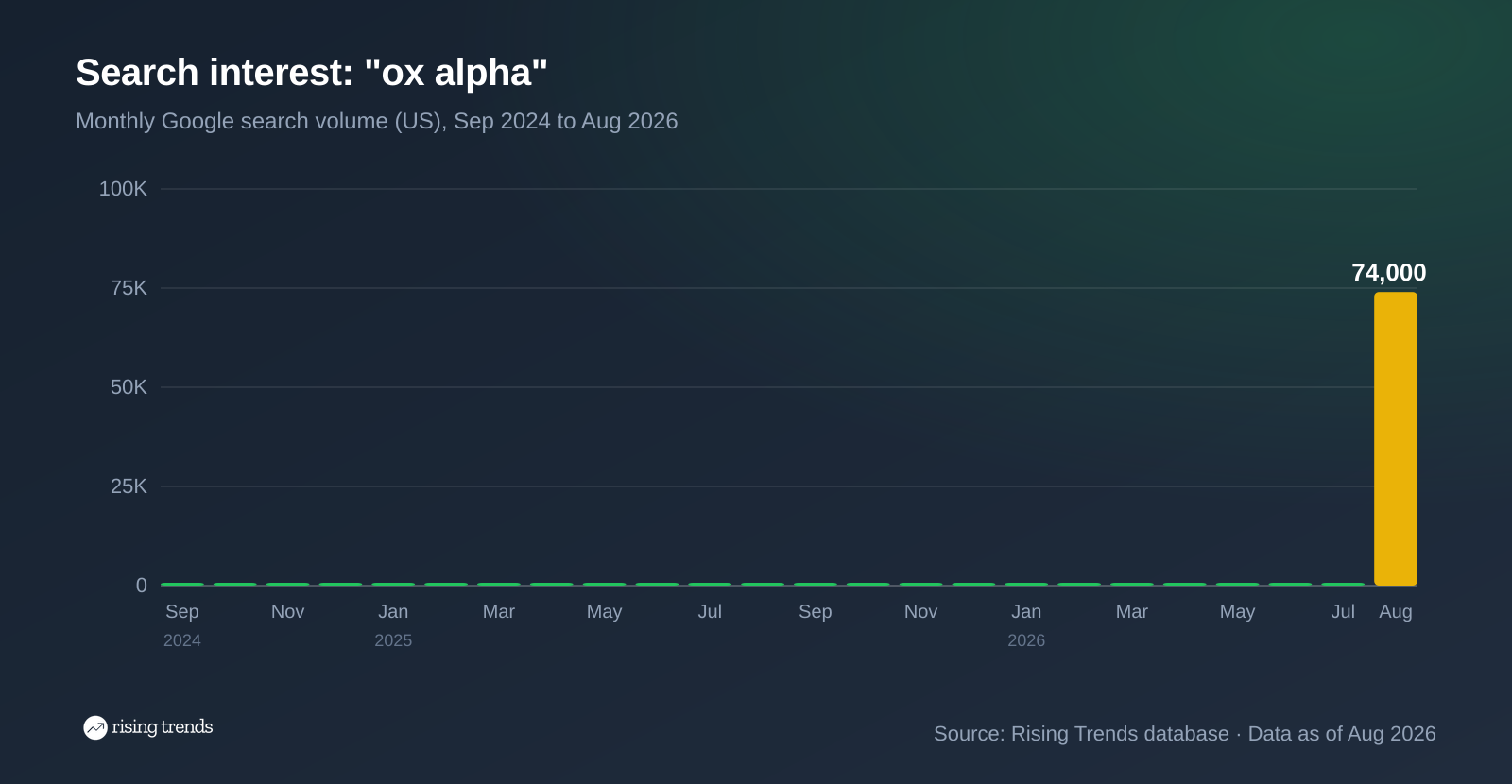
That shape is rare. Most product launches we track show a step, because the name circulated in developer channels before it circulated on Google. This one could not, because the name did not exist until the listing went live. The whole curve was built in the last twelve days of August.
Now put the codename next to the product. This is the comparison that makes the case.
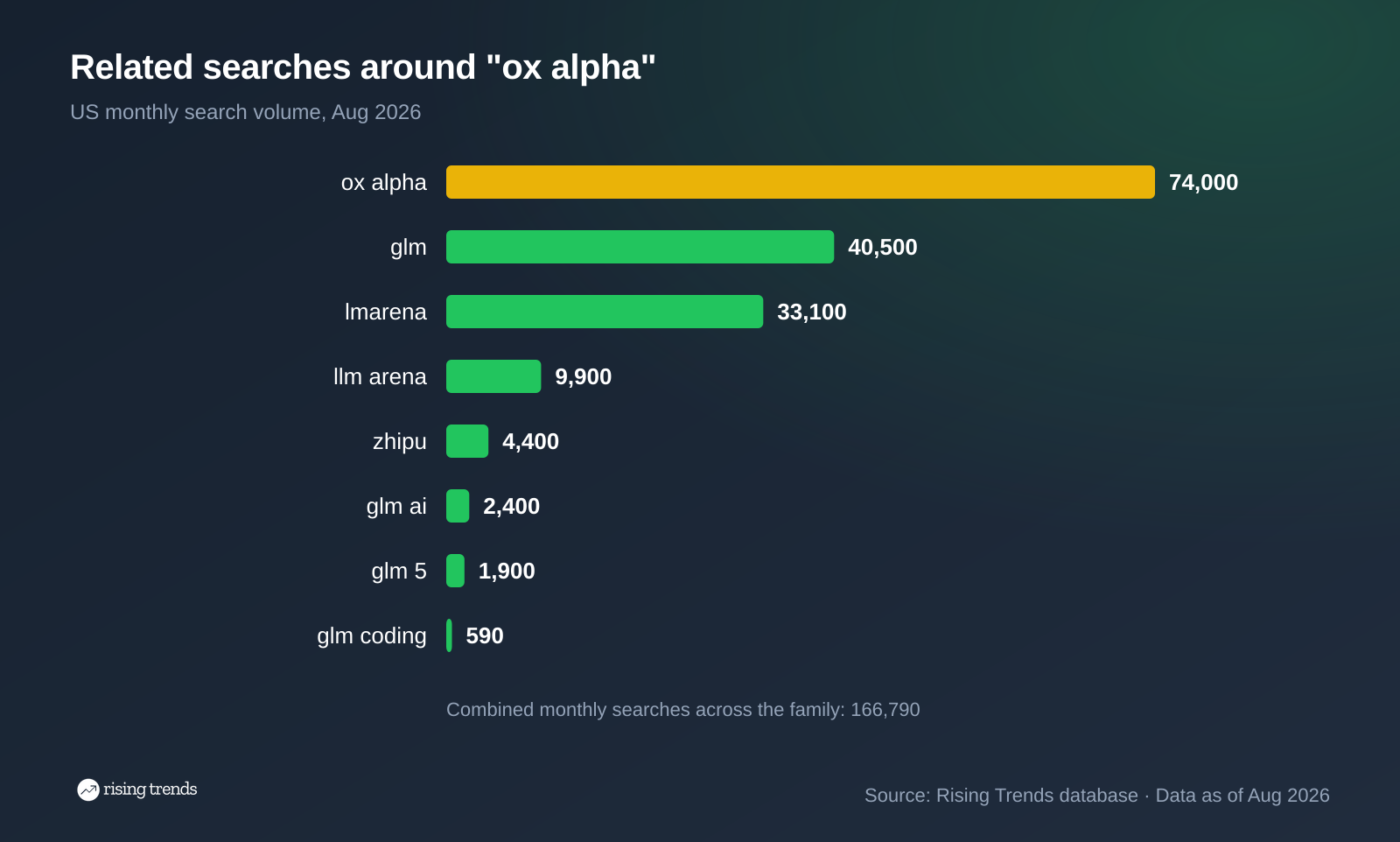
A temporary alias on a routing platform pulled 74,000 searches against 1,900 for "glm 5", as of August 2026. That is 39x. Even "glm" on its own, the umbrella term for the whole model family, sits at 40,500. The company name does worse still: "zhipu" is 4,400. The disguise was a better brand than the brand. You can watch all of these terms move on the live Ox Alpha trend page and the GLM trend page in our dashboard.
The listing itself is still up, and it now carries its own answer at the top of the page.
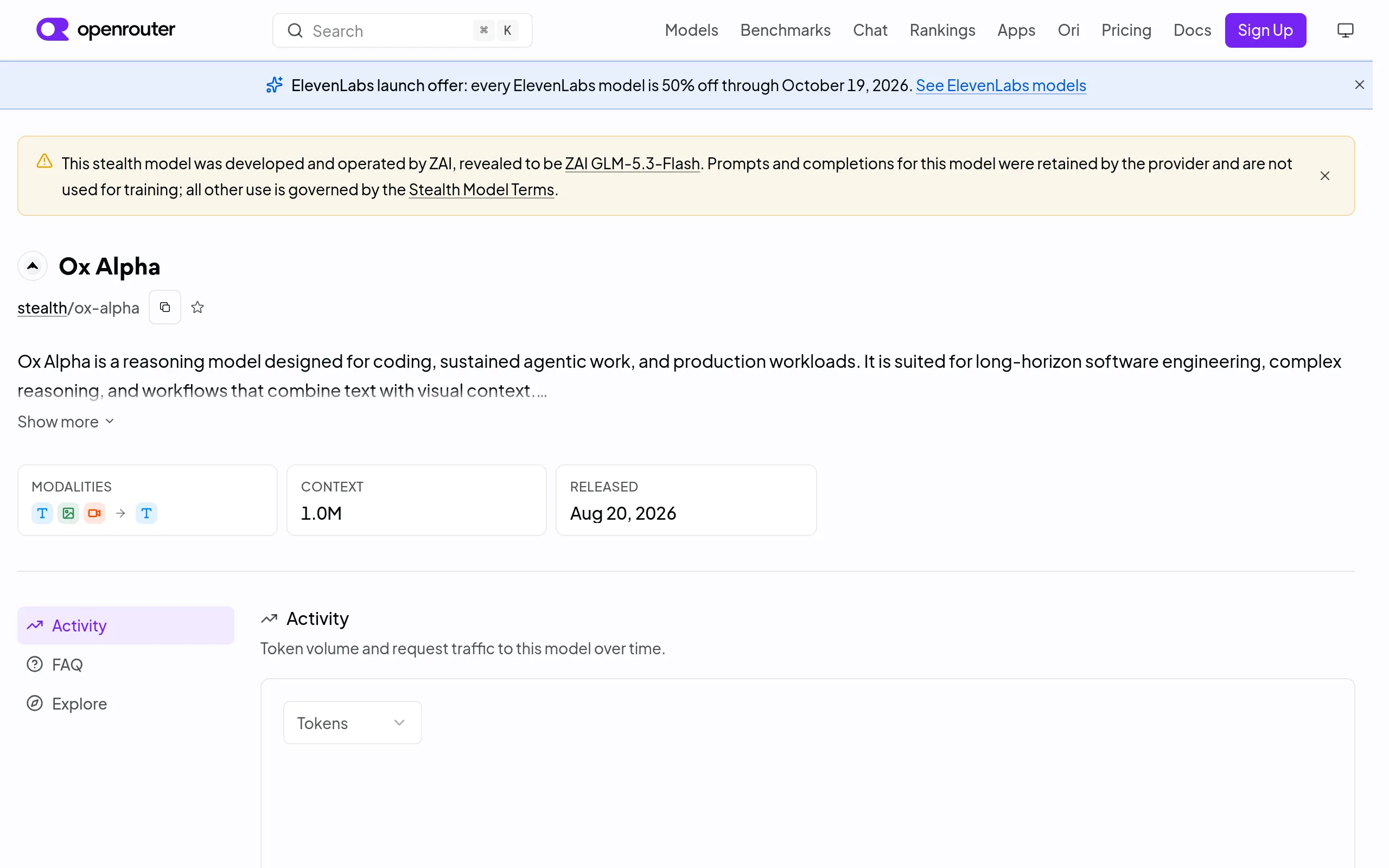
The OpenRouter model page gives the spec: released 20 August 2026, a 1,048,576 token context window, text, images and video in, text out, and a description of "a reasoning model designed for coding, sustained agentic work, and production workloads". Everything else was blank. The provider was "a third-party provider who has chosen to remain anonymous during this preview".
Underneath, it was GLM-5.3-Flash: 320 billion total parameters with 18 billion active, the first model in the GLM-5 series built as natively multimodal, and, by Z.ai's own account, the first open-source frontier model to combine sparse and linear attention. Z.ai's own documentation puts the saving at 3.01x less attention compute and 4.44x less KV cache than GLM-5.3. The weights went up on Hugging Face under an MIT license and have been downloaded 6,489,462 times in the last month.
The preview cost nothing. The named model now lists from $0.0261 per million input tokens and $0.90 per million output across 28 providers on OpenRouter's GLM-5.3-Flash page. That page also carries the third-party scores: an Artificial Analysis Coding Index of 71.5, Terminal-Bench 2.1 at 84.3%, and a Vals AI SWE-bench result of 92.0%.
Because for six days it was the best free thing on the internet, and nobody knew who was paying for it. OpenRouter announced the listing on 20 August, and the post carries 4,249 likes on X.
What followed was a week of amateur forensics. A developer built modelprint, a browser tool that fires nine infrastructure probes at an anonymous endpoint and compares the responses against known models, and it matched Ox Alpha to GLM-5.3 on six of the nine. The tool's own documentation is careful about what that proves: matching fingerprints establish shared infrastructure, not model identity.
Then the numbers arrived. OpenRouter said the model had processed over 20 trillion tokens in six days. Z.ai founder Jie Tang put it at nearly 20% of OpenRouter's weekly token volume, the top slot on the platform. On 26 August, Z.ai's launch post ended the guessing with one sentence: "Before release, we tested GLM-5.3-Flash anonymously as ox-alpha on OpenCode and OpenRouter to gather user feedback. It quickly became the most popular model of the week."
The two are the same weights. Almost nothing else about them is the same.
| Ox Alpha (20 to 26 Aug 2026) | GLM-5.3-Flash (from 26 Aug 2026) | |
|---|---|---|
| Who built it | Undisclosed | Z.ai, named on its own blog |
| Price | $0 in, $0 out | From $0.0261 in, $0.90 out per million |
| Weights | None published | MIT license on Hugging Face |
| Benchmarks | Community runs only | Artificial Analysis, Vals AI, Design Arena |
| Data terms | Prompts retained, governed by the stealth EULA | Standard provider terms, 28 providers |
| Searches, Aug 2026 | 74,000 | 1,900 for "glm 5" |
The data terms are the part most people skipped. The Ox Alpha page says prompts and completions are retained by the provider and not used for training, while the Stealth Program EULA it incorporates for all other use grants a broader license over submitted content. Both are first-party documents and they do not say the same thing. If your team cares about where code goes, that is the same diligence problem we covered in our explainer on zero data retention.
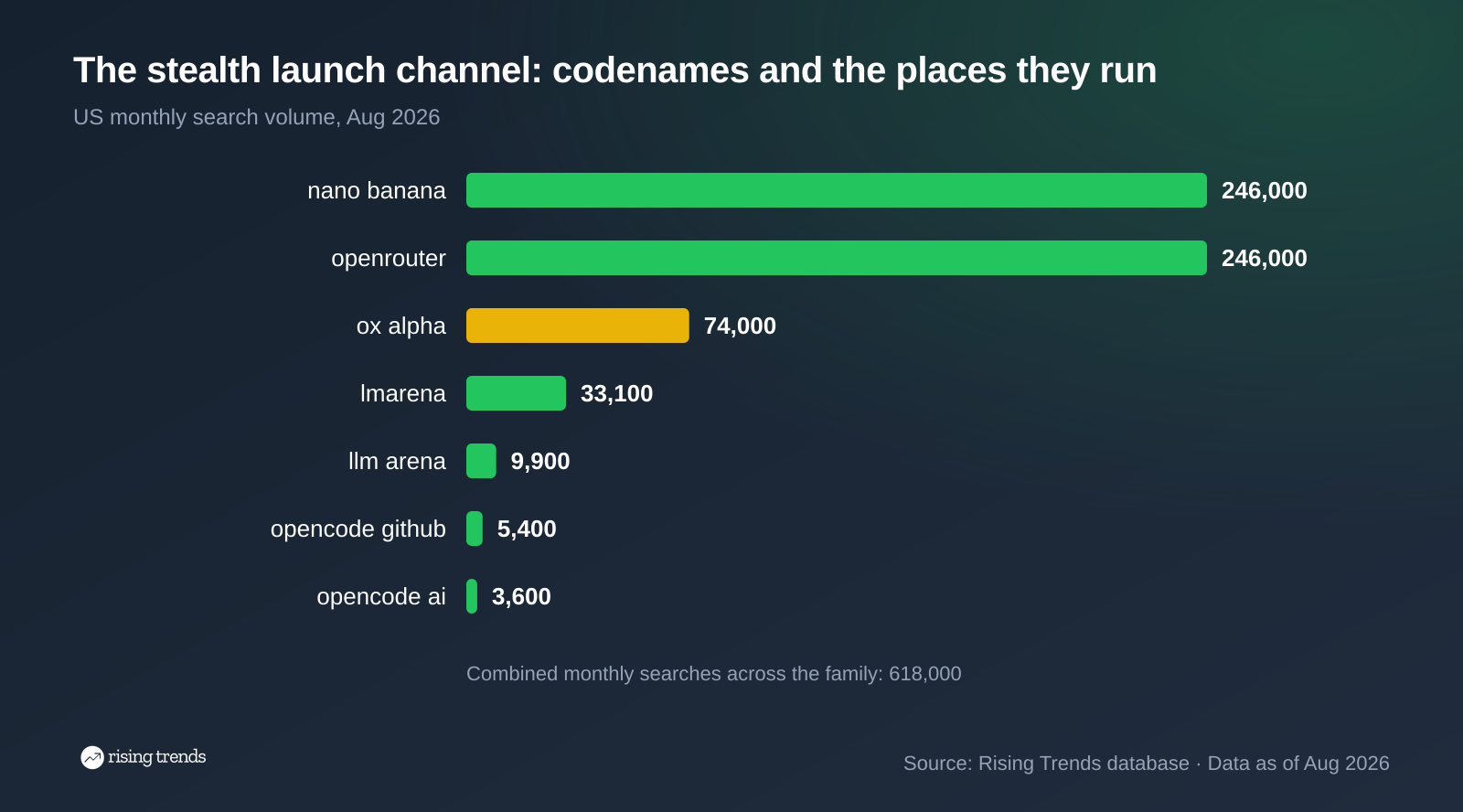
Ox Alpha is also not the only codename out-performing its product. Set it against nano banana, the image model that spent its own pre-launch weeks running under a codename, and the pattern is obvious.
Mixed, and more useful for being mixed, because nobody knew whose model they were grading. On Hacker News, where the listing drew 264 points and 204 comments, one commenter called the identity early from writing style alone: "Based on its indecisive and far-too-lengthy thinking traces... as well as a rudimentary stylometry comparison with latest non-stealth models, this is almost certainly a GLM model." Another was blunt about the weak spot: "It did an absolutely terrible job at generating CSS." A third found the opposite: "On softer/looser/creative matters, this is an extremely impressive model."
The most rigorous number came from a developer who ran the entire 113-task DeepSWE suite against the anonymous endpoint and published the whole log on GitHub. The result was 66 solved out of 113, or 58.4%, over 20 hours and 39 minutes of agentic work, with a 95% confidence interval of 49.2% to 67.1%. The decomposition matters more than the headline: 90 of the 113 tasks cleared at least 90% of their fail-to-pass tests, and the author attributes 9.7% of the benchmark to tool-call format failures rather than to reasoning. It is a blind, reproducible run, and the most detailed independent read on the preview that anyone published.
The suspicion was constant throughout. The top comment on the Hacker News thread asked the obvious question: "I'm curious what the model provider is using the prompt/response pairs for... They aren't offering a model for free without their name on it for no reason."
A stealth listing buys a lab something it cannot buy any other way: a week of real agentic traffic, on real codebases, with no brand halo attached. Twenty trillion tokens of adversarial use from people who had no idea which country the model came from is a better evaluation than any internal suite, and it costs less than a launch campaign. That is why the slot keeps getting filled. OpenRouter's stealth index now lists three models, with Union Alpha added on 16 September 2026 and Space Bunny Alpha on 23 September.
For buyers, the lesson is sharper. The thing that broke was not the model. It was the string. Developers built workflows on a free alias with no contract behind it, and the alias disappeared on schedule. One r/openrouter poster summed it up after the ID was pulled: "I burned 350M tokens in 2 days from 2 accounts... The worst part is i started planning so much work around it not knowing that it will end in 2 days."
For the rest of the market, this is a pricing event dressed as a mystery. A model that its own lab positions as approaching Claude Opus 4.8 on coding and agentic work now ships with open weights at a fraction of frontier pricing, and it proved its case before anyone knew to discount it for its origin. That pressure is the same one we traced in open-source AI agents and in the economics behind small, purpose-built models.
Three things, each with a term in our database that will confirm it.
The codename becomes the category. If stealth listings keep working, expect the alias to be the thing people search, not the model. Watch "ox alpha" itself: a term that holds above 10,000 a month into 2027, long after the name was retired, tells you the codename outlived the product.
The GLM brand catches up, or it does not. "glm 5" at 1,900 and "glm coding" at 590 as of August 2026 are tiny next to the traffic the model actually got. If Z.ai converts the preview into brand demand, those curves move. If they stay flat, the lab bought usage and not recognition.
The arenas get crowded. "lmarena" is at 33,100 and down 45% in a year as of August 2026, while routing platforms rise. If anonymous previews move entirely to routers and coding harnesses, the leaderboard sites lose the one thing they had, which was being first to touch a new model. Our AI trends hub tracks the whole cluster, and the broader shift toward models that improve from deployment is covered in self-improving AI.
Want to catch the next stealth launch while the curve is still forming? Read our guide on how to identify market trends, follow the live Ox Alpha trend page, or browse what is breaking out right now on the Rising Trends dashboard.
Thousands of Emerging Trends
Thousands of Breakout Apps
Mega Trends
Trend Analysis Tool