Trends


For two years the term "one piece sneakers" sat in our database doing nothing. It moved between 210 and 590 searches a month, the sort of flat line that belongs to a niche nobody is in a hurry to join. Then August 2026 arrived and it hit 49,500, a 103x jump off the month before and the single steepest one-month move in our footwear set this year.
What makes it worth writing about is not the spike. It is what the spike sits next to. Across the same twelve months, LEGO's One Piece sets lost most of their search demand while the sneakers gained more than a hundred times theirs. The licence did not get bigger. It moved house. Below we lay out the curve, the drop calendar that caused it, the resale numbers that say which parts of the licence are actually scarce, and the one detail of Nike's rollout that nobody is pricing correctly: a piece of cardboard.
Key takeaways:
Let's get into it.
Here is the monthly search volume for "one piece sneakers" over the last two years, straight from our database. For 23 of those 24 months the line is effectively flat.
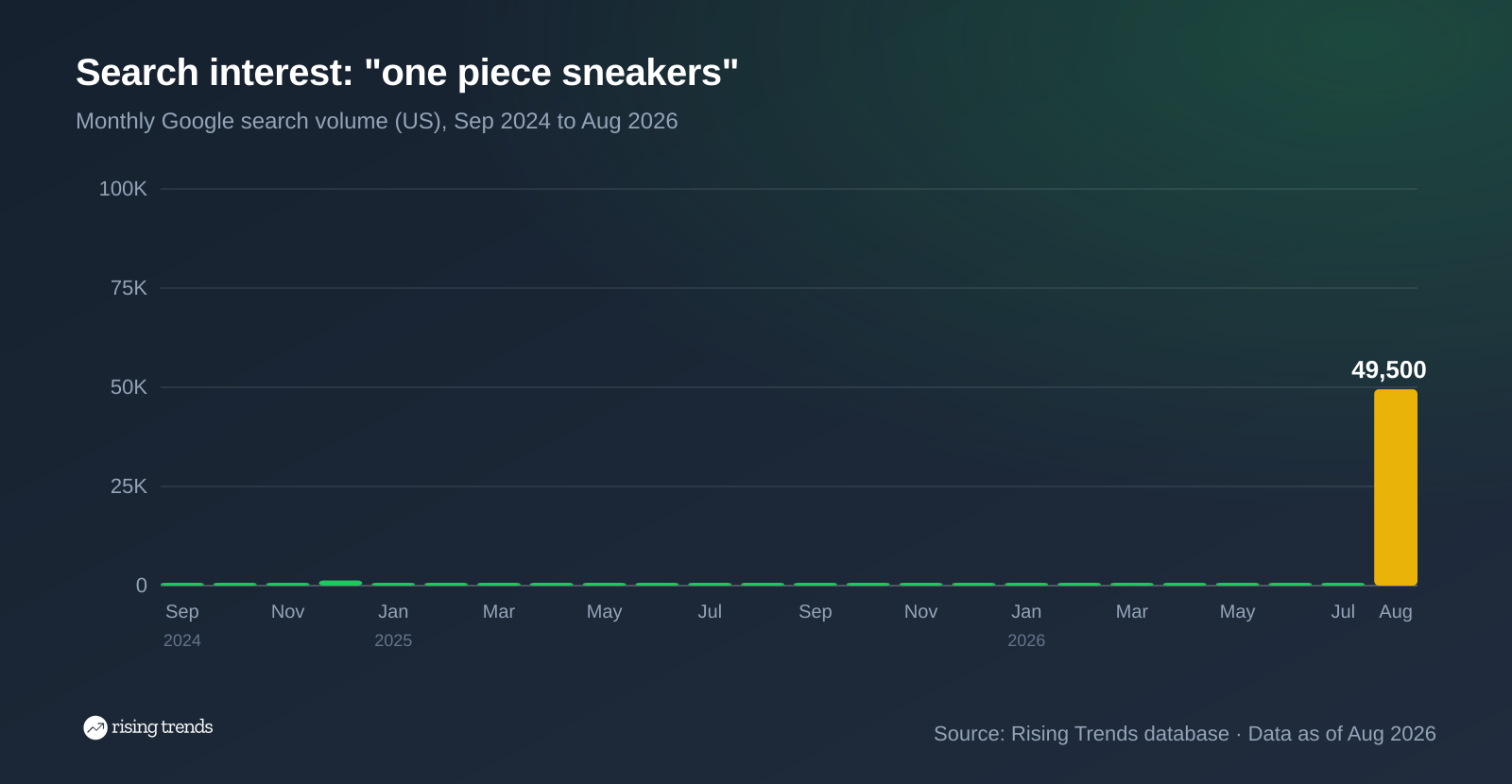
That shape is the opposite of a slow build. July 2026 ran at 320 searches. August closed at 49,500. Twelve months earlier the term was doing 480, which makes the year-over-year number 10,213%, and the two-year number 8,290%. The database marks it EXPONENTIAL with a LOW seasonality score, meaning this is not a December toy spike wearing a different hat.
One term breaking out is a news event. A family moving is a market. So we pulled every licensed-collab footwear term we track and put them on one axis.
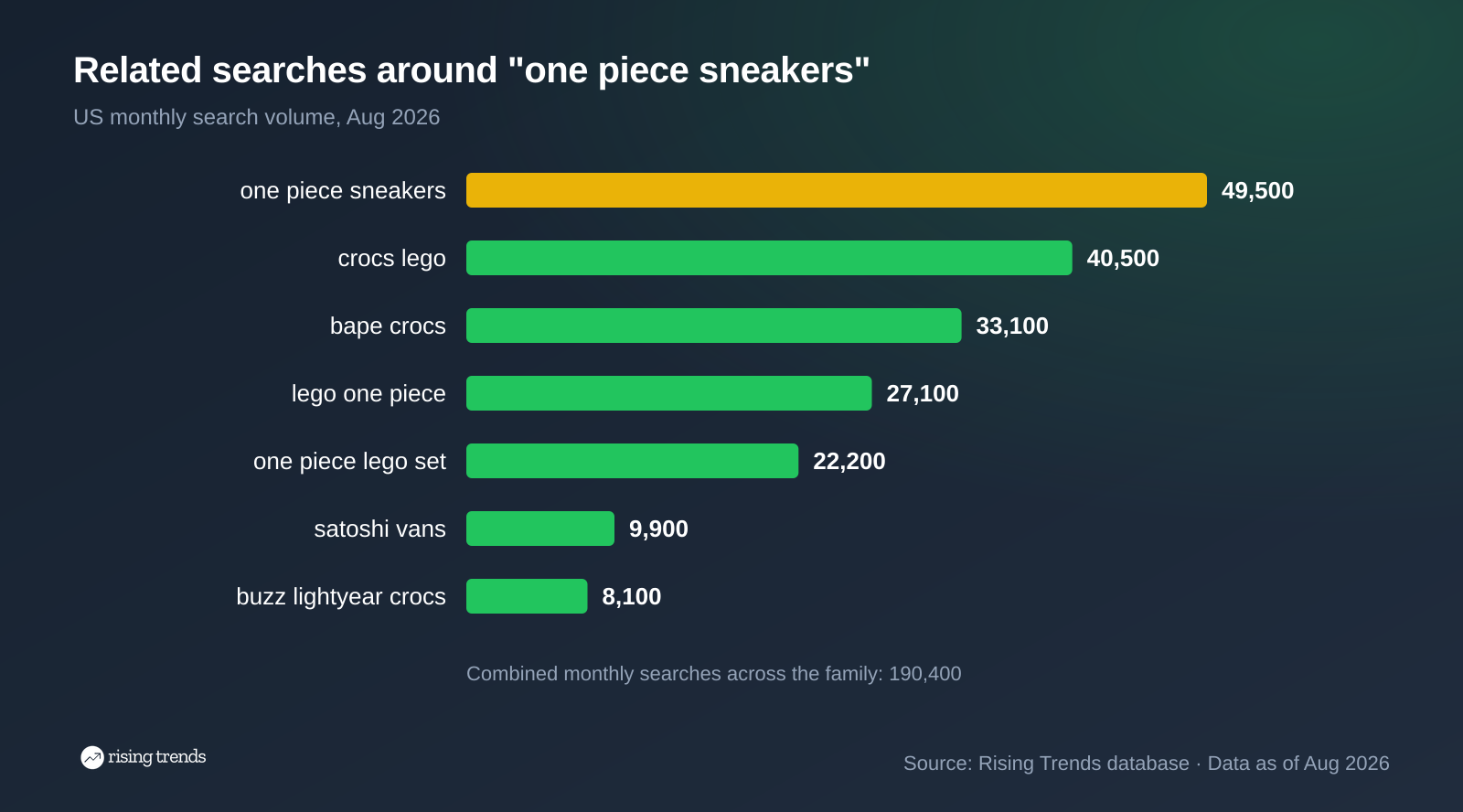
Those seven terms are worth 190,400 searches a month between them as of August 2026, and the One Piece sneaker is now the largest single one. Crocs is in that chart three times. That is not an accident, and we come back to it below.
The comparison that actually explains the story is the growth ranking, because it splits the same intellectual property down the middle.
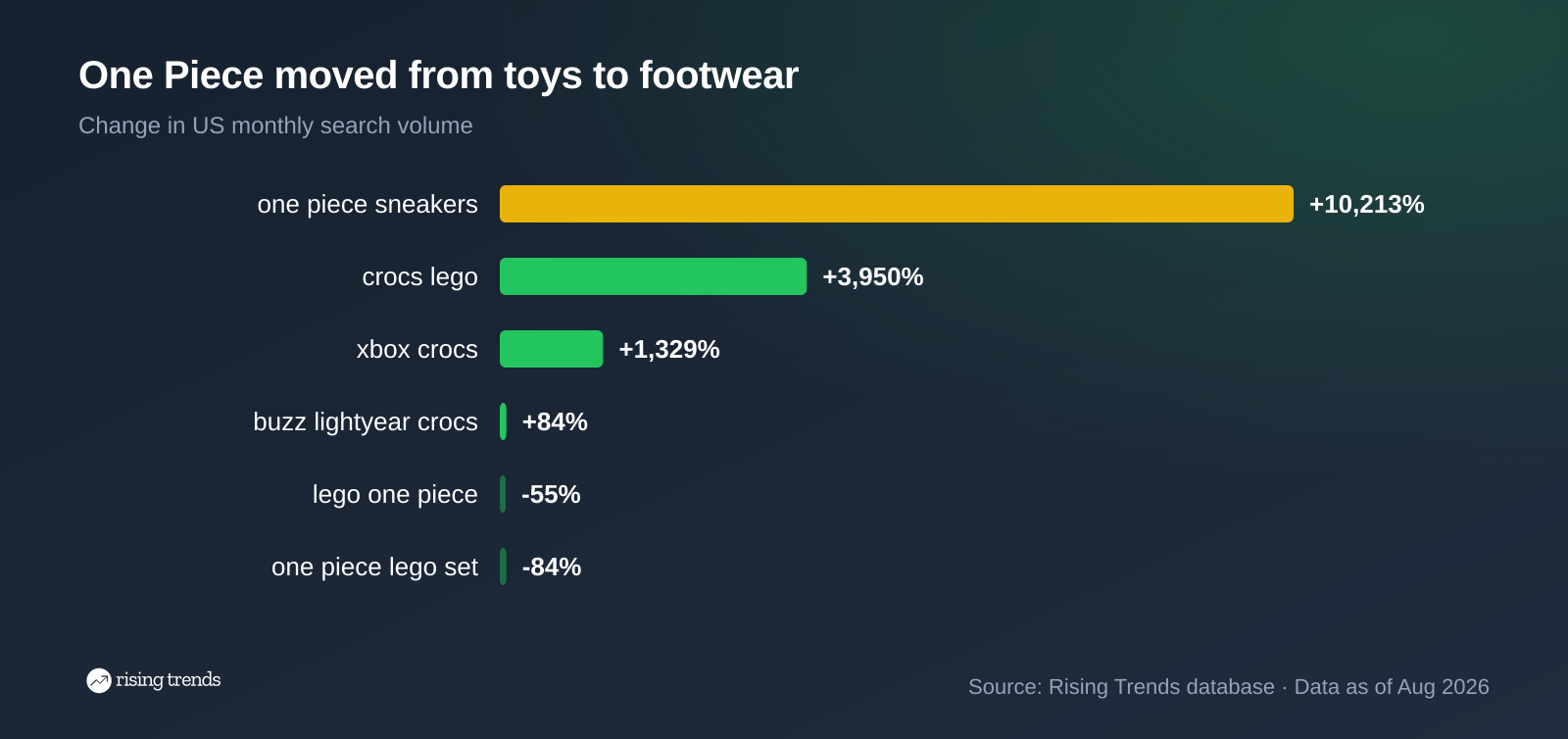
Read the top and the bottom of that chart together. One Piece on a shoe is up 10,213% in a year. One Piece on a LEGO set is down 84%. Same franchise, same twelve months, and the toy terms are still large in absolute volume (27,100 and 22,200 as of August 2026) but falling fast. We wrote about the front half of that toy cycle in our breakdown of the Dragon Ball LEGO trend, where search peaked four months before LEGO announced a single set. The One Piece sets are what the back half looks like.
The trigger has a date and a URL. On 23 August 2026, Nike published the collection on its corporate newsroom.
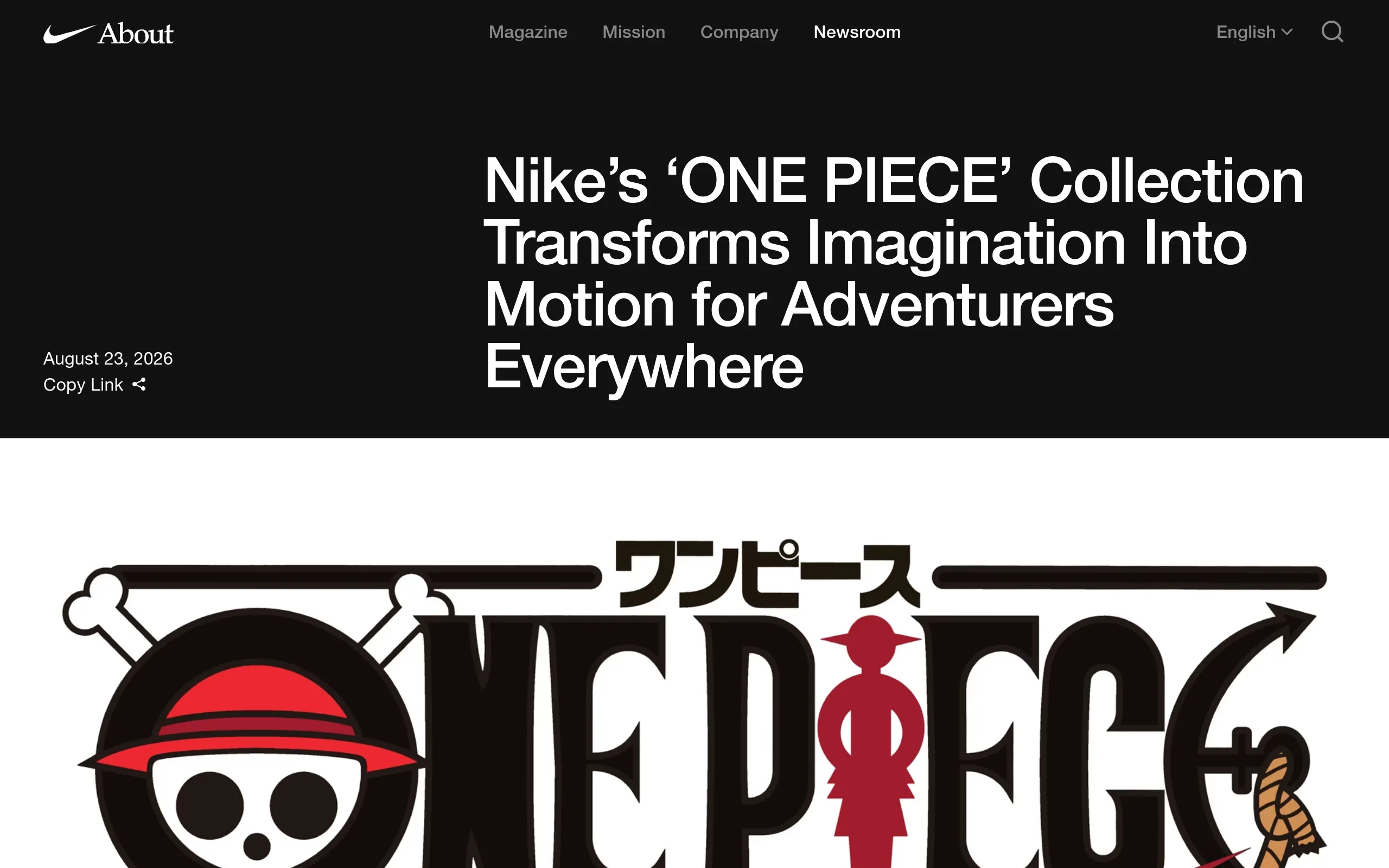
The Nike newsroom release describes three Air Max Plus colorways built around the Devil Fruits, the fictional fruits that grant powers and cost the eater the ability to swim: the Gomu Gomu no Mi, the Ope Ope no Mi and the Mera Mera no Mi. Nike says each shoe has "completely retooled uppers exclusive to the collection", which is a bigger commitment than the usual graphic-print collab. Nick Remlinger, the company's GM for Energy Gaming, puts the pitch this way in the release: "We were inspired by the superhuman abilities that are unleashed when ONE PIECE characters eat the Devil Fruits, much like the feeling an athlete has when they put on a pair of Nikes."
That announcement landed eight days before the August search month closed, which is why the whole 49,500 shows up in one bar rather than spread across two.
The reaction is the part the search curve cannot show you. This reel from @aishkhar, posted on 25 September 2026, is an unboxing from India and carries 2,452 likes and 34 comments according to the post's own page.
Note where that video was shot. Nike's rollout did not run through one American launch; it ran through doors in Tokyo, Taipei, Jakarta, Seoul, Mexico City, Amsterdam and nine other cities. The demand arrived everywhere at once, and so did the resale listings.
The detail most coverage skipped is in Nike's own calendar. Instead of a single SNKRS release, the company staged the collection like a concert tour, and listed every stop in the release.
| Date (2026) | Where | Doors |
|---|---|---|
| Sep 4 to 6 | Tokyo pop-up | 1 |
| Sep 11 | Hong Kong, Shanghai, Taipei | 4 |
| Sep 12 | Jakarta, Mexico City, Seoul, Umeda | 5 |
| Sep 19 | Amsterdam, Dallas, Decatur, Dusseldorf, Lawrenceville, London, Madrid, Milan, San Diego, Stockholm, Washington DC | 11 |
| Sep 25 | SNKRS, global | online |
| Oct 16 to 18 | Sydney | 1 |
That is 22 physical releases across 20 cities over seven weeks, with the one online launch sitting in the middle rather than at the front. Each stop produced its own photographs, its own queue footage and its own round of searches. By the time SNKRS opened on 25 September, three weeks of scarcity had already been manufactured in public.
Here is the mechanic nobody has priced out loud. Nike's release, updated on 2 September, says that in-person footwear buyers also received a card from the Nike x One Piece Premium Card Collection: a "DON!! Card" for the One Piece trading card game, in a design matching the colorway. Tokyo buyers got a Gomu Gomu version; everyone else got the English-language card. Buy the same shoe online and you get the shoe.
StockX now lists each pair twice, with and without that card, which means the market has put a number on it.
| Pair | Lowest ask, no card | Lowest ask, with card | Difference |
|---|---|---|---|
| Gomu Gomu (IR0968-500) | $322 | $486 | $164 |
| Mera Mera (IW1283-800) | $314 | $398 | $84 |
| Ope Ope (IW1282-600) | $456 | $460 | $4 |
On the Gomu Gomu, a promotional trading card is carrying a $164 spread on the lowest ask, close to the full retail price of the shoe. That is the price of having physically stood somewhere. Card collectors have noticed, and not all of them are pleased about it: in the r/OnePieceTCGRestocks thread titled "not for sale", a collector points out the obvious about the cards now being flipped, that "every promo card printed has this on it."
Scarcity is easy to claim and easy to check. All three pairs carry the same $180 retail price, confirmed on the release pages for the three Devil Fruit SKUs. Some outlets have reported $210, which is a market reading rather than a counter price. The StockX page for the Ope Ope lists that $180 retail against an average sale price of $473 over the last three months, across 305 sales, with a twelve-month range of $242 to $1,066. The last recorded sale carried a 163% premium over retail. The Gomu Gomu page shows 404 sales, an average of $407 and a 103% premium. Between them, those two colorways cleared 709 StockX sales in three months.
Now hold that against the same licence on a different shoe. The Crocs Classic Clog One Piece Luffy went on sale on 5 March 2026 at $70, through a Foot Locker raffle and a first-come drop at 10:00 AM ET, per the release guide for the Crocs four-pack. It has an average sale price of $86 over three months across 165 sales, and its last recorded sale closed at a 10% discount to retail.
| Nike Air Max Plus Ope Ope | Crocs Classic Clog Luffy | |
|---|---|---|
| Released | 19 Sep 2026 | 5 Mar 2026 |
| Retail | $180 | $70 |
| Average sale, last 3 months | $473 | $86 |
| Sales, last 3 months | 305 | 165 |
| Premium on last sale | +163% | -10% |
The licence is identical. The character is from the same crew. One sells at 2.6x retail and one sells at a discount. Whatever is driving the premium, it is not the anime.
One Piece has been on shoes for nine years, and the history is the control group. Sole Retriever's history of One Piece sneaker collabs walks the whole run: Converse Japan in 2017 for the Chuck Taylor centenary, the Japanese brand LEAD in 2019 with boxes that formed a picture of the Going Merry when lined up, Puma Japan's Cell trio for the Stampede film the same year, Vans in 2022 with five silhouettes in family sizing, a Puma Suede four-pack for the Pirate Emperors in March 2024, and the atmos x Crocs clog in 2025.
None of those moved our search line. Three things were different this year:
Crocs is the interesting loser here, and its own data says so. "Crocs lego" is up 3,950% in a year to 40,500 searches as of August 2026, and "xbox crocs" is up 1,329%, so the clog collab machine still works. It just did not work for this particular licence at this particular moment, because by March the One Piece drop everyone was waiting for had not happened yet.
Licence scarcity is now the product, not the licence. The same One Piece rights produced a 2.6x resale multiple and a sub-retail clog within six months of each other. A brand paying for an anime licence on the assumption that the fandom does the work is buying the cheaper half of the deal. What generated the premium was a seven-week, 22-door rollout that made the online launch feel like the last chance rather than the first.
The physical door is being repriced. The DON!! card is a small, cheap object that turns a store visit into an asset. It is an elegant answer to a problem every sneaker brand has: how do you make people queue when the same shoe appears online three weeks later? The answer Nike found was to put something in the box that the website cannot ship. Expect that mechanic to spread, and expect it to be copied badly.
Licensed collabs beat house franchises on velocity, not on volume. A collab like this is a spike, not a line. The 49,500 in August is enormous, but the curve behind it is flat, which means the demand is event-driven. We saw the same shape with Vivet, the Kai Cenat label that peaked eight months before it shipped, and with Labubu, where the collectible hype cycle ran far ahead of the product calendar. Companies that treat a spike like a baseline over-order for the follow-up.
The resale market is doing Nike's price discovery for free, and keeping the money. Three hundred and five Ope Ope sales at an average of $473 is roughly $144,000 of transaction value on a single colorway on a single platform, against a retail take of about $55,000 on the same pairs. That gap is the argument for every brand that has tried to move its own secondary market in-house. We dug into the same dynamic with Swatch's $400 Royal Pop and its real StockX premiums, where the brand chose deliberately to flood supply instead.
Watch whether the curve holds a floor. The honest read of our data is that August 2026 was one month. The question for the next reading is not whether 49,500 repeats, it is whether the term settles at 5,000 or back at 400. Our live one piece sneakers trend page is where that shows up first, and the Sydney drop on 16 to 18 October gives it one more push before the number has to stand on its own.
Watch crocs lego, not one piece lego set. The clog collab lane is the one still compounding: crocs lego is up 3,950% in a year to 40,500 searches as of August 2026, against 27,100 and falling for lego one piece. If Crocs gets a second One Piece window after the Nike heat, that term is where the handoff would be visible.
Watch for the promo-card copycat. If a second brand ships a collectible with in-store purchases this quarter, the DON!! card stops being a Nike curiosity and becomes a distribution tactic. The tell will be a trading-card term breaking out alongside a footwear term, which is exactly the kind of cross-category pairing we track on our footwear trends and fashion trends pages.
One last thing worth saying plainly. Not everyone likes these shoes. A poster in r/OnePiece asked the thread, "Am I the only one thinking all the Nike one piece collab shoes are ugly as hell?", and the replies were split. A commenter in r/Sneakers who had never seen the show said it looked like a cool collab anyway. That is the whole trend in two comments: the people who care about the anime are arguing about the design, and the people who do not care about the anime are buying the shoe. A licence that converts the second group is worth paying for. One that only flatters the first group is a $70 clog selling at $63.
Want to catch the next collab before the resale market prices it? Read our guide on how to identify market trends, follow the live one piece sneakers trend page, or browse what is breaking out right now on the Rising Trends dashboard.
Thousands of Emerging Trends
Thousands of Breakout Apps
Mega Trends
Trend Analysis Tool