Trends


The strange thing about "dragonball lego" is not how fast it grew. It is when. The term sits at 12,100 US monthly searches as of August 2026, up 831% in a year, and it peaked at 14,800 back in June. LEGO did not confirm a Dragon Ball partnership until 29 September 2026. The set does not go on general sale until 4 November. Peak demand arrived four months before the product had a name and five months before anyone could buy it.
That gap is the story, and it is not unique to Dragon Ball. Across our database the LEGO terms that are climbing are all licence terms, and the parent brand is barely moving. "lego" itself is a 2,740,000-a-month giant growing 22% a year. "lego pokemon" grew 309%. "lego playstation" grew 823%. Below we go through the curve, the licence ladder underneath it, what LEGO actually announced, and what the one previous anime licence tells you about what happens next.
Key takeaways:
Let's get into it.
Start with the curve itself. For two years this term sat in a narrow band, mostly between 1,300 and 5,400 a month. Then June 2026 happened.
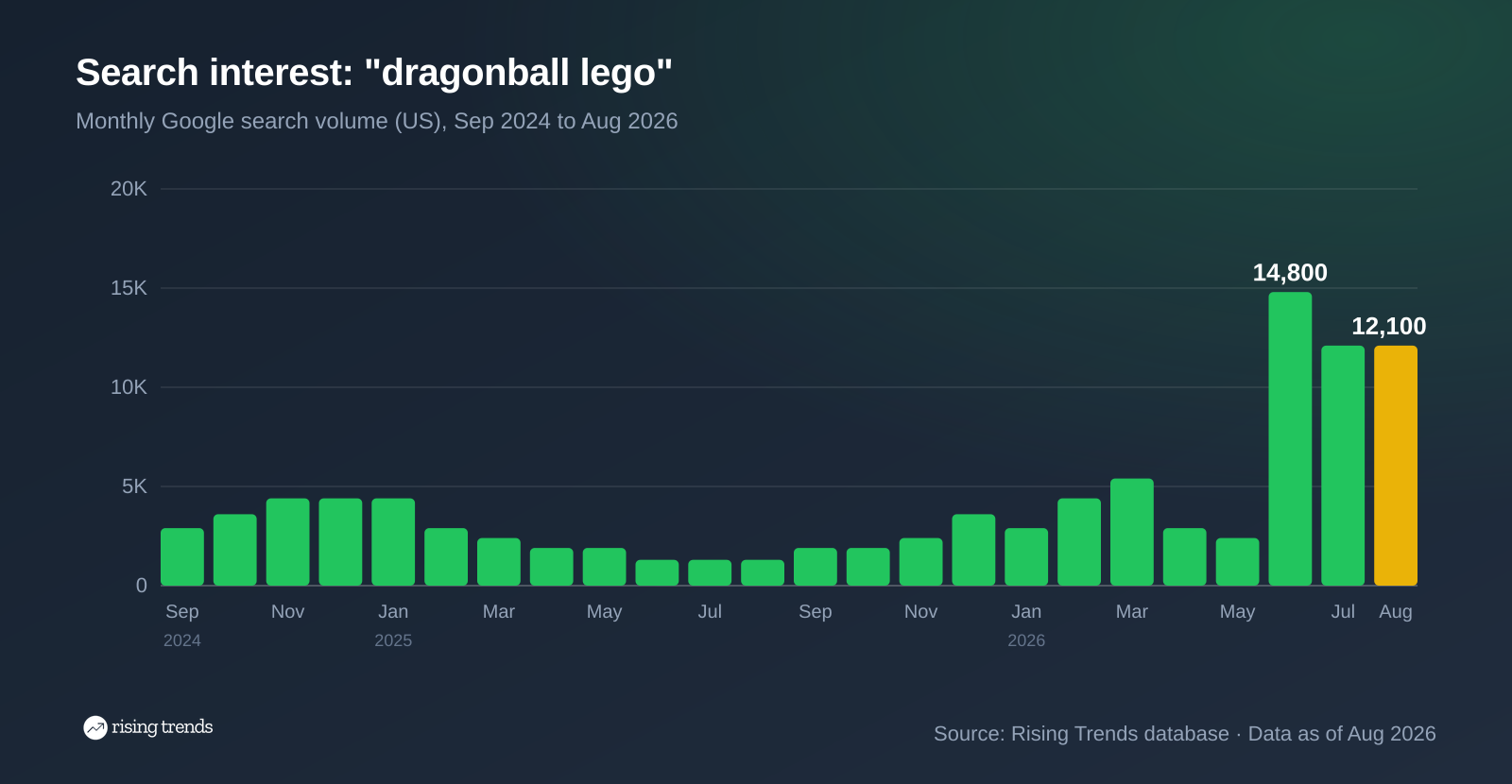
The jump from 2,400 in May to 14,800 in June is a 6x move in a single month, and it did not give any of it back: July and August both held at 12,100. A year earlier the term was at 1,300. Two years earlier, 2,900. Our model classifies the pace as EXPONENTIAL and the trajectory as RISING, and the last three months average 3.9x what the same term did two years ago.
Now put it next to its neighbours. Every other term on this chart is a LEGO licence, and most of them are bigger.
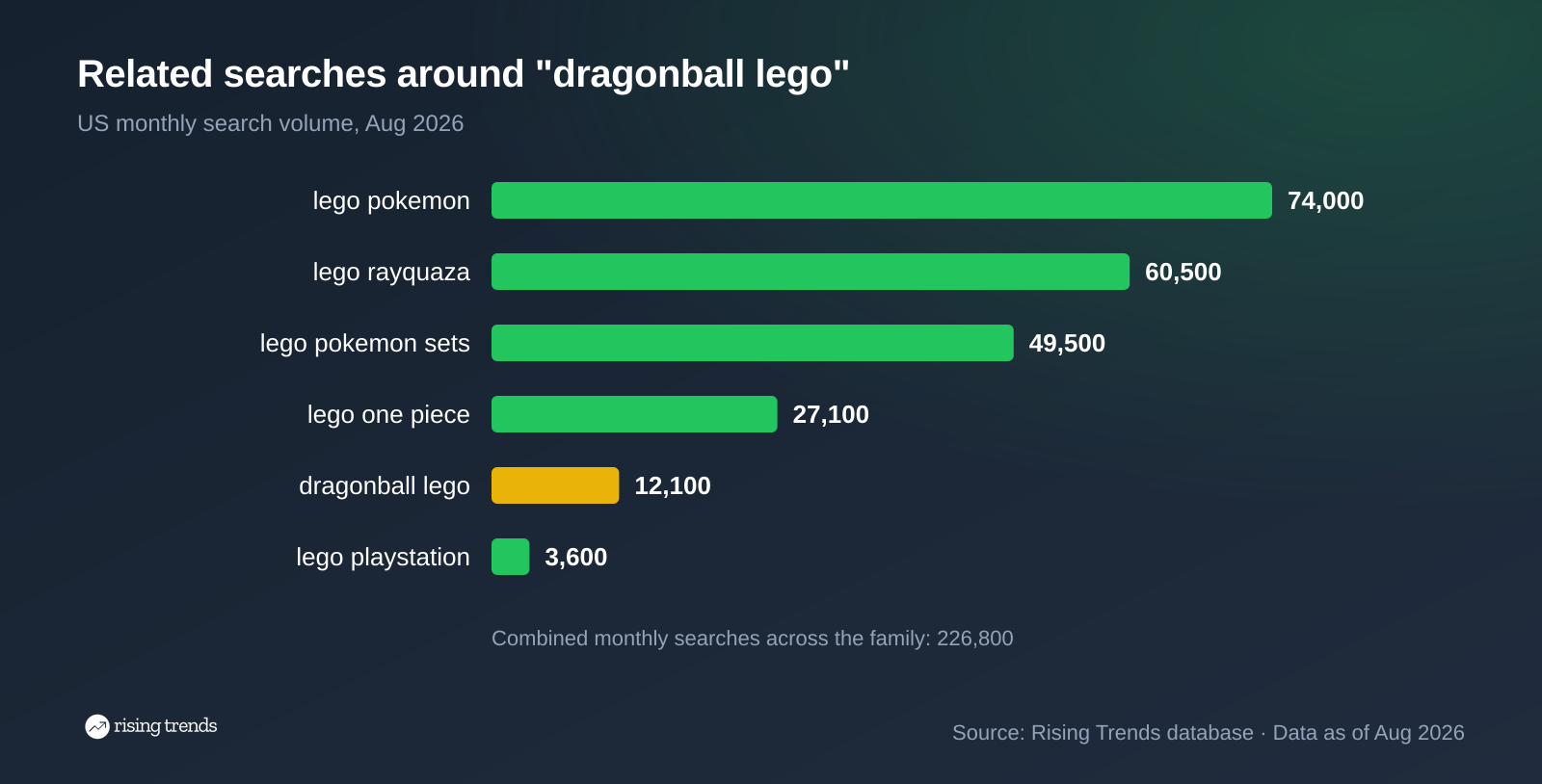
"lego pokemon" is at 74,000 as of August 2026, nearly six times Dragon Ball's number. "lego rayquaza", which is one Pokemon, is at 60,500. Dragon Ball is at 12,100 with no set in anyone's hands. The headroom is the point: Pokemon shows you what the number looks like once the boxes are on shelves. You can follow the live dragonball lego trend page as the November release lands.
Here is the comparison nothing else ranking for this term will give you. Rank the same set of LEGO searches by one-year growth instead of volume and the shape inverts.
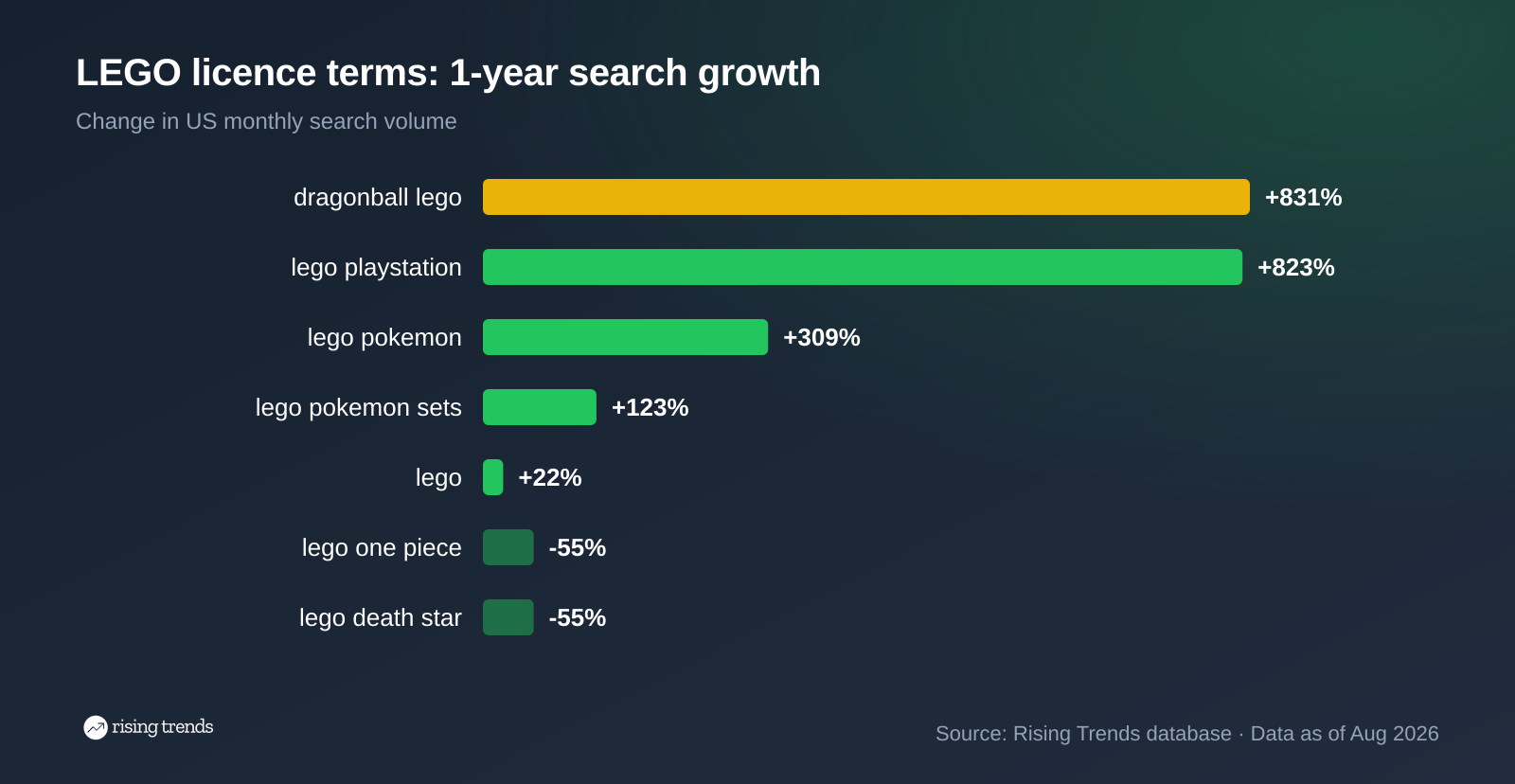
The parent brand grew 22%. Every new licence term grew by hundreds of percent. And the two terms falling fastest are the two oldest licences in the group: lego death star, a two-decade evergreen, and lego one piece, the anime theme LEGO launched before this one. Both down 55% in a year.
So the growth is not "people like LEGO more". It is a rotation. Attention moves to whichever licence is newest, spikes, then drains back out. Six licence terms we charted add up to roughly 226,800 searches a month between them, and the mix inside that total turns over constantly. If you track categories rather than single products, this is the pattern worth internalising, and it is the same one we walk through in our guide on how to identify market trends.
The official record is short and dated. On 29 September 2026 in Billund, LEGO announced its first-ever partnership with Toei Animation, the studio behind Dragon Ball, and unveiled one product: LEGO Icons Dragon Ball Shenron & Goku, set 11390. It is 1,764 pieces, rated 18+, and priced at $179.99 in the US. Kid Goku rides his Kintoun at the centre, seven 2x2 bricks stand in for the seven Dragon Balls, and the finished model is about 32cm high. The product page lists it as coming on 4 November, with LEGO Insiders getting early access on 1 November.
None of that explains June. Nothing was announced in June. What moved then was leak chatter, which our curve picks up the same way it picks up launches, because search does not distinguish between a rumour and a release. People type the same words either way.
That is the practical lesson for anyone watching demand. A search curve is a measure of attention, not of sales. It went to 14,800 on a rumour and settled at 12,100 on confirmation, which means the confirmation was worth less than the speculation. We saw the identical shape in gaming when policy chatter, not product, drove the spike behind Xbox disc to digital.
Here is the reveal as the LEGO community saw it. This clip from @matticusbricks, posted 29 September 2026, has 96,200 views and 10,200 likes as of 2 October, and it names the designer who presented the set.
His framing is the one that keeps coming back: "After the success of LEGO One Piece, it's exciting to see another LEGO set based on an anime property, this time being directly based on the manga and anime." The audience is not reading this as a toy launch. It is reading it as a licence precedent.
LEGO is negotiating from strength. Its H1 2026 results put revenue at DKK 41.9 billion, up 21%, with consumer sales up 22% and over 330 new products launched in six months. The company describes its bestselling themes as a mix of homegrown and entertainment IPs, and names Formula 1, the FIFA World Cup and KPop Demon Hunters among the partnerships driving excitement. September 2026 alone brought Dragon Ball, a first-ever PlayStation set, Downton Abbey and a NINJAGO collaboration.
Toei Animation brings a catalogue that the LEGO release describes as six episodic series and 21 feature films. The Pokemon Company International showed the template: LEGO announced that multi-year partnership on 18 March 2025, then shipped the first three sets on 27 February 2026. Eighteen months from handshake to shelf, and 74,000 monthly searches on the other side of it.
The group that loses here is the one that used to supply the ideas. On 5 March 2026 a builder called Briquette posted a 2,870-piece Dragon Ball Shenron scene to LEGO Ideas and collected 8,879 supporters. The page is now labelled Archived, with the note "We've had to take this idea out of the running."
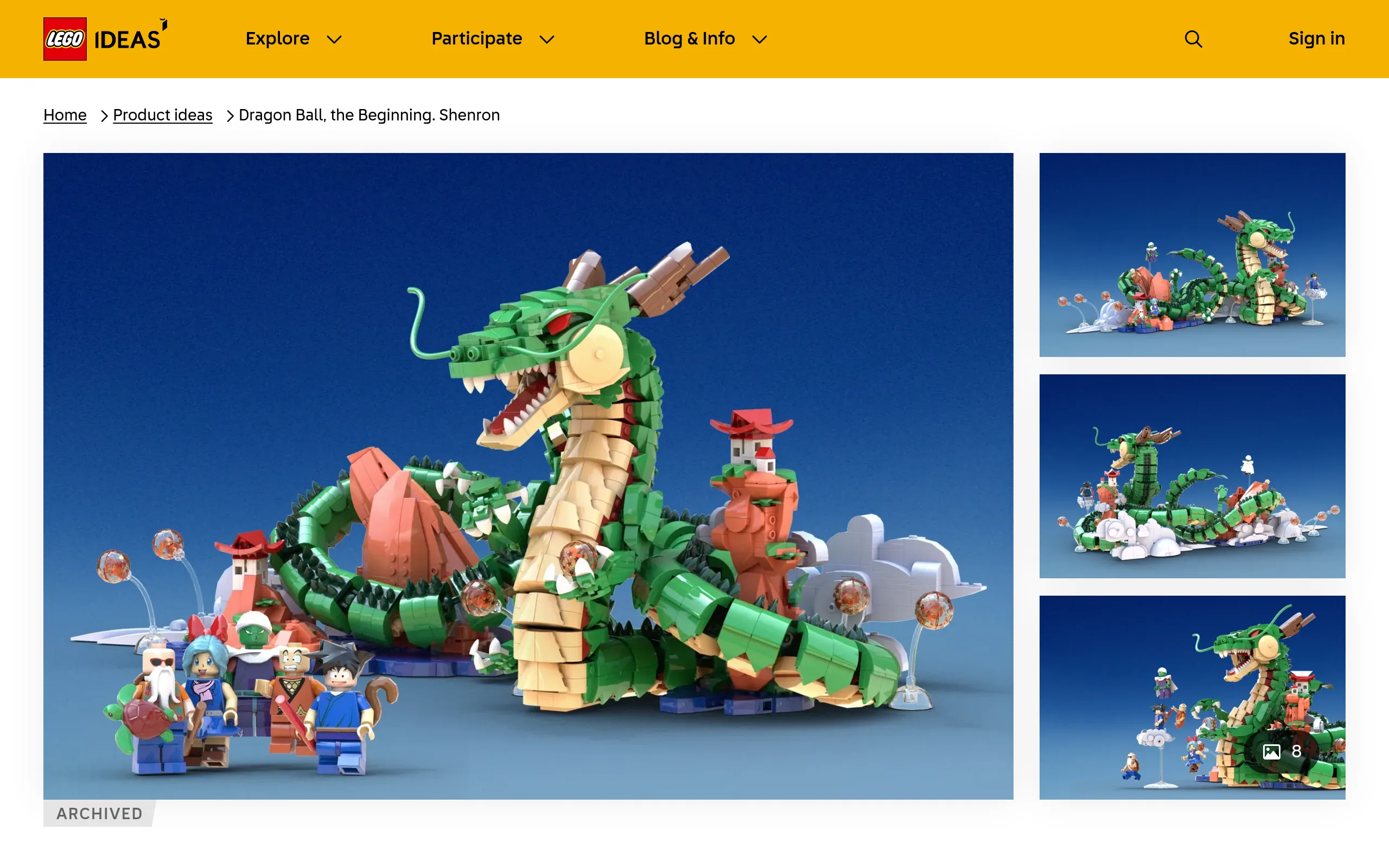
Briquette's pitch was personal: "For me, Dragon Ball is the series that introduced me to manga and gave me a taste for this culture in the 1990s." In our data the fan channel is the one going backwards. lego ideas is at 90,500 monthly searches as of August 2026, down 18% in a year, while the licensed terms climb. Crowdsourcing was how LEGO used to find demand. Buying the licence is faster.
Read the reaction videos and almost nobody is talking about the build. They are talking about being 35.
Tiago Catarino's review passed 125,388 views and 2,236 likes within two days of posting on 30 September 2026, and his own description gives the game away: "OMG I cannot believe LEGO is doing Dragon Ball now of all times! The new LEGO Icons Dragon Ball: Shenron and Goku brings back so many childhood memories that I gotta give it a fair shot. But it isn't fair... Nostalgia hits hard."
That is the product LEGO is selling at $179.99 to an 18+ audience: a display piece priced like furniture, bought by adults who watched the original series. The second thing buyers want is the roadmap. A TikTok from @hachiroku24 on 1 October puts it plainly: "I hope this means we will get more anime set in the near future (that Naruto Ideas set need to happen)." LEGO has confirmed more Dragon Ball sets for 2027, so the roadmap question has an answer, and the answer is feeding the searches.
This is the same adult-collector engine behind the other toy breakouts in our database. It is what made the Labubu trend work, and the same scarcity-and-identity mechanics show up in sensory fidget toys. Dragon Ball just adds a 40-year-old franchise and a $179.99 price tag.
Three things fall out of the numbers.
The licence is the growth, so the licence is the cost. Only the newest licence term grows fast. That gives the IP holder pricing power at renewal, and it means a brand that stops signing new licences stops growing its long-tail search. LEGO shipped over 330 products in six months and still needed four separate partnership announcements in September alone.
Demand peaks before revenue, which breaks forecasting. If you had sized this market from the June peak you would have overbuilt. The signal to plan against is the post-launch level, and the only honest estimate of that is a comparable licence. Here that is lego pokemon at 74,000 and holding, versus lego one piece at 27,100 and falling.
The fan pipeline is now marketing, not sourcing. An 8,879-supporter Ideas project is proof of demand that LEGO can read for free before paying for a licence. The builder gets nothing. Expect more archived projects immediately before official announcements, and expect fan designers to notice.
For the retail side, the November window matters more than usual. Insiders early access on 1 November, general release on 4 November, and a 1,764-piece set at $179.99 lands exactly into holiday gifting. The Activities & Hobbies trends we track are heavily fourth-quarter weighted, and this one was engineered for it.
The number will go up, then down. Expect "dragonball lego" to clear its June peak around the 4 November release as buying intent replaces curiosity. Then expect the one piece pattern: a steep first-year decay once the novelty clears. Watch lego one piece as the control group, since it is already a year into that curve.
Set-level terms will split off from theme-level terms. "lego pokemon sets" sits at 49,500 and "lego rayquaza", a single set, at 60,500. A single set out-searching the sets category is what a hit looks like. If a specific Dragon Ball set number starts appearing in our database by early 2027, the 2027 wave is working.
Anime becomes a standing LEGO category, not a one-off. One Piece was the test, Dragon Ball is the commitment, and the reaction videos are already asking for Naruto. The term to watch is the generic one: if "lego anime" enters our database with real volume, the category has stopped being a licence and started being a shelf.
The thing to hold onto is the gap we opened with. A product that nobody can buy generated 14,800 searches a month. That is not fandom being patient. It is a measurement of how much pent-up demand a 40-year-old franchise carries, sitting there for anyone who bothered to look before the press release.
Want to catch category shifts like this before the announcement? Read our guide on how to identify market trends, follow the live dragon ball lego trend page, or browse what is breaking out right now on the Rising Trends dashboard.
Thousands of Emerging Trends
Thousands of Breakout Apps
Mega Trends
Trend Analysis Tool