Trends


A year ago, about 18,100 Americans a month typed "volufiline" into Google. As of August 2026 it is 60,500, up 234% in a year, and it peaked at 90,500 in April. The searches are almost all about one thing: whether a 21 dollar serum can put volume back under your eyes without a needle.
Here is what nothing ranking for the term tells you. The company that makes volufiline does not sell it for faces. Croda Beauty, which owns the Sederma trademark, lists exactly two applications on its own product page: body care and leg care. The only human trial anyone has published was run on 28 women's decolletes for 56 days, and it moved volume by 2.2% at a confidence level that would not clear the bar in a medical journal. We pulled the search curve, the patent and the manufacturer's own page, and the gap between them is the story.
Key takeaways:
Let's get into it.
Here is monthly US search volume for "volufiline" over the last two years, straight from our database.
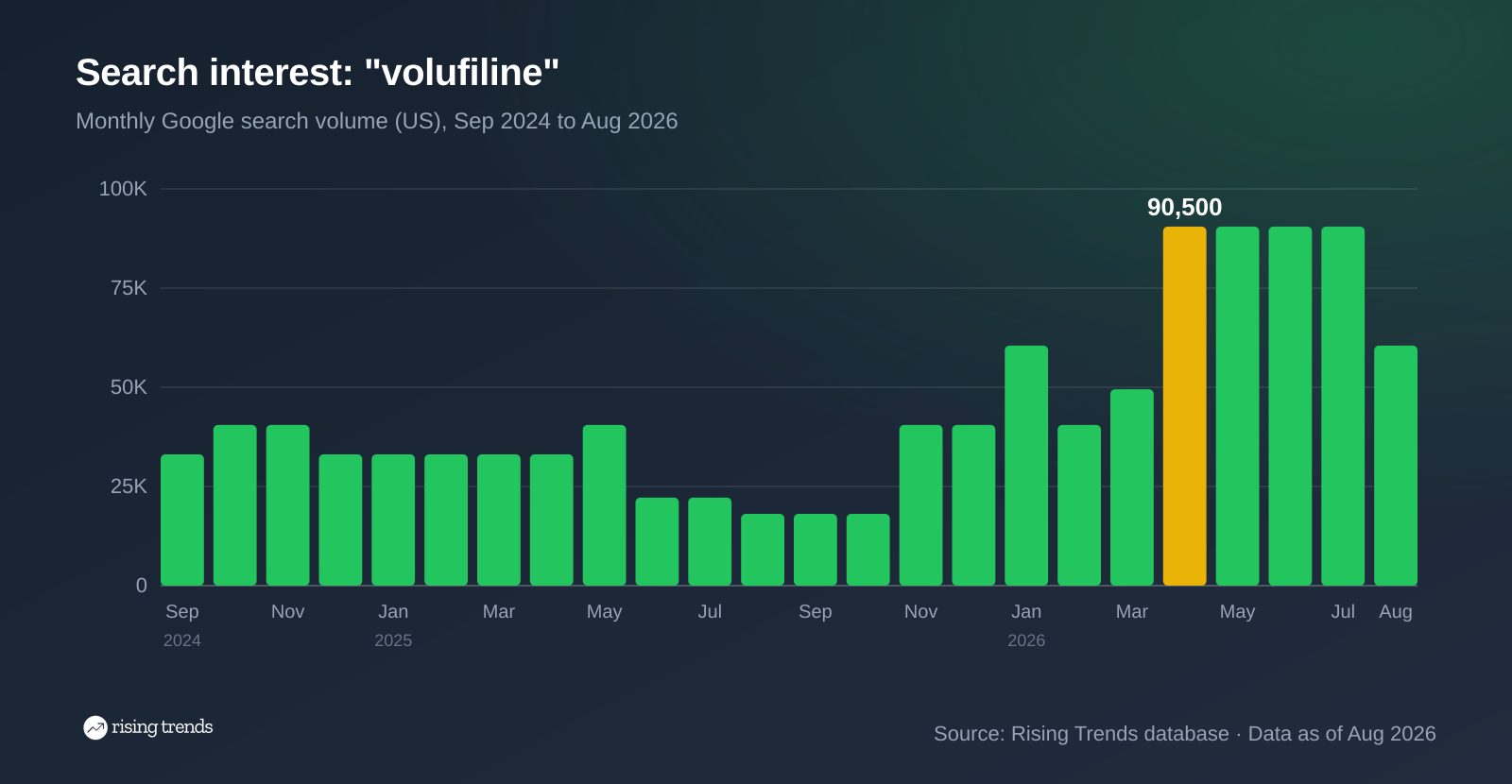
The shape matters more than the peak. Volufiline had a first life: it sat around 33,100 to 40,500 a month through 2024 and early 2025 on the back of K-beauty serums and before-and-after clips. Then it collapsed to 18,100 and stayed there from July to October 2025. The ingredient was dying as a search term.
November 2025 is where it turns. The Ordinary shipped its version, and volume more than doubled to 40,500 inside the month, hit 60,500 in January and 90,500 by April 2026, where it held for four straight months. The derived term "volufiline ordinary" is up 2,300% in a year as of August 2026, which tells you the launch is the engine rather than the ingredient's own reputation. August 2026's reading of 60,500 is a 33% fall off the peak, so the curve is already cooling.
The company it sits next to in our database is instructive.
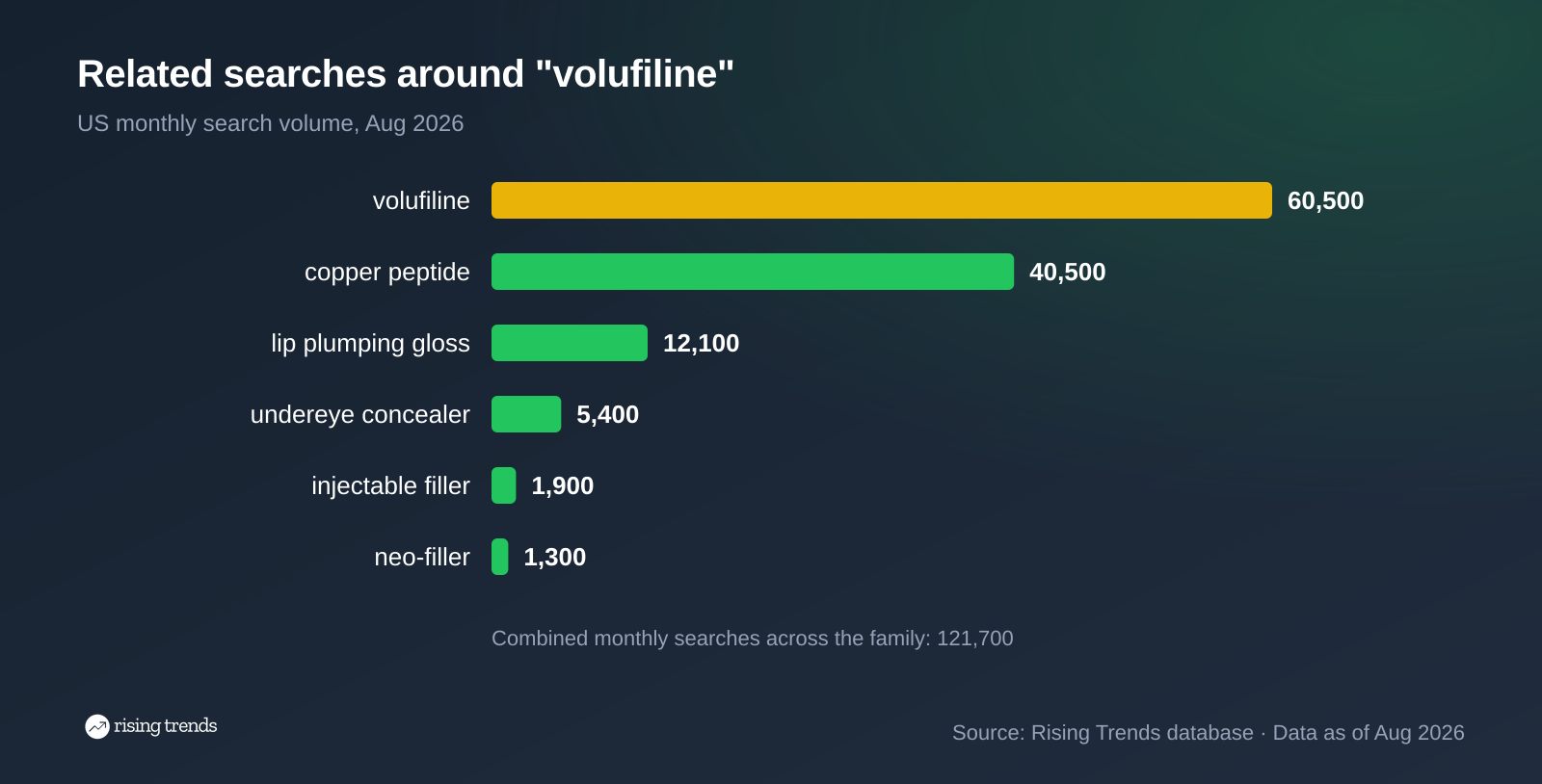
Volufiline is now the largest term in its own family at 60,500 a month as of August 2026, ahead of copper peptide at 40,500. The thing it is sold against, injectable filler, draws 1,900. A topical ingredient is pulling more than 30 times the search demand of the procedure it claims to replace.
Volufiline is not a product. It is a raw material sold in bulk to brands, and its INCI name is hydrogenated polyisobutene plus Anemarrhenae asphodeloides root extract. The active molecule is sarsasapogenin, a steroidal sapogenin from the root of that plant. Croda does not publish what fraction of the liquid is sarsasapogenin, which matters later.
The Croda Beauty product page is blunt about the mechanism. "Volufiline stimulates the production of adipocytes (fat cells) in the skin. This creates a plumping effect that enhances volume and smoothness." Under applications it lists body care and leg care. Under consumer benefit it lists silhouette sculpture. Croda also says plainly that it sells ingredients in bulk to brands and does not sell finished products to consumers.
The product people are actually buying is The Ordinary's.
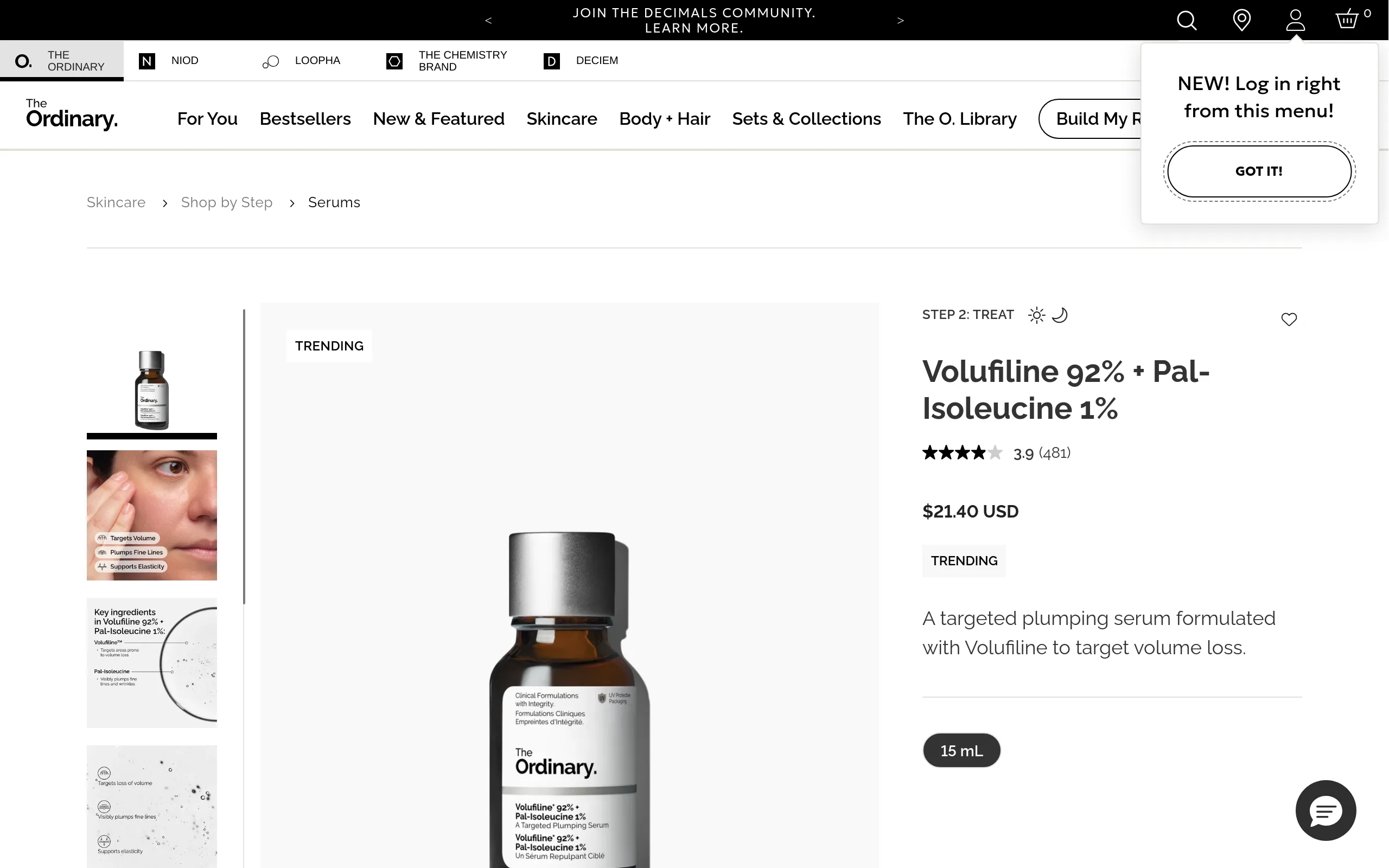
That page prices the serum at 21.40 dollars for 15 mL and describes it as "a targeted plumping serum formulated with Volufiline to target volume loss". The formula is 92% Volufiline plus 1% palmitoyl isoleucine, a lipoamino acid. The directions say to apply it after moisturizer, directly to "the temples, hollow of the eyes, and around the cheeks and smile lines". The page also carries a line that gets skipped in every review: "Volufiline is a trademark of Sederma Inc. Neither DECIEM nor The Ordinary is affiliated with Sederma Inc."
Read the brand's claims closely and they are all appearance claims. Targets the look of volume loss. Visibly plumps fine lines. Supports elasticity. The ingredient page never says the serum grows fat. The supplier says that. The retailer does not.
The pitch travelled faster than the product. By the middle of 2026 the framing in beauty media had settled on "filler in a bottle", and the use case had drifted from legs and decolletes to the hollow under your eyes, which is the one place on the face where a few cubic millimetres is visible. British Vogue ran a first-person test on hollow undereyes in August 2026. Harper's Bazaar ran an explainer in July. None of that coverage is where the demand came from, but it is what kept it at 90,500.
The counter-argument is being made by dermatologists on the same platforms. This reel from @drkreamderm, posted on September 2, 2026, goes straight at the claim.
The point it makes is the one worth checking: company-funded research is not automatically wrong, but the evidence that volufiline increases fat comes only from the manufacturer, and nobody independent has confirmed it. So we went and looked at what the manufacturer actually published.
All of it sits in one place: US Patent 8,361,516 B2, filed by Sederma SA on July 31, 2007 with a priority date of August 3, 2006, granted January 29, 2013. The patent's own words are "Surprisingly, we have discovered that sarsasapogenin was able to produce cosmetical 'lipofilling' by mean of a cutaneous filling provided by an increase of the adipocytic mass neoproduced by the organism itself."
The lab work is real and it is strong. In 3T3-L1 mouse pre-adipocytes, sarsasapogenin raised the differentiation marker G3PDH by 535% at 17.5 micromolar and lipid uptake by 492%, both comparable to pioglitazone, a diabetes drug used as the positive control. If your cells are in a dish, the molecule does what Croda says.
Then comes the only human study, and it is the number everybody quotes without reading.
| What was tested | Detail |
|---|---|
| Body site | Upper breast, the decollete zone. Not the face, not the undereye |
| Formula | Cream gel at 5% sarsasapogenin, applied twice daily |
| Duration | 56 days |
| Subjects | 32 women aged 18 to 35 enrolled, 30 completed, 28 evaluable at day 56 |
| Design | Single blind, treated side versus untreated side, randomised |
| Result at day 56 | Treated +2.2% (p = 0.10), untreated +0.9% (p = 0.52) |
| Best 8 responders | +8.4% treated, -2.0% untreated |
Four things fall out of that table. The net effect over the untreated side is about 1.3 percentage points after two months of twice-daily use. The p value is 0.10, which the patent itself describes as "90% certainty" and which is half the confidence a clinical journal normally asks for. The site was the decollete, so there is no human data at all for the undereye, the place everyone is buying it for. And the test concentration was 5% sarsasapogenin, which is not 92% Volufiline, because Volufiline is sarsasapogenin dissolved in hydrogenated polyisobutene and the supplier does not publish the ratio. Nobody outside Croda can tell you how the serum on the shelf maps onto the cream in the patent.
There is no second study. PubMed returns zero records for "volufiline", checked on October 8, 2026. Searching the molecule instead of the trademark returns six papers, none of them a topical plumping trial. The closest one, a 2021 paper in Acta Pharmacologica Sinica, found that sarsasapogenin improves adipose tissue inflammation and insulin resistance in high-fat-diet mice, which is oral, systemic and aimed at shrinking metabolic dysfunction rather than growing fat under anyone's eyes.
This is the same pattern we traced in the PDRN trend, where a topical sold itself on evidence generated by injections. The claim outran the delivery. Here the claim did not even outrun an injection. It outran a decollete.
The most revealing chart is not volufiline's own curve. It is what happened to everything it competes with.
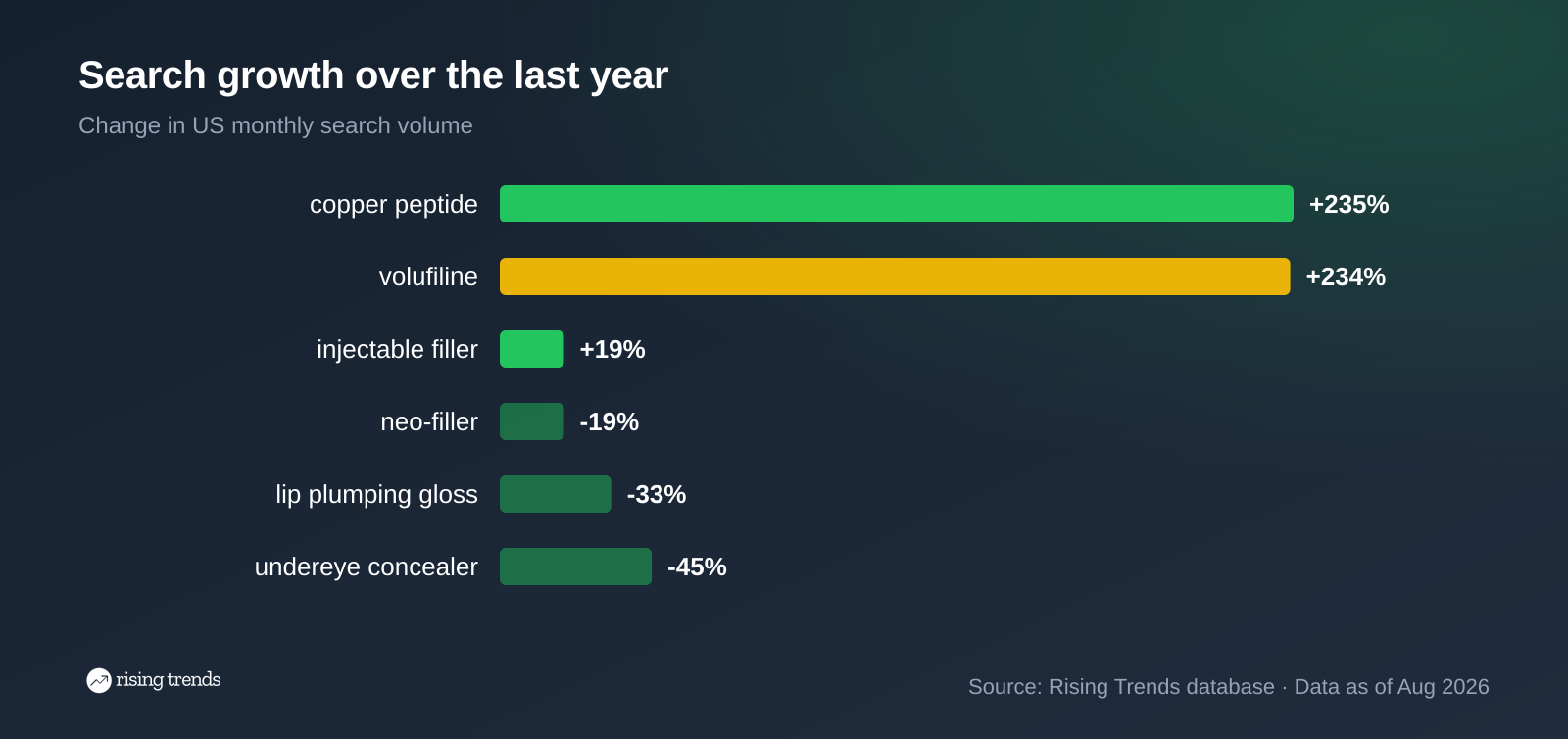
Every category that offers an alternative route to the same look is falling. Lip plumping gloss is down 33% over the year to 12,100 a month as of August 2026. Undereye concealer is down 45% to 5,400. Neo-filler, the branded topical that came before this one, is down 19%. The only things rising are volufiline at +234% and copper peptide at +235%, and the needle itself is up a mild 19% off a tiny base.
So the demand is not moving from makeup to serums as a category shift. If it were, the concealer and gloss terms would be falling into a rising pool of topical alternatives, and the pool would be bigger than the drain. It is not. Volufiline grew by 42,400 searches a month over the year while concealer and gloss together gave up about 10,400. Most of volufiline's volume is new demand created by a product launch and a phrase, not demand switching out of the old categories. That is the difference between an ingredient moment and a category rebound, and it is the thing to check before anyone builds a range around it.
| Route to more volume | Cost | Evidence base | US searches, Aug 2026 |
|---|---|---|---|
| Volufiline serum | 21.40 dollars for 15 mL | One 56 day supplier study, n=28, p=0.10, on the decollete | 60,500 |
| Copper peptide serum | Roughly 10 to 60 dollars | Decades of published topical work on skin renewal | 40,500 |
| Undereye concealer | Roughly 8 to 35 dollars | Not applicable, it is coverage not change | 5,400 |
| Injectable filler | Hundreds to thousands per session | Regulated devices with approval pathways | 1,900 |
The quantified reaction is on the retailer's own page. The Ordinary's serum holds 3.9 stars from 481 reviews as of October 8, 2026, with a "TRENDING" badge sitting above it. For a brand whose bestsellers routinely sit above 4.3, 3.9 is the rating of a product that works for some people and not others, which is exactly what a result driven by eight best responders out of 28 would look like at scale.
The qualitative reaction is harsher and it is mostly about who is selling. A thread on r/SkincareAddiction titled "I think volufiline is a dropshipping scam" opens by noting the ingredient is "a trending skincare ingredient, popular on TikTok" that "can supposedly grow fat tissue on areas such as undereyes". A separate thread on r/30PlusSkinCare, titled "PSA: Volufiline scam???", says "I'm not the only person who's noticed how many accounts with no karma have been singing the praises of volufiline on here." These are forum posts, not findings, and they are about the marketplace rather than the molecule. But they describe a real structure: a trademarked ingredient with no consumer-facing owner, sold by anyone who can print a label.
That is the distinction worth holding onto. The Ordinary's product is a real formulation from a company owned by Estee Lauder, with a published ingredient list and a returns policy. The unbranded "100% pure volufiline" bottles on marketplaces are a different business, and nothing verifies what is in them.
The ingredient supplier is the one winning. Croda's H1 2026 results, published on July 28, 2026, put group sales at 880.5 million pounds and Consumer Care up 8% organically, with Beauty Actives up 19%, the fastest-growing line in the group. Croda's own stated strategy is "growing share in 'affordable beauty'". A viral trademark that sells through dozens of brands at once is precisely that strategy working. The brands fight over the 21 dollar bottle. Croda sells the drum to all of them.
Trademarked actives are becoming the unit of demand. Three years ago people searched for products and brands. Now the search term is the raw material, and the volume sits upstream of everyone selling it. We see the same shape across skincare trends, where GHK Cu and copper peptide pull more search than most of the serums that contain them, and across the peptide trend, where the molecule name became the category. If your brand's growth depends on an ingredient you license, your moat is a logo.
The evidence gap is a distribution opportunity, not a dead end. Nobody has published a topical facial trial on this molecule. The first brand to run instrumental measurements on the undereye, publish the protocol and show the numbers would own the only defensible claim in a 60,500 search a month category. That is a cheaper moat than most people think and nobody has taken it.
Watch whether 60,500 is a floor or a slide. Volufiline is down 33% from its April 2026 peak in three months. If the volufiline trend page stabilises in the 50,000 to 60,000 range through the end of the year, the ingredient has a durable base and brands should formulate. If it keeps stepping down, this was a launch spike with a 10 month half-life.
Watch "volufiline ordinary" against "volufiline". The branded term is at 720 a month as of August 2026, up 2,300% in a year, which is still only about 1% of the generic. If that ratio climbs, The Ordinary has converted a trend into a product franchise. If the generic falls while the branded term holds, everyone else selling unbranded bottles is being squeezed out, which would be the healthiest outcome for buyers.
Watch for the first independent study. A single peer-reviewed topical trial on facial skin would change this category overnight, in either direction. Until one exists, the honest answer to "does volufiline work" is that one supplier measured 2.2% on 28 decolletes over eight weeks at 90% confidence, and everything else is a before-and-after photo.
The broad signal here is not about one serum. It is about how fast a 2006 patent can become 60,500 searches a month when a 21 dollar bottle and a good phrase arrive at the same time. The molecule did not change. The packaging did.
Want to spot the next breakout ingredient before the serum launches? Read our guide on how to identify market trends, follow the live volufiline trend page, or browse what is breaking out right now on the Rising Trends dashboard.
Thousands of Emerging Trends
Thousands of Breakout Apps
Mega Trends
Trend Analysis Tool