Trends


A year ago, 20 people a month typed "aerocano starbucks" into Google. As of August 2026 it is 1,000, and the drink had not yet gone on sale anywhere in North America. Starbucks confirmed the US date on the last day of that month and put the Aerocano in stores on September 29. The demand arrived first.
That ordering is the story. US searchers were looking up a drink they could not buy, because they had seen it in Seoul, in Santiago or on a phone screen. And while the Aerocano climbed, the word "starbucks" itself fell 55% in a year. Nobody ranking for this drink has that pair of numbers side by side. We do, and together they say something uncomfortable about how a 41,000-store chain now reaches people.
Key takeaways:
Let's get into it.
Here is the monthly volume for "aerocano starbucks" over the last two years, straight from our database. For twenty of those twenty-four months the line is flat on the floor.
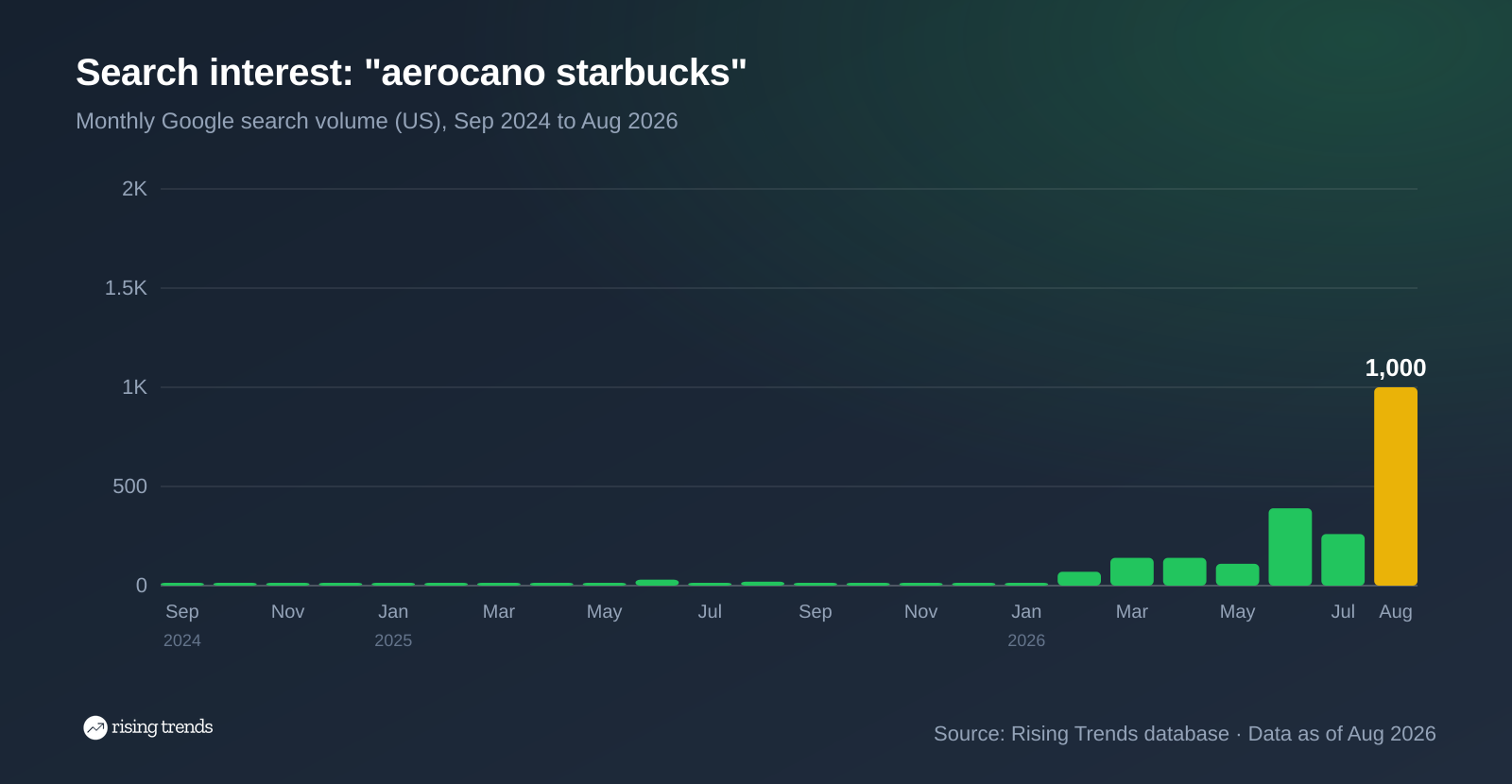
The first movement is February 2026, from 10 to 70, the month Starbucks Korea put the drink on sale. March and April hold at 140. Then June jumps to 390, which is when the Latin America and Caribbean rollout had been live for a few weeks. August hits 1,000, the peak, and the 12-month change lands at 4,900%. Our acceleration score for the last three months against the prior three is 4.23, which is why the pace reads EXPONENTIAL rather than merely RAPID.
Hold that against the parent brand. This is the comparison that matters, and it is the one nothing else ranking for this drink will show you.
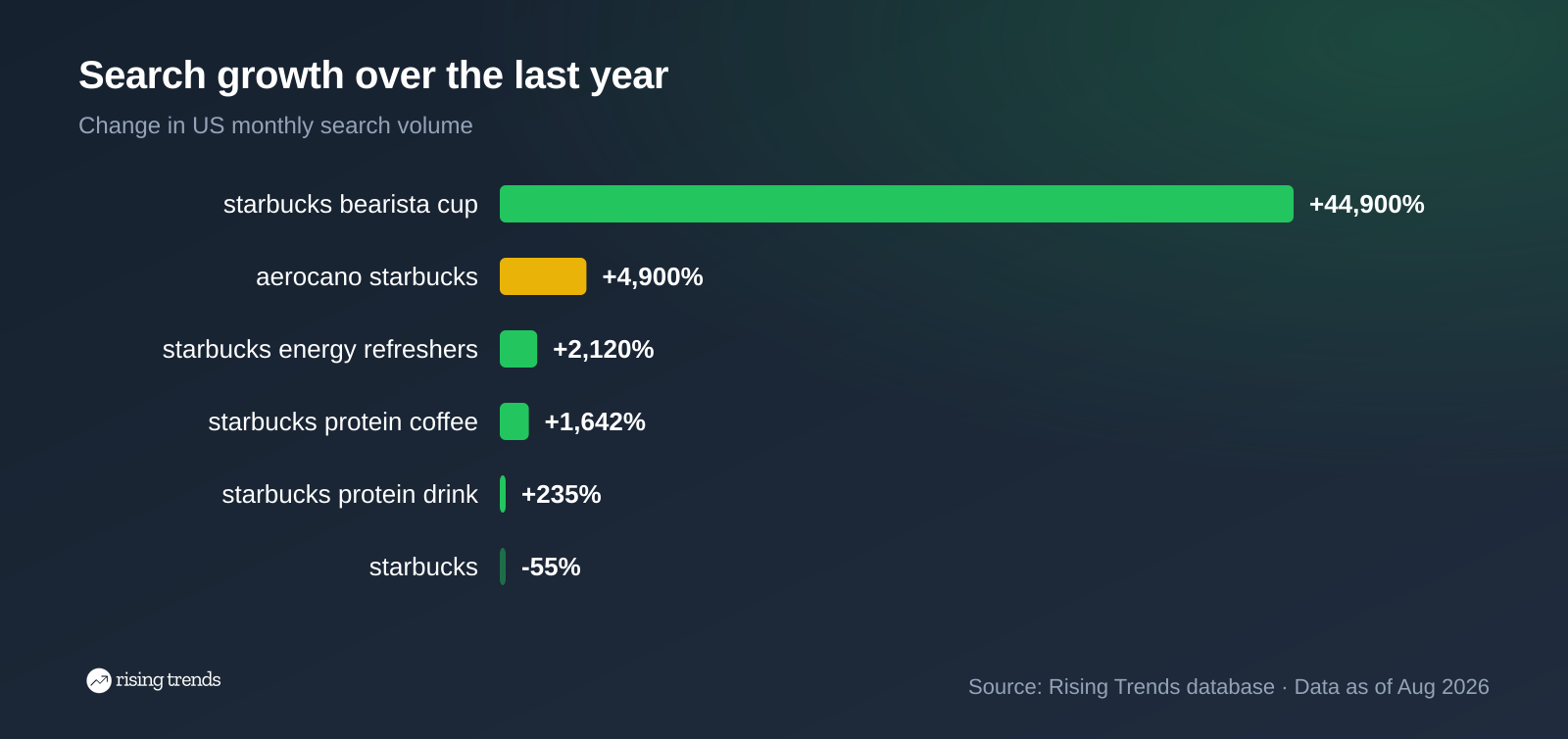
Every named product is up. The brand name is down 55%. Starbucks still pulls 13.6 million searches a month as of August 2026, so this is a very large number falling, not a small one. But the shape is unambiguous: people have stopped searching the chain and started searching the drink.
It is an iced Americano, rebuilt around texture. Starbucks takes Blonde Espresso, aerates it, and pours it over ice, which produces a layer of microfoam and a cascade down the side of the cup as the shot settles. There is no dairy and no added water. The company's own newsroom calls it "a modern take on the Iced Americano" and notes the Americano has been on the menu since 1984. It joined the permanent core menu alongside a Caramel Aerocano.
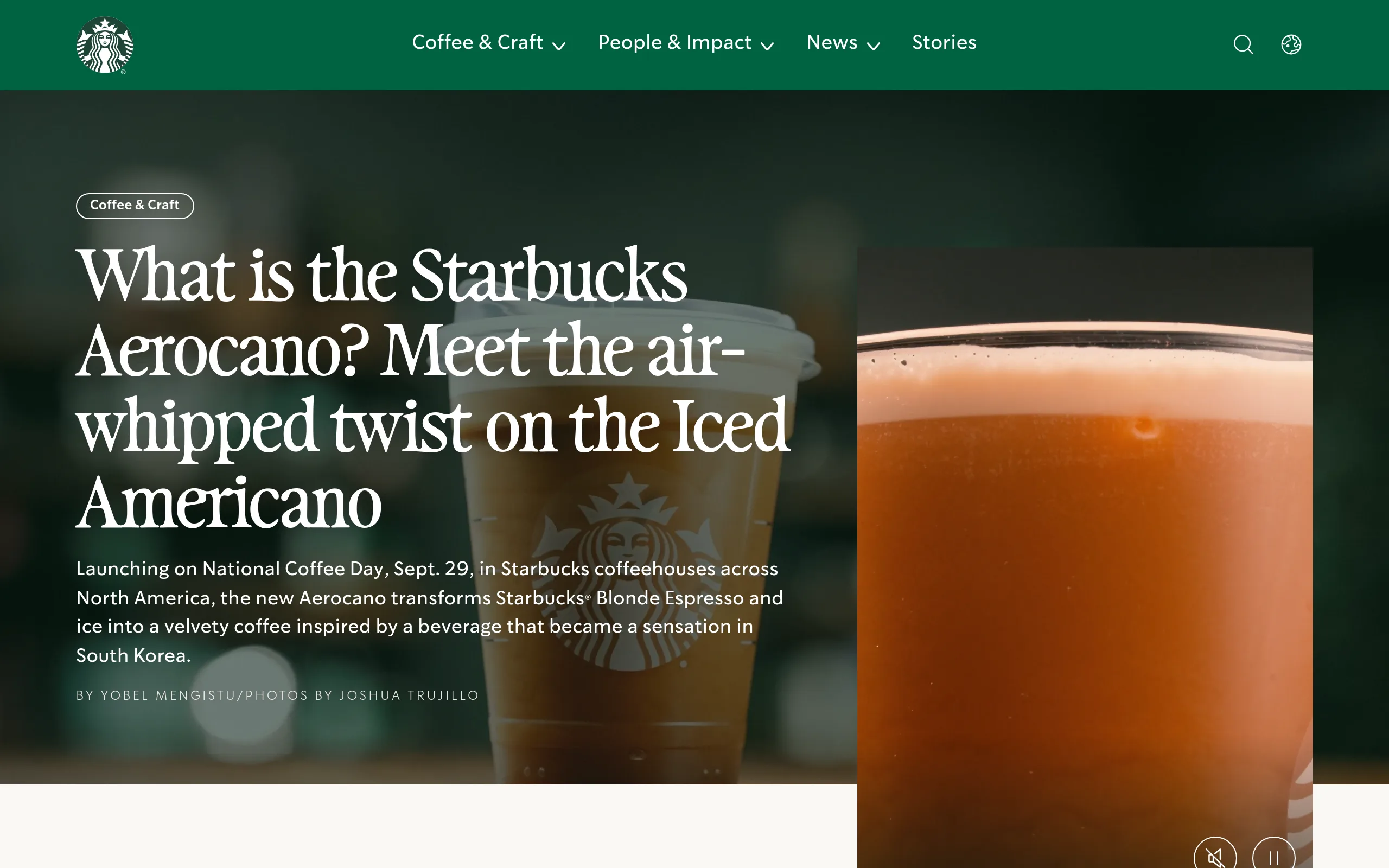
The mechanics are worth pausing on, because they are unusual for this company. Starbucks Australia's explainer is the clearest first-party description: baristas "control the timing, sequence and intensity of each step" to get the foam cap and the cascade, and "there are no fancy machines or technology creating this effect". Air-whipping introduces microbubbles, and microbubbles are what make the mouthfeel read as smooth rather than thin.
That is the whole product. No syrup in the base version, no new bean, no equipment. The innovation is a hand movement, trained into hundreds of thousands of staff.
Because it worked somewhere else first. Starbucks named the Aerocano in a February 2026 piece on cold drinks, describing it as "a foam-crafted iced Americano built around a proprietary aeration technique" made for Korea's Americano habit. The same page explains the strategy behind it: cold is roughly 60% of Starbucks international beverage sales, and at Investor Day the company said roughly two-thirds of beverages sold in US company-operated stores are cold.
Korea answered fast. Starbucks Korea told reporters the drink passed one million cups in the week after its February 26 launch, the fastest any of its iced beverages had reached that mark there. For comparison, the company's previous record-holders took nine, ten and eleven days.
From there it travelled. A Starbucks press release dated May 14 put it into select Latin America and Caribbean markets from May 15. Singapore followed in late May. North America was confirmed on August 31 in a one-minute newsroom post that also introduced three Mini Pies, and the drink landed on September 29, National Coffee Day.
Line that up against our curve and it fits almost month for month.
| Date | Event | US searches that month |
|---|---|---|
| Jan 2026 | Nothing. Drink exists nowhere. | 10 |
| Feb 26, 2026 | Korea launch | 70 |
| May 15, 2026 | Latin America and Caribbean | 110 |
| Jun 2026 | Rollout spreads across Asia | 390 |
| Aug 31, 2026 | North America date confirmed | 1,000 |
The first reactions are already stacking up on TikTok, where most of this demand was manufactured. This clip from @dumbblondee16, posted on October 3, is typical of the week-one verdict from people who order espresso on purpose.
Her line, "if you like strong coffee you will love the aerocano," is the pitch Starbucks would write itself. It is also the limit of the audience.
The Aerocano sits in a crowded part of the menu, and the comparison that decides whether people repeat-buy is the one against the drink it is derived from.
| Drink | Base | What you are paying for | Added sugar |
|---|---|---|---|
| Aerocano | Blonde Espresso, ice, air | Texture and the cascade | None |
| Caramel Aerocano | Blonde Espresso, ice, caramel | Texture plus sweetness | Yes |
| Iced Caffe Americano | Signature Roast, water, ice | The espresso itself | None |
| Iced Shaken Espresso | Blonde Espresso, milk, ice | Dilution and dairy | Usually |
| Cold Brew | Slow-steeped coffee | Lower acidity, caffeine | None |
Two differences do the work. The Aerocano uses Blonde Espresso where the classic iced Americano uses the darker Signature Roast, which changes the flavour more than the aeration does. And it costs more. A barista running the numbers on the r/starbucks thread put it bluntly: "Weighing in at 4.75 vs an Iced Shaken Espresso for the same price, 3.75 for an iced triple Blonde, 4.25 for an iced Americano." Treat that as one worker's local menu board rather than a national price, but the direction is right. You pay a premium over the Americano for the same coffee, prepared differently.
Mixed, and the split falls along a clean line: the texture converts people, the Blonde Espresso does not.
Food Republic's Nicole Alexander ordered a Grande of each with no customisations on October 1 and found a lingering bitter aftertaste in the plain version that she did not get from the classic iced Americano. She preferred the Caramel. Her read was that the Blonde roast, not the air, was the problem. She also found a creator who drinks Americanos daily, dislikes Blonde Espresso, and had already started ordering the Aerocano with Signature Roast instead. A workaround formed inside week one.
The Washington Post was harsher. Tim Carman's verdict on October 2 ran under the headline "built for style, not substance", with the cascading effect framed as the drink's only real selling point. He opens on the contradiction at the heart of the launch: Starbucks is built for speed, not handcrafted coffee, and here is a drink whose entire value proposition is craft.
Then there is the oldest objection. Greek City Times and plenty of others pointed out that the Aerocano is, structurally, a freddo espresso with a new name, and freddo espresso has been the default cold coffee in Greece for decades. That is fair. What Starbucks is selling is not the invention of whipped cold espresso. It is the ability to make the same thing identically in 41,000 locations, which is a genuinely hard problem and a completely different one.
The Aerocano is evidence of a shift that our data has been showing across the drinks category all year: brands are no longer discovered, individual products are.
The brand name is not the front door any more. 13.6 million monthly searches for "starbucks" as of August 2026, down 55% in a year, while the bearista cup pulls 49,500 and the energy refreshers 22,200. A customer who sees a drink on TikTok searches the drink. The chain's name is the answer to that search, not the start of it. That is the same pattern we tracked through the functional soda boom, where product names outgrew the categories that contained them.
Declining brand search is not declining business. This is where most commentary gets it wrong. Starbucks reported global comparable store sales up 7.9% for the quarter ended June 28, 2026, driven by a 4.2% rise in transactions, with North America up 8.1% and 41,304 stores open. That is the fourth consecutive quarter of comp growth. The brand is being searched less and visited more.
The launch calendar is now the marketing budget. Starbucks says August 25 was the strongest fall launch day in its history in the US and Canada. A company that gets its demand from launch days has to keep launching, and each launch has a shorter half-life than the last. The wider beverage trends we track show the same compression, and it reshapes retail merchandising calendars well beyond coffee.
Texture is the new flavour. Every lever on flavour has been pulled. What is left is mouthfeel, visual drama and ritual, which is exactly what the Aerocano sells. Expect competitors to chase the same ground, because it needs no new supply chain. It needs training.
Whether September and October hold above 1,000. A launch spike that decays back to 300 means the drink was a look, not a habit. One that holds means Starbucks found a new platform. The live Aerocano trend page is where that shows up first, and it will show up before any earnings call mentions it.
Whether "aerocano recipe" grows faster than "aerocano starbucks." People already make it at home with a steam wand and ice. If the how-to term overtakes the brand term, Starbucks has educated the market into leaving. That is what happened to cold brew.
Whether the next launch outruns this one. Compare the Aerocano's trajectory to starbucks bearista cup at 49,500 and starbucks energy refreshers at 22,200, both as of August 2026. A drink built on craft should hold its curve longer than merchandise built on scarcity. If it does not, the lesson for the category is that spectacle beats substance, and the Post's critique lands harder than it reads today.
The broader signal is simple. A chain with 41,000 stores imported a drink from Korea, announced it with a one-minute blog post, and watched US search demand hit its all-time high a month before the product was available to buy. The old sequence was launch, then advertise, then demand. This one ran backwards, and it cost almost nothing. Whatever Starbucks does next, that playbook is now the default.
Want to spot the next breakout product before it reaches your local menu? Read our guide on how to identify market trends, follow the live aerocano starbucks trend page, or browse what is breaking out right now on the Rising Trends dashboard.
Thousands of Emerging Trends
Thousands of Breakout Apps
Mega Trends
Trend Analysis Tool