
Trends


For two straight years, about 480 people a month typed "vivet" into Google. In January 2026 that number was 368,000. Nothing had shipped. There was no store, no price list, no product. What existed was a leather-bound journal, a logo, and a 23-minute video from a Twitch streamer explaining why he had walked away from the most subscribed career on the platform to learn how to sew.
By August 2026 the same term was back down to 22,200, as of our latest data month. Then, on September 12, Vivet put 20 pieces on a runway at Cipriani in Lower Manhattan and put all 20 on sale the same night. That sequence is the story, and it is the part nobody ranking for the brand has bothered to measure: a creator brand can generate half a million searches for an idea and then spend eight months watching that attention drain away while the actual product gets made. We have the curve.
Key takeaways:
Let's get into it.
Here is the monthly search volume for "vivet" over the last 24 months, straight from our database. It is not a staircase. It is a flare.
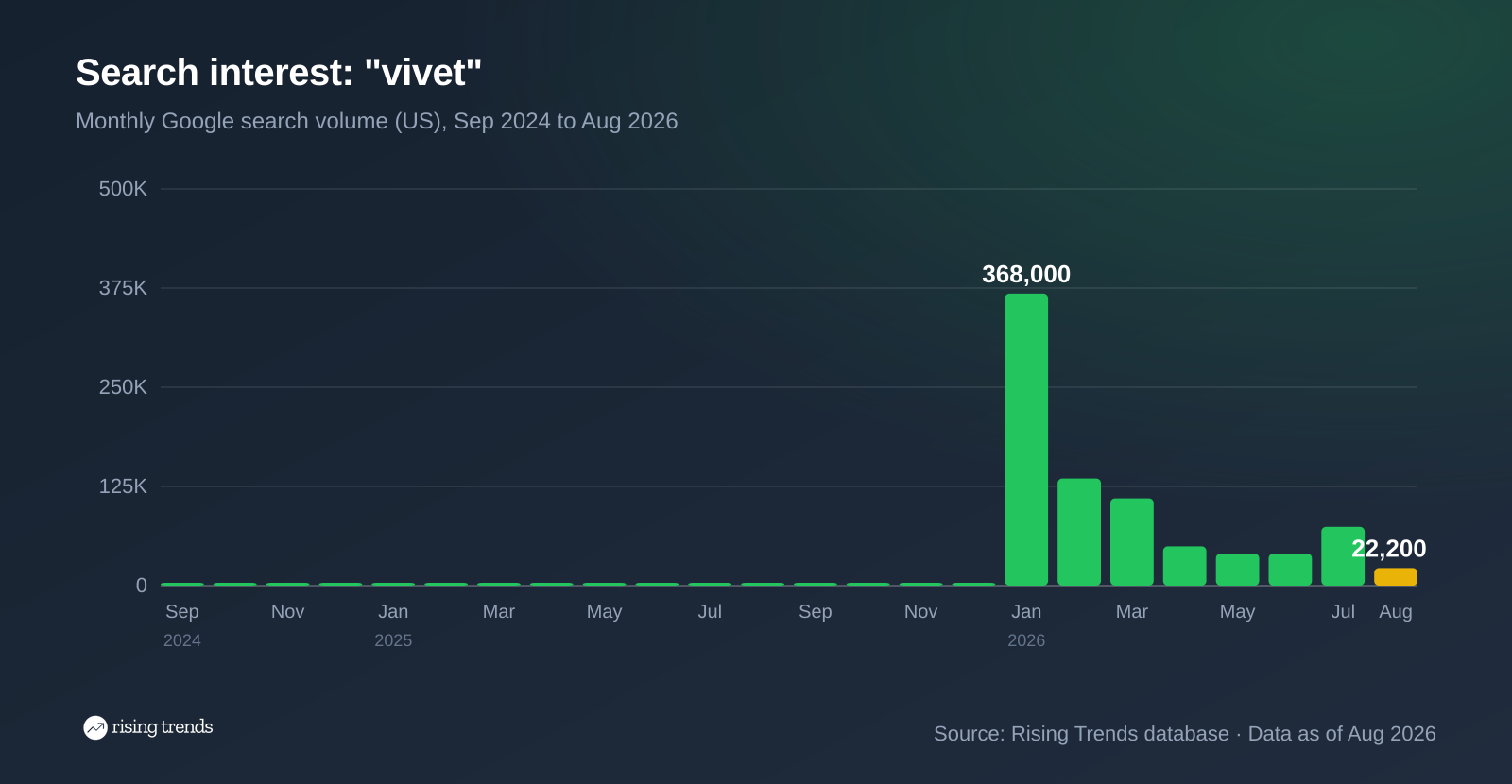
Read the flat part first. From September 2024 through December 2025, the term sits between 390 and 480 searches a month, which is the noise floor for a word that is also Latin and also a surname. Then January 2026 arrives at 368,000. That is the breakout month, and on a two-year view the last three months average 88.2 times what the term was doing two years earlier. Year over year the term is up 4,525%. Over five years it is up 6,838%.
Now read the fall. Six months after the peak the term is down 84%. July 2026 produced a partial rebound to 74,000 when Cenat came back to streaming, and then August gave most of it back to land at 22,200. One thing to be clear about: our data runs through August 2026, so the September runway show is not in this chart. Whatever the show did to demand will show up in next month's series, not this one. The live Vivet trend page is where that will land first.
The more useful comparison is the category Vivet launched into, because it is going the other way.
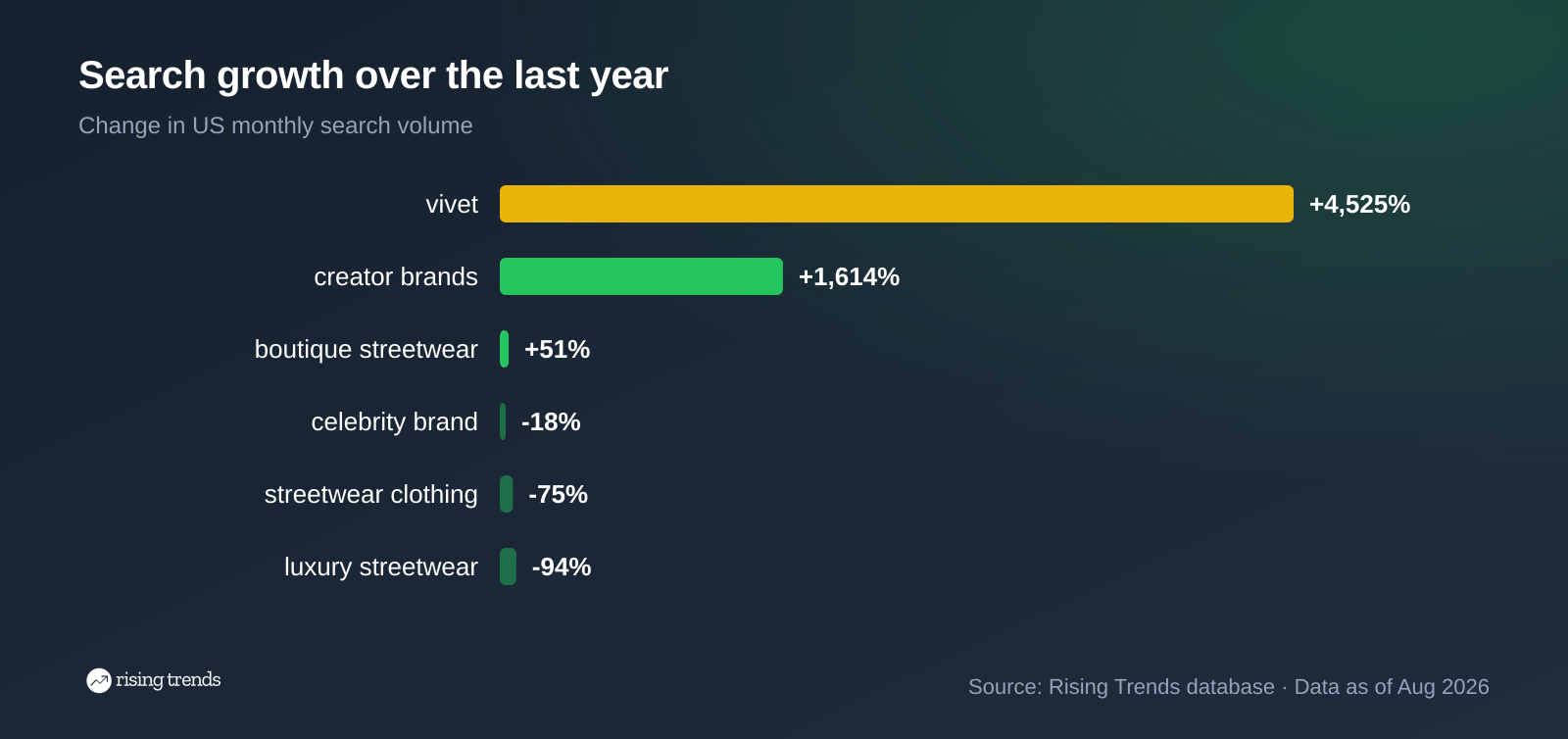
Streetwear clothing is at 33,100 searches a month and down 75% on the year. Luxury streetwear is at 2,400 and down 94%. The generic "celebrity brand" term is at 590 and slightly negative. Only two things in this set are climbing: Vivet itself, and creator brands at 2,400 searches and up 1,614%.
Hold those two numbers next to each other. In its worst month since launch, a nine-month-old label pulled two thirds of the search volume of the generic term for its entire category. The word "streetwear" is losing value as a search. The name of a specific person's brand is gaining it.
One more term belongs here: "vivet clothing" sits at 4,400 searches a month, up 439,900% on the year. That is the commercial-intent version of the query, and it is the one to watch after the show.
Until September 12 the answer was: nothing. Since September 12 the answer is a 20-piece collection across menswear, womenswear, outerwear, footwear and accessories, sold direct from the brand's own site under a see-now-buy-now model. No wholesale, no department stores, no waitlist.
We pulled the full catalogue on September 27. Every product carries a publish date of September 12, 2026, which confirms the whole line went live with the runway rather than trickling out. Here is the price ladder.
| Piece | Price | Category | Stock on Sep 27 |
|---|---|---|---|
| Raglan Zip Up Jacket | $1,195 | Outerwear | All 5 sizes available |
| Travel Backpack | $995 | Accessories | Sold out |
| Slim Fit Leather Pants | $995 | Bottoms | Available |
| Leather Oxford / Leather Button Down | $800 | Tops | Available |
| Cargo Jacket | $580 | Outerwear | Available |
| Streaming Backpack | $550 | Accessories | Sold out |
| Balaclava Sweater | $395 | Knitwear | Available |
| Electrician Boot | $320 | Footwear | Available |
| Beginner Hoodie | $160 | Knitwear | Available |
| Beginner Sweatpant | $140 | Knitwear | Available |
| Vivet Journal | $20 | Accessories | Sold out |
The median price across all 20 pieces is $320, and the two ends of the ladder tell opposite stories. At the bottom, the $20 Vivet Journal sold out. It is a leather-covered notebook with blank pages, not clothing: it is the artefact from the announcement video, bought as a souvenir of a story people watched unfold. At the top sits the piece that generated most of the noise.
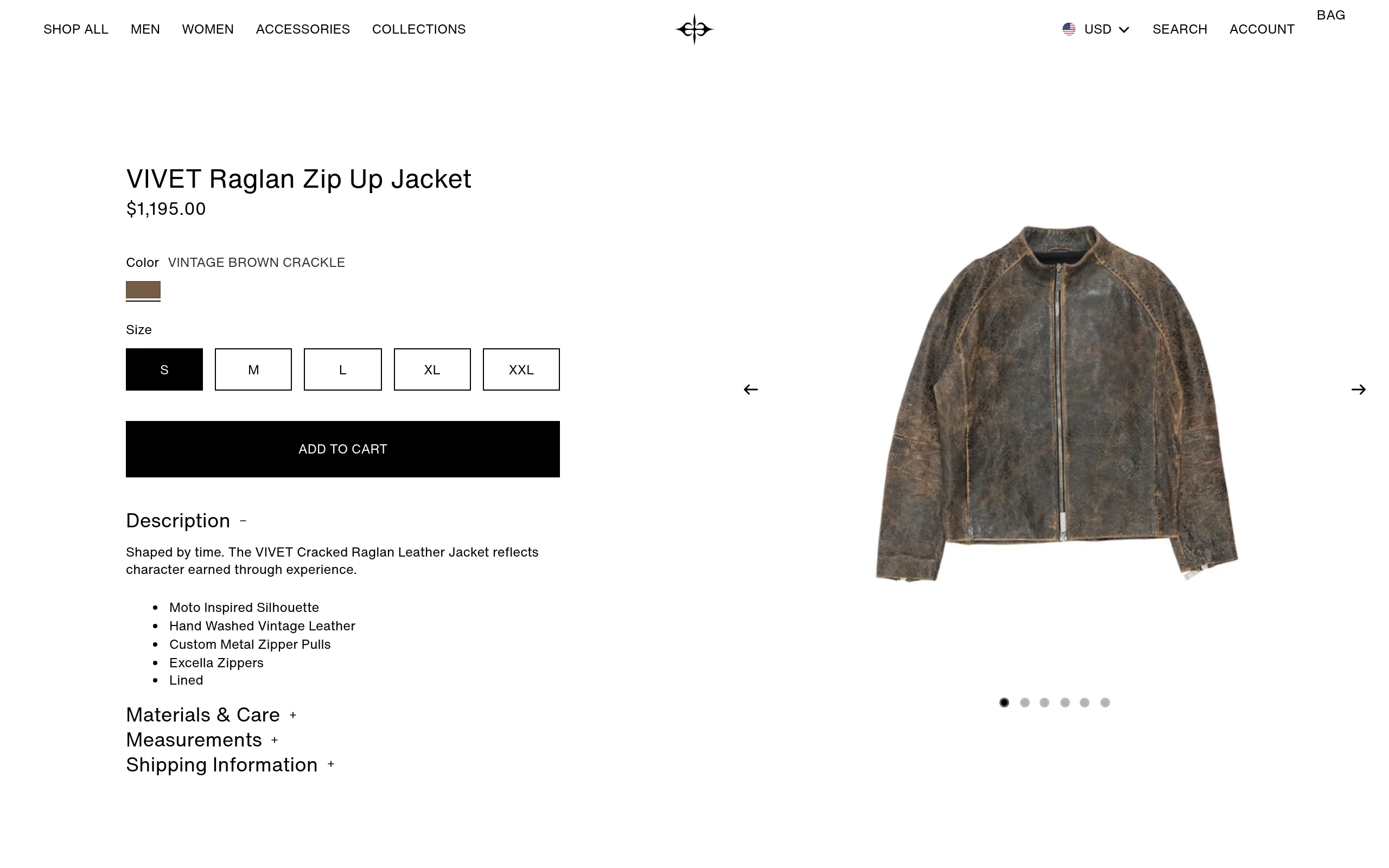
The $1,195 Raglan Zip Up Jacket is hand-washed vintage leather with a moto silhouette, and the page describes it as "shaped by time." Fifteen days after launch, every size from S to XXL was still in stock. Both backpacks, at $995 and $550, were gone.
That is a clean signal. The buyers who showed up were not shopping for a leather jacket. They were shopping for the thing that reads as Vivet across a room, which is why a bag and a notebook cleared before the most expensive garment did. It is the same logic we wrote about in the Labubu boom, where the object people bought was a badge rather than a product.
The entry point, and the emotional centre of the collection, is the $160 Beginner Hoodie. It is the first piece Cenat sewed by hand, and it opened the show.
Four dated moments explain every bend in that curve.
December 6, 2025: the announcement. Cenat posts a video titled "CLICK HERE" on his second YouTube channel, showing the journal and the logo, and explains that "vivet" is Latin for "he, she, or it will live forever." The next day at the Streamer Awards he says on stage that he intends to become a fashion designer. Our series does not move: December 2025 is 480 searches.
January 13, 2026: the documentary. He posts "I Quit," a 23-minute film about stepping away from streaming, in which he says, "This is not me sticking my name on a brand and money-grabbing." Within a week he is at Paris Fashion Week Men's with the journal under his arm, and an account dedicated to that journal starts posting its pages. That cluster is the 368,000 month. Note what is not in it: a product.
July 6 and 12, 2026: the return. He ends a nine-month streaming hiatus, then teases Vivet pieces in a diss track, holding a bedazzled Vivet bag. Searches bounce back to 74,000 for the month before fading again.
September 12, 2026: the show. Vivet debuts Collection 1 at Cipriani, livestreamed on Twitch to more than 180,000 viewers. Lauryn Hill, Jaden Smith, Luka Sabbat and Law Roach are in the room. Streamers Duke Dennis, BruceDropEmOff and Rayasianboy walk in the show alongside the professional model Alton Mason.
Rolling Stone's Jeff Ihaza reviewed it and asked Cenat why he cast his own friends. The answer is the clearest statement of the brand's logic anyone has got on the record: "You have to be honest with who you are and what world you stem from. So it was just very honest to include those people in the world."
The backlash started the next morning and it was about money, not clothes. The streamer Tectone posted a one-line dismissal of anyone who would buy the collection, using a slur about disability, and it picked up more than 1,500 likes. HotNewHipHop rounded up the reaction, including one comparison that stuck: "This is just ripped off Yeezy designs."
Two weeks on, the mood in the places where people actually buy things is calmer. This unboxing, posted on September 25, is the tone of most of them.
The caption on that clip from @toniovenchy reads "Unboxing the new @VIVET. I might be the target audience," which is the whole customer thesis in eight words. The people defending the prices are the people who already own the hoodie.
There is no capital stack to report, and that is the most unusual fact about this company.
| Date | Event | Figure | Source |
|---|---|---|---|
| Dec 6, 2025 | Brand announced on YouTube | No funding disclosed | Vivet, Wikipedia |
| Oct 2025 | Twitch subscribers before the hiatus | Over 1 million | Deeds Magazine |
| Jul 6, 2026 | Peak viewers on the return stream | Over 1 million combined | Deeds Magazine |
| Sep 12, 2026 | Runway show livestream | Over 180,000 Twitch viewers | Wikipedia |
| Sep 12, 2026 | Collection 1 goes on sale | 20 products, $20 to $1,195 | vivetofficial.com |
| Sep 27, 2026 | Products fully sold out | 3 of 20 | vivetofficial.com |
Three caveats belong with that table. Vivet has published no revenue figure, so nobody outside the company knows what the show sold. The ownership detail, that the brand sits in a Georgia LLC wholly owned by Cenat with no outside investors, comes from Deeds Magazine's reporting, not from a filing we read ourselves. And sold out on a storefront tells you a size run is exhausted, not how large it was.
The absence of investors is not trivia. It explains the pricing. A venture-backed creator brand has a board asking why the entry hoodie is not $80 and in more stores. A self-funded one prices to the founder's taste and eats the discourse. Cenat's response to the price complaints was that Vivet was built to match his own vision without compromise, which is what sole ownership buys you.
Vivet's competition is not Supreme. It is the attention of the same audience, and our database shows where that audience already spends it. Streamer University, Cenat's other venture, pulls 74,000 monthly searches and is up 233% on the year, more than three times Vivet's August volume. His own projects are the brand's biggest rival for the same search demand.
Inside fashion, the peer group is thinner than it looks. "Celebrity brand" as a search is down 18% on the year to 590. The category that is growing is the one defined by who makes it rather than what it is, and there the benchmark is Skims, which holds 1,220,000 monthly searches on our clothing trends page with a flat year. That is what a mature creator brand looks like: enormous and boring. Vivet is at the opposite corner, small and violently volatile, with no direct competitor yet because no other streamer has taken nine months off to do this.
The official calendar has stopped being the gate. The CFDA's preliminary Official NYFW Schedule for the spring-summer 2027 season lists 70 runway shows and presentations across September 10 to 15. Vivet is not on it. A show that was not on the industry's own calendar was watched live by more people than most of the shows that were. If an off-calendar debut can out-draw the schedule, the schedule is a formality.
See-now-buy-now finally has the right buyer. The model has been tried and abandoned repeatedly by traditional houses, because their customer was not watching the show. Vivet's customer was watching the show, on Twitch, on the platform where Cenat has spent five years training them to act on what he does in real time. The entire collection went live the same night. That only works when the audience and the customer are the same people.
Attention arrives long before capacity. The January peak of 368,000 was demand for a brand that could not sell anything, and 84% of it had evaporated by the time there was product. The dopamine shopping behaviour we tracked earlier this year is the consumer-side version of the same gap: intent that never converts because the checkout is not there. For a creator planning a launch the lesson is blunt. Announce when you can ship, or accept you are warming up an audience you will have to re-acquire.
Price is the trust test for creator brands. A $1,195 jacket from a nine-month-old label is a bet that the founder's story carries luxury pricing. The stock data two weeks in says the story sells accessories and sells out a $20 notebook, and that the jacket is still waiting. That distinction, between merch pricing and fashion pricing, is where most creator brands find out what they actually are. You can see the same split across our fashion trends page, where cheap, loud accessories are outgrowing four-figure leather goods by a wide margin.
The September number is the whole test. Our series ends in August at 22,200. The show happened on September 12 with a livestream audience above 180,000. If September does not clear the July rebound of 74,000, the runway was a media event rather than a demand event, and the January peak stands as the brand's high-water mark. That single data point is worth more than every review published this month.
Watch "vivet clothing," not "vivet." The bare brand name captures curiosity, which is what spikes when a streamer announces something. The 4,400 searches a month for "vivet clothing" are people looking for the store. If that term grows while the bare name falls, Vivet is converting fame into a business. If both fall together, it was a moment.
Collection 2 is the real debut. First collections from famous people are graded on nerve. Second collections are graded on clothes, without the documentary, the billboards or the nine-month absence to sell them. Cenat has said more journals and more collections are coming, and the buyers who paid $995 for a backpack will decide whether that is a brand or a souvenir run.
The lesson in this curve is not about one label. A single person with a camera can now manufacture more search demand in thirty days than an entire product category generates in a year, and still have nothing to sell at the end of it. Attention is cheap to create and expensive to keep. Vivet spent 279 days learning that in public.
Want to spot the next breakout brand before its first collection ships? Read our guide on how to identify market trends, follow the live Vivet trend page, or browse what is breaking out right now on the Rising Trends dashboard.
Thousands of Emerging Trends
Thousands of Breakout Apps
Mega Trends
Trend Analysis Tool