
Trends


Two years ago, 320 people a month typed "pocket ai" into Google. As of August 2026 it is 40,500, an 83x lift, and the term is classified EXPONENTIAL in our database. It is not a category. It is one product: a credit-card-sized recorder that snaps onto the back of your phone with MagSafe and turns what you say out loud into notes.
Here is the part nobody ranking for the term will tell you. The generic words for this thing are all flat or shrinking. "ai wearables" is up 19% in a year. "ai recorder" is flat. "ai note taking app" is down 33%. "humane ai pin" is down 84% in two years. Only the product names are growing, and Pocket is the fastest of them. The search data says buyers stopped shopping for a category and started shopping for a brand, and that happened inside about six months.
Key takeaways:
Let's get into it.
Here is the monthly curve for "pocket ai" over the last two years, straight from our database.
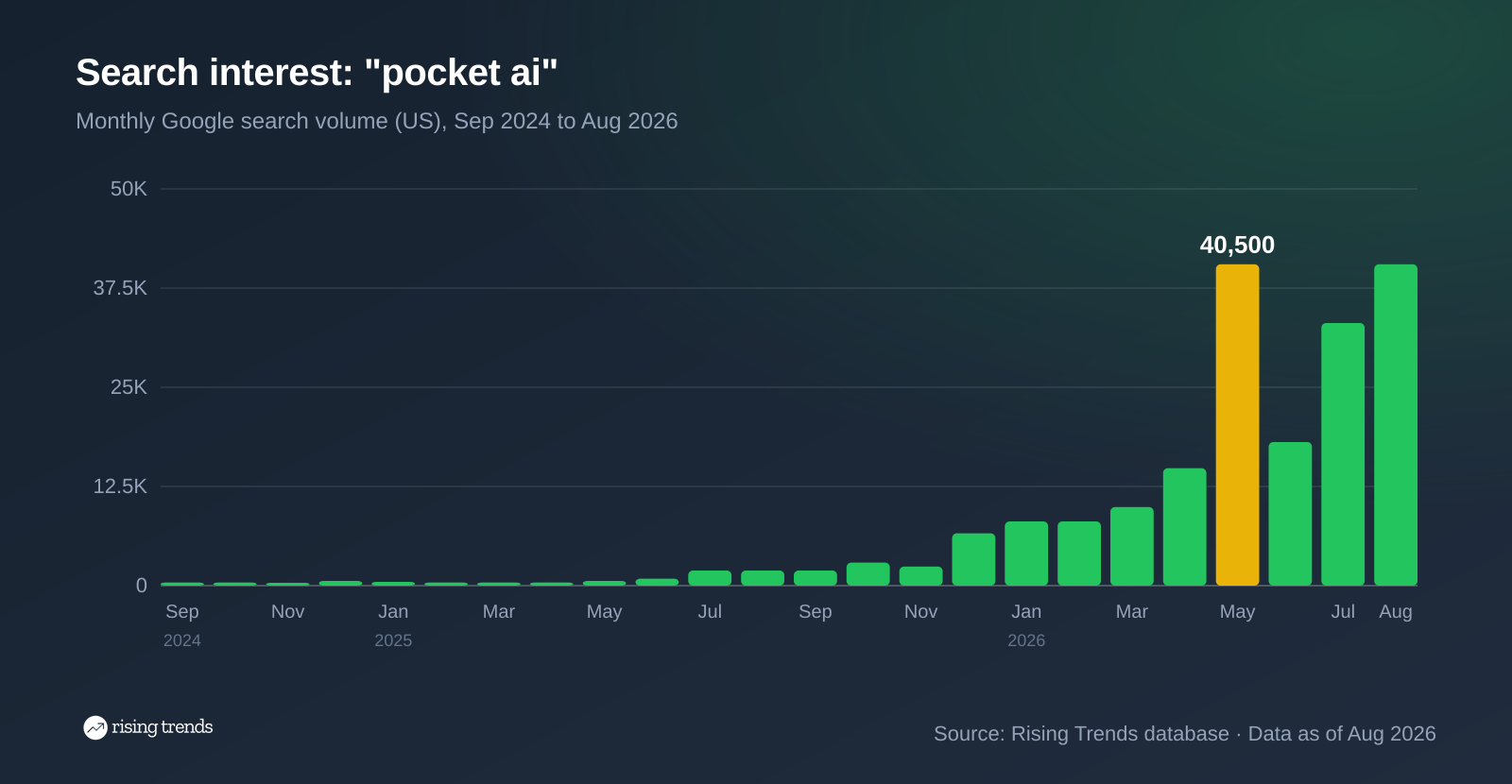
For eighteen months this was a nothing term, sitting between 320 and 880 searches a month. It reached 1,900 in July 2025, held there through September, then started stepping: 6,600 in December, 8,100 in January, 9,900 in March. April 2026 was the breakout at 14,800. May went to 40,500, a 2.7x jump in one month.
Then it did the interesting thing. June dropped to 18,100, which is what a viral spike looks like on the way down. July recovered to 33,100 and August matched the May peak at 40,500. Demand did not decay. It dipped and came back, which in our experience separates a product with customers from a product with a moment.
Now put it next to everything else on the same shelf.
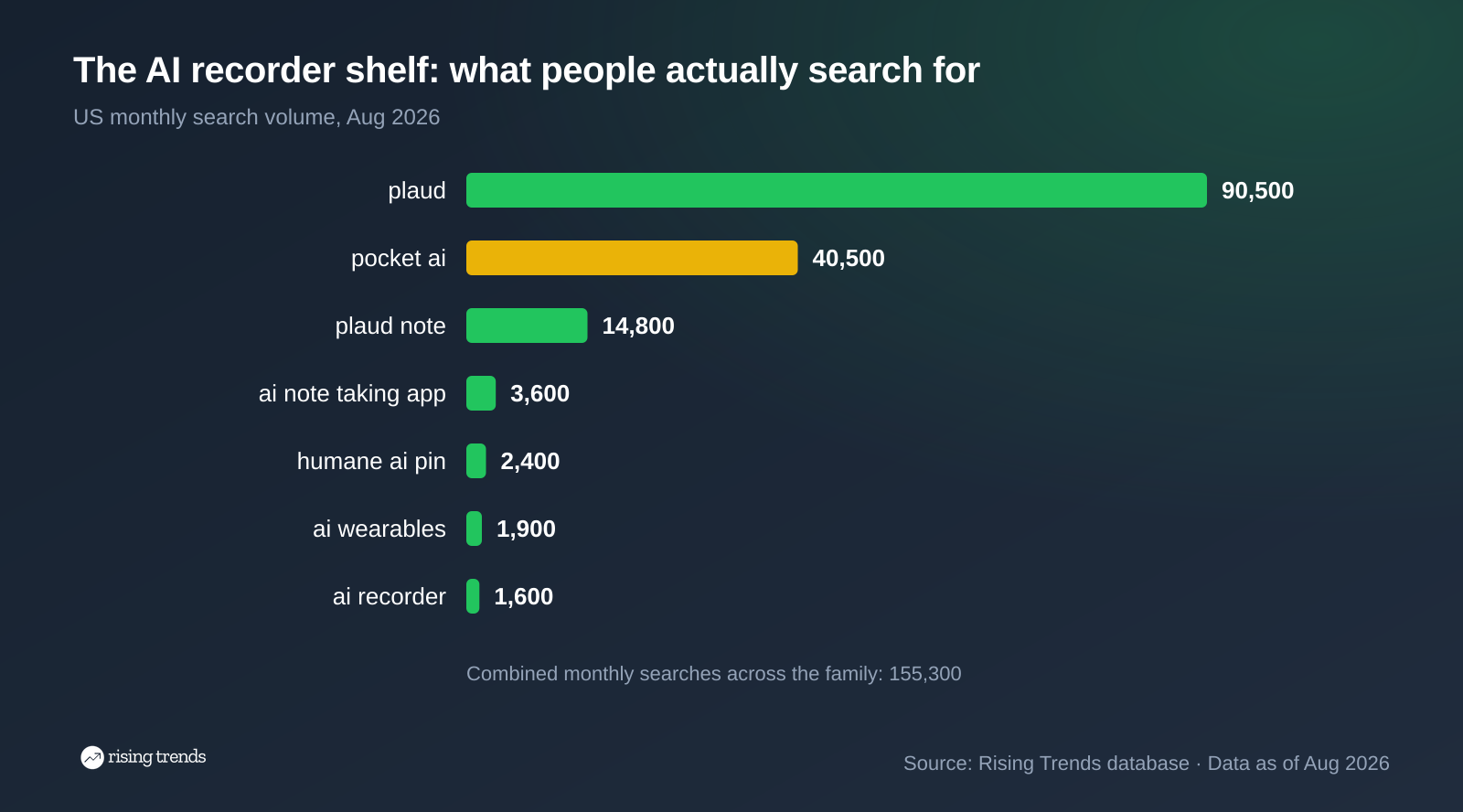
Two brand names, plaud and pocket ai, account for 131,000 of the 155,300 monthly searches in that chart. The generic terms are rounding errors by comparison: ai wearables at 1,900 and ai recorder at 1,600. Anyone still optimising for the category phrase is fishing in a pond with 3,500 fish in it while 131,000 swim past.
It is a 52 gram slab, 3.4 by 2.2 by 0.2 inches, that sticks to the back of a phone with MagSafe. One button on the side starts and stops recording. A side switch moves it between in-person mode, which uses two studio microphones, and call mode, which uses a contact microphone to pick up phone audio without the speaker being on.
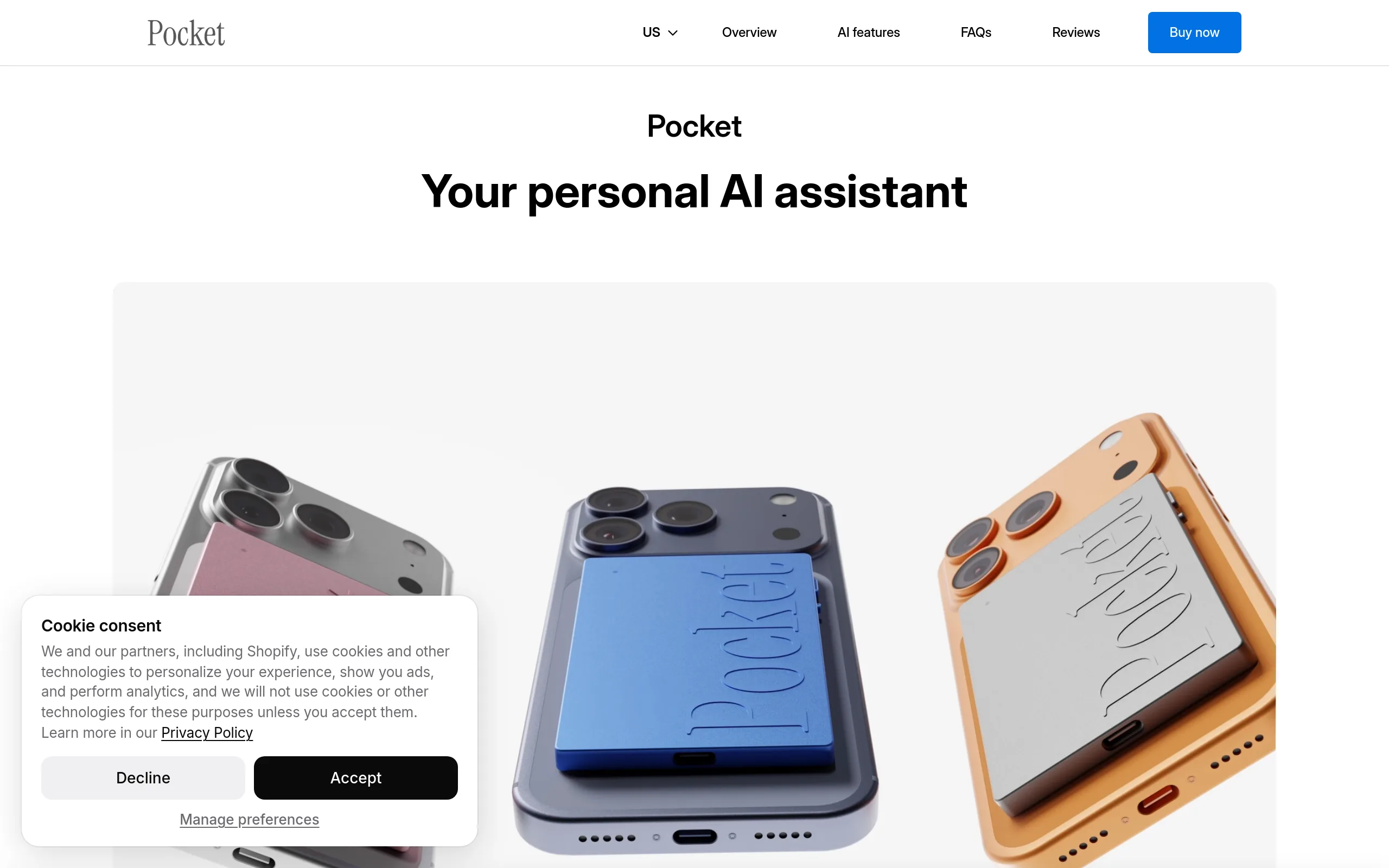
The published specifications are a four-day battery on active use, a 90 minute charge, 64GB of onboard storage plus cloud, a rated pickup range up to 15 metres, and transcription in 120 or more languages. The app turns each recording into a transcript, a summary, action items and a mind map, and an "Ask Pocket" feature lets you query your own recording history in plain language. There is an MCP server, so the assistant can be wired into other tools.
Pricing has two layers, and the second one is where the arguments happen. The device is $99 on the buy card today against a $199 list price, with free shipping, a one-year warranty and 30-day returns. The free software tier gives unlimited standard-accuracy transcription but caps Ask Pocket at two messages a day and deletes summaries after 30 days. Pocket Pro is $19.99 a month, billed yearly at $239.88, and unlocks higher accuracy, permanent history, speaker names and full exports.
The company is younger than the search curve suggests. Open Vision Engineering was founded in 2024 by Akshay Narisetti and Gabriel Dymowski, went through Y Combinator's Winter 2026 batch, and has 15 employees in San Francisco with 11 roles open. Narisetti was a founding member of Omi, a rival note-taking device, before starting this one.
On June 29, 2026, TechCrunch reported an $11 million round from Accel, Y Combinator and ElevenLabs co-founder Mati Staniszewski, with the company claiming more than 130,000 units sold since launch. Narisetti's pitch to the reporter explains the positioning better than the website does: "We thought every meeting notetaker was built for online conversations, but nothing was geared towards real-life talk. AI really needs a lot of context to work better for us, and a lot of that context exists offline."
That is the wedge. Otter, Granola, Fireflies and Zoom all own the video call. Nobody owned the corridor, the car, the clinic or the site visit. Accel partner Cecilia Wang named the buyers in the same piece: "lawyers, salespeople, doctors, real estate agents, construction workers, and students."
The demand side shows up on TikTok, where the format is always the same: someone holds up the puck and explains what it replaced. This clip from @isocialyou1, posted on September 14, 2026, is titled "this tiny device just replaced my assistant, my notes app, and my memory."
Note what the pitch is not. It is not an AI assistant that talks back, which is what Humane and Rabbit sold and what the market rejected. It is a recorder. The ceiling is lower and the promise is keepable.
Plaud is the incumbent and it is still bigger. Here is the side-by-side on published numbers only.
| Spec | Plaud Note Pro | |
|---|---|---|
| Hardware price | $99 on the buy card, $199 list | $189 |
| Microphones | 2 studio, 1 contact | 4 MEMS with beamforming, 1 VPU |
| Rated pickup range | Up to 15 m (49 ft) | Up to 5 m (16.4 ft) |
| Recording endurance | 4 days of active use | Up to 50 hours in Endurance mode |
| Languages | 120 or more | 112 |
| Zoom, Teams and Meet capture | No native support | Yes, via Plaud Desktop |
| Published certifications | None named in the privacy policy | SOC 2 Type II, ISO 27001, ISO 27701, GDPR, HIPAA |
| Subscription | Pro at $19.99 a month | Free Starter plan, 300 min a month |
Sources: the Pocket product page above, the Plaud Note Pro page and Plaud's published trust centre. Pocket wins on range, battery and entry price. Plaud wins on online meetings and on paperwork, and the paperwork is the part a procurement team reads.
Search growth tells you which way the momentum runs even so.
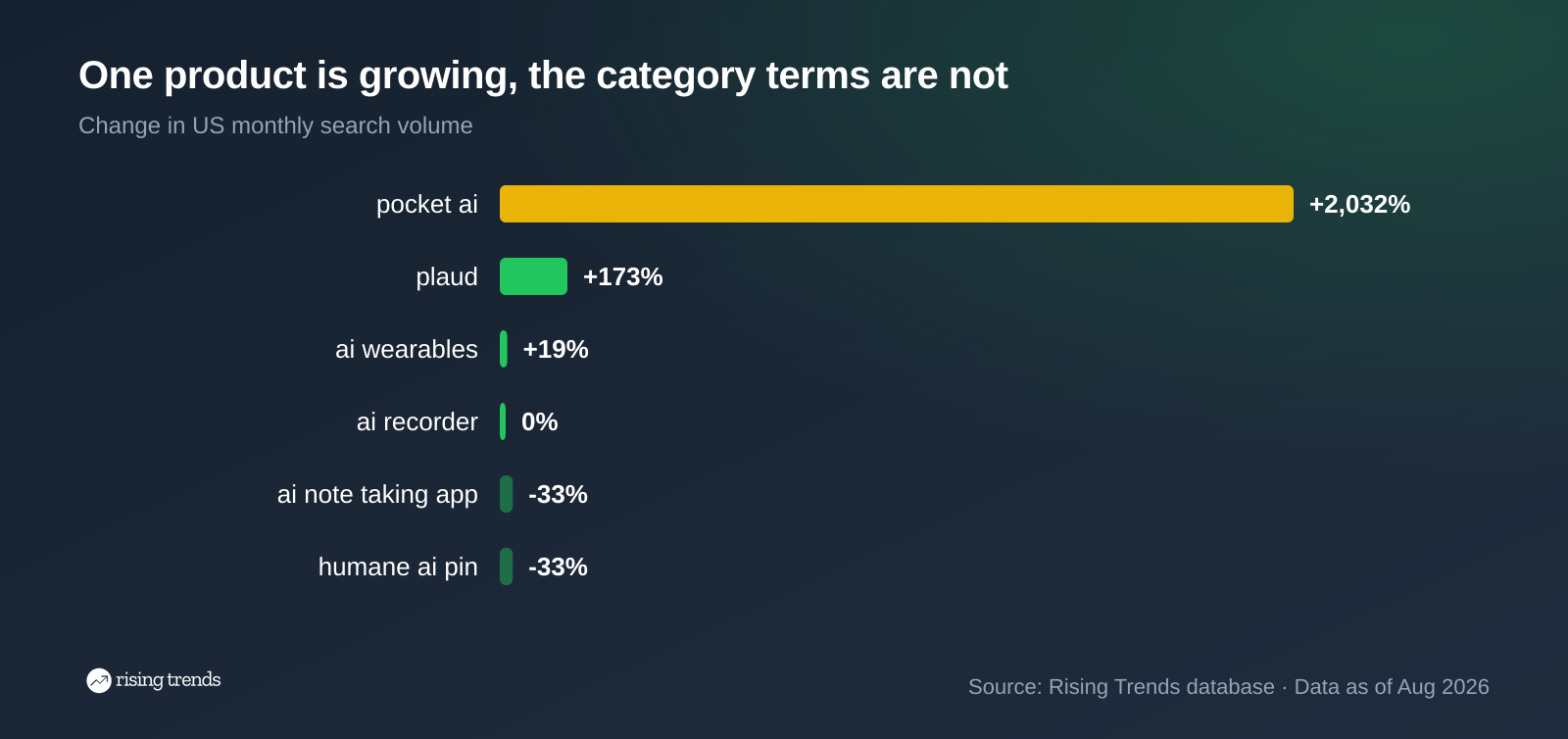
Plaud grew 173% in a year from a much larger base, which is a strong number. Pocket grew 2,032%. And humane ai pin, the device that was supposed to be this category, is down 33% in a year and 84% in two. The screenless AI gadget did not fail. The screenless AI gadget that tried to replace your phone failed. The one that attaches to your phone and does one job is the one selling.
Three public review pools, all first-party, all pointing the same way.
The App Store listing carries 4.9 out of 5 from 6.1K ratings. The Google Play listing shows 4.8 from 2.75K reviews and 50,000 or more downloads. That is a lot of goodwill for a company this young.
Read the text and the complaints cluster in three places. Fulfilment came first. "Ordered at the website on 5/21 where it was advertised as 'in stock' and 'ships within 3 days'," wrote an App Store reviewer on June 6, 2026. "Once purchased, I immediately received an email advising that it wouldn't ship for 21-30 days." That review lands in the exact month our curve dipped from 40,500 to 18,100.
Second is the free tier. A one-star Google Play review from August 26, 2026 puts it bluntly: "Your stuff gets deleted from the device you bought after 30 days." The developer replied two days later saying it is working on exports and storage limits.
Third is the AI itself. "Transcription is only moderately accurate, it does not assign me accurately as a speaker," wrote another Play reviewer on August 21. That matches the only mainstream hands-on we could find. TechDay's Jake MacAndrew tested it in May 2026 and concluded it "works well for capturing phone calls if you can live with a few hardware quirks and an ongoing subscription. As far as in-person meeting transcription, the device is lacking."
The positives are just as specific. One App Store reviewer in July described using it with early-onset Alzheimer's: "All I have to do is keep it charged every few days and remember to press the button." Another praised the release cadence, and the version history backs that up: 25 public iOS releases between July 10 and September 28, 2026, and the app is still on a 0.6.x build number.
Hardware is now a distribution channel for a subscription. Pocket sells the puck near cost and charges $239.88 a year for the software that makes it useful. That is the same shape as the customer experience trends we track across categories, and the same playbook behind premium single-purpose objects like the Anthros office chair: win the object, then own the relationship. The complaints about the free tier are not a bug in that model. They are the model working.
The compliance gap is the next competitive front. Pocket's privacy policy puts the burden on the buyer: "You are responsible for obtaining any consents from third parties whose voices or information are captured." It names no SOC 2, ISO 27001 or HIPAA certification. In April 2026, attorney Michael D.J. Eisenberg wrote directly about HeyPocket and warned that where a vendor's terms "allow human review, secondary uses, or disclosure to third parties, privilege can be placed at risk." Accel's own list of target buyers starts with lawyers and doctors. Those two groups cannot buy on trust alone.
The category term is dead as a marketing target. If you sell in this space, the ai note taking app keyword is down 33% and worth 3,600 searches. The brand names are worth 131,000. That is the same brand-over-category pattern showing up across the AI agents market and in generative AI, where people search for tools by name long before they search for what the tools do.
Whether August holds. Two peaks at 40,500 four months apart is a plateau, not a top, but the next reading decides it. If September and October stay above 33,100, Pocket has a durable demand base rather than a launch echo. Watch the pocket ai trend page for the monthly print.
Whether Plaud's lead narrows. Plaud sits at 90,500 and grew 173% last year. If Pocket closes to within 20,000 of it while both keep growing, the category has two real brands rather than one leader and one challenger. If Plaud pulls away, the compliance certifications will be why.
Whether the certifications arrive. A SOC 2 announcement from Open Vision Engineering would be the single clearest signal that it is going after enterprise rather than prosumer buyers. Watch it alongside "is pocket ai legal" and "is pocket ai legit" queries, which are already among the questions Google surfaces for the term.
The same cheap-object logic is now running through reading hardware, where a $69, 58 g E Ink slab pushed mini e-reader searches from 170 to 2,900 a month while Kindle and Kobo terms stayed flat.
Three years ago this shelf was a graveyard. A pin, a pendant and an orange box all promised to replace the phone and all lost. The thing that actually worked was smaller and much less ambitious: a button you press to remember a conversation you were having anyway. Our data says 40,500 people a month are now looking for that specific thing by name, and the generic words for it are going nowhere.
Want to spot the next breakout product before the funding round makes it obvious? Read our guide on how to identify market trends, follow the live pocket ai dashboard page, or browse what is breaking out right now on the Rising Trends dashboard.
Thousands of Emerging Trends
Thousands of Breakout Apps
Mega Trends
Trend Analysis Tool