
Trends


Two years ago, "mini e readers" was a dead search term in our database. It sat at 110 searches a month as of August 2024 and stayed there. In August 2026 it hit 2,900 a month, up 1,606% in a year, on a curve that has not had a down month since November. That on its own is a nice little breakout. What makes it worth 2,000 words is the term sitting next to it: xteink, a brand almost nobody had heard of in 2024, is now at 33,100 monthly searches and up 66,100% year over year as of August 2026.
Every page that ranks for this right now is a "best small e-readers" round-up. None of them has the thing that actually explains the category: while the new terms went vertical, every incumbent term stayed exactly where it was. Kindle Paperwhite: flat. BOOX: flat. Onyx BOOX Palma: down. This is not an upgrade cycle where Kindle owners trade up. It is a new class of device, between 3.7 and 4.3 inches and under $100, pulling in demand the incumbents are not touching. Here is what the data says, who is building the hardware, and what it costs the companies that own the old shape.
Key takeaways:
Let's get into it.
Here is the monthly search volume for "mini e readers" over two years, straight from our database. The left two thirds of this chart is a flat line.
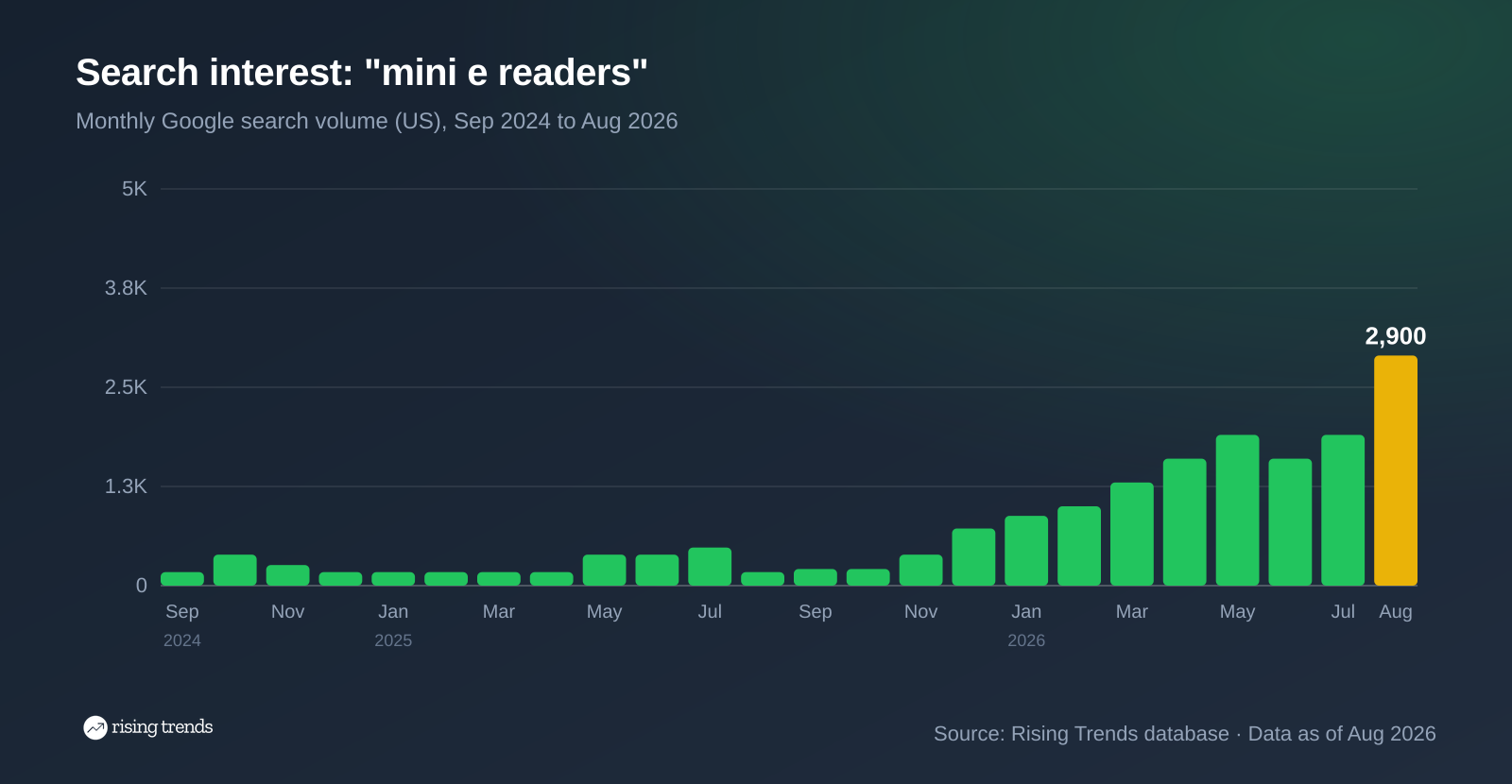
The shape is the tell. This is not a spike, which is what a news cycle produces. It is a staircase: 390 in November 2025, 720 in December, 880 in January, and up every month since except one, finishing at 2,900 as of August 2026. A year earlier the same term was at 170. Our classifier calls the pace EXPONENTIAL and the acceleration positive, meaning the last three months grew faster than the three before them.
A rising category term means nothing on its own, though. The question is whether the money moved with it. So we pulled the growth rate for every device and brand term around it.
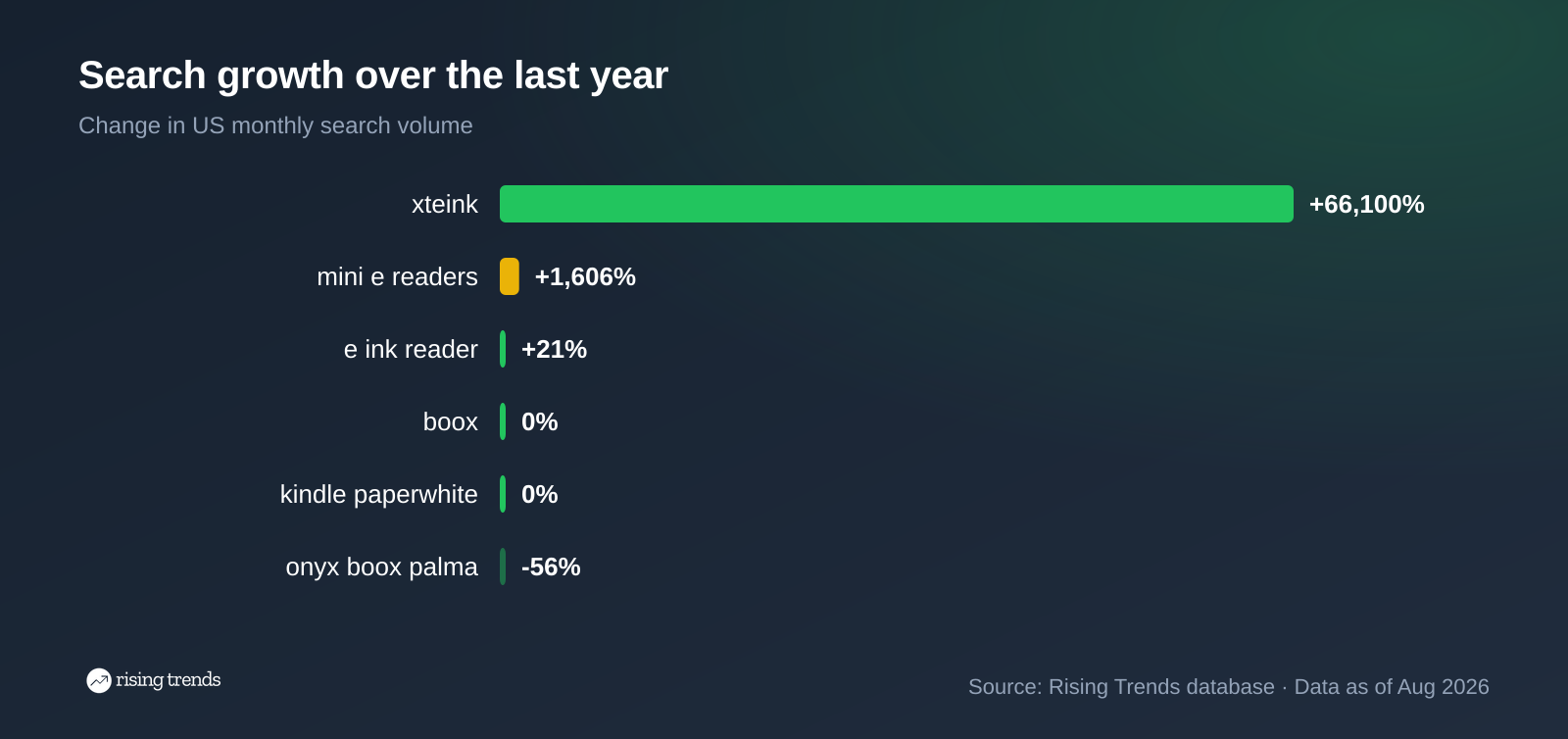
This is the chart nobody ranking for this term has. Two bars are moving and four are not. Xteink is up 66,100% in a year, the category term is up 1,606%, and then it stops: e ink reader up 21%, boox 0%, kindle paperwhite 0%, onyx boox palma down 56% (all as of August 2026). If mini e-readers were an upgrade path for existing e-reader owners, the incumbent terms would move too. They do not move at all.
The absolute volumes make the point sharper.
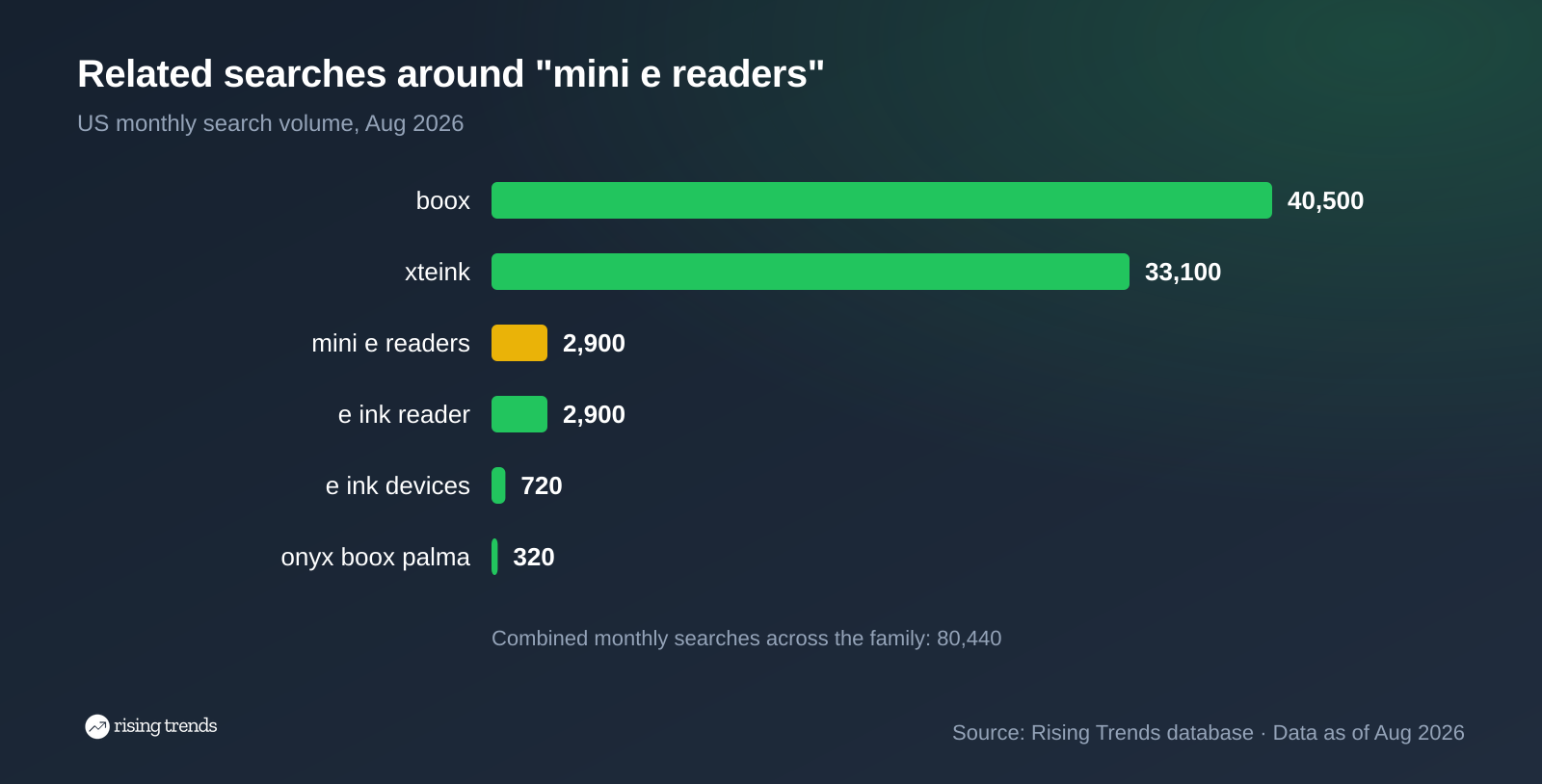
BOOX has been building E Ink hardware for more than fifteen years and gets 40,500 searches a month. Xteink, whose first pocket reader was listed in December 2025, gets 33,100, or 82% of that, as of August 2026. One of those numbers took more than fifteen years. The other took nine months. Meanwhile kindle paperwhite, at 110,000 searches a month, is the biggest term in the whole neighbourhood and has not grown in a year. You can follow both curves live on the mini e readers trend page.
For fifteen years "small e-reader" meant six inches. That is still what it means at the incumbents. Kobo's own small screen eReaders collection is literally defined as "a 6-inch E Ink screen", and the cheapest thing in it, the Clara BW, is $159.99. Amazon has never shipped a Kindle under 6 inches.
The new class is a different object. The Xteink X3 has a 3.7-inch screen, weighs 58 g, is 5.1 mm thick and costs $69.00. It has buttons instead of a touchscreen, no front light, no store, no wifi bookstore and no account. You put EPUB, MOBI, PDF or TXT files on a microSD card or push them from an app. It has a magnetic backplate, so it sticks to the back of a Qi2 phone and travels as part of it.
Then look at the same company's full line-up: the X4 Classic is 4.3 inches, 68 g and $79.00, and the X4 Pro is 4.3 inches, 72 g, adds a touchscreen and a front light, and costs $99.00. The whole range fits inside the price of one Kobo.
Against that, the incumbent pocket device is the BOOX Palma 2: 6.13 inches, about 170 g, full Android with the Google Play Store, $269.99 in the US. It is a better computer. It is also 2.9x the weight and 3.9x the price of an X3, and it is the term in our family chart that fell 56% over the year.
| Device | Screen | Weight | US price |
|---|---|---|---|
| Xteink X3 | 3.7 in | 58 g | $69.00 |
| Xteink X4 Classic | 4.3 in | 68 g | $79.00 |
| Xteink X4 Pro | 4.3 in | 72 g | $99.00 |
| BOOX Picco | 3.97 in | about 58 g | $109.99 (pre-order) |
| Kobo Clara BW | 6 in | n/a | $159.99 |
| BOOX Palma 2 | 6.13 in | about 170 g | $269.99 |
The honest answer is that the curve follows a product catalogue, not a news cycle. Xteink listed the X3 on its own store on 8 December 2025. Our breakout month is January 2026. It listed the X4 Pro on 7 July 2026 and the X4 Classic on 3 August 2026, and August 2026 is the peak month at 2,900. When a search curve maps that cleanly onto listing dates, you are watching supply create demand, which is the opposite of how most trends in our database start.
What supply is meeting is a demand that has been visible for a while in adjacent terms. We wrote up screenless wearables when people started paying to take displays off their bodies, and pocket AI when a $50 clip-on recorder beat two much better funded devices to the same pocket. The same instinct is showing up in AI addiction searches. A mini e-reader is the cheapest possible way to buy the feeling of putting your phone down without actually leaving the house without it.
You can see the pitch in ten seconds in this clip from TikTok creator Lilah, posted on 31 August 2026, in which the entire product demo is taking the device out of a pocket.
Note what is not in that video: a screen comparison, a page-refresh rate, a font test. The demo is the pocket.
Xteink is the whole story on the challenger side. Three devices, all under $100, sold direct from its own storefront with an 8% referral programme rather than a retail channel.
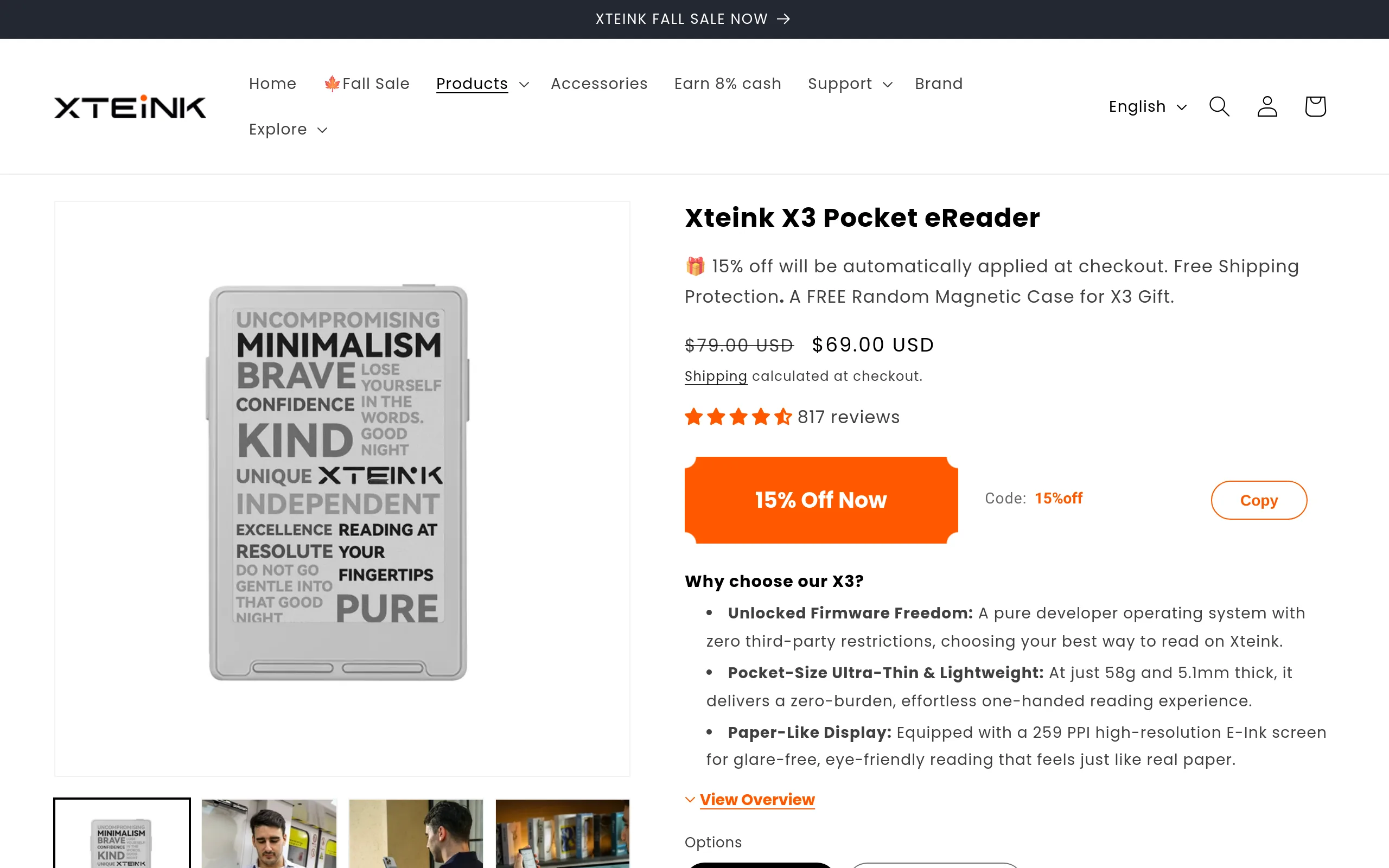
That page carries 817 reviews for one product, and the store-wide rating on the homepage is 4.70 stars across 4,128 reviews. Treat vendor reviews as marketing, because that is what they are, but the volume is a signal even when the sentiment is curated. The independent read is kinder than you would expect. Mark Jansen bought an X4 himself and wrote it up for Android Police in January 2026. His verdict on the reading experience was harsh: "You don't get a lot of words on the page, even with the smallest font available, and the seemingly forced justified orientation means there are big gaps and formatting errors throughout your books." His verdict on the device was not: "There's no backlight, which hurts, and it's janky as all hell, but none of this puts me off because I've bought a tiny e-reader that fits onto the back of my phone for $60."
BOOX has answered. At IFA in August 2026 it unveiled the Picco, the first device in a new "BOOX Tiles" line: 3.97 inches, about 58 g, 920 mAh, a front light, buttons plus touch, a magnetic case that snaps onto the back of a phone, and a stripped reading OS instead of Android. It is the Xteink spec sheet with a front light and a warranty. As of today it is still pre-order at $109.99 in the US, marked for shipping around October.
Amazon and Kobo have shipped nothing. That is the finding. The two companies that own e-reading have no product in the fastest-growing shape in their own category, and their brand searches show it.
The sceptics now exist too, which is itself a maturity signal. The most-discussed critical review in the category is a YouTube video titled "I Hate mini e-readers (XTEInk, Pocketbook Q, Boox Picco)" from The French eReader Guy. A category gets a backlash channel when it gets big enough to have one.
Three things changed on the buyer's side, and none of them is about reading technology.
They stopped buying an ecosystem. A Kindle is a store with a screen attached. These devices have no store at all: you sideload files. Buyers used to treat that as a defect. The people writing verified reviews on Xteink's site treat it as the feature, because it is what makes the device $69 instead of $159. One buyer, Evan, describes keeping the X3 in a flip billfold "right alongside my cash", which is a sentence you cannot write about a Kobo.
They optimised for carry, not for reading. Every complaint about these devices is about the reading. Every compliment is about the carrying. That is a category where the job to be done moved from "replace my books" to "replace the phone in the queue at the coffee shop", and the winning spec is grams, not pixels.
They accepted disposability. At $69 the device is priced like an accessory, and buyers behave accordingly. One anonymous X4 Pro reviewer on Xteink's own page describes the flip side: "One con however is the constant worry of damaging the screen. After hearing multiple stories on how everyone ended up damaging the screen, I'm really careful with mine and end up not taking it outside, especially since I paid $100 for it." Cheap hardware sold direct with a one-year warranty makes durability the customer's problem, and at some volume that becomes a returns problem instead.
Hardware margin is moving to a price point the incumbents cannot reach. Amazon sells Kindles near cost and makes the money back in the bookstore. That model needs a store on the device. A $69 sideloading reader has no store to subsidise it, which means it must make its margin on hardware, which means Xteink is running a business Amazon structurally cannot copy without cannibalising the one it has. The same split is running through the rest of retail: cheap, direct, single-purpose hardware against subsidised platform hardware.
Direct-to-consumer beat the retail channel again. There is no Xteink shelf in a store. There is a Shopify storefront, a referral programme paying up to 8%, and creators on TikTok and Instagram doing the demos. The brand reached 82% of BOOX's search volume without a distribution deal.
Ownership is the quiet argument. A device with no store cannot revoke your library. That matters more to buyers than it did five years ago, which is the same nerve we hit writing about what you actually own after a disc-to-digital conversion. "No account required" has become a selling point in a category built entirely on accounts.
The exposure is concentration. One brand is carrying this category. If Xteink's quality complaints compound, or if BOOX's Picco ships well in October with a front light and a warranty at $109.99, the xteink curve could invert as fast as it rose. Categories built on one supplier usually are.
Three calls, each with a term in our database you can check yourself.
BOOX converts or it does not, and we will see it by December. The Picco ships around October. Watch boox, which has been at 0% growth for a year. If a 3.97-inch device at $109.99 moves that flat line, the incumbent kept the category. If boox stays flat while xteink keeps climbing, the challenger owns it outright.
Amazon will be asked about a small Kindle and will say nothing. The signal to watch is kindle paperwhite, at 110,000 searches a month and 0% growth as of August 2026. A flat market-leading term next to a category growing 1,606% is the clearest gap-in-the-line-up chart we have produced this year.
The category term outgrows the brand term, or the trend was a brand. Right now xteink is ten times bigger than "mini e readers". Healthy categories invert that: people search the thing before the maker. If "mini e readers" pushes past 5,000 a month while the brand terms settle, this is a product class. If it does not, it was one good Shopify store, which is the pattern we keep seeing in small business breakouts.
The number we keep coming back to is the flat one. A category term up 1,606% in a year should drag the incumbents with it, and this one dragged nothing. That gap is where the next $69 device gets built.
Want to catch category shifts like this while they are still 390 searches a month? Read our guide on how to identify market trends, follow the live mini e readers dashboard page, or browse what is breaking out right now on the Rising Trends dashboard.
Thousands of Emerging Trends
Thousands of Breakout Apps
Mega Trends
Trend Analysis Tool