
Something switched in our database this year. The bare phrase "no screens" sat at 260 monthly searches two years ago and 480 a year ago. It is now running at 3,600 a month as of October 2026 (early estimate), up 650% in a year, and almost the entire move happened between January and August 2026. The term is classified EXPONENTIAL, and it peaked in August rather than spiking and falling back.
Most coverage of this is either a panic piece about children's brains or a list of rainy-day activities. Neither explains what actually changed. Parents did not get more worried about screens in 2026. They changed the words they search with. The vocabulary of rationing a screen is shrinking while the vocabulary of removing one explodes, and the research that landed in the middle of that switch backs neither camp cleanly.
Key takeaways:
- "No screens" went from 480 to 3,600 US monthly searches in a year, up 650% and up 15.9x on a two-year view, with May 2026 as the breakout month (Rising Trends data, as of October 2026).
- The management words are going the other way. "Screen time apps" is down 47% in a year and "digital detox" down 18%, while "screen free" is up 1,018%.
- The UK's Smartphone Free Childhood Parent Pact now lists over 190,000 families signed, covering 13,750 schools and more than 55% of UK schools.
- Australia ran the regulated version. Three months in, its own regulator found account ownership among 10 to 15 year olds fell from about 52% to 42%, while platform use barely moved, from almost 86% to more than 81%.
- The 2026 evidence is genuinely mixed. A Scottish cohort of 3,786 children published in August concluded that screen use "was not consistently associated with poorer outcomes for children".
- The hardware is selling regardless. tonies, which makes a screen-free audio box, reported H1 2026 revenue of EUR 242.9 million, up 38%, with North America up 48%.
Let's get into it.
What we're seeing in the Rising Trends data
Here is the monthly search volume for "no screens" over the last two years, straight from our database. For about eighteen of those twenty-four months the line is a flat floor. Then 2026 happens.
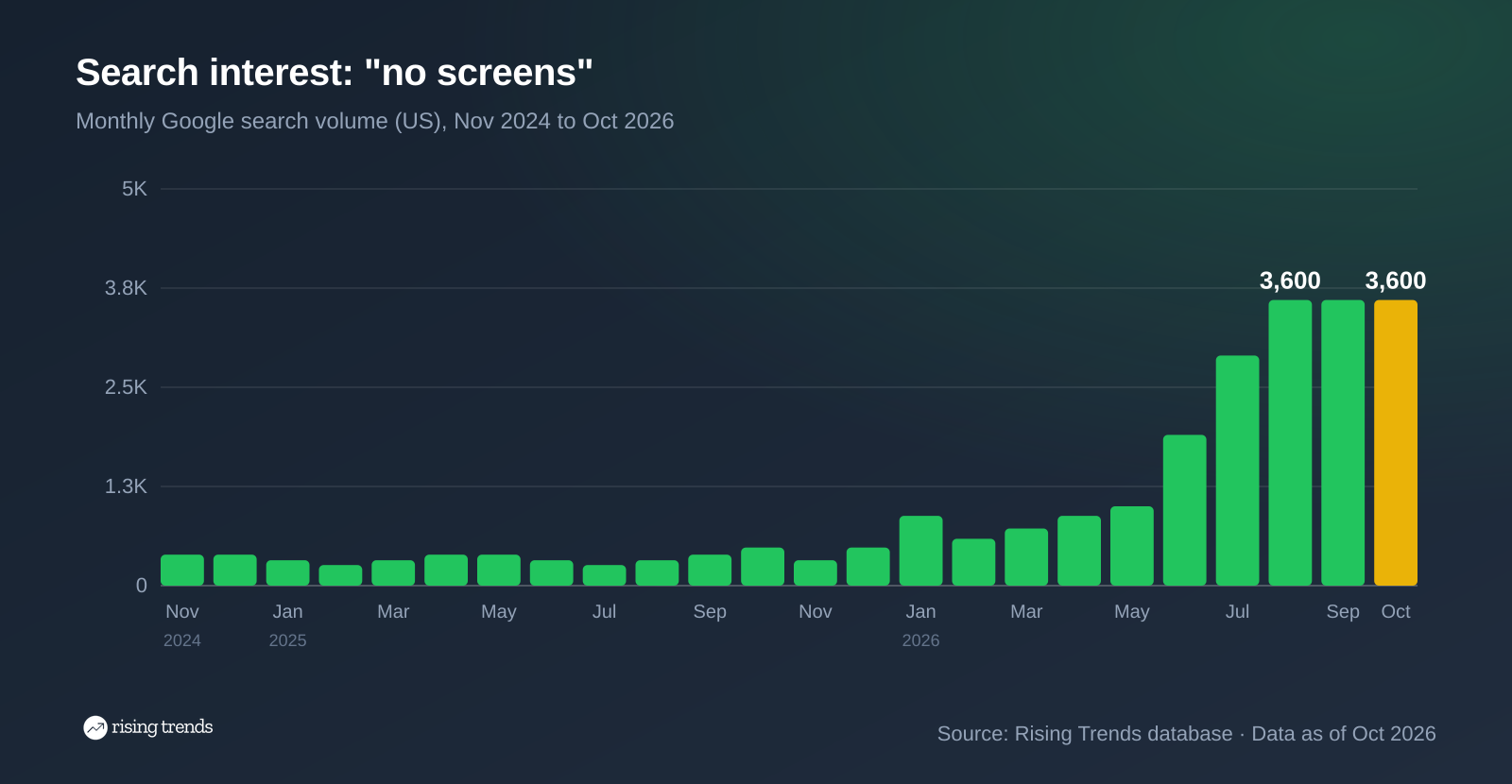
The shape is the first clue. This is not a news spike with a decay curve behind it. The term climbed through spring, jumped in June and July, hit 3,600 in August 2026 and held that level through September and October. Seasonality here is LOW, so the plateau is not a school-holiday artefact. A phrase that holds its peak for three straight months is a behaviour settling in, not a story being passed around.
The more useful view is what the neighbouring words are doing. We pulled every lexical relative in our database and split them into two groups: the words for removing a screen and the words for managing one.
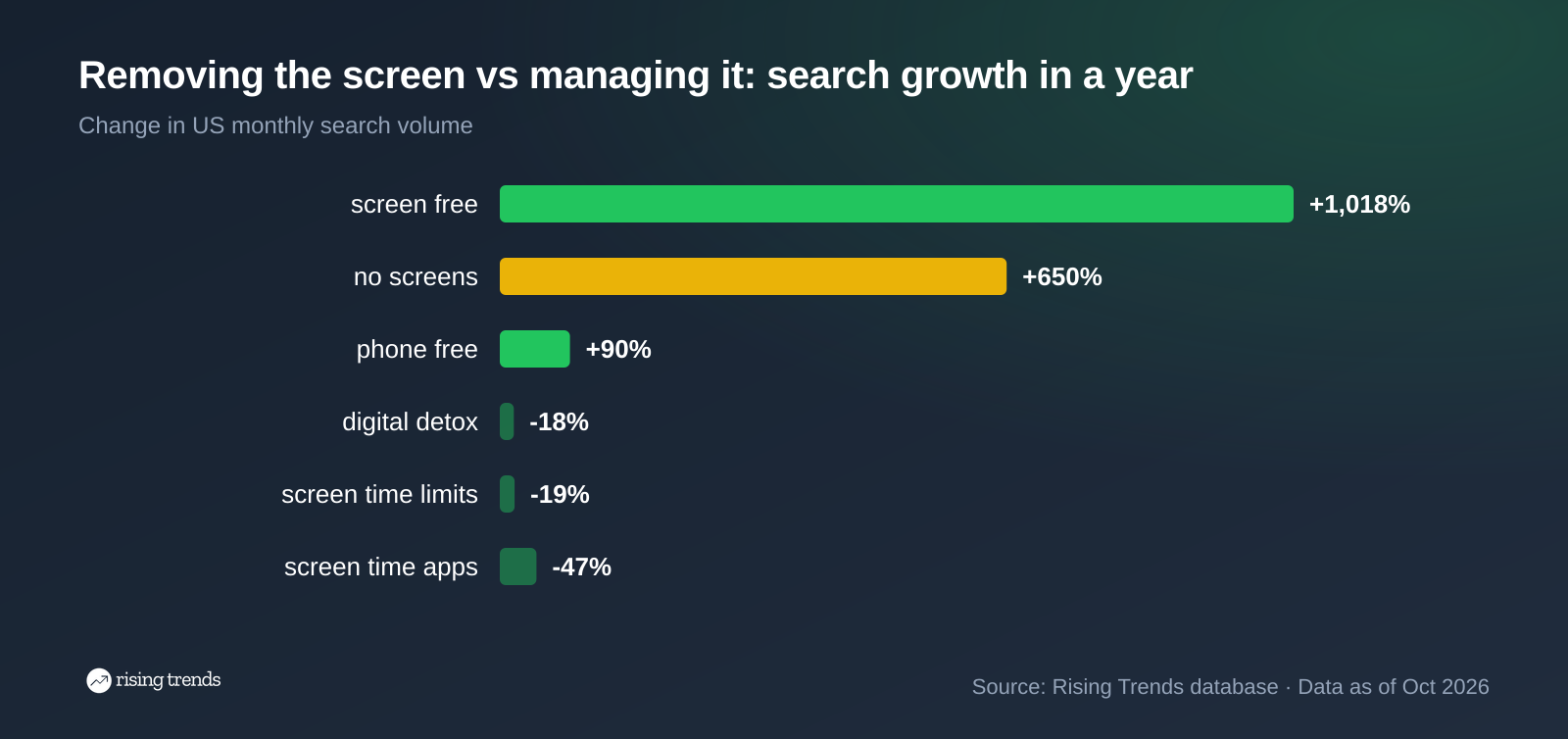
That split is the story of the year. "Screen free" is up 1,018% and "no screens" up 650%, while "screen time apps" is down 47%, "screen time limits" down 19% and "digital detox" down 18%. One level further the pattern repeats: "digital detox app" is down 71%, "digital detox retreats" down 45%. The tools built to meter the screen are losing searches exactly as the words for switching it off compound.
Absolute volumes keep this honest. These are small terms next to the umbrella, where "screen time" itself still carries 60,500 monthly searches as of October 2026 and is up 49% on the year. Within the avoidance cluster, though, the ranking has already shifted.
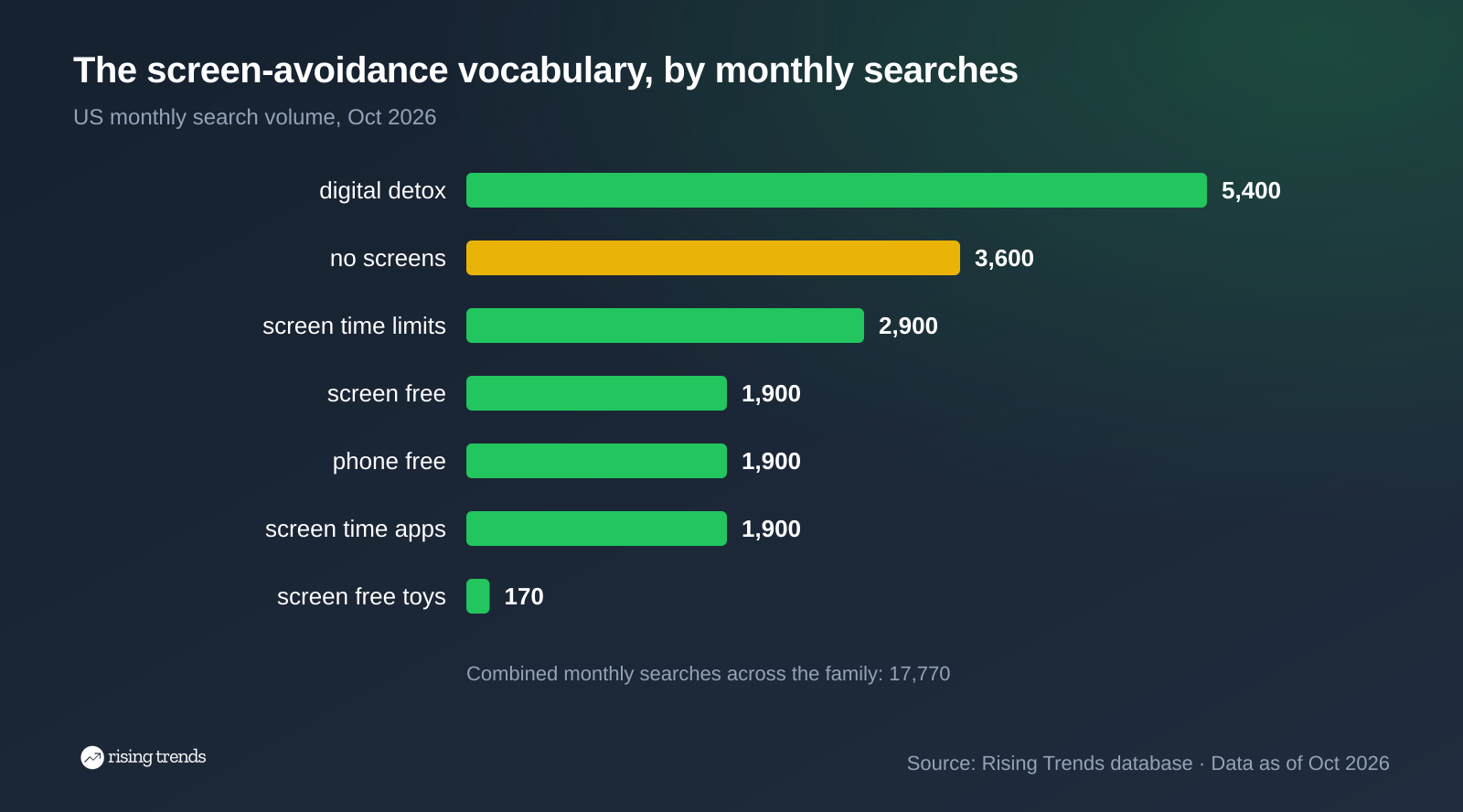
"No screens" at 3,600 has already passed "screen time limits" at 2,900 and "screen time apps" at 1,900, and it is closing on "digital detox" at 5,400 while that term shrinks. On current trajectories it is the biggest term in this cluster within a year. Nothing ranking for "no screens" shows you that comparison, because the pages that rank are blogs, forum threads and Facebook groups rather than anyone holding the search data.
What no screens actually is
"No screens" is not a product and not a campaign slogan, which is part of why it took so long to surface as a search term. It is the position parents take when the negotiation ends: no tablet, no television, no phone, as a household default rather than a daily allowance. Our database files it under Family and Relationships, Education, and Social Issues.
The vocabulary is older than the search spike. Screen-Free Week, the campaign that gave the "screen-free" half of this family its name, began life as TV Turnoff Week in 1994, created by Henry Labalme and Matt Pawa. It became Screen-Free Week in 2010 and sat at the advocacy group Fairplay until the end of 2024. On 1 January 2025 the American Association for the Child's Right to Play, the US affiliate of the International Play Association, took over running it. It still lands in the first week of May, which matters for the curve above.
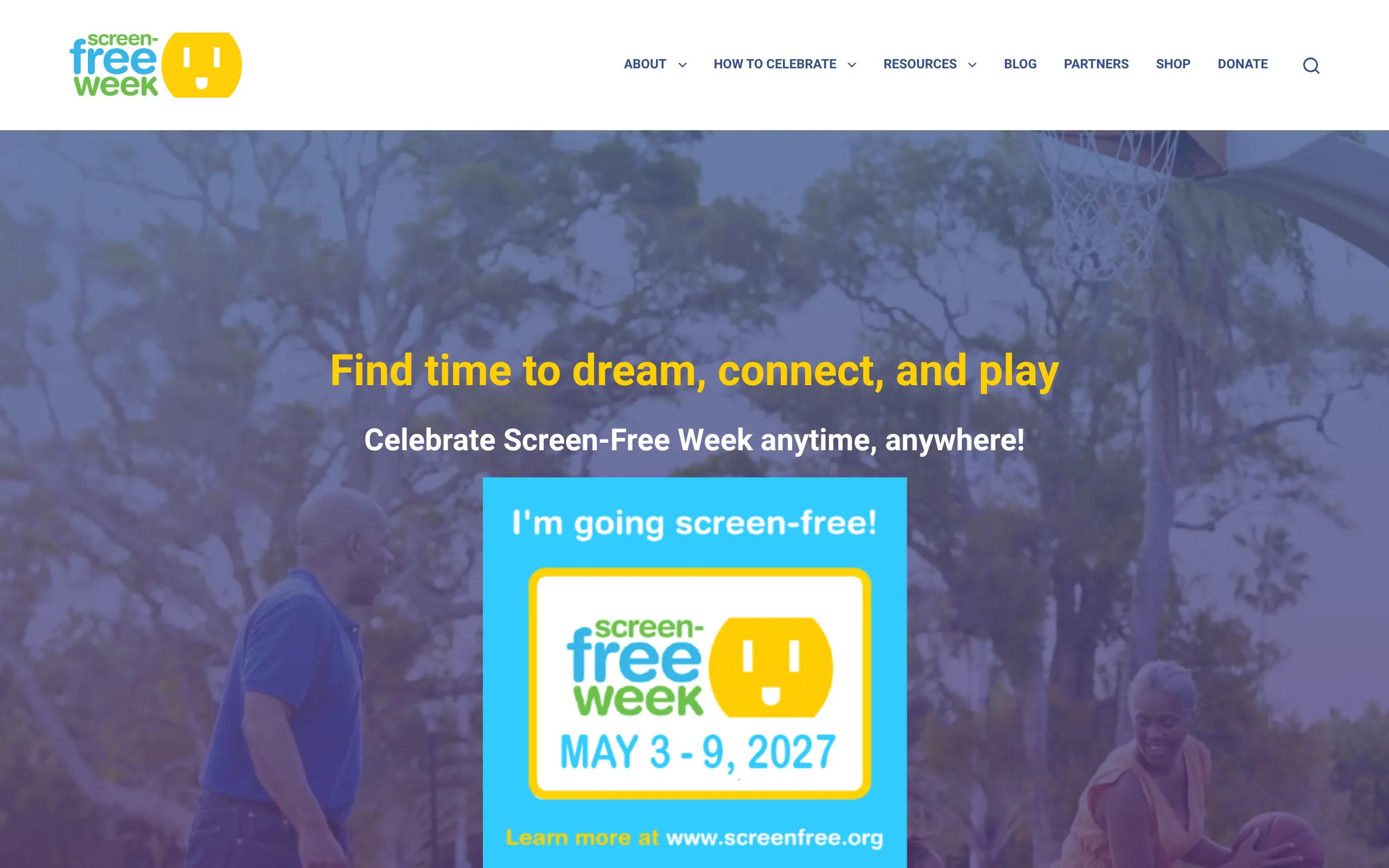
Note what the campaign asks for on that page: a break from entertainment screens, for an hour, a day or a week, celebrated "anytime, anywhere". Thirty-two years in, the organised version is still a week-long invitation. The search behaviour has run past it into something permanent, and that gap is what the newer movements fill.
Why it's trending now
Three dated things sit under the 2026 curve.
The first is the calendar. Our breakout month is May 2026, and Screen-Free Week 2026 ran 4 to 10 May. That is a reliable annual nudge, but alone it makes a spike, not a plateau.
The second is the regulated alternative stalling. Australia's under-16 social media minimum age took effect on 10 December 2025, the hardest version of this experiment anywhere. On 31 July 2026 the eSafety Commissioner published the three-month follow-up of its two-year evaluation, run with Stanford University's Social Media Lab across more than 4,000 children and a parent each. Account ownership among 10 to 15 year olds fell from about 52% to 42%, but use of at least one age-restricted platform fell only from almost 86% to more than 81%, and daily use from around 61% to around 58%. The regulator's explanation is blunt: not VPNs, not borrowed IDs, but that "many children reported that platforms had not yet checked their age". One finding should worry every parent. The share of parents unaware their child was using social media rose from about one in four to one in three.
The third is the research, which arrived pointing somewhere unexpected. On 3 August 2026 JAMA Network Open published a secondary analysis of a Scottish birth cohort covering 3,786 children at age 5, 3,126 at 10 and 2,598 at 15. It found no significant association between screen use and total difficulties at 5 or 10. At 15, more than five hours a day of gaming carried higher odds of above-average difficulties, while more than an hour a day of social media and messaging carried lower odds. The conclusion is the line everyone skipped: screen use "was not consistently associated with poorer outcomes for children", and "guidelines focusing solely on screen time may have limited impact on psychosocial outcomes".
Then on 1 November 2026 JAMA Pediatrics published a Norwegian cohort of 747 children followed from age 5 to 7. Most of the children's own screen measures showed no link to language growth. The one that held was about the adults: each extra hour a day of the primary parent's smartphone time was associated with slower annual growth in the child's receptive vocabulary.
That is a strange combination to sit on top of a boom in abstinence searches, and it explains the tone of what parents now post. The argument has moved from "how many hours" to "whether at all", partly because the hours framing keeps failing to produce a clean answer. This clip from the podcast channel The Lion Glass, posted in early November 2026, had 11,547 views inside a week, and its title is the whole shift in one line.
Not "my child gets 45 minutes". Why I say no to iPads for kids. That is a position, not a policy.
The new behaviour: what people are doing differently
The before-and-after is unusually concrete here, because the people doing it write it up.
Before: a daily allowance, a timer app, a weekend deal, a renegotiation every afternoon. After: the device leaves the house. The most-shared account is a parenting Substack with over 8,000 subscribers, which published one year without screens in April 2025. The trigger was a holiday: after a four-hour flight with the children on iPads, the family landed at a resort, and the first thing the kids asked in the room was whether they could have their iPads back. "It was like their little souls got pulled right into the screens," the author wrote.
The honest part is the admission underneath. "We were using screens as a parenting crutch, a way to switch off when things got tough," they wrote. "But in hindsight, that crutch was actually making everything harder." That is the sentence doing the work here. What gets removed is not the child's entertainment, it is the parent's relief valve, which is also where the Norwegian study pointed.
What these households land on is rarely zero. The same family went months at zero, added a family movie night, and settled at about 30 minutes of television a week. The pattern is a default of no with named exceptions, which is a different model from an allowance of yes with a cap. Australia's evaluation found the same from the other direction: parents put the "right age" for a social media account at around 15.2 years on average.
It also recorded the costs in parents' own words: some reported better family rules and less screen time, others raised "concerns about social isolation or children becoming more secretive about their online behaviour". Both can be true in one cohort, and the people selling the trend rarely mention the second half. If you are weighing this for your own child, the research is mixed enough that a paediatrician is a better guide than a search curve.
Who's building on it
The movement grew an infrastructure fast, and almost none of it is software.
Parent networks are the distribution layer. Smartphone Free Childhood was founded in February 2024 in the UK after a WhatsApp group between two friends, Daisy and Clare, went viral; it now claims over 350,000 parents. Its Parent Pact, a commitment to delay smartphones until 14 and social media until 16, lists over 190,000 families signed, 142,609 children and 13,750 schools covered, which the campaign puts at more than 55% of UK schools. That is collective action solving the only real objection to going screen-free, which is that your child becomes the only one.
Legislatures did the schools. The National Conference of State Legislatures counts 42 states plus Washington DC and Puerto Rico with enacted legislation on cellphone use in schools, as of its July 2026 update. A parent who already accepts a bell-to-bell ban at school has a much shorter argument to make at home.
Audio hardware is the commercial winner. tonies, the SDAX-listed maker of the Toniebox, reported H1 2026 group revenue of EUR 242.9 million, up 38% year on year, with North America its largest and fastest-growing market at EUR 104.3 million, up 48%. It guides to over EUR 760 million for the full year. Its rival sells the same promise in its own product name: the Yoto Player is marketed as a screen-free audio platform for children at $149.99, and "yoto" carries 135,000 monthly searches as of October 2026 in our data.
Adult hardware is the quieter half. "Dumb phone" sits at 60,500 monthly searches as of October 2026, up 22% on the year, and the Light Phone III anchors the premium end at 40,500 searches for the brand. That brand term is down 18% in a year, which suggests the adult version is broadening past one product rather than consolidating around it. We saw the same instinct priced differently in screenless wearables and again in mini e-readers.
What it means for business
The loser is the screen-time product category. Parental control apps, timer subscriptions and usage dashboards were built on the premise that the screen stays and gets metered. "Screen time apps" down 47% and "digital detox app" down 71% in a year is a demand signal, not noise. The pitch that still works is replacement, not measurement: give the hour back with something that fills it.
The winner is anything credibly not a screen. tonies growing 38% while screen-time tooling shrinks is the thesis in two numbers. The qualifying test is strict: a tablet in a wooden case does not pass. What passes tends to have no display at all, which is why the same logic pulled in pocket AI devices.
Retail and marketing lose a channel, school by school. If a parent network covering 55% of UK schools delays phones to 14, a whole tier of advertising reach disappears for several cohorts, by local agreement rather than regulation, which makes it far harder to lobby against. Education buyers are moving the same way, visible across the education trends we track.
Anyone defending screens needs better arguments than the ones in circulation. Two large cohorts this year found weak or absent links between children's own screen hours and outcomes, and the clearest finding pointed at the parents' phones instead. A brand arguing that screens are fine should cite the actual papers, because the other side already does.
Where this is heading
Three calls, each with a term in our database to watch.
"No screens" becomes the category label, replacing "digital detox". Digital detox described a temporary break and is shrinking at 5,400 searches. No screens describes a default and is growing at 3,600. Watch whether it crosses digital detox in the next two quarters. If it does, every product page written around detox language is aimed at a shrinking query.
The adult version is the bigger market. Parents adopt first because they have authority over someone else's device. The grown-up terms move more slowly but from a larger base: "phone free" is up 90% to 1,900 searches, and the event variants move fastest, with "phone free concerts" up 457%. Live music and hospitality are where the first mainstream no-screens format shows up.
Someone will sell abstinence as a service, and it will be contested. The pattern is familiar from AI addiction searches, where clinical-sounding language arrived long before clinical consensus. Expect no-screens schools, camps and childcare at a premium, then the fairness question about who can afford to opt out. The spec-chasing dynamic behind the 720Hz monitor trend runs in reverse here: the status good is the absence of the thing.
The signal we trust most is the one we opened with. A phrase does not hold its all-time peak for three consecutive months because of a news cycle. It holds because the people searching it already changed something at home and are looking for others who did the same. Screen-Free Week spent thirty-two years asking for one week. In 2026 the search data stopped asking for a week.
Want to catch behaviour shifts like this before they get a name? Read our guide on how to identify market trends, or see what is breaking out right now in our trending topics list.
Never miss a trend again
- One trend broken down with the numbers
- Who's making money, and what to build
- A website on the rise
- A breakout app
Join 5,000+ founders