Trends


Two years ago, 20 people a month searched for a 720hz monitor. As of August 2026 it is 1,300, and the term is the fastest growing thing in our entire monitor category. Meanwhile "oled monitor", the mainstream term with 74,000 searches a month, grew 49% over the same year. "oled gaming monitor" grew nothing at all.
That split is the story. A single spec broke out while the category it belongs to stayed flat, which almost never happens with hardware. Below we walk through what actually shipped, why one panel supplier caused the whole thing, what 720Hz buys you in milliseconds (less than you think), and why the resolution it runs at is the rarest one on Steam. None of the pages ranking for this term put the curve next to the category. We can.
Key takeaways:
Let's get into it.
Here is the two-year curve for "720hz monitor", pulled straight from our database.
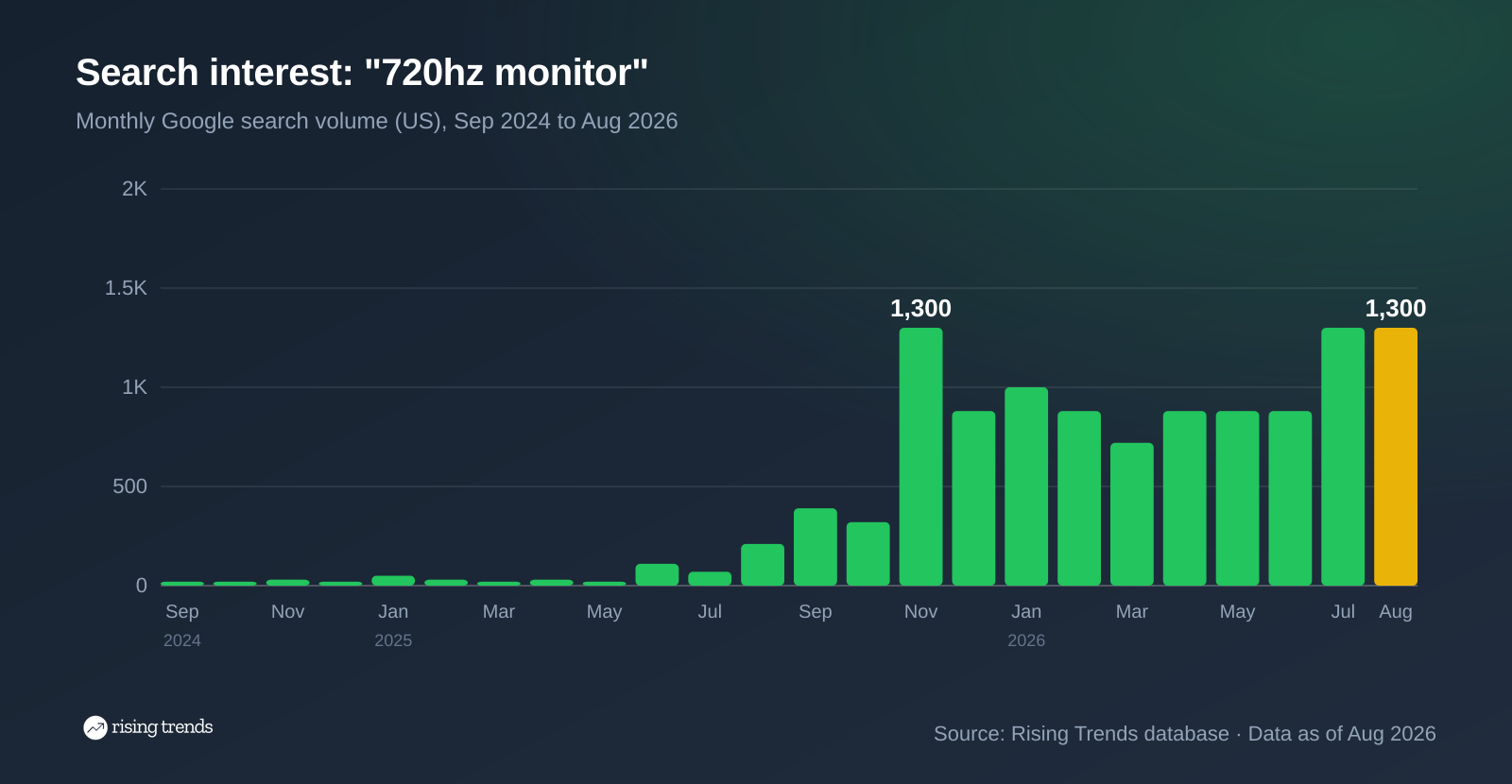
The shape matters more than the height. Nothing happens for a year, the line breaks out in September 2025, peaks at 1,300 in November 2025, sags through the spring, then returns to 1,300 in July and August 2026. That is not a news spike. A news spike decays. This one came back, which means the term found a second source of demand after the announcement cycle ended: people who can now actually buy the thing.
The volume is small in absolute terms, and we want to be honest about that. Here is where it sits next to the rest of the monitor family in our database.
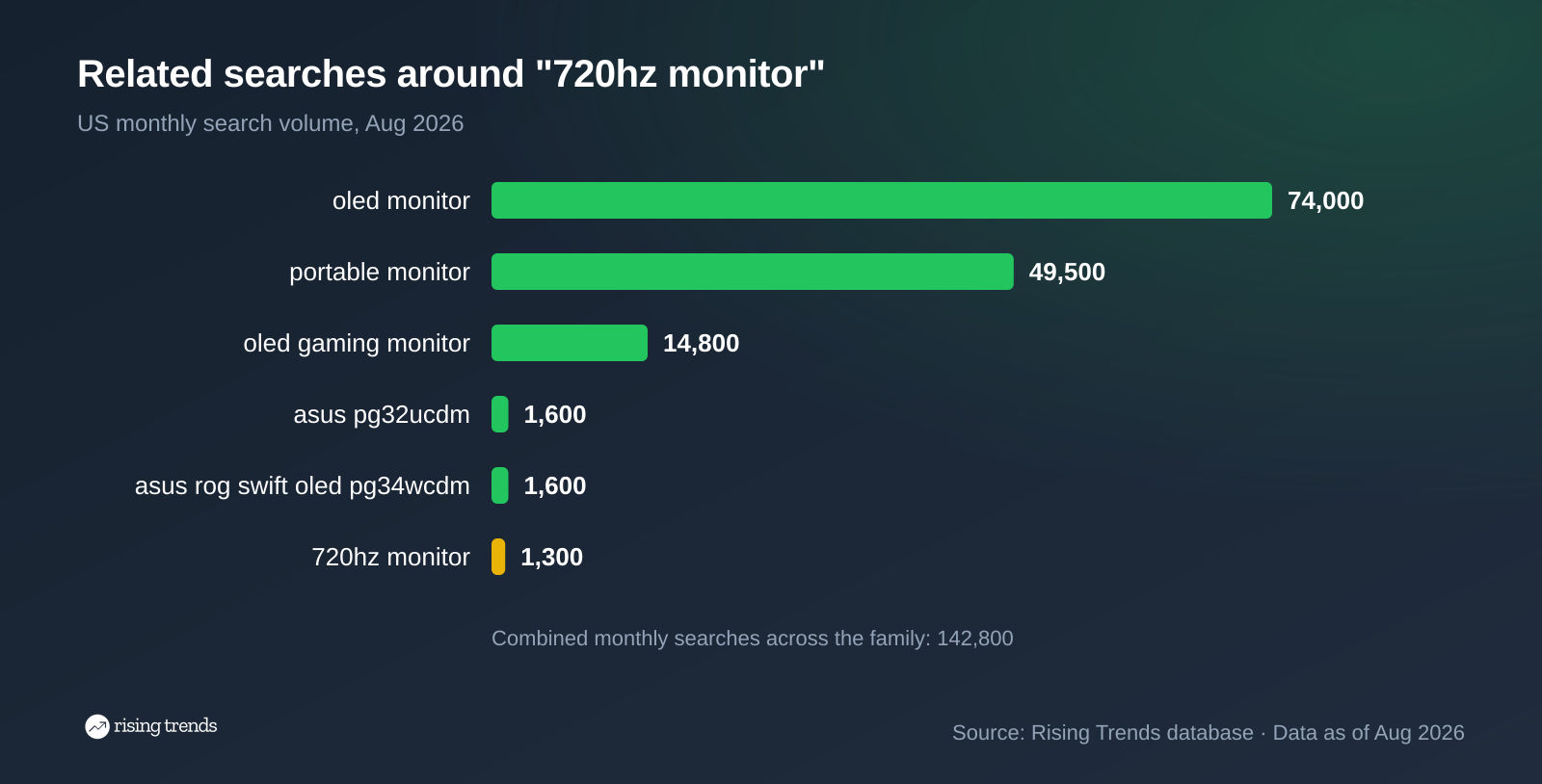
At 1,300 searches a month, "720hz monitor" is roughly one fiftieth of "oled monitor". It is smaller than two individual ASUS model numbers. Anyone telling you 720Hz is the new standard is looking at a bar that barely clears the axis.
Now flip the same six terms to growth and the picture inverts completely.
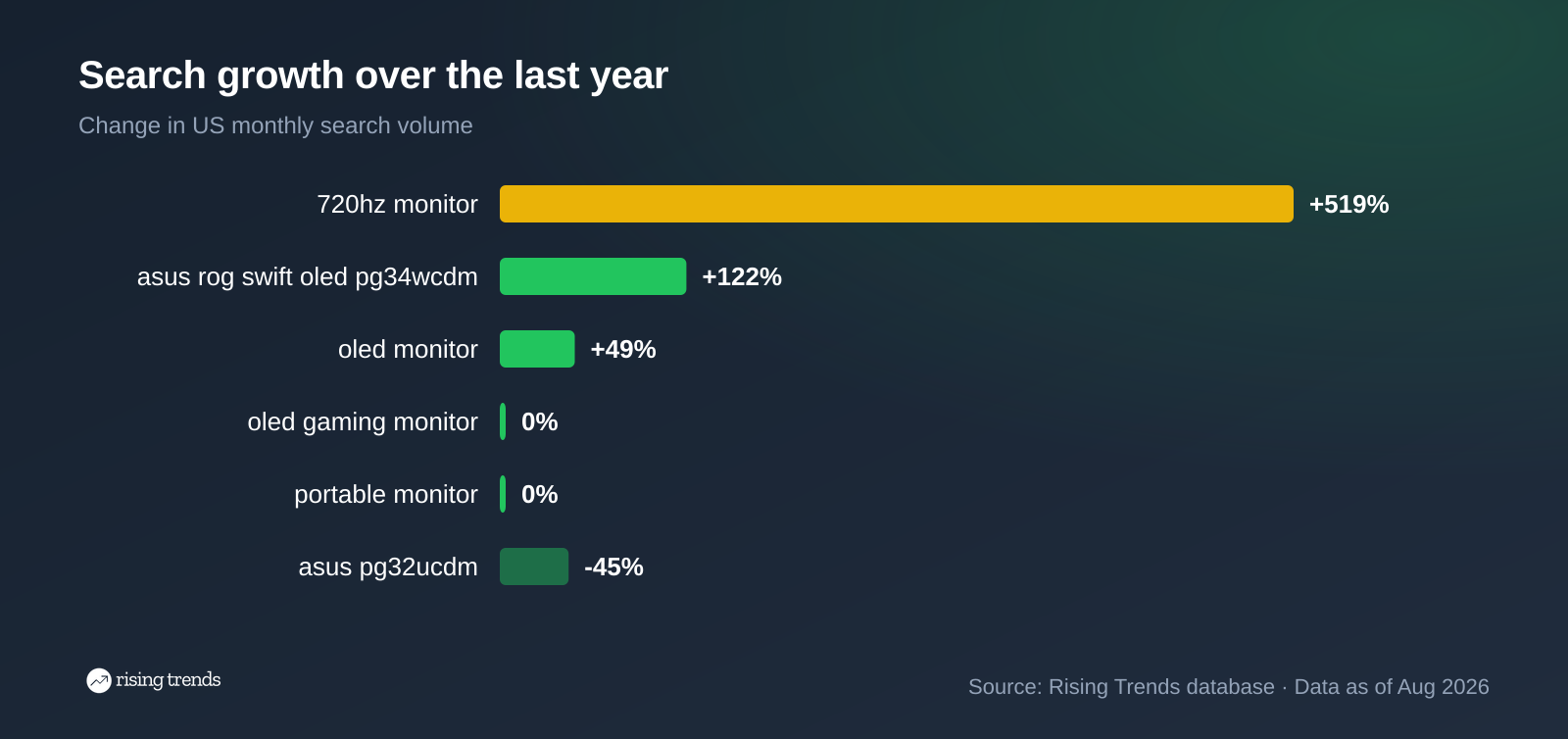
This is the information gain. The halo spec is growing five times faster than the category that contains it, and the category is barely moving. Our live page for "oled gaming monitor" has been flat for a year while the flagship term accelerated. In a healthy category upgrade, the general term rises with the specific one. Here it did not. That tells you 720Hz is pulling curiosity, not replacement demand.
Until 2025, a monitor had one refresh rate. You bought 144Hz or 240Hz or 360Hz and that was the number on the box.
The 720Hz generation changed the shape of the claim. These are dual-mode panels. Native mode is 2560x1440 at 540Hz. Press a hotkey and the panel drops to 1280x720 and runs at 720Hz. Two products in one chassis, and the headline number belongs to the mode almost nobody will leave it in.
That distinction gets flattened in most coverage, including in our own initial brief, which said 1080p. It is not 1080p. RTINGS measured the ASUS ROG Swift OLED PG27AQWP-W and describes the feature precisely as a "720p @ 720Hz Frame Rate Boost". Their verdict on the panel is genuinely positive: "Motion looks sharp at any refresh rate, and it also has low input lag for a responsive feel." Their listed downsides are "Noticeable VRR flicker" and uniformity issues in dark grays.
Here is what the extra refresh actually buys, in frame intervals.
| Refresh rate | Time per frame | Saved vs the step below |
|---|---|---|
| 60Hz | 16.67ms | n/a |
| 120Hz | 8.33ms | 8.33ms |
| 240Hz | 4.17ms | 4.17ms |
| 360Hz | 2.78ms | 1.39ms |
| 480Hz | 2.08ms | 0.70ms |
| 540Hz | 1.85ms | 0.23ms |
| 720Hz | 1.39ms | 0.46ms |
The jump everyone remembers, 60Hz to 120Hz, returned 8.33 milliseconds. The jump being sold now returns 0.46. Human simple reaction time to a visual stimulus sits in the hundreds of milliseconds. The argument for 720Hz is not reaction time, it is motion clarity: at 1.39ms of persistence, a strafing target smears less across your retina. That is a real and visible effect. It is also a much narrower claim than the marketing makes.
The trigger is not a brand. It is a supplier.
On June 27, 2025, LG Display announced mass production of its 27-inch fourth-generation OLED monitor panel. The release lists 1,500 nits peak brightness at 1.5% APL, a 0.03ms response time, and the highest tier of VESA's motion standard, ClearMR 21,000. It also says exceeding 500Hz "had been considered a virtually unbreakable threshold" because of the picture-quality penalty, and that a proprietary algorithm got them past it.
Buried in the same release is the sentence that created this trend. LG Display's Dynamic Frequency and Resolution technology, it says, "enables ultra-high refresh rate modes of up to 720Hz in HD resolution". Hyeon-woo Lee, who runs the company's Large Display Business Unit, framed it as a moat: "With proprietary technologies like fourth-generation OLED and DFR, which competitors cannot replicate, LG Display will enhance its competitiveness in the premium monitor market."
Our curve breaks out in September 2025, two months later, as monitor brands started announcing what they would build with it. The buyers found it on TikTok long before they found it in a store. This clip from @kayjayohpcs, posted on September 23, 2026, is the format the term travels in: a camera pointed at a screen, captioned "720HZ monitors are INSANNEEEE".
Videos like that one are why the search term recovered to its November peak nine months later. You cannot see 720Hz through a phone camera, which is the quiet joke of the whole genre, and it does not matter. The number is the content.
Because the panel is single-sourced, the competitive layer is thin. Everyone is selling the same glass with a different coating and a different bezel.

ASUS took the flagship slot. The ROG Swift OLED PG27AQWP-W product page lists dual-mode QHD at 540Hz or HD at 720Hz, a 0.02ms gray-to-gray response, DisplayPort 2.1a at 80Gbps, and a price of $1,099.00. It claims the Tandem construction gives 15% higher peak brightness, 25% larger color volume and 60% longer panel lifespan than the previous generation. It carries VESA DisplayHDR 500 True Black, one of the tiers defined in VESA's DisplayHDR performance criteria.
LG sells the same panel to itself. The UltraGear 27GX790B-B is the matte sibling, and RTINGS confirms it is the same 540Hz native, 720Hz dual-mode part with a different finish. Acer, AOC and Gigabyte have all announced 27-inch dual-mode models on the same supply.
That leaves the interesting player off the monitor list entirely: whoever renders the frames. This is the same dynamic we described when NVIDIA shipped two different machines under one name, where the hardware headline and the workload that actually runs on it drift apart.
Here is the number that reframes the whole category. In Valve's August 2026 Steam Hardware Survey, 1280x720 is the primary display resolution for 0.22% of respondents. 1920x1080 is 50.52%. 2560x1440 is 21.86%.
So the resolution that unlocks 720Hz is the least used primary resolution on the largest PC gaming census there is. A buyer who spends $1,099 on this monitor spends almost all of their time in the 540Hz mode, and treats 720Hz as a party trick they show people once.
The GPU side is worse. The single most common graphics card on that same survey is the RTX 3060 at 3.76% of users. Sustaining 720 frames per second in a competitive shooter is not a card problem anyway. Run the pixel math: 720p is 921,600 pixels, 1440p is 3,686,400, exactly four times as many. At 540 frames a second in native mode the panel is being fed roughly three times the pixel throughput of the 720Hz mode. The low-resolution mode is the lighter GPU load. What limits you at 700-plus frames a second is the CPU, the game engine's simulation tick and the network, none of which the monitor can fix.
This is the pattern behind a lot of hardware trends we cover. The spec moves because it can be manufactured, not because a workload asked for it. We saw the mirror image in screenless wearables, where buyers actively pushed back against more display, and in mini e-readers, where a deliberately worse screen created a new category.
The spec ceiling is now a marketing asset, not a product. ASUS and LG are not expecting volume at 720Hz. They are buying the top row of every comparison table for a year, then converting that attention into sales of 240Hz and 360Hz OLEDs at a third of the price. Our data says it is working as attention and not as demand: the flagship term is up 519% while the category term is up 49%.
Single-sourcing sets the floor price. One panel maker supplying every badge means nobody can undercut anybody on the part that matters. Expect differentiation to move to coating, stand, warranty and burn-in insurance rather than price, which is exactly where the ASUS and LG pages already compete.
Dual mode is the real product innovation. Switchable resolution and refresh in firmware is a better idea than the headline it is being used to sell. It lets one panel serve a slow single-player game and a competitive shooter properly. That feature will outlive the 720Hz number, and it will show up on cheaper panels first.
The losers are mid-tier LCD gaming monitors. When a 540Hz OLED exists at $1,099, a 360Hz IPS at $600 stops looking like the sensible choice and starts looking like the old choice. That compression is already visible in our data, where "asus pg32ucdm", a well-reviewed previous-generation flagship, is down 45% in a year.
Watch the mainstream term, not the halo term. The signal that 720Hz became real is not "720hz monitor" going from 1,300 to 3,000. It is our "oled gaming monitor" page breaking out of the flat line it has held for a year. Until that happens, this remains a spec people read about rather than buy. Our guide on how to use Google Trends to find profitable niches walks through the same halo-versus-category test on other markets.
Expect 1000Hz talk before 720Hz sells. The panel roadmap moves faster than the install base, and the supplier has already framed refresh rate as its competitive moat. The next threshold announcement will arrive while most buyers are still on 144Hz. Track it on the live 720hz monitor trend page, where a second breakout would show up weeks before the retail listings.
The bottleneck conversation moves to the CPU. Once enough people own dual-mode panels and discover that 720 frames a second is a processor and engine problem, the searches follow. That is where we would expect the next related breakout in the gaming trends we track for 2026, and it is a far bigger market than monitors.
The honest summary is that 720Hz is a genuine engineering achievement attached to a marginal user benefit, sold into an install base that mostly runs 1080p on a three-generation-old graphics card. Our numbers say people are fascinated by it and are not buying it. Both things can stay true for a long time, and the search curve will tell us the day one of them changes.
Want to catch a spec breakout before the retail listings appear? Read our guide on how to identify market trends, follow the live 720hz monitor trend page, or browse what is breaking out right now on the Rising Trends dashboard.
Thousands of Emerging Trends
Thousands of Breakout Apps
Mega Trends
Trend Analysis Tool