
"RAM pricing" was a trade term for most of its life. In October 2025 it ran at 2,900 monthly searches in our database, the sort of number you get from procurement people and nobody else. Two months later it hit 246,000. That is the steepest two-month move we have recorded in consumer electronics, and it happened because an industrial shortage reached a price tag ordinary people hold in their hands.
Every page ranking for this term quotes a price: a spot quote, a retail kit, a contract forecast. None of them shows the demand curve, which is the part that tells you whether this is a panic or a condition. It is a condition. The term has come down a long way from its December spike and still sits at 33,100 monthly searches as of September 2026, roughly 33 times where it was a year earlier. Below is the full shape, the family of terms moving with it, the prices that actually changed, and the one search term that says where buyers think relief is coming from.
Key takeaways:
- "RAM pricing" went from 1,000 monthly searches to a peak of 246,000 in December 2025, and still runs at 33,100 as of September 2026, up 3,210% year over year (Rising Trends data).
- The 16GB Raspberry Pi 5 has gone from $120 at launch to $385 on 2 November 2026, across four separate increases, every one of them blamed on memory.
- Micron shut down Crucial, its 29-year-old consumer brand, in February 2026 to send supply to data centre customers instead.
- Micron's fiscal fourth quarter revenue was $54.23 billion against $11.32 billion a year earlier, at an 86.8% gross margin against 44.7%.
- TrendForce puts PC DRAM contract prices up 13% to 18% quarter on quarter in the fourth quarter of 2026, with notebook shipments already down 15.8% in the third.
- The search data shows where buyers are looking for a way out: "cxmt" is up 1,582% in a year and "cxmt ddr5" up 3,500%, while the plain shopping term "ddr5 ram" is up only 124%.
Let's get into it.
What we're seeing in the Rising Trends data
Start with the family. These terms all live in the same aisle, and they are not moving the same way.
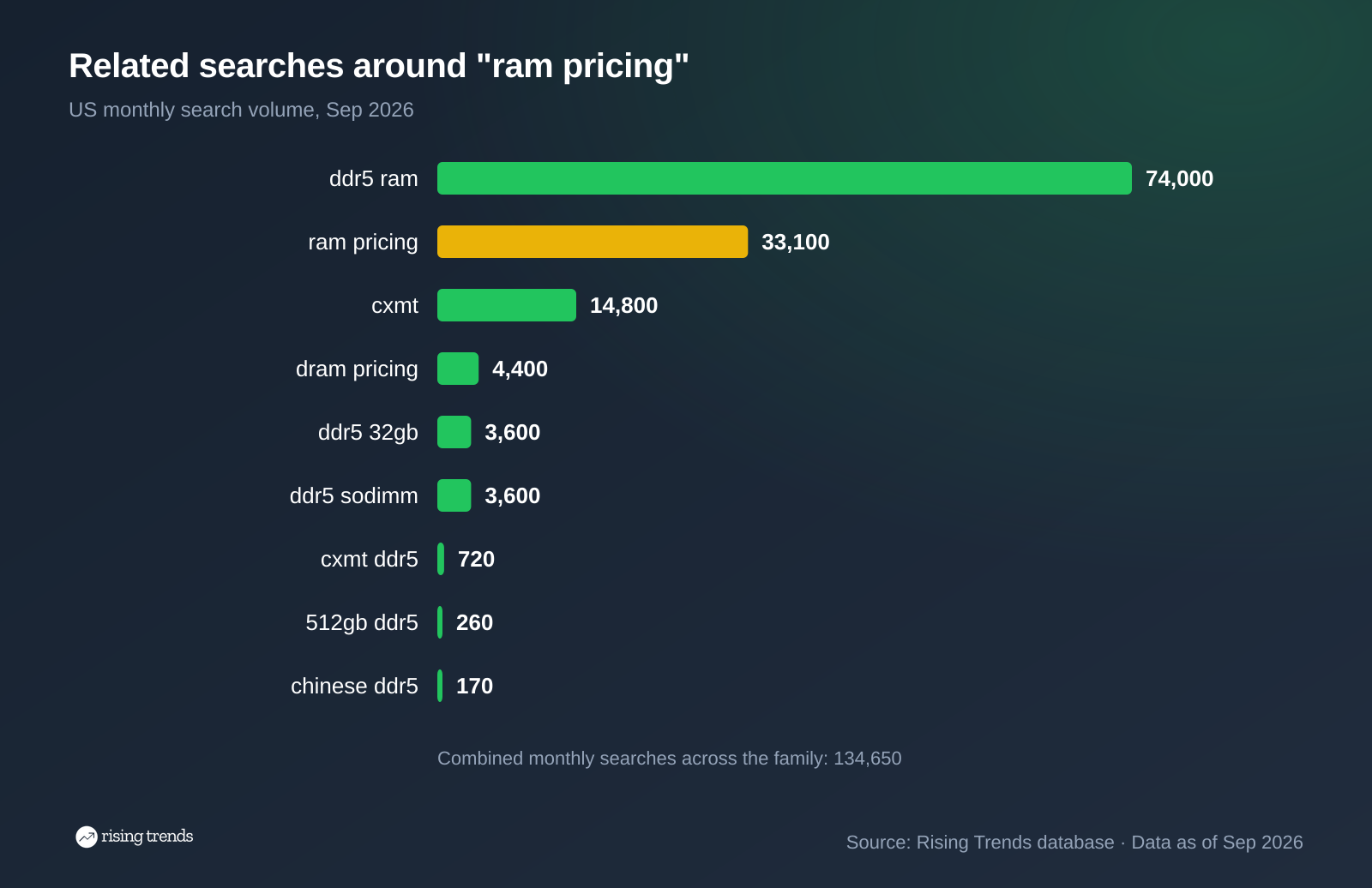
The shopping term still leads on raw volume: "ddr5 ram" takes 74,000 searches a month as of September 2026. But "ram pricing" at 33,100 and "dram pricing" at 4,400 are the two that did not exist as consumer queries two years ago. And sitting third in the list, at 14,800, is a company almost nobody outside the industry could name in 2024.
Rank the same terms by growth and the story inverts.
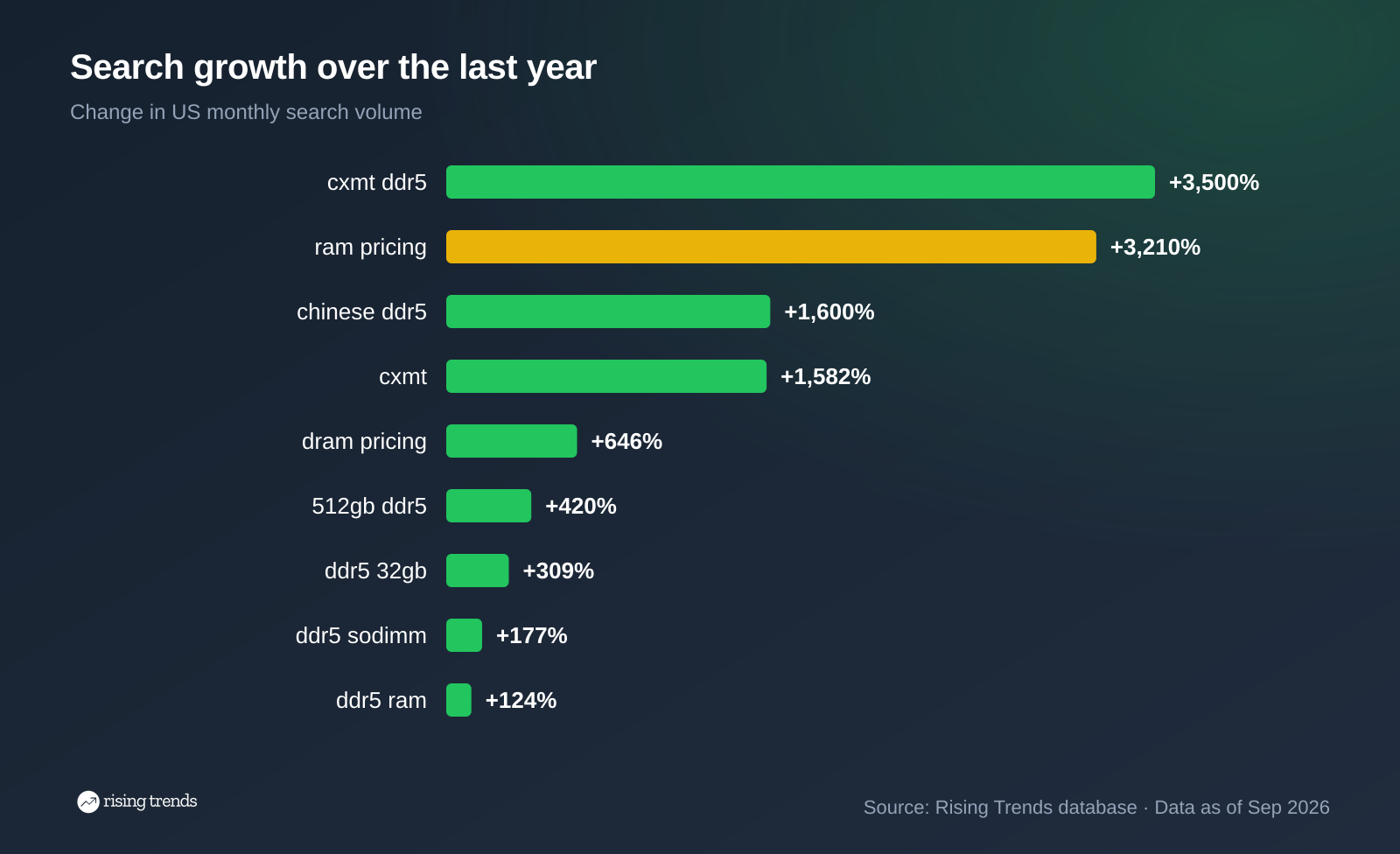
Buying is flat. Pricing is not. "ddr5 ram" grew 124% over the year, which is a healthy category. The price terms grew between 646% and 3,210%. The three fastest movers in the list are all about the same thing: Chinese supply. "cxmt ddr5" is up 3,500%, "chinese ddr5" up 1,600%, and the bare company name "cxmt" up 1,582%. People are not researching which kit to buy. They are researching whether a second source exists.
Now the leader's own curve, which is the part nobody else publishes.
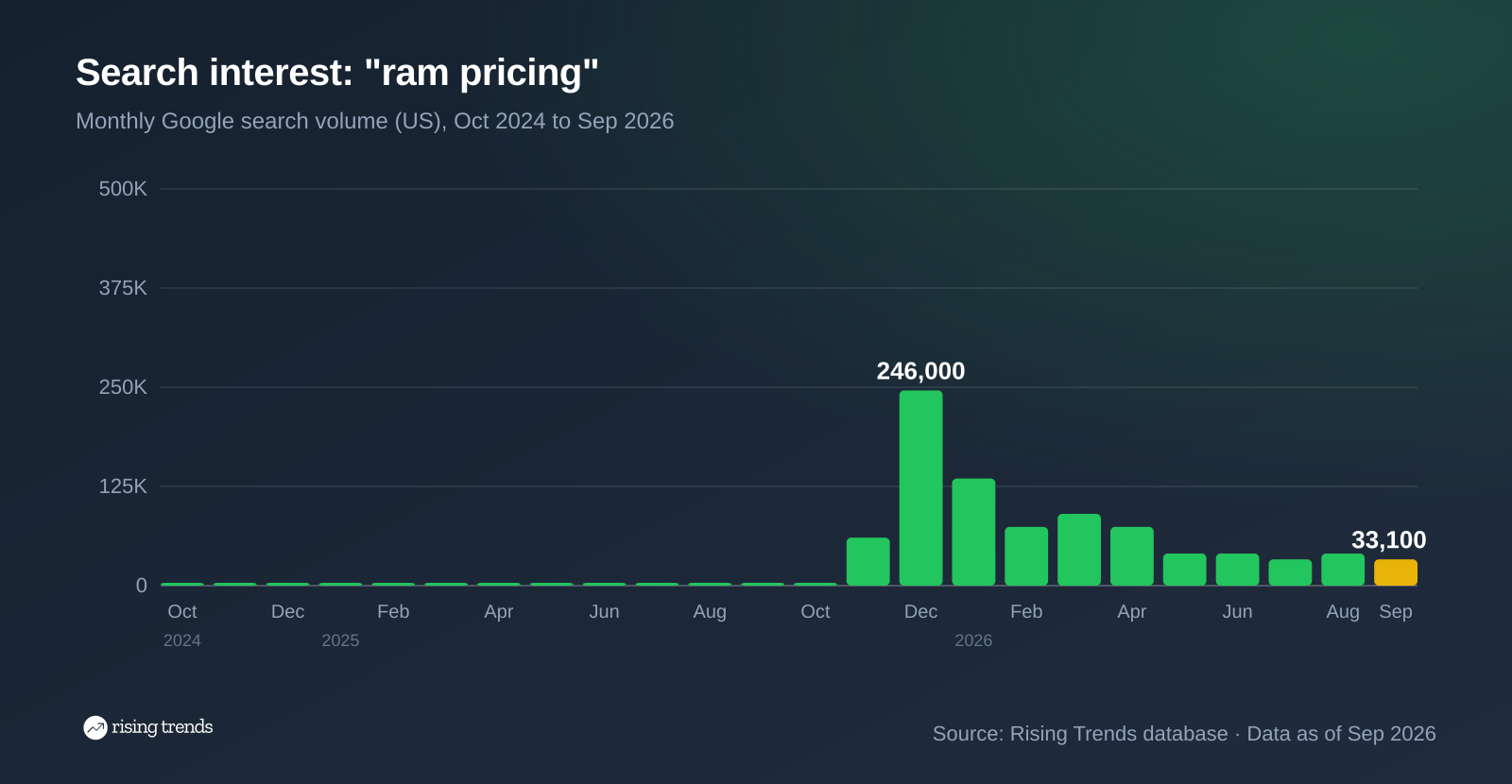
Twenty-two months of nothing, then a wall. The term sat at 880 two years ago and 1,000 a year before the spike. December 2025 took it to 246,000. What matters is what happened next: it did not go back. Three months of data put the average at 24.9 times the level of two years earlier, and the term has not dropped below 33,100 in any month since July 2026. The 3-month change reads -18% and the 6-month -63%, which is a comedown from a spike, not a return to normal. A term that spends a year at 33x its old baseline has stopped being news and started being a market condition.
What changed for the person buying
Here is the clearest version of the squeeze, because it is one product, one company, and a public price list.
Raspberry Pi launched the 16GB Raspberry Pi 5 at $120 in January 2025. Four price rises later, it costs $385.
| Date | 16GB Raspberry Pi 5 | What the company said |
|---|---|---|
| Jan 2025 | $120 | Launch price |
| 1 Dec 2025 | $145 | "Unprecedented rise in the cost of LPDDR4 memory" |
| 2 Feb 2026 | $205 | "The cost of some parts has more than doubled over the last quarter" |
| 1 Apr 2026 | $305 | "A seven-fold increase over the last year in the price of the LPDDR4 DRAM" |
| 2 Nov 2026 | $385 | "A lack of alternative supply for 16GB DRAM" |
That is 3.2 times the launch price in under two years, on a board whose entire reason for existing is being cheap. The April 2026 announcement is the one that tells you the scale: CEO Eben Upton put the rise in LPDDR4 at sevenfold in twelve months, and the company's response was to introduce a 3GB Raspberry Pi 4 so buyers could step down a rung rather than pay. The December 2025 post did the same thing at the bottom of the range, launching a 1GB Pi 5 at $45 on the day it raised everything else.
Memory used to be the spec you skipped past. It is now the line item that decides the product.
Why now
The cause is not mysterious, and it is not a shortage in the usual sense. Fabs did not break. They were re-pointed.
Memory makers moved advanced-process capacity to high-bandwidth memory and server DRAM, because that is where AI buyers are paying. TrendForce's fourth-quarter price outlook describes the mechanism in one line: suppliers "continue to prioritize advanced-process capacity for high-performance server products," leaving the overall market undersupplied and conventional DRAM contract prices rising another 10% to 15% quarter on quarter. On the consumer side the same note says major suppliers "remain committed to production cuts," leaving that segment leaning on Taiwanese makers. This is the consumer end of the same capex wave we tracked in our AI industry trends breakdown, where memory sits alongside power as the binding constraint.
Then there is the withdrawal that made it personal. On 3 December 2025, Micron announced it was exiting the Crucial consumer business worldwide, with shipments through retail ending in February 2026. Sumit Sadana, the company's chief business officer, was direct about why: "The AI-driven growth in the data center has led to a surge in demand for memory and storage. Micron has made the difficult decision to exit the Crucial consumer business in order to improve supply and support for our larger, strategic customers in faster-growing segments." A brand that had sold memory to ordinary people for 29 years was closed because ordinary people were the least profitable customers left.
The effect lands in places you would not predict. The clip below, posted on 15 October 2026, is about hobbyists giving up on running language models at home because the RAM to hold them now costs more than the GPU did.
That is the loop closing. AI demand raised the price of memory, and the price of memory priced people out of running AI locally. The same squeeze is why a desktop AI box like the NVIDIA DGX Spark and its 128GB of unified memory reads as a bargain this year in a way it would not have in 2024.
The players
One side of this market is having the best year in its history. The other is writing apology posts.
The suppliers. Micron's fiscal 2026 results are the cleanest measure of where the money went. Fourth-quarter revenue was $54.23 billion against $11.32 billion in the same quarter a year earlier. GAAP gross margin was 86.8%, against 44.7% a year before. Full-year revenue was $133.19 billion against $37.38 billion. Those are not cyclical numbers. That is a supplier with pricing power and no obligation to use it kindly.
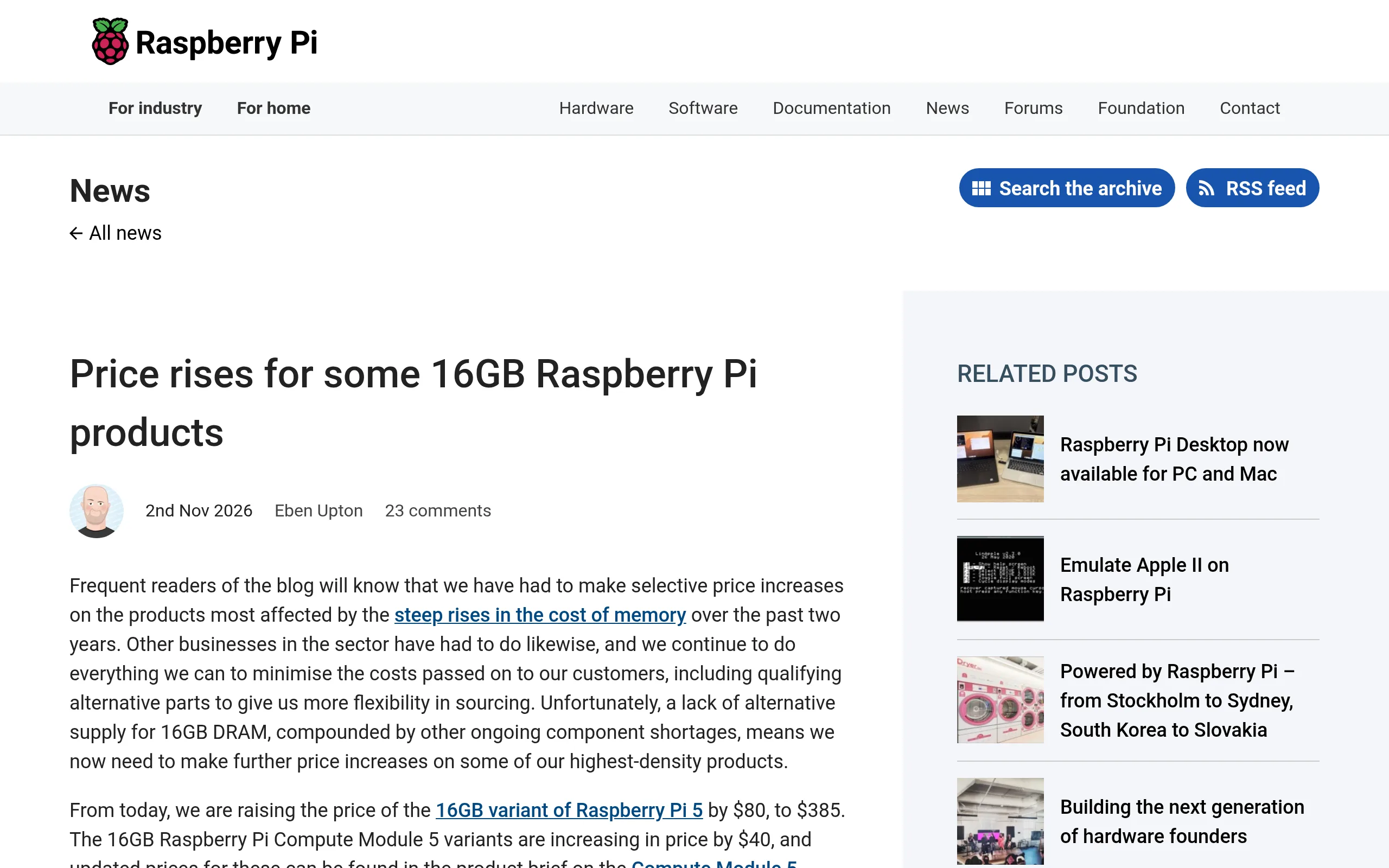
The buyers of memory who sell something else. Raspberry Pi is the visible case because it publishes its prices and explains them. Its November post is unusually blunt: the company says it has been "qualifying alternative parts to give us more flexibility in sourcing," and that it raised the 16GB Pi 5 anyway because no alternative 16GB supply exists. It held the price of the Pi 500+, which also has 16GB, and warned that resellers were inflating prices and shifting parts that "aren't what they seem."
The challenger everyone is searching for. CXMT is the Chinese DRAM maker whose name went from obscure to 14,800 monthly searches as of September 2026, up 1,582% in a year. We are not going to quote a market-share estimate for it, because the credible ones sit behind paywalls and the public ones disagree by a factor of two. What we can show is demand for the answer: "cxmt ddr5" up 3,500% and "chinese ddr5" up 1,600% over the same year. Western buyers are actively shopping a supplier most of them had never heard of, which is what a genuine supply crisis looks like from the demand side.
What buyers started doing instead
Three behaviours show up, and all three are the opposite of what the industry wants.
People buy less memory on purpose. In the comments under Raspberry Pi's November post, a user called rclark described checking the memory use on every Pi he runs: "all are way under 1GB. So even if I needed an RPI-5, it will be a RPI-5 1GB version." Raspberry Pi is encouraging exactly this, pointing customers at memory-optimisation guides and lower-density variants. A company telling you to buy the cheaper model is a company that cannot get the expensive one.
People stockpile. Another commenter bought a Pi 500+ at $199 to lock the price in and saw the increase announced two days later. The phrase in the thread is "#RAMaggedon," and the mood in it is the mood of a market where waiting is punished.
Manufacturers quietly downgrade. This is the one buyers do not see. TrendForce reported on 6 November 2026 that reballed memory, recovered chips re-prepared for reuse, is now in an estimated 3% to 4% of smartphones, heading for 7% to 9% next year, concentrated in budget handsets. The firm is explicit about the trade-off: inconsistent quality, shorter device lifespans, higher warranty costs. Nobody is putting that on the box. If you want a parallel, the same pressure is reshaping what gets into mid-range displays, which is part of why the 720Hz monitor trend is a story about panel supply as much as refresh rates.
What it means for business
The memory squeeze has quietly rewritten the economics of every device with a chip in it, and the second-order effects are bigger than the sticker prices.
Hardware margins moved upstream. Micron booked an 86.8% gross margin last quarter. Device makers did not. Every dollar of that margin came out of a bill of materials somewhere, which means PC, phone and single-board computer vendors are absorbing a cost increase they cannot price through in full. That is a transfer from assemblers to component makers, and it keeps going as long as AI buyers outbid everyone.
Demand is cracking at the top of the range. TrendForce's 11 November note is the most important number in this article for anyone selling hardware: notebook shipments fell 15.8% quarter on quarter in the third quarter of 2026, with another single-digit decline possible in the fourth, and finished-goods inventories are piling up in North American distribution. PC DRAM contract prices are still set to rise 13% to 18% in the fourth quarter. Rising input costs against falling unit sales is the squeeze that ends product lines.
2027 hardware will be worse specified. The same note says OEMs are rethinking 2027 line-ups around "lower-specification memory chips and CPUs with fewer cores" and a bigger share of private-label models. Expect the mainstream laptop to stop gaining memory, and expect 8GB to stay alive years past its sell-by date. For anyone tracking component flows, this now belongs in the same bucket as tariffs and freight: a cost shock that re-plans a product roadmap, which is why it sits in our logistics and supply chain trends as much as in tech and gadget trends.
Repair and resale win. When a new 16GB board costs $385, a used one at $200 is a market. Our data already shows the repair side of PC parts outgrowing the buying side, and a second-hand memory market is the natural consequence of a two-year price step.
Where this is heading
Three calls, each with a term in our database that will confirm or kill it.
Relief comes from China or it does not come. The clearest signal in our data is not a price, it is a name. Watch "cxmt" above 14,800 monthly searches and "chinese ddr5" holding its 1,600% growth. If those keep climbing while "ram pricing" falls, a second source arrived. If "cxmt" fades and "ram pricing" holds, it did not.
The laptop is the next price story. "ddr5 sodimm," the laptop memory format, is up 177% year over year at 3,600 searches as of September 2026, well behind the desktop terms. Notebook makers have been eating the cost rather than passing it on. With shipments down 15.8% in a quarter, that stops. Watch "ddr5 sodimm" accelerate.
The panic term settles instead of dying. "RAM pricing" is down 63% over six months and has stayed at or above 33,100 since July 2026. Our call is that it floors somewhere in the tens of thousands rather than returning to its old 1,000 a month, because the thing it describes is now permanent enough to have a search habit attached to it. The number to watch is whether it stays above the 24.9x two-year multiple into 2027.
The uncomfortable read on all of this is that nothing broke. Every company in the chain did the rational thing: sell the scarce part to the buyer who pays most. The result is that a $120 computer for schoolchildren costs $385, and the search curve we opened with is just the sound of several million people finding that out one at a time.
Want to catch supply shocks while they are still a search term? Read our guide on how to identify market trends, or see what is breaking out right now in our trending topics list.
Never miss a trend again
- One trend broken down with the numbers
- Who's making money, and what to build
- A website on the rise
- A breakout app
Join 5,000+ founders