
Trends


Two years ago, 210 people a month searched Google for the anthros office chair. As of July 2026 it is 8,100, and in March it touched 9,900. That is a rounding error next to Herman Miller. It is also the only office chair term in our database that went up at all this year.
Here is the part nobody ranking for this chair mentions. The category it sits in is collapsing. "Ergonomic office chair" is down 63% in a year. "Herman miller aeron desk chair" is down 63%. "Adjustable office chair" is down 84%. Demand for office seating is draining out of the market, and one $2,000 chair built by wheelchair seating clinicians in Grand Rapids, Michigan is absorbing what is left. We have the curve, and we have the month it broke, and neither one lands where you would expect.
Key takeaways:
Let's get into it.
Here is the monthly search volume for "anthros office chair" over the last two years, straight from our database. For eighteen of those twenty four months the line is basically flat against the floor.
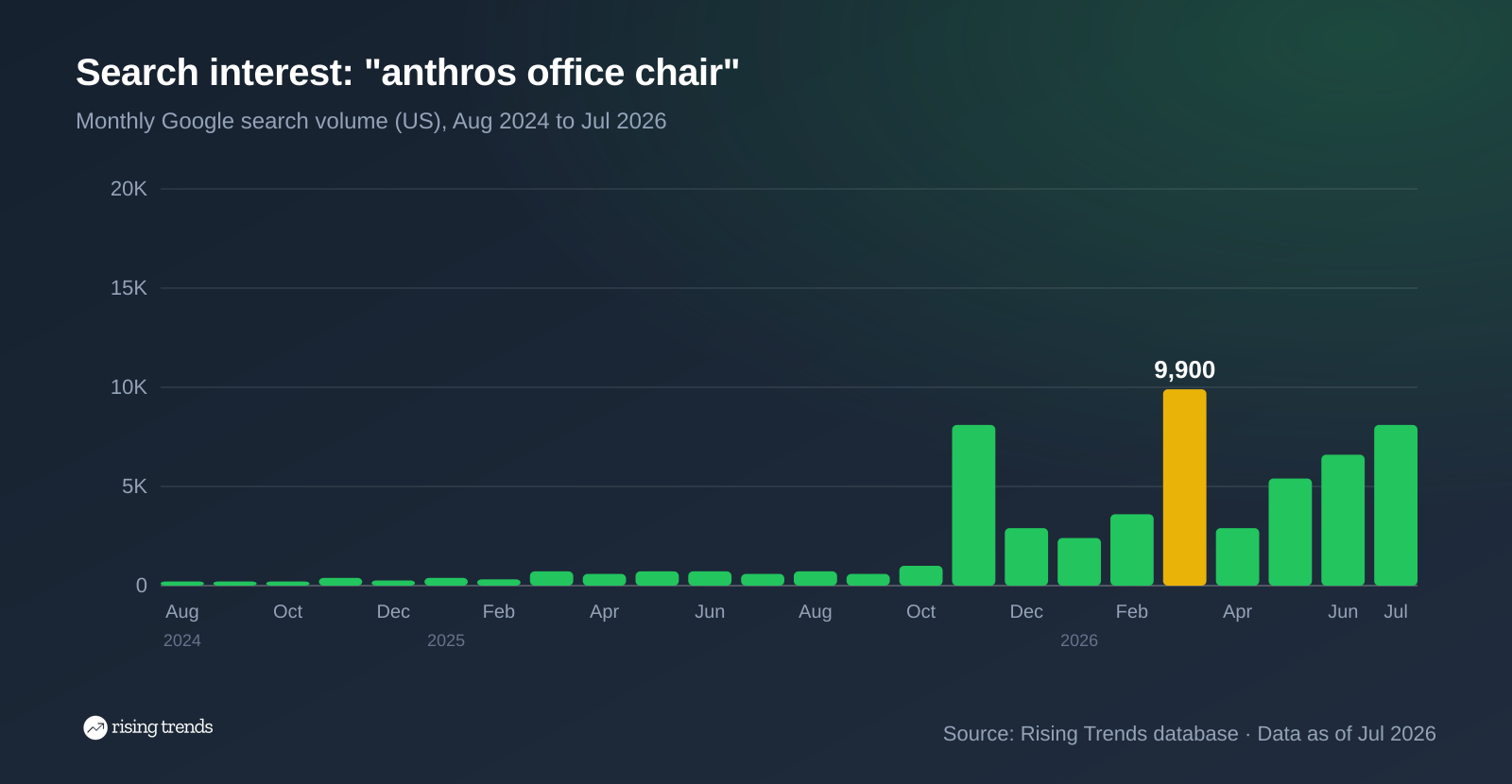
The shape matters more than the height. Two years ago the term did 210 searches a month. A year ago, July 2025, it did 590. Then October 2025 closed at four figures and November opened at 8,100, an eight-fold jump in a single month. March 2026 set the peak at 9,900, and the trailing three months average 6,700, which is 29.6x where this term sat two years ago. Nothing about that is a spike that decays. Volume in July 2026 is back at 8,100, level with the breakout month.
Now put it against everything else people search when they want a chair.
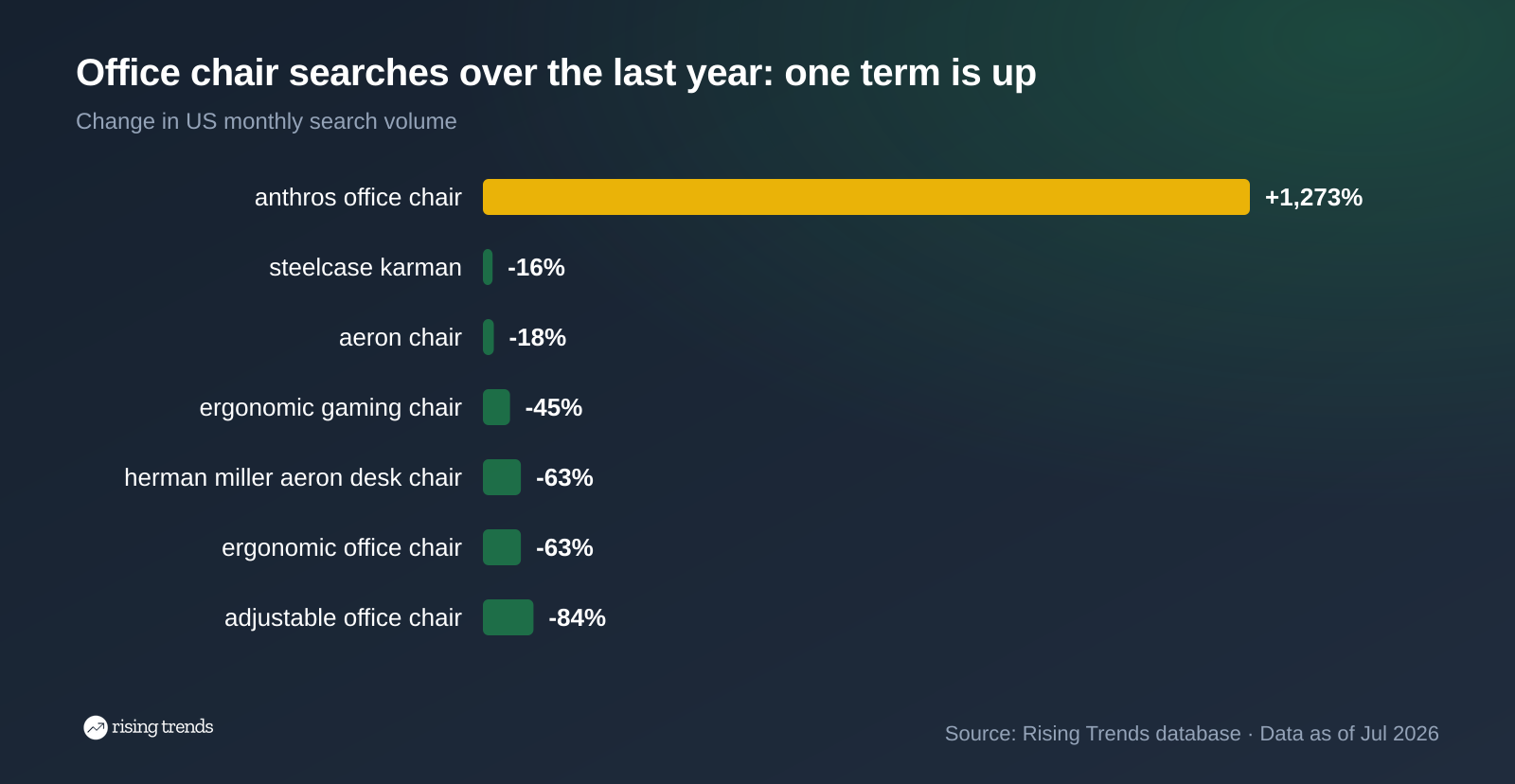
That is the whole story in one chart. Ergonomic office chair, the category head term, is down 63% to 110,000 a month. Aeron chair is down 18% at 49,500. Steelcase Karman, the lightweight mesh answer to the same problem, is down 16% and sitting at 1,600. The return-to-office furniture boom is over and the searches went with it. Anthros is up 1,273% into that.
The company was not founded by furniture people. Per its own about page, Anthros came out of the wheelchair seating industry: clinicians, seating technicians and product designers who kept hearing "I wish my office chair felt like this" at trade shows. The CEO, Steven DuFresne, ran product development at a wheelchair seating manufacturer. The chair is built in Grand Rapids, Michigan.
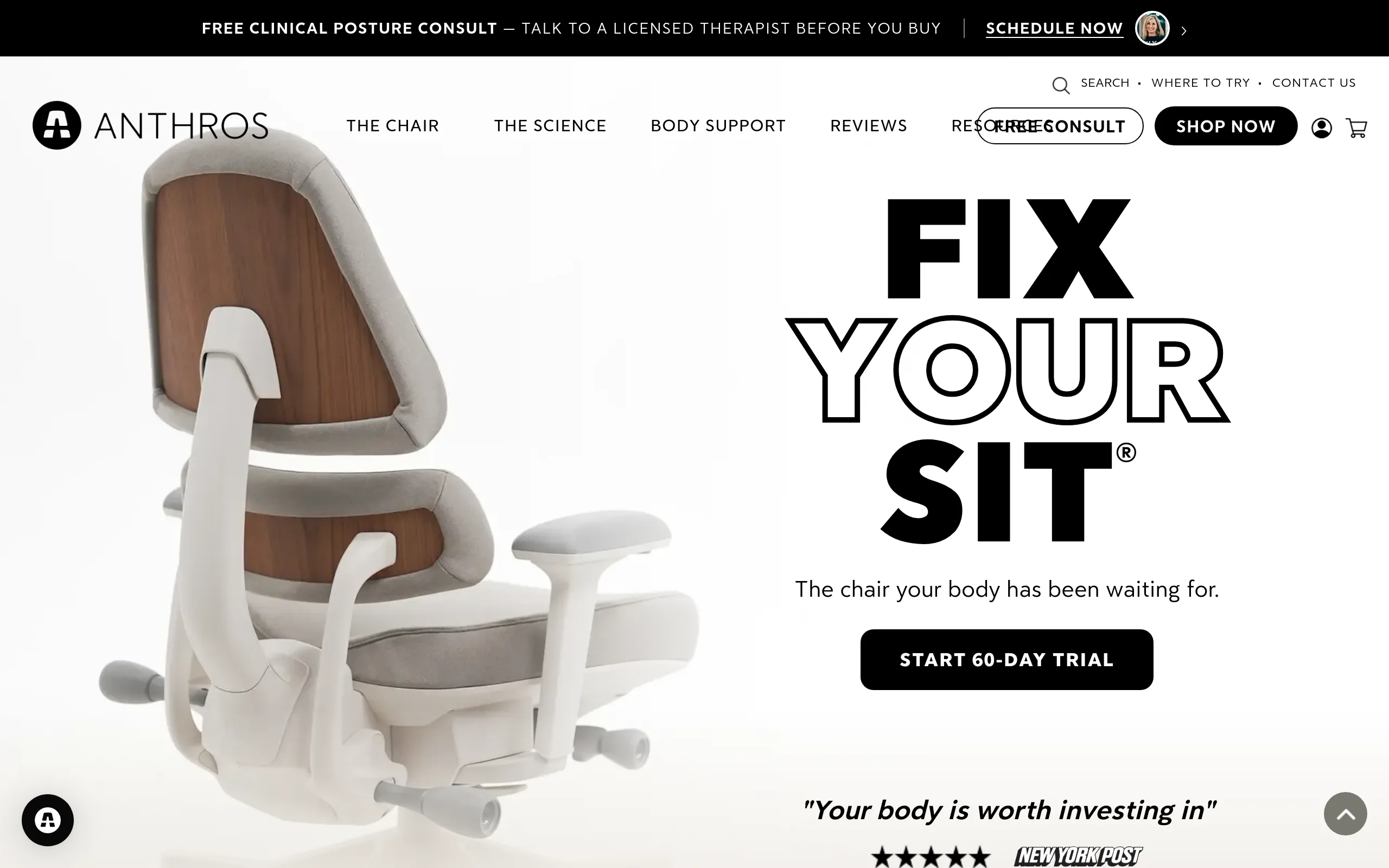
The design argument is one idea. Conventional chairs push a lumbar pad into your lower back; Anthros supports the pelvis instead and lets an independent upper section handle the thoracic spine. The company's product site calls it the Precision Posture System and claims it reduces disc pressure by up to 40%. Pricing runs from $1,949 for the fixed Anthros Black configuration up to $2,576 once you add wood veneers, leather and 4D arms. Every order comes with a 60-day trial and a video consultation with a licensed occupational or physical therapist, before you buy.
The V2 revision is a cushion and cover update rather than a new chair: a waterfall front edge on the seat, reworked low-back geometry and new fabrics. Notably, V1 owners can buy replacement seat and back cushions instead of a new chair, which is an unusual thing for a company to offer when it wants an upgrade cycle.
This is where the data gets awkward for the product story. Wired published its V2 review on June 26, 2025, an 8 out of 10, calling it possibly the most supportive office chair the reviewer had sat on. That is the launch moment. Our volume the following month was 590.
The breakout is November 2025. What happened in November 2025 was a sale. Anthros ran its biggest discount window of the year on a dedicated Black Friday and Cyber Week page at $250 off, and creators ran it with them. BTOD's chair channel published a video titled "Anthros V2, What They Fixed Since My First Review and the Black Friday Offer" on November 28, 2025. That is the pattern across the month: not reviews of a new product, but offer-led videos pointing at a checkout.
The engine did not switch off. Anthros runs a public affiliate program, branded Team Anthros, whose pitch to creators is "help us change that and build real income while you do it." Applications route through a dedicated creators portal. Wired's reviewer noticed before he ever sat in the chair: the V2 "has been on my radar for several months, thanks to endless Instagram marketing reels, but honestly, those just made me even more skeptical."
Here is one of those reels, posted on August 19, 2026 by the fitness channel Live Lean TV, covering the first few days in the chair. Note the $200 discount code in the caption.
The creator is honest about the drawbacks, which is exactly why it works. The reel flags no headrest and slippery armrests, and it still carries a code. That combination of a health claim, a personal before-and-after and a discount is the same machinery that drove the body optimization wave we covered in the maxxing trend, pointed at furniture.
Anthros publishes its own side-by-side against Herman Miller. These are the company's figures, not ours, and the pressure numbers come from bench testing rather than from people sitting. Read them as a claim, then read the price row twice.
| Spec | Anthros | HM Embody | HM Aeron |
|---|---|---|---|
| Back support | Two-part, pelvis plus upper back | Single plane | Single plane with sacral lumbar |
| Peak cushion pressure (bench test) | 88.5 mmHg | 168 mmHg | 184 mmHg |
| Return period | 60 days | 30 days, plus $99 | 30 days |
| Warranty | 12 years | 12 years | 12 years |
| List price | $1,948 | $2,045 | $1,830 |
The price row is the one that should stop you. The Aeron, the chair that defined the premium office category for a generation, now lists below the newcomer. Anthros is not undercutting anybody. It is charging more than the incumbent and winning demand anyway, which only works when the buyer believes a specific claim about their own body.
The independent evidence is genuinely there, and it is genuinely narrow. Anthros' university testing page documents two studies. On April 5, 2025 the University of Pittsburgh's School of Health and Rehabilitation Sciences ran ISO 16840-6 pressure mapping across 11 leading office and gaming chair cushions with a rigid load indenter, and Anthros posted the lowest peak pressure index. In August 2025 Jack Callaghan's spine biomechanics lab at the University of Waterloo put 16 participants through an hour of computer work in the Anthros and in a Herman Miller Gaming Embody, and measured 36 mmHg lower mean peak seat pressure plus reduced posterior pelvic tilt. The Waterloo report's own wording: the lower support "was effective in restricting posterior rotation of the pelvis, facilitating a posture closer to neutral."
To its credit, Anthros publishes the caveat next to the result. The Pittsburgh method, its page says, "doesn't reflect how real people move, shift, or react to sitting." Sixteen people for one hour is a study, not a clinical outcome.
The reviewers who bought the argument still docked it for the same three things. Wired's verdict is "pricier than a Herman Miller" and "backrest doesn't dissipate body heat too well." BTOD's Greg Knighton, after 30 days in the V2, landed in the same place: "The arm pads are still too rounded and feel wider than they should, and the padded backrest holds onto heat." PCMag gave it 4.0 out of 5 in a review updated September 27, 2025, with a bottom line of "though pricey, the sturdy and adjustable Anthros Chair can potentially reduce your back pain by encouraging you to sit with better posture," and a listed con of an adjustment period the chair requires before it feels right.
That last one is the real friction. Multiple reviewers describe day one as uncomfortable, because the chair is pushing a posture change rather than accommodating your current one. Wired's reviewer felt sore at first and put it down to "my posture correcting itself." A $2,000 chair that feels worse on day one is a returns problem, which is presumably why the 60-day window is twice the industry standard and the free therapist consult exists at all.
Scale first, so the growth number stays honest.
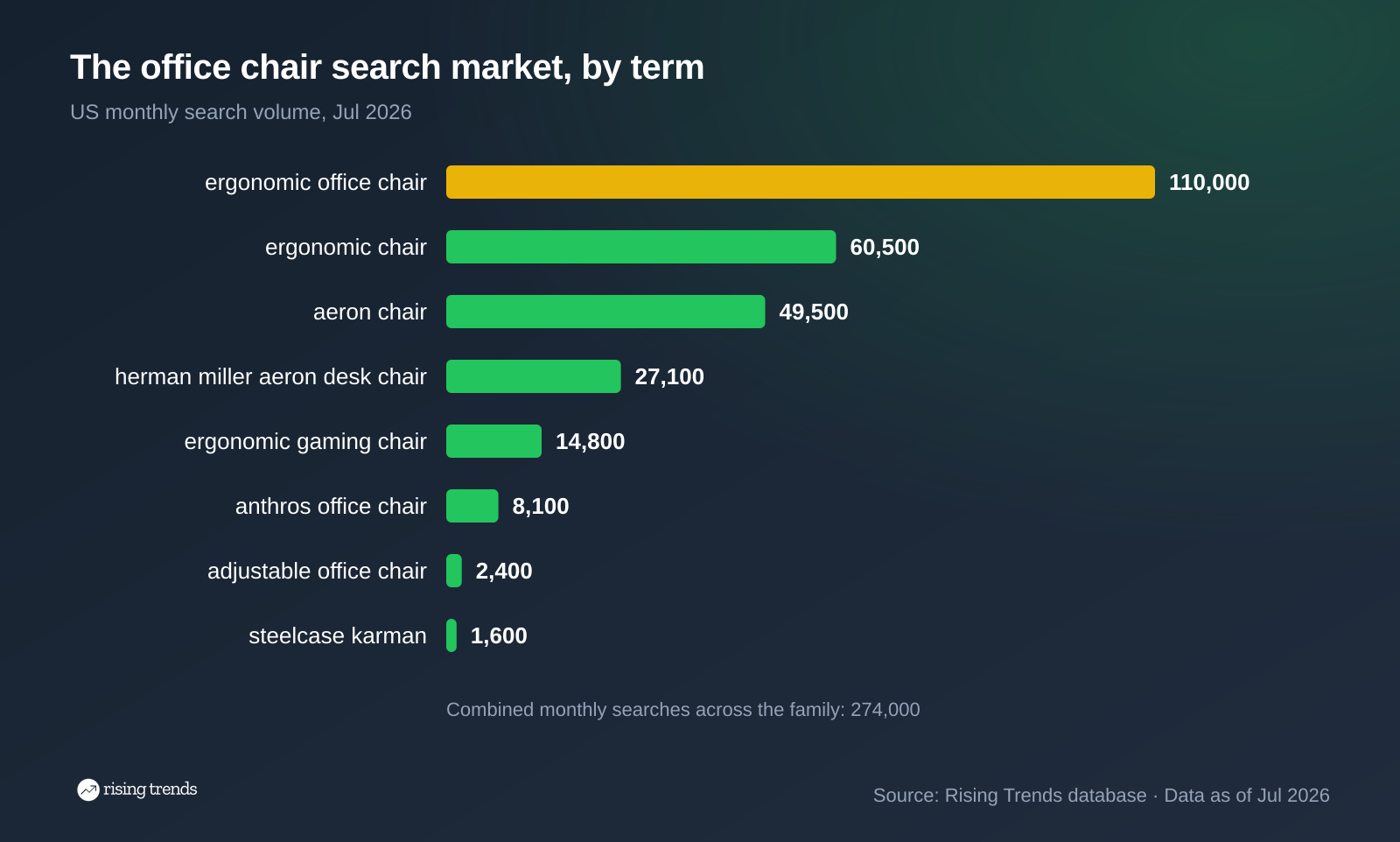
Anthros is sixth of eight, at 8,100 against the category head term's 110,000. Nobody is dethroning Herman Miller on volume. What is changing is where the growth lives, and three things follow from that.
The chair is being sold as a health product, not furniture. Anthros' site is organised by body part: lower back, sciatica, stenosis, hip, shoulder. It sells a free consult with a licensed therapist before a chair. Our database files this term under Health Conditions as well as Workplace, and that is the correct read. Ergonomic furniture competing on adjustability is losing to one competing on pain.
Distribution beat product by five months. A better chair existed in June 2025 and demand did not move. Demand moved when creators with audiences who already talk about back pain were given a code and a reason to use it. That is the same playbook running across the categories we track in home improvement and design, and it is why a brand can now outgrow its own category from a standing start.
The incumbents' problem is the category, not the challenger. Aeron search demand did not move to Anthros; 27,100 is far more than 8,100 and the gap that opened is bigger than Anthros' entire volume. Office seating demand is shrinking for everyone, and the only pocket that grew was the one attached to a medical claim and an affiliate link. That reframes the whole interior design category for anyone selling into home offices in 2026.
Whether the seasonality repeats. Our database rates this term MEDIUM seasonality, and the November 2025 jump has a discount campaign sitting underneath it. If November 2026 delivers another step up and it holds through the spring the way the last one did, the brand has real base demand. If it spikes and gives it back, the demand is rented. The live Anthros trend page is where that shows first.
Whether Herman Miller answers on evidence. Anthros is running a science-led attack using published university studies against an incumbent that has historically competed on design and warranty. Watch aeron chair volume for a stabilisation, and watch for Herman Miller publishing pressure or posture data of its own. It has never needed to before.
Whether the V2 cushion upgrade cannibalises new chair sales. Letting V1 owners buy replacement cushions is good for customers and bad for revenue per household. If the next revision quietly drops that path, it tells you the growth has stopped paying for the generosity.
One last thing the curve says. For a product this expensive, the interesting number is not 1,273%. It is that a category falling 63% still had room for one brand to grow thirteen-fold, on the argument that the thing you sit in all day is a medical device you have been buying as furniture. That argument is going to get copied, and the next chair to make it will not need five months to find its audience.
Want to catch the next brand breaking out of a shrinking category? Read our guide on how to identify market trends, follow the live anthros office chair trend page, or browse what is breaking out right now on the Rising Trends dashboard.
Thousands of Emerging Trends
Thousands of Breakout Apps
Mega Trends
Trend Analysis Tool