
We picked up something unusual in the Rising Trends database three weeks ago. The bare term "maxxing" went from 1,900 monthly searches a year ago to 9,900 in March 2026, and it is not the only one. A whole family of related search queries (looksmaxxing, fibermaxxing, protein maxxing, androgenic looksmax) all broke out together inside a six-month window.
Most coverage of this trend is either a moral panic piece or a glow-up explainer. Neither is useful if you actually want to understand what is happening. So below we walk through what "maxxing" means, where it came from, the full taxonomy of its subgenres, what doctors say about the extreme versions, the psychological research that matters, and the economy that grew up around it.
Key takeaways:
- "Maxxing" search volume is up 5.2x year over year, from 1,900 monthly searches in April 2025 to 9,900 in March 2026 (Rising Trends data).
- The umbrella covers a family of subgenres: looksmaxxing, mewing, fibermaxxing, protein maxxing, androgenic looksmax, softmaxxing, hardmaxxing, and bonesmashing.
- Eating disorder hospitalizations among boys have risen 400% since 2002, per UC San Francisco researcher Jason Nagata.
- Bonesmashing, the most extreme variant, involves striking your own face with objects to "remodel" bone. Surgeons say it causes nerve damage and fractures, not facial restructuring.
- The American Association of Orthodontists has issued formal warnings against mewing.
- A 2024 study in the journal Body Image found that just 10 minutes of exposure to idealized social media images measurably lowered body appreciation and self-esteem.
Let's get into it.
What we're seeing in the Rising Trends data
Here is the search volume for "maxxing" over the past 12 months, pulled directly from our database.
Search interest: "maxxing"
Monthly Google search volume (US) · Source: Rising Trends database
The plain "maxxing" curve is a clean breakout. But the real story is the family of related terms. When we pulled every "-maxxing" or "-max" related query from our database, the ecosystem looks like this.
The "-maxxing" family: monthly search volume (March 2026)
Source: Rising Trends database · All terms US monthly search
A few things jump out. Looksmaxxing dominates the family with 301,000 monthly searches, more than triple the next biggest term ("mewing" at 90,500). Mewing is older and has plateaued. The newer subgenres (fibermaxxing, protein maxxing, androgenic looksmax) are smaller individually but every one of them is classified by our system as EXPONENTIAL in pace. When eight related search terms break out together inside the same six-month window, you are not looking at a meme cycle. You are looking at a behavior shift.
What "maxxing" actually means
The plain definition is that "maxxing" is internet slang for ruthlessly maximizing some aspect of your life. The verb tense matters. You do not "improve" your jawline, you "maxx" it. You do not "eat more fiber," you "fibermaxx." The word borrows the language of video game stat optimization (max out a skill tree, max out a build) and applies it to the human body and life.
The phrase originated in male incel communities on forums like Lookism and PSL in the 2010s. According to Northeastern University researchers, the cultural lineage is the "quantified self" movement: the same instinct that produced fitness trackers and macro counting now applied to facial symmetry and lifestyle optimization. What changed in 2024 and 2025 is that TikTok turned a closed forum subculture into an open mainstream content category, and the algorithm rewarded escalation.
Why "looksmaxxing" became the dominant subgenre is straightforward. Appearance is the easiest variable to film, the easiest to score numerically (the PSL scale rates faces 1 to 10), and the easiest to before-and-after. Everything else in the maxxing family is downstream of that visual loop.
The taxonomy: softmaxxing, hardmaxxing, and the subgenres
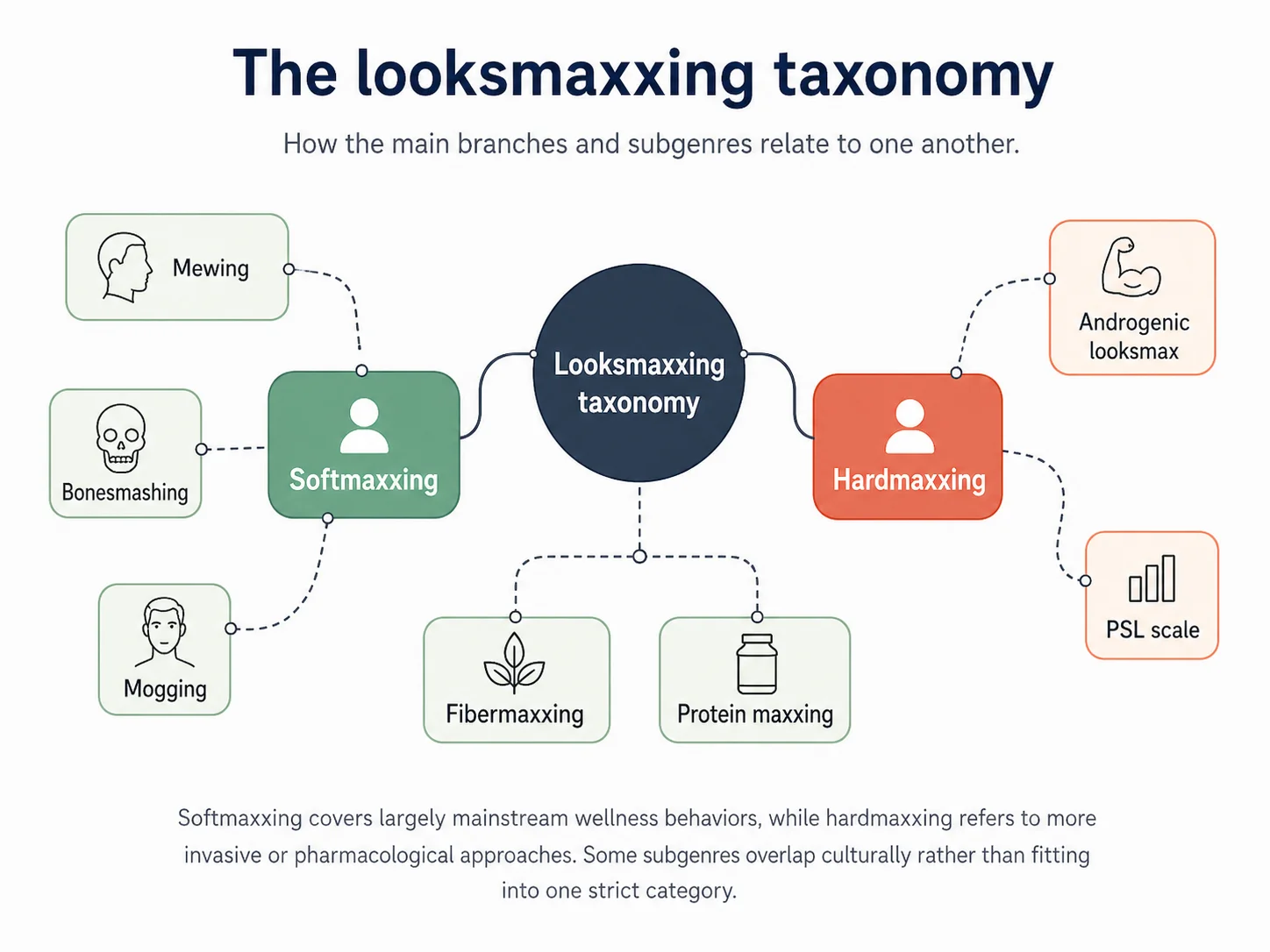
The community has built its own ontology, which is worth knowing if you want to read this trend accurately. Pulling from our database tags and the British Psychological Society's analysis, here are the major variants.
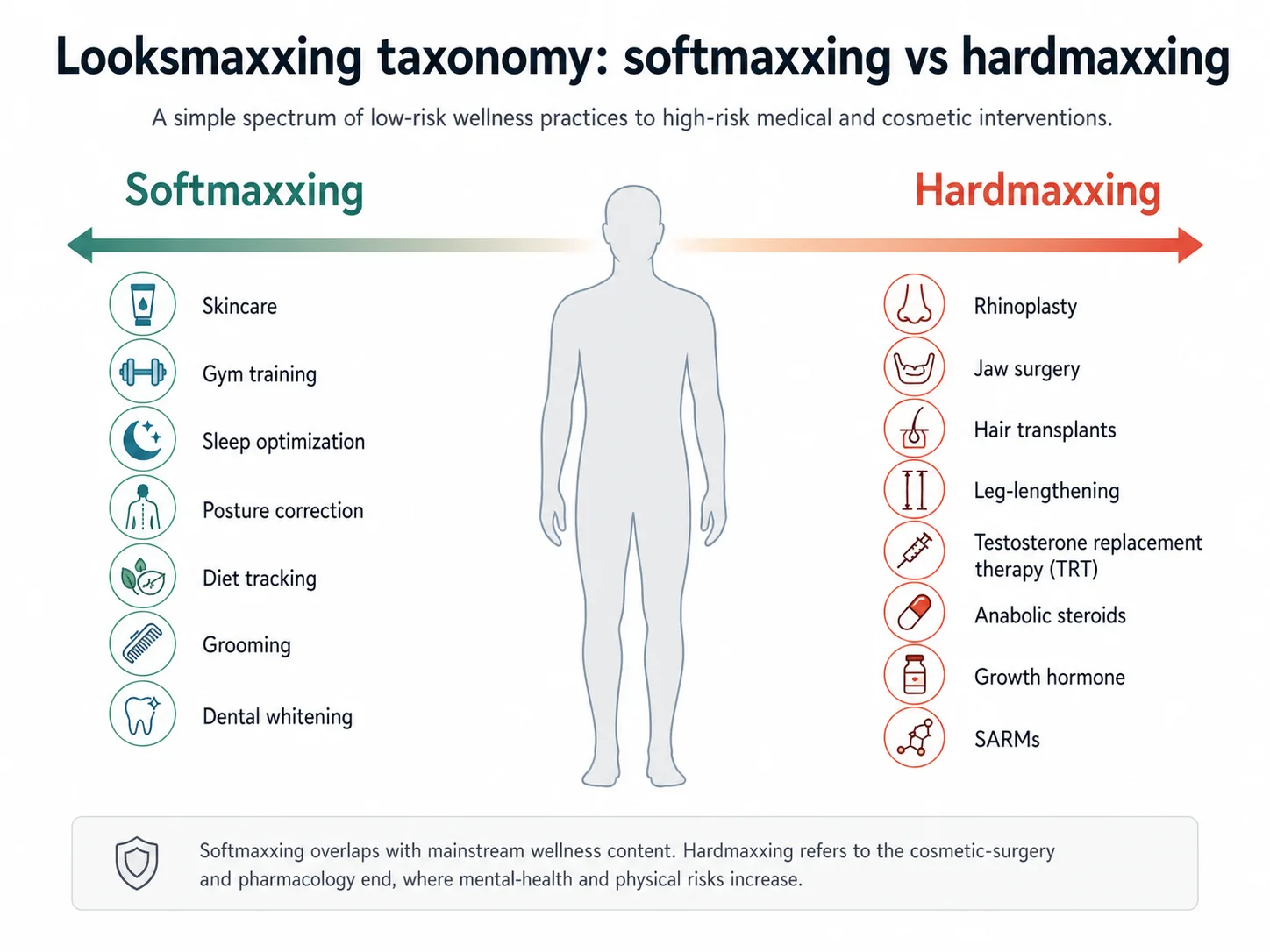
Softmaxxing covers everything legal and largely uncontroversial: skincare, gym training, sleep optimization, posture correction, diet tracking, grooming, dental whitening. Most softmaxxing is indistinguishable from generic wellness content, which is part of why the trend has crossed over into the mainstream. The same posture-correction impulse is now moving hardware too, which is how a $2,000 pelvic-support office chair became the only office seating term in our database that grew this year.
Hardmaxxing is the cosmetic surgery and pharmacology end: rhinoplasty, jaw surgery, hair transplants, leg-lengthening procedures, testosterone replacement therapy, anabolic steroids, growth hormone, and SARMs. This is where the mental-health risk profile gets serious.
Mewing is a tongue-posture technique invented by orthodontist Dr. John Mew, claimed to remodel adult jawlines. It is the second-largest term in the family at 90,500 monthly searches and has plateaued.
Bonesmashing is the practice of striking your own face with hammers, bottles, or fists to "remodel" bone via a misapplied version of Wolff's Law. It is the most controversial subgenre.
Mogging is showing off being more attractive than someone else in side-by-side photos or videos. It is the dunk culture of the looksmaxxing world.
Fibermaxxing and protein maxxing are nutrition variants, both classified as EXPONENTIAL by our system. Both are now appearing in mainstream registered-dietitian content, decoupled from the manosphere origin.
Androgenic looksmax is the testosterone-focused subset, often involving TRT clinics or grey-market hormone use.
The PSL or looksmaxxing scale is the 1-10 attractiveness rating system the community uses to grade faces. Search volume on the rating scale itself has gone from near zero to 12,100 monthly searches in 18 months.
The extreme techniques and what doctors actually say
Two practices have drawn the loudest medical warnings.
Mewing. The American Association of Orthodontists has issued formal statements that there is no scientific evidence that tongue placement can reshape an adult jawline. The same statements warn that DIY orthodontics carry real risks including loosened teeth, speech impediments, and TMJ disorders. Researchers reviewing the technique have argued that evidence supporting any meaningful change in adult facial structure is lacking.
Bonesmashing. Maxillofacial surgeon Dr. Larry M. Wolford and facial plastic surgeon Dr. Edward S. Kwak have both published explicit warnings. The risks they list include facial fractures, neurovascular injuries, malocclusion, dental fractures, permanent nerve numbness, sinus and orbital injury when the brow ridge is targeted, and alterations in vision. The community's justification cites Wolff's Law, which describes how bone gradually remodels under controlled physiologic loading from muscle activity. Surgeons point out that this has nothing to do with blunt-force trauma. As Dr. Kwak put it in Vice's investigation, hitting your face does not remodel bone. It causes permanent nerve damage and fractures.
The pattern across the extreme end of the maxxing family is consistent. Every controversial technique borrows real medical or scientific concepts (Wolff's Law, tongue posture, hormone optimization) and applies them in ways the underlying science does not support.
The psychology of why young men, why now
The mental health data here is where the trend stops being a curiosity and starts mattering.
UC San Francisco researcher Jason Nagata has documented a 400% increase in eating disorder hospitalizations among boys since 2002. NPR's reporting on bigorexia, the muscle-focused variant of body dysmorphic disorder, describes a clinical picture in which young men become preoccupied or obsessed with the belief that they are not muscular enough, even when their build is objectively normal or above average. People with bigorexia are at significantly elevated risk of disordered eating, anabolic steroid use, and suicidal ideation.
University of Toronto professor Kyle T. Ganson, who specializes in eating disorders, told reporters that the looksmaxxing community creates "tunnel vision" in which young men internalize an impossible aesthetic ideal, leading to severe depression and suicidal ideation. The compulsive measuring, mirror-checking, and rating behaviors that are central to looksmaxxing content overlap heavily with the symptomatology of body dysmorphic disorder, even in users who would not meet a clinical diagnosis.
The exposure side has its own evidence base. A 2024 study published in the journal Body Image by researchers at the University of the West of England and City, University of London, found that just 10 minutes of exposure to idealized social media images measurably reduced body appreciation and state self-esteem in participants. Looksmaxxing TikTok is, structurally, ten-minute exposure on infinite loop.
The honest reading is that you can hold two things at once. Wanting to look better, lift more, and eat more protein is not pathological. The full pipeline (PSL ratings, daily mirror sessions, unsupervised hormone protocols, bonesmashing) is.
The economy that grew up around it
A trend at this scale produces a market. The most visible consumer product is LooksMax AI, a mobile app that analyzes user photos and generates personalized appearance recommendations. The app hit 49,500 monthly searches at peak and is now steady at around 5,400. The most visible creator is Braden Peters, who posts under the handle "Clavicular" and has been profiled across mainstream press as the public face of the movement.
Around them sits a stack of products and services: jaw-exerciser hardware, mewing gum, peptide supplements, low-cost overseas cosmetic procedures, hair-transplant package tours, TRT clinics that operate in regulatory grey zones, and a long tail of TikTok-native supplement brands. The TikTok creator economy provides direct financial incentive to keep escalating, since more extreme content reliably draws higher view counts and stronger algorithmic distribution.
The mainstream wellness adoption is the more interesting commercial story. Fibermaxxing and protein maxxing are now appearing in content from registered dietitians and major health publications, increasingly disconnected from their manosphere origins. The vocabulary is leaking into the broader self-improvement market, which means the umbrella term "-maxxing" will keep generating new subgenres for years.
Where this is heading
Three things look likely going into late 2026.
The umbrella will keep spawning variants. Sleepmaxxing, moneymaxxing, and careermaxxing are already gaining ground on TikTok and follow the same linguistic pattern. Expect them to show up in next year's search data. The clinical shadow of the movement is already measurable too: searches for optimization OCD, the informal term for compulsive self-optimization, are up 12,959% year over year.
The counter-swing is already visible. In makeup, the same optimization instinct has flipped to doing less: searches for "makeup minimalist" are up 517% in a year while the bare-lash look documented in the ghost lashes trend peaked two summers running. Maxxing and minimalism are the same impulse to control how you read to other people, pointed in opposite directions. The same pared-back shift is reshaping the colour aisle on our makeup and cosmetics trends page.
The mainstream wellness side will accelerate. As fibermaxxing and protein maxxing get covered by dietitians and gym influencers, they will be increasingly read as ordinary nutrition advice rather than as part of an incel-forum-derived vocabulary. The cultural distance between "maxxing" and "optimizing" will keep shrinking.
The backlash has found its own word, too. Searches for the slang insult behind the polyester slang trend went from 10 to 1,600 a month in August 2026, and the thing it accuses you of is exactly what a maxxed self can look like from the outside: assembled, synthetic and trying.
The hard-extreme end will face moderation pressure. Bonesmashing content has already been removed in waves from TikTok and YouTube under self-harm policies, and unsupervised hormone protocols are likely to get similar treatment. The underground forums where these practices originated will remain. The mainstream platform reach will compress.
The signal worth watching is whenever a community develops its own quantified rating system, like the PSL scale. That is usually the early indicator that the behavior around it is about to escalate. Maxxing is the second time in a decade we have seen this pattern (the first was the early-2010s rise of macro-counting and Reddit fitness culture). It will not be the last.
Want to spot emerging shifts like this before they hit the headlines? Read our guide on how to identify market trends, or browse what is breaking out right now in our trending topics list.
Never miss a trend again
- One trend broken down with the numbers
- Who's making money, and what to build
- A website on the rise
- A breakout app
Join 5,000+ founders