Trends


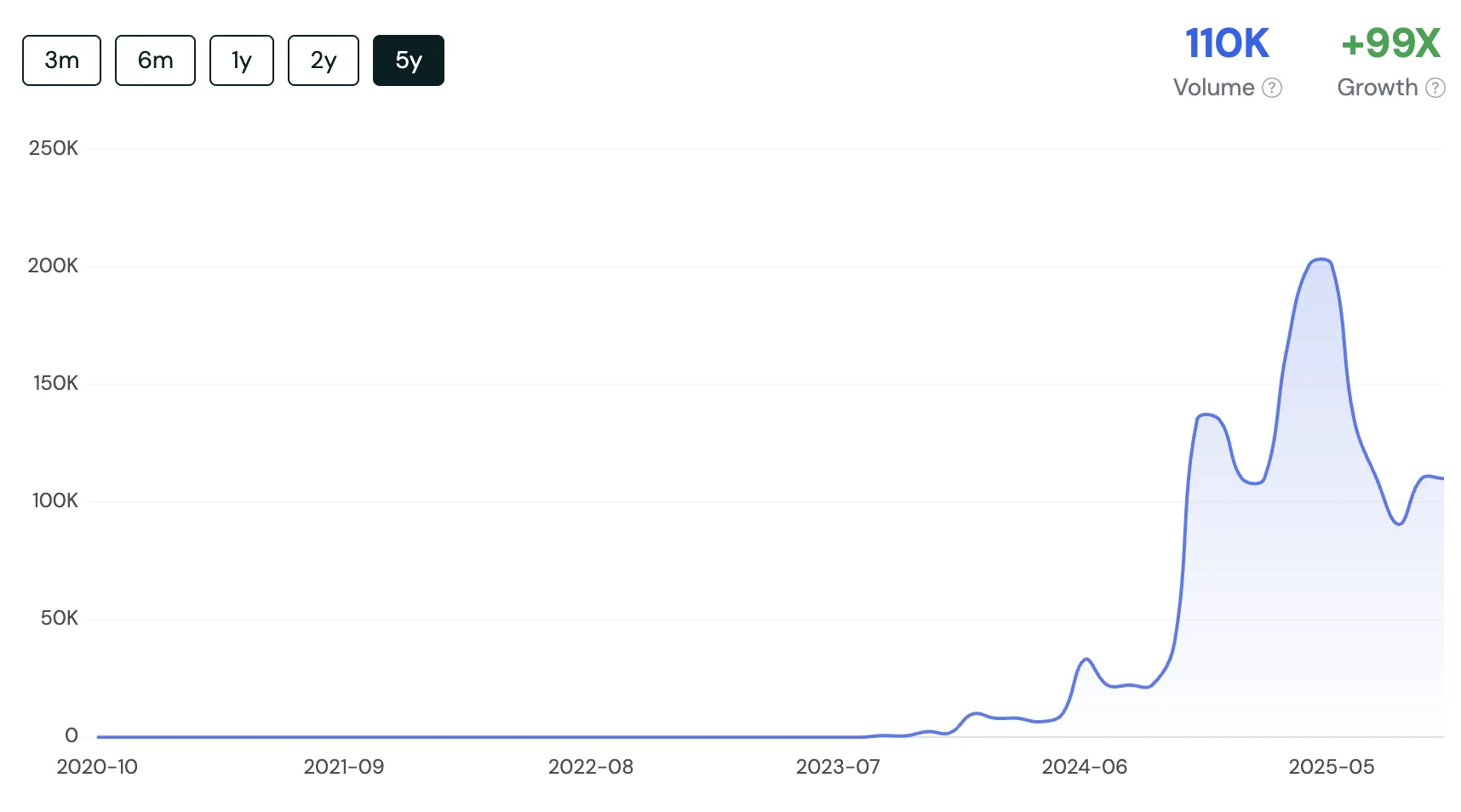
We picked up something striking in the Rising Trends database last month. Searches for "cortisol meter" went from 30 monthly searches in April 2025 to 9,900 in March 2026. That is a 330x increase in eleven months, with the breakout happening between December and February. Almost nobody was searching for this device a year ago. Now it is one of the fastest-growing health-tech queries on Google.
The device sits inside a much larger story. The broader cortisol wellness category already does roughly $1.6 million in monthly Amazon revenue across the top 10 keyword listings, and a separate Rising Trends term, "cortisol spike," is up 1,041% in the past six months. Below we explain what a cortisol meter actually is, the science behind continuous cortisol monitoring, the products and startups racing to ship one, the Amazon market it is entering, and why this looks structurally like the next category after CGMs and Oura.
Key takeaways:
Let's get into it.
Here is the search volume for "cortisol meter" over the past 12 months, pulled directly from our database.
Search interest: "cortisol meter"
Monthly Google search volume (US) · Source: Rising Trends database
That is the cleanest breakout shape we have seen this quarter. Eight straight months below 100 monthly searches. Then 590 in December, 1,900 in January, and 9,900 by February. The device search did not break out in isolation. It broke out after the broader cortisol concept had already been mainstreamed. When we pulled every cortisol-related term from our database, the surrounding ecosystem looks like this.
The cortisol search family: monthly search volume (March 2026)
Source: Rising Trends database · US monthly search
The broader concept terms ("cortisol detox," "cortisol supplement") have been mature for over a year. What changed in late 2025 is that the device terms broke out. People moved from learning about cortisol to looking for tools to measure it. That is the same sequence that played out for blood glucose between 2020 and 2024 before continuous glucose monitors went mainstream.
Cortisol is the body's primary stress hormone, produced by the adrenal glands and regulated by the hypothalamic-pituitary-adrenal (HPA) axis. It follows a strong daily rhythm: highest in the morning to drive alertness, lowest at night to allow sleep, with acute spikes layered on top in response to stress, exercise, and fasting.
A cortisol meter is any device that lets you measure your cortisol level outside of a lab. Two distinct technology categories share the name and need to be distinguished.
Spot-test devices are the consumer products dominating Amazon today. These are saliva test strips, finger-prick lateral flow assays, and at-home immunoassay kits priced around $20 to $40. They give you a single reading at a single moment, which you mail in or read on a small handheld device. Useful for confirming a high or low cortisol pattern, but not a continuous picture.
Continuous wearable cortisol monitors are the new category. These are sweat-based or skin-interfaced biosensors that measure cortisol throughout the day, the way a continuous glucose monitor measures blood sugar. The chemistry is harder than glucose because cortisol circulates at far lower concentrations and the signal is less stable, but the research has caught up.
The Amazon cortisol meter listings selling at $27.59 are almost entirely in the first category. The startups and academic groups building toward the continuous wearable category are about to redefine what the term means.
The cortisol meter would not be breaking out without the cultural runway built over the past two years. Looking at the related search volumes pulled above:
"Cortisol detox" (90,500 monthly searches) became the umbrella wellness term in 2024 after a viral wave of TikTok and YouTube content about lowering chronic cortisol through diet, sleep, and meditation. Search volume has plateaued but stayed high.
"Cortisol spike" (33,100, up 1,041% over six months) is the fastest-growing concept term in the entire family. The shift in language matters: people have moved from a vague "I want to detox" framing to a specific physiological event they want to track and interpret.
"Cortisol supplement" and "cortisol detox diet" show that the consumer is already buying products to act on the concept. Roughly $20-30 per item on Amazon, repeat purchases, no measurement loop.
The cultural drivers behind all of this are well documented: post-pandemic stress, the Andrew Huberman / Peter Attia-style longevity content ecosystem, the GLP-1 era's broader focus on metabolic and hormonal health, and the conditioning effect of CGMs and Oura that taught a generation of consumers to expect continuous biomarker data on their phones.
The cortisol meter is what happens when an existing concept hits a generation already trained to want a tracker for it.
The same calm-seeking audience is rotating on the exercise side too: tai chi walking went from 210 to 673,000 monthly searches in six months, the first breakout walking trend whose explicit hook is lowering arousal rather than burning calories. The hands-on recovery side shows up in a different language entirely, in the ventosa therapy trend, where the Spanish term for cupping spikes while the English one stays flat.
Here is what the cortisol and stress category looks like on Amazon right now, ranked by monthly revenue per listing (top 20 listings averaged for each keyword).
Amazon stress + cortisol category: monthly revenue per listing
Source: Rising Trends Amazon categories data · Average across top 20 listings per keyword
A few things stand out. Stress relief supplements is a half-million-dollar-per-month-per-listing category, more than seven times the size of cortisol meter listings today. Ashwagandha alone does $181K per top listing per month. The cortisol meter at $66K monthly revenue per listing is solid for a category that effectively did not exist 12 months ago, but the upside is what that revenue line does when continuous wearables hit Amazon at $300+ price points.
The signal for sellers and investors is that the consumer demand is already proven across the supplement layer. The measurement layer is the unfilled gap. Whoever wins the consumer-grade continuous cortisol wearable will be selling into a category that already does $1.6M per month per listing in adjacent products.
The continuous cortisol wearable category has two technical approaches that are currently neck-and-neck in the academic literature.
Sweat-based aptamer biosensors use synthetic short DNA strands (aptamers) that bind specifically to cortisol molecules. When cortisol is present, the aptamer changes shape, which changes an electrical or optical signal the sensor reads. A 2021 paper in Science Advances demonstrated a smartwatch-integrated aptamer field-effect transistor system that detected stress-associated cortisol increases in sweat in real time. This is the dominant approach for several commercial products in development.
Molecular imprinting biosensors create polymer cavities shaped exactly like cortisol molecules, then detect when a cortisol molecule fits into a cavity. A 2025 paper in ScienceDirect from Zhejiang University, the Continuous Wearable System for Cortisol Continuous Monitoring (CWSCCM), combines this chemistry with organic bioelectronics and an active sweat-stimulation system to generate continuous data without the user needing to exercise.
The most ambitious recent work is Stressomic, published in Science Advances in 2025, a multiplexed microfluidic biosensor that simultaneously profiles cortisol, epinephrine, and norepinephrine in sweat at picomolar sensitivity. It uses iontophoresis (a mild electrical current) to extract sweat on demand, eliminating the need for the user to be sweating naturally.
The validation milestone the field has been waiting for arrived in a 2025 Nature Sensors paper, which showed that skin-interfaced wearable sensors track acute cortisol responses on the same time scale as blood-based cortisol measurements. That is the threshold continuous glucose had to cross before CGMs could be marketed as clinically meaningful.
EnLiSense's Corti is the highest-profile commercial product. According to EnLiSense's April 2024 Business Wire announcement, Corti is the first wearable device to provide real-time continuous monitoring of cortisol and melatonin together, the two hormones that govern stress and sleep. The company says Corti captures more than 3,000 measurements per biomarker in a single week, and its underlying passive-sweat sensor technology is built on more than a decade of research and 500,000+ biomarker readings recorded during development.
BioSens8 sells a commercial cortisol monitor targeting the same continuous-monitoring use case. Stanford University's materials science department has developed a wearable sweat cortisol patch with similar capabilities, currently at the research stage.
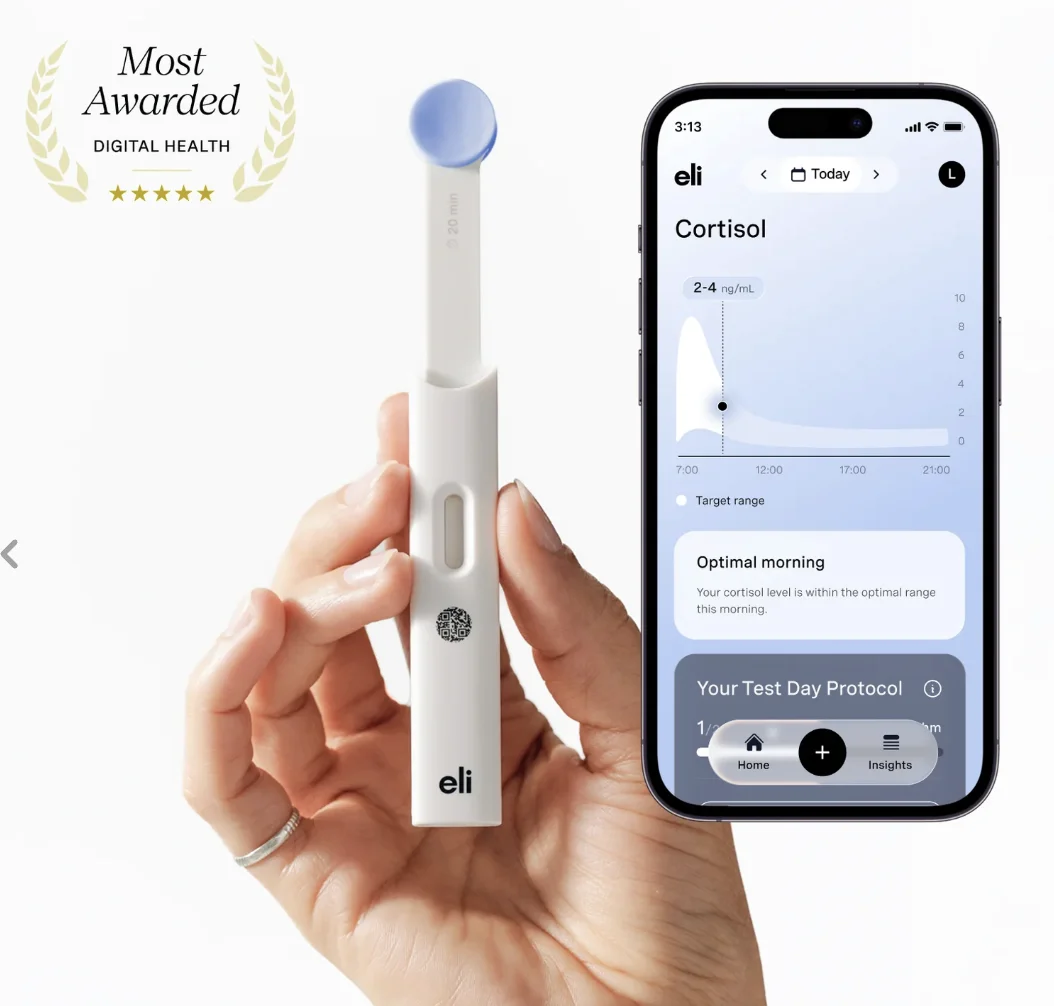
Eli Health, a Montreal-based startup, is taking a different angle with its Hormometer — a saliva-based at-home cortisol and progesterone test that pairs with a phone app to deliver lab-grade readings in minutes. Instead of solving for continuous monitoring like Corti, Eli Health is solving for accessibility: a $30-ish disposable test that brings clinical-grade hormone measurement to anyone with a smartphone. It is the closest thing the category has to a mainstream consumer entry point right now.
The pattern across every serious research group and commercial player is the same: sweat-based sensing, aptamer or molecular-imprinting chemistry, wireless Bluetooth output to a phone app, and an explicit positioning around continuous data rather than spot tests. The hardware paradigm has converged. What differs is execution, regulatory strategy, and which consumer brand reaches the mass market first.
The cleanest framing for readers who already wear a tracker:
A continuous glucose monitor (Dexcom Stelo, Abbott Lingo) gives you continuous blood glucose. FDA-cleared for non-diabetic consumer use as of 2024. Mainstream now.
An Oura ring or Whoop strap gives you continuous heart-rate variability, sleep stages, and skin temperature. Validated, mainstream, and treated as a serious health signal by users.
A cortisol meter, in the continuous wearable form factor, gives you continuous stress hormone levels. The science just crossed the validation threshold. Commercial products are launching. The mainstream consumer brand has not arrived yet.
Why cortisol cannot just be a feature added to existing wrist wearables: the chemistry requires a fluid sample (sweat) and a specific binding system (aptamer or MIP) that the optical sensors in current rings and watches cannot do. It is a separate hardware category, not a firmware update. That is the same constraint that kept CGMs off Apple Watches.
The plausible end state, three to five years out, is a single wearable that gives a user HRV, glucose, cortisol, and melatonin in real time on the same app. Several startups are explicitly racing to build it, and at least two large consumer health platforms are reportedly evaluating acquisitions in this space.
Three things look likely going into late 2026.
The Amazon spot-test layer will keep growing through 2026 as the cortisol concept matures. Expect more $20-40 saliva and sweat test kit listings, expect price compression, and expect the cortisol meter keyword search volume to keep climbing.
The first major consumer health brand launch of a continuous cortisol wearable will be the inflection point that pushes "cortisol meter" search volume from five figures into six. Whether that comes from EnLiSense scaling Corti, a startup acquisition by Apple or Garmin, or a direct Oura launch is the open question.
FDA clearance for a consumer continuous cortisol device will reset the category. None has been granted yet for non-clinical consumer use. The first clearance will materially change the marketing language vendors can use, which historically pulls a category from "wellness" to "health."
The longer-term thesis is that cortisol joins glucose as the second mainstream ambient biomarker that consumers track on their phones. That reshapes how the wellness industry talks about stress, from a vague feeling to a measured variable. The category structure suggests this is a question of when, not if.
Want to spot emerging shifts like this before they hit the headlines? Read our guide on how to identify market trends, explore the live cortisol meter trend page, or browse what is breaking out right now on the Rising Trends dashboard.
Thousands of Emerging Trends
Thousands of Breakout Apps
Mega Trends
Trend Analysis Tool