
Two years ago about 170 people a month typed "vertical dramas" into Google. As of September 2026 it is 8,100, a 32x lift, and the curve just set a new high after five flat months. Three other terms in the same family moved with it: "short drama" is at 12,100 a month, up 236% in a year, and "microdramas" is at 1,300, up 233%.
Here is the part nobody has written down. Over the same year the two biggest apps that actually sell this stuff, DramaBox and ReelShort, each grew 83%. The format is outgrowing its own storefronts by four to one. People have stopped searching for a shop and started searching for a genre, which is what happens right before a category stops being an app-store curiosity and becomes a line item in a studio budget.
Key takeaways:
- "Vertical dramas" hit 8,100 US monthly searches in September 2026, up from 1,900 a year earlier and 170 two years earlier, classified EXPONENTIAL in the Rising Trends database (data as of Sep 2026).
- The generic format terms are growing four times faster than the apps. Vertical dramas +326%, short drama +236%, microdramas +233%, against reelshort +83% and dramabox +83% over the same year.
- Owl & Co puts the vertical video economy outside China at $150 billion in 2026, up 41% in a year, of which dedicated drama apps are about $4 billion.
- The audience is not who the stereotype says. Male share of monthly users on one major app went from 1.1% to 30.3% in seven quarters, and 70% of viewers watch in bed before falling asleep.
- A series is made in one to two months for roughly $150,000, with a cliffhanger engineered every two to three minutes. The economics come from mobile games, not from television.
- The smallest term in the family is the fastest: "ai microdramas" is up 10,900% in a year, from nothing to 110 searches a month.
Let's get into it.
What we're seeing in the Rising Trends data
Here is the monthly search volume for "vertical dramas" over the last two years, straight from our database. The term barely existed in late 2024.
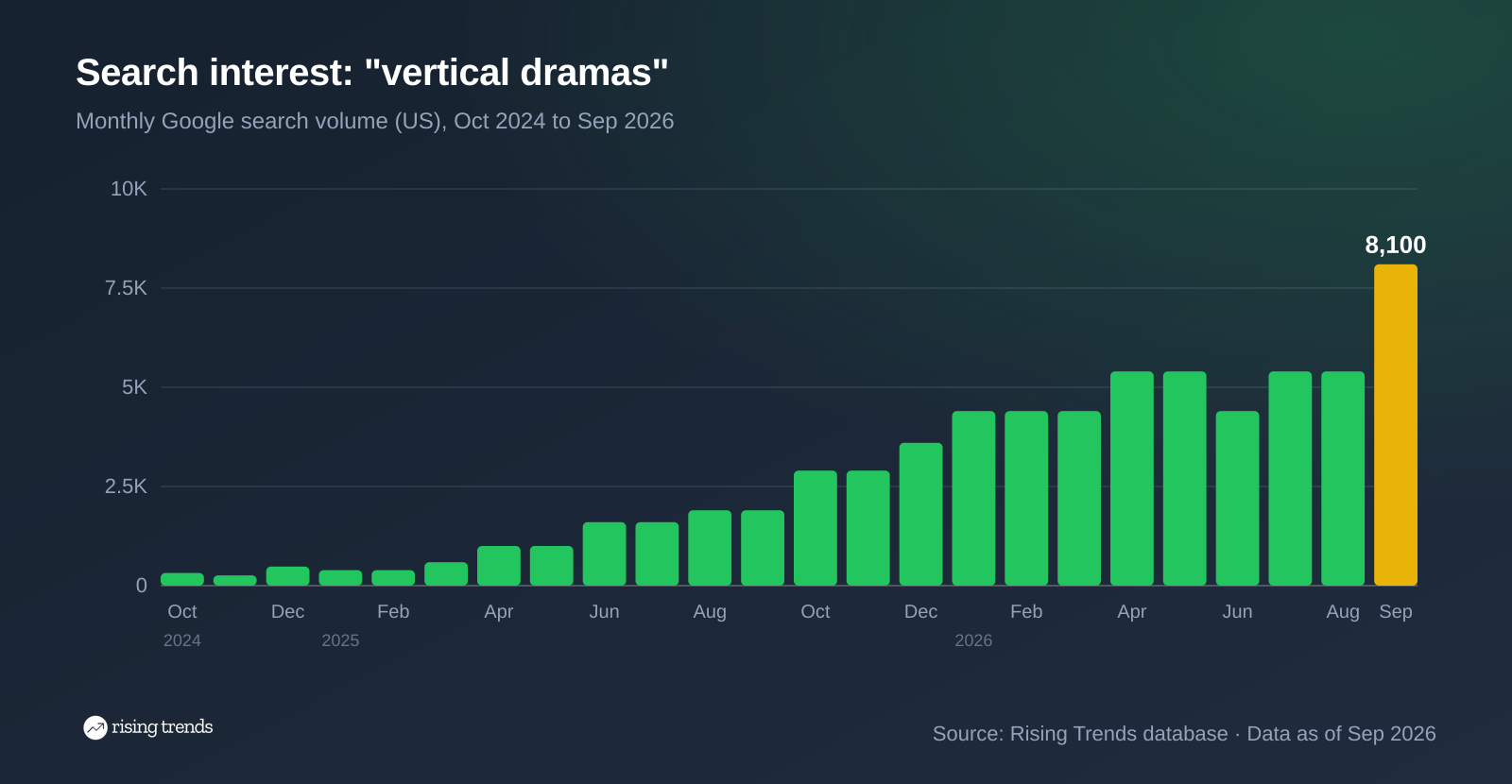
The shape is a staircase, not a spike. The breakout month was October 2025, when the term first crossed a quarter of today's level. It then climbed through 2026 and sat at 5,400 for most of the summer before jumping to 8,100 in September 2026. That is a 32x lift on the level of two years ago and a 50% jump in a single month, with no viral news event behind it. Demand like that is usually a format finding its name.
Now the comparison that makes the point. We put the generic format terms next to the brand names and ranked them by one-year growth.
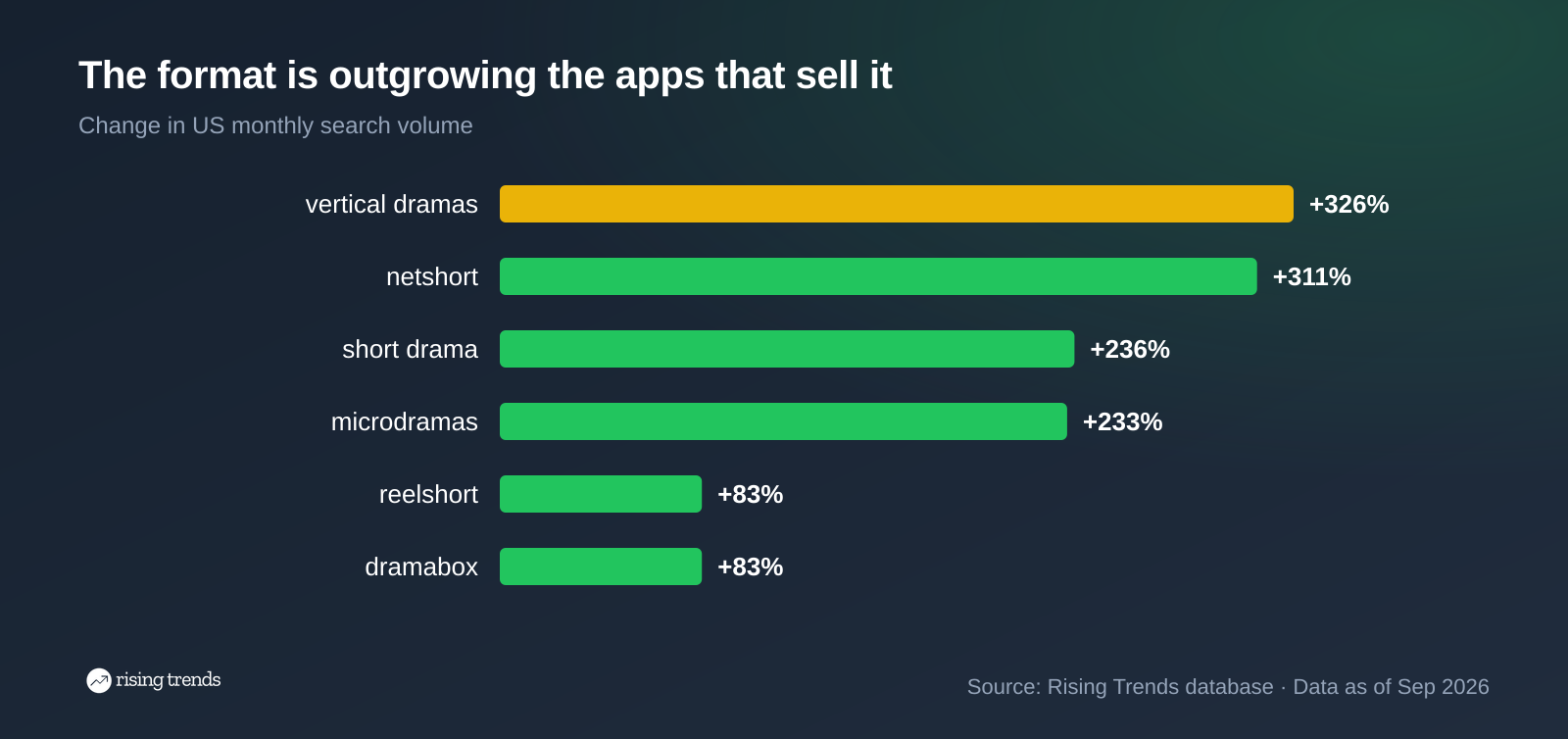
Four of the top four are format words. "Vertical dramas" leads at +326%, with "netshort" the one app keeping pace at +311% off a much smaller base. DramaBox and ReelShort, the two giants, are both stuck at +83%. In a healthy app market the brands grow fastest, because the brand is how people find the thing. Here it is reversed.
That does not mean the apps are small. They are enormous, and the volume chart shows how lopsided the category still is.
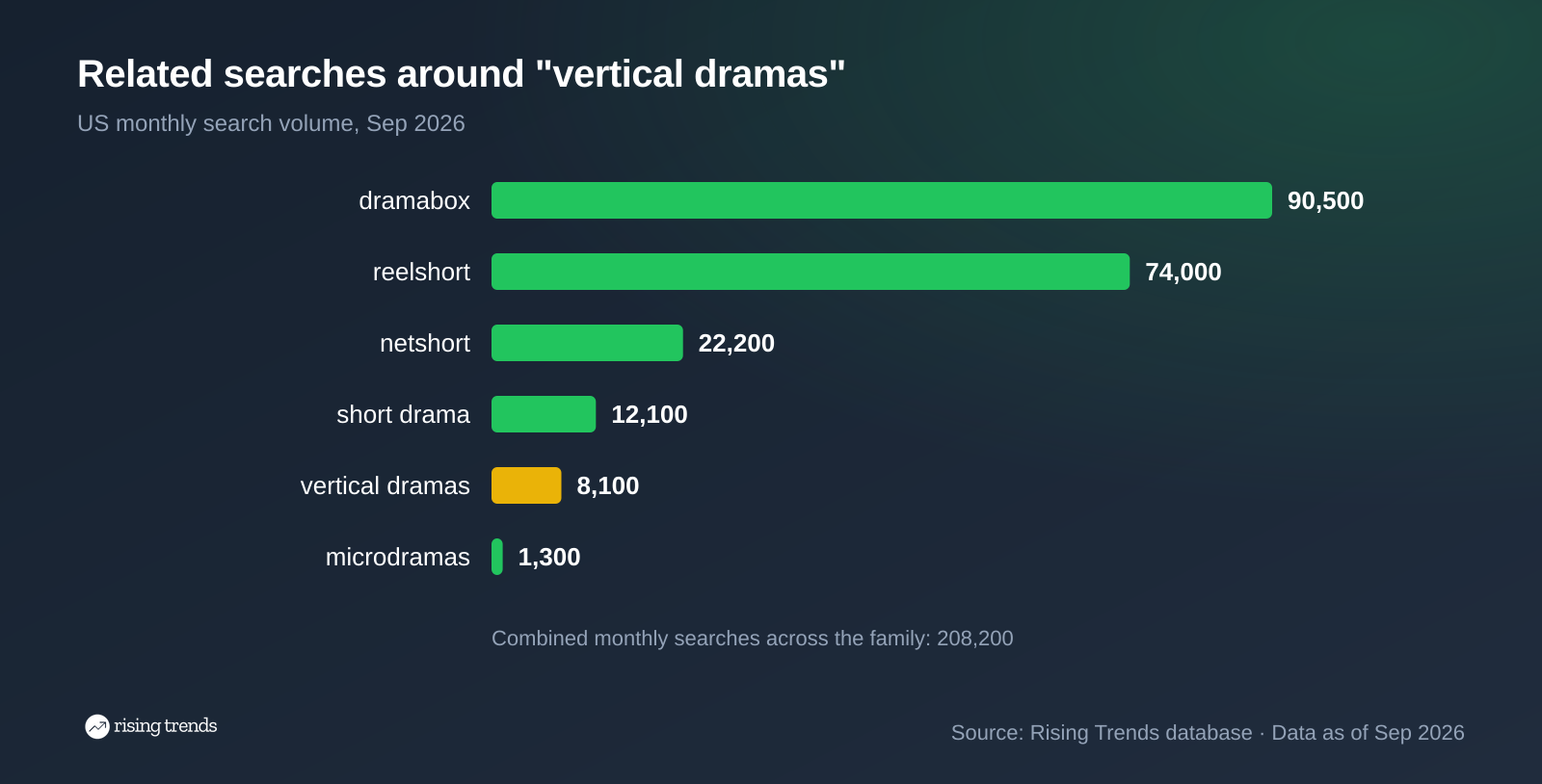
DramaBox alone takes 90,500 searches a month, more than ten times the format term. Across the six terms the family is worth 208,200 monthly searches. The apps own the volume; the format owns the growth. Those two facts point at different futures, and the rest of this piece is about which one wins.
What a vertical drama actually is
A vertical drama is a scripted series shot in 9:16 portrait for a phone, cut into episodes of roughly one to three minutes, with 20 to 100 of them in an arc. You watch it the way you watch TikTok, thumb on the right edge, except the thing on screen is a soap opera about a secret billionaire husband or a werewolf CEO.
The structure is the product. Raindance, the independent film body, is blunt about where the form came from: it "evolved from mobile monetisation mechanics," not from cinema. Its guide tells writers that every two to three minutes they must "spike curiosity, interrupt resolution, force continuation." The line that sticks: "You are not writing scenes. You are engineering compulsion loops."
The money side matches. A series gets shot in one to two months for around $150,000 across roughly 100 pages. Lighting is secondary, wide shots are mostly pointless, and the on-set hierarchy runs speed, coverage, clarity, then everything else. That is a budget closer to a long commercial than to a TV episode, which is why so many exist.
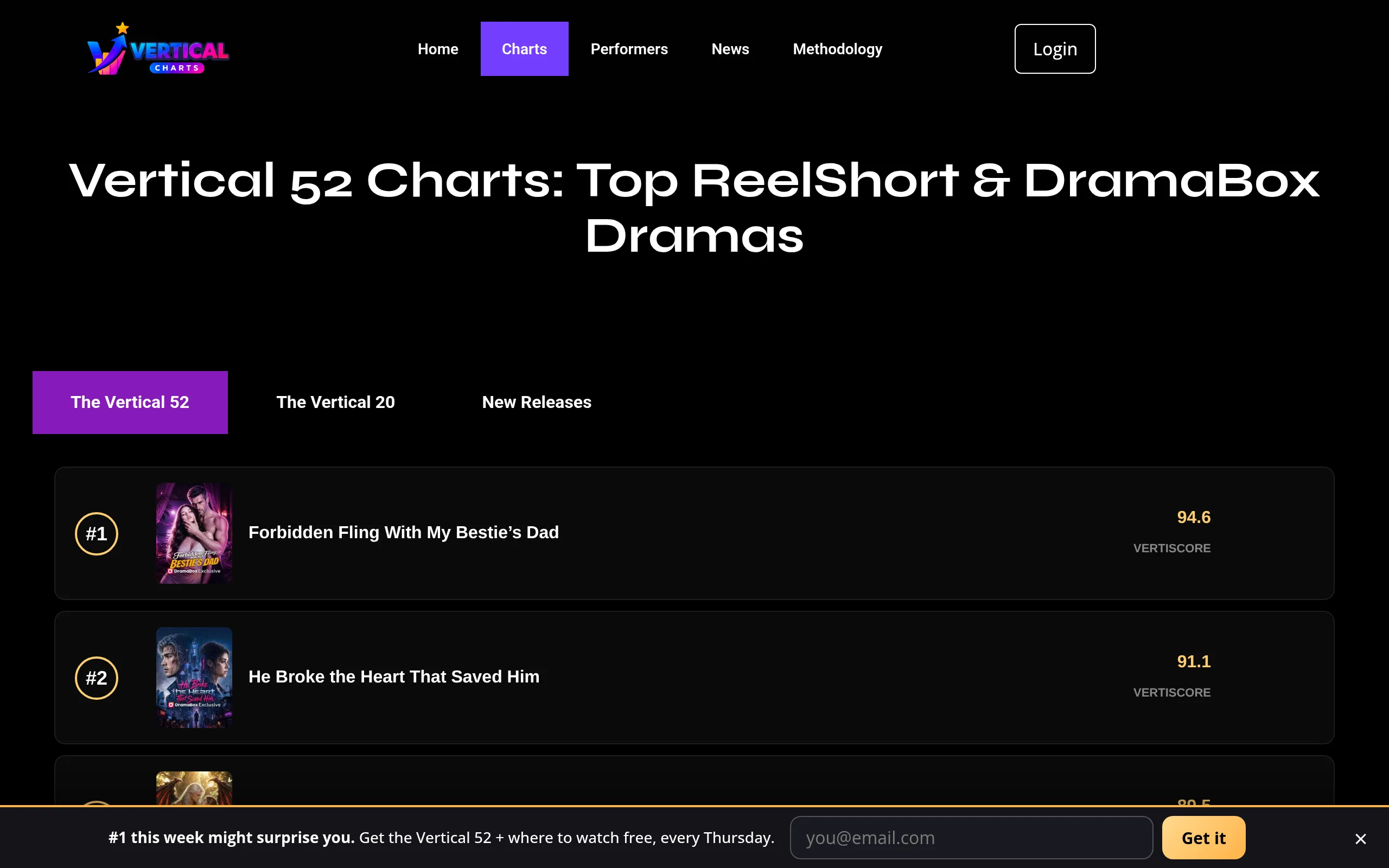
That screenshot is the clearest sign the format has grown up: it has a chart. Vertical Charts ranks 52 ReelShort and DramaBox titles a week on a 0 to 100 score built from views, velocity, fan saves and placement. In the week of 22 October 2026 the number one was "Forbidden Fling With My Bestie's Dad" at 94.6, and nine of the top ten were DramaBox titles against one from ReelShort. Formats get charts when enough money is riding on which title wins.
Why it's trending now
The September jump has a cause, and it is not a single viral clip. It is that the industry spent 2026 arguing about what to call this, and the argument produced coverage.
In July, HOLYWATER TECH and the consultancy Owl & Co published the first industry report built on real in-app behaviour from two Western drama apps, combined with a May 2026 survey of 2,737 users. Its headline estimate is that the vertical video economy outside China reaches $150 billion in 2026, up 41% in a year, with dedicated drama apps accounting for about $4 billion of it. Worth saying plainly: Holywater owns the apps the data came from, so read the numbers as the category's own account of itself.
The report's conclusion is the interesting part. "A category that spans many genres needs the name of a format," said co-CEO Anatolii Kasianov. "We are calling it, vertical series." Co-founder Bogdan Nesvit put the growth case this way: "The category started with romance. Other genres can make it much bigger, and we already see them starting to work in the data." Hernan Lopez of Owl & Co added the caveat that makes the study usable: "observed behavior tells you only what people did, not why."
A format in the middle of being renamed is a format people have to look up. That is what our September curve is.
Then money arrived in public. On 13 October 2026 Fox Entertainment and Kevin Hart's Hartbeat announced a slate of 25 live-action vertical titles under the Codeblack, Essence and Revolt brands, with Fox Entertainment Studios holding a first look at any film or TV adaptation. Fox already had an equity stake in Holywater and a commitment for more than 200 titles. The pattern is consistent: Hollywood is not buying the apps, it is buying slots on them.
Producers are noticing faster than the studios. This reel from @rah_ali, posted on 19 October 2026, is a media company announcing it has moved into the business.
"Vertical dramas are art," the caption reads. "They're storytelling, expression, and a part of where media is going, so we've created space for more of it." The company says it is producing and distributing dozens of series through its own studio and platforms. Five years ago that sentence would have described a YouTube channel.
The new consumer behaviour
Strip out the industry noise and three things have genuinely changed about how people watch.
It replaced the pre-sleep scroll, not television. On My Drama, 70% of viewers watch vertical series in bed before falling asleep and 59% watch on the couch. That is prime-time behaviour pointed at a phone. The same report has heavy viewers averaging 13.1 hours a week, up from 9.5 five months earlier, which is a Netflix-sized habit forming inside an app most people over 35 have never opened.
The audience stopped being women only. Male share of monthly active users on that app went from 1.1% to 30.3% across seven quarters. The format was built on romance and is now absorbing revenge, crime and faith-based storytelling, which is exactly the genre expansion the Fox and Hartbeat slate is betting on.
Viewers know it is trash and watch anyway. A commenter in r/CDrama put it as well as any analyst: "It's one of my guilty pleasures and some are very funny. I noticed that the quality has gone up this past year." Over in r/CDramaRecs, a viewer describes watching "for almost a year and I am still addicted even tho I go back to watching long dramas." Nobody in these threads is defending the writing. They are describing a compulsion loop working exactly as designed, which is the same honesty you hear from people tracking the AI addiction trend.
The friction they complain about is price. The apps sell episodes by the coin, unlocking one cliffhanger at a time, and we broke that pricing apart in our piece on NetShort's coin paywall. It is why "short drama apps" is the only term in the family going backwards, down 65% in a year to 1,900 searches a month as of September 2026. People are not looking for an app to install. They are looking for a series to watch and, often, a way to watch it without paying per episode.
Who's building on it, and who loses
The category has four tiers now, and they want different things.
The incumbent apps are DramaBox at 90,500 monthly searches and ReelShort at 74,000, both up 83% in a year. They own distribution and the coin paywall, and the Vertical 52 chart says DramaBox is winning the content war nine to one this week. Their problem is that brand growth has flattened while the category's has not.
The challengers are smaller and faster. NetShort is at 22,200 searches a month, up 311% in a year, the only brand keeping pace with the format itself.
The Western studio play is Holywater's My Drama, which reports more than 100 million lifetime downloads across its apps and has Fox money behind it. Its sibling app My Muse makes series with generative AI, and the numbers there should worry anyone whose job is on a vertical set: AI-made series convert viewers to paying subscribers at 23.6%, against 23.9% for the human-made app. Within rounding error. Eighty-nine percent of surveyed My Muse users said they want more AI-generated stories.
The service layer is the newest tier and the best evidence this is now an industry rather than a fad. There is a job board, Vertical Drama Jobs, and it is big enough to run a three-day summit in November 2026 on what studios fund and who they hire. One speaker's credit line gives away where production is going: fully AI-generated vertical dramas for ReelShort and DramaWave, with 30-day turnarounds and million-view launches.
Who loses? Not traditional TV, at least not yet. The pressure lands on everything competing for the last 40 minutes before sleep: scrolling feeds, mobile games, podcasts. It also lands on anyone selling attention at the old price, which is why the category now sits alongside the shifts we track in advertising trends for 2026.
What it means for business
Three implications, and they do not all point the same way.
The cheap-content thesis is real and it is about to get cheaper. A series at $150,000 was already a rounding error against a streaming budget. If AI series convert at the same rate as live action, and a studio can test a genre in weeks instead of months, the marginal cost of a new vertical line goes toward zero. Kasianov's own words: "testing a new genre used to take months, and on My Muse it takes weeks." Expect the volume of titles to rise faster than the quality bar, and expect discovery, not production, to become the bottleneck. That is the same squeeze that hit language and localisation when YouTube turned auto dubbing on for everyone.
The storefront is the weak link. When a category's generic terms grow four times faster than its brands, viewers are describing what they want rather than where they get it. That is the setup for aggregation: a chart, a recommendation layer, a feed, or a big platform absorbing the format wholesale. The apps' moat is their payment rail, and payment rails are the easiest thing to undercut.
The $150 billion number is not the one to plan against. It is mostly platform ad revenue, and the slice that belongs to dedicated drama apps is about $4 billion. Anyone pitching a vertical-drama business should be sizing against the $4 billion, with a US audience that will pay by the coin but complains about it in public. The honest comparison is a mid-sized mobile game category, not a streaming service. Free, infinitely replayable formats have a habit of eating the paid ones, as Songless Unlimited showed in music.
Where this is heading
Three calls, each with a term in our database to watch.
"Vertical series" will beat "microdrama" as the name, and the search data will show it first. The industry's own operators are pushing the rename, and our September jump is what the start of that looks like. Watch whether "vertical dramas" holds above 8,100 through the winter rather than falling back to 5,400. Holding is the signal that the name stuck.
AI production stops being a side experiment within a year. "AI microdramas" sits at just 110 searches a month as of September 2026, but it is up 10,900% in a year, the steepest curve in the family. Paired with a 23.6% paid conversion rate and 30-day turnarounds, that tiny term is the one worth setting an alert on. Small and vertical is how these things start.
The apps will buy their way back into growth. DramaBox and ReelShort at +83% cannot let the format outrun them indefinitely. The obvious moves are licensing real shows, signing celebrity brands, and dropping the per-episode paywall for a flat subscription. Watch "short drama apps," down 65% this year: if it turns back up, the apps have fixed the pricing problem.
The thing to keep in mind is how young all of this is. Two years ago the term we built this article around had 170 searches a month. Today a job board for it runs a conference, a weekly chart ranks 52 titles, Fox is buying slates, and the machines are already writing some of the episodes. Nobody has yet made a vertical drama anyone will remember, and roughly $4 billion a year says that is not the point.
Want to catch a format while it is still at 170 searches a month? Read our guide on how to identify market trends, or see what is breaking out right now in our trending topics list.
Never miss a trend again
- One trend broken down with the numbers
- Who's making money, and what to build
- A website on the rise
- A breakout app
Join 5,000+ founders