
The biggest digital marketing trends for 2027 are AI answers taking clicks away from search, ads moving inside AI assistants like ChatGPT, and marketing budgets that stay flat while more of them go to AI. Here are all ten, with the number behind each:
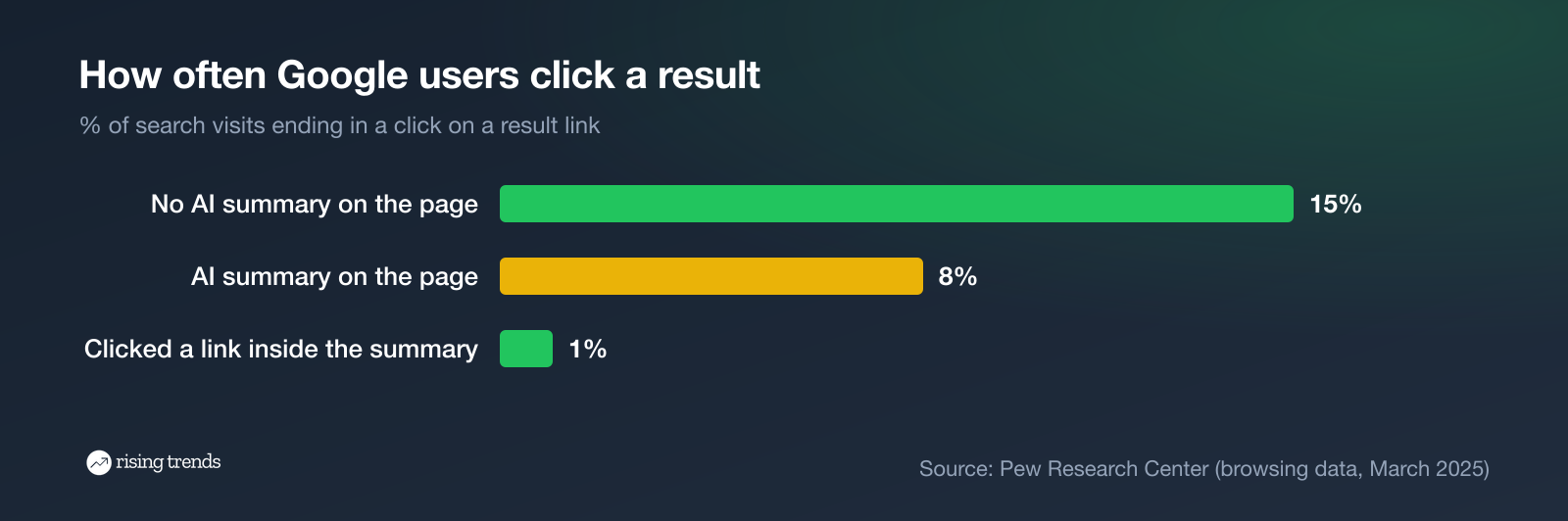
- AI answers eat the click. Google users click a result on 8% of visits when an AI summary appears, versus 15% without one (Pew), and Google's AI Mode passed 1 billion monthly users.
- Ads move inside AI answers. ChatGPT ads launched in February 2026 and now run in about 40 markets, reaching a product used by 1.2 billion people a week.
- GEO becomes a line item. 41.5% of companies already do generative engine optimization (CMO Survey), and 76% of ad buyers call AI-answer optimization their top area of focus (IAB).
- Budgets stay flat, AI takes a bigger share. Marketing budgets are 7.8% of revenue and 15.3% of them now go to AI (Gartner).
- AI takes the wheel in media buying. Meta's Advantage+ automated campaigns passed a $75 billion annual run rate.
- Social, creators and video take the budget. US social ad revenue grew 32.6% to $117.7 billion in 2025, passing search, and creator ad spend reached $37 billion.
- Commerce media keeps growing. Commerce media hit $63.4 billion in 2025 and Walmart's ad business grew 38% in its latest quarter.
- Measurement gets rebuilt. Only 39% of buyers use MMM, attribution and incrementality together, and 86% expect to change how they measure within a year.
- The human signal becomes a premium. 76% of Americans say it matters to tell AI from human content, and Reddit revenue grew 61%.
- AI creative goes mainstream, and "AI slop" gets a cost. 9 million small businesses use Meta's AI ad creative tools, while 38% of ad buyers worry about low-quality AI content.
Every figure comes from the organization that measured it (Pew Research, IAB, Gartner, the CMO Survey, and the platforms' own filings and announcements), plus our own search data where it adds something. Vendor research is labeled as such.
Let's get into it.
1. AI Answers Eat the Click
The click from search is shrinking, and it is now measured, not guessed.
Google says AI Mode passed 1 billion monthly users and has been merged with AI Overviews into one search experience. Independent data shows what that does to traffic. Pew Research tracked the browsing of 900 US adults and found people clicked a traditional result on 8% of visits when an AI summary appeared, versus 15% without one. They clicked a link inside the summary on just 1% of visits.
Vendor data points the same way. Ahrefs found the click-through rate for the top-ranking page is 58% lower when an AI Overview appears, across 300,000 keywords. And people are changing where they search: a 2026 Pew survey found 42% of US adults use AI chatbots to search for information.
What companies are doing
Google is monetizing the change rather than losing to it: Search revenue grew 17% to $63.3 billion in Q2 2026, and Google says AI Mode is increasing total queries.
What to expect in 2027
Expect fewer organic clicks per ranking in 2027, especially on long, question-style searches, where Pew found AI summaries appear on more than half of 10-word queries. Traffic forecasts built on 2023 click-through rates will be wrong. The answer is not to abandon search but to measure visibility in AI answers alongside rankings, and to invest in content that earns the click AI can't give: tools, data, comparisons and first-hand experience.
2. Ads Move Inside AI Answers
2026 is the year conversational AI became a paid media channel.
OpenAI began testing ads in ChatGPT on February 9, 2026 for logged-in adults on its Free and Go tiers, with paid plans kept ad-free and no ads near health or politics. By the end of August it had expanded to 31 European markets and opened a self-serve Ads Manager, saying tens of thousands of marketers had advertised. In October it said ChatGPT reaches 1.2 billion people a week and added a pixel, a Conversions API, attribution partners and incrementality testing.
What companies are doing
OpenAI is building the measurement stack advertisers expect: attribution with AppsFlyer, Triple Whale, Northbeam and Rockerbox, and geo-tests with Haus, Measured and WorkMagic. Meta says more than 1 million businesses use its AI business agents on WhatsApp and Messenger every week. Google has announced ads inside AI Mode.
What to expect in 2027
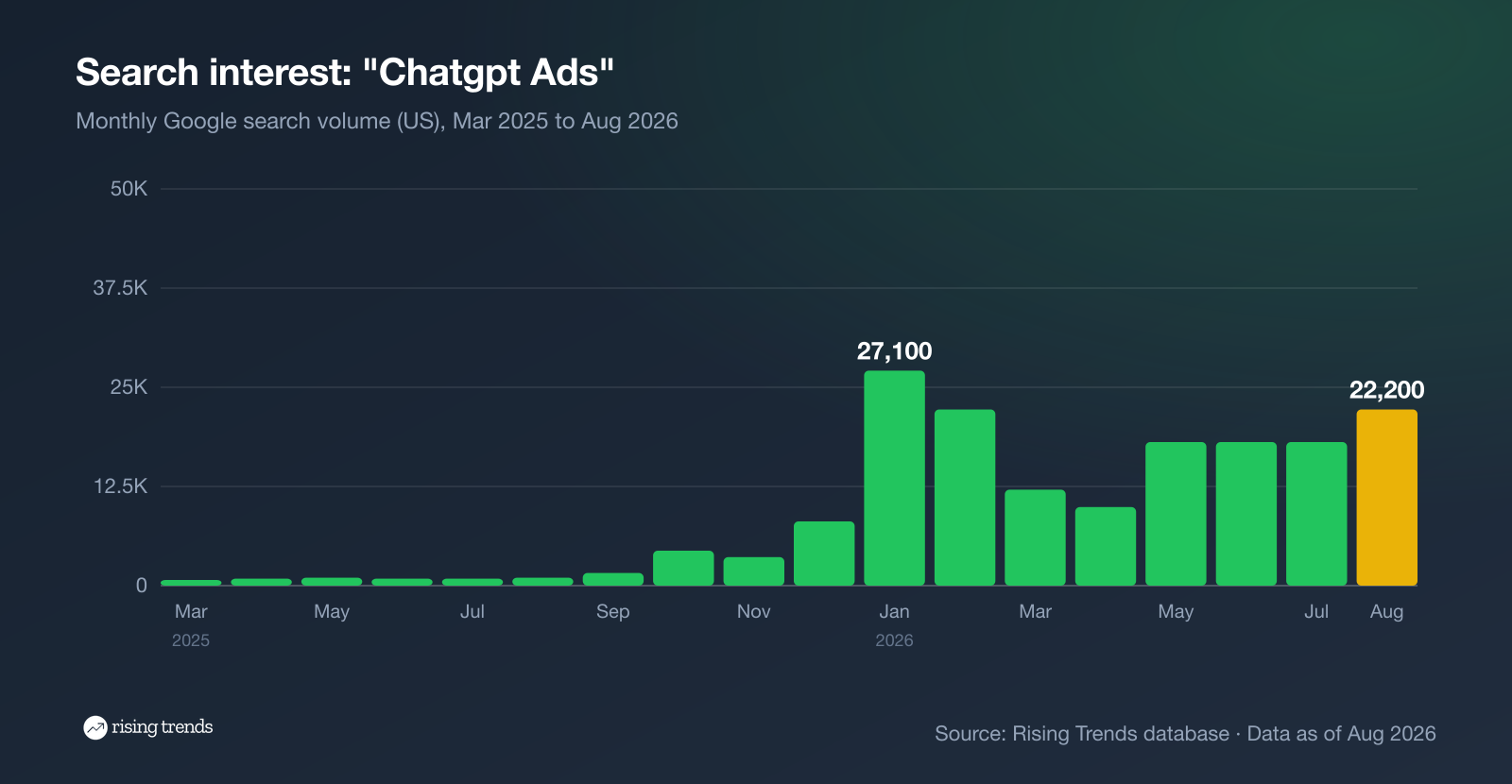
Expect AI assistants to become a standard line in 2027 media plans, starting with performance budgets that can be measured with the new conversion tools. Our search data shows how fast marketers noticed: "chatgpt ads" went from about 1,000 searches a month in August 2025 to a peak of 27,100 at the January launch, and is at 22,200 in August 2026.
3. GEO Becomes a Line Item
Getting cited by AI answers went from a fringe tactic to a mainstream goal in about a year.
The CMO Survey 2026 (308 US marketing leaders) found 41.5% of companies already use generative engine optimization (GEO). IAB's September 2026 Outlook update found 76% of ad buyers rank optimizing content for AI-generated answers as their top area of increased focus, and 44% call adapting to AI search their biggest media challenge.
It is a different game from SEO. BrightEdge (vendor data) found only about 17% of sources cited in AI Overviews also rank in the organic top 10, and AI Overviews now appear on about 48% of the queries it tracks.
What to expect in 2027
Expect "AI visibility" (how often your brand is cited or recommended in AI answers) to become a reported KPI in 2027, with its own tools and budget. Our search data shows the shift from buzzword to buying: "generative engine optimization" searches are down 45% in a year, while "ai seo agencies" is up 392%. Companies are no longer asking what GEO is; they are hiring someone to do it.
4. Budgets Stay Flat, AI Takes a Bigger Share, Teams Get Thinner
Marketing is being asked to do more with the same money.
Gartner's 2026 CMO Spend Survey puts marketing budgets at 7.8% of company revenue, effectively flat, with 15.3% of budgets going to AI. 56% of CMOs say they lack the budget to deliver their strategy. The CMO Survey found marketing spending grew only 1.7% in the past year, the weakest since 2021, and marketing headcount growth fell by more than half.
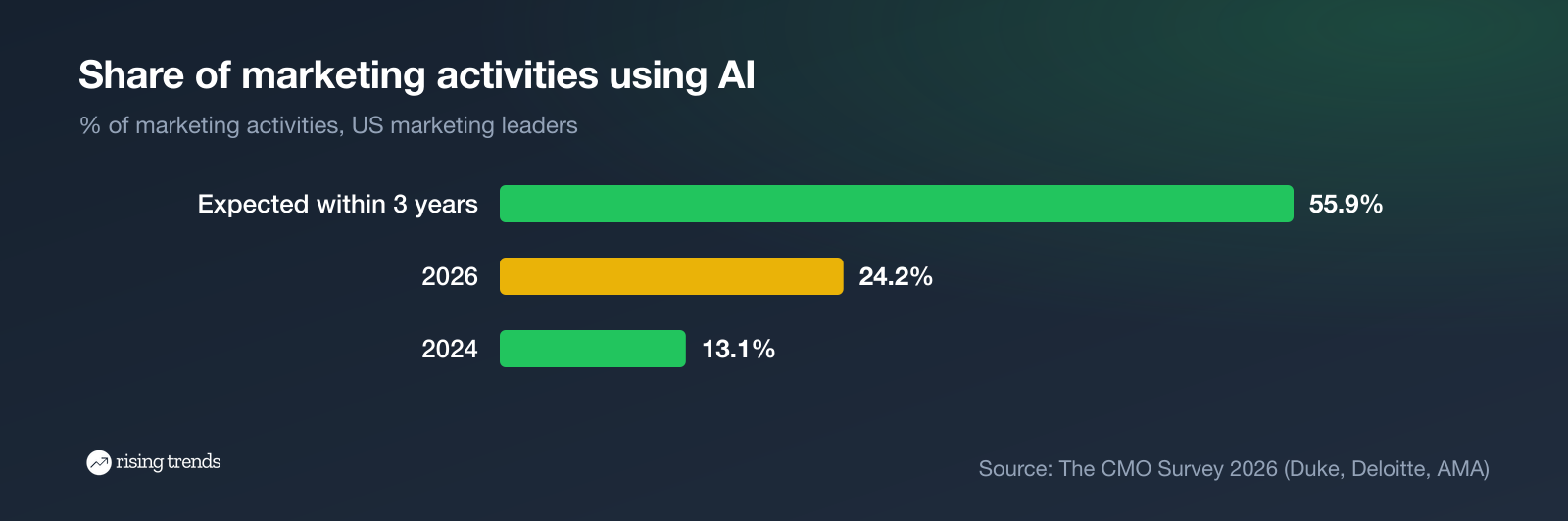
The money that is moving goes to AI and digital. The same CMO Survey shows AI used in 24.2% of marketing activities, up from 13.1% in 2024, and expected to reach 55.9% within three years. US internet ad revenue still grew 13.9% to $294.6 billion in 2025, and IAB raised its 2026 US ad spend growth forecast to 12.3%.
What to expect in 2027
AI is being funded by squeezing labor and training (training budgets are at 3.8% of marketing spend, against a pre-pandemic 5.8%). Expect 2027 to bring smaller teams that run more automated systems, and a skills gap: Gartner predicts that by 2027 a lack of AI literacy will be one of the top three reasons CMOs are replaced at large companies.
5. AI Takes the Wheel in Media Buying
The big ad platforms now push advertisers into automated campaigns by default.
Meta said its Advantage+ end-to-end solutions passed a $75 billion annual revenue run rate, and its AI ranking improvements raised conversions on Facebook by 15.7%. Google moved AI Max out of beta with hundreds of thousands of advertisers and automatically upgraded older search campaign types to it in September 2026. Amazon expanded its Ads Agent to 11 more countries.
The agencies and brands are following. IAB's 2026 digital video report found 21% of video buyers spending $1 million or more are already live with agentic AI in some campaigns, and another 25% plan to start this year.
What to expect in 2027
The media buyer's job shifts from pulling levers to supplying inputs: creative variety, first-party data, conversion signals and guardrails. Expect 2027 negotiations with platforms to be about transparency into what the automation is doing, because the controls marketers used to have are disappearing.
6. Social, Creators and Video Take the Budget
Social is now the biggest digital ad channel in the US.
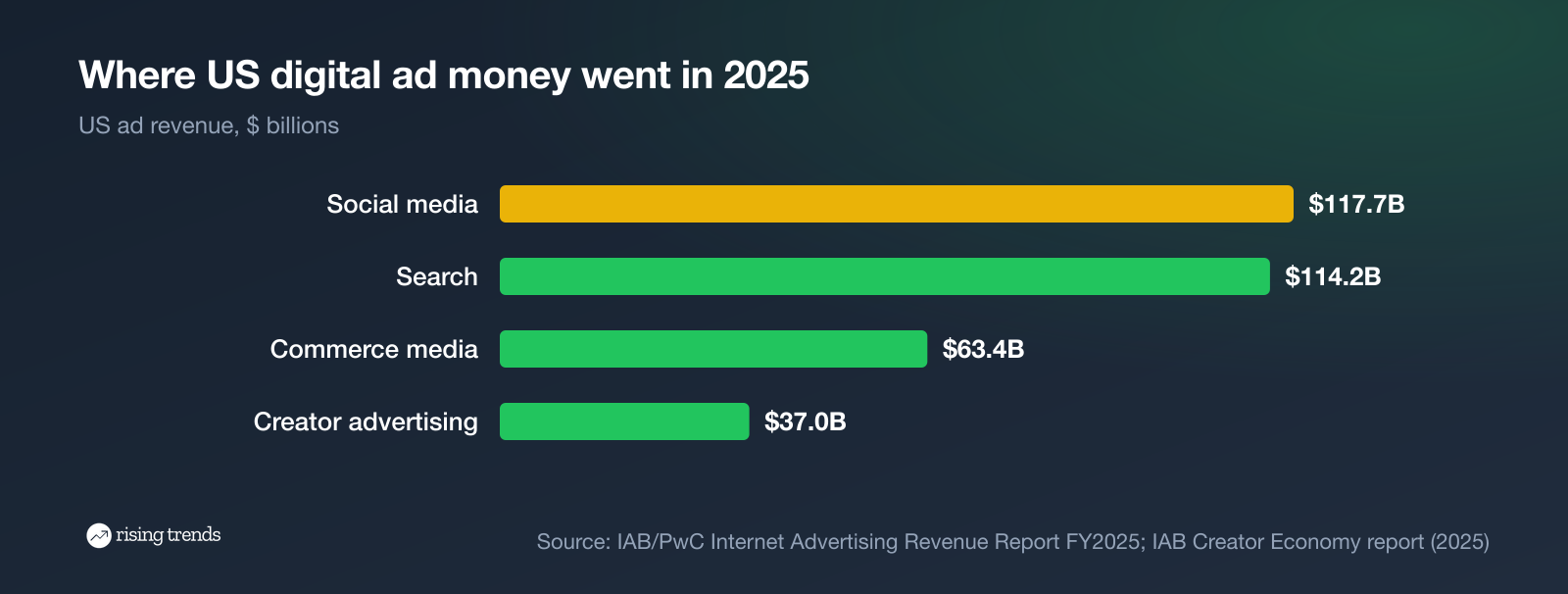
The same IAB/PwC report shows social media ad revenue grew 32.6% to $117.7 billion in 2025, about 40% of US internet ad revenue, ahead of search at $114.2 billion. IAB's creator economy report puts US creator ad spend at $37 billion in 2025, projected at $44 billion in 2026, growing about four times faster than total media. In video, social video ($28.2 billion) passed connected TV ($26.5 billion) in 2025.
Audiences explain why. Pew's 2025 social media survey found 84% of US adults use YouTube and 37% use TikTok, up from 21% in 2021.
What to expect in 2027
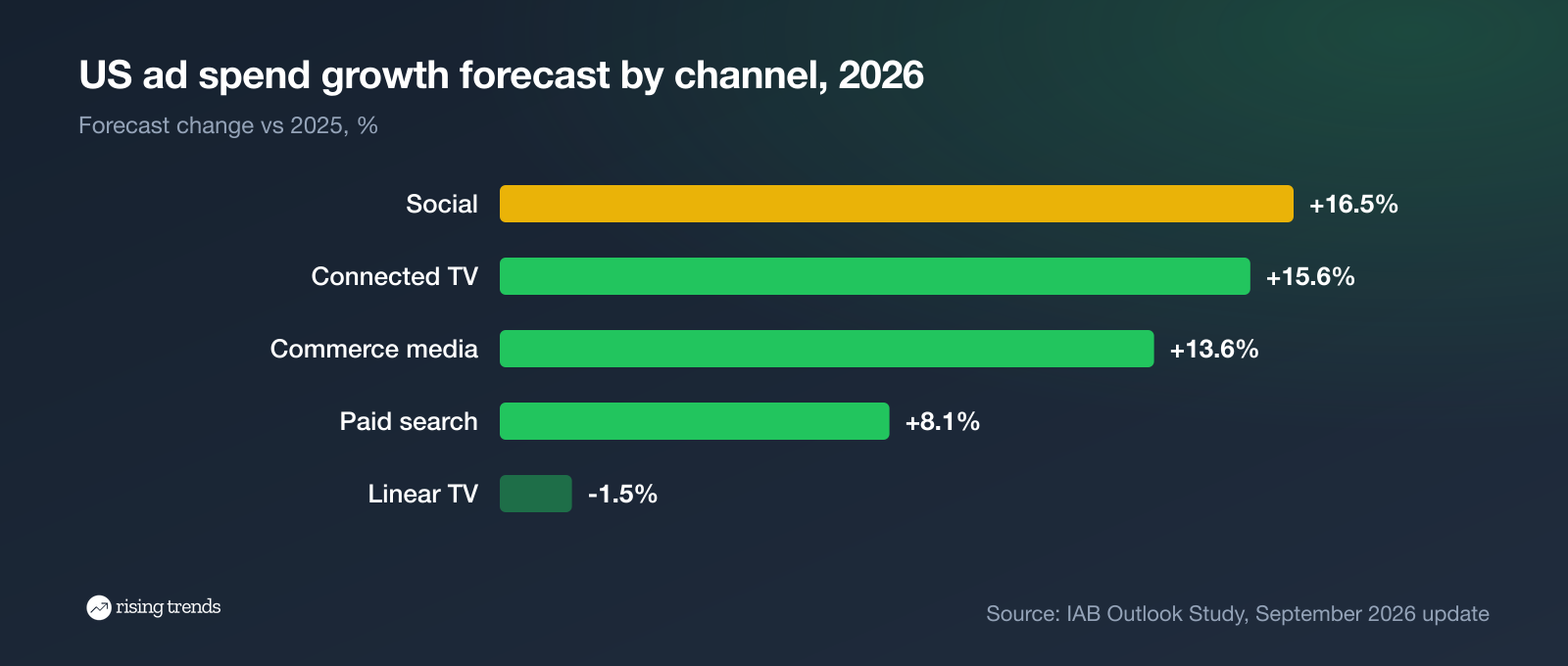
IAB's buyers expect social to keep leading 2026 growth at +16.5%, with connected TV at +15.6% and paid search at +8.1%. Creator partnerships are the ad type with the most increased focus (54% of buyers). Our search data agrees: "ugc creators" searches are up 173% in a year and "influencer marketing agency" up 83%.
7. Commerce Media Keeps Growing as the Shelf Moves Into Feeds and Chats
Retailers' ad networks are still growing faster than the overall market.
Commerce media reached $63.4 billion in 2025, up 18%, or 21.5% of US internet ad revenue, per IAB/PwC. Amazon's advertising revenue grew 26% to $19.8 billion in Q2 2026, and Walmart's global advertising grew 38%, with Walmart Connect up 43%.
Checkout is also moving into social and AI surfaces. TikTok said TikTok Shop topped $500 million in US sales over the 2025 Black Friday weekend (a company figure). Google has announced protocols for agent-led checkout on its AI surfaces.
What to expect in 2027
IAB buyers expect commerce media to grow 13.6% in 2026. Expect 2027 to blur the lines between retail media, social commerce and AI shopping, which makes product feed quality and retailer data partnerships part of the marketing job, not just the ecommerce team's.
8. Measurement Gets Rebuilt
Last-click attribution is breaking under signal loss and AI-driven journeys, and buyers are rebuilding.
IAB's State of Data 2026 found most buy-side decision-makers use at least one of incrementality testing, attribution or marketing mix modeling (MMM), but only 39% use all three, and up to 75% say the leading approaches fall short. IAB's September update found 86% expect to change how they measure media within 12 months because of conversational AI and agents.
The tools are getting cheaper. Google made its open-source MMM, Meridian, available to everyone, using incrementality results to calibrate the model. And the cookie deadline is gone: Google retired most Privacy Sandbox technologies in October 2025, citing low adoption, while Chrome keeps third-party cookies.
What to expect in 2027
Expect MMM plus experiments to become the default way large advertisers judge channels in 2027, with AI used to refresh models faster. IAB found more than 70% of teams not yet using AI in measurement expect to by 2027. The channels most underrepresented in today's models (creators, commerce media, gaming) stand to gain budget once they can be measured.
9. The Human Signal Becomes a Premium
As AI content floods feeds, people look harder for real humans.
Pew found 76% of US adults say it is extremely or very important to tell AI-made from human-made content, and 53% are not confident they can. That demand shows up in where people go. Reddit grew revenue 61% to $805 million in Q2 2026 with 514.6 million weekly users, and said more than 80 million people search directly on Reddit every week.
What to expect in 2027
Gartner predicts that by 2027, 20% of brands will differentiate by stressing the absence of AI, and that brands will put half of influencer budgets toward authenticity work such as identity checks and provenance. Expect community, first-hand expertise and clear AI disclosure to become brand assets in 2027, and expect regulators to keep watching: the FTC's rule on fake reviews and testimonials, which covers AI-generated reviews, carries penalties of up to $53,088 per violation.
10. AI Creative Goes Mainstream, and "AI Slop" Gets a Cost
Generative AI is now the default creative engine for many advertisers.
Meta says 9 million small businesses use at least one of its AI ad creative tools. The CMO Survey found 73.9% of companies use AI for content creation. But buyers are pulling back on low-quality output: IAB's September update found 38% of buyers worry about "AI slop", and the share using generative AI in media campaigns fell to 69% from 78% in January.
Consumers want to know. Gartner found 78% of consumers rate explicit labeling of AI content as very important or the most important factor for trust.
What to expect in 2027
Volume is no longer the advantage, because everyone can produce it. Expect 2027 creative strategy to separate AI used for testing and variation from AI that ends up as low-effort content in front of customers, with disclosure policies written down rather than improvised.
What We're Seeing in Search
Our database tracks US search demand across tens of thousands of trends. For marketing, as of August 2026:
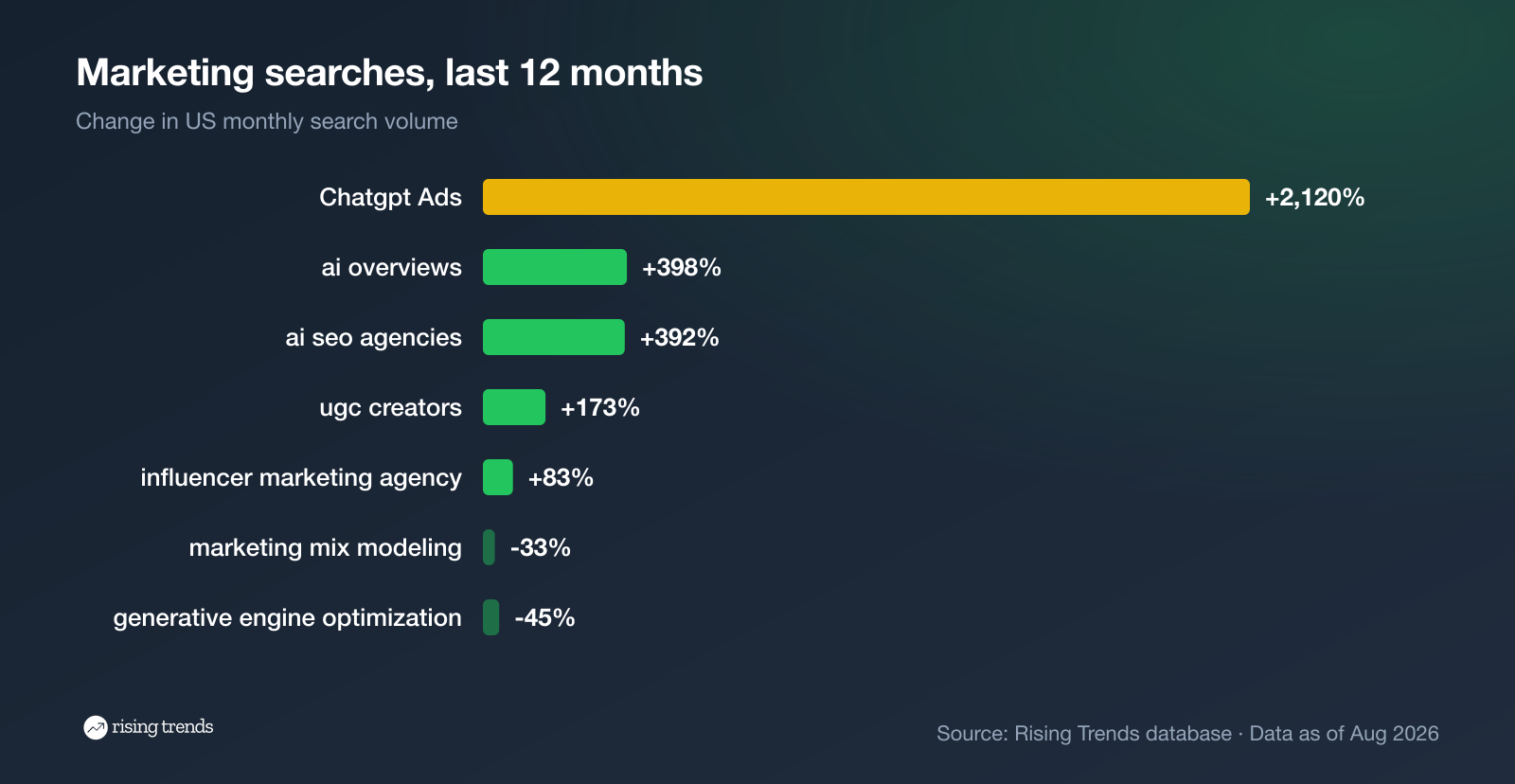
- AI ads are the new channel. "chatgpt ads" is up about 2,100% in a year.
- AI search is mainstream. "ai overviews" is up 398%.
- GEO moved from learning to hiring. "generative engine optimization" is down 45% while "ai seo agencies" is up 392%.
- Creators are in demand. "ugc creators" is up 173%, "influencer marketing agency" up 83%.
- Some jargon fades. "marketing mix modeling" searches are down 33%, even as large advertisers adopt it. The work is moving into tools rather than search.
For related reads, see our advertising trends, email marketing trends and AI industry trends, or how to find trending SEO niches.
The Common Thread
Put the ten shifts side by side and one pattern runs through them: marketing is being rebuilt around AI systems it doesn't fully control.
AI answers decide whether you get the click. AI assistants are becoming an ad channel. Platform automation decides where your budget goes. Measurement has to be rebuilt because the old signals no longer describe the journey. And all of this is happening with flat budgets and thinner teams.
If you plan for three things in 2027, plan for these: measure your brand's visibility in AI answers, not just your rankings, and fund the content that earns citations; test AI assistant ads while costs are low and measurement is new; and invest in the inputs automation can't create for you (first-party data, original creative and a human voice), because that is what separates you from everyone else using the same tools.
Frequently Asked Questions
What are the biggest digital marketing trends for 2027?
The biggest shifts are AI answers reducing search clicks, ads inside AI assistants like ChatGPT, generative engine optimization (GEO) becoming standard, flat budgets with a growing AI share, automated media buying, social and creator spending overtaking search, commerce media growth, rebuilt measurement, demand for human authenticity, and the cost of low-quality AI content.
Are AI Overviews reducing website traffic?
Yes, on average. Pew's browsing data found users clicked a search result on 8% of visits with an AI summary versus 15% without one, and Ahrefs (vendor data) found the top result's click-through rate about 58% lower when an AI Overview appears. Google says AI is increasing total searches and still sends billions of clicks a week.
What is generative engine optimization (GEO)?
GEO is the practice of getting your brand and content cited or recommended in AI-generated answers from tools like ChatGPT, Google AI Mode and Perplexity. The CMO Survey 2026 found 41.5% of companies already do it.
Can you advertise on ChatGPT?
Yes. OpenAI started testing ads in ChatGPT in February 2026, expanded to Europe and launched a self-serve Ads Manager in August 2026, and added conversion tracking and incrementality testing in October 2026. Ads appear for users on the Free and Go tiers.
How much do companies spend on marketing in 2026?
Gartner's 2026 CMO Spend Survey puts marketing budgets at 7.8% of company revenue, with 15.3% of those budgets going to AI. The CMO Survey, which covers a different set of US companies, puts it at 9.0% of revenue.
Want to spot the next marketing shift before your competitors? Read our guide on how to identify market trends or browse what's gaining traction in our trending topics list.
Never miss a trend again
- One trend broken down with the numbers
- Who's making money, and what to build
- A website on the rise
- A breakout app
Join 5,000+ founders · Free