Trends


Let's cut through the B2B ecommerce hype.
Every year you get the same recycled "top trends" listicles — vague predictions about "digital transformation" written by people who've never managed a wholesale catalog or negotiated net-60 terms. That's not what this is.
The global B2B ecommerce market hit $32.11 trillion in 2025 and is growing at a 14.5% CAGR toward $36 trillion in 2026, according to the International Trade Administration.
Gartner predicted that 80% of B2B sales interactions would occur in digital channels by 2025 — and we're now living in that reality. AI agents are negotiating quotes. Buyers are placing six-figure orders without ever talking to a rep. And the line between B2B and B2C experiences has essentially dissolved.
Every trend here is backed by first-party data from the organizations actually measuring this shift — Gartner, Forrester, McKinsey, Digital Commerce 360, and the companies building the infrastructure.
The 11 B2B ecommerce trends reshaping 2026:
Let's get into it.
This is the trend that changes everything else in B2B commerce: AI is no longer a tool you query — it's a participant in the deal.
According to Forrester's 2026 predictions for digital commerce, 20% of B2B sellers will be compelled to respond to AI-powered buyer agents with dynamically delivered counteroffers via seller-controlled agents.
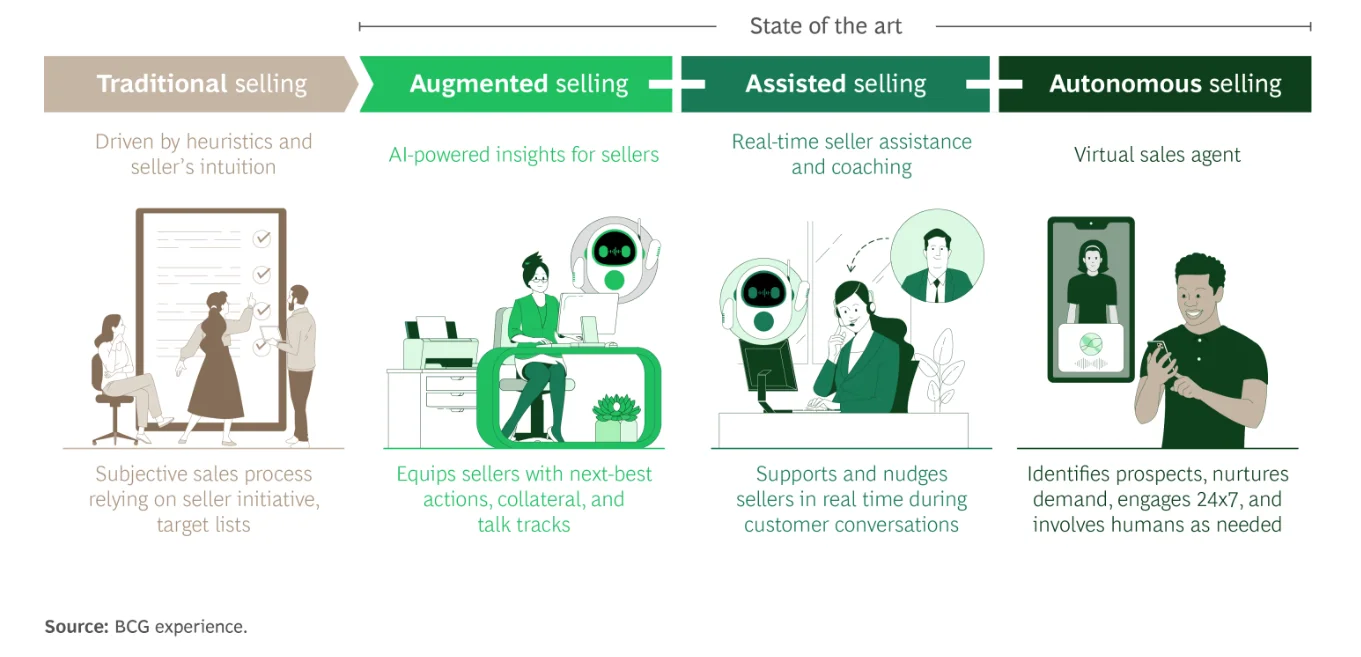
These aren't chatbots answering FAQ questions. Buyer bots are negotiating prices and terms, establishing replenishment cadence, and confirming compliance — while seller bots ensure prices remain tenable and plan inventory availability for negotiated orders.
Forrester also warns that ungoverned use of AI will lead to over $10 billion in enterprise value losses — making governance the flip side of this opportunity.
Salesforce launched Agentforce with pre-built AI agents for procurement, inventory management, and supplier evaluation — autonomous systems that reason, plan, and act on behalf of the organization without human intervention for routine decisions.
SAP expanded AI copilot capabilities across S/4HANA, enabling natural language queries and autonomous exception handling in procurement and logistics workflows.
Shopify reported its revenue rose 30% to $11.56 billion in 2025, with B2B GMV increasing 96% year-over-year — growth fueled in part by AI-powered commerce features embedded across its platform.
2026 is the year AI stops being "a feature" and starts being a counterparty. The companies that win aren't the ones with the fanciest AI demos — they're the ones who figure out governance, guardrails, and when to let the machine negotiate versus when to pull a human in.
Forrester predicts five major US or European brands will unify "agentic commerce" experiences this year. That means AI handling everything from quote generation to order fulfillment, with humans overseeing strategy and exceptions.
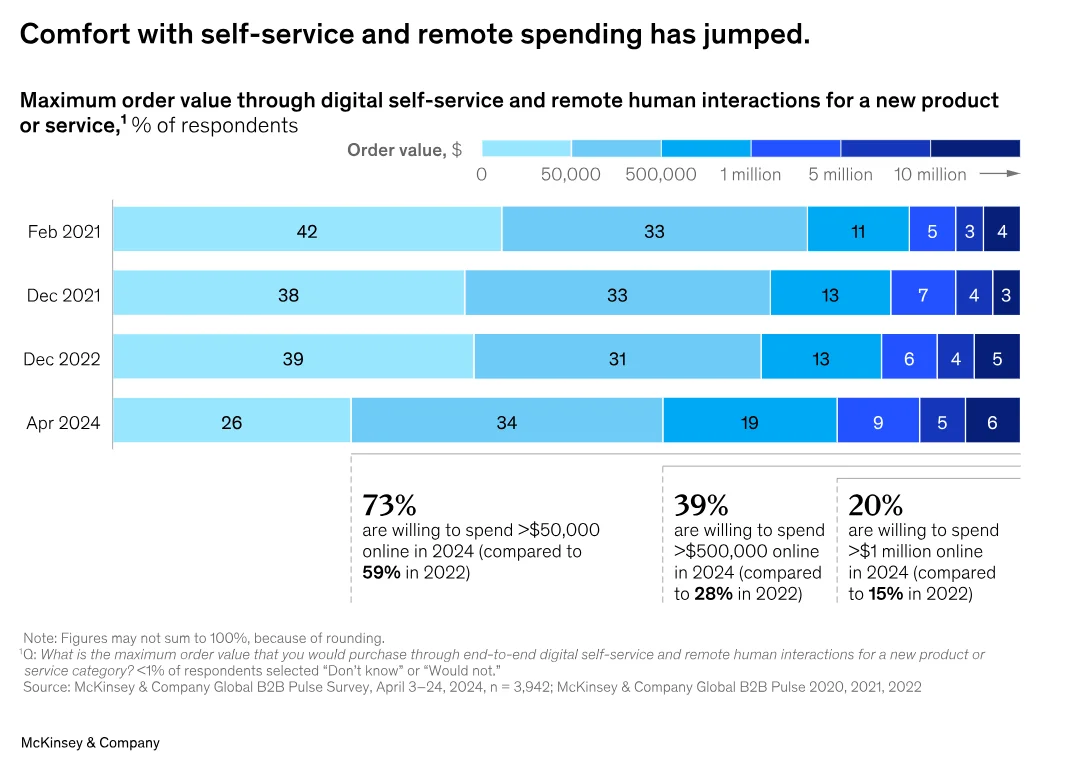
Here's a stat that should make every B2B sales leader reconsider their org chart: 73% of B2B buyers are now willing to place orders over $50,000 through digital self-service channels.
According to McKinsey's B2B Pulse survey, 39% of B2B buyers now spend over $500,000 per order through self-service ecommerce or remote interactions — up from 28% just two years ago. E-commerce has dethroned in-person sales as the top revenue-generating channel among organizations that offer it.
And it's not just the transaction itself. Gartner’s latest findings show that 61% of B2B buyers now prefer a completely seller-free experience. This shift is driven by the generational turnover in buying committees — Millennials and Gen Z now hold the majority of B2B purchasing power.
The preference for digital self-service has become the definitive standard for the modern buyer journey.
Faire, the wholesale B2B marketplace, hit a $5.2 billion valuation in late 2025, with GMV growth accelerating for eight consecutive quarters. Retailers are ordering from more brands each year with net dollar retention above 110% — all through self-service.
Shopify saw B2B ecommerce sales surge 109% year-over-year in Q1 2025, as enterprise customers like Sonepar (international electrical distributor) and Follett (1,000+ campus bookstores) shifted wholesale operations to digital self-service.
Amazon Business surpassed $35 billion in annualized GMV, now serving over 8 million organizations including 97 of the Fortune 100. Product selection from small business sellers rose 80% year-over-year.
The sales rep isn't disappearing — they're being repositioned. The routine reorder, the catalog browse, the standard quote request? Those are self-service now. Reps are being redirected toward complex deals, strategic accounts, and relationship management where human judgment still matters.
The companies getting this wrong are the ones still gating basic purchasing behind "contact sales" buttons. That's not a strategy — it's a buyer repellent.
Personalization in B2B used to mean putting the buyer's company name in an email subject line. That era is over.
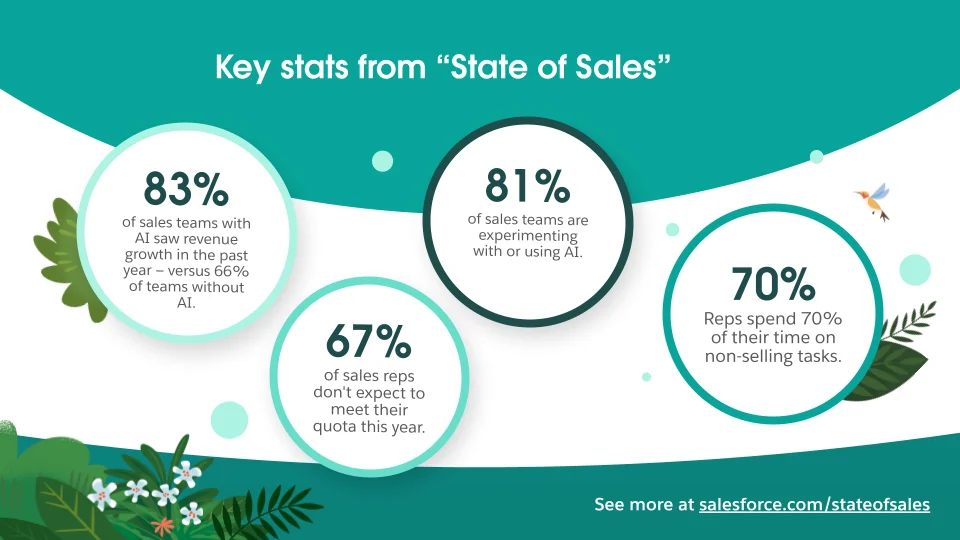
According to Salesforce's State of Sales data, 83% of sales teams using AI grew revenue in the past year — compared to just 66% of teams without it. The gap is widening, not narrowing, and the shift is accelerating.
Forrester's 2026 buyer insights reveal that a staggering 94% of B2B buyers have now integrated generative AI as one of the top tools for self-guided research throughout every phase of their buying process. That means your buyers are already using AI to evaluate you — and they expect you to use it right back.
Salesforce reports that shoppers who click AI-powered recommendations are 4.5x more likely to purchase — a stat that holds in B2B contexts where recommendation engines surface compatible parts, accessories, and frequently co-purchased items.
SAP released their State of B2B Ecommerce report showing AI is reshaping product catalog management, with generative AI automatically creating rich, technical, SEO-optimized descriptions for thousands of SKUs — work that previously required entire content teams.
BigCommerce integrated AI-driven personalization across their B2B platform, enabling custom catalogs, dynamic pricing displays, and account-specific product recommendations — all generated automatically based on buyer history and industry segment.
The personalization bar keeps rising. In 2026, "personalized" doesn't mean showing relevant products — it means anticipating reorder timing, predicting when a buyer's inventory will run low, and proactively surfacing alternatives when supply chain disruptions hit their preferred items.
The companies that treat GenAI as a content automation tool are leaving money on the table. The winners are using it as a demand intelligence engine. (For a broader look at how generative AI is reshaping industries beyond commerce, see our generative AI trends for 2026.)
Here's a number that tells the whole story: five years ago, Digital Commerce 360 counted just 75 B2B marketplaces. Today, that number has surged past 850 and is on a relentless climb toward 1,200 by 2027.
In the global arena, Alibaba.com continues to anchor the Asia-Pacific market with over $135 billion in annual revenue influence. On the other hand, Amazon Business has maintained a global annualized gross sales run rate of over $35 billion. The North American market remains the primary driver of this growth, consistent with its nearly 60% share of the company's total revenue.
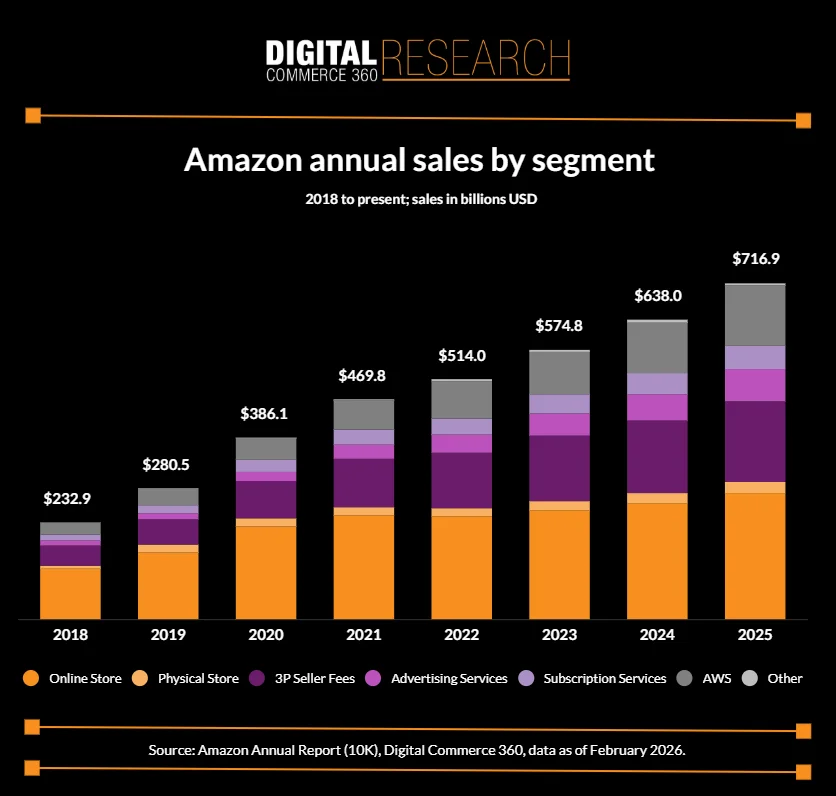
Marketplaces are no longer just 'discovery channels' — they are the operating systems of global trade.
Amazon Business has cemented its position as a global procurement powerhouse, maintaining an annualized GMV of over $35 billion. The platform's massive scale now serves 8 million organizations, including 97 of the Fortune 100, 66 of the FTSE 100, and 38 members of Germany’s DAX-40.
Faire reached a $5.2 billion valuation, annualizing over $500 million in revenue with 40%+ year-over-year growth — proving the wholesale marketplace model works beyond industrial procurement.
Alibaba.com continued expanding its global B2B marketplace, with the AIDC segment posting 22% year-over-year revenue growth driven by cross-border ecommerce and smarter buyer-seller matching tools.
The marketplace explosion is forcing manufacturers and distributors to develop multi-marketplace selling strategies — the same way B2C brands learned to sell on Amazon, Walmart, and their own DTC sites simultaneously.
But here's the catch: marketplace dependency is a risk.
The smartest B2B companies are using marketplaces for discovery and acquisition, then migrating high-value buyers to their own digital properties for deeper relationships and better margins.
BNPL isn't just for consumer impulse purchases anymore. The B2B version — embedded trade credit at checkout — is experiencing explosive growth.
According to Juniper Research, BNPL transaction value will rise 106% globally by 2028, catalyzed by regulatory breakthroughs and — critically — increased B2B use. An earlier Juniper forecast projected global BNPL spend reaching $995 billion in 2026, up from $266 billion in 2021.
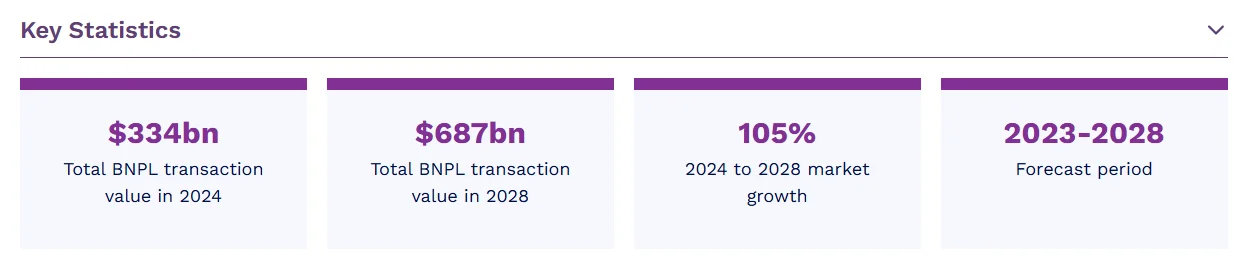
The US BNPL market alone is projected to grow from $107.38 billion in 2025 to $258.4 billion by 2031, according to a Research and Markets report.
Hokodo raised a $40 million Series B to expand its B2B BNPL platform internationally, offering instant trade credit decisions at checkout for business buyers — eliminating the weeks-long credit application process that kills conversion.
Mondu raised $56 million from Valar Ventures and FinTech Collective, building embedded B2B payment solutions that integrate directly with ecommerce checkouts, offering invoice payments, SEPA direct debit, and installment plans.
Billie established itself as a leading B2B BNPL provider in Europe, offering real-time credit decisions and non-payment risk protection as standard — removing the biggest friction point in B2B digital purchasing.
B2B BNPL is solving one of the oldest problems in wholesale: the mismatch between when buyers need goods and when they can pay. Traditional trade credit processes — paper applications, manual credit checks, weeks of waiting — are incompatible with the instant-checkout world buyers now expect.
The winners here are companies embedding credit decisioning directly into the purchasing flow, making "pay in 30/60/90 days" as frictionless as clicking a button. (For a deeper look at how open banking and AI-powered underwriting are enabling instant business credit, see our fintech trends for 2026.)
The monolithic ecommerce platform — the one where your catalog, checkout, CMS, and search are all welded together — is becoming a competitive liability.
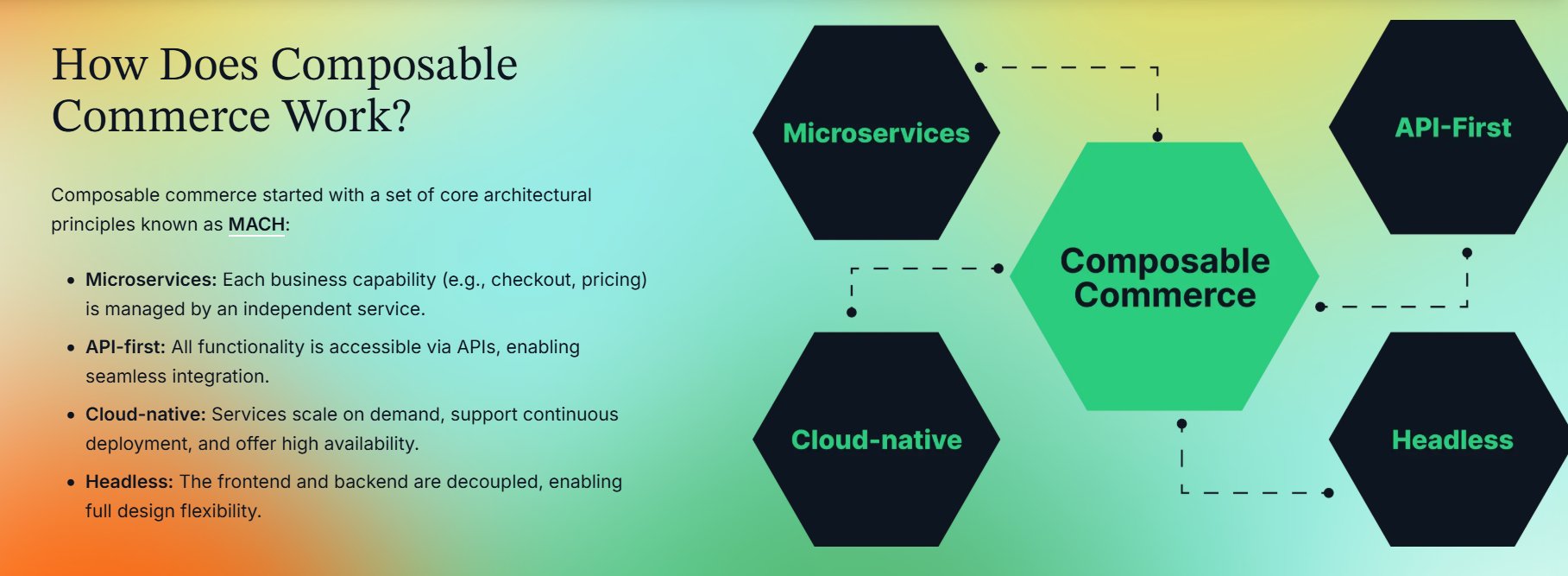
The global headless commerce market was valued at $1.7 billion in 2025 and is projected to grow to more than $7 billion by 2032, according to Coherent Market Insights. The shift is being driven by a fundamental truth: B2B commerce in 2026 requires flexibility that monoliths can't deliver.
Forrester's 2026 Buyers' Journey Survey reinforces this: 94% of B2B buyers now use GenAI for self-guided research — and companies on rigid platforms simply can't integrate these new AI-driven experiences fast enough.
commercetools — a fully composable, MACH-certified platform — is leading the charge in API-first B2B commerce, enabling companies to plug in or replace any service independently. Their platform lets each component scale on its own, making it ideal for complex B2B scenarios.
BigCommerce launched its composable storefront Catalyst, earning placement in the 2025 Paradigm B2B Combine and recognition as a Challenger in the 2025 Gartner Magic Quadrant for Digital Commerce. Movora, a vet medtech brand, migrated to BigCommerce and went headless — achieving over 100% ecommerce growth in the US within months.
Elastic Path expanded its composable platform to support B2C, B2B, and marketplace models simultaneously, enabling fast launches, free integration, and global scale from a single architecture.
By the end of 2026, composable architecture won't be a competitive advantage — it'll be table stakes. Companies still running monolithic platforms will face a growing gap: unable to integrate new AI capabilities, unable to launch new buyer experiences quickly, and unable to support the omnichannel journeys their buyers demand.
The question isn't "should we go composable?" anymore. It's "how fast can we decompose what we have?"
The days of emailing PDFs back and forth and scheduling 14 follow-up calls to close a B2B deal are numbered.
Gartner identified digital sales rooms as one of seven technology disruptions transforming sales through 2027, predicting that 50% of B2B buyers would interact with a digital human in a buying cycle — and in 2026, that prediction is now reality.
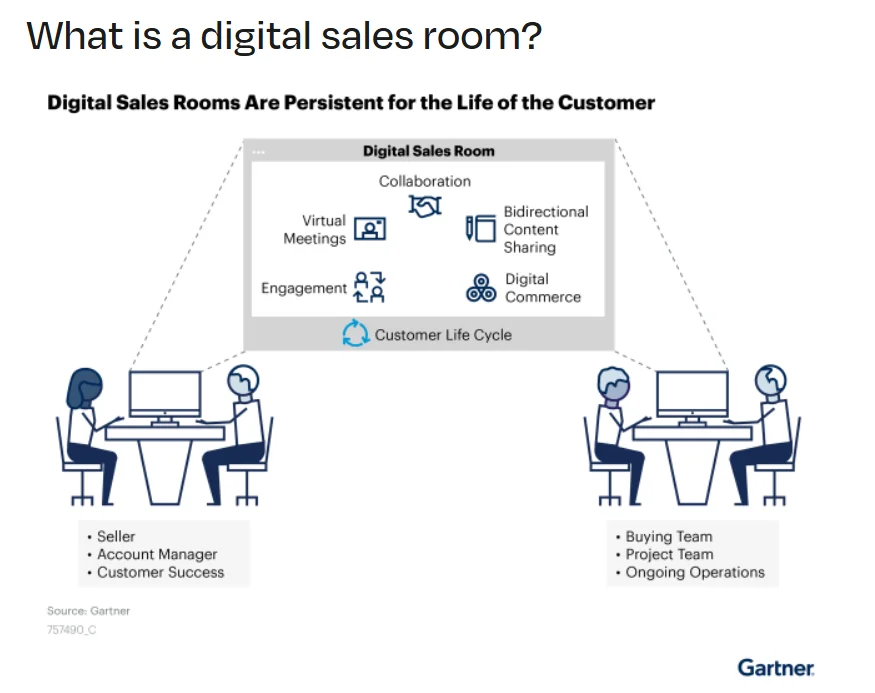
McKinsey's research found that using digital sales rooms can increase sales productivity by up to 30% while reducing sales costs by up to 20% — driven by asynchronous collaboration, embedded analytics, and faster buying committee alignment.
Gartner published their Market Guide for Digital Sales Rooms, recognizing the category as a critical enabler of modern B2B sales — not just a nice-to-have, but a fundamental shift in how complex deals are managed.
Salesforce reported in their 2026 State of Sales research that 60% of B2B sales organizations are moving to data-driven selling, merging sales process, applications, and data into unified operational practices — with digital sales rooms serving as the central hub.
commercetools highlighted digital sales rooms as a pivotal trend in their 2026 B2B digital commerce whitepaper, noting that these spaces compress sales cycles by giving buying committees a shared, persistent environment to evaluate proposals, negotiate terms, and track deal progress.
Digital sales rooms are evolving from "shared document folders with analytics" to "intelligent deal environments." The next wave integrates AI that summarizes stakeholder engagement, identifies which committee members haven't reviewed proposals, suggests optimal follow-up timing, and flags when a deal is at risk.
For B2B sellers managing complex, multi-stakeholder deals, this technology isn't optional anymore — it's how you compete.
If you think social selling is just for consumer brands hawking skincare on Instagram, think again. Social is now a core node in an increasingly complex B2B buying web — and the companies that treat it as an isolated channel are getting left behind.
According to Forrester's 2026 B2B buyer research, as generative AI provides buyers with more information, they increasingly turn to human experts and peer networks on social platforms to validate insights and answer complex questions. Seven in ten B2B decision-makers now use social platforms to research or evaluate vendors, with usage reaching 75% or higher in some segments.
Here's the bigger picture: the McKinsey B2B Pulse data shows B2B decision-makers now use an average of 10.2 channels in their buying journey — up from just five channels in 2016. That's a 100% increase in channel complexity in under a decade.
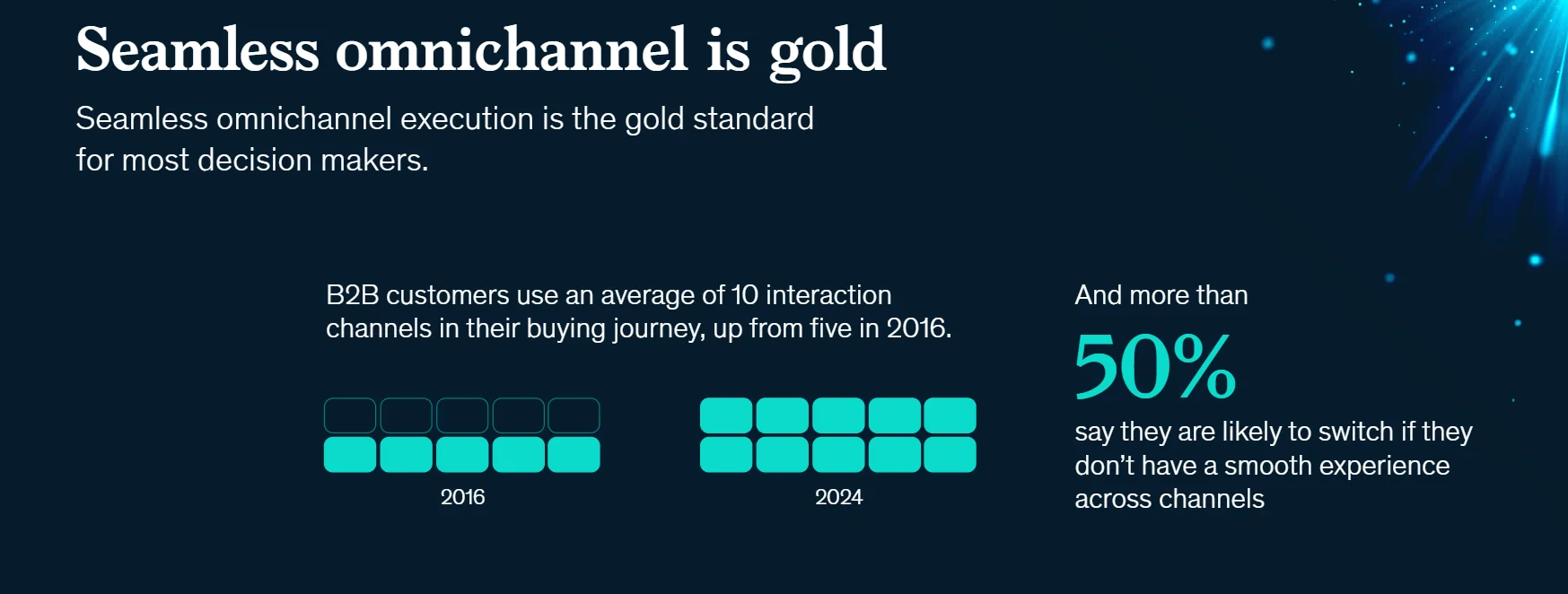
Social media, marketplaces, mobile search, email, direct web portals — buyers move fluidly between all of them. And according to the same McKinsey data, 54% of B2B decision-makers would abandon a purchase or switch suppliers if they experienced a poor omnichannel experience.
LinkedIn has evolved from a job board into the dominant B2B social commerce platform, with buyer research, thought leadership engagement, and direct messaging driving vendor evaluation and shortlisting — making it the #1 social channel for B2B purchasing decisions.
Alibaba.com executed an omnichannel strategy across its B2B, B2C, and cross-border platforms — leveraging social and content-driven discovery to fuel its AIDC segment's 22% year-over-year revenue growth, using buyer-seller matching algorithms and social proof features to accelerate cross-border transactions.
Shopify expanded B2B social commerce integrations, enabling wholesale merchants to connect their product catalogs directly to social platforms — blending B2C discovery mechanics with B2B purchasing workflows.
Kibo Commerce built a unified commerce and OMS platform specifically designed for B2B and B2C omnichannel, enabling companies to manage inventory, orders, and customer experiences across every touchpoint from a single system.
2026 is the year B2B marketers stop treating social as "brand awareness" and start treating it as a revenue channel. (For how social commerce is playing out on the consumer side — including TikTok Shop crossing $23B — see our advertising trends for 2026.) But it doesn't work in isolation. True omnichannel means unified data everywhere — same pricing, same inventory visibility, same account history — whether a buyer starts on LinkedIn, moves to your marketplace listing, and finishes on your mobile app.
The technology that makes this possible — PIM systems, composable architecture, unified data platforms — is maturing fast. The bottleneck in 2026 isn't technology. It's organizational willingness to break down channel silos.
Expect B2B social commerce features to mature rapidly: in-platform quoting, embedded product configurators, and social proof from verified business buyers.
If your B2B site still relies on a basic search bar and faceted filters to help buyers find what they need, you're already behind.
Here's the stat that should alarm every B2B commerce leader: according to Forrester's Buyers' Journey Survey, 2025, 94% of B2B buyers have adopted generative AI as a top source of self-guided information — meaning they're already using conversational AI to research products, compare specifications, and evaluate suppliers before they ever reach your site.
The Reveation Labs analysis of B2B product discovery trends puts it bluntly: traditional catalog search is being replaced by AI agents that navigate inventory more efficiently than manual workflows — understanding complex requirements, compatibility constraints, and even suggesting alternatives when preferred items are unavailable.
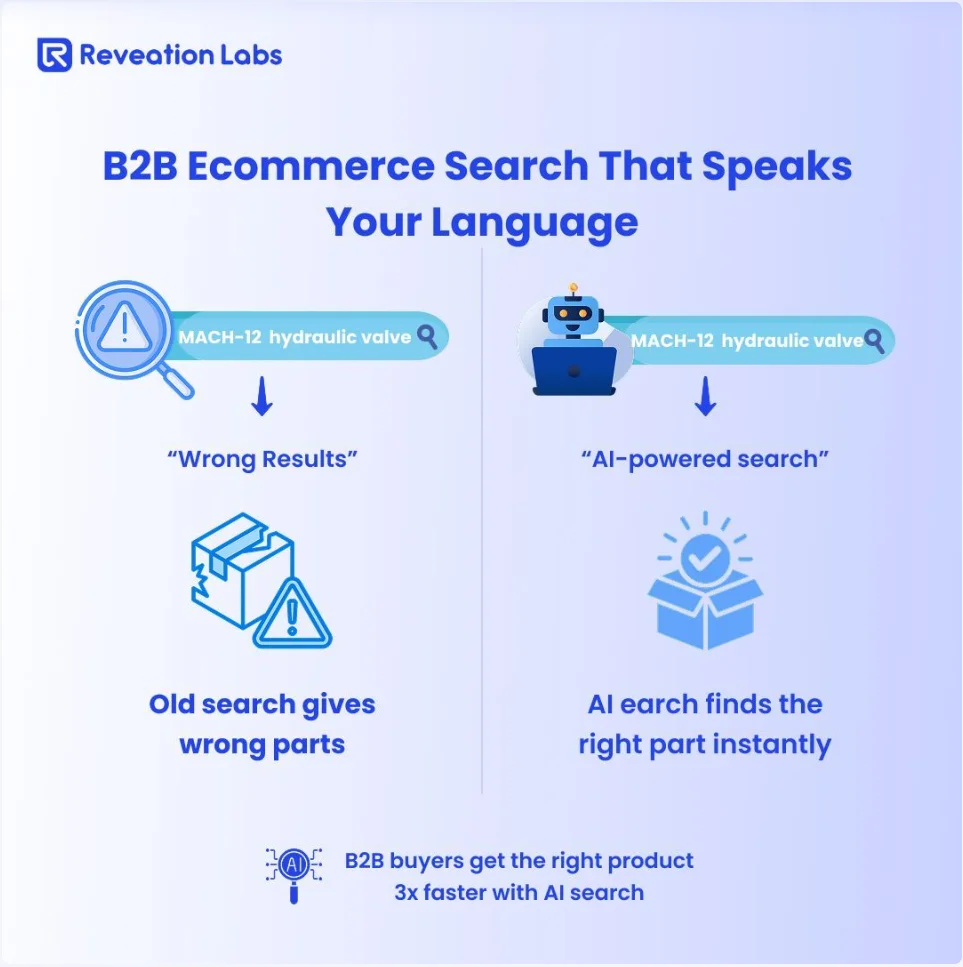
SAP extended the capabilities outlined in their State of B2B Ecommerce report by integrating natural language product discovery into their commerce stack, enabling buyers to describe complex technical requirements conversationally — and receive accurate product matches across catalogs with tens of thousands of SKUs.
BigCommerce embedded AI-powered search that understands industry jargon, technical specifications, and part number variations — dramatically reducing the "zero results" problem that plagues traditional B2B search.
commercetools deployed composable search APIs that allow businesses to swap in AI-driven discovery engines without rebuilding their entire frontend — giving companies access to conversational product discovery regardless of their existing tech stack.
The end state isn't just "better search." It's AI that knows your buying history, understands your equipment compatibility requirements, monitors your inventory levels, and proactively surfaces products you'll need before you search for them.
In 2026, product discovery shifts from reactive (buyer types a query) to predictive (AI anticipates the need). Companies with 50,000+ SKU catalogs will see the biggest impact.
Here's a reality check: the B2B buyer placing a $200,000 order is doing their research on their phone.
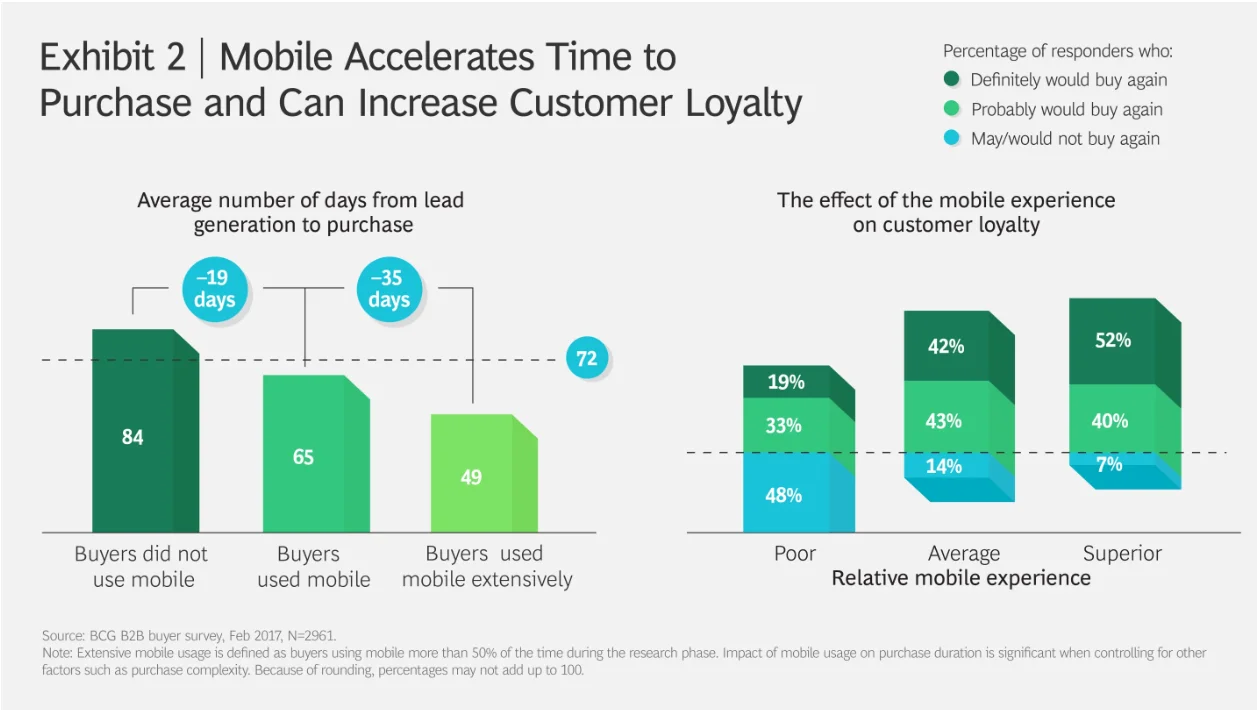
According to SellersCommerce 80% of B2B buyers use smartphones and tablets to compare pricing, read reviews, and evaluate product catalogs before ever contacting a sales rep.
This tracks with the broader demographic shift: millennials now represent 73% of B2B buyers, according to Coalition Technologies' B2B marketing data — a generation that grew up with Amazon and expects self-service portals and consumer-grade mobile experiences in every purchasing context.
Shopify built mobile-first B2B capabilities directly into their platform, including company accounts with multiple buyers, mobile-optimized custom catalogs, and payment term management — all accessible on any device.
OroCommerce developed purpose-built B2B mobile experiences with features that go beyond responsive design: offline access for field reps, barcode scanning for reorders, and push notifications for order status updates.
Faire attributes a significant portion of its wholesale marketplace growth to mobile-first design — enabling independent retailers to discover and order from new brands directly from their phones during store hours, rather than sitting at a desktop after closing.
Mobile-first in B2B doesn't mean "shrink the desktop site." It means purpose-built mobile experiences: one-tap reordering, camera-based part identification, voice-enabled search, and location-aware inventory lookups.
The companies still treating mobile as an afterthought are losing deals at the research stage — long before buyers even reach the checkout page.
ESG isn't just a compliance checkbox anymore — it's a procurement filter.
The Corporate Sustainability Reporting Directive (CSRD) is now in effect, requiring thousands of companies to report on environmental, social, and governance metrics — and that requirement cascades through supply chains. If you sell to companies subject to CSRD, they need sustainability data from you.
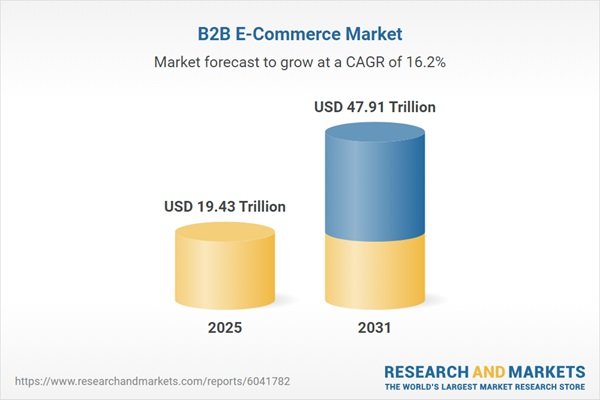
According to the Global B2B E-Commerce Market report via GlobeNewswire, the market is projected to reach $47.54 trillion by 2030, driven by three forces: AI, omnichannel strategies, and sustainability. Sustainability isn't a trend separate from ecommerce — it's becoming embedded in purchasing decisions, vendor qualification, and platform features.
SAP embedded sustainability tracking directly into its commerce and procurement platform, enabling businesses to measure carbon footprint data at the product and supplier level — turning ESG reporting from a manual process into an automated workflow.
Shopify expanded sustainability features for B2B merchants, including carbon-aware shipping options and tools for tracking and communicating environmental impact data to business buyers.
Alibaba.com introduced supplier verification tools that include sustainability certifications and ethical sourcing credentials, enabling buyers to filter and prioritize suppliers based on environmental and social impact criteria.
In 2026, the most forward-thinking B2B companies aren't just reporting on sustainability — they're making it a selling point. Blockchain-based traceability, real-time carbon footprint calculators, and ESG scorecards embedded in product listings are moving from "nice to have" to "required for enterprise deals."
Procurement teams at large organizations now include sustainability metrics as hard requirements in RFPs. If you can't prove your environmental impact, you're getting cut from the shortlist.
Across all eleven trends, one pattern keeps emerging: the B2B buyer is now in control — and they expect a B2C-level experience with B2B-level complexity built in.
Self-service over sales calls. AI agents over email chains. Mobile research over in-person demos. Instant credit over paper applications. Conversational discovery over keyword search. Sustainability data over trust-me promises.
The companies winning in 2026 aren't necessarily the ones with the biggest tech budgets. They're the ones who recognized a fundamental shift: B2B buyers don't separate their consumer expectations from their professional purchasing behavior anymore. They want the Amazon ease, the Instagram discovery, the Klarna flexibility — but with the custom pricing, bulk ordering, complex approval workflows, and trade credit terms that B2B requires.
The technology to deliver all of this — composable architecture, generative AI, agentic commerce, embedded fintech — is mature enough to deploy today. The bottleneck isn't capability. It's speed of adoption.
If you're still running a B2B operation that requires buyers to call for pricing, fax purchase orders, or navigate a catalog built in 2018 — 2026 is the year that strategy stops being "behind" and starts being "out of business."
Want to spot emerging B2B ecommerce trends before they hit mainstream? Check out our guide on how to identify market trends or explore what's gaining traction on our trends dashboard.
Looking to stay ahead in ecommerce? Learn how to find trending ecommerce products and spot rising ecommerce brands with Rising Trends.
Thousands of Emerging Trends
Thousands of Breakout Apps
Mega Trends
Trend Analysis Tool