Trends


Look, I'm tired of those generic "top trends" articles that sound like they were written by someone who hasn't shipped code since jQuery was cool.
So let's do this differently.
Every trend here comes with hard numbers from recent surveys and studies by giants like GitHub, Stack Overflow and the Rust Foundation — the folks actually measuring what developers do.
Top Software developement trends going into 2026:
Let's get into it.
Here's a wild stat: according to the 2025 Stack Overflow Developer Survey, 84% of developers now use or plan to use AI tools in their development process. That's up from 76% just last year.
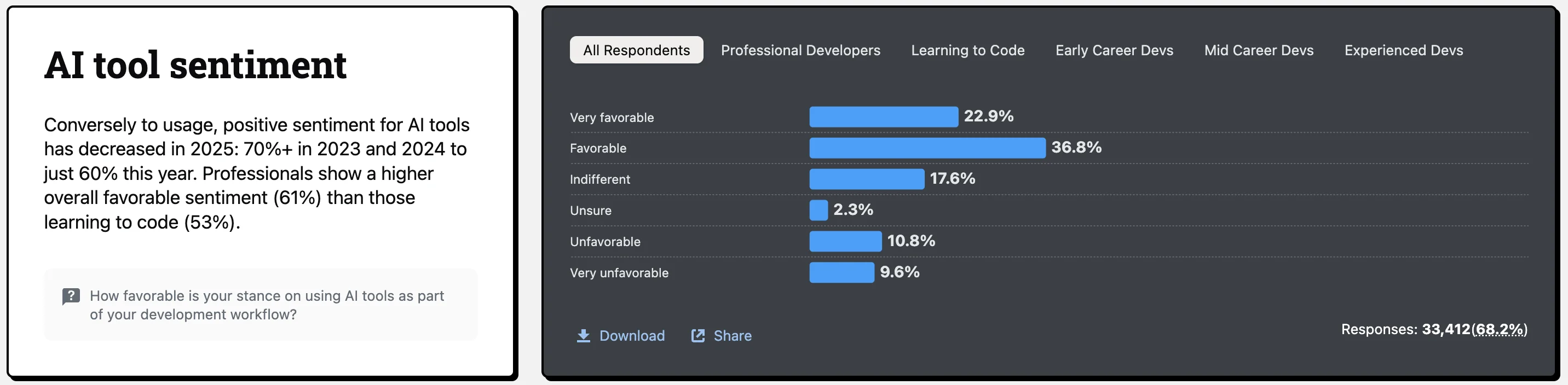
But here's where it gets interesting. While usage climbed, trust tanked. The same survey found that 46% of developers don't trust the accuracy of AI tool output — up dramatically from 31% the year before. Positive sentiment for AI tools dropped from over 70% in 2023 to just 60% in 2025.
The biggest frustration? 66% of developers cited "AI solutions that are almost right, but not quite" as their top pain point. Debugging AI-generated code that's 90% correct but subtly wrong? Apparently worse than writing it yourself.
GitHub Copilot has become almost default for many teams. According to GitHub's Octoverse 2025 report, 80% of new GitHub users try Copilot within their first week on the platform. The launch of Copilot Free in December 2024 accelerated signups globally.
Anthropic's Claude has carved out a interesting niche. The Stack Overflow survey shows Claude Sonnet is used more by professional developers (45%) than by those learning to code (30%), and it ranked as the most admired LLM this year. Professional devs apparently prefer it for complex reasoning tasks.
But here's a reality check: 77% of developers said "vibe coding" is NOT part of their professional work. Most devs are using AI as a sophisticated autocomplete, not as a replacement for thinking.
We're entering the "productive disillusionment" phase. Teams will get better at knowing when to use AI (boilerplate, tests, documentation) versus when to avoid it (security-critical code, complex architecture). Expect tooling that verifies AI output to become its own category — AI that checks AI.
The developer who learns to work with AI's quirks while maintaining healthy skepticism? That's the profile that's going to thrive. The next step beyond coding assistants is fully agentic coding — AI that autonomously writes, tests, and ships features with light human oversight. For a deep dive into this shift and nine other AI agent trends reshaping 2026, see our AI agent trends for 2026. The infrastructure underneath is moving too: Cursor shipped its own Git hosting service in August 2026, and we broke down what Cursor Origin is and what it is missing.
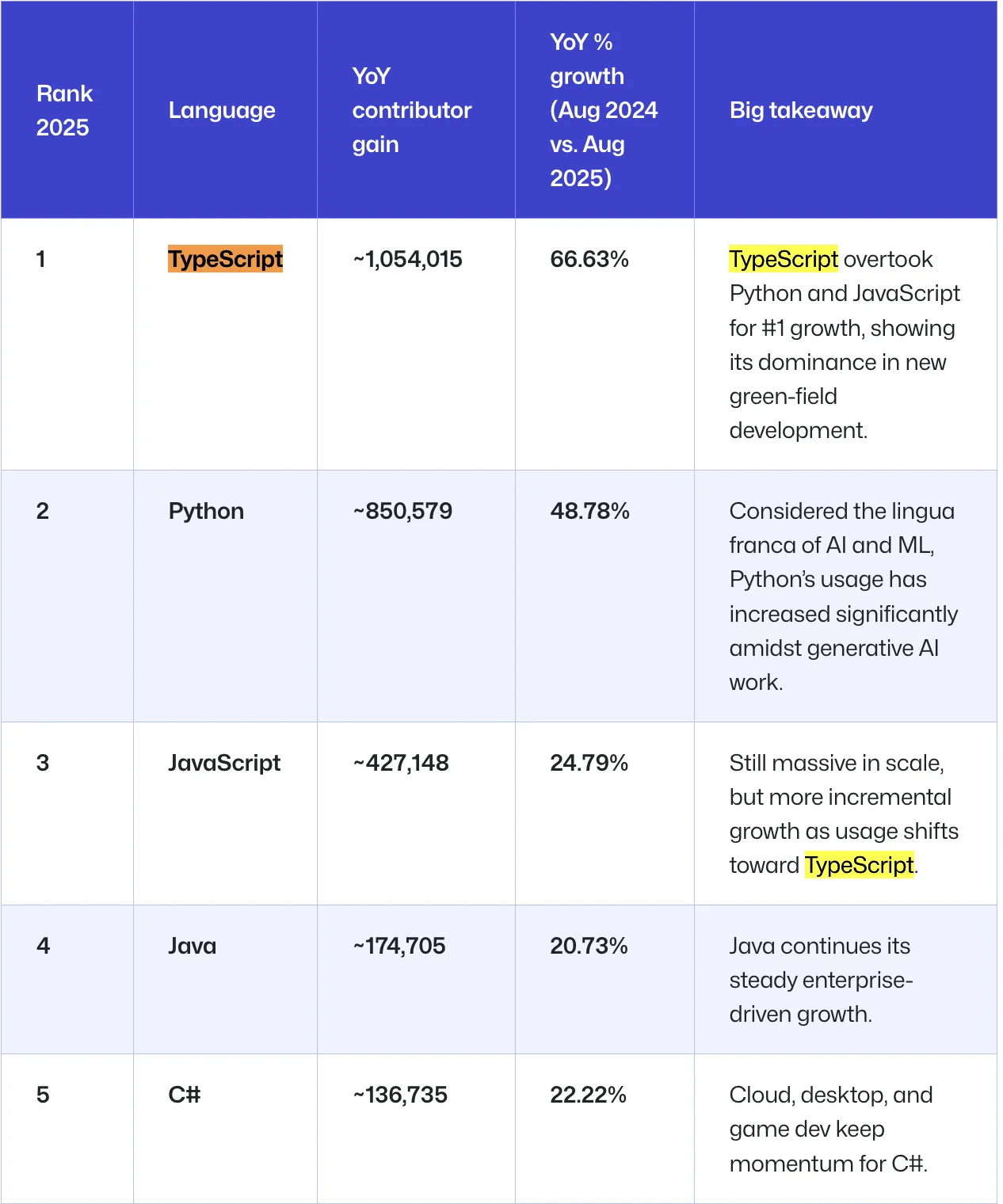
In August 2025, something historic happened. According to GitHub's Octoverse 2025, TypeScript overtook both Python AND JavaScript to become the most-used language on GitHub. Not just "growing fast" — it actually dethroned the two previous champions in a single month.
The numbers are staggering: TypeScript grew by over 1 million contributors year-over-year, a growth rate of 66.63%. For context, Python grew by about 850,000 contributors (48.78% growth), and JavaScript added around 427,000 (24.79% growth).
Microsoft (TypeScript's creator) obviously dogfoods it everywhere, but the more telling story is the broader ecosystem. VS Code — built entirely in TypeScript — is now the most-used IDE in the world. That created a feedback loop: developers use VS Code, get excellent TypeScript support, adopt TypeScript, which makes TypeScript support even better.
Shopify made a massive bet on TypeScript for their frontend infrastructure. Their Hydrogen framework for headless commerce is TypeScript-first. Their engineering team heard that developers really wanted TypeScript in demo store templates, so they delivered. They've also built GraphQL Codegen integration that automatically generates types based on Storefront API queries.
Airbnb published data showing that 38% of bugs in their codebase were preventable with TypeScript. They built ts-migrate, an open-source tool that helped them convert projects with over 50,000 lines of code in a single day. By the time of their blog post, 86% of their 6-million-line frontend monorepo had been converted to TypeScript.
The JetBrains State of Developer Ecosystem 2025 report adds another angle: TypeScript, Rust, and Go rank highest on their "Language Promise Index" — measuring growth, stability, and developer willingness to adopt. Meanwhile, JavaScript, PHP, and SQL are hitting their "maturity plateau."
JavaScript isn't going anywhere — TypeScript compiles to it, after all. But the writing's on the wall for starting new projects in vanilla JS. The real question is what happens to the JavaScript-first frameworks.
Next.js, Remix, and SvelteKit already treat TypeScript as the default. Expect React and Node.js to push TypeScript more aggressively in documentation and examples. Within a few years, "learning JavaScript" might actually mean "learning TypeScript" from day one.
The 2024 State of Rust Survey (published February 2025) dropped a milestone: 45% of organizations now use Rust significantly in production — a seven percentage point jump from 2023. That's not experimental usage. That's real workloads, real teams, real code in prod.
Even more telling: 38% of respondents use Rust for the majority of their coding at work, up from 34% in 2023. And 82% report that Rust helped their company achieve its goals.
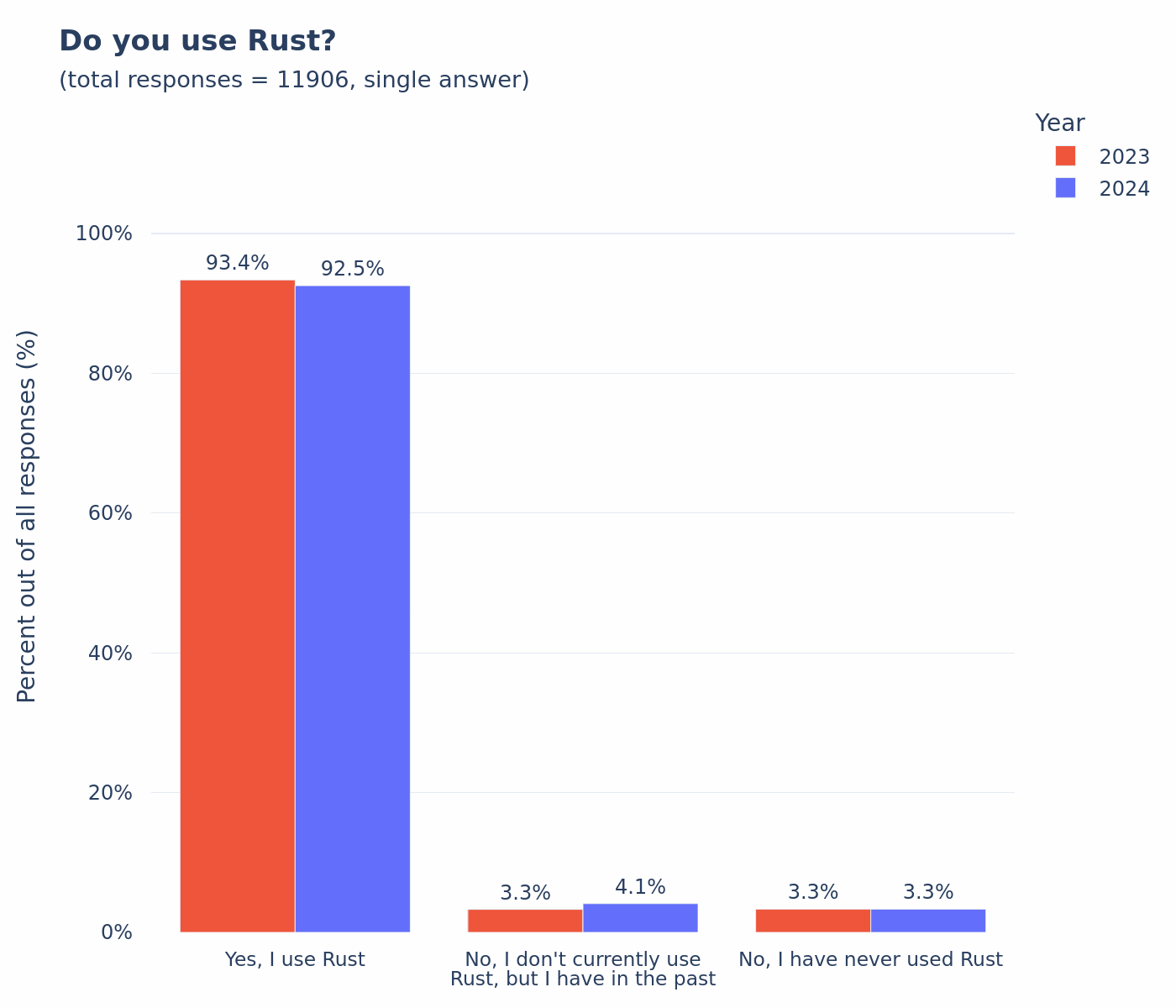
Why the jump? Organizations cite building correct and bug-free software (87.1%), performance (84.5%), and security/safety properties (74.8%) as their top reasons for choosing Rust.
Cloudflare has bet heavily on Rust for their edge infrastructure. Their Pingora proxy handles over a trillion requests per day and was written in Rust. In production, Pingora consumes about 70% less CPU and 67% less memory compared to their old NGINX-based service. They've open-sourced Pingora after it handled nearly a quadrillion internet requests.
Discord rewrote their Read States service from Go to Rust after hitting performance walls. The service tracks what messages you've read across all your servers — accessed every time you connect, every time a message is sent, every time a message is read. Go's garbage collector caused latency spikes every few minutes. After switching to Rust, average response time dropped to microseconds and max latency to milliseconds.
AWS has embedded Rust throughout their infrastructure. Firecracker (the virtualization tech behind Lambda and Fargate) was written in Rust for memory safety guarantees. AWS explains why they love Rust: it's used to deliver S3, EC2, CloudFront, Route 53, and more.
Rust won't replace everything, but it's becoming the default answer for "we need this to be fast and we can't afford bugs." Systems programming, infrastructure tooling, game engines, cryptography — anywhere C++ used to be the choice, Rust is now the conversation.
The compilation speed complaints are real (it's the top concern in the survey), but the community is actively addressing it. Expect Rust to keep climbing that adoption curve, especially as more CS programs start teaching it as a first systems language.
Something remarkable showed up in the 2025 Stack Overflow Developer Survey: 55.6% of developers now use PostgreSQL. That's the highest share of any database, and it represents a 7 percentage point jump in a single year — the largest expansion in the survey's history.
For perspective, PostgreSQL now has a 15 percentage point lead over second-place MySQL. Among professional developers specifically, usage hits 58.2% — an 18.6 point gap.
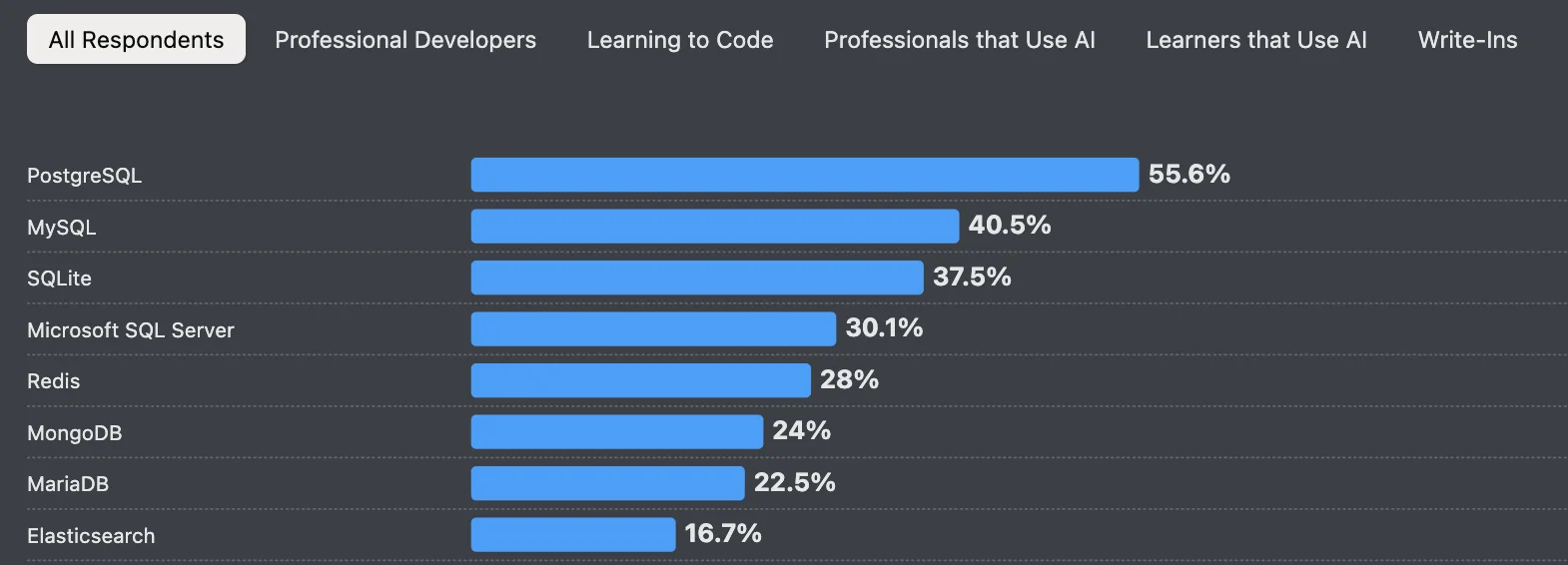
This isn't just survey sentiment. PostgreSQL ranked highest for developers who want to use it next year (47%) AND for those who want to continue using it (66%), for the third consecutive year.
Instagram built their entire backend on PostgreSQL and scaled it to billions of users using custom sharding. They created 480 logical shards distributed across physical databases, with a custom ID generation system that produces sortable-by-time IDs. When a platform with 2+ billion users trusts your database, that's a signal.
Supabase has built an entire Backend-as-a-Service platform with PostgreSQL at the core. They treat Postgres as the application layer, not just data storage — using it for auth, real-time subscriptions, and edge functions. They've raised over $500 million in funding (including a $100M Series E at $5B valuation) essentially betting that Postgres is the future of application development.
Notion runs on PostgreSQL and has documented how they've pushed Postgres to handle their complex block-based data model. Their engineering team detailed how they sharded their Postgres monolith into 480 logical shards, and later tripled their database capacity from 32 to 96 machines with zero downtime.
Every major cloud provider now offers managed PostgreSQL (AWS RDS, Google Cloud SQL, Azure Database for PostgreSQL), often with proprietary features. The ecosystem is mature enough that you can run Postgres anywhere and find tooling for anything.
PostgreSQL is increasingly becoming the "safe default" for new projects. Its extensions ecosystem (PostGIS for geospatial, TimescaleDB for time-series, pgvector for AI embeddings) means you can often avoid adding specialized databases to your stack.
The competition is shifting. It's not "Postgres vs. MySQL" anymore — it's "Postgres vs. specialized databases." And Postgres keeps absorbing use cases that used to require separate tools. That trend isn't slowing down.
According to Docker's 2025 State of Application Development Report, container usage among IT professionals hit 92% — up from 80% the previous year. But here's the nuance: only 30% of developers across all industries say they use containers. IT-heavy shops have gone all-in; the broader market is still catching up.
The gap makes sense when you look at architecture patterns. IT industry respondents work with microservices 68% of the time, versus just 31% in other industries. Containers and microservices go hand-in-hand.
Meanwhile, Datadog's Container Report shows the average number of containers per organization jumped from 1,140 in 2023 to 2,341 in 2025. Organizations aren't just adopting containers — they're doubling down.
Spotify runs thousands of microservices in containers, orchestrated by Kubernetes. They've built Backstage (now a CNCF project with 3,000+ adopters) to help developers manage this complexity. According to their internal studies, Backstage users deploy software 2x as often and their software runs for 3x as long.
Netflix pioneered many container patterns that are now industry standard. Their Titus container management platform launches over three million containers per week across three AWS regions. Deployments that took tens of minutes with VMs now complete in one to two minutes. They've open-sourced the platform.
Shopify moved from a monolithic Rails app to a container-based architecture during their massive scaling phase. They've talked about how containerization allowed them to handle Black Friday traffic spikes without the infrastructure headaches of their previous setup.
The 92% number among IT professionals suggests we're approaching saturation in tech-forward organizations. The next wave is the "late majority" — industries like manufacturing, healthcare, and government that move slower but have massive scale.
Serverless containers are the interesting frontier. Datadog reports that 46% of container organizations now run serverless containers, up from 31% two years ago. On Google Cloud specifically, that number is 68%. The line between "containers" and "functions" keeps blurring.
Gartner predicted that by 2026, 80% of large software engineering organizations will establish platform engineering teams — up from 45% in 2022. We're watching that prediction play out.
According to their research, platform engineering now appears on over 10 different Gartner hype cycles — nearly 5x more than last year. That's not a trend anymore; that's a category.
The State of Platform Engineering survey adds texture: over 55% of platform teams are less than two years old. This is new for most organizations. The primary driver? 49% cited reducing reliance on repetitive tasks through better automation.
Spotify's Backstage is the canonical example. They open-sourced their internal developer platform after using it internally for years, and it's now adopted by over 3,000 organizations ranging from American Airlines to Zalando. Five years after open-sourcing, it's still what their 700 R&D squads rely on daily. Backstage provides a "single pane of glass" for services, documentation, infrastructure, and tooling.
Mercado Libre (Latin America's largest e-commerce platform) built an internal platform that lets developers go from idea to production without touching infrastructure directly. They've discussed how this reduced deployment time from days to minutes while handling massive regional scale.
DoorDash has been vocal about their platform engineering journey. They created internal tooling that abstracts away Kubernetes complexity, letting product engineers focus on features rather than YAML files. Their engineering blog details how this improved both developer velocity and reliability.
The JetBrains State of Developer Ecosystem 2025 adds an important finding: 66% of developers don't believe current metrics reflect their true contributions. Platform engineering isn't just about tools — it's about rethinking how we measure developer productivity. Non-technical factors (collaboration, communication, clarity) now matter as much as technical ones.
Platform engineering is quickly becoming table stakes for organizations at scale. If you're making developers configure their own CI/CD, wrangle Kubernetes directly, or hunt for documentation across fifty wikis — you're going to lose talent to companies that don't.
Expect AI to transform this space rapidly. Platforms that can suggest configurations, auto-remediate issues, and predict problems before they happen will define the next generation. The boring work of maintaining internal tools is about to get a lot more interesting.
According to the CNCF and SlashData State of Cloud Native Development report, cloud native adoption has reached 15.6 million developers globally. That's not early adopters anymore — that's mainstream.
The CNCF Annual Survey 2024 shows Kubernetes production usage hitting 80%, up from 66% in 2023. Add in those piloting or evaluating, and you're at 93%. Finding an organization NOT using Kubernetes is becoming the exception.
Other telling metrics: 60% of organizations now use CI/CD platforms to build and deploy most cloud-native applications (up 31% year-over-year), and GitOps adoption has reached 77%.
Apple runs iCloud on Kubernetes at massive scale. When a company as infrastructure-obsessive as Apple adopts Kubernetes for production workloads, that's a validation of the technology's maturity.
Adidas migrated their e-commerce platform to Kubernetes and has discussed how it handles traffic spikes during product launches (those limited sneaker drops generate massive, unpredictable load). They've credited cloud native architecture with making their platform resilient during these events.
The New York Times runs on Kubernetes and has been open about their cloud-native journey. Deployments that took 45 minutes on legacy VMs now complete in seconds to minutes. During Q4 2020, they handled 273 million global readers and four straight days of highest-ever election traffic with no data loss. As one engineer put it: "This year, for election night, I relaxed and ate a pint of ice cream."
The CNCF data shows Helm leading as the package manager (75% adoption), with Argo CD reaching 60% of Kubernetes clusters. The ecosystem around Kubernetes has matured to the point where most problems have established solutions.
Cloud native won — but now comes the hard part. Organizations have the infrastructure; they're struggling with complexity. 46% of CNCF survey respondents cited "cultural issues" as their biggest challenge, followed by CI/CD (40%), lack of training (38%), and security (37%). For a detailed breakdown of the cloud security threats — from misconfigured IAM policies to state-sponsored infrastructure pre-positioning — that make that 37% number a pressing concern, see our cybersecurity trends for 2026.
The next phase isn't about adoption; it's about making cloud native manageable. Platform engineering (see trend #6) is partly a response to this complexity. Expect continued investment in tools that simplify Kubernetes operations, especially AI-powered solutions that can spot issues and suggest fixes.
Look at these trends together and a pattern emerges: developers want more power with less complexity.
TypeScript gives you JavaScript's flexibility with compile-time safety. Rust gives you C++'s performance with memory safety. PostgreSQL gives you a general-purpose database that handles specialized use cases. Platform engineering gives teams infrastructure without infrastructure headaches. AI assistants give you code faster (when they work).
Every winning technology is answering the same question: "How do we do more without making it harder?"
If you're building tools, frameworks, or platforms — that's the bar. Power is table stakes. The differentiator is reducing friction while maintaining control.
The developers who thrive in this environment? They're the ones treating every new tool as a trade-off to evaluate, not a bandwagon to jump on. TypeScript isn't universally better than JavaScript — but for certain projects, the trade-off is obviously worth it. Same for Rust, for containers, for AI assistants.
Understanding those trade-offs, staying skeptical while remaining open, choosing the right tool for each job — that's the actual skill that matters in 2025.
Want to spot emerging technology trends before they hit mainstream? Check out our guide on how to identify market trends, explore what's gaining traction on our trends dashboard, or pull the same data into your own stack via the Rising Trends API.
Thousands of Emerging Trends
Thousands of Breakout Apps
Mega Trends
Trend Analysis Tool