Trends


Let's cut through the customer experience noise.
Every year brings a fresh wave of CX predictions dressed up in the same tired language — "seamless journeys," "omnichannel everything," "putting the customer first." Articles recycled from 2019 with a thin coat of AI paint. That's not what this is.
Every trend here is backed by hard data from the organizations actually measuring the CX landscape — Salesforce, Klarna, McKinsey, Gartner, Bain & Company, PwC, Edelman, and others who run the primary research that tells us what's actually changing at the front line of customer interaction.
Because 2026 isn't an incremental year for CX. The bar has permanently moved — and the brands that understand exactly how and why are building advantages their competitors won't close for years.
Top customer experience trends going into 2026:
Let's get into it.
The chatbot era is over. Here's the number that makes it official: in February 2024, Klarna published a press release announcing their AI assistant had handled two-thirds of all customer service chats in its first month — the equivalent of 700 full-time agents. Customer satisfaction scores matched human agents. Average resolution time dropped from 11 minutes to under 2. That's not a pilot. That's a category-level shift.
The distinction that matters in 2026 is between reactive AI — answering questions, drafting responses, routing tickets — and agentic AI: systems that take actions, resolve issues end-to-end, and complete multi-step workflows autonomously. Reactive AI has been table stakes since 2023. Agentic AI — capable of processing a refund, updating an order, rerouting a shipment, or negotiating a billing dispute without human handoff — is where the CX frontier sits now.
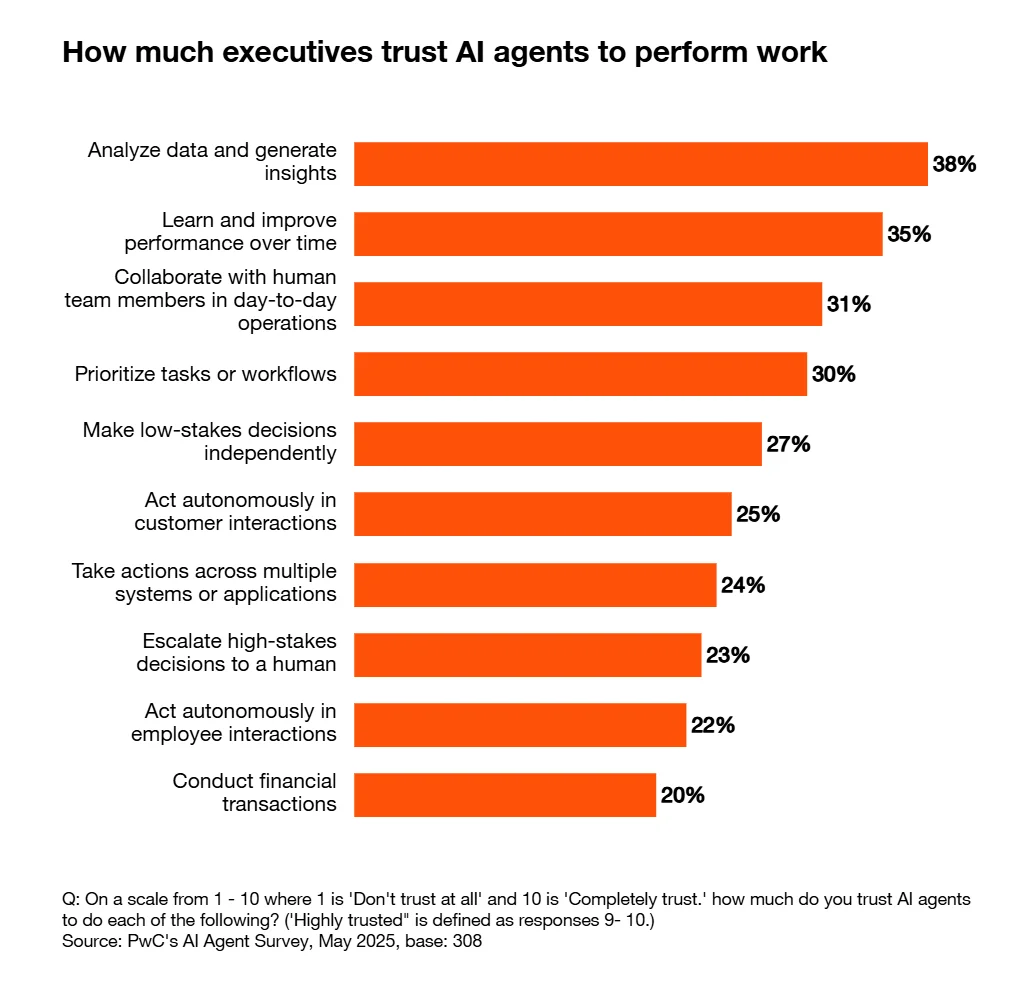
PwC's AI Agent Survey of 300 senior executives found that 79% of companies are already adopting AI agents, with 88% planning to increase AI budgets specifically because of agentic capabilities. The competitive question isn't whether to adopt this infrastructure. It's how fast you can do it before your competitors do.
Klarna deployed their AI assistant globally across 23 markets in 35 languages within its first year. Beyond headline cost savings, the business impact compounds: by resolving issues completely on the first interaction, they reduced repeat contact rates significantly. When a customer's problem is actually solved — not deflected — they don't come back with the same issue. That flywheel effect on contact volume is what makes agentic AI structurally valuable, not just operationally cheap.
Salesforce launched Agentforce at Dreamforce 2024 — a platform deploying autonomous AI agents across service, sales, and marketing workflows. The key architectural difference from previous CRM AI: these agents can take actions inside and outside the Salesforce ecosystem, coordinating with external APIs, systems of record, and communication channels. Announced customers using the platform are processing millions of service interactions with autonomous resolution rates above 80%.
Zendesk published benchmark research on their AI agents showing that businesses deploying their AI agent product resolve more than 80% of customer issues without human involvement. Their data across thousands of enterprise customers shows consistent results: faster resolution, lower cost per contact, and — critically — CSAT scores that match or exceed human agent performance for routine issue types.
The benchmark separating leading CX organizations in 2026 is no longer "time to first response." It's autonomous resolution rate — the percentage of customer issues fully resolved without any human touchpoint. Companies that invest in building this capability now are compressing cost structures while simultaneously improving the customer experience — a combination that almost never coexists in traditional service models.
By 2027, companies with sub-60% autonomous resolution rates for routine service interactions will be at a structural cost disadvantage compared to those operating at 80%+. The migration from reactive to agentic AI is the defining CX infrastructure investment of this period. (For a broader look at how AI agents are reshaping enterprise software across sales, marketing, and operations, see our generative AI trends for 2026.)
Here's the stat that reframes the entire CX conversation: Salesforce's State of the Connected Customer (6th Edition) found that 80% of customers say the experience a company provides is as important as its products and services — not slightly important, equally important to the actual product. The same research found that 62% of customers will share personal data in exchange for personalized experiences.
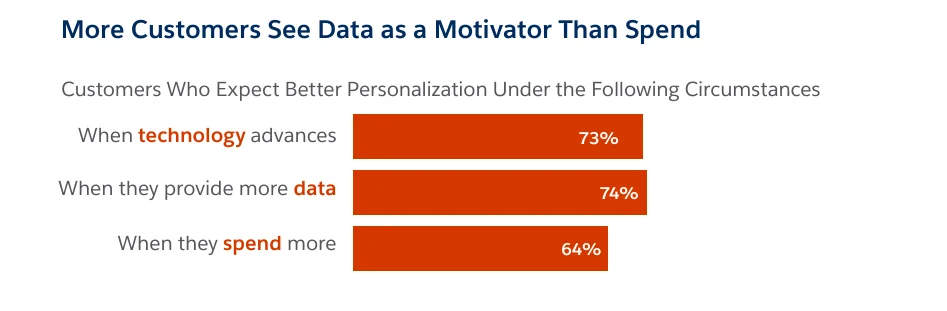
Customers want to feel known. The frustration isn't with AI or automation — it's with digital amnesia: having to re-explain the same situation on every interaction, as if the last conversation never happened.
The shift in 2026 is that AI memory architectures are mature enough to operationalize true relationship continuity. Not just storing purchase history — building persistent context across every channel, every interaction, and every time period. An AI that remembers the product issue from six months ago, the preference for email over SMS, that this customer mentioned they run a small business, and that their last renewal conversation ended on a positive note — and brings all of that to every new touchpoint.
McKinsey's personalization research found that companies excelling at personalization generate 40% more revenue from those activities than average players — and that 76% of consumers get frustrated when personalization doesn't happen. The business case is not ambiguous. (For how brands are operationalizing first-party data and personalization strategies across the full marketing funnel, see our digital marketing trends for 2026.)
Amazon has built the canonical example of memory-persistent AI at consumer scale. Their recommendation engine — synthesizing every purchase, browse session, wishlist addition, and review across years of history — is the most commercially validated proof of concept for what persistent customer context delivers. Their "buy again" feature, auto-replenishment subscriptions, and personalized homepage all express the same underlying principle: the brand that remembers what you need before you need to ask it delivers fundamentally better experiences. Every other retailer is measured against this benchmark now.
Spotify built Spotify AI DJ — a feature synthesizing years of listening history, skip patterns, and mood signals into a personalized radio experience with contextual commentary. The AI doesn't just know what you've listened to — it understands when you listen, what you skip, and how your taste shifts over time. For CX leaders, this is the most publicly accessible demonstration of what persistent AI context actually feels like from the customer's side.
Intercom launched Fin AI with a specific architecture around long-term customer memory — an enterprise AI agent trained on a company's entire knowledge base while simultaneously building context about individual customer histories across interactions. Brands using Fin report that customers who interact with the AI multiple times over months experience dramatically different support quality than first-time interactions — the AI gets better with every conversation, and customers notice.
The conversation in 2026 has moved from "should we personalize?" to "how deep should the memory go?" The frontier is AI that maintains persistent context not just within a brand, but across devices, channels, and life events.
The customer who recently changed jobs, moved cities, or had a major purchase milestone — and the brand that acknowledges that context shift without being asked — will define what loyalty looks like by the end of this decade.
The NPS survey sent 24 hours after a call ended has always been a lagging indicator at best. In 2026, leading brands are replacing it with real-time emotional signal detection — AI systems that identify frustration, confusion, hesitation, or delight during the interaction itself, and respond before the customer hangs up or abandons the cart.
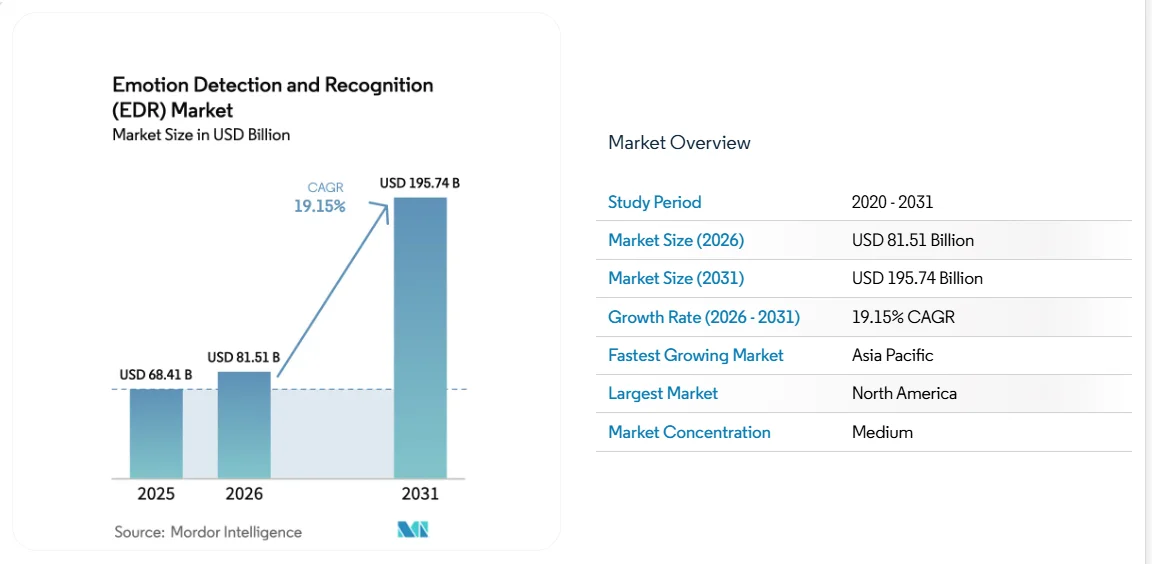
The market validating this shift is substantial. Mordor Intelligence values the global emotion detection and recognition (EDR) market as one of the fastest-growing enterprise tech segments, expanding at nearly 20% annually (19.15% CAGR) - with the market expected to more than double in value by 2031. This growth is no longer speculative; it is being driven by the operationalization of 'Emotion AI' across enterprise CX, automotive safety, and healthcare, as brands move away from lagging surveys toward immediate, multimodal emotional intelligence.
The technology is farther along than most CX leaders realize. Through voice tone analysis (pitch, pace, energy), word choice and sentiment signals, response latency patterns, and behavioral cues on digital channels (scroll speed, cursor hesitation, form abandonment), AI systems now build an accurate emotional profile of a customer interaction in near-real-time.
The applications are direct: a customer whose voice signals rising frustration gets escalated to a human agent before they ask. A customer showing decision paralysis on a pricing page gets a simplified comparison. A customer who just expressed delight about their resolution gets a loyalty offer surfaced at peak satisfaction. These aren't marketing tactics. They're the operationalization of emotional intelligence at machine speed — and at a fraction of the cost of hiring more empathetic humans.
Cogito is the most commercially deployed real-time emotional intelligence platform for enterprise contact centers. Their AI analyzes voice calls in real time, providing agents with live behavioral cues about a customer's emotional state — prompting slower speech, more empathy, or a different approach before frustration escalates. Large insurers and financial services firms using Cogito have reported measurable improvements in first-call resolution and CSAT by giving agents live emotional coaching during calls rather than post-call feedback that arrives too late to matter.
Amazon Connect includes built-in real-time sentiment analysis as part of their cloud contact center platform — analyzing customer speech and surfacing emotional signals to supervisors and AI routing systems live. The practical effect: calls where customer sentiment is trending negative can be flagged for supervisor intervention before the call ends, rather than discovered only when a survey response arrives days later. For the tens of thousands of businesses running contact centers on AWS infrastructure, this is emotional intelligence by default.
Qualtrics launched their Experience iD platform — a system aggregating signals from surveys, behavioral data, and interaction analytics into unified customer emotional profiles. Instead of a single satisfaction score, Qualtrics customers see the full emotional trajectory of a customer relationship — identifying patterns that predict churn before any explicit complaint is made. The predictive application, using emotional trajectory to forecast customer lifetime value and churn risk, is where this technology becomes genuinely transformative for CX strategy.
The most sophisticated version of emotion intelligence in 2026 is moving from detection — identifying how a customer feels right now — to anticipation — predicting how they'll feel based on what's about to happen.
An airline knowing that a customer who's already experienced two delays this quarter is about to receive a third cancellation notice, and pre-deploying a different communication and compensation protocol for that specific customer, is the future of emotional CX. The companies building those predictive models now are the ones whose CX benchmarks will look inexplicably good in 18 months.
The highest form of customer service in 2026 is the kind the customer never consciously experiences. Here's what the data says about its business case: McKinsey research on proactive service strategies has found that companies deploying proactive service reduce inbound contact volume by 20–30% while simultaneously improving satisfaction scores. You spend less money and customers like you more. That combination is rare enough to pay attention to.
The mechanism is straightforward: instead of waiting for customers to report problems, brands with predictive CX infrastructure identify risk signals before the customer is even aware an issue exists — and reach out with a solution.
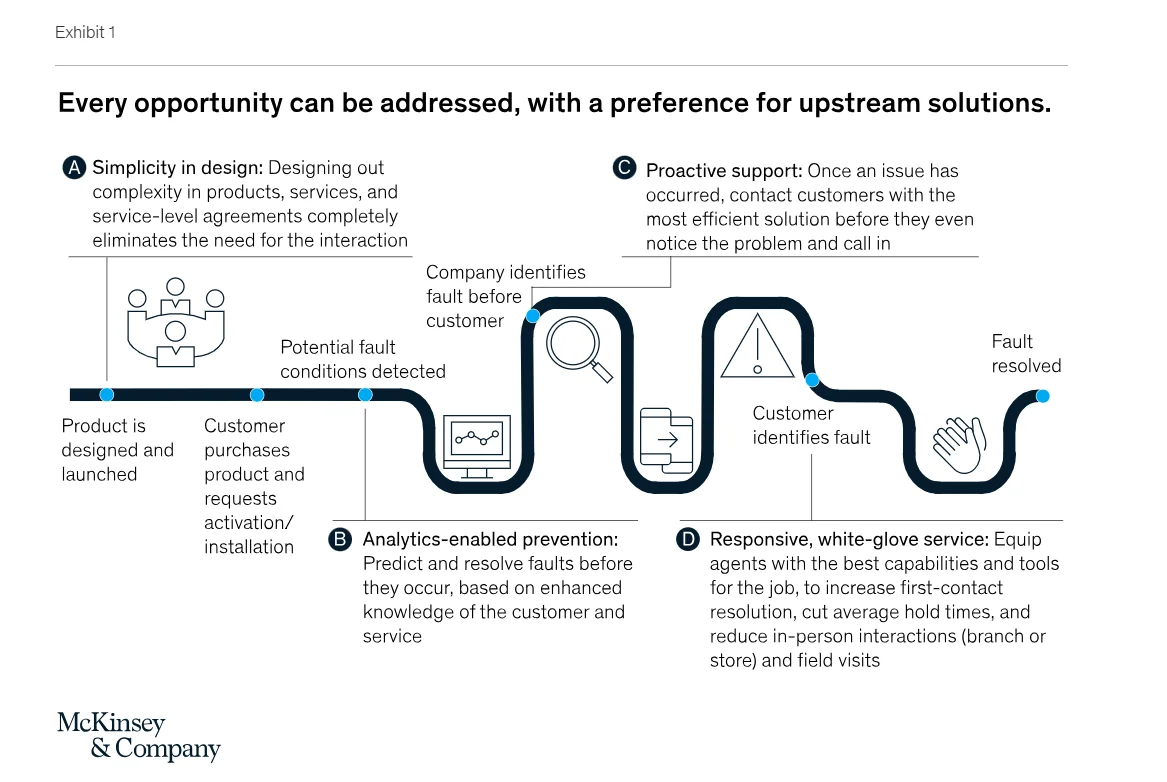
The signals predictive service models use are increasingly specific: a product showing early failure indicators in IoT telemetry data before the customer notices any symptom. A delivery running 48 hours late — proactive notification and compensation offered before the customer thinks to check the tracking link. A subscription renewal approaching for a customer whose engagement has dropped 60% over the past 90 days — proactive outreach with a value reinforcement offer, not a desperate retention call triggered after the cancellation button is clicked.
Gartner's customer service research consistently places proactive engagement as the highest-ROI CX investment for organizations that have already optimized their reactive service layer. The companies building that predictive infrastructure now are the ones that will show the results in their benchmarks within 12–18 months.
Delta Air Lines has become the most-referenced example of predictive CX in travel. Their Fly Delta app and operational AI proactively notifies passengers of connection risks, gate changes, and delay scenarios — and proactively offers rebooking options before disruptions fully materialize. In many cases, passengers receive alternative booking options before the original flight cancellation is formally announced. The NPS differential between airlines that communicate proactively and those that wait for passengers to discover disruptions themselves is one of the largest performance gaps in the entire industry, and it lines up with the broader shifts in our travel trends for 2026.
Tesla runs over-the-air software updates and predictive maintenance alerts that resolve issues before customers are impacted. Their telematics system continuously monitors vehicle health and performance, proactively notifying owners — and in some cases scheduling service appointments — when components show early degradation signals. A significant percentage of Tesla service events are resolved remotely or before the customer experiences any symptom. That's predictive CX applied to physical product ownership at scale.
Apple has transitioned from proactive alerts to Agentic Predictive Service With the rollout of iOS 26. Utilizing on-device Apple Intelligence, iPhones now analyze Adaptive Power patterns to resolve microscopic hardware instabilities before they impact performance. Instead of just notifying the user, the system autonomously optimizes background processes and charge limits to preserve longevity. When a repair is necessary, it silently drafts a technician summary and offers one-tap booking during the user’s downtime. The lesson: in 2026, the gold standard of customer service is silent resolution, prioritizing the user’s time over unnecessary conversation.
In 2026, the benchmark shift in service CX is from "time to resolution" to "issues prevented per thousand customers." The most forward-thinking CX organizations are beginning to report proactive deflection rates alongside traditional CSAT and first-contact resolution metrics.
The companies that can show high deflection numbers are demonstrating a qualitatively different understanding of their customer journey — and the infrastructure investment gap between them and reactive-only competitors is widening every quarter.
Something fundamental changed when Apple shipped Vision Pro. The long-promised convergence of physical and digital environments stopped being a concept demo and became a product category. And the CX implications — for purchase confidence, return rates, and brand experience depth — are becoming measurable.
PwC's "Seeing is Believing" report on extended reality technologies projected that XR will unlock $1.5 trillion in global economic impact by 2030 — with retail, CX, and training being three of the largest beneficiary categories. The economic driver isn't the hardware. It's the elimination of the distance between a customer's imagination and their purchase decision.
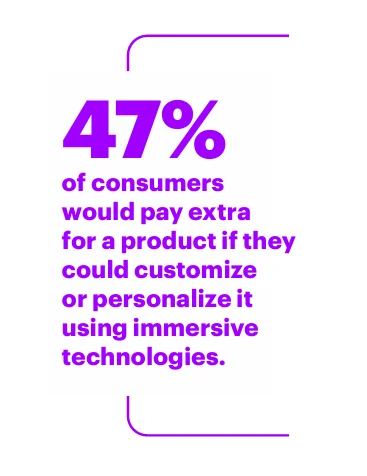
The CX applications that are actually working in 2026 are more specific than "VR experiences" suggest. Virtual try-on for apparel, eyewear, and accessories is reducing return rates by 25–40% for brands that have implemented it at scale. AR product placement for furniture and home goods is increasing purchase confidence and average order value. Immersive brand environments — showrooms and product demonstrations accessible from anywhere — are expanding the effective reach of high-touch retail formats that previously couldn't scale beyond their physical locations, a shift we also track in VR and AR trends for 2026. The same experience-first logic is spilling into hospitality formats too, which is why our restaurant trends for 2026 now read more like an operations and theater playbook than a standard dining forecast.
The return rate reduction alone changes the unit economics of e-commerce dramatically. Returns cost retailers between 15–30% of the product's selling price to process. Any technology that meaningfully reduces them is a margin story, not just an experience story.
IKEA transitioned from the pioneering IKEA Place to the AI-powered IKEA Kreativ platform, marking a shift from simple AR 'placement' to full-room transformation. By allowing users to digitally delete old furniture and replace it with true-to-scale 3D models, IKEA has effectively turned the smartphone into a professional design studio. The result is a measurably more confident consumer; in 2025-2026, IKEA reported that online sales fueled by these spatial tools reached nearly one-third of their total retail volume, proving that AR is no longer an experiment, but an essential component of the modern furniture value chain.
Warby Parker built virtual try-on directly into their app and website using iPhone TrueDepth camera technology — allowing customers to see exactly how any frame looks on their face before ordering. Virtual try-on customers show significantly higher purchase completion rates and lower return rates than customers selecting frames without the AR feature. For an e-commerce category where the primary purchase barrier is "will these look good on me?", eliminating that friction with accurate AR has proven commercially transformative — and set the expectation for every eyewear retailer that followed.
BMW developed BMW Virtual Showroom experiences allowing customers to configure and explore vehicles in immersive 3D environments — seeing custom color and option combinations in photorealistic detail without physical inventory at every dealership location. Extended to Apple Vision Pro compatibility, customers can explore vehicles at 1:1 scale. For a purchase where seeing the exact configuration drives buying confidence, this collapses the gap between online research and the dealership visit that previously took weeks to close.
2026 is the year that AR-assisted purchase becomes the default expectation for furniture, eyewear, apparel, and automotive — not a differentiating feature. The next frontier is persistent spatial brand environments: places customers can return to across devices and sessions, where their configuration history, personalized recommendations, and purchase journey are all preserved. Think of it as a brand's physical store experience, available anywhere, personalized to the individual, and continuously improving.
Here's the CX problem no amount of AI investment can solve on its own: customer trust is structurally eroding, and the pace of AI deployment is making it worse.
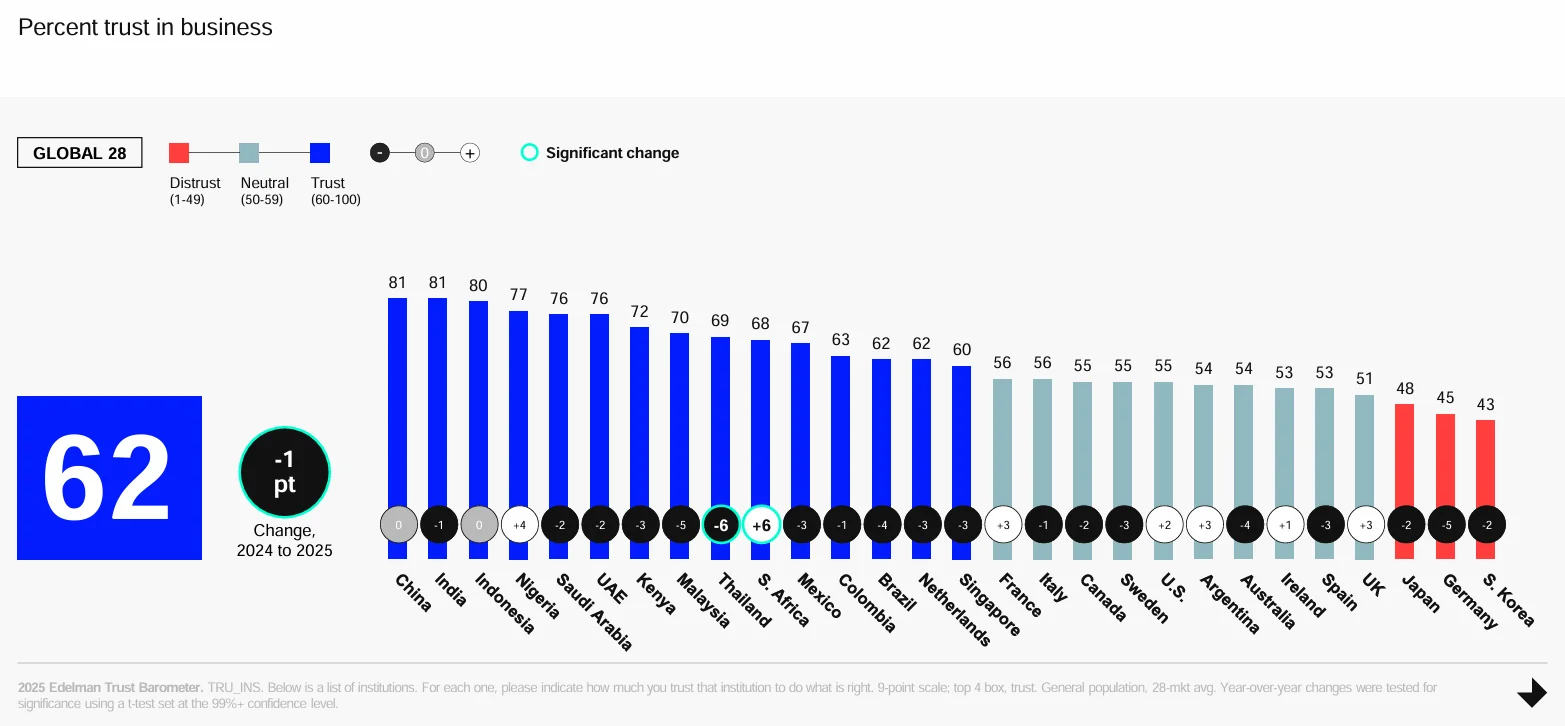
Edelman's Trust Barometer 2025 found that only 62% of consumers trust businesses to do what is right — that number is a fragile ceiling, not a solid floor. Beneath the surface, this trust is being hollowed out by AI-generated content and opaque data practices. For every personalization win, companies risk a total collapse of confidence if the customer feels they are being managed by an algorithm they can't see, touch, or challenge.
The response that's actually working in 2026 is Trust Architecture — the deliberate design of transparency into the customer experience itself. This means: explicit disclosure of when AI is involved in an interaction, explanations of how recommendations are generated, customer control over what data is used for personalization, and human escalation paths that aren't buried in IVR frustration loops.
The counter-intuitive finding from multiple CX studies: proactively disclosing AI use increases customer satisfaction rather than decreasing it. Customers don't object to AI — they object to being deceived about it. Brands that are openly transparent about their AI stack are outperforming those that obscure it across every trust and satisfaction benchmark. The companies that understood this early are now running a differentiation play that combines brand advantage with regulatory preparedness. That's a rare combination.
Salesforce built the Einstein Trust Layer — an explicit infrastructure layer for enterprise AI deployment that includes data masking, audit logs, zero-retention prompting (customer data never trains external AI models without consent), and explainability features that let customers understand why the AI responded the way it did. The product exists specifically because enterprise buyers demanded it, and because Salesforce recognized that trust infrastructure is the prerequisite for AI adoption at scale. Their CX customers use the Trust Layer as the architecture that lets them deploy AI without the legal and reputational risk of opaque data practices.
Adobe launched Content Credentials — an industry-wide initiative attaching verifiable provenance metadata to digital content, allowing consumers and platforms to identify AI-generated content at the source. For brands creating AI-generated marketing and CX content, Content Credentials provides the transparency infrastructure that makes "this was AI-generated, here's how and by whom" a practical reality — which is increasingly demanded by both regulation and consumer expectation. The standard is being adopted across publishing, advertising, and entertainment with meaningful velocity.
Intercom implemented proactive AI disclosure throughout their Fin AI product — marking AI-generated responses, giving customers easy access to human agents, and providing conversation summaries that transfer seamlessly between AI and human handlers. According to the same Intercom Fin research referenced above, customers who understand they're talking to AI and have a clear path to human escalation report higher satisfaction than customers in ambiguous interactions where the nature of the responder is unclear. Transparency turns out to reduce anxiety, not create it.
2026 is the year trust transparency becomes regulatory, not optional. The EU AI Act's customer interaction requirements are forcing disclosure standards that were previously voluntary.
Brands building trust architecture now — disclosure systems, explainability layers, customer data control interfaces — are building regulatory compliance infrastructure that competitors will have to retrofit at significantly higher cost within two years. The organizations treating this as a brand opportunity rather than a compliance burden will look prescient within 18 months.
Here's the design principle defining the frontier of CX in 2026: the best experience is one the customer barely has to consciously engage with. Their needs are anticipated, their preferences applied automatically, and the value delivered before they think to ask.
Gartner named "Ambient Invisible Intelligence" as one of the top 10 strategic technology trends for 2025 — defining it as ultra-low-cost sensing and AI processing embedded into everyday environments, enabling continuous, contextually aware interactions that require zero conscious engagement from users. What was a Gartner prediction category in 2024 is a design reality in 2026.
The design implication is practical: every point of friction between a customer's need and its fulfillment is a CX failure waiting to be optimized away. Ambient CX removes the friction entirely. The household staple is replenished automatically based on usage patterns — no reorder screen to navigate. The subscription tier adjusts to actual usage — no upgrade flow to initiate. The issue is detected and resolved before the customer is aware of it — no support ticket to open.
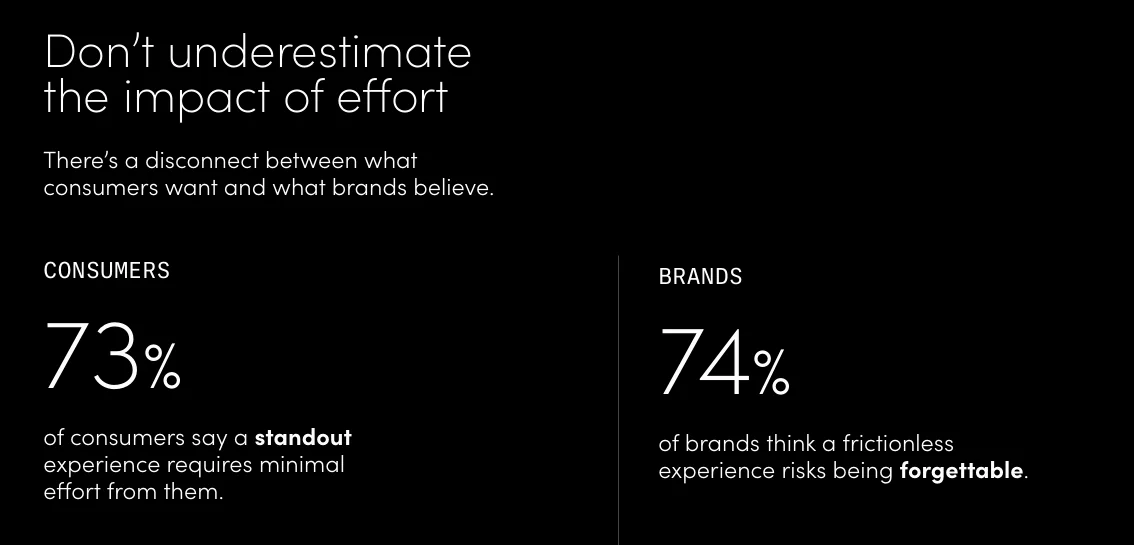
The businesses that have mastered this are operating on a fundamentally different efficiency model, one where the cost per customer interaction approaches zero as more touchpoints become automated, contextual, and invisible.
Amazon operationalized ambient commerce through Dash Replenishment Service — automatically reordering household consumables (printer ink, detergent, water filters) when sensors in connected devices detect low inventory. Customers who enable this feature show dramatically higher retention and lower purchase consideration time than those using traditional e-commerce, because the purchasing decision has been effectively removed from the conscious experience entirely. The customer gets what they need without the experience of shopping — and that's exactly the point.
Josh.ai provides the gold standard for residential zero-UI ambient CX through its "Privacy-First" spatial awareness. Their system—integrating high-end natural language processing with presence detection—manages the home’s ecosystem of lighting, climate, and security without requiring a single button press or app interaction. When a homeowner walks into a room that has already adjusted its temperature and shading to their preferred circadian rhythm based on the time of day, that is ambient CX at its most intuitive. It builds a level of atmospheric loyalty that traditional, fragmented smart home systems, which rely on manual control, cannot match. The consumer-facing version of that shift is visible across our home improvement and design trends for 2026, while the climate-control stack is moving even faster in HVAC trends for 2026.
Apple has made Intent-based Intelligence a foundation of their CX model — leveraging on-device personal context to surface deep-linked app actions, contacts, and routes before a user even initiates a search. By integrating with the App Intents framework, brands can move from being 'available' to being 'proactive,' appearing in the Smart Stack or Lock Screen exactly when the user's context demands it. For brands in the Apple ecosystem, building for these intelligent handoffs is now a CX imperative for reducing digital friction.
The trajectory of zero-UI is toward fully ambient commerce and service — where customer needs are managed continuously in the background by AI systems operating within defined permissions. The customer who sets preferences once and stops having to think about a category of purchases, services, or maintenance tasks has moved into a fundamentally different relationship with a brand. Not repeat purchase behavior — standing authorization. The highest form of customer trust, and the loyalty model of the next decade.
One of the most underestimated CX investments in 2026 is also one of the most cost-efficient: giving customers the infrastructure and incentives to solve each other's problems, co-create product improvements, and build the knowledge base that no internal team could construct alone.
The Community Roundtable's State of Community Management Report — the most comprehensive annual study of brand community performance — consistently shows that communities with dedicated management generate engagement rates 3–4x higher than unmanaged communities, and that brands with active customer communities report measurably lower support costs, higher NPS, and stronger product-market fit than comparable brands without them.
A well-designed customer community delivers four CX functions simultaneously: peer support (customers solving each other's questions at zero marginal cost to the brand), product intelligence (unfiltered insight into real usage patterns and unmet needs), social proof (user-generated content that builds purchase confidence for prospects), and retention (customers embedded in a community are dramatically less likely to churn than those with purely transactional relationships).
The brands doing this well in 2026 aren't just managing communities — they're structuring them as co-creation platforms, where the most engaged customers have direct influence over product roadmaps, feature prioritization, and service design. That level of involvement creates a category of customer with no equivalent in any traditional loyalty program.
Figma built Figma Community into one of the most valuable product resources in the design industry. Thousands of user-created templates, plugins, and component libraries have been published and shared — turning customer expertise into product value at a scale no internal team could match. The community doesn't just support Figma. It continuously extends and improves the product. For CX leaders, this is the most commercially validated example of customers-as-co-creators at scale: the community generates value that feeds directly back into the product's competitive moat.
Salesforce built Trailhead — a community learning platform where customers teach each other, earn certifications, build professional reputation, and advance their careers within the Salesforce ecosystem. Customers who invest in building expertise around a platform are effectively building switching costs into their own behavior. Salesforce's renewal rates and expansion revenue from Trailhead-certified customers are consistently higher than from non-certified users. The community is a retention mechanism, an expansion revenue driver, and an advocacy engine simultaneously.
Peloton built their community layer directly into the product experience — live leaderboards, group workouts, challenges, and instructor-led social features that make the hardware and software meaningfully more valuable when used alongside other members. Customers who engage with the Peloton community show dramatically higher retention and lower churn than those using the product purely as exercise equipment. The community is the product retention mechanism. It's not a nice-to-have marketing channel — it's the structural reason customers renew.
In 2026, the CX leaders building the most defensible customer relationships are treating community as product infrastructure — not a social media strategy. The brands that have created genuine co-creation loops, where customer input measurably shapes product decisions, have built the kind of loyalty that no competitor's feature set, pricing change, or advertising campaign can easily break.
The investment required is real — dedicated community management, co-creation tooling, reputation systems — but the churn reduction and NPS lift from active brand communities consistently delivers measurable ROI within 12–18 months.
For a decade, CX budgets went to acquisition. The data on why that allocation is wrong has been available the entire time — and it's finally being acted on.
Here's the foundational stat: Bain & Company research — the same firm that invented Net Promoter Score — found that a 5% increase in customer retention increases company profits by 25–95%. The range is wide because it varies by industry margin structures, but the direction is unambiguous in every sector. The marginal customer you keep is dramatically more profitable than the marginal customer you acquire.
What's shifting in 2026 is that post-purchase experience has become the primary lever for that retention improvement — and it's dramatically underfunded relative to its return. The moments immediately after a purchase are when customer expectations are highest, when brand perception is most malleable, and when a single great or terrible interaction has the longest-lasting impact on lifetime value.
Qualtrics research on CX ROI consistently shows that customers who have an exceptional post-purchase experience are 2–3x more likely to become repeat buyers and active advocates than customers who complete a transaction without meaningful follow-up. The math on that multiplier — applied to acquisition spend — makes post-purchase investment the highest-leverage line item in the CX budget.
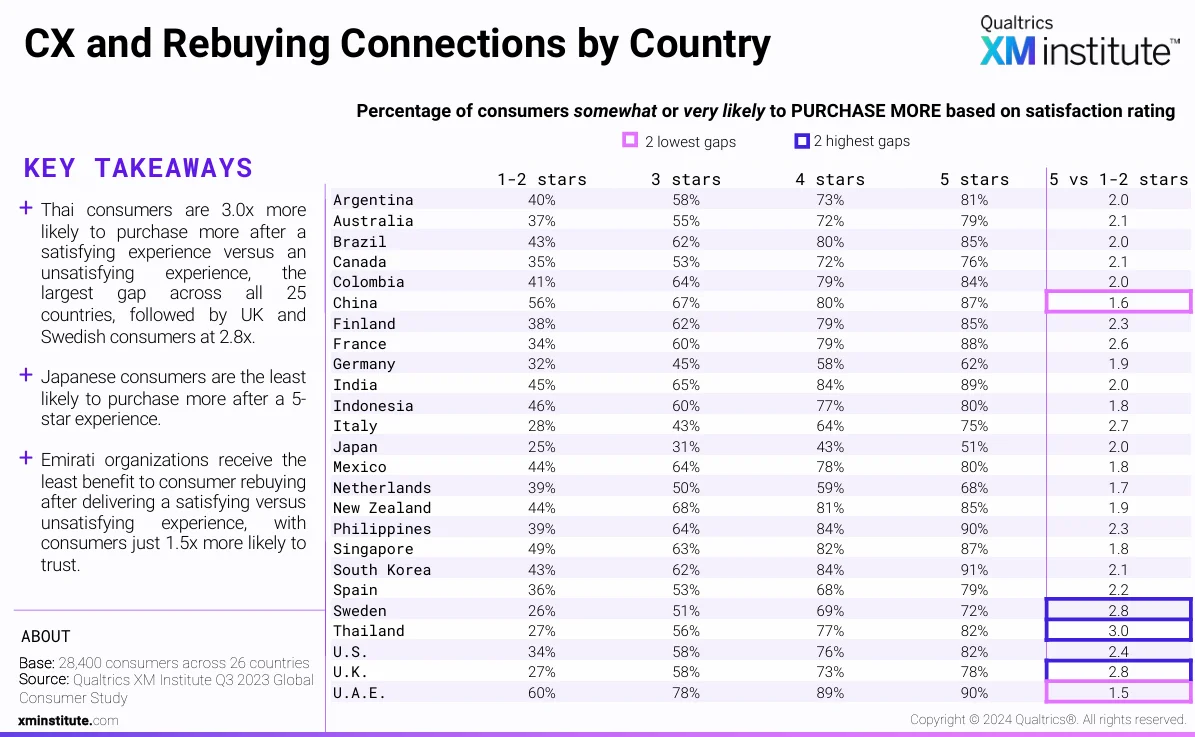
The leading organizations in 2026 are investing in three specific post-purchase experiences: onboarding (ensuring customers get full value quickly after their first purchase), proactive success check-ins (outreach with relevant guidance, not just renewal reminders), and unanticipated delight moments (the gift, the handwritten note, the unexpected upgrade that transforms a transaction into a story worth telling).
Chewy has built the most-referenced post-purchase CX playbook in e-commerce. Their practice of sending handwritten sympathy cards and flowers to customers when a pet passes away has generated millions of dollars in earned media — not because it was a campaign, but because the gesture is genuinely human. The business model insight: Chewy earns lifetime customer loyalty through post-purchase moments that cost relatively little but signal deep care. Their repeat purchase rates and NPS scores consistently rank among the highest in e-commerce, driven almost entirely by post-purchase CX investment rather than product uniqueness.
Apple built Today at Apple — a global in-store educational program — specifically as a post-purchase experience helping customers get more value from products they've already bought. The program isn't selling anything. It teaches customers to use what they purchased more deeply. The CX insight is precise: customers who use their products more fully are more satisfied, more likely to buy the next product in the ecosystem, and more likely to recommend Apple to others. Post-purchase investment drives the top-of-funnel metrics that acquisition spend can't match.
Nike built the NikePlus membership program as post-purchase CX infrastructure — offering member-exclusive early access, personalized training plans, anniversary recognition, and local event access to create a genuine relationship layer on top of every transaction. NikePlus members spend significantly more over their lifetime and show dramatically lower churn than non-members. The membership is free. The investment is in building an ongoing relationship rather than extracting maximum margin from the initial sale — a different philosophy that produces measurably different LTV outcomes.
The post-purchase renaissance in 2026 is the recognition that the customer journey doesn't end at checkout — it starts there. The brands investing in onboarding excellence, proactive success programming, and authentic relationship moments are building the LTV advantage that acquisition-focused competitors will spend years trying to understand.
The specific playbook: map the 90 days after first purchase with the same rigor as the acquisition funnel, invest in the top three post-purchase touchpoints that drive second purchase, and treat churn prevention as a revenue expansion activity rather than a defensive cost center. (For a data-backed look at how behavioral email automation — from abandoned cart sequences generating $7–$14 per recipient to win-back flows — is the primary channel infrastructure powering post-purchase revenue in 2026, see our email marketing trends for 2026.)
Read across all nine trends and the pattern is harder to miss than to see: the brands winning CX in 2026 are those that have stopped treating customer experience as a cost center and started building it as a compounding growth asset.
Agentic AI doesn't just reduce service costs — it compounds resolution quality over time as models improve and autonomous resolution rates rise. Memory-persistent AI doesn't just personalize interactions — it builds relationship depth that becomes harder for competitors to replicate with every passing month. Community-powered design doesn't just deflect support tickets — it creates a customer base that feels genuine ownership over the product. Post-purchase excellence doesn't just retain customers — it generates advocates whose referrals arrive at zero acquisition cost.
What all nine trends share is this: they reward investment that keeps compounding. Unlike paid advertising — where the value disappears the moment spend stops — these investments build structural advantages. A customer community takes 18 months to build and 18 years to replicate. A memory-persistent AI relationship gets better with every interaction. A trust architecture built before regulatory requirements arrive costs a fraction of what it will cost to retrofit. A proactive service model that prevents problems creates brand memories that no reactive service model can manufacture.
The CX organizations that will define their categories by 2028 are making specific, deliberate infrastructure investments right now: agentic AI resolution capability, persistent customer memory systems, transparent trust layers, and post-purchase experience design that turns first-time buyers into lifetime advocates.
The insight that separates leaders from laggards isn't awareness that these trends exist. It's the recognition that the compounding value of early investment makes every month of delay increasingly expensive. The math on that — applied to the 5% retention figure, the 40% personalization revenue premium, the 20–30% proactive service deflection — isn't subtle. It's one of the clearest ROI arguments in business right now.
Want to spot emerging customer experience trends before they hit mainstream? Check out our guide on how to identify market trends or explore what's gaining traction on our trends dashboard.
Thousands of Emerging Trends
Thousands of Breakout Apps
Mega Trends
Trend Analysis Tool