Trends


Two years ago, auto dubbing was a dead phrase. Our database logged about 20 searches a month for it in August 2024. As of August 2026 it is 2,400 a month, a 62x lift off that trough and up 11,900% over the two years, and the curve has not had a losing quarter since the start of 2025.
What changed is not that people discovered a technology. It is that a technology was switched on for them. Auto dubbing is now the name of a YouTube feature that generates translated audio tracks for your videos using a synthetic voice, and it is on by default. The questions Google shows next to the term give the game away: "What is auto dubbing?", "How do I turn off auto dubbing?", "How do I turn off automatic dubbing on YouTube?" People are not shopping for a dubbing tool. They are trying to work out what just happened to their video, or to the video they are watching.
Key takeaways:
Let's get into it.
Here is five years of monthly search volume for the phrase, straight from our database. It is not a hockey stick. It is a death and a resurrection.
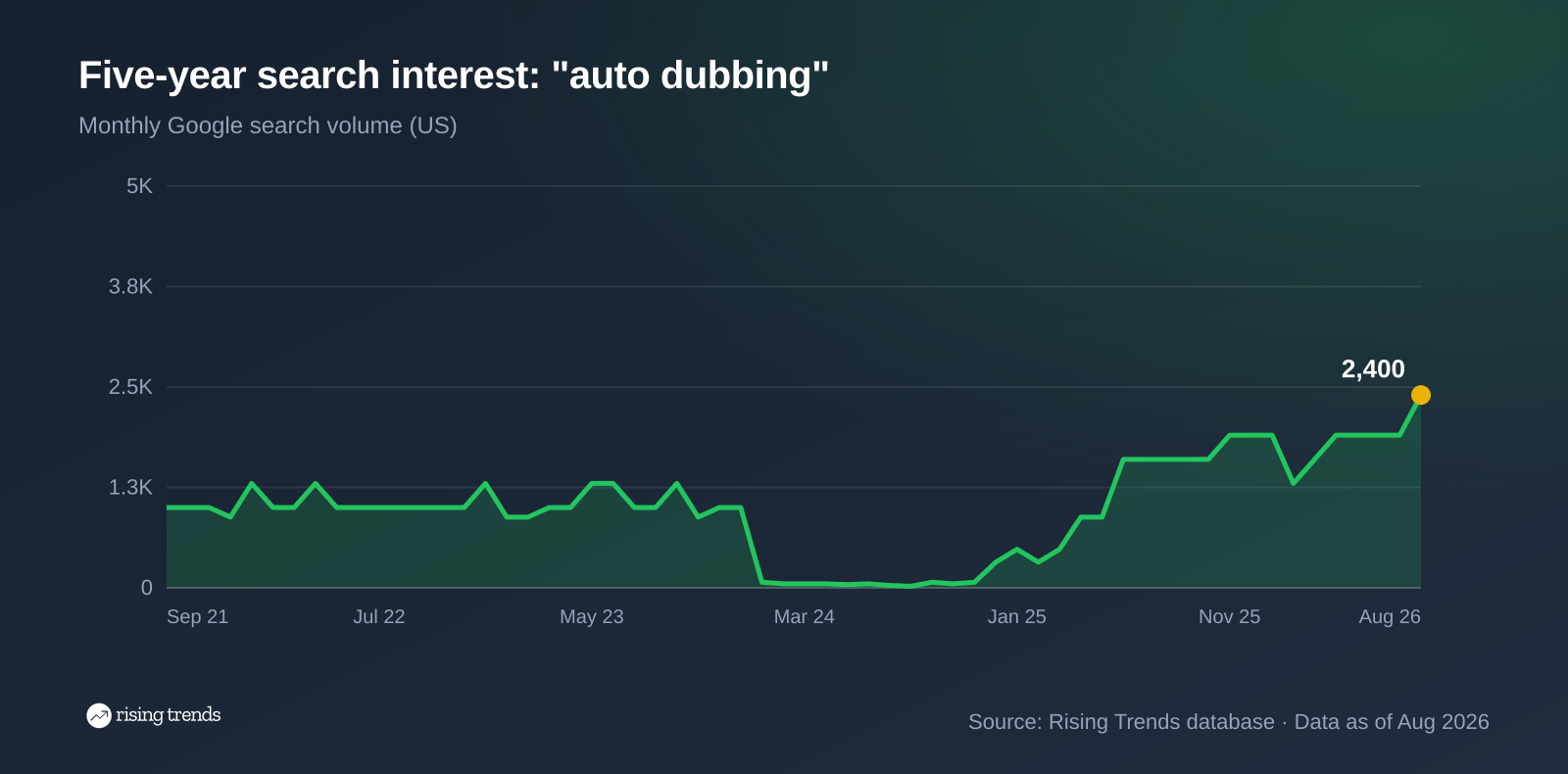
Read it left to right. Through 2021 and 2022 the phrase held a floor of roughly 1,000 searches a month, back when it mostly meant automated audio replacement in post-production software. Then it falls off a cliff in late 2023 and sits near zero for all of 2024, bottoming at 20 searches in August 2024. The rebuild starts in January 2025, crosses our breakout threshold in April 2025, and climbs in steps to 2,400 by August 2026. The three-month average is now 2,067.
That shape matters. A word that dies and comes back is usually a word that got attached to a shipped product, not organic curiosity about machine translation. The rest of the family confirms it.
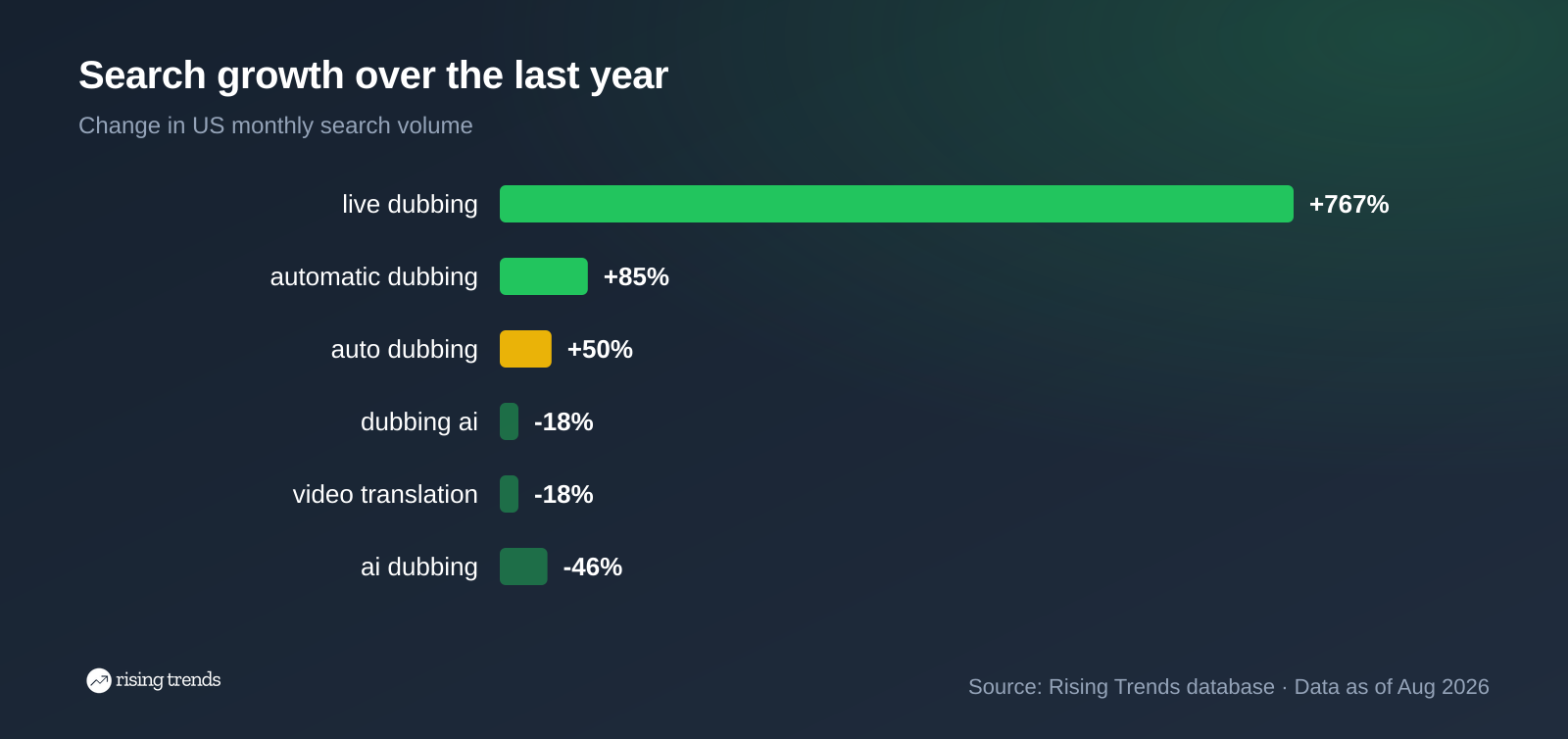
Three terms are up and three are down, and the split is not random. The risers are the words YouTube uses in its own interface: live dubbing, automatic dubbing, auto dubbing. The fallers are the words you would type if you were looking for a tool to buy: ai dubbing, dubbing ai, video translation. That is what a platform absorbing a category looks like in search data.
By raw volume the old generic terms are still much bigger, which is the other half of the story.
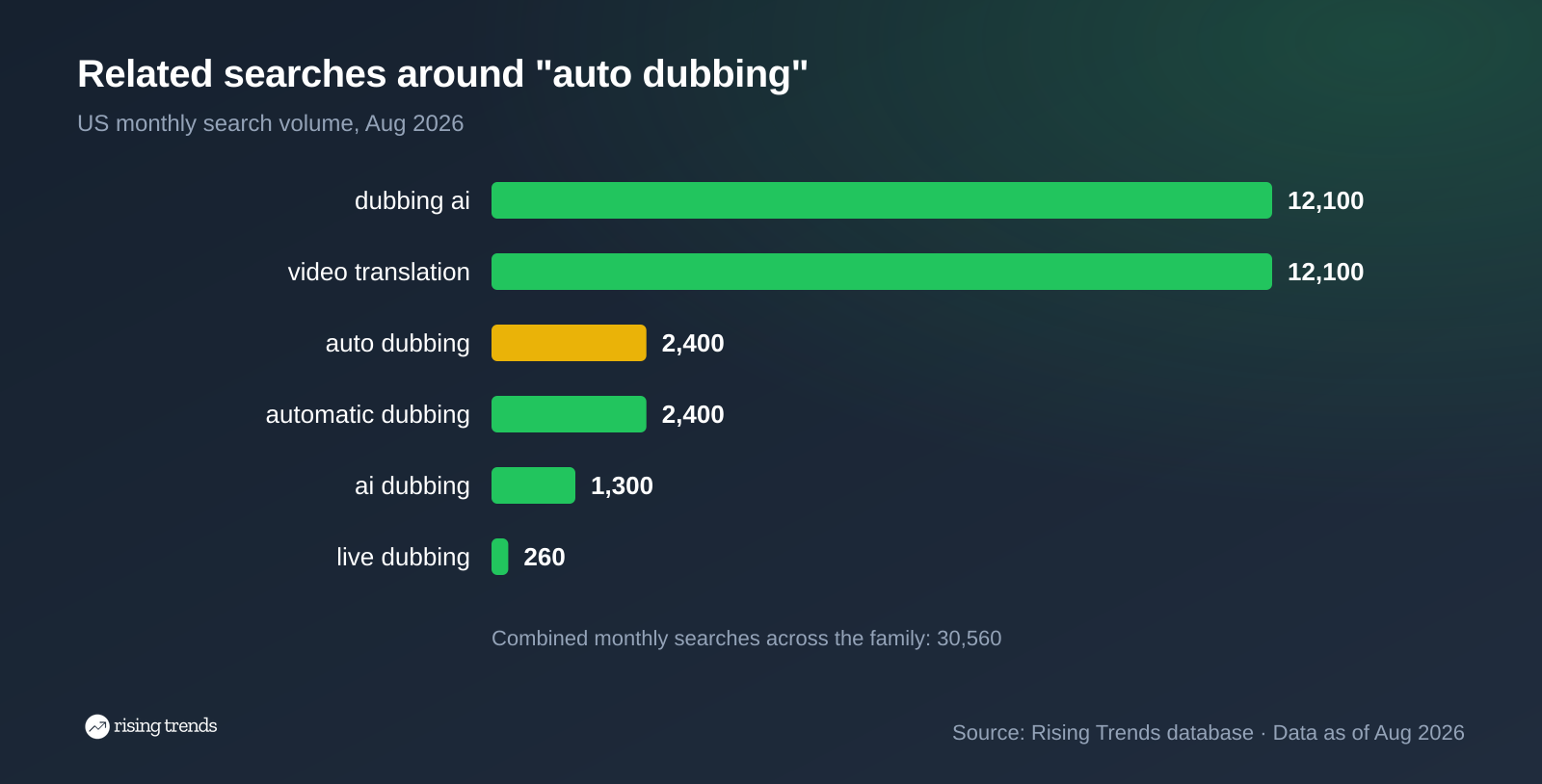
Dubbing ai and video translation still pull 12,100 searches a month each, and both are shrinking while the feature names grow. If you sell a dubbing product, that chart is your five-year problem in one picture.
Strip out the marketing and it is three machine-learning steps bolted together. A speech model transcribes the original audio, a translation model converts the transcript, and a text-to-speech model speaks the result in a synthetic voice timed to the original. Better systems add a fourth step that clones the speaker's own voice, and a fifth that moves their lips.
YouTube's version is documented in one place, and it is worth reading before you form an opinion about it.
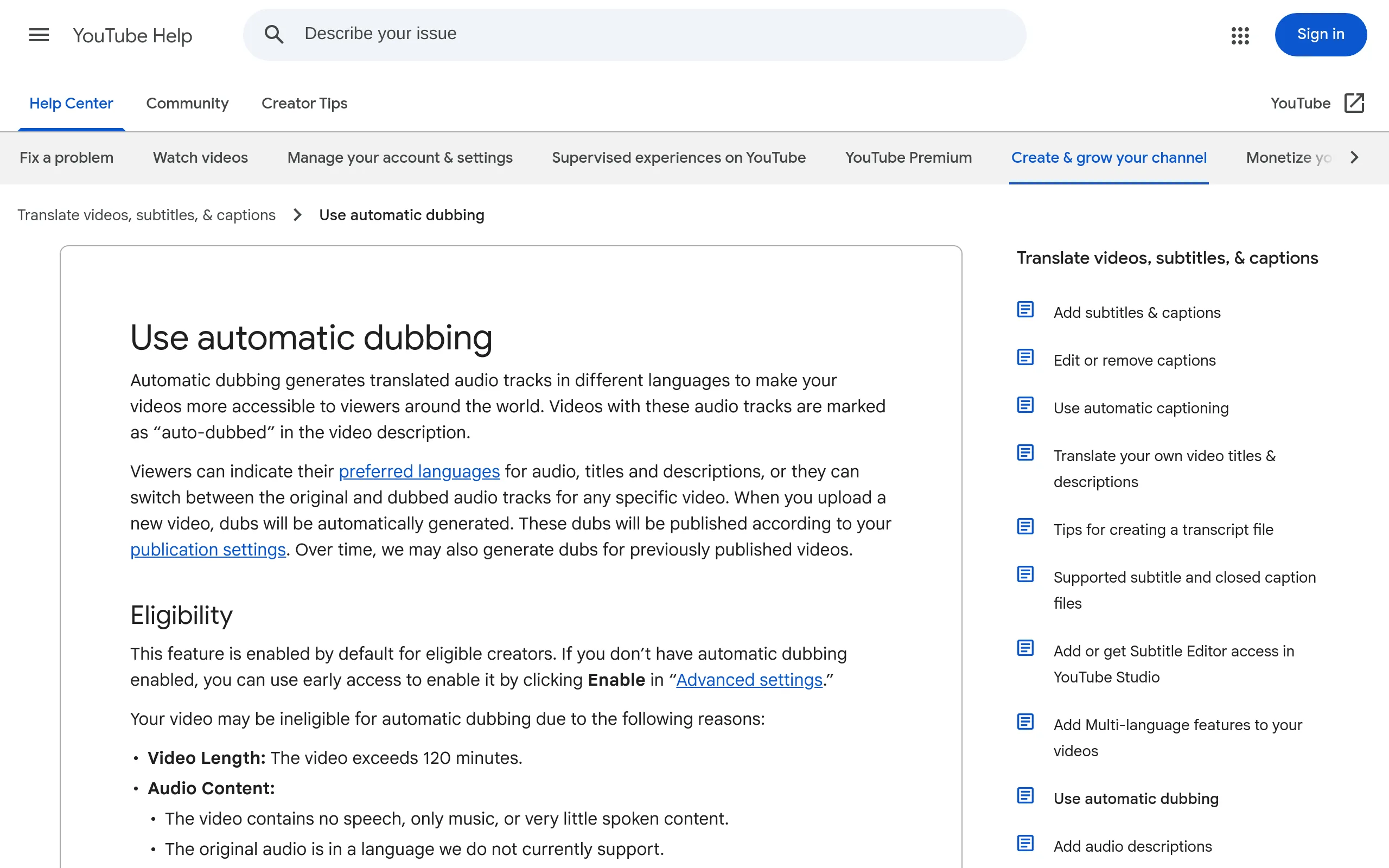
That page is the spec, and four lines on it decide everything people are arguing about. First: "This feature is enabled by default for eligible creators." Second: "When you upload a new video, dubs will be automatically generated." Third: "Over time, we may also generate dubs for previously published videos." Fourth, and the one creators find hardest: "You cannot edit automatic dubs." You can preview a dub, publish it, unpublish it or delete it. You cannot fix a line of it.
The language matrix on the same page is narrower than the headline suggests. Thirty source languages are supported, but an English video only dubs into 20 target languages, and most other languages dub into English alone. Seven of those English pairings support what YouTube calls expressive speech, which copies the original pitch and intonation. The rest get a flatter read.
A video is skipped if it runs over 120 minutes, has no real speech, is spoken too fast to dub without sounding sped up, or carries a copyright claim. Everything else gets dubbed whether or not anybody asked.
The origin is older than the feature. It began as Aloud, built inside Google's Area 120 incubator by Buddhika Kottahachchi and Sasakthi Abeysinghe, two Sri Lankan engineers who had been high school rivals in competitive programming. YouTube published their story in September 2023, and the framing has not changed since: 80% of the world does not speak English.
Three dated moments explain the staircase in that first chart.
December 10, 2024. YouTube turned auto dubbing on for hundreds of thousands of channels in its Partner Program, starting with knowledge and information content. The launch covered nine languages in total, dubs carried an "auto-dubbed" label, and the post was candid that "it won't always be perfect." Our curve starts moving the following month.
February 4, 2026. The feature went to everyone. YouTube product manager Chandralekha Motati announced 27 languages, expressive speech and a lip sync pilot in one post, along with the number that reframes the whole thing: in December, YouTube averaged more than 6 million daily viewers who watched at least 10 minutes of auto dubbed content. That is not a pilot. That is a distribution channel.
September 23, 2026. At Made On YouTube, Barbara Macdonald of YouTube Live announced Live auto dubbing, which translates a streamer's speech in real time, piloting from early 2027. The post also gives the reason: more than 40% of live watch time already comes from viewers outside a creator's home country, and in August 2026 more than 600 million logged-in viewers watched live content each day.
The search traffic that follows each of these is overwhelmingly practical, and most of it is people looking for a switch. This clip from @ionhowto, posted on September 2, 2026, is one of hundreds answering the same question: how to get at the audio track and change it back.
Videos like that one are the trend: a feature nobody opted into generates a search query, and the query is a troubleshooting query.
YouTube is not the only one, but it is the only one that does not need you to visit a website.
| Player | What it sells | One number |
|---|---|---|
| YouTube | Dubbing built into upload, on by default | 27 languages, 6M daily viewers of dubbed content |
| ElevenLabs | Dubbing v2, conditioned on the original performance | 90+ languages; 368,000 brand searches a month |
| HeyGen | Video translation with avatars and lip sync | 175+ languages; 135,000 brand searches a month |
| Vozo | Editable dubs with cloning and lip sync | 160+ languages |
| Kapwing | Browser dubbing inside a wider editor | "kapwing ai" down 45% in a year to 720 a month |
ElevenLabs is the serious independent. Its pitch is that Dubbing v2 "conditions on the source performance, not a transcript," so tone and delivery survive translation, and every dub is spoken in a clone of the original voice. The company claims more than a million creators and enterprise customers. Search demand for the brand runs at 368,000 a month, up 22% in a year, as of August 2026, which makes it one of the largest AI brands we track.
HeyGen sells the same job with blunter copy: 175+ languages and dialects, "no voice actors or dubbing needed." Vozo competes on control instead, offering 160+ languages with dubs you can actually edit, which is precisely what YouTube forbids.
The pattern underneath is familiar from every other AI category we have covered in our generative AI trends report. A capability arrives as a product, gets good enough to be a feature, and then becomes a default inside the platform where the content already lives. Standalone dubbing tools are being squeezed into the gap marked "I need to fix the output," which is a real market and a much smaller one.
Localisation stops being a budget line. Dubbing a video used to mean a translator, a voice actor, a studio and a schedule. For a mid-size channel that was the reason not to bother. Now the default is dubbed and the decision is whether to turn it off. Anyone selling human localisation is now selling an upgrade, not a service.
The audience you reach is no longer the audience you wrote for. If YouTube's dubs carry your explainer into Hindi and Portuguese, your comments, your retention curve and your ad rates all start reflecting viewers you never addressed. Most creators get moved into that business without a decision.
Voice becomes a distribution asset. The same shift is visible in the synthetic speech market we wrote about in our piece on Gemini's text-to-speech models: the valuable thing is not the voice, it is the right to use it everywhere at once. For brands running video at scale, this lands in the same place as the advertising trends we track, where one asset gets produced once and permuted by machine.
Search intent moves from "tool" to "setting." When a capability becomes a default, people stop searching for products and start searching for controls. You can watch it happen on our live auto dubbing trend page, using the method in our guide on how to spot a market trend early.
The quality complaints come mostly from multilingual viewers. On r/youtube, in a thread titled "The automatic AI dubbing on Youtube got to be the worse feature ever," a viewer in Quebec wrote in March 2025 that "even if my computer is set in english, it still keeps automatically dubbing english videos in french with this terrible AI voice. AND the worst thing is that it even dubs french videos in english which does not make any sense." A year and a half later that thread is still collecting replies.
In r/languagelearning, someone asking how to turn it off in September 2025 described the core failure: "Anybody else notice that YouTube will now automatically start playing videos dubbed in the language it presumes you are fluent? I even have my YouTube set to Spanish, and I still have to stop it from auto playing the English dub." Another commenter in the same thread said a dub of a video in their own native language "took me a while to notice," because they assumed the robotic English was a joke. These are anecdotes, not measurements, but they are the same anecdote over and over.
YouTube has answered part of it. A preferred-language setting arrived in late 2025, and the reaction in the language-learning community was relief rather than enthusiasm: the person who found the setting called it a fix for "a massive source of frustration." Automatic smart filtering now skips music and silent videos. Expressive speech covers eight languages. None of that changes the two structural facts: the dub is generated whether you want it or not, and you cannot edit it.
Then there is the question of whose voice it is. The National Association of Voice Actors runs a pledge called fAIr Voices, built on three words: consent, control, compensation. Its signatories include Voices.com, Voice123, Backstage and Bodalgo. The pledge is aimed at the companies that hold recorded performances, and the ask is simple: do not clone what you were given for one job and reuse it for another. A platform that auto-generates a synthetic read of every eligible upload is not covered by anybody's pledge, which is the gap the next few years of this argument will be about. The broader anxiety about AI replacing skilled work, which we looked at in our explainer on the AI apocalypse number, lands here in a very specific form: the first jobs auto dubbing displaces are dubbing jobs.
Live dubbing is the leading indicator. At 260 searches a month it is tiny, but it is up 767% in a year and YouTube's pilot does not start until early 2027. If live dubbing steps up again in the first quarter of next year, the pilot shipped and streamers noticed.
Watch whether the generic terms keep falling. Dubbing ai and video translation are the vendor-neutral queries. If they keep shedding volume while the feature names grow, the independents are losing the top of their funnel, and the next move is consolidation or a pivot into editing and compliance.
Watch the opt-out queries. "How do I turn off auto dubbing" is already in the People Also Ask box. If that family grows faster than the explainer queries, YouTube has a defaults problem rather than a quality problem, and defaults problems get fixed in settings menus. Our audio dubbing page is the clean control term to watch alongside it.
The honest summary is that auto dubbing is not a trend people chose. It is a setting that got flipped for several hundred million videos, and the search curve is the sound of everyone finding out. The technology will keep getting better, because the lip sync pilot and expressive speech are both aimed straight at the complaints. The question that will not be solved by a better model is who gets to decide which voice speaks your words, and right now that decision is a checkbox you have to go looking for.
Want to spot shifts like this before the platform ships them? Read our guide on how to identify market trends, follow the live auto dubbing trend page, or browse what is breaking out right now on the Rising Trends dashboard.
Thousands of Emerging Trends
Thousands of Breakout Apps
Mega Trends
Trend Analysis Tool