
Something moved in the sleep category this year, and it did not move in the supplement aisle. Searches for "peptides for sleep" went from 590 a month two years ago to 6,600 in August 2026, an 11.2x climb, with a peak of 8,100 in July. At the same time almost every established sleep-supplement term in our database went backwards. This is not a new product arriving next to the old ones. It looks like a swap.
Most of what ranks for this query is a tier list or a clinic page telling you which peptide is best for deep sleep. Almost none of it tells you that the peptides being named have no approved use for sleep, that the human trial record for the most-discussed one ends in 1992, or that the regulatory door opening for peptides in 2026 is not opening for these. So we pulled the curve, read the FDA filings, and went back to the original studies.
Key takeaways:
- "Peptides for sleep" is up 175% in a year and 11.2x in two, from 590 to 6,600 US monthly searches (Rising Trends data, as of August 2026).
- The incumbents are falling as it rises. Magnesium sleep supplements are down 45%, sleep supplement down 55%, deep sleep supplement down 45% and magnesium sleep down 97% over the same year. That makes this a substitution, not an addition.
- No peptide is FDA-approved to treat insomnia. Delta sleep-inducing peptide, sold as DSIP, appears on FDA's list of compounding substances that were nominated and then withdrawn, after the agency said it lacked enough information to know whether the drug would cause harm in humans.
- The human evidence stops in 1992. The two controlled DSIP insomnia trials on PubMed concluded the effect was "of little clinical significance" and "not likely to be of major therapeutic benefit". ClinicalTrials.gov lists no registered study using DSIP as an intervention.
- The 2026 policy opening is not about sleep. The four peptides FDA's advisory committee reviewed in July 2026 were put forward for ulcerative colitis, wound healing and obesity.
- The tooling tells you what people are actually doing. "Peptide calculator" runs at 368,000 monthly searches and "bacteriostatic water" at 201,000. Those are reconstitution tools, not pills.
Let's get into it.
What we're seeing in the Rising Trends data
Here is the monthly search volume for "peptides for sleep" over the last two years, pulled straight from our database.
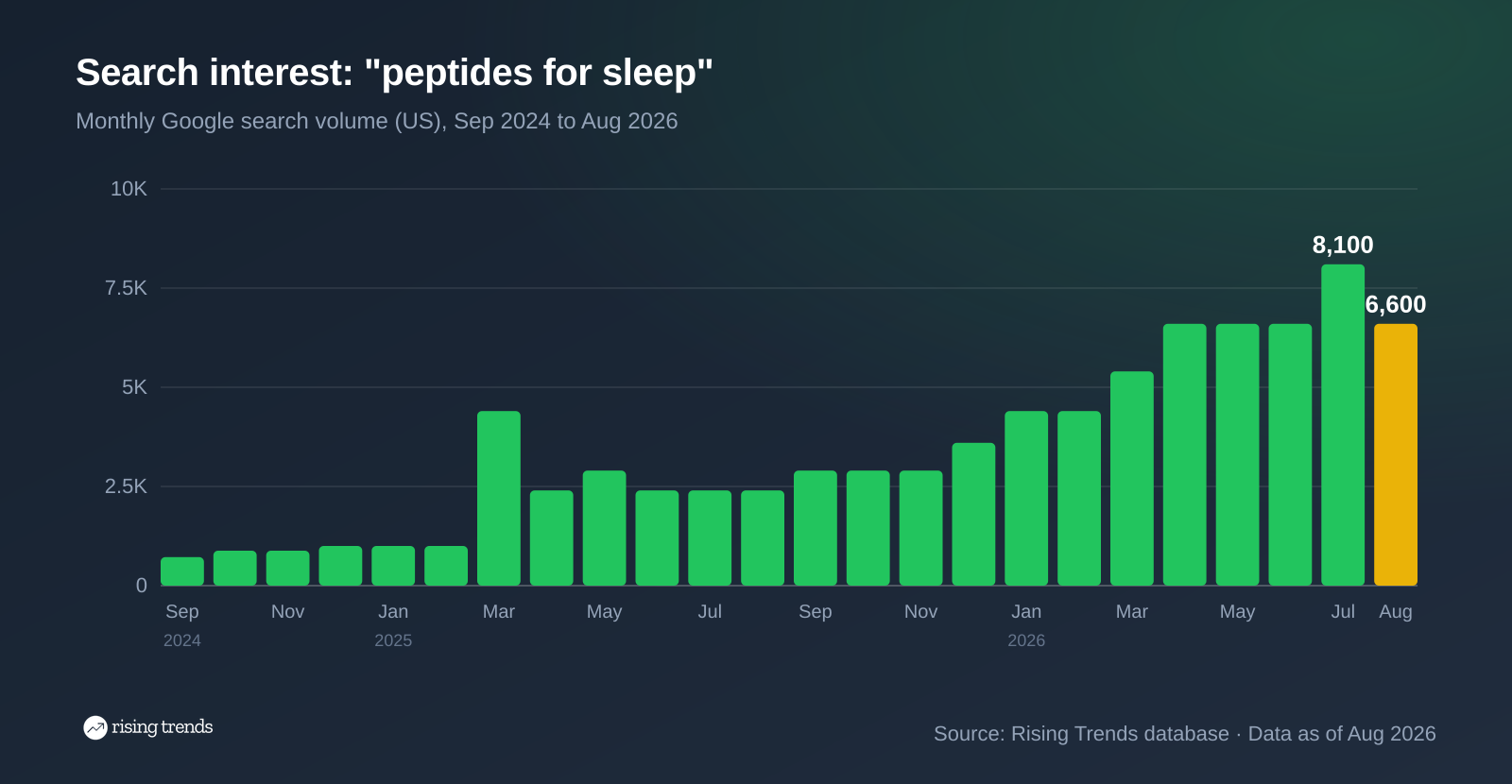
The shape matters. There is a one-month spike in March 2025 that falls straight back, which is what a news cycle looks like. Then from the end of 2025 the line stops spiking and starts climbing, month after month, to 8,100 in July 2026 and 6,600 in August. A year earlier it was 2,400. Two years earlier, 590. Our system rates the pace EXPONENTIAL, and the last three months average 7,100 searches a month.
A rising curve on its own only tells you people are curious. The useful question is what they stopped searching for. So we put the peptide sleep terms next to every incumbent sleep-supplement term we track.
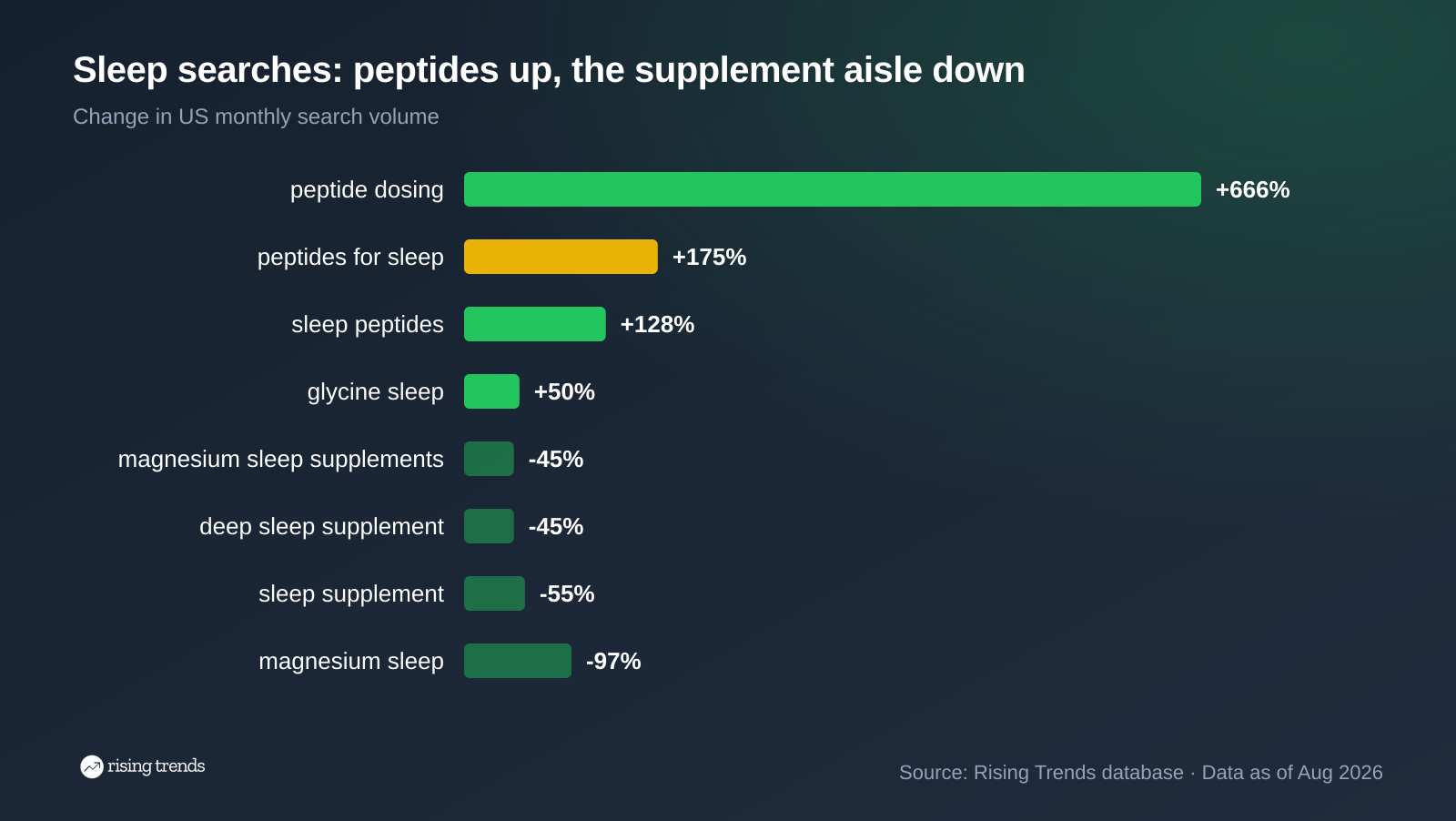
That is the finding. Everything with "peptide" in it is green and everything that describes a capsule or a powder is red. "Sleep peptides" is a second term at 6,600 searches, up 128%, and "peptide dosing" is at 22,200, up 666%. Against that, magnesium sleep supplements still has the bigger audience at 27,100 a month but is shrinking 45% a year, and magnesium sleep has collapsed 97%. Melatonin supplement is the one exception on the old side, at 18,100 and still growing, which is complicated for reasons we come back to.
Keep the absolute sizes in view, though. "Sleep aid" is still 60,500 searches a month. Peptides for sleep is 6,600. This is an early behaviour with a steep slope, not a mass market.
What "peptides for sleep" actually means
A peptide is a short chain of amino acids. The ones in this trend are not the collagen peptides in a tub next to the protein powder. They are injectables, and they fall into two groups.
The first is delta sleep-inducing peptide, almost always written as DSIP, named in the 1970s for the slow-wave sleep its discoverers associated it with. The second is the growth hormone secretagogues, mostly ipamorelin and CJC-1295, which do not sedate you at all. They nudge the body's own overnight growth hormone pulse, and better sleep is argued as a downstream effect. Epitalon, a pineal peptide out of Soviet-era research, sits apart and gets discussed for circadian rhythm rather than for falling asleep.
None of these is an approved medicine for a sleep disorder in the United States. The clearest place to see where they actually stand is FDA's own compounding page.
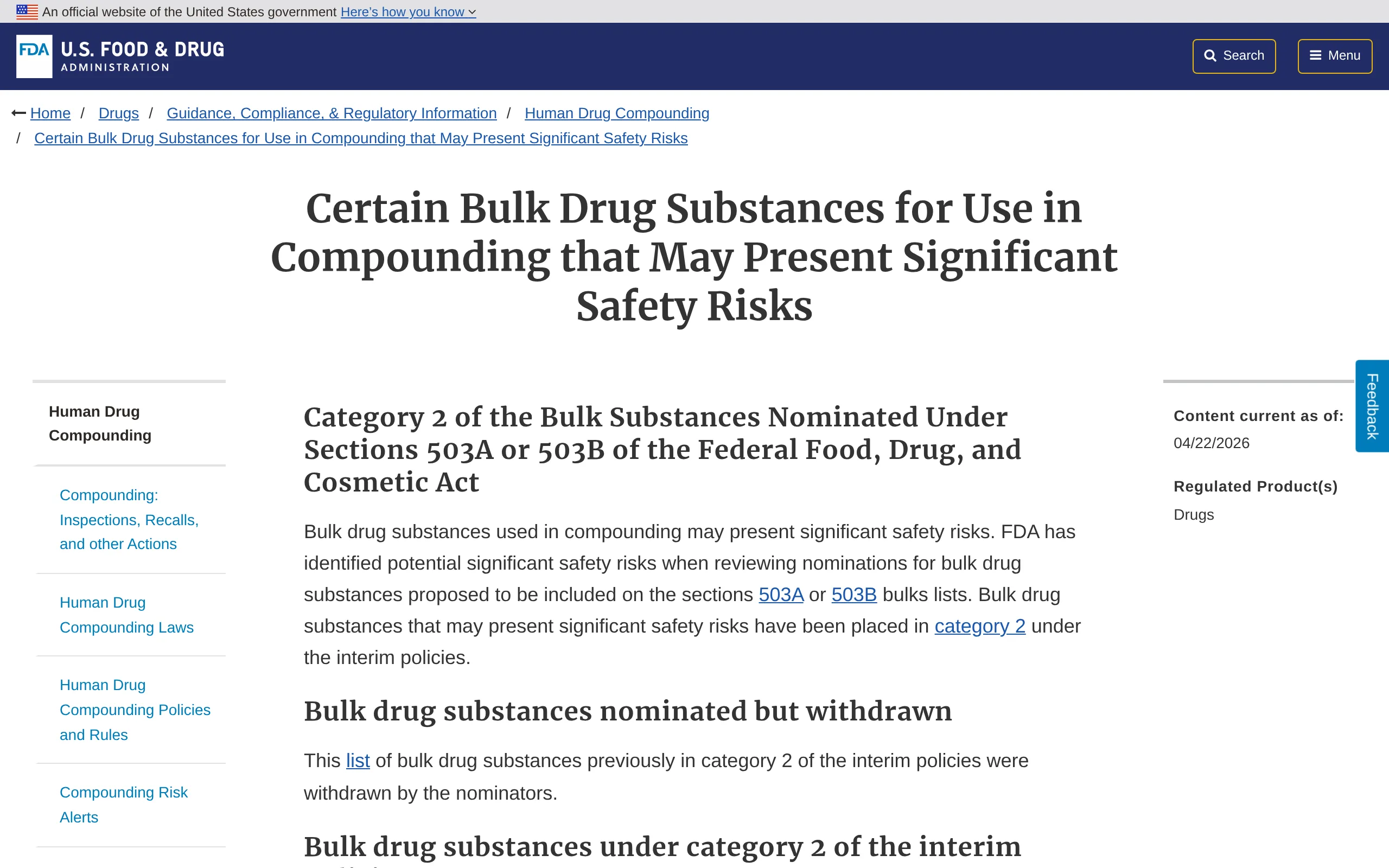
That page carries two tables. The first lists the substances currently in category 2 of FDA's interim policy, the ones the agency says "may present significant safety risks" if compounded. The second lists substances previously in category 2 that were withdrawn by the nominators. Seventeen substances sit in that second table, and every one of them is a peptide. Here is where the four sleep names land.
| Peptide | Status on FDA's compounding tables | FDA's stated concern |
|---|---|---|
| Emideltide (DSIP) | Nominated, then withdrawn by the nominator | Possible immunogenicity; agency "lacks sufficient information to know whether the drug would cause harm if administered to humans" |
| Epitalon | Nominated, then withdrawn | Possible immunogenicity from aggregation and peptide-related impurities |
| CJC-1295 | Nominated, then withdrawn | Serious adverse events identified, including increased heart rate and systemic vasodilatory reaction |
| Ipamorelin acetate | Withdrawn for 503A, still in category 2 for 503B | Serious adverse events including death reported with intravenous use in one published study |
Then there is the evidence. DSIP was studied properly, just a very long time ago. A 1987 double-blind crossover trial using polysomnography concluded "sleep improvement under DSIP treatment is of little clinical significance". A 1992 double-blind study in 16 chronic insomniacs found slightly better sleep efficiency, judged the effects weak, and concluded that short-term treatment of chronic insomnia with DSIP "is not likely to be of major therapeutic benefit". Nothing has replaced those. A query of ClinicalTrials.gov on 11 November 2026 returns zero registered studies using delta sleep-inducing peptide as an intervention, and the three studies that name ipamorelin are about post-operative ileus, gastrointestinal motility and PTSD. None is about sleep.
Why it's trending now
Three dated things happened, and they stack.
The melatonin scare, 3 November 2025. The American Heart Association published a preliminary abstract reporting that, among adults with insomnia, long-term melatonin use was associated with roughly a 90% higher chance of being diagnosed with heart failure over five years. The study covered more than 130,000 adults and has not been peer reviewed. Lead author Ekenedilichukwu Nnadi put it plainly in the AHA's own release: "Melatonin supplements may not be as harmless as commonly assumed." Columbia's Marie-Pierre St-Onge, who was not involved, added that melatonin "should not be taken chronically without a proper indication." Our peptide curve stops spiking and starts climbing in exactly that window.
The peptide boom had already built the pipes. By 2025 a parallel market for injectable peptides existed, with its own vocabulary, its own suppliers and its own search behaviour. We mapped it in our breakdown of the peptide trend, and the clearest case of demand running ahead of approval is retatrutide, a drug nobody can legally buy. Sleep was simply the next use case to be plugged into infrastructure that was already there.
Washington reopened the question, on 30 October 2026. HHS published an enforcement discretion policy for 503A compounding with certain peptide bulk substances, signed by Secretary Robert F. Kennedy, Jr. It says HHS "does not intend to take enforcement action against a State-licensed pharmacy, Federal facility, or licensed physician" compounding with the peptides in its appendix. It is a draft, it is not binding, and the same notice repeats that "compounded drugs are not FDA-approved, which means FDA does not review their safety, effectiveness, or quality before they are marketed."
The gap nobody is pointing at is which peptides that opening is about. When FDA's Pharmacy Compounding Advisory Committee met on 23 and 24 July 2026, it reviewed four peptide families: BPC-157, KPV, TB-500 and MOTS-c. The uses on the agenda were ulcerative colitis, wound healing and inflammatory conditions, wound healing, and obesity and osteoporosis. Not one sleep indication. The policy conversation and the search behaviour are about different molecules.
You can watch the behaviour itself in the content people are making. This video, published on 15 October 2026 by Ryan Sims of Optimal Health Project, is a first-person epitalon self-test with 9,423 views on the YouTube page as of 11 November 2026, and the framing is typical: run it yourself, log the sleep, report back.
That format, the n-of-1 experiment published as content, is the engine of the whole category.
The new behaviour: what people are doing differently
Before, a bad sleeper bought a bottle. The search was "best magnesium for sleep", the decision took one evening, and the worst case was that nothing happened.
Now the same person is running a protocol. The search is not for a product, it is for a dose, a schedule and a vial. Look at what moved fastest in our data: "peptide dosing" at 22,200 searches a month, up 666% in a year, and "peptide stacks" at 1,300, up 171%. Those are not shopping queries. They are operating instructions.
Three things changed with it.
The threshold went up. Swallowing a capsule and mixing a vial for injection are not the same act. People crossing that line have decided the supplement aisle is a dead end, which is the sharpest reading of those four red bars.
The trust anchor moved. It used to be the label and the brand. Now it is a creator with a sleep tracker and a spreadsheet. The same pattern turned up in the vagus nerve reset trend, where 49,500 people a month searched for a protocol that doctors do not recognise, and in the horse gelatin trend, where the citation holding up the whole thing did not exist.
The ask got narrower. This cohort does not want general wellness. It wants deep sleep, measured, and it will accept an unapproved compound to get it. That is a different buyer from the one reading about sleep hygiene.
One thing worth saying plainly, because almost nothing ranking for this query says it: none of these peptides is approved to treat insomnia, several are flagged by FDA for possible immunogenicity and, in CJC-1295's case, for reported cardiac events. If you are not sleeping, that is a conversation for a doctor, not for a comment section.
Who's building on it
Follow the money and it is not in sleep at all. It is in the kit.
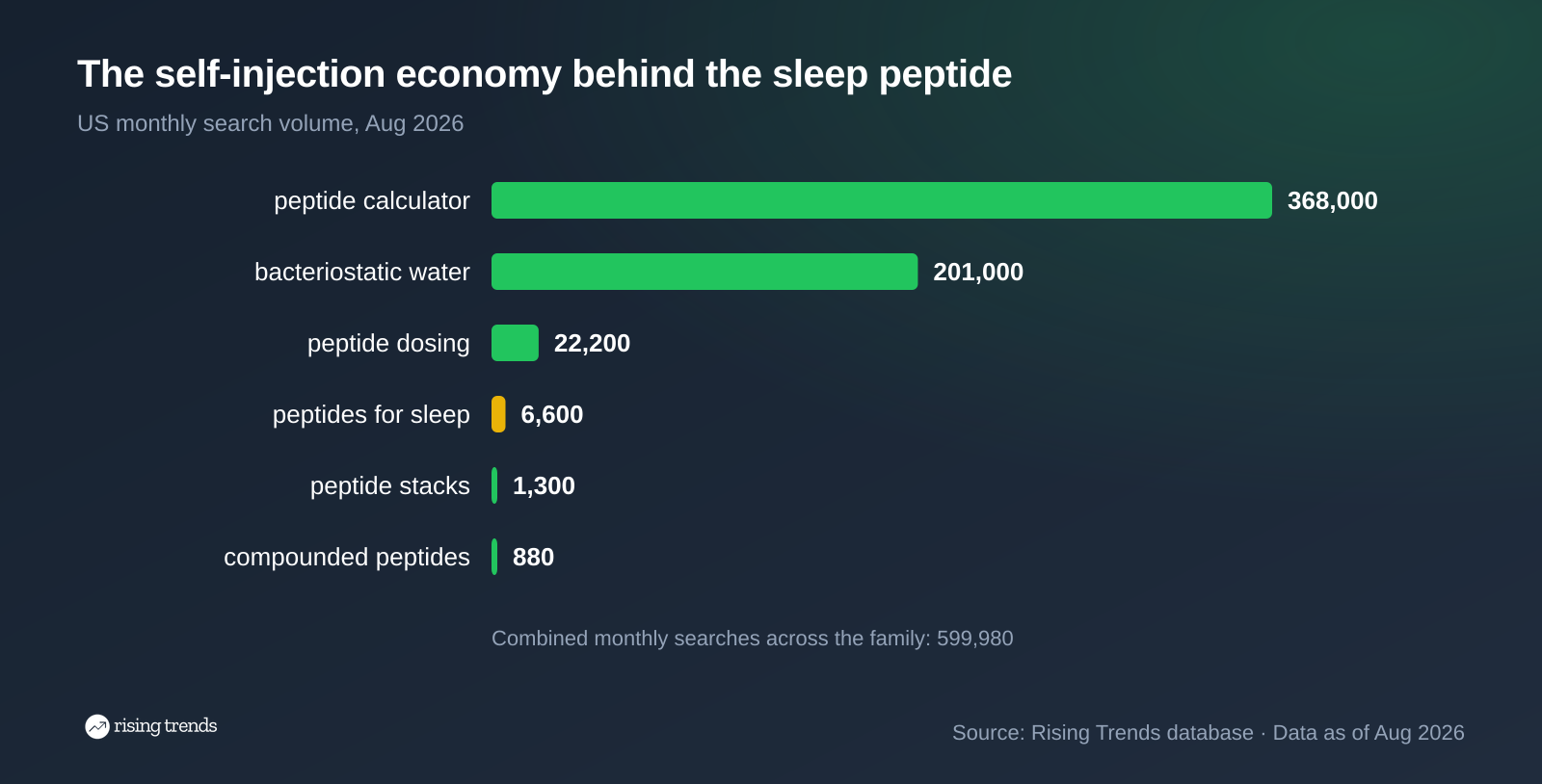
The tooling layer is the real business. Peptide calculator does 368,000 searches a month, up 123% in a year; bacteriostatic water does 201,000, up 232%. Both exist to work out a dose and mix a vial. The sleep term is a rounding error next to them, which tells you peptides for sleep is one doorway into a much larger self-injection habit.
The gray market is being papered. FDA sent warning letters to at least nine US peptide sellers during 2026, including a batch of five dated 24 August. The letter to Peak Performance Peptides names six products plus bacteriostatic water as unapproved new drugs, and the footnote is the part sellers should read twice: despite labelling products "research use only" and "not for human consumption," FDA said evidence from the website established they were intended as drugs for humans, and that selling bacteriostatic water alongside them provided "the means to prepare an injectable drug for human administration."
The licensed channel is tiny but legitimising. "Compounded peptides" is only 880 searches a month, up 83%. HHS's October notice is addressed to pharmacies and physicians, not consumers, so growth here comes from clinics, not search.
The approved sleep drug of 2026 is not a sleep peptide. On 5 August 2026 FDA approved Takeda's ORZEYFUL (oveporexton) for narcolepsy type 1, under application NDA 220860. It works on orexin, the wakefulness pathway, and in our data "orexin antagonist" is already at 6,600 searches a month, up 83% in a year. The science that cleared the bar and the science people are buying on the internet are not the same science.
What it means for business
Supplement brands are losing a segment, not a season. A 45% annual decline in magnesium sleep supplements is not a packaging problem. The highest-intent end of the sleep market is leaving for something a retailer cannot stock. Anyone selling into the supplement category should assume their most motivated customer is the one most likely to go.
Melatonin is the swing category. Melatonin supplement is still growing at 83%, which looks like a contradiction until you read the queries around it. After November 2025 much of that search is about safety, not purchase, and growth powered by people checking whether a product is dangerous is not healthy growth.
Compliance risk sits with marketing, not formulation. The FDA letters turn on website copy. The "research use only" disclaimer did not survive contact with the product pages. Any brand within a mile of this space should assume its own claims, not its chemistry, are the exposure.
There is an unserved honest product. Nobody is selling the obvious thing: a measured, legal, non-injectable deep-sleep protocol with real data behind it, for people who have outgrown gummies. Glycine sleep is up 50% to 9,900 searches, a small sign the evidence-led end of the aisle still has demand. The sleep category is wide open for a brand that treats this buyer as a sophisticate rather than a mark.
Where this is heading
Watch whether peptides for sleep holds above 6,000 through the winter. July's 8,100 was the top. If the term settles at or above its August level through the dark months rather than fading like the March 2025 spike, it has become a category instead of a curiosity.
Watch the HHS appendix. If a sleep peptide is ever added to a 503A list, clinic supply becomes legal overnight and the search behaviour moves from "peptide dosing" to clinic names. If one never is, the gap between policy and practice widens and the letters keep coming. "Compounded peptides" at 880 searches is the early indicator either way.
Watch orexin. The approved pathway now has a product behind it, and orexin antagonist is already at 6,600 searches a month and rising. The likeliest ending for this trend is not that DSIP gets vindicated. It is that a regulated drug arrives, performs, and makes the gray market look like what it is: a workaround for a gap that closed.
The number we trust most is still the pair at the top. A term goes from 590 to 6,600 searches in two years while four established competitors fall by 45% to 97%. That is not curiosity. That is people who tried the aisle, decided it did not work, and went looking for something stronger, which they now buy from sellers being told by letter that they are not allowed to sell it.
Want to catch behaviour shifts like this while they are still small? Read our guide on how to identify market trends, or see what is breaking out right now in our trending topics list.
Never miss a trend again
- One trend broken down with the numbers
- Who's making money, and what to build
- A website on the rise
- A breakout app
Join 5,000+ founders