Trends


Two years ago, "vagus nerve reset" was a phrase almost nobody typed into Google. In July 2026 it pulled 49,500 US searches in a single month, the highest reading in our database and a 1,607% jump over two years. The term broke out in January 2025 and has not stopped climbing since.
What makes the curve interesting is the term sitting right next to it. "Vagus nerve" itself, the plain anatomical query, draws 246,000 searches a month and has been flat for a year. People are not asking what the nerve is any more. They are asking what to do to it. Every page ranking for the reset query is a hospital explainer listing the same five exercises, and not one of them shows you this split. So we pulled the numbers, read what the clinicians quoted on those pages actually said, and checked whether the money is following the searches.
Key takeaways:
Let's get into it.
Here is the monthly search volume for "vagus nerve reset" over the last two years, straight from our database. The line starts at 5,400 and does not have a single flat stretch in it.
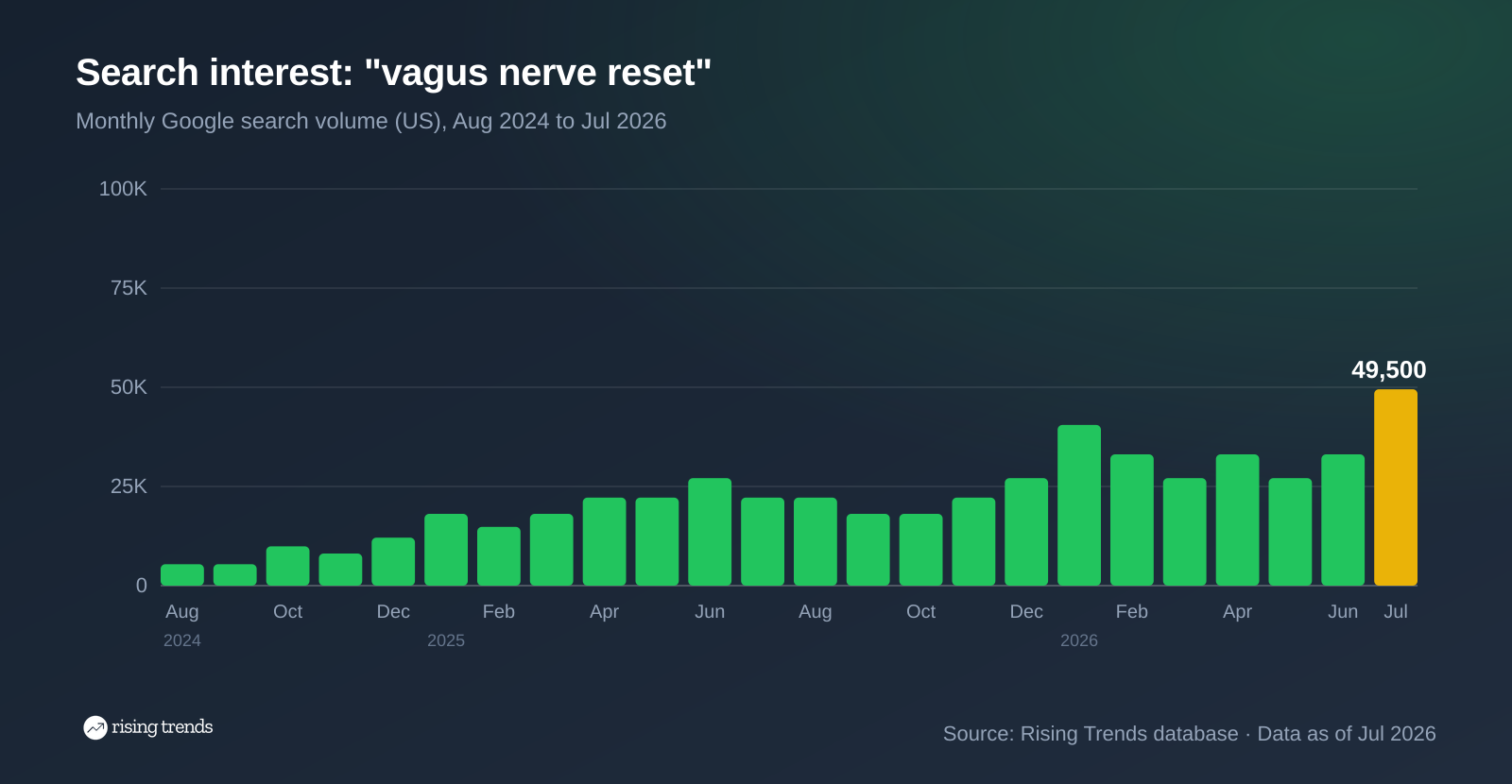
The shape is a staircase, not a spike. There is no single viral moment in it. The breakout month is January 2025, and every New Year since has stepped the base higher: the January 2026 reading of 40,500 was the largest month in the series until July 2026 beat it. Two years ago the term was doing 2,900 searches a month. As of July 2026 it does 49,500, which is 13.4 times the level of two years ago measured on a three-month average. Seasonality is high, which fits: this is a resolution-shaped behaviour.
The more useful view is what is happening to everything around it. We took the eight nearest terms in our database and ranked them by how they moved over the last year.
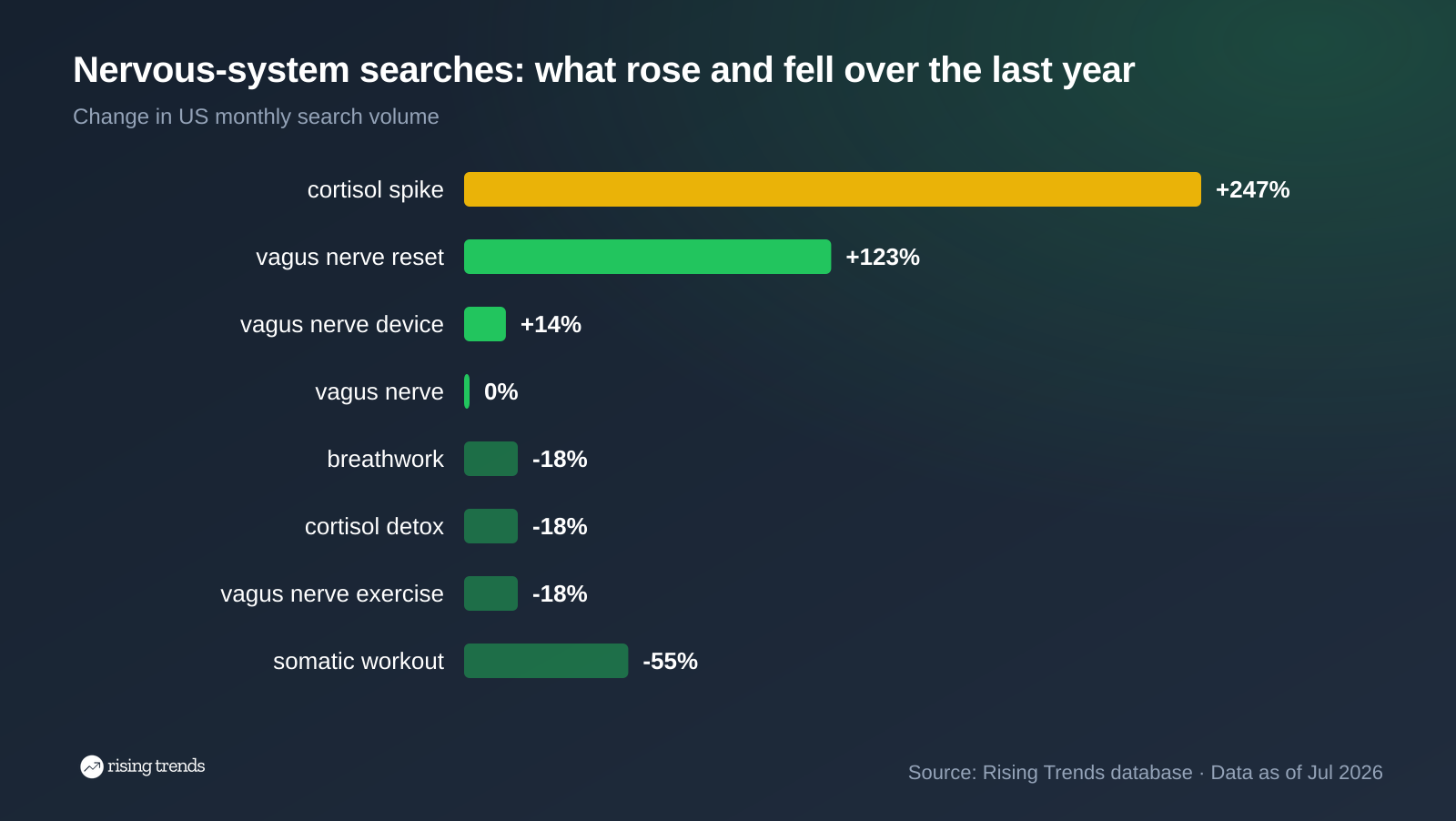
Three things fall out of that ranking. First, the fastest riser is not the nerve at all: "cortisol spike" is up 247% to 6,600 searches a month, and the measurement version, "cortisol meter", is up 1,700% off a small base of 720. People want a number for their stress before they want a fix for it. Second, the losers are the words wellness used before this one. "Breathwork" is down 18% to 9,900, "vagus nerve exercise" is down 18% to 9,900, "cortisol detox" is down 18% from 60,500, and "somatic workout" is down 55%. Third, "vagus nerve device" grew 14%, to only 1,000 searches a month. The interest is overwhelmingly in the free version.
That is the whole story in one chart. The same behaviour keeps getting renamed, and "reset" is the name that is winning right now.
The vagus nerve is the longest cranial nerve in the body. It runs from the brainstem down through the neck to the gut, and it carries the traffic of the parasympathetic nervous system, the one associated with rest and digestion rather than fight or flight.
A "reset", as the term is used online, is a short routine meant to push you from one state to the other. The techniques are consistent across every guide. Cleveland Clinic lists five: intentional breathing with a four second inhale and a six second exhale, movement, cold exposure, sound such as humming or singing, and massage. Its neurologist Emad Estemalik, MD, is quoted saying that "resetting the vagus nerve helps bring your body back into balance". Baylor Scott & White lists seven, adding gargling and eye and neck relaxation, and is more careful about the timing. Its internal medicine physician Dr. Deepika Kumaresan says that "while a 'vagus nerve reset' isn't instant, these simple practices can help train your body to respond to stress more effectively over time."
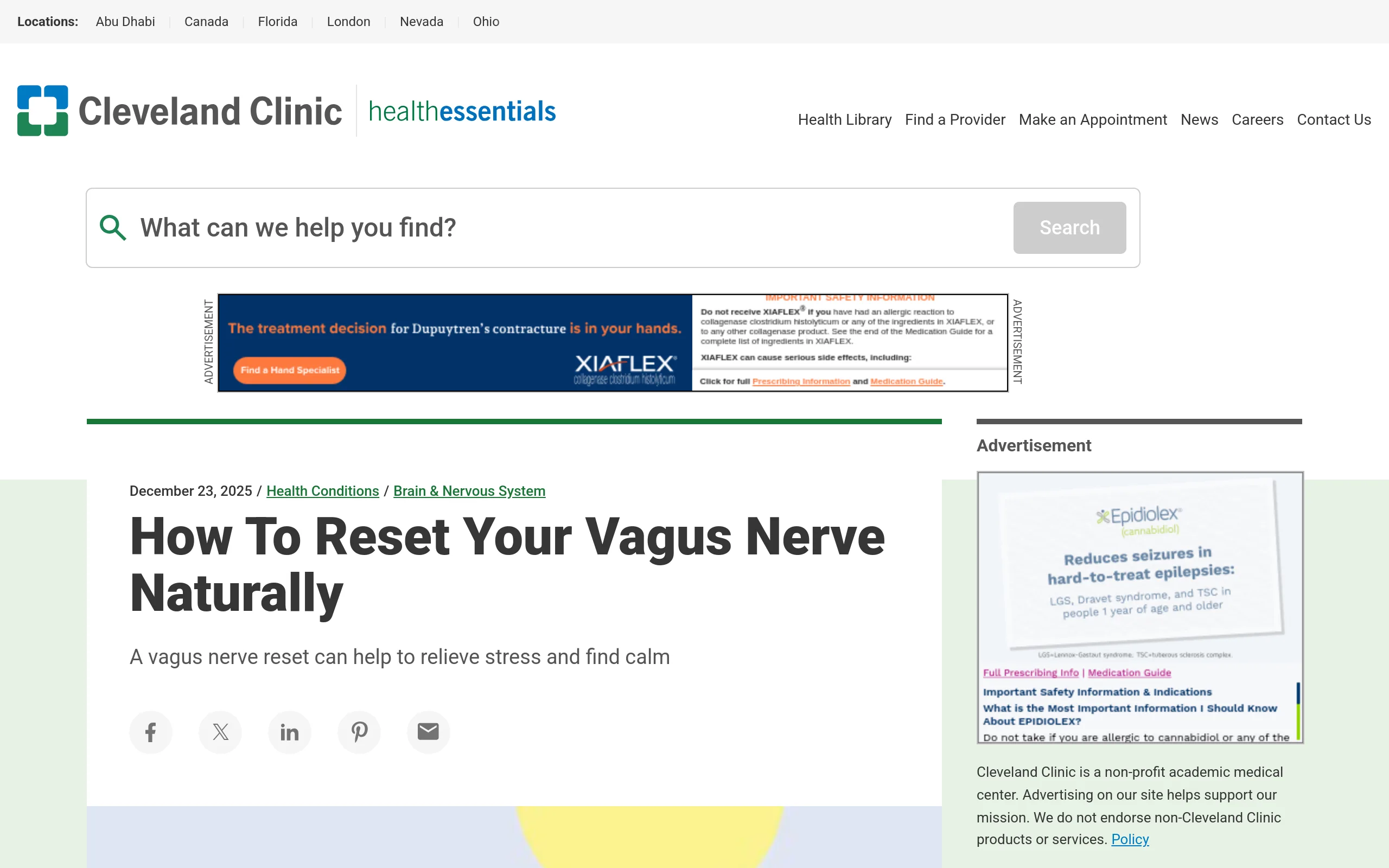
That screenshot is the trend in one image. A major academic medical centre put a wellness verb in its own H1 in December 2025, one month before our curve stepped up again. When the hospital adopts the search term, the search term stops being fringe.
Nothing viral lit this fuse. Three slower things did.
The first is institutional cover. Between December 2025 and June 2026, Cleveland Clinic, Baylor Scott & White, Houston Methodist, Cedars-Sinai and UVA Health all published pages using the reset or exercise framing. Once the top of the results page is hospital domains, a query stops feeling like a risk and starts feeling like a lookup.
The second is the category getting a name. On 27 January 2026 the Global Wellness Summit named the rise of neurowellness one of its 10 wellness trends for 2026, and its follow-up analysis in April called the vagus nerve "the longest in our body and the cornerstone of the parasympathetic nervous system". That piece counted more than 230,000 TikTok videos tagged with nervous system healing, and cited Gallup's 2025 finding that 40% of people globally report high anxiety on a given day.
The third is that the practice is free, short and filmable. Here is a typical clip, posted on 22 July 2026 by the psychologist who runs the account @nevernsubermoney, captioned simply "Can you do this?". It is breath, a small sound and a small movement, in under a minute, with nothing to buy.
Compare that to what it replaced. A somatic workout is a class. Breathwork is a session. A cortisol detox is a diet. A reset is 60 seconds in a car park before a meeting, which is why those three terms are falling while this one climbs.
The shift is from learning to dosing. Two years ago the search behaviour was educational: what is this nerve, what does it do. Now it is procedural, and it is repeated. Reddit has grown a dedicated r/VagusNerve community around the practice, and the threads there read like people managing a routine rather than reading an article.
They are also honest about the wobble. One member of r/CPTSD writes that they "tried the massages for ears, neck, sides of nose, abdomen, and toes" along with the reset technique. In r/VagusNerve, a post titled "Doing vagus nerve reset makes my feel tired and slouchy" reports that "in the beginning, I used to feel energised and peaceful". In r/Anxiety, someone says they have "started doing guided meditations with vagus nerve reset etc. It's been really helpful to me." And a long-running r/IsItBullshit thread asks the obvious question about the word itself. That spread, from ritual to fatigue to doubt, is what an adopted behaviour looks like rather than a fad.
The honest answer is that the calm is real and the mechanism claim is the contested part.
The strongest evidence under the headline technique is a Stanford trial (NCT05304000), published in Cell Reports Medicine in January 2023. It randomised 108 people across four arms for 28 days: mindfulness meditation, cyclic sighing, box breathing and cyclic hyperventilation with retention, five minutes a day. Exhale-focused cyclic sighing produced the biggest improvement in mood and the biggest drop in respiratory rate, beating meditation. That is a real result for long exhales. It is not a result about the vagus nerve.
For the nerve specifically, the picture is messy. A 2023 systematic review in Clinical Autonomic Research screened 2,458 studies and included 21 on transcutaneous auricular stimulation in healthy people. Significant changes showed up in 86% of studies for one heart rate variability index and in only 25% for another, and baroreflex sensitivity moved in just one of the six studies that measured it. The authors' own conclusion is that "the results were mixed".
The clinicians on the ranking pages say the same thing more bluntly. Houston Methodist neurologist Dr. Timea Hodics told her own hospital's blog that "a lot of what's available online is really just trying to create relaxation" and "may not be highly relevant to how the vagus nerve actually functions". Her sharpest line is the one nobody quotes: "Most people's vagus nerves are functioning just fine. Feeling uncomfortable or off does not automatically mean something needs to be fixed." Back in May 2022, McGill's Office for Science and Society had already called the framing a boogeyman and panacea myth, quoting physiologist Dr. Simon Cork on a popular exercise video: "the recommendations the video made were not based on science."
The commercial layer is thinner than the search curve suggests, and that is the most useful finding here.
electroCore is the listed pure play. Its prescription gammaCore device treats headache, and its consumer brand Truvaga sells the wellness version. In its second quarter 2026 results, published 6 August 2026, the company reported net sales of $9.5 million, up 28% year over year, at an 86.5% gross margin. Truvaga contributed $1.3 million. That is up about 27% on the year, but down about 17% from the previous quarter, after the company cut Truvaga media spend because advertising got more expensive.
Pulsetto, the Vilnius neurotech brand the Global Wellness Summit named by name, sells a bilateral neck stimulator. Its own product page prices the FIT model at $296 against a $546 list price and the Lite at $269, with an optional premium app tier at $45 a quarter, built around four-minute sessions. The company's page claims "8 out of 10 users say Pulsetto helps them relax and sleep better", and cites a 2025 study of its own showing stress down 56% and sleep up 41% in four weeks. Read those next to Hodics: "those consumer devices aren't designed to treat any medical condition, and the industries that sell these devices may not be the best source of unbiased data."
Hospital content teams are the biggest winners so far, in traffic rather than revenue. They own the query.
Creators supply the rest. The format is cheap, the props are optional, and the same clip works on three platforms, which is the same distribution physics we saw drive tai chi walking to a breakout and cupping therapy back into the feed.
The first implication is that free is the product. "Vagus nerve device" draws 1,000 searches a month against 49,500 for the reset itself, as of July 2026. A hardware company looking at this curve and reading it as demand for a $296 gadget is reading it wrong. The demand is for a 60-second protocol, and protocols do not have a checkout.
The second is that measurement is where the money moves next. The fastest-growing term in the family is not a technique, it is a readout: cortisol spike, up 247%. We have written before about the cortisol meter boom, and the pattern holds. People will pay to see the number long before they pay for the intervention, which is why wearables and at-home tests are better positioned here than stimulators are.
The third is the backlash risk, and it is already priced into the category's own trade body. The Global Wellness Summit's 2026 list has "The Over-Optimization Backlash" sitting at number two, one slot above neurowellness. That tension is visible in our data too, in the rise of optimization OCD as a search term: the same audience that adopts a self-regulation routine eventually searches for whether the routine has become the problem. Anyone building in mental health or alternative medicine should assume both waves arrive.
The fourth is a plain safety note that belongs in marketing copy and mostly is not. Hodics warns that overstimulation can trigger a vasovagal response, a sudden drop in heart rate or blood pressure that causes dizziness or fainting. A brand that ships the caveat will outlast one that ships the miracle.
Three calls, each with a term in our database to watch.
The word will change again, but the behaviour will not. "Breathwork", "somatic workout" and "vagus nerve exercise" are all falling while the identical set of exercises rises under a new label. Watch whether the vagus nerve reset trend page holds above its July 2026 level through the autumn. A January 2027 step up would confirm this is a seasonal habit with a stable base, not a name in rotation.
Measurement pulls ahead of intervention. Cortisol spike at 6,600 a month and rising 247% is the leading indicator. If it crosses the flat 9,900 that breathwork still holds, the category's centre of gravity has moved from doing to tracking, and the products that win will be the ones that show you a graph.
The clinical correction is overdue and will be loud. Two hospital systems have already published careful pushback inside six months, and the evidence base is honest about being mixed. Expect a regulator or a major medical body to say something specific about consumer stimulation claims within a year, particularly the stress and sleep percentages device makers quote from their own studies. The same arc ran through the peptide boom, where the scrutiny arrived only after the searches did.
The signal worth keeping is the one we opened with. A term does not go from 2,900 to 49,500 searches a month in two years because a nerve got more interesting. It gets there because a lot of people are looking for something they can do in a minute, for free, that makes the next hour feel survivable. The anatomy is the packaging.
Want to spot behaviour shifts like this before the hospitals write them up? Read our guide on how to identify market trends, follow the live vagus nerve reset dashboard, or browse what is breaking out right now on the Rising Trends dashboard.
Thousands of Emerging Trends
Thousands of Breakout Apps
Mega Trends
Trend Analysis Tool