
Trends


In April 2025, 110,000 Americans a month typed "slate ev" into Google. As of August 2026 that term is down to 8,100, off 33% in a year, and on paper the story reads like a startup that peaked at its own launch party. It is not. The demand did not leave. It changed words.
"slate truck" now pulls 368,000 US searches a month and is up 83% year over year. Add the other names people use for the same vehicle and the Slate brand accounts for 469,400 searches a month as of August 2026. The generic category it was supposed to create, the one every analyst wrote about, is still a rounding error: "affordable ev" is 2,900 a month. That gap is the whole story of this truck, and it is not on any page currently ranking for it. Here is what the curve shows, what $24,950 actually buys, and what the number looks like once you finish the truck.
Key takeaways:
Let's get into it.
Here is the monthly curve for "slate ev" over two years, straight from our database. It is two spikes, not a staircase.
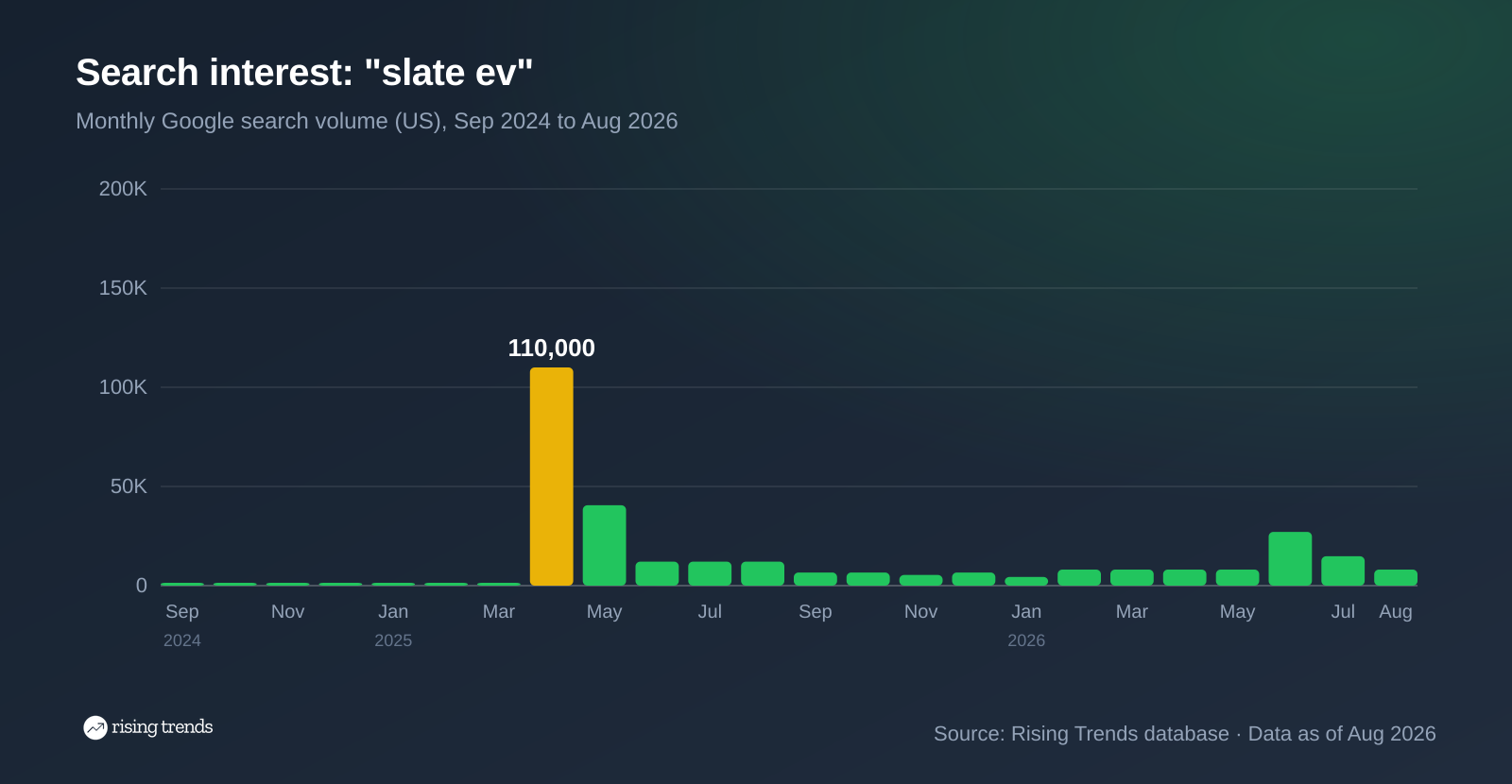
The first spike is April 2025, the month Slate came out of stealth, and it is the all-time peak at 110,000. The second is June 2026 at 27,100, when the price landed and the press drove the truck. By August it was back to 8,100, the same place it sat in February. A year earlier the term was 12,100, which is where the -33% comes from.
Look at that in isolation and you would write Slate off. Look at the family and you get the opposite reading.
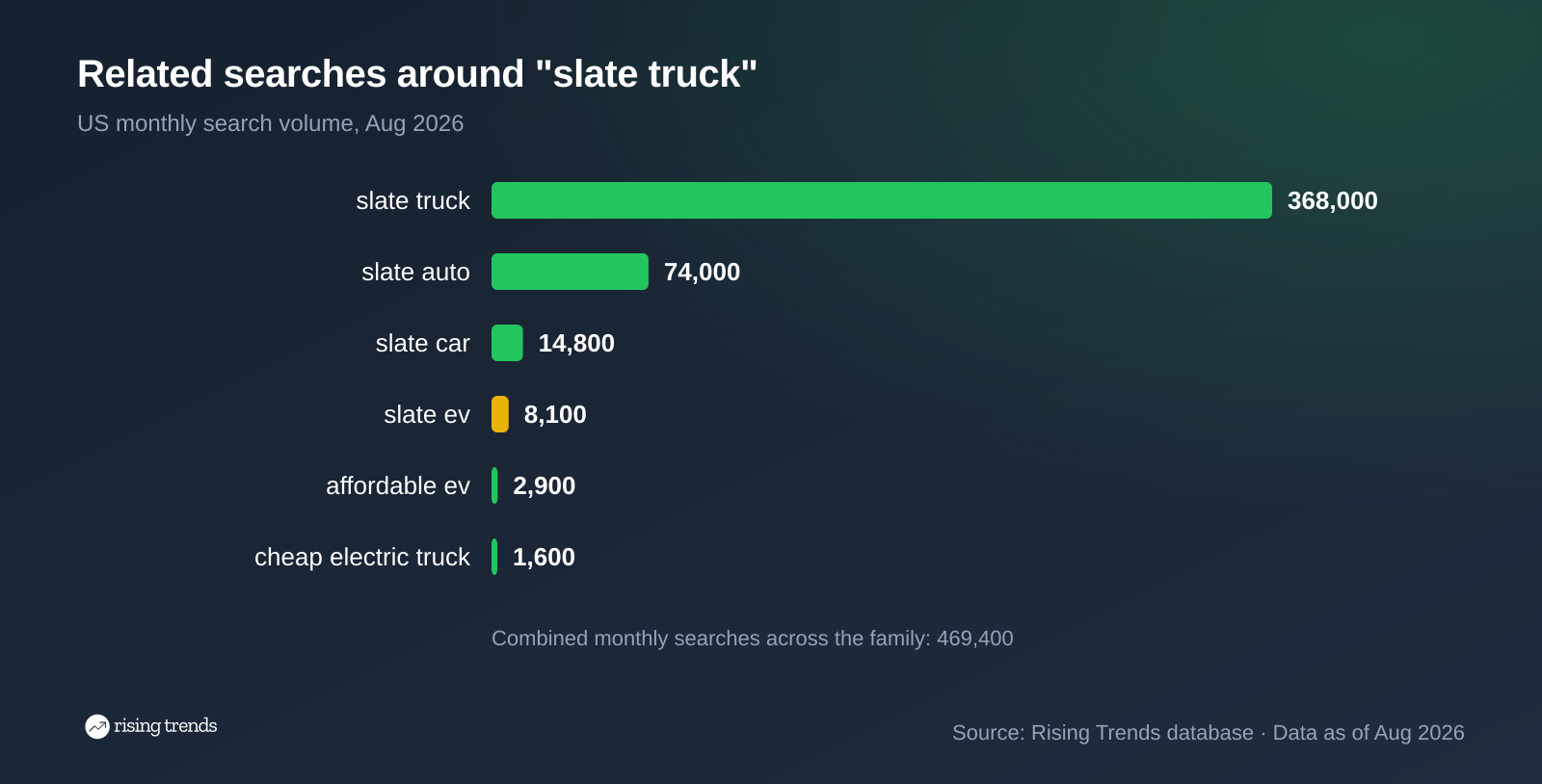
"slate truck" is 45 times the size of "slate ev" and still climbing. "slate auto" is 74,000 and up 49%. What happened is simple and easy to miss: people stopped describing this thing by its powertrain and started describing it by its shape. Nobody calls a Ford Maverick a "Ford hybrid". The live slate ev trend page tracks the term that is shrinking; the brand behind it is doing fine.
The price is on Slate's own site, with the asterisk in the headline.
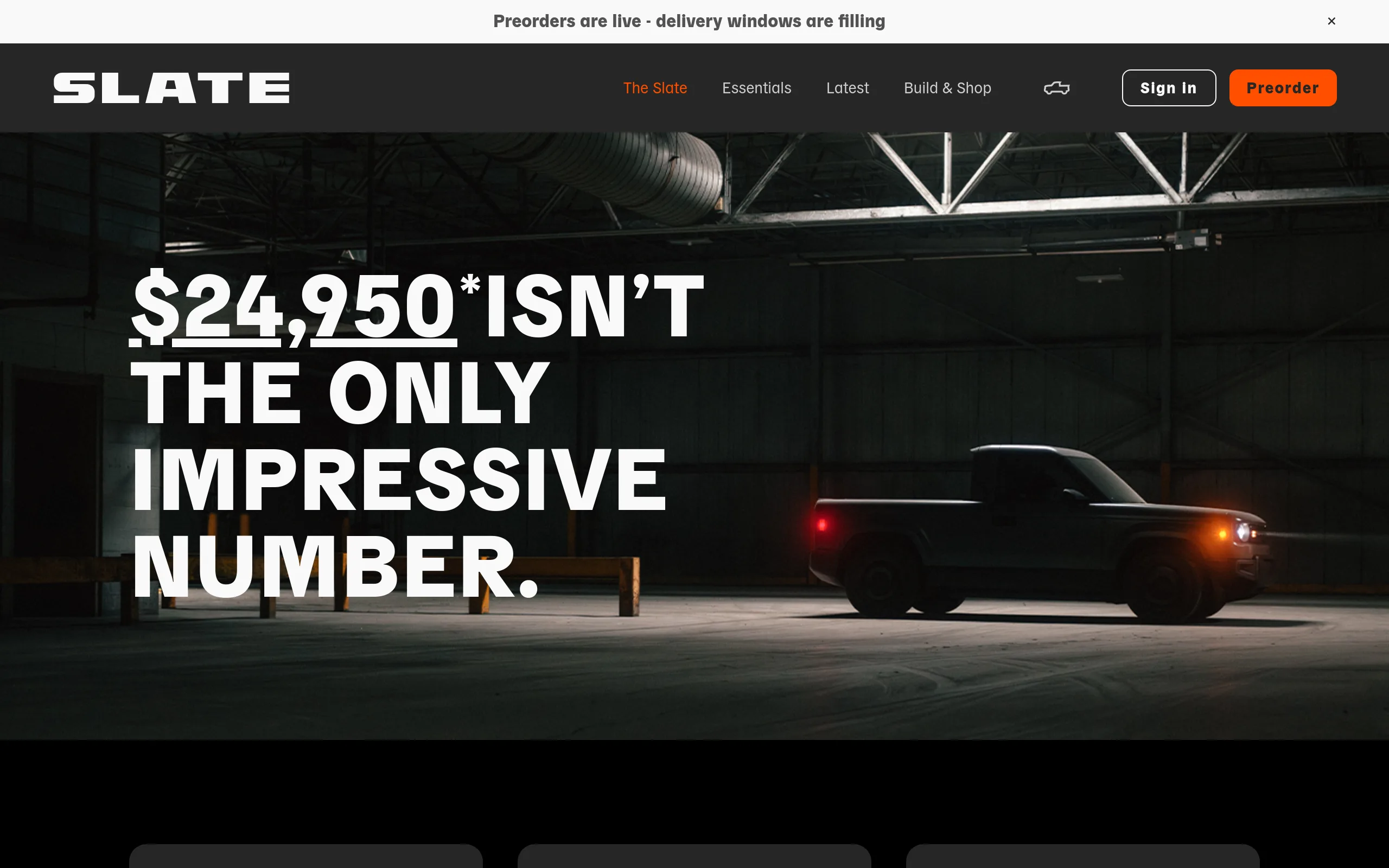
That banner across the top is the live state of play: preorders open, delivery windows filling. Per Slate's own FAQ, the Blank Slate is a two-door, two-seat electric pickup, 174.6 inches long with a five-foot bed, a 35.1 cubic foot cargo bed and a 7 cubic foot frunk. One rear-mounted 135 kW motor. Payload around 1,550 lb, towing 2,000 lb. Range is 205 miles, raised from an estimated 150 without moving the price.
What you do not get is the interesting half. No infotainment system. No touchscreen. Analog HVAC dials. No CarPlay, no Android Auto, no paint (every Slate leaves the factory grey and is meant to be wrapped). Crank windows. Ars Technica reported from the launch event that the telematics modem is a $275 option, not standard, and that power windows quietly vanished from the marketplace before launch.
The compromises are deliberate and costed. The Autopian's David Tracy was told by Slate engineers that the manual window regulators come from Brazil because nobody makes them in the US any more, and that choosing cranks over motors saved the company $40 per vehicle. An engineer called the approach "yestertech". A team of fewer than 200 engineers also considered leaf springs, drum brakes and a manual steering rack before settling.
For fourteen months after the unveiling, Slate had a concept and a promise. On June 24, 2026 it had a number and a press day, and the curve moved the same week.
Three things happened at once. Slate confirmed the $24,950 price and the $1,450 destination charge. It converted $50 refundable reservations into $300 non-refundable preorders. And it lifted the embargo on first drives, so Ars Technica, The Autopian, Car and Driver, MotorTrend, Bloomberg and MKBHD all published within hours of each other. Slate had 180,000 reservation holders going in, up from 160,000 in April, and Ars Technica reported that more than 10,000 firm preorders were placed by 9am Pacific on launch day.
The specs also got better rather than worse, which almost never happens between concept and production. Range went from the 150 miles Slate showed at the unveiling to 205 on the same sticker. Towing doubled from 1,000 lb to 2,000 lb. Payload went from 1,400 lb to 1,550 lb. New CEO Peter Faricy told the assembled press that "Slate is so much more than an affordable truck."
Four months on, that reaction is still running on social. This clip from @mobile_mama, posted on September 4, 2026, is the shape of most of it: a short walkaround and a straight question about whether people would actually buy one.
Here is the part nobody ranking for this term has put in one place.
Slate launched in April 2025 promising a pickup "under $20,000". That figure counted the $7,500 federal EV tax credit. Congress passed the tax bill ending that credit on July 3, 2025, and TechCrunch confirmed that the "under $20,000" language came off Slate's website within a day, having been there the previous morning. The sticker you see now is the real one, with no subsidy inside it.
Then there is the business model. Slate sells you an unfinished truck and sells you the finishing separately. Stack the options most buyers will actually take:
| Line item | Cost | Source |
|---|---|---|
| Blank Slate truck | $24,950 | Slate FAQ |
| Destination charge | $1,450 | Slate FAQ |
| SUV conversion kit (Slate expects 60% of buyers to take it) | $5,000 | The Autopian |
| Full-body wrap, DIY kit | about $500 | Slate FAQ |
| Professional wrap installation | targeted under $500 | Slate FAQ |
| Telematics modem, first year included | $275 | Ars Technica |
| Center speaker plus outer pair | $400 | The Autopian |
| Running total | about $33,075 | |
| Fully specified SUV with lift kit and tires | about $35,000 | Ars Technica |
That is 33% above the headline price, and it is not a gotcha: every line is optional and most of it can be bought years later. But it changes who the competition is. A Slate SUV with a wrap and a stereo costs more than a Chevy Bolt, which Ars prices at $28,995 including destination with 262 EPA miles and faster charging. The honest pitch is not "cheapest EV". It is "cheapest way into a new truck you can keep modifying", and Slate knows it. Asked what would make someone choose a Slate over a rival, President of Vehicles Chris Barman answered in four words: "I think the customization."
The accessory flywheel is already spinning. On September 30, 2026 Slate added Monster Jam and Grave Digger factory wraps at $999.99 and $1,259.99, a $39.99 door decal kit, and clip-on dashboard badges it calls slatelets, with Crayola and artist Max Kolo collaborations alongside. That is a merchandise business attached to a vehicle, which is a very different margin structure from selling trim levels.
The loudest reaction is not about the EV part. It is about the austerity, and it is warmer than you would expect.
The most-upvoted comment on Ars Technica's first-ride piece, with 326 votes, reaches straight for the historical comparison: "In the early 90s you could get a stripped Ford Ranger for $9999, which is $24,602.75 in today's dollars. Slate nailed the pricing." Another reader, with 296: "Even with no features, this truck is pretty cool. I'm not a truck guy and I'm looking at this as a potential purchase." A third, on the optional modem: "An electric S-10? And the modem is optional? Pinch me, I'm dreaming."
The objection is consistent too, and it is small and practical rather than ideological. One commenter: "Lack of power windows isn't just a problem with getting fresh air, its a big QoL issue for anyone who either visits fast food drivethroughs, or needs to badge in for gated access to workplace parking."
The reviewers who drove it landed in a similar place. Tracy, after a drive around Slate's Los Angeles headquarters, called it "by far, the most soulful new vehicle an American consumer will be able to buy for $25,000", while listing every reason it might fail: two doors, modest range, and a Chevy Trax that costs the same with far more equipment.
The important finding is in the growth column, not the volume column.
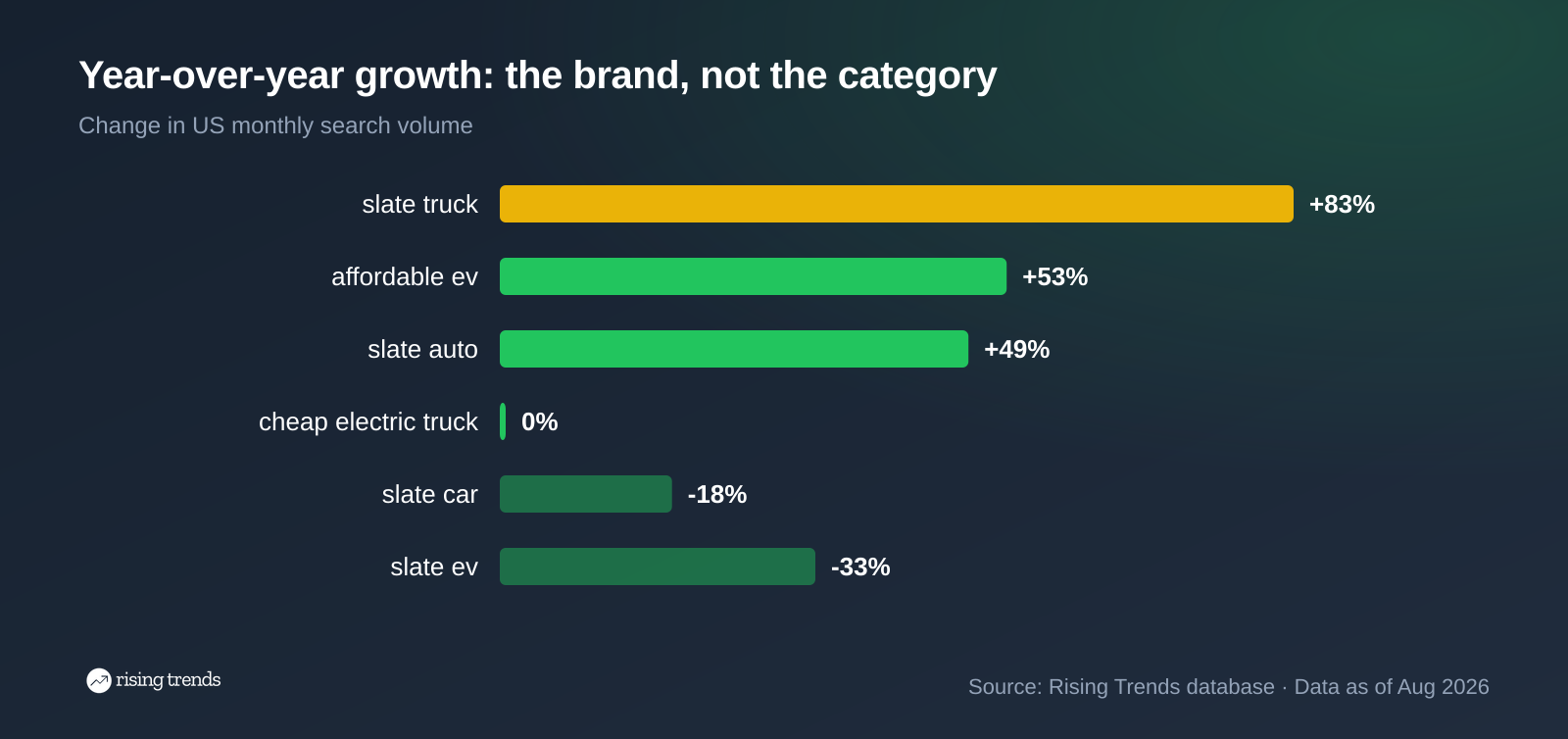
affordable ev is up 53% year over year but sits at 2,900 searches a month. cheap electric truck is flat at 1,600. "affordable ev truck" is 110. Nobody is shopping for a category. They are shopping for a named truck, and right now there is one.
Three things follow from that. Brand beats segment in a collapsed category, which is why Telo, the other small electric truck startup, is at 22,200 searches and falling 18% a year while Slate climbs. Cheap now means unbundled, not stripped. Slate did not build a penalty-box truck, it built a platform and moved the features to a marketplace, which is the same unbundling the rest of the automotive industry has been doing badly with subscriptions. And durability became the green pitch. A vehicle you reconfigure instead of replacing is a different argument from a tailpipe one, which puts this squarely among the sustainability trends worth watching.
There is a supply story underneath as well. The battery is LFP from Gotion, packed in Illinois, replacing a Korean NMC pack Slate originally picked partly to qualify for the credit that no longer exists. The truck is about 60% US and Canada content. For anyone tracking supply chain software trends, a 250-piece steel body with no megacastings and a 3,000-shop independent service network is a deliberate bet against the vertically integrated EV playbook.
Does the first delivery quarter actually happen? Slate's FAQ says late 2026 and the company has not committed to a date. Watch "slate truck" in our database through December. A delivery slip usually shows up as a volume drop in the brand term two to three weeks before it is announced.
Does the accessory attach rate hold? Slate expects 60% of buyers to take the $5,000 SUV kit. If that holds, the marketplace is the business and the truck is the customer acquisition cost. Monster Jam wraps at $1,259.99 are the early test of how far that goes.
Does the category ever catch up? This is the one to bet on. If "affordable ev" and "cheap electric truck" are still at 2,900 and 1,600 a year from now while the Ford $30,000 electric pickup ships, then the lesson is that cheap EVs do not have a category, only champions. If they move, Slate created a market rather than just filling a hole in one. Either way, the tell will be visible in the search data months before it shows up in registrations, which is the whole point of learning to read these curves.
For now the scoreboard is clear enough. A startup with fewer than 200 engineers, a factory in Warsaw, Indiana and a truck with crank windows is generating nearly half a million searches a month, and the only real question left is whether 180,000 reservation holders turn into buyers when the thing shows up in a driveway without a stereo in it.
Want to catch the next product that outgrows its own category? Read our guide on how to identify market trends, follow the live slate ev trend page, or browse what is breaking out right now on the Rising Trends dashboard.
Thousands of Emerging Trends
Thousands of Breakout Apps
Mega Trends
Trend Analysis Tool