
Two years ago, about 1,000 people a month typed "micro1" into Google. As of July 2026 it is 33,100, and the curve has not had a down month since December. The company behind the name does not sell anything to those searchers. It sells human expertise to AI labs: pathologists, litigators, physicists and senior engineers who spend hours grading model answers and building the training environments that frontier models learn from.
That gap is the story. The search demand for micro1 is not customers looking for a vendor. It is people looking for work. The questions Google shows next to the name are "Is Micro1 a legit company?", "How much does Micro1 pay?" and "How to pass a Micro1 interview?" A four-year-old startup with a 25-year-old founder has become one of the most searched employers in the AI economy, and nobody ranking for the term has the numbers on how that happened. We do.
Key takeaways:
- "micro1" grew from 1,000 to 33,100 US monthly searches in two years, up 513% year over year, classified as EXPONENTIAL in the Rising Trends database (data as of July 2026).
- The company told TechCrunch in August 2026 it had reached a $500 million gross annual run rate, up from $100 million eight months earlier, keeping 60 to 70% of that as net revenue.
- Its last priced round was a $35 million Series A at a $500 million valuation on September 12, 2025, led by 01 Advisors, the fund of former Twitter executives Dick Costolo and Adam Bain.
- micro1 is one of five companies people search for when they want to get paid to train AI. Together, handshake ai, mercor, outlier ai, scale ai and micro1 draw 483,600 searches a month. Only scale ai is falling.
- The hiring machine is an AI interviewer called Zara, built on GPT-4o and described in a paper the company published in April 2025. Its Trustpilot page holds a 4.7 rating across 9,999 reviews, most of them from applicants.
- The next moves are visible on the company's own X account: 10,000 robotics trainers hired in a week, and a program paying companies $100,000 to $2 million or more for anonymised operational data.
Let's get into it.
The numbers
Here is the monthly search volume for "micro1" over the last two years, straight from our database. It is a staircase, not a spike: each step matches a funding or revenue headline, and none of the steps has been given back.
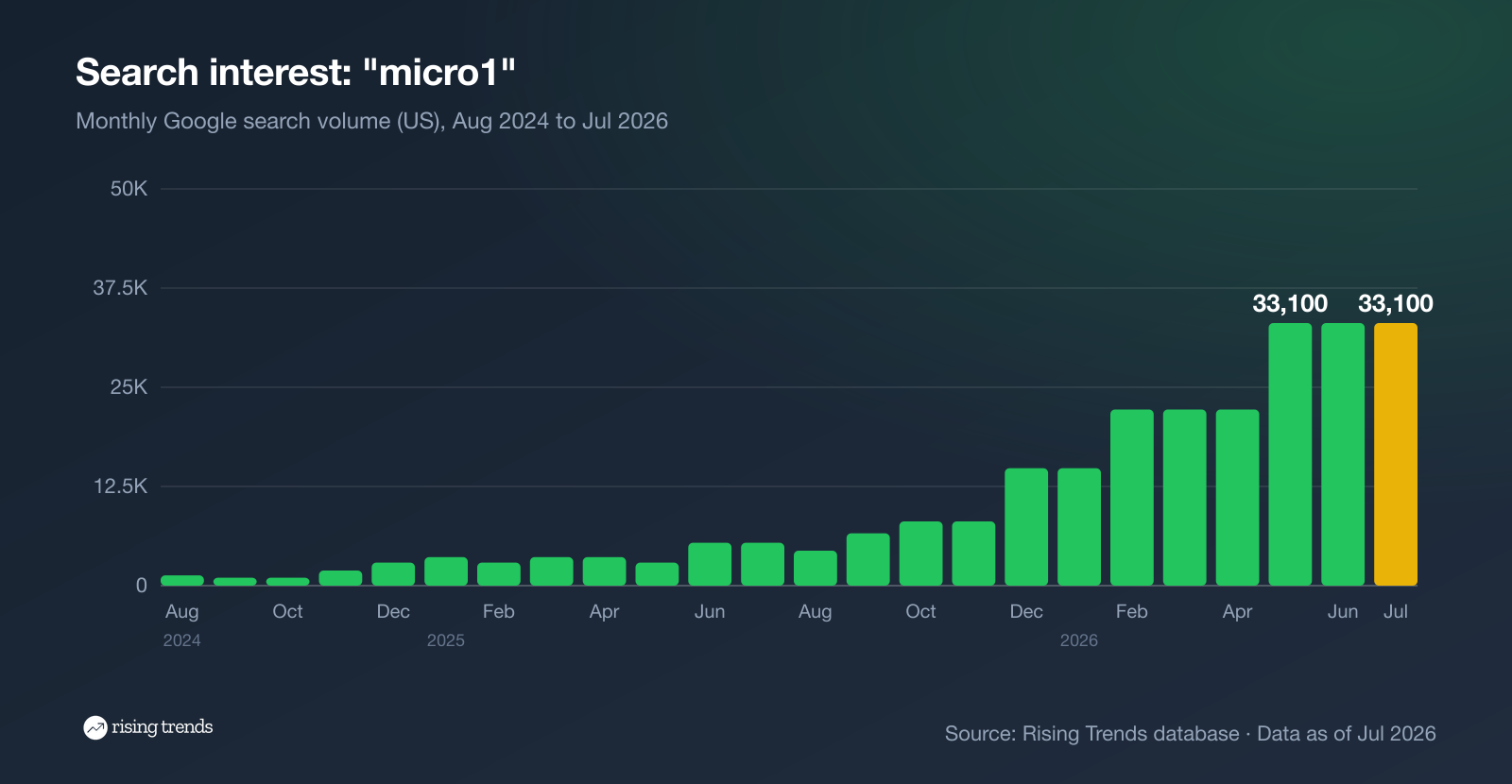
The first step is September 2025, the month of the Series A, when volume moved from 4,400 to 6,600. The breakout is December 2025, when Forbes ran its profile of the founder and searches nearly doubled to 14,800. February 2026 took it to 22,200, May to 33,100, and it has held there for three months. The related terms in our database confirm what the searchers want: "micro1 ai" is up 1,028% in a year and "micro1 valuation" is up 875%, both classified as EXPONENTIAL.
micro1 is not alone in this. It sits inside a cluster of companies that pay people to produce training data, and the cluster is one of the largest employer-search stories of 2026.
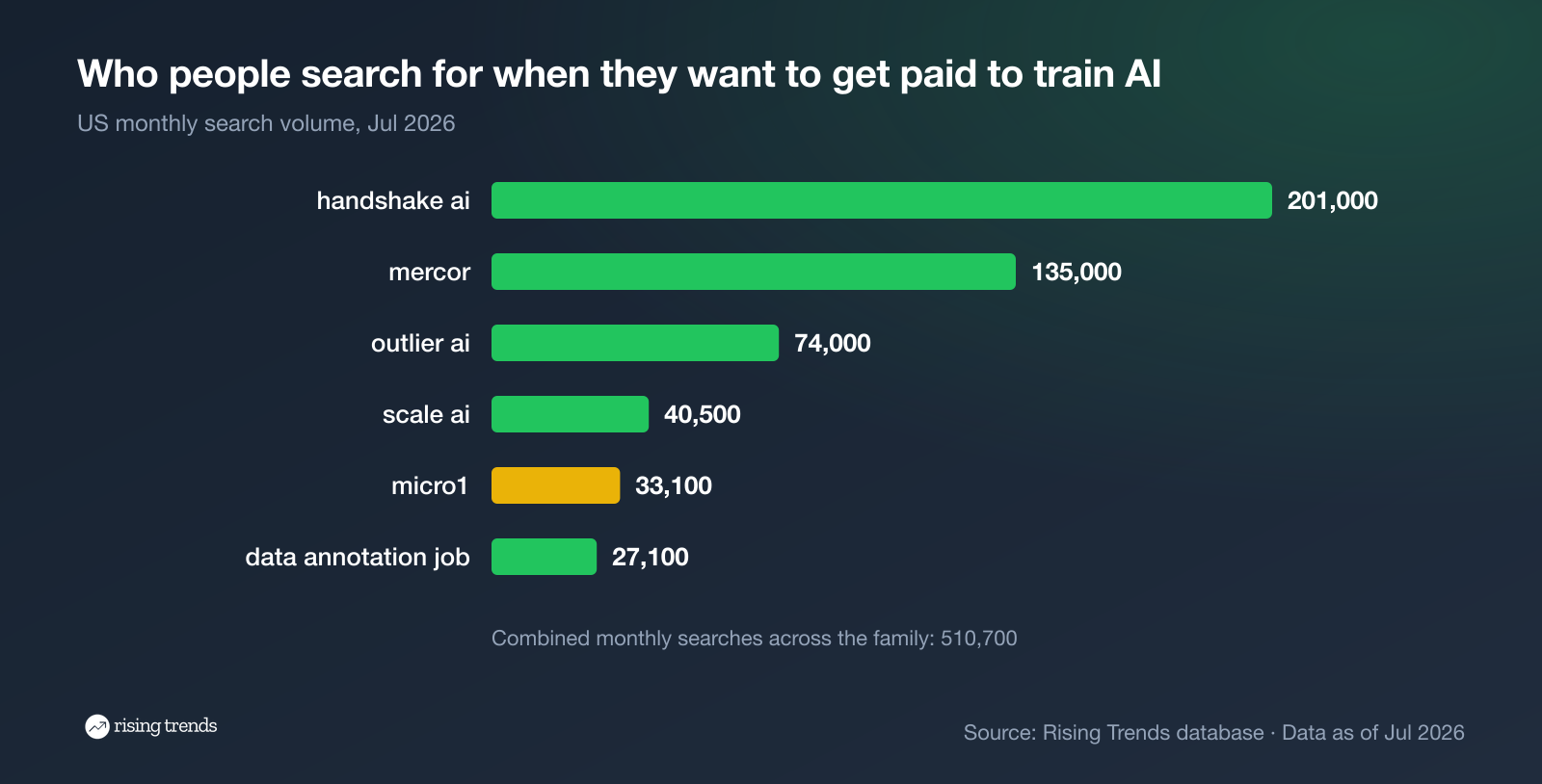
Add those six terms up and you get 510,700 monthly searches for the act of getting paid to train AI, as of July 2026. For comparison, "data annotation job", the generic term, is 27,100. The brands have outgrown the job title.
What micro1 does
The company's own description is one line: a data lab to train frontier models and evaluate agents. In practice it does three things. It recruits domain experts, it puts them to work producing training and evaluation data, and it sells the output to AI labs and large enterprises.
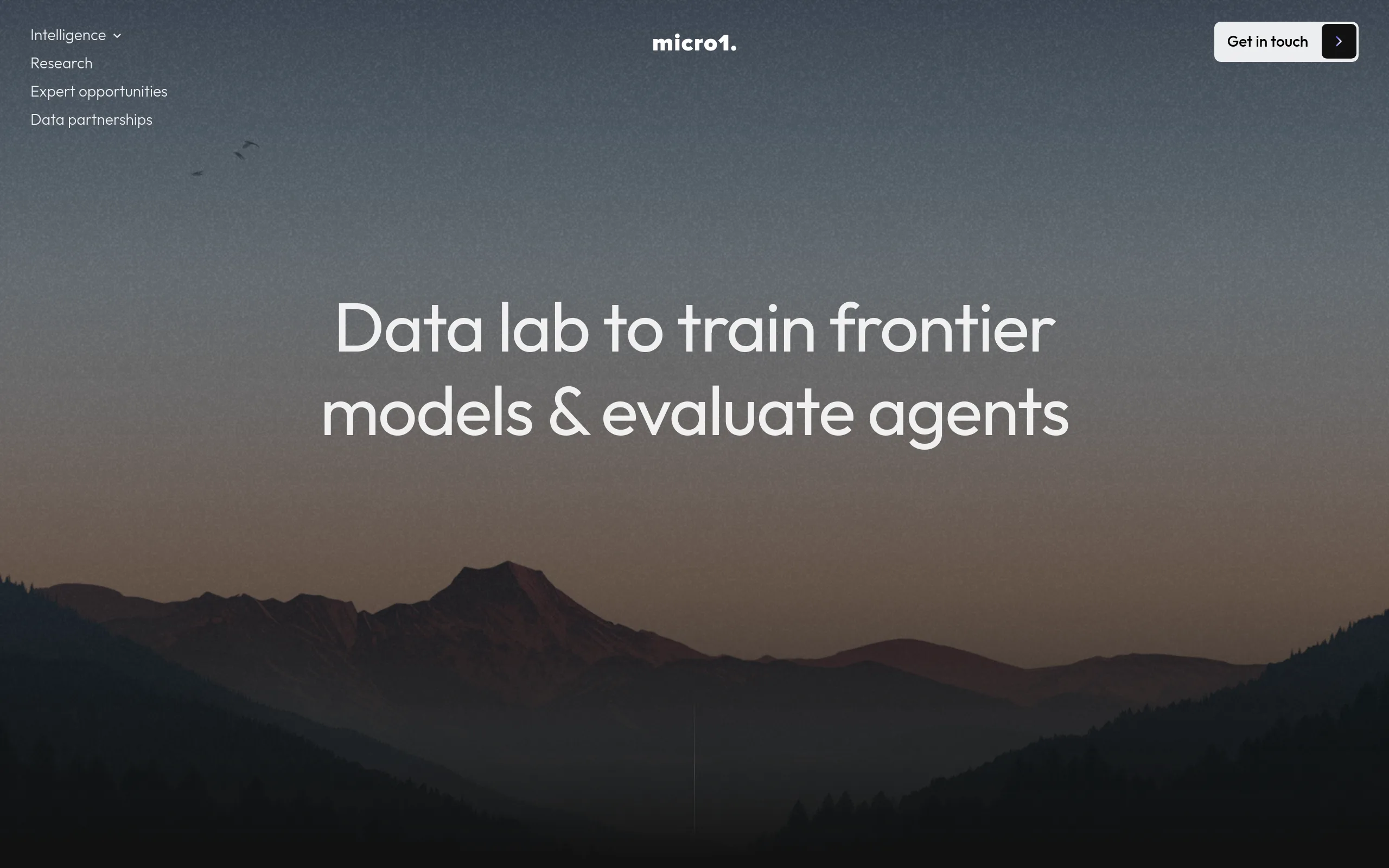
The product names on the site map to the three ways a lab now buys human judgment. Realm is a set of reinforcement-learning environments that mirror real work, so a model can be trained on how a lawyer reads a contract or how a pathologist reads a report; micro1 publishes its own benchmarks in legal, pathology and financial reasoning. Cortex is an evaluation platform for AI agents already in production. The third line is robotics data, recorded in the physical world to train embodied systems.
The business model is a marketplace with a margin. micro1 recruits the expert, vets them, manages the work, handles quality control and global payroll, and bills the lab. TechCrunch's August 2026 reporting puts the retained share at 60 to 70% of gross billings, with margins of 80 to 90% on off-the-shelf datasets that can be sold more than once. The customer list has never been published in full. The Series A announcement says "leading AI labs and Fortune 10 companies"; TechCrunch named Microsoft at the time of the round.
The part that explains the search curve is the recruiting side. micro1 started life as an AI recruiting startup, and the interviewer it built for that business, Zara, is now the front door for every expert who applies. The company described the system in an April 2025 paper by Nima Yazdani, Aruj Mahajan and Ali Ansari: an interviewer built on OpenAI's GPT-4o that runs practice sessions, conducts the assessment, writes structured feedback and answers applicant questions. Every one of the 33,100 people searching the name each month meets Zara before they meet a human.
Why it's suddenly everywhere
Three things happened in the space of twelve months, and the search curve steps up at each one.
September 2025: the Series A. micro1 raised $35 million at a $500 million valuation, led by 01 Advisors. TechCrunch reported annual recurring revenue of $50 million, up from $7 million at the start of that year. Adam Bain's quote in the announcement is the thesis in one sentence: "Really the only way models are now learning is through net new human data."
December 2025: the founder becomes the story. Forbes profiled Ali Ansari, then 24, under the headline that he had built a multibillion-dollar AI training business in eight months. Searches for the company nearly doubled that month. By spring, Inc. was writing that a $2.5 billion valuation in funding talks would make his stake worth more than a billion dollars. Whether or not that round closed at that price, the coverage did what founder coverage does: it sent people to Google to find out if they could work there.
August 2026: the run rate. The company told TechCrunch it had passed a $500 million gross annual run rate, five times the figure from eight months earlier. Ansari's most-quoted line from that story was not about growth. It was a jab at rivals: "We believe it's shameful to claim American AI dominance desires while selling millions worth of data to countries that we are in adversarial competition with."
The social proof is unusual for a B2B company, because the public-facing side is a jobs board. The company's X account reads like a labour exchange. This post, hiring 10,000 robotics trainers in seven days, is typical of it.
The applicant side leaves a paper trail too. micro1's Trustpilot page shows a 4.7 out of 5 rating across 9,999 reviews, 83% of them five stars and 3% one star, and the reviews are overwhelmingly about the interview rather than the work. "The way the interview is conducted, it is pretty natural," wrote one applicant on August 31, 2026. The one-star minority complains about hard questions and tight time limits. For a company whose product is human judgment, ten thousand reviews of its own hiring funnel is the customer feedback.
The people and money behind it
The founder is Ali Ansari, 25, who started the company four years ago as a recruiting tool and pivoted it to data when the labs started paying for experts instead of engineers. The stated mission on the Series A page is broader than data labelling: "Where should humanity spend its time? At micro1, we believe this is the most important question of our generation."
The capital stack, from the company's own announcement and the reporting around it:
| Date | Event | Figure | Source |
|---|---|---|---|
| Sep 12, 2025 | Series A led by 01 Advisors | $35M at a $500M valuation | micro1, TechCrunch |
| Sep 2025 | Annual recurring revenue | $50M, from $7M in January 2025 | TechCrunch |
| Dec 2025 | Forbes founder profile | "Multibillion-dollar" in eight months | Forbes |
| Aug 20, 2026 | Gross annual run rate | $500M, net $150M to $200M | TechCrunch |
Two caveats belong here. Gross run rate counts what labs pay before experts are paid, so the net figure is the one to compare with software companies. And the $2.5 billion valuation that circulated in 2026 came from funding talks reported by the press, not from a filing or an announcement.
Who it's up against
The AI data business now has a leaderboard, and search demand tracks it closely.
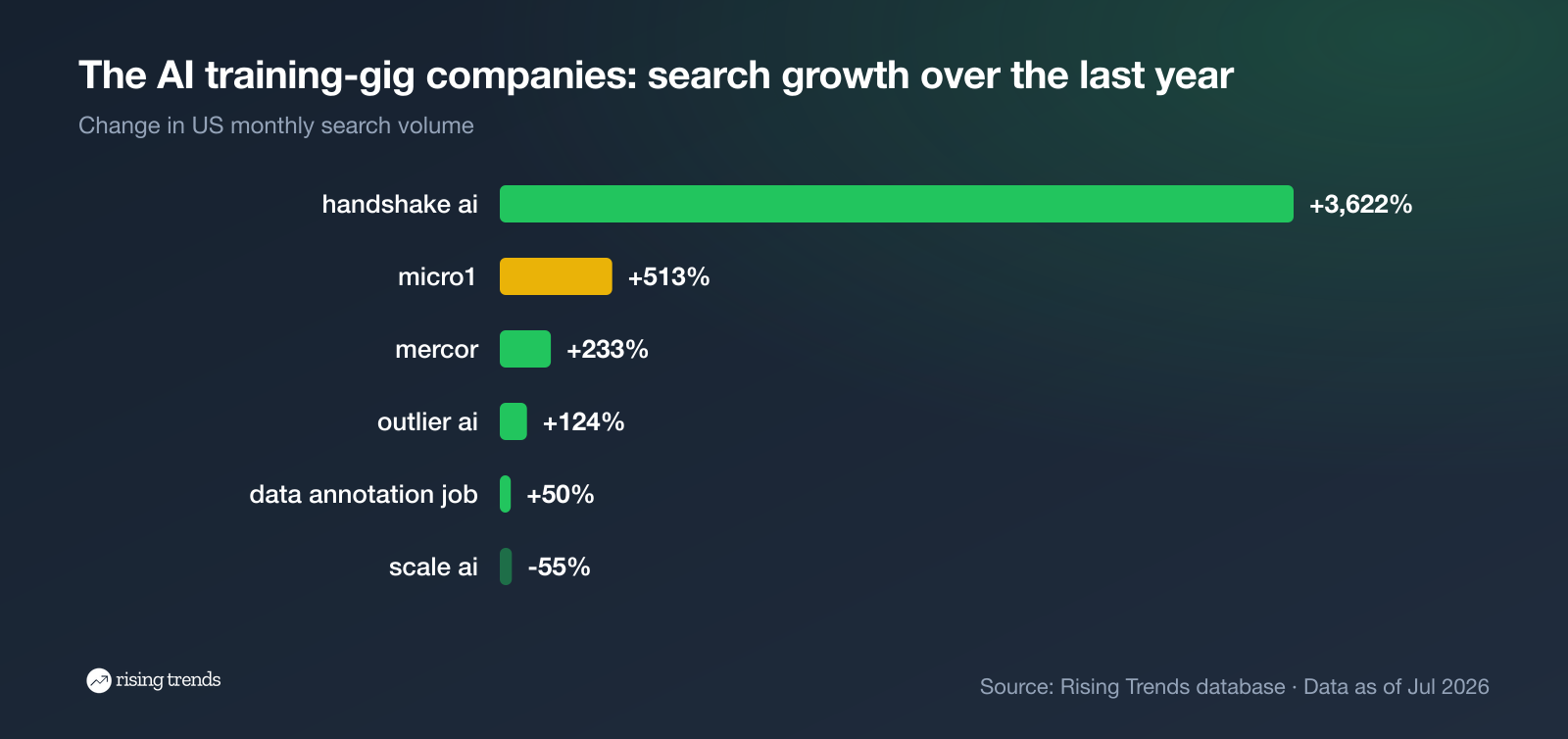
Mercor is the direct rival: same model, same experts, bigger. TechCrunch put its gross annualised revenue at $2 billion by summer 2026, four times micro1's, and its search volume is 135,000 a month, four times micro1's too. Handshake, the college careers network, turned its student base into an AI training workforce and is the fastest-growing name in the set at 3,622% year over year, with a reported $1 billion in revenue. Outlier, the gig brand of Scale AI, still draws 74,000 searches a month. Surge, which does not appear in our database as a search term because it does not recruit publicly, is the largest by revenue.
The odd one out is Scale AI, the company that created the category. Its searches are down 55% in a year. Meta's exclusive agreement with Scale in 2025 pushed rival labs to find other suppliers, and Ansari's comment about selling data abroad is aimed at that vacuum. micro1's growth is partly Scale's customers moving.
What it means for the industry
Human data is the constraint, and it is being industrialised. Every company in that chart exists because pre-training on the public internet stopped producing gains. The labs now pay for what a model cannot scrape: a doctor's judgment on a report, a lawyer's reading of a clause, a robot operator's hands. The margin structure TechCrunch describes, with 80 to 90% on reusable datasets, is a data business wearing a staffing company's clothes.
The expert gig economy is real and it is white-collar. Half a million monthly searches for these brands is a labour market. It runs through AI interviewers, pays by the hour, and recruits professors alongside recent graduates. The human resources trends we track show the same shift from job boards to assessment platforms; micro1's Zara is that shift with a business model attached. Candidates are running the same playbook in reverse, which is why searches for HiringCafe, the ad-free job index that crawls career pages directly, are up 834% in two years while Indeed is down 33%. The political argument over who keeps the productivity gains these models produce is now a bill in Congress, which we cover in the 32 hour work week, explained.
The buyers are consolidating. The labs building the agents we covered in our 2026 AI agents report need evaluation data for agents in production, which is exactly what Cortex sells. Suppliers that only label will be squeezed; suppliers that build environments and evaluations become infrastructure. That is the bet behind the Realm benchmarks, and it is the same bet that turned generative AI from a demo into an enterprise line item.
Where this is heading
Robotics data is the next revenue line. The 10,000-trainer hiring post above is not an outlier. micro1 is recording physical-world data at home and in the field to train embodied systems, and its X account has become a recruiting channel for it. Watch "micro1" searches and the robotics terms in our database together; if the company's volume keeps stepping up without a funding headline, robotics is why. It is walking into a market that already has a specialist: XDOF raised $70 million in June 2026 to do nothing but collect robot training data.
Companies become the suppliers. The Company Data Partnership Program, announced on the company's X account, pays businesses with 30 or more employees between $100,000 and $2 million or more for anonymised operational data. If that scales, micro1 stops being a staffing marketplace and becomes a data broker for enterprise workflows, which is a different regulatory conversation.
"Is it legit" is the risk. The searches behind micro1's growth are applicants, and applicant trust is fragile. A pay dispute, a data-handling incident or a bad quarter for one of its labs would show up first in the "micro1 legit" and "micro1 pay" queries. Search volume for "micro1" is where that would surface before any press release.
The broad signal is the one the search data makes plain. Three years ago the phrase "get paid to train AI" described a Mechanical Turk task. Today it describes a set of venture-backed brands drawing half a million searches a month, and micro1 is the one whose founder is 25 and whose interviewer is a language model. Whichever of them wins, the labour market they created is not going back.
Want to spot the next breakout company before it makes the funding headlines? Read our guide on how to identify market trends, or browse what is breaking out right now in our trending topics list.
Never miss a trend again
- One trend broken down with the numbers
- Who's making money, and what to build
- A website on the rise
- A breakout app
Join 5,000+ founders