
The biggest email funnel trends for 2027 are a widening gap between the first purchase and the second, urgency that only works when the deadline is real, and AI inboxes that make open rates useless as a funnel metric. Here are all six, with the number behind each:
- The second purchase is the leak. First-time buyers placed 59% of Black Friday and Cyber Monday email orders last season, but only 16.6% of them bought again in Q1 2026.
- Urgency has to be real. Adobe expects $275.1 billion in US online holiday spending, with discounts climbing from about 14% in early November to 30% in Cyber Week, and shoppers are searching "manufactured scarcity" 30% more than a year ago.
- AI inboxes break the open rate. Apple Mail accounts for 76.56% of tracked opens, inflated by automatic machine opens, and Gmail started rolling out its AI Inbox in October 2026.
- Behavior picks the next email. Personalized emails earned 11% higher order values in the 2025 peak season, and searches for "personalized email" are up 313% in a year.
- SMS joins the funnel, email stays the base. SMS converted up to 6x better per message at peak, yet email is still the preferred marketing channel in every market Klaviyo surveyed.
- Owned lists replace bought ones. On beehiiv's business publications, owned and earned channels now bring in more than 99% of new subscribers, and bought subscribers fell from about 3.5% to 0.5%.
Every figure comes from the organization that measured it (Mailchimp, Adobe, Litmus, Google, Klaviyo and beehiiv), plus our own search data from the Rising Trends database. For the wider channel picture, see our email marketing trends report.
Let's get into it.
1. The Second Purchase Is Where Funnels Leak
Most email funnels are built to get the first conversion. The data says the bigger loss comes after it.
Mailchimp's peak season analysis, published September 21, 2026, found that first-time buyers made up 59% of Black Friday and Cyber Monday email orders in the 2025 season, with order values 21% higher than repeat buyers. But only 16.6% of those first-time peak-season buyers bought again in Q1 2026, and the ones who did came back after a median of 26 days.
So the holiday funnel works at the top and stalls one step later. More than four out of five new customers acquired at the most expensive time of year did not place a second order in the following quarter.
What to do about it
Map the funnel around the decisions people actually make, not around your campaign calendar. A buyer who just placed a first order needs a different next email than a subscriber who has only read a guide: setup help, a use case, a reason to come back.
Give every email in the post-purchase sequence one job and time it inside that 26-day window. If two emails do the same job, merge them. A sequence that introduces, helps, proves and then asks gives the reader a clear reason to open the next one.
2. Urgency Only Works When the Deadline Is Real
The 2026 holiday season will be the biggest test yet of deadline-driven email.
Adobe forecasts US online holiday spending of $275.1 billion, up 6.7%, with Cyber Monday (November 30) alone at $15.1 billion and Black Friday at $12.9 billion. Discounts follow a predictable curve: about 14% in early November, 21% just before Thanksgiving and up to 30% in Cyber Week, then 10% to 15% through December. Every one of those steps is a real deadline an email can point to.
Shoppers are also more alert to fake ones. Searches for "manufactured scarcity" are up 30% in a year in our database. Klaviyo's 2026 holiday buyer survey of 6,750 consumers, shared by Klaviyo's community team in October, found 36% value early access to sales, which is urgency built on a real benefit rather than a vague "act soon".
What to do about it
Name the deadline, the offer and what ends, in plain words. "Early access closes Friday at 5 p.m. ET" works; "hurry, ending soon" does not.
For time-limited sends such as early access windows, webinar registration or the Cyber Week discount peak, customizable countdown timers show the remaining time inside the email itself. Keep the timer next to the call to action and make sure the landing page shows the exact same deadline. A timer that resets, or a sale that "ends" and then extends, teaches subscribers to ignore the next deadline, and that cost shows up in every campaign after it.
3. AI Inboxes Make Open Rates Useless as a Funnel Metric
If your funnel report still starts with open rate, the number is now mostly measuring software.
Litmus's email client market share for September 2026, based on more than 1.5 billion opens, puts Apple at 76.56% of opens, Gmail at 16.10% and Outlook at 3.48%. Apple's share includes opens triggered by Mail Privacy Protection, which downloads email content in the background whether or not a person reads it. Litmus itself says those are not reliable opens.
Gmail is moving the other way: reading the email for the user. On October 15, 2026, Google said its AI Inbox is rolling out to paid Workspace users in the US, pulling "action items, deliverables, and deadlines" out of emails into suggested to-dos and summarizing topics to catch up on. A month earlier it took AI Overviews in Gmail search global for English-language accounts.
Search interest is following: "ai email assistant" is up 241% in a year to 9,900 a month, and "gmail gemini" is up 108%.
What to do about it
Measure movement between funnel stages instead: clicks, replies, trial starts, completed forms and orders, by email and by segment. A welcome email with strong engagement can hide a later message that causes the unsubscribes, so look for the sharp drop between two consecutive emails and fix that exact point.
Write for the summary too. If an AI inbox turns your email into a to-do, the deadline and the action need to be stated clearly in the text, not only in an image or a button.
4. Behavior, Not the Calendar, Picks the Next Email
Static sequences send everyone down the same path. The 2025 peak season showed what branching earns.
In Mailchimp's peak season data, segmented or personalized emails with dynamic content had 11% higher average order values during Black Friday and Cyber Monday, and emails with abandoned-cart content blocks got a 28% higher click rate. Both are emails chosen by what the subscriber did, not by the send date.
Readers mostly don't mind how the email was written as long as it fits them. In Klaviyo's holiday buyer survey, 57% assume most brand messages are AI-generated, and 55% don't care if a message is AI-written as long as it is relevant.
Our search data shows the same shift. "Personalized email" searches are up 313% in a year, climbing every month since spring, while "ai email generator" is down 64%. Marketers are less interested in AI that writes more emails and more interested in sending the right one.
What to do about it
Branch on one clear signal first. A click on a tutorial can trigger an advanced use case; no click can trigger a shorter email with a different angle; a second pricing-page visit can trigger a comparison or a customer story. Then test one variable at a time (subject line, send interval or where the call to action sits) and decide the success metric before you launch.
5. SMS Joins the Funnel, but Email Stays the Base
Text messages convert harder per send. Email still carries the funnel.
At peak season, Mailchimp found SMS delivered up to 6x higher order rates than email and 3x the revenue per message, and nearly 70% of SMS orders came from first-time buyers. Email still drove more revenue in total.
Customers still prefer email. Klaviyo's survey found email is the preferred marketing channel in every one of the eight markets it covered, from 52% in Singapore to 73% in the UK.
Interest in SMS as a standalone tactic is cooling: "sms marketing" searches are down 56% in a year. The pattern is SMS as a step inside an email-led funnel, not a separate program.
What to do about it
Use SMS for the moments where speed matters most (a shipping update, the last hours of a real deadline, an abandoned cart) and keep the explaining, comparing and onboarding in email. Ask for the phone number after the first purchase, when the subscriber has a reason to want fast updates, rather than at sign-up.
6. Owned Lists Replace Bought Ones, and the Rules Enforce It
The fastest-growing email audiences in 2026 were built, not bought.
beehiiv's 2026 enterprise report, covering 4,755 business publications as of September 2026, found that owned and earned channels bring in more than 99% of monthly new subscribers. Bought subscribers fell from about 3.5% in late 2024 to about 0.5% in 2026. Smaller lists engage better too: publications with 1,000 to 10,000 subscribers open at 44.54%, against 40.12% for lists over 250,000.
The mailbox providers make that the only safe route. Google's sender guidelines require bulk senders to authenticate with SPF, DKIM and DMARC, offer one-click unsubscribe and keep spam complaints below 0.3%, with a target under 0.1%. Yahoo also requires unsubscribes to be honored within two days.
Searches for "email deliverability tools" are down 74% in a year and "email spam filter" down 64%. Authentication is now table stakes. Getting into the inbox depends on whether people want the email.
What to do about it
Make leaving easy and staying worth it. An unsubscribe link people can find costs you less than a spam complaint. Ask only for the information each stage needs (an email address for a newsletter, a few qualifying questions for a sales call), and send the email you promised, on the day you promised it.
What We're Seeing in Search
Our database tracks US search demand for tens of thousands of trends. Here is what it shows for email marketing as of September 2026, compared with September 2025.
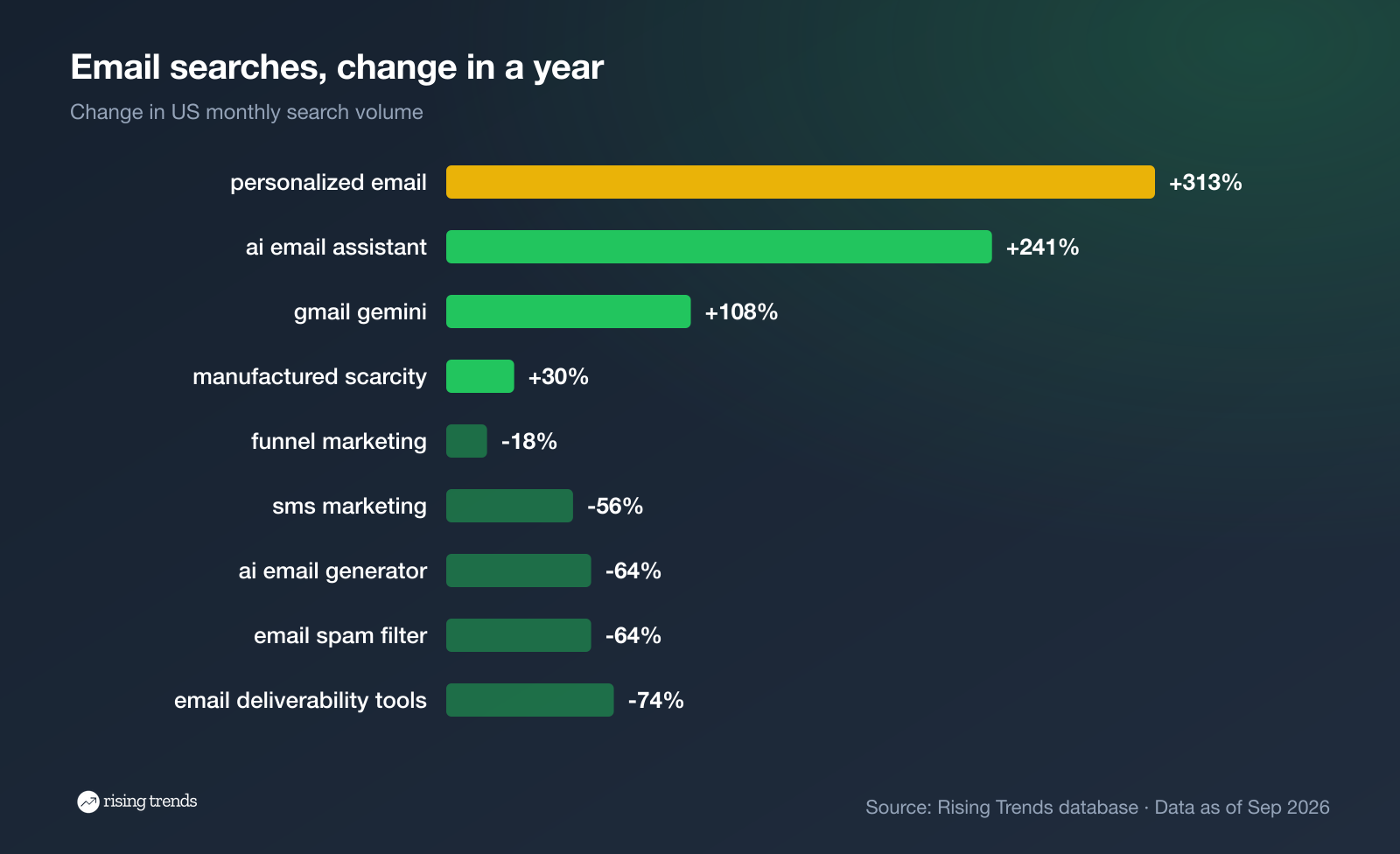
- Relevance is the rising theme. "personalized email" (+313%) is the fastest riser in the set, backing the behavior-led funnels in trend 4.
- AI is moving into the inbox. "ai email assistant" (+241%) and "gmail gemini" (+108%) are up while "ai email generator" is down 64%. People want help reading and sorting email more than writing more of it.
- Fake urgency gets noticed. "manufactured scarcity" is up 30%, a small but steady signal for trend 2.
- Tactics without a strategy cool down. "funnel marketing" (-18%) and "sms marketing" (-56%) are both lower than a year ago.
- Deliverability is solved, not exciting. "email deliverability tools" (-74%) and "email spam filter" (-64%) dropped as the 2024 and 2025 sender rules became standard setup.
If you want to use search data like this to test an idea before you build an email program around it, our guide on validating market demand walks through the method.
The Common Thread
Put the six shifts side by side and one pattern runs through them: an email funnel is now judged by what happens after the click, not before the open.
AI inboxes summarize the message, Apple inflates the opens, and mailbox providers filter on complaints. What is left to optimize is whether each email does one useful job, whether its deadline is true, and whether the next email arrives when the subscriber is ready for it.
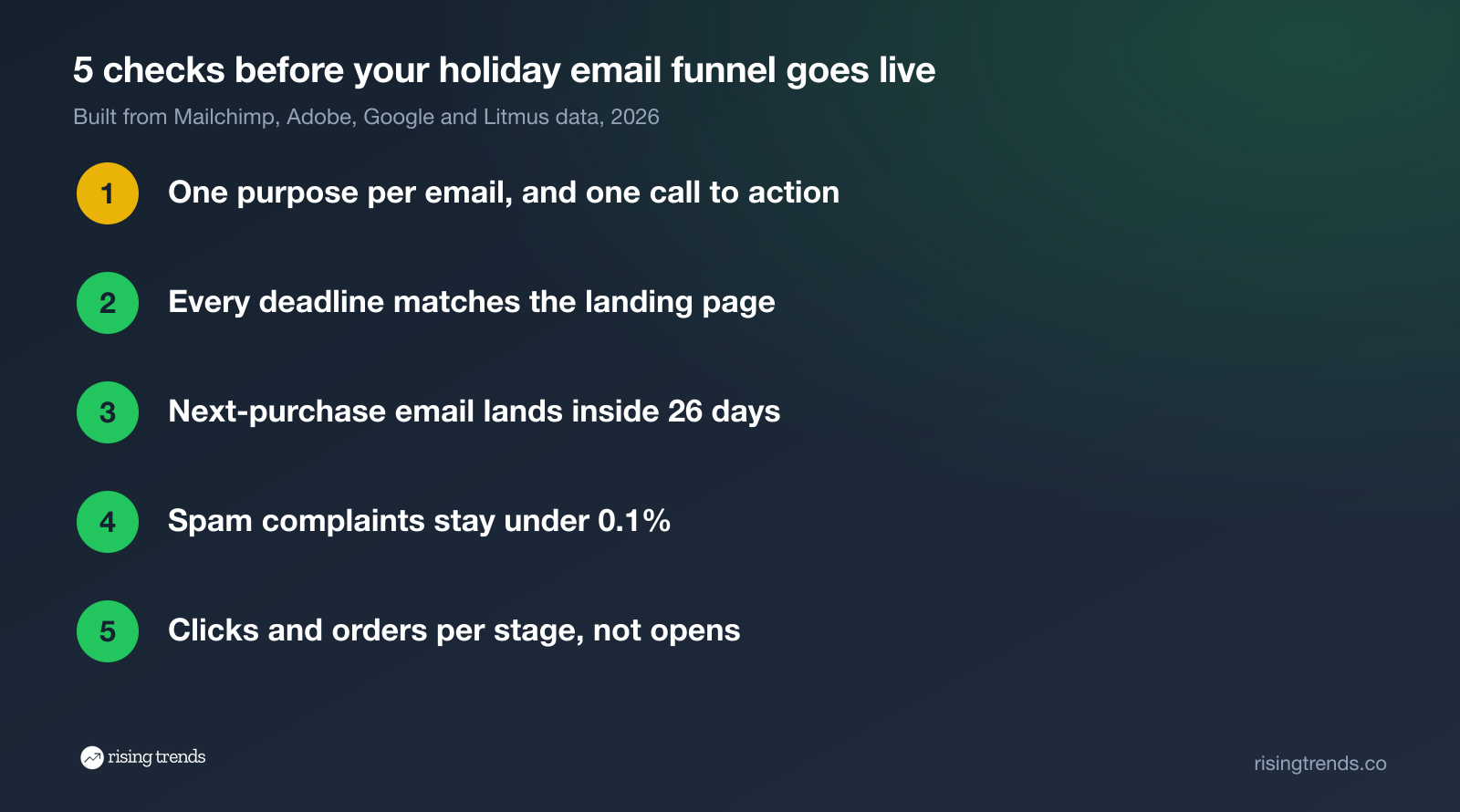
If you only fix three things before the 2026 holiday sends: build a post-purchase sequence that lands inside the first month, make every countdown and deadline match the landing page, and replace open rate with clicks and orders per funnel stage in your reporting.
Frequently Asked Questions
What are the biggest email funnel trends for 2027?
The repeat-purchase gap after the first order, urgency built on real deadlines, AI inboxes that make open rates unreliable, behavior-based branching and personalization, SMS used as a step inside email funnels, and growth from owned audiences under stricter sender rules.
Are open rates still a reliable email metric?
Not on their own. Apple accounts for 76.56% of tracked opens according to Litmus (September 2026), and Apple Mail Privacy Protection loads emails automatically, so many opens are not real reads. Clicks, replies and conversions per funnel stage are more reliable.
Do countdown timers in emails work?
They work when the deadline is real and matches the landing page, such as early access windows, webinar registration or a sale that genuinely ends. Timers that reset or deadlines that get extended reduce trust in later campaigns.
How do you improve retention in an email funnel?
Give each email one purpose, branch the next message on what the subscriber did, time post-purchase emails inside the first month (Mailchimp found returning holiday buyers came back after a median of 26 days), and fix the specific step where subscribers drop off.
What are the Gmail and Yahoo bulk sender requirements?
Senders of more than 5,000 emails a day to Gmail must authenticate with SPF, DKIM and DMARC, support one-click unsubscribe and keep spam complaints below 0.3%. Yahoo has similar rules and requires unsubscribes to be honored within two days.
Want to spot the next marketing shift before your competitors do? Read our guide on how to identify market trends or browse what's gaining traction in our trending topics list.
Never miss a trend again
- One trend broken down with the numbers
- Who's making money, and what to build
- A website on the rise
- A breakout app
Join 5,000+ founders