
The biggest last-mile delivery trends for 2027 are drone delivery moving from pilots to metro networks, delivery robots signing city-wide deals, and a fleet equipment boom that lands on finance teams just as lease accounting changes again. Here are all seven, with the number behind each:
- Drone delivery becomes a network. Wing and Walmart are adding Denver and Seattle in 2027, taking drone delivery to nearly 20 metros, and the FAA's draft review for Zipline in Texas allows up to 220,000 deliveries a day.
- Sidewalk robots sign city deals. Coco and Deliveroo launched an exclusive UK rollout in October 2026, and Hoboken started a 12-month, 20-robot pilot.
- Electric vans grow, but slower than the rules. UK battery-electric van registrations hit a record 4,832 in September 2026, yet their 10.8% share for the year is less than half the 24% mandate.
- Fleet finance gets busier and stricter. US equipment finance volume is up 19.1% year over year, and IFRS 18 changes how lease costs appear in the income statement from January 1, 2027.
- Speed expectations keep rising. 39% of US shoppers now expect delivery within one to two days, a four-year high.
- Carriers finish reshuffling around Amazon. UPS completed its Amazon volume glide-down in June 2026, after Amazon Logistics became the largest US parcel carrier by volume in 2025.
- Healthcare is the courier growth lane. Searches for "medical courier" are up 123% in a year while total US courier employment is flat at about 1.09 million.
Every figure comes from the organization that measured or announced it (Wing, the FAA, SMMT, the European Parliament, the BLS, ELFA, Ryder, UPS and the IFRS Foundation), plus our own search data from the Rising Trends database.
Let's get into it.
1. Drone Delivery Becomes a Network, Not a Pilot
For years drone delivery meant one town and a press release. The 2026 announcements are about metros.
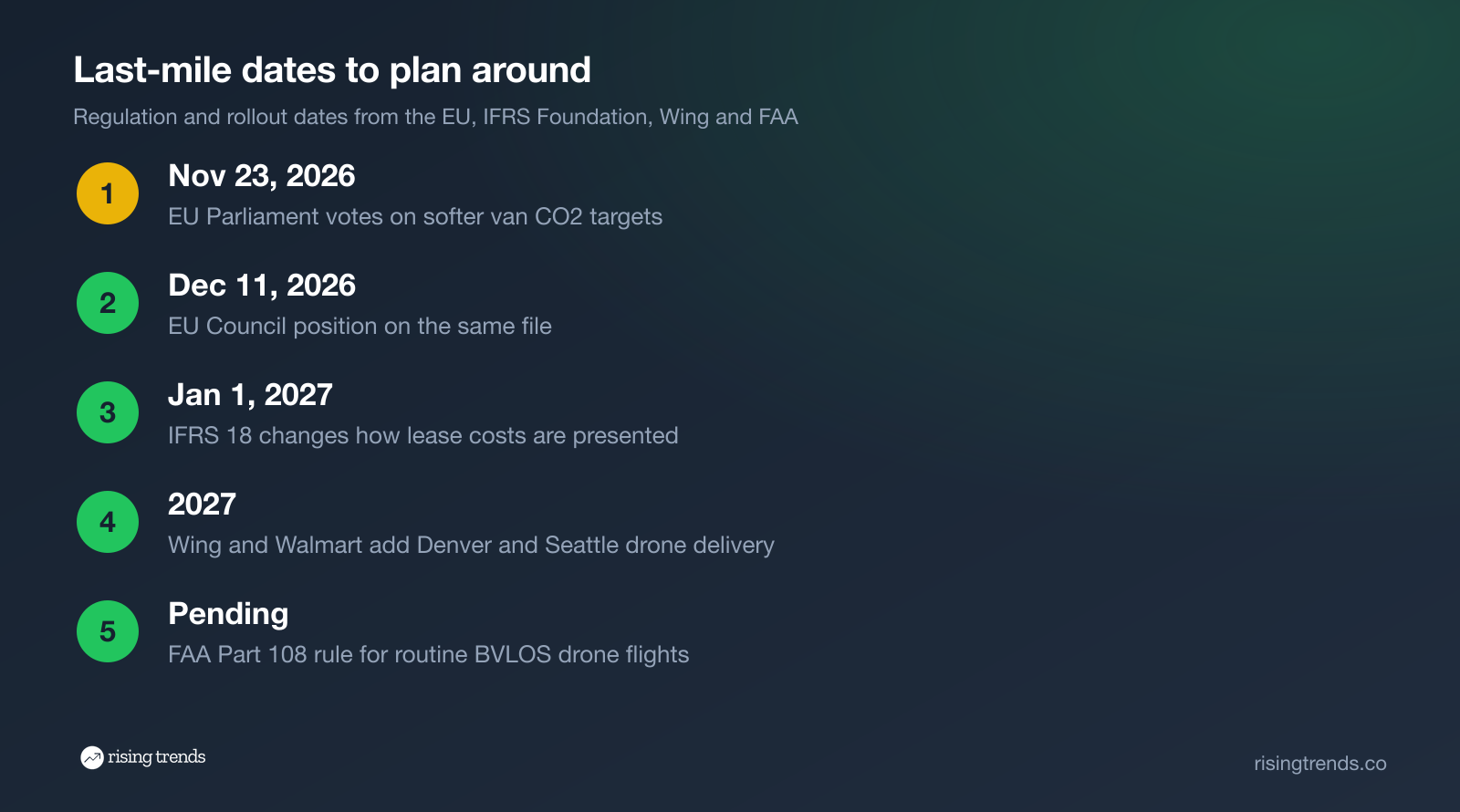
On October 5, 2026, Wing said it is adding Denver and Seattle to its Walmart network in 2027, bringing it to nearly 20 metro areas. The partnership has served more than 3 million customers and is building toward more than 270 Walmart stores and over 40 million people within range.
The regulator is starting to plan at that scale too. On September 11, 2026, the FAA published a draft environmental assessment for Zipline covering Houston, San Antonio, Austin, Amarillo and El Paso. It assesses up to 220,000 deliveries a day across those metros, with up to 1,000 a day from a single charging site.
Consumer interest is following. In our database, US searches for "drone delivery" rose 175% in a year (from 4,400 to 12,100 a month) and "amazon drone delivery" rose 174% to 22,200.
What to expect in 2027
The missing piece is still the rule. The FAA's proposed Part 108, which would make routine beyond-visual-line-of-sight flights possible without case-by-case waivers, was published as a proposal in August 2025 and is still not final as of October 2026. In September 2026 the FAA was still calling for technical roundtables on BVLOS security, a sign the rule is not imminent. Until it is final, every new metro runs on waivers and exemptions like the Zipline review above.
For retailers and carriers, drones in 2027 are a store-radius product: light parcels, short distances, dense suburbs. They take the most expensive single-item drops off the van route, not the route itself.
2. Sidewalk Robots Move From Campuses to City Contracts
Delivery robots spent years on college campuses. In 2026 they started signing with cities and national platforms.
On October 5, 2026, Coco Robotics and Deliveroo announced an exclusive partnership to scale robot delivery across the UK, starting in Canary Wharf in October and then Milton Keynes, Leeds, Stockton-on-Tees and Nottingham. Coco says it has completed more than 500,000 deliveries for more than 4,500 merchants.
In the US, the City of Hoboken launched a 12-month delivery robot pilot starting with 20 robots, 10 from Coco and 10 from Avride. City-run pilots with set fleet sizes are how sidewalk rules get written, so this is the template to watch.
Search shows where the attention is: "doordash robotics" is up 238% in a year to 8,100 monthly US searches, the fastest riser in our last-mile set.
What to expect in 2027
Expect more pilots with caps, permits and reporting requirements rather than open sidewalks. For restaurant and grocery operators, the practical question is short-radius orders under about two miles, where a robot can replace a gig driver on cost. For everyone else, robots stay a niche until the per-delivery numbers are published by more than one operator.
3. Electric Vans Grow, but Slower Than the Rules Assume
Electric vans are selling more than ever and still missing their targets.
In the UK, SMMT reported a record 4,832 battery-electric vans registered in September 2026, up 13.4% and a 9.6% share of the month. Year to date, battery-electric vans hold a 10.8% share against a 24% Zero Emission Vehicle Mandate target. SMMT's verdict: demand is less than half the mandated level.
Brussels is already adjusting. The Commission's proposal to cut the 2030 van CO2 target from 50% to 40% and the 2035 target from 100% to 90% is scheduled for a Parliament plenary vote on November 23, 2026, with a Council position expected December 11.
In the US the subsidy is gone. The 45W commercial clean vehicle credit of up to $40,000 only applies to vehicles acquired by September 30, 2025. Gas vans still dominate: Ford sold 119,185 Transit vans through September 2026 and holds a 41% share of US Class 1 to 7 commercial trucks and vans.
Interest is rising anyway. "Electric vans" searches are up 125% in a year and "ev van" up 85%.
What to expect in 2027
Mixed fleets are the realistic plan. Dense urban routes with depot charging go electric first because the energy and maintenance savings are largest there. Long rural routes stay on diesel or gas. Without the US credit, the case rests on total cost of ownership, which makes the lease terms and residual values in trend 4 matter more than the sticker price.
4. Fleet Finance Gets Busier, and the Accounting Gets Stricter
All of the above needs equipment: vans, drones, robots, chargers, sort machines. Equipment finance is booming to pay for it.
The Equipment Leasing and Finance Association's CapEx Finance Index for August 2026 shows $11.8 billion in new business volume, up 19.1% year over year and up 17.3% year to date, with a record $137.7 billion forecast for 2026. Lenders are tightening at the same time: credit approvals fell to 75.4%, the lowest since February 2025.
Search interest points the same way. "Fleet finance" is up 50% in a year, while "lease management" is down 46% and "telematics fleet management" down 46%. Operators are asking how to pay for fleets more than how to administer them.
That is where the risk sits. A delivery network built on leases can sign hundreds of contracts in a growth year, each with its own term, payment schedule, renewal option and substitution clause. Under IFRS 16, almost every lease longer than 12 months puts a right-of-use asset and a lease liability on the balance sheet, so each van added for peak season shows up as debt, depreciation and interest.
2027 adds a second change. IFRS 18 replaces IAS 1 for annual periods starting on or after January 1, 2027. It introduces a required operating profit subtotal and puts interest on lease liabilities in the financing category, below operating profit. Fleet-heavy companies will see their operating profit and financing lines reshaped, and they need comparatives for the prior year too.
For finance teams, spreadsheets stop scaling well before a portfolio reaches hundreds of vehicles. IFRS 16 compliance software for finance teams can automate lease recognition, discounting and balance sheet impact, and keep each entry traced back to its contract, which matters more once IFRS 18 starts splitting those numbers across new categories.
What to expect in 2027
Three habits separate fleets that grow safely from those that end up with idle vans on long leases:
- Test every lease against a demand drop. A van that pays back at full route density may not at 15% less volume. The Pitney Bowes data in trend 6 shows how fast volume can move between carriers.
- Track use against liability. Cost per stop, vehicle use rate, idle days and remaining lease term on one monthly view, so operations and finance see the same fleet.
- Start renewal reviews early. Months before notice deadlines, compare extending, swapping for an electric van or returning the vehicle.
US companies reporting under US GAAP (ASC 842) are not affected by IFRS 18, but anyone with IFRS reporting entities in the group should run a dry run of 2026 numbers in the new format before year-end.
5. Speed Expectations Keep Climbing
Shoppers want parcels sooner, and they care less about free shipping than they used to.
Ryder's 2026 E-commerce Consumer Study, a survey of 1,160 US shoppers published in August 2026, found:
- 39% expect delivery within one to two days, a four-year high.
- 76% would rather have fast shipping than pick a specific delivery date.
- 71% have abandoned a cart over unexpected shipping fees.
- The influence of free shipping on purchase decisions fell 14%.
Searches for "same day delivery" are up 22% in a year to 18,100 a month, and spike every December (33,100 in December 2025, 40,500 in January 2026).
What to expect in 2027
The fee matters less than the surprise. Retailers that show the delivery date and the shipping cost early in checkout keep the basket. For carriers, the pressure is on more local stock and more sort points close to customers, which is exactly what drones and robots in trends 1 and 2 are built around.
6. Carriers Finish Reshuffling Around Amazon
The US parcel map changed in 2025, and 2026 was the year the incumbents rebuilt around it.
The Pitney Bowes Parcel Shipping Index put US parcel volume at 23.1 billion in 2025, up 3.3%. Amazon Logistics became the largest carrier by volume at 6.9 billion parcels, ahead of USPS, while UPS's share of parcel revenue slipped from 34% to 31.6%. Volume for smaller "other" carriers more than doubled, driven by Shein and Temu.
UPS has now finished its response. In its August 31, 2026 leadership announcement, the company said it completed its Amazon volume glide-down and network reconfiguration in June 2026 and moved to a single global operating model on September 1. FedEx is simplifying too: it spun off FedEx Freight in June and on October 1, 2026 completed the sale of FedEx Supply Chain to CMA CGM at a $1.4 billion enterprise value.
What to expect in 2027
UPS reports its first full quarter after the glide-down on October 27, 2026, and that is the number to watch: lower volume at higher revenue per piece. For shippers, a smaller, more selective UPS and a bigger Amazon network mean more carrier mixing and more negotiating room for mid-sized volume.
7. Healthcare Is the Courier Growth Lane
The fastest-growing courier search in our database is not food or parcels. It is medicine.
US searches for "medical courier" more than doubled in a year, up 123% to 90,500 a month, and "medical courier jobs" is up 82% to 165,000. Those are among the largest volumes in the whole last-mile category.
Total courier work is not growing at that pace. The BLS counts about 1.09 million couriers and messengers employed in September 2026 (preliminary), essentially flat on the summer months, with average hourly earnings of $25.57.
So the growth is a shift inside the workforce, not a hiring wave: drivers are looking for the better-paid, steadier niche of lab samples, prescriptions and temperature-controlled loads.
What to expect in 2027
Healthcare logistics rewards compliance (chain of custody, temperature logs, HIPAA-aware handling) more than raw speed. Courier companies that can document those controls will win hospital and pharmacy contracts; gig platforms that cannot will stay in food.
What We're Seeing in Search
Our database tracks US search demand for tens of thousands of trends. Here is what it shows for last-mile delivery as of September 2026, compared with September 2025.
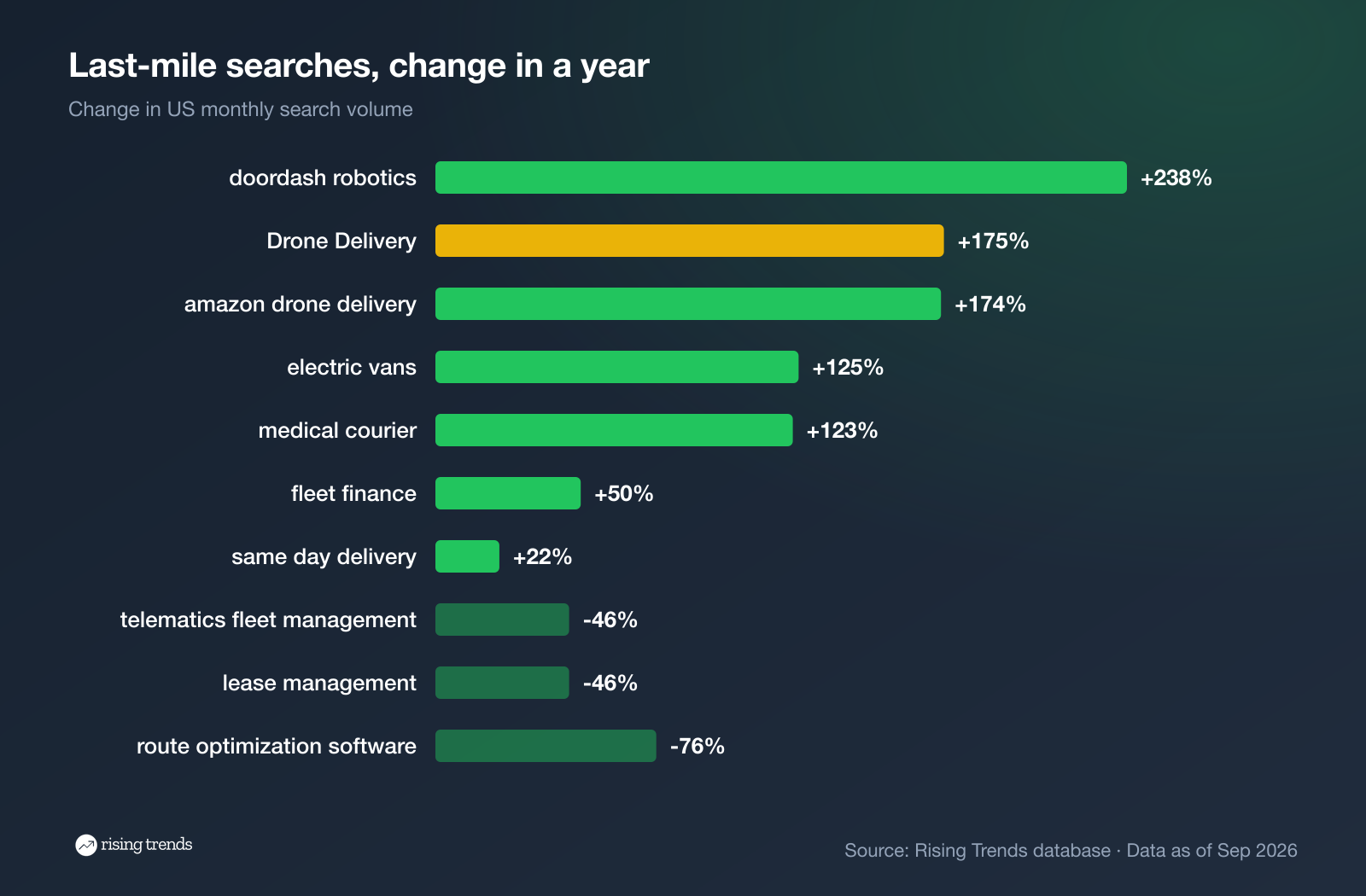
- New delivery methods lead. "doordash robotics" (+238%), "drone delivery" (+175%) and "amazon drone delivery" (+174%) are the fastest risers, matching the rollouts in trends 1 and 2.
- Electric vans are a live question. "electric vans" is up 125% even after the US credit ended, which suggests buyers are researching the cost case on its own.
- Healthcare is the biggest volume. "medical courier" at 90,500 searches a month is larger than every other term in the set combined.
- Software for running fleets is cooling. "route optimization software" is down 76% and "telematics fleet management" down 46%. These tools are now standard, so people search for vendors by name instead.
- "last mile" itself is flat at 2,900 a month outside the holiday spike. The interest is in the specific methods, not the buzzword.
If you use search data like this to size a market before committing capital, our guide on validating market demand walks through the method. For the wider picture, see our live logistics and supply chain trends table.
The Common Thread
Put the seven shifts side by side and one pattern runs through them: last-mile capacity is getting more specialized, and every specialized asset is a long commitment.
A drone network, a robot pilot, an electric van depot and a healthcare courier unit each serve a narrow slice of deliveries well. Each also comes with permits, contracts and multi-year equipment payments. The carriers that did best in 2026 were the ones that matched capacity to the volume they actually had, which is what UPS spent a year and a half doing.
If you only plan for three things in 2027: decide which delivery types are worth a dedicated method (short-radius, healthcare, bulky) rather than adding more general vans; stress-test every new lease against a volume drop before you sign; and get your lease data ready for IFRS 18 before the first 2027 quarter closes.
Frequently Asked Questions
What are the biggest last-mile delivery trends for 2027?
Drone delivery scaling to metro networks (Wing and Walmart in nearly 20 metros), sidewalk robots signing city and platform deals, electric vans growing slower than mandates, rising speed expectations, carriers restructuring around Amazon, growth in healthcare courier work, and a fleet equipment finance boom that meets new IFRS 18 presentation rules on January 1, 2027.
Is drone delivery legal in the US?
Yes, but each operator needs FAA approvals, waivers and exemptions for beyond-visual-line-of-sight flights. The FAA's proposed Part 108 rule would make those flights routine, and it is still not final as of October 2026.
Are electric delivery vans growing?
Yes, but slower than targets. UK battery-electric vans set a monthly record in September 2026 yet hold 10.8% of the market against a 24% mandate. The EU is voting on softer van CO2 targets in late 2026, and the US commercial EV credit ended for vehicles acquired after September 30, 2025.
How does IFRS 16 affect delivery fleets?
Under IFRS 16, most vehicle and equipment leases longer than 12 months create a right-of-use asset and a lease liability on the balance sheet, with depreciation and interest replacing a single rent expense. From January 1, 2027, IFRS 18 also moves lease interest into a separate financing category below operating profit.
Who is the largest parcel carrier in the US?
By volume, Amazon Logistics, with 6.9 billion parcels in 2025 according to the Pitney Bowes Parcel Shipping Index, ahead of USPS. UPS still has the largest share of parcel revenue.
Want to spot the next logistics shift before it shows up in earnings? Read our guide on how to identify market trends or browse what's gaining traction in our trending topics list.
Never miss a trend again
- One trend broken down with the numbers
- Who's making money, and what to build
- A website on the rise
- A breakout app
Join 5,000+ founders