Trends


The biggest food industry trends for 2027 are a value squeeze that keeps menu prices rising faster than grocery, a wave of dye and additive deadlines, and shoppers who buy less but want more protein. Here are all nine, with the number behind each:
Every figure comes from the organization that measured it (BLS, USDA, FDA, the National Restaurant Association, IFIC, PLMA and company earnings filings), plus our own search data where it adds something.
Let's get into it.
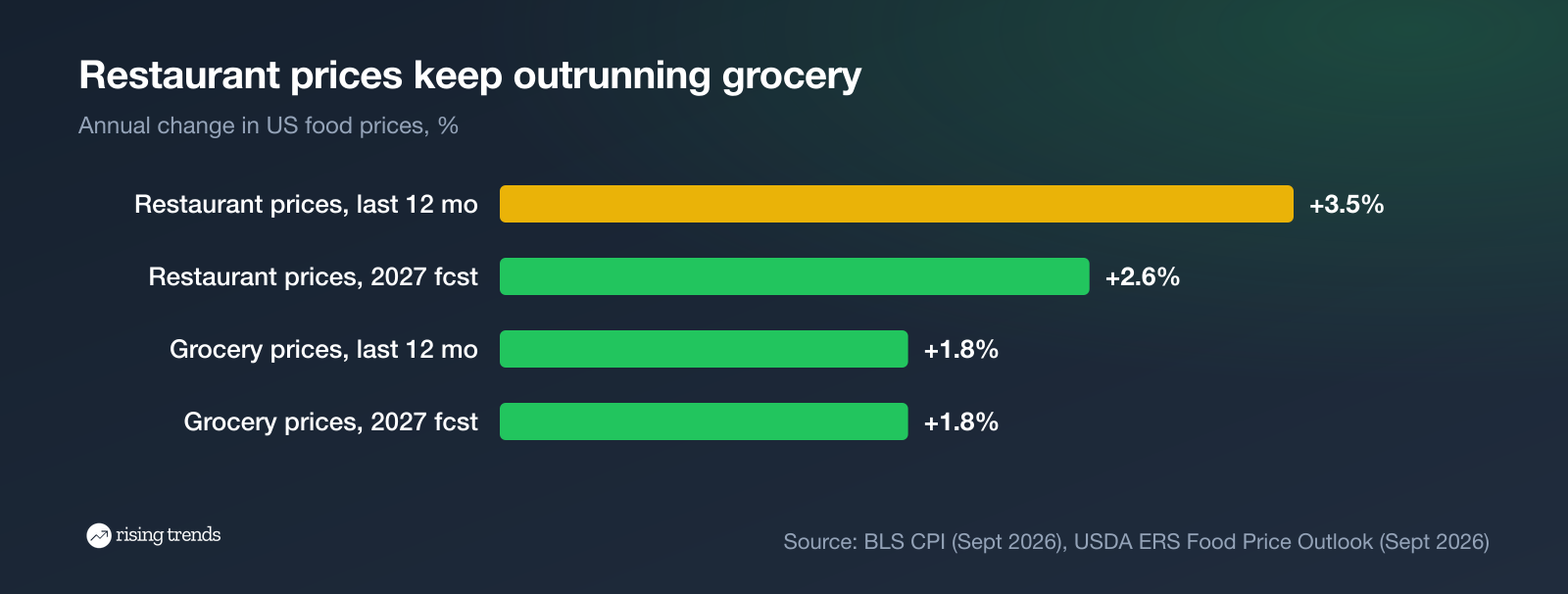
The gap between eating out and eating in is not closing. In the 12 months to September 2026, the food away from home index rose 3.5% while food at home rose 1.8%, according to the BLS. Full-service meals were up 3.8%, limited-service up 3.2%.
That price gap lands on an industry that was already thin. The National Restaurant Association's 2026 State of the Restaurant Industry projects $1.55 trillion in sales but only 1.3% real growth. In 2025, 60% of operators saw softer traffic and 42% were not profitable.
Spending still flows, just unevenly. Census advance retail data shows restaurant and bar sales up 7.0% year over year in September 2026 against 0.9% for grocery stores. Those are nominal figures. Netting out the CPI numbers above, our rough calculation puts real restaurant spending up about 3.4% and real grocery spending down about 0.9%.
The shopper is stretched. FMI's June 2026 shopper snapshot (n=1,516) found 71% very or extremely concerned about inflation and 77% changing how they spend. Only 26% describe themselves as living comfortably.
McDonald's grew US comparable sales only 0.8% in Q2 2026, with growth coming from check while guest counts went negative. Its loyalty program passed $40 billion in trailing sales, which is where the value fight is now being fought.
Starbucks went the other way. US comps rose 7.9% in its fiscal Q3 with transactions up 4.2%, after falling 3.7% a year earlier. It bought traffic back with labor and service under "Back to Starbucks," not discounts, and took the margin hit to do it. (We covered one of its menu bets in our piece on the Starbucks Aerocano.)
Taco Bell grew same-store sales 7% in Q2 2026, and Yum now gets more than 60% of system sales (ex-Pizza Hut) through digital. Chipotle grew comps 2.2%, but restaurant margin fell to 25.2% from 27.4% as food costs climbed on beef and freight.
USDA's first 2027 forecast has all food prices up 2.0%, restaurant prices up 2.6% and grocery up 1.8%. Both cool, but menus keep rising faster than shelves for a third straight year. The intervals are wide (restaurant prices anywhere from +0.2% to +5.1%), so treat it as direction, not a budget number.
For operators, the split between McDonald's and Starbucks is the lesson for 2027: price-led growth has run out of room, and the brands gaining traffic are winning on experience, speed or a clear value anchor. For CPG and grocers, a shopper who is cutting volume rewards pack-price architecture and smaller formats more than another price increase.
This is the busiest US food compliance calendar in decades, and most of it lands in 2027.
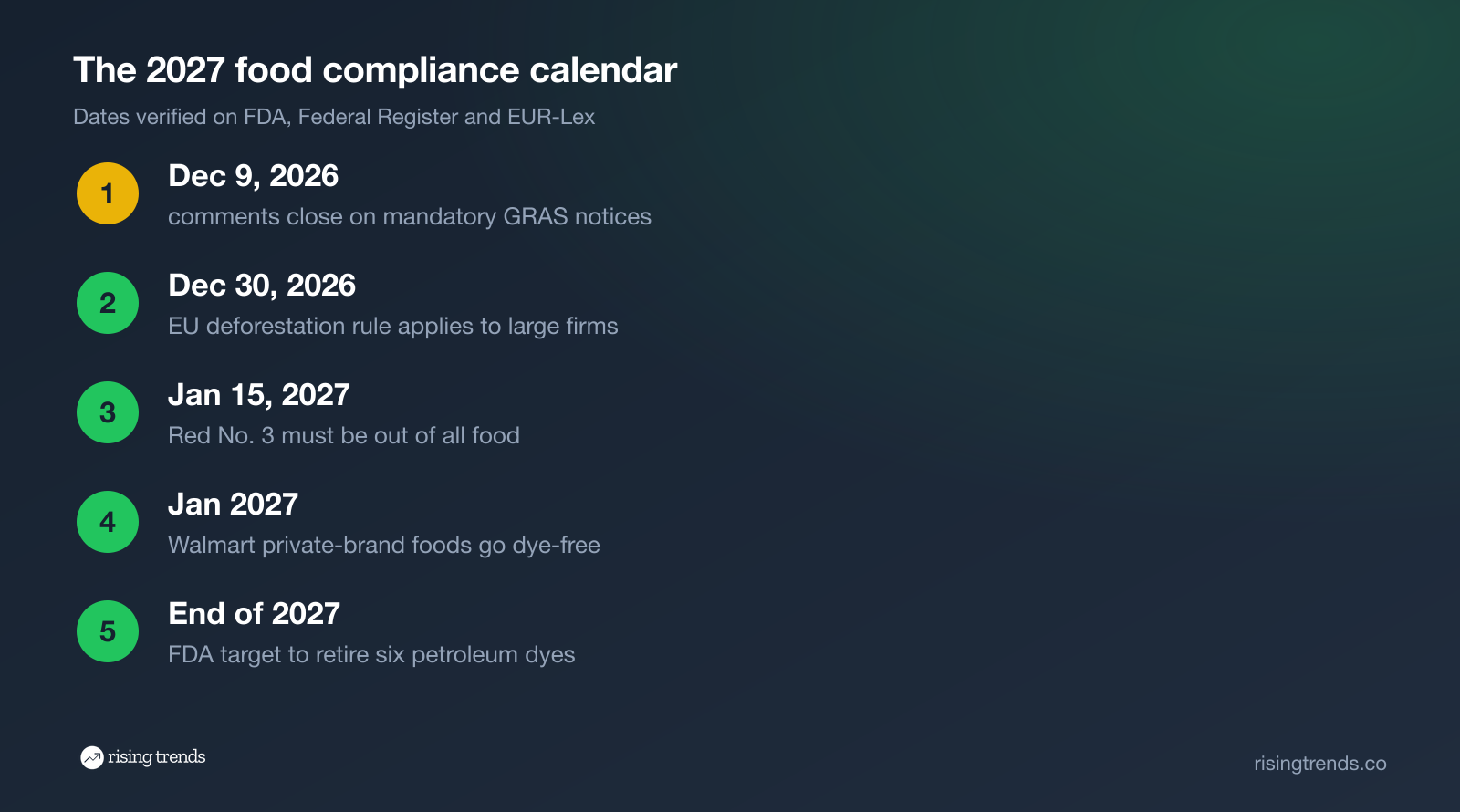
The FDA's pledge tracker (current as of October 16, 2026) says the agency is working to eliminate six remaining petroleum-based dyes by the end of 2027: Green 3, Red 40, Yellow 5, Yellow 6, Blue 1 and Blue 2. That target has slipped a year from the original end-of-2026 goal. The tracker lists 32 company pledges, 12 complete and 20 in progress. Separately, Red No. 3 must be out of food by January 15, 2027.
The color supply side is moving too. Six natural color additives have been approved or expanded since May 2025, including gardenia (genipin) blue and beetroot red.
The bigger structural change is GRAS. On August 11, 2026, the FDA proposed requiring GRAS notices for substances companies have so far self-affirmed as safe. Comments close December 9, 2026. Meanwhile, a final rule allowing salt substitutes in standardized foods takes effect December 14, 2026, which opens a sodium-reduction route that standards of identity used to block. The front-of-package nutrition box is still only a proposal.
General Mills committed to removing certified colors from all US cereals and K-12 foods by summer 2026 and from all US retail by the end of 2027. It said 85% of its US retail portfolio was already free of them. The FDA tracker still shows it in progress.
Kraft Heinz stopped launching new US products with FD&C colors and set the end of 2027 for the rest. Nestlé USA is marked complete on the FDA tracker. Walmart has set January 2027 for its private-brand foods, and Kellanova set December 31, 2027 for retail.
Expect 2027 to be the year reformulation costs show up in gross margins and in shelf-life complaints, since natural colors are less stable and more expensive than the dyes they replace. Expect the GRAS rule to be the sleeper: if it is finalized as proposed, every ingredient a company self-affirmed becomes a filing.
For brands, the practical question is supply. Six approved natural colors spread across 32 pledging companies and their private-label partners is a tight market. For restaurants, the NRA's 2026 culinary forecast already ranks "cleaner recipes with fewer additives and dyes" in its top 10, so menus will be asked the same questions as labels.
Protein has been the top nutrition pull for years. In 2026 it got an official target.
The 2026 IFIC Food & Health Survey (n=3,005) found 70% of Americans try to consume protein versus 7% who limit it, the top nutrient for the sixth year running. 27% followed a high-protein diet in the past year, up from 18% in 2023 and the most common eating pattern for the fourth year in a row. Fiber is close behind at 62%.
Then the Dietary Guidelines for Americans 2025 to 2030 set protein serving goals of 1.2 to 1.6 grams per kilogram of body weight per day, told Americans to prioritize protein at every meal and called for a dramatic reduction in highly processed foods.
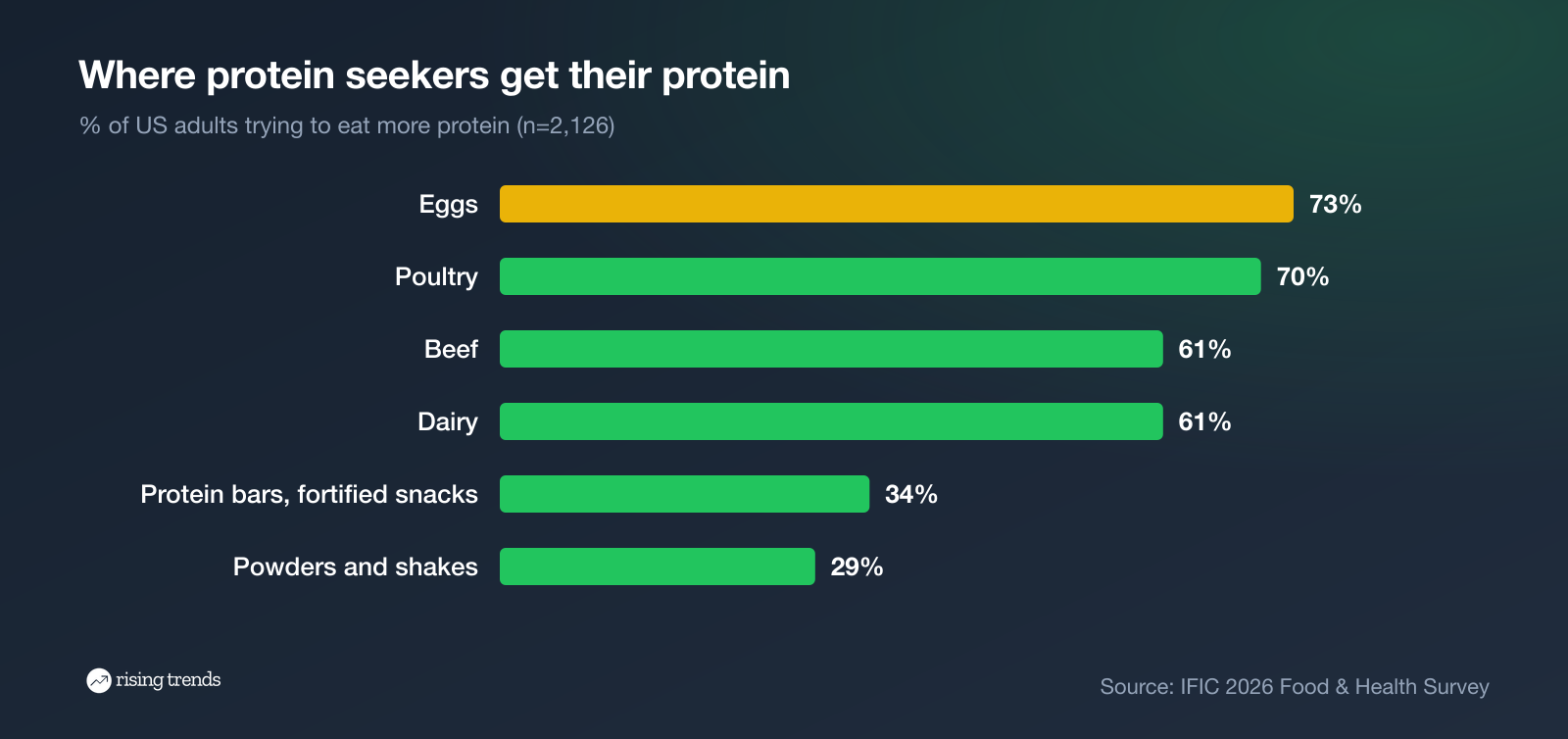
The detail that matters for product teams: among people trying to eat more protein, the same IFIC survey found 73% get it from eggs, 70% from poultry and 61% from beef, but only 34% from protein bars and fortified snacks and 29% from powders and shakes. Whole foods still win the protein occasion.
PepsiCo put Doritos Protein on shelves in March 2026 with 10 g of protein per ounce, and in its Q2 2026 results the CEO named hydration, protein and fiber as growth drivers. Foods North America organic revenue still fell 2% that quarter, so protein is a lever, not a rescue.
Chipotle launched its first High Protein Menu, led by a 32 g, 180-calorie protein cup at a national average of $3.82, with items ranging from 15 g to 81 g of protein.
Federal guidelines flow into school meals and other federal food programs, which makes protein a structural tailwind through 2030, not a fad. Expect protein claims to keep spreading into snacks, beverages and limited-service menus, and expect fiber to be the next claim everyone chases.
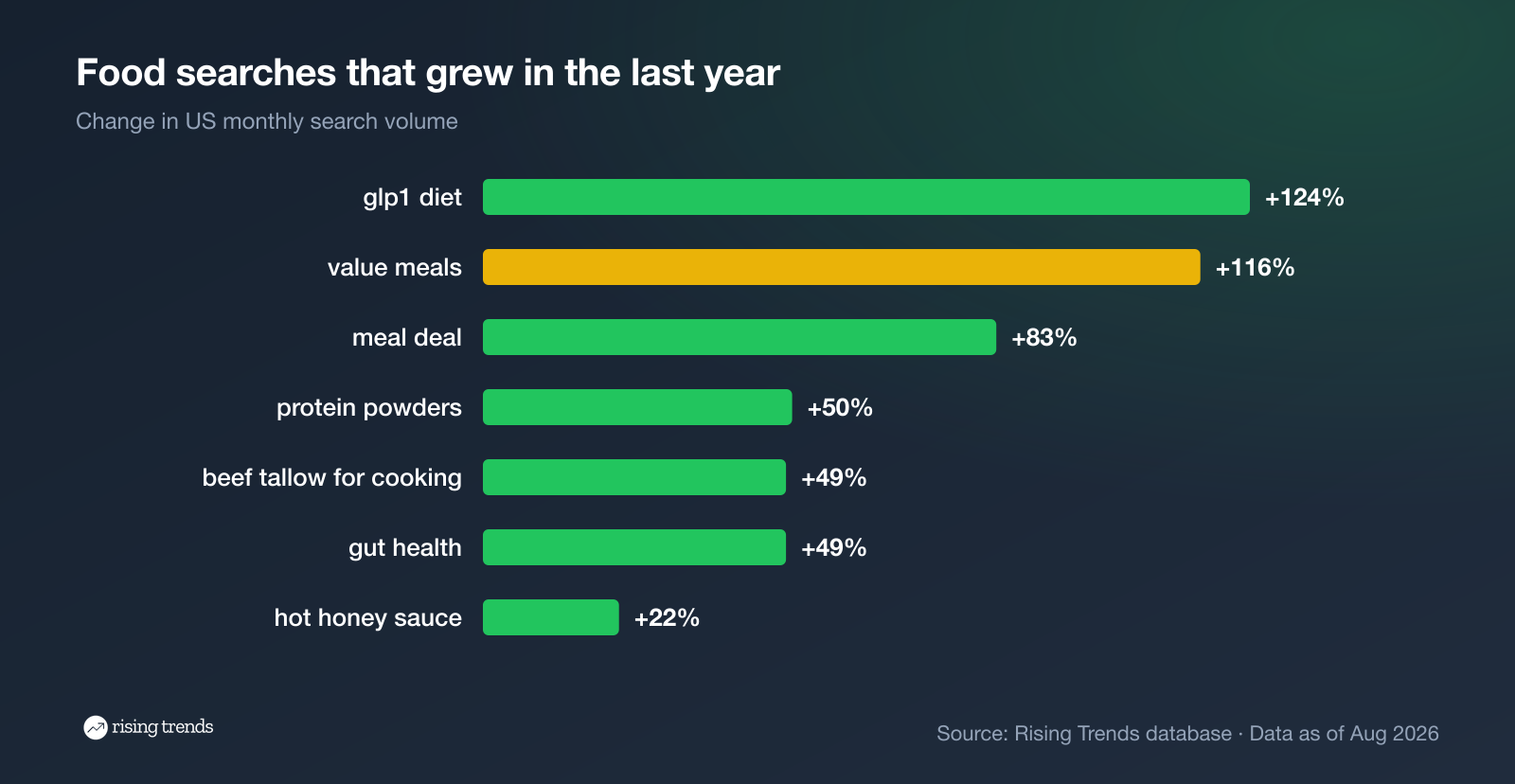
There is a warning in our own data, though. In our search database, "high protein snacks" is down 55% year over year (August 2026) while "protein powders" is up 50%. Interest is shifting from protein-added snacks toward the base ingredient. If you are launching a protein SKU in 2027, the bar is a real nutritional reason to exist, not a protein callout on an old product.
One in eight US adults is now on a GLP-1 drug, and the purchase data is no longer anecdotal.
A KFF poll (n=1,350, November 2025) found 12% of US adults currently take a GLP-1 drug, up from 6% in May 2024, and 18% have taken one at some point.
What happens to their spending? A Cornell-led study in the Journal of Marketing Research, built on a Numerator panel of about 150,000 households, found grocery spending falls about 5.3% within six months of starting a GLP-1 (more than 8% in higher-income homes). Limited-service restaurant spending falls about 8% and savory snacks about 10%, while yogurt, fresh fruit, nutrition bars and meat snacks gain.
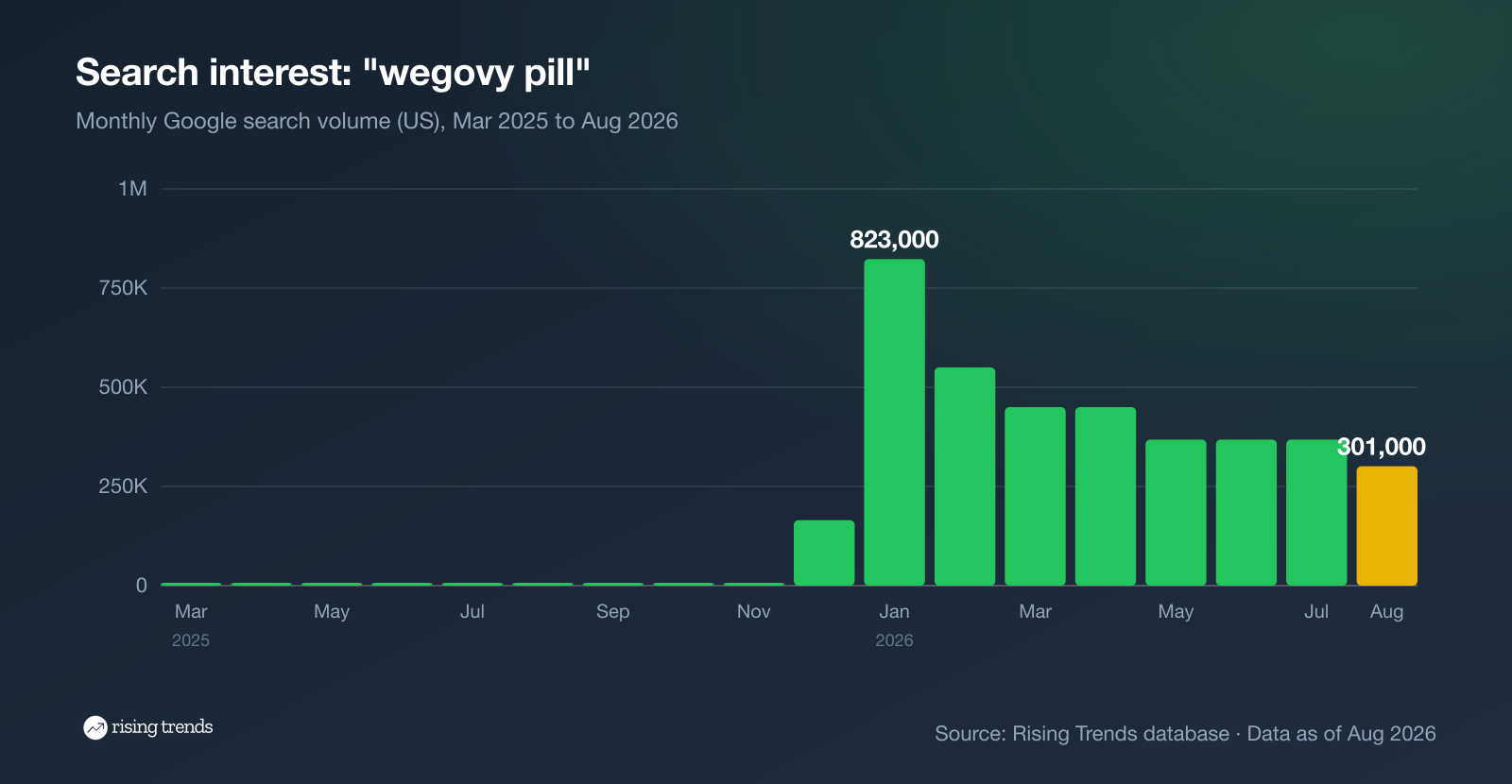
Our own data points to the next leg. US searches for "wegovy pill" went from about 2,400 a month in August 2025 to a peak of 823,000 in January 2026, and were still at 301,000 in August 2026. Searches for "glp1 diet" are up 124% in a year. People are asking about pills and about how to eat on the drugs, which suggests the user base is widening and the diet questions are moving into the kitchen.
Chipotle labeled two items on its protein menu "GLP-1 friendly," including a High Protein-High Fiber Bowl with 46 g of protein and 14 g of fiber at 540 calories.
Coca-Cola launched BODYARMOR FIT, a zero-sugar sparkling sports drink with electrolytes and caffeine marketed for "metabolism support."
We also looked at the compounded-drug side of this market in our piece on Embody tirzepatide.
The study found the spending effect persists for at least a year among people who stay on the drugs and fades after they stop. So 2027 planning should assume a growing, permanent segment of smaller-appetite, higher-protein buyers, not a one-time dip.
For CPG, that means portion-controlled and nutrient-dense formats. For quick-service restaurants, it means the 8% spend drop is concentrated in exactly the indulgent, high-calorie items many menus rely on, which is why "GLP-1 friendly" labels are appearing on menus already.
Private label is not having a recession moment. It is having a decade.
PLMA data from Circana shows store brands hit a record $282.8 billion in 2025, growing 3.3% against 1.2% for national brands, with a record 23.5% unit share. From 2021 to 2025, unit share climbed from 21.6% to 23.5%.
The first half of 2026 made the pattern sharper. Store brands reached a record 23.8% unit share, with units up 0.2% while national brands lost 0.5%. National brands still grew dollars (+2.2%) because they raised prices while store-brand dollars stayed flat. Store brands grew units in 52% of 166 food categories.
Hershey is the clearest case of national-brand price elasticity. In its Q2 2026 results, North America Confectionery took about 14 points of price and lost about 10 points of volume.
Walmart is putting tariff refunds into lower prices and pushing its private-brand foods to go dye-free by January 2027, which turns store brands into the "clean" option, not just the cheap one.
Nobody publishes an official private-label forecast for 2027, but four straight years of unit-share gains and a record H1 2026 point one way. The interesting shift is quality positioning: when retailers' own brands meet the dye deadlines before some national brands do, the old "cheaper but worse" trade-off weakens.
For national brands, growing dollars on price while losing units is not a strategy that survives 2027. Expect more price-pack architecture, more promotions funded through retail media, and more brands making private label for the same retailers they compete with.
Commodity planning for 2027 is unusually messy because the big inputs are not moving together.
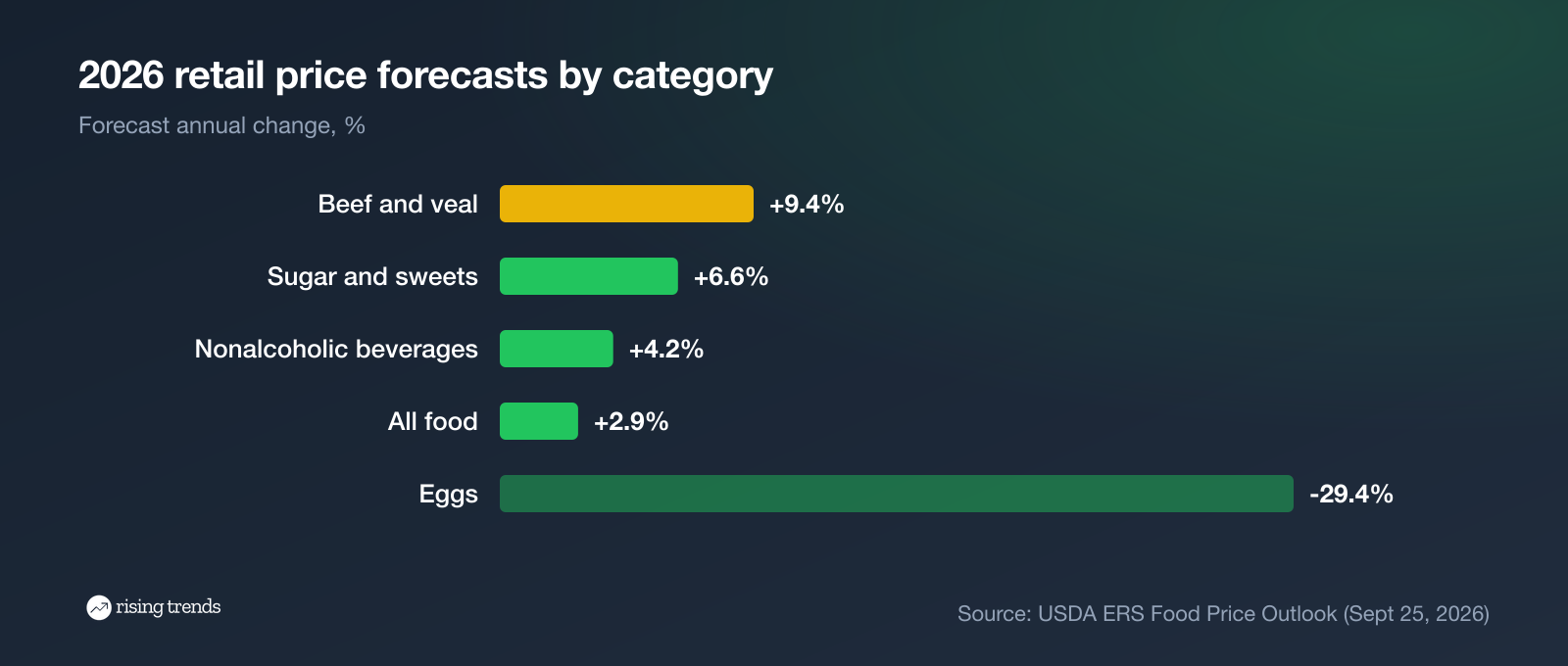
USDA's Economic Research Service forecasts beef and veal retail prices up 9.4% in 2026, with beef production about 2% lower than a year earlier. Sugar and sweets are forecast up 6.6%, nonalcoholic beverages up 4.2% and retail coffee was up 6.1% year over year in August. At the other end, eggs are forecast down 29.4% as production recovers from avian flu.
Chipotle blamed beef and freight for pushing food, beverage and packaging costs to 29.7% of revenue, up from 28.9%.
Hershey shows the other side: adjusted gross margin rose 350 basis points to 41.6% on lower net commodity costs as cocoa came off its highs, even as volume fell.
Walmart said its gross profit rate rose 96 basis points mainly because of tariff refunds, and that it will keep putting the remaining refunds into price.
USDA does not publish 2027 forecasts by category, but the US cattle herd is still shrinking, so tight beef supply into 2027 is the reasonable assumption (our inference, not a USDA forecast). For menus built around beef, that argues for chicken, eggs and blended proteins in the 2027 menu plan, especially with egg prices falling.
For confectionery and coffee buyers, 2027 is about whether easing input costs get passed through. Hershey's volume losses suggest the shopper will reward the first brand that brings prices down.
This is the long-term shift underneath the value fight.
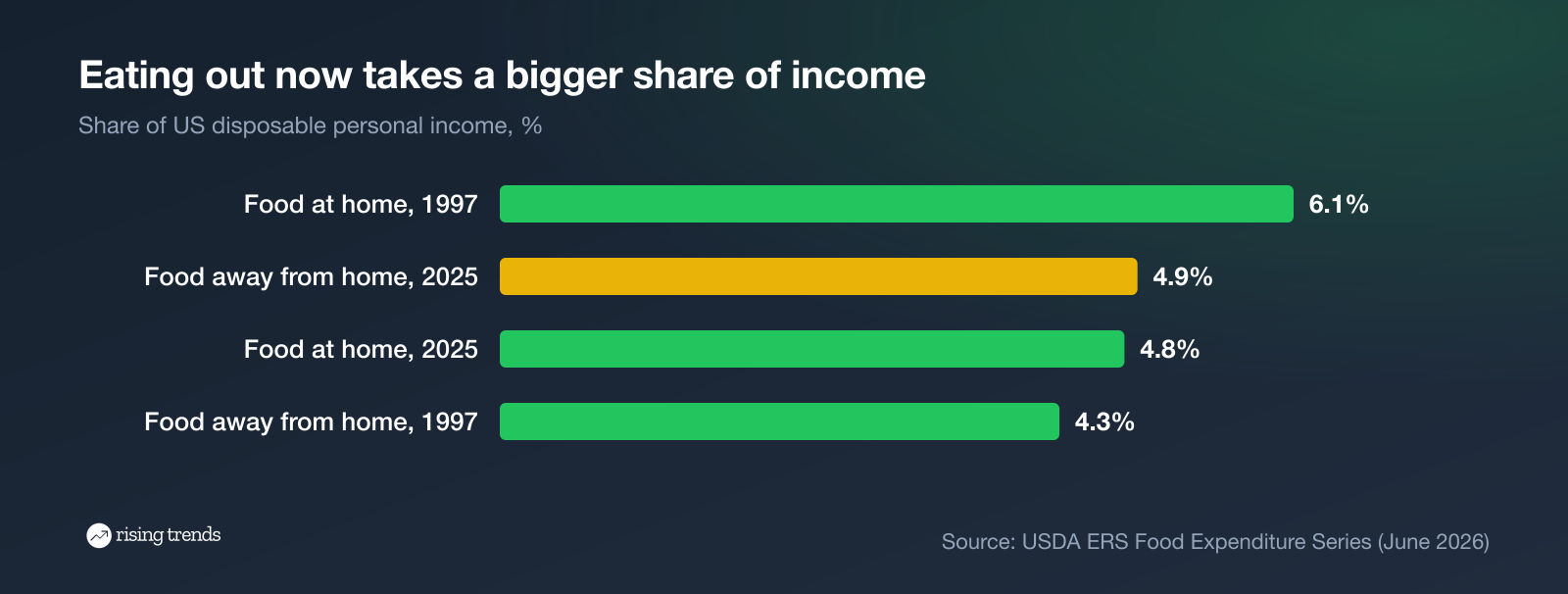
USDA data shows food away from home made up 56.3% of total US food spending in 2025, $1.41 trillion of $2.51 trillion. Measured against income, eating out took 4.9% of disposable income versus 4.8% for food at home. In 1997 those numbers were 4.3% and 6.1%.
DoorDash handled 970 million orders in Q2 2026, up 27% (17% excluding Deliveroo), and expects its Dot delivery robot to handle a high single-digit share of orders in its largest test market by year-end.
Chipotle now gets 38.3% of food and beverage revenue through digital, up from 35.5%. Yum is above 60% outside Pizza Hut.
Instacart grew gross transaction value 14% to $10.35 billion, so grocery delivery is growing too, just not as fast.
USDA's 2027 forecast keeps restaurant inflation above grocery inflation, and the shopper is still choosing to spend more of a smaller food budget away from home. For grocers and CPG, the competitor is not just the store across the street but the delivery app. Expect more prepared foods, more restaurant-quality private label and more meal-solution merchandising aimed at the same occasions.
For restaurants, digital is now the default order channel for many chains, which makes loyalty data and app placement as important as real estate.
The fastest-growing line at the big grocers is not food.
In Walmart's Q2 fiscal 2027 results, Walmart Connect grew 43% (global advertising +38%) while Walmart US comparable sales grew 2.6%. At Kroger, Precision Marketing profit grew 24% while identical sales grew just 0.2%. Instacart's advertising and other revenue grew 16% to $297 million, faster than its order value.
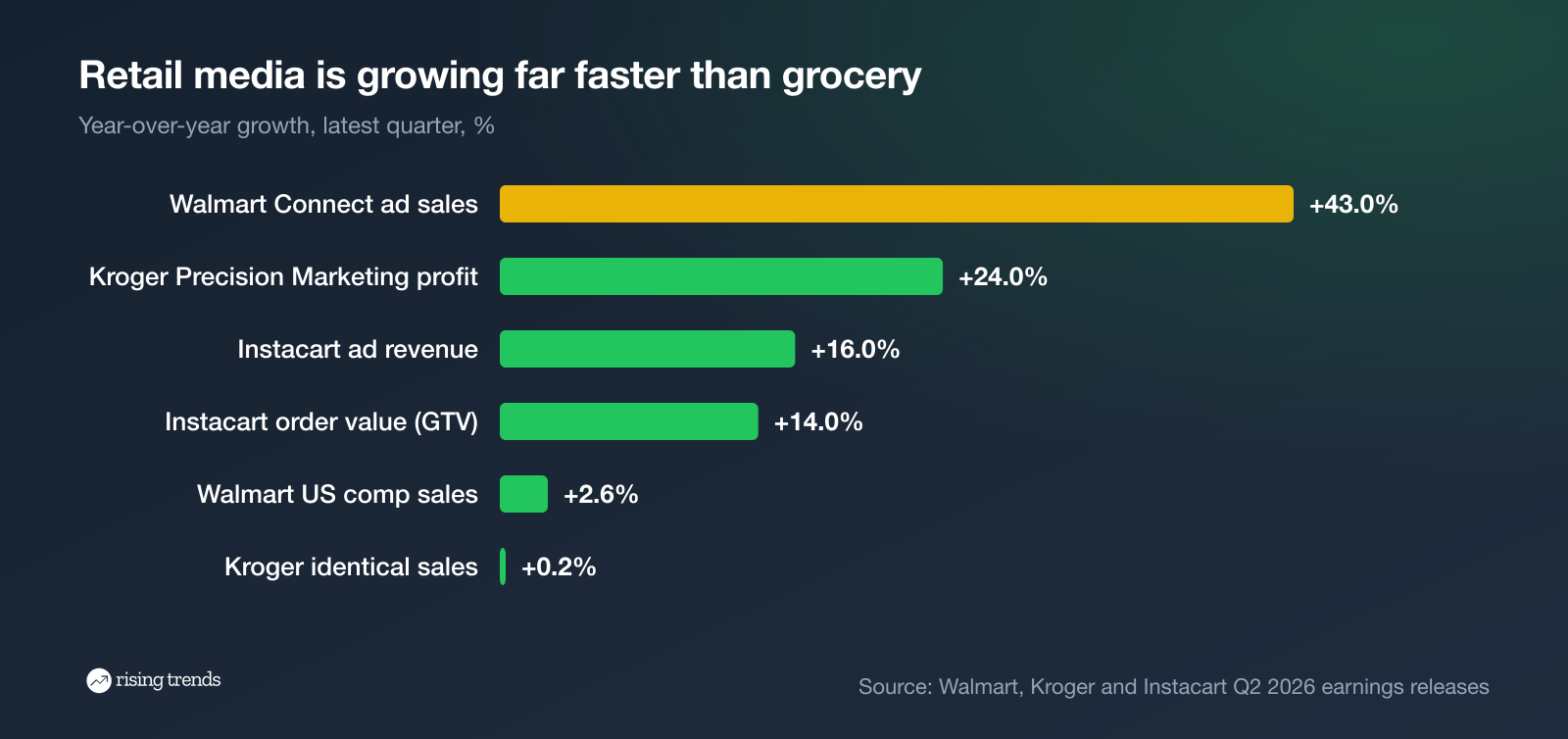
For grocers, media profit is what funds price. Walmart is cutting prices while growing margin partly because ads carry so much profit. For CPG, trade budgets keep migrating into retailer ad networks, which makes retail media a cost of distribution rather than optional marketing.
The next shift is discovery. IFIC asked about AI for the first time in 2026 and found 29% of Americans use AI weekly to decide what to eat, what groceries to buy or where to eat, including 44% of Millennials and 40% of Gen Z. In 2027, the shelf a brand has to win may increasingly be the answer an AI assistant gives, not the one in the store or the retailer app.
The growth in beverages sits in functional and zero-sugar, and the big strategics are buying it rather than building it.
PepsiCo closed its $1.95 billion acquisition of poppi in May 2025. In energy, Celsius Holdings now holds about a 20.1% dollar share of US ready-to-drink energy (Circana, 13 weeks to June 28, 2026), driven by Alani Nu, whose retail sales grew 55.7% while the Celsius brand itself slipped 2%.
The base is soft. PepsiCo Beverages North America had organic volume down 2% in Q2 2026, and USDA forecasts nonalcoholic beverage prices up 4.2% this year. Functional is growing inside a shrinking category.
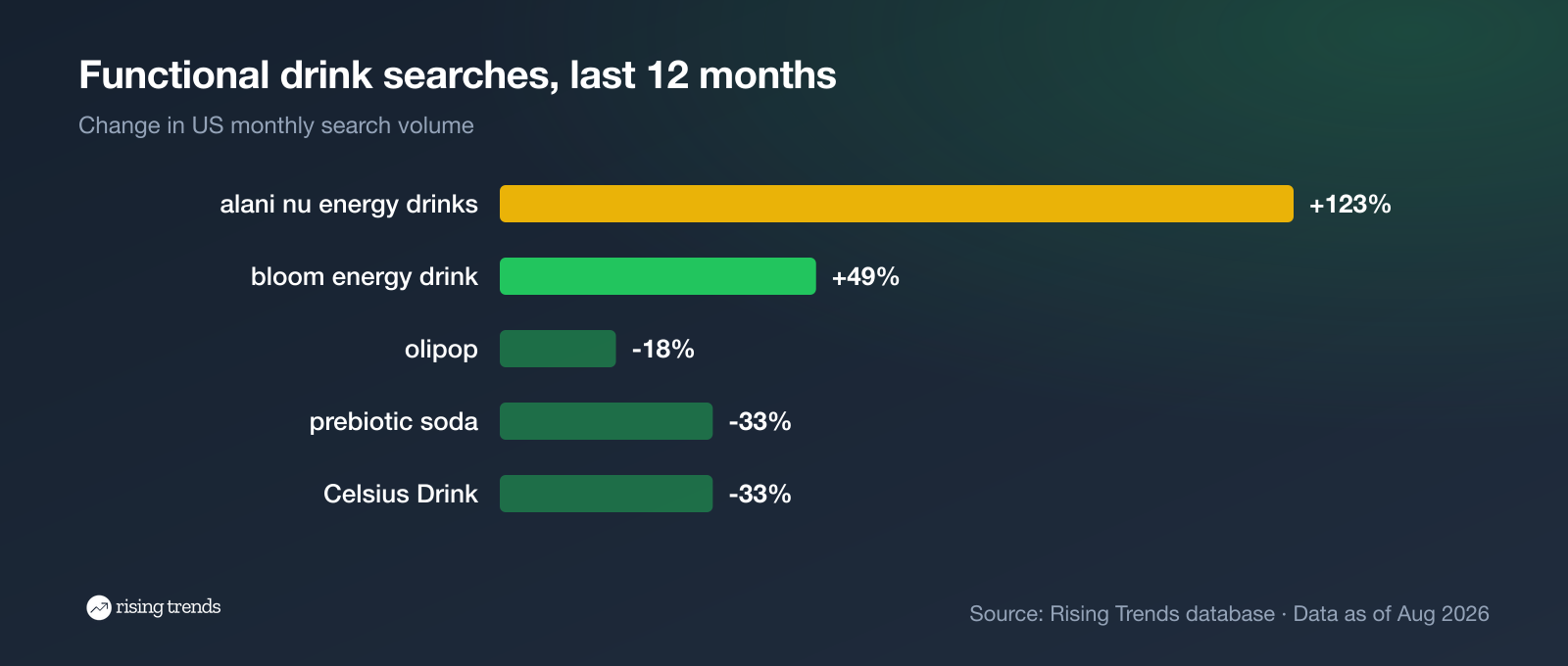
Our search data matches the shift inside the category. Over the last year, searches for "alani nu energy drinks" are up 123% and "bloom energy drink" up 49%, while "prebiotic soda" is down 33%, "olipop" down 18% and "celsius drink" down 33%. Prebiotic soda looks like a category that peaked in consumer curiosity just as the majors bought in, which is common: the acquisition comes at the top of the hype and the work of building a lasting category starts after.
Expect more "metabolism," hydration and protein claims in beverages, more launches from the majors' own labs (like BODYARMOR FIT), and more acquisitions of the challengers that are still growing. Expect the risk side too: Coca-Cola had to suspend US fairlife production after a ransomware attack in July 2026, a reminder that concentrated, fast-growing brands are also concentrated supply-chain risks.
Our database tracks US search demand for tens of thousands of trends. Here is what it shows for food and beverage as of August 2026, and how it lines up with the industry data above.
For the consumer side of these categories, see our live trend tables for beverages, snacks, nutrition, coffee and cooking.
Put the nine shifts side by side and one pattern runs through all of them: the industry is being forced to earn volume again.
For a few years, price did the work. Restaurants raised menus, brands raised list prices, and dollar sales looked fine. The 2026 data shows the limit of that. McDonald's grew on check while losing guests. National brands grew dollars while store brands took units. Hershey took 14 points of price and lost 10 points of volume.
What wins volume in 2027 is a real reason to buy: a clearer value anchor, a product that fits how GLP-1 and protein-focused shoppers actually eat, a cleaner label that meets the deadlines early, or a better experience, as Starbucks showed. On top of that sits a regulatory calendar that will make reformulation a 2027 budget line whether you planned for it or not.
If you only plan for three things in 2027, plan for these: lock in natural color and ingredient supply before the end-2027 deadlines tighten it further; build portion and protein options for a shopper who buys less but cares more; and decide how much of your marketing budget now has to run through retailer media and AI discovery to be seen at all.
Based on government and company data, the biggest shifts are the value squeeze (restaurant prices rising faster than grocery), the FDA's dye and GRAS changes with deadlines through end-2027, protein backed by the new Dietary Guidelines, GLP-1 households spending less, private label taking unit share, diverging commodity costs led by beef, eating out taking a bigger share of food spending, retail media growth, and functional beverage consolidation.
USDA's first 2027 forecast, published September 2026, has all food prices up 2.0%, restaurant prices up 2.6% and grocery prices up 1.8%. That is slower than 2026, but restaurant prices are still expected to rise faster than grocery prices.
Red No. 3 must be out of food by January 15, 2027. For the six other petroleum-based dyes (Green 3, Red 40, Yellow 5, Yellow 6, Blue 1, Blue 2), the FDA is working toward elimination by the end of 2027 and tracks voluntary company pledges on its website.
About 12% of US adults take a GLP-1 drug. Research published in the Journal of Marketing Research found their grocery spending falls about 5.3% within six months, with bigger drops in savory snacks (about 10%) and fast-food spending (about 8%), and gains in yogurt, fresh fruit and nutrition bars.
Yes. Store brands reached a record 23.8% unit share in the first half of 2026 and a record $282.8 billion in sales in 2025, according to PLMA using Circana data.
Want to spot the next food trend before it hits shelves and menus? Read our guide on how to identify market trends or browse what's gaining traction in our trending topics list.
Join 5,000+ founders · Free