Trends


In February 2026, nobody in the United States was googling "embody tirzepatide." Our database records a flat zero for that month, and for every month before it. By July 2026 the term was pulling 9,900 monthly searches, which is more than "lillydirect tirzepatide" and more than "ro tirzepatide," the two names most people would have guessed sit at the top of this category.
That is a brand going from nothing to the most-searched way to buy tirzepatide in five months, with no funding round, no launch event and no press coverage to hang it on. The questions Google now shows alongside the name are not product questions. They are "Is embody legit for tirzepatide?" and "Is embody tirzepatide FDA-approved?" This piece is about what is actually behind the name, what the company's own pages say, and why the pricing you see first is not the pricing in its terms.
Key takeaways:
Let's get into it.
Here is the monthly search volume for "embody tirzepatide," straight from our database. It is not a curve so much as a wall.
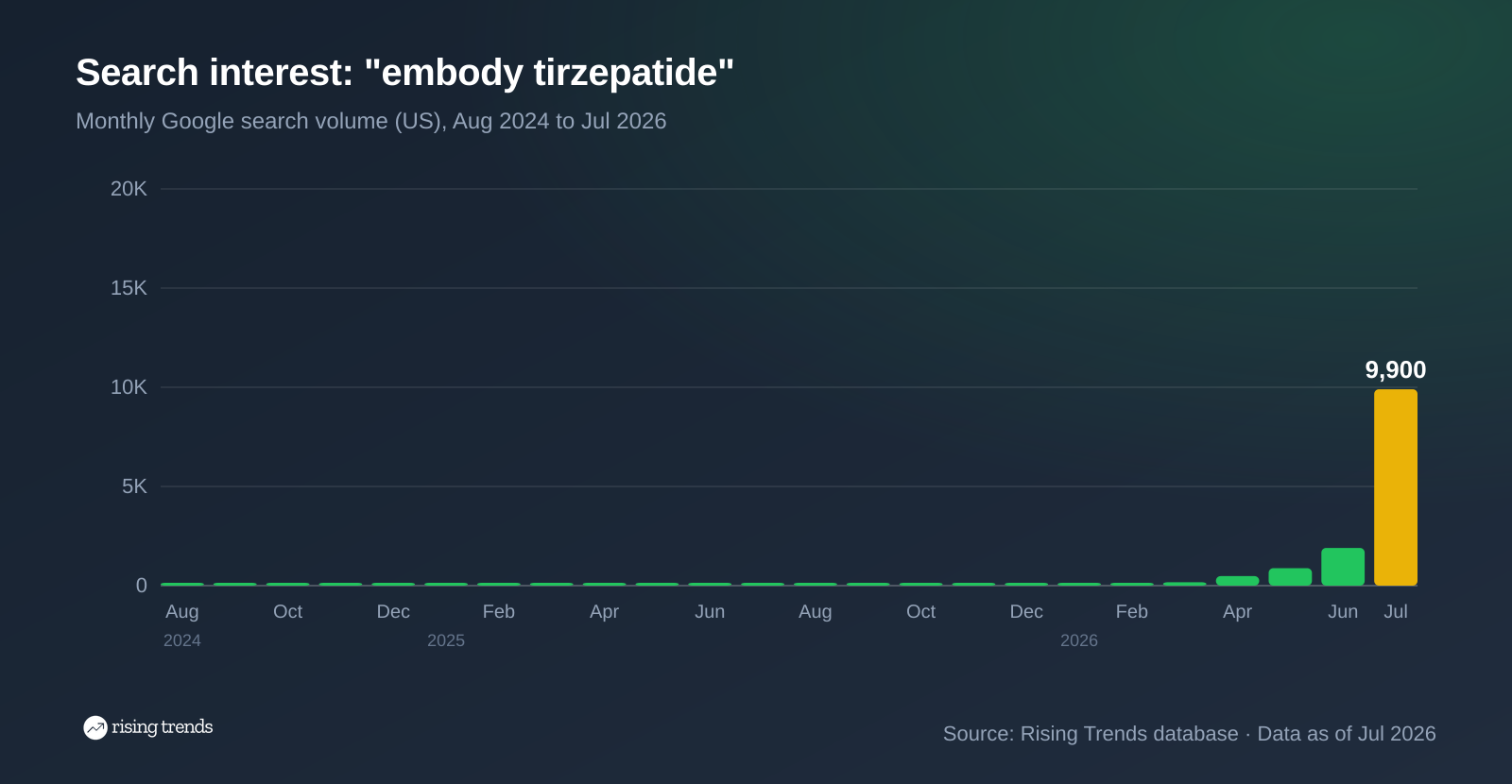
The first non-zero month is March 2026, at 170 searches. April was 480. May was 880. June was 1,900. Then July was 9,900, a 5.2x jump in a single month. Measured properly, the last three months ran at 19.5x the three before them, and the three-month growth column reads 1,963%. Every month since the term appeared has been a record month, which is why the database classifies it as EXPONENTIAL with a RISING trajectory as of July 2026.
What makes that number worth a second look is the company it now keeps.
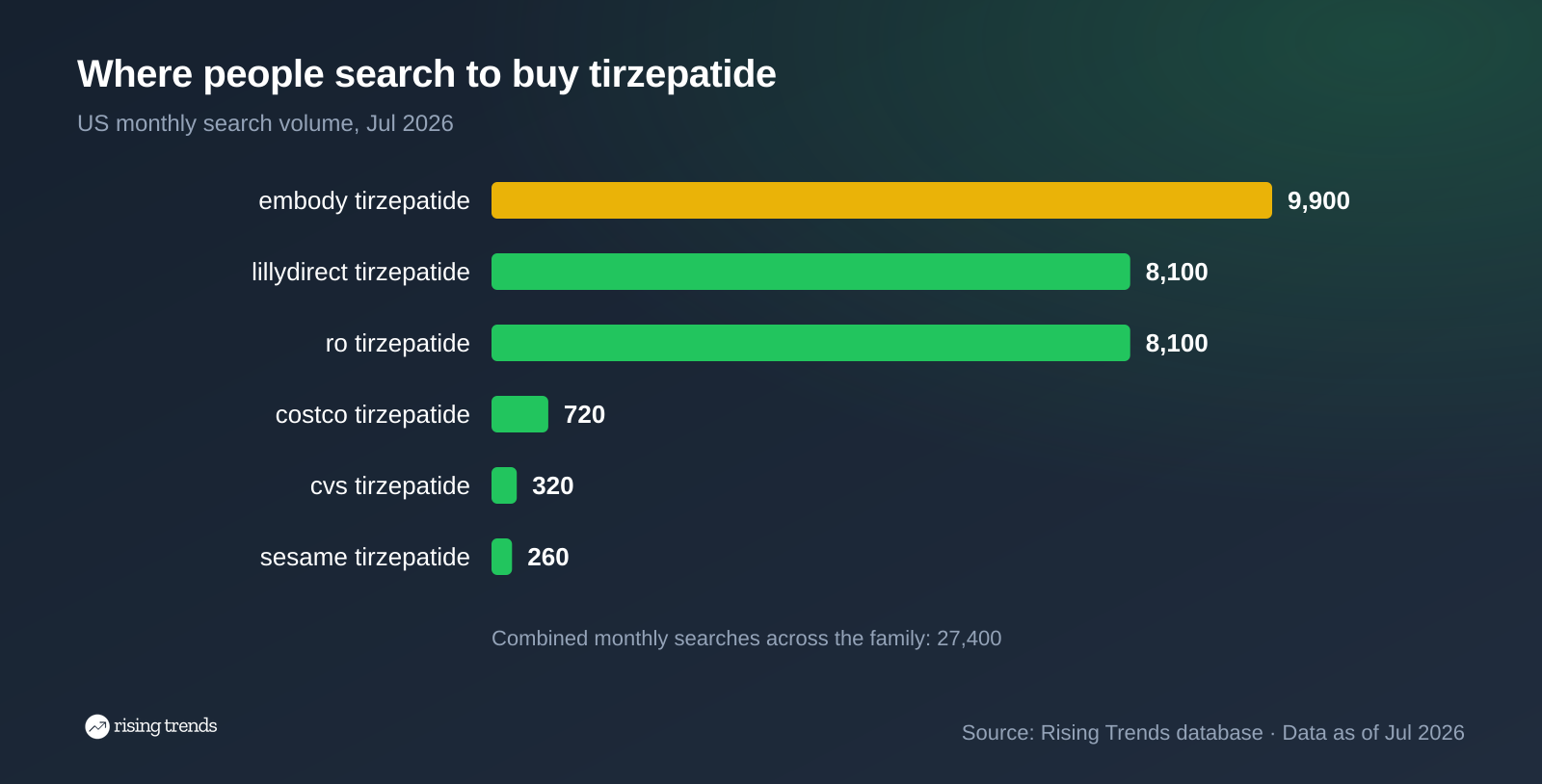
LillyDirect is Eli Lilly selling its own drug straight to patients. Ro is a decade-old telehealth company with a national brand. Both sit on 8,100 searches a month as of July 2026. A brand that did not exist as a search term in January is now above both of them, and the retail routes people also try, Costco at 720 and CVS at 320, are rounding errors next to it.
Embody is a direct-to-consumer weight-care brand operated by Modern Metabolic Medicine, Inc., registered in Wilmington, Delaware. Its website opens on "Fat Loss made simple, powered by GLP-1 Science + Care," a two-minute eligibility quiz, and two price cards: GLP-1 injections from $79 a month, GLP-1/GIP injections from $129 a month.

Three things on that page matter more than the marketing. The first is the word compounded. Embody does not sell Zepbound or Mounjaro. It sells compounded tirzepatide, prepared for an individual patient by a state-licensed 503A pharmacy, and its own footer says the quiet part out loud: compounded medications "have not been evaluated or approved by the FDA for safety, efficacy, or quality." Its medication safety page goes further and notes that "FDA-approved medicines containing Tirzepatide are available."
The second is that Embody is not the clinic. The footer names OpenLoop Health as the network whose clinicians decide whether to prescribe. The third is that Embody is not the pharmacy either: it names Red Rock Compounding Pharmacy, Health Warehouse, Precision Medicine and Triad Rx as the partners that actually fill the order. In its own words, "Embody does not produce compounded medications."
That structure is the business. Embody owns the storefront, the checkout and the customer. Everything clinical is rented.
The honest answer is that we cannot see the ad spend, and neither can anyone else. What we can see is the shape of the demand and what moved in around it.
The category itself got a lot of attention this summer. On August 7, 2026, Yale School of Medicine published a secret shopper study of online GLP-1 sellers, since published in JAMA. A medical student posed as an eligible patient and approached 49 websites. Forty-five of them offered a prescription. Senior author Reshma Ramachandran put it plainly: "We found out it was incredibly easy to get this medication, oftentimes without any sort of clinician oversight." Lead author Ashwin Chetty added that only about half the sites asked about eating disorders, "and that's increasingly becoming a concern for GLP-1s, because they can induce or worsen eating disorders."
This clip from HCPLive, posted on August 5, 2026, walks through what the researchers found.
The regulator moved in the same direction and earlier. On March 3, 2026, the FDA announced 30 warning letters to telehealth companies over claims about compounded GLP-1s, the second wave after a crackdown that began in September 2025. Commissioner Marty Makary's line was "It's a new era. We are paying close attention to misleading claims being made by telehealth and pharma companies across all media platforms."
Then there is what filled page one. We pulled the ten organic results for "embody tirzepatide" and not one of them is independent journalism. There is joinem.co itself, a Trustpilot page, a Reddit thread, a Facebook post, a pharmacy product listing, an article in a site's health press release section, a review post on an addiction-recovery blog, and two pages belonging to entirely different companies that happen to be called Embody, one of them a WebMD property. The tenth, a September 2 review bylined "SPONSORED CONTENT," discloses that it earns a commission on purchases, then routes every "official Embody website" button through an affiliate redirect on a different domain.
That is not coverage arriving after a story. That is an affiliate market forming around a search term that is already moving, which is what a category looks like when the demand is bought rather than earned.
Here is the part nothing else ranking for this term mentions. Embody publishes two sets of tirzepatide prices, on two pages of the same website, and they do not agree.
| Where it appears | Plan | Tirzepatide injection |
|---|---|---|
| Homepage price card | "starting at" | $129/month |
| Terms, Start Program | Month 1 | $149 |
| Terms, Start Program | Month 2 onward | $399/month |
| Terms, Flat Program | Monthly, no commitment | $299/month |
| Terms, Flat Program | 6-month bundle | $259/month |
| Terms, Flat Program | 12-month bundle | $249/month |
The Terms and Conditions, last updated April 24, 2026, are unambiguous about the structure. The Start Program is a cheap first month followed by the standard rate. The Flat Program is a locked price that gets cheaper the longer you commit, and the bundles are not refundable for unused months except on medical disqualification. Recurring charges are authorised "without additional notice, unless required by law."
The homepage, meanwhile, promises "transparent monthly pricing" with "no hidden fees or surprise charges," and the figure it leads with, $129, does not appear anywhere in that table. The cheapest number in the company's own terms is $249 a month, and it costs a year of commitment. When we captured the homepage on September 13, a banner across the top read "FALL SALE PROMO APPLIED. SAVE $230 EVERY MONTH," which only makes sense against the $399 rate, not the $129 one.
None of this is illegal, and promotional pricing is normal in subscription commerce. It is worth knowing because the FDA's consumer checklist for telehealth red flags leads with prices "that seem too good to be true," and because reviewers are clearly hitting the gap. Embody's Trustpilot page holds a 3.8 out of 5 across 7,514 reviews, with 62% five stars and 23% one star. That split is unusual. Susan Miller wrote on September 12, 2026: "The nurse was excellent. She was kind and answered all my questions." Larry, the day before: "They charged me instanttly for 3 months worth of product. They sent me 1 month, and I was supposed to receive my second month Sept 10th...still nothing from nobody." A thread on r/compoundedtirzepatide from July 18 captures the same instinct: "They have great prices so I am skeptical."
Strip Embody out and the rest of the tirzepatide access family is growing fast but not vertically.
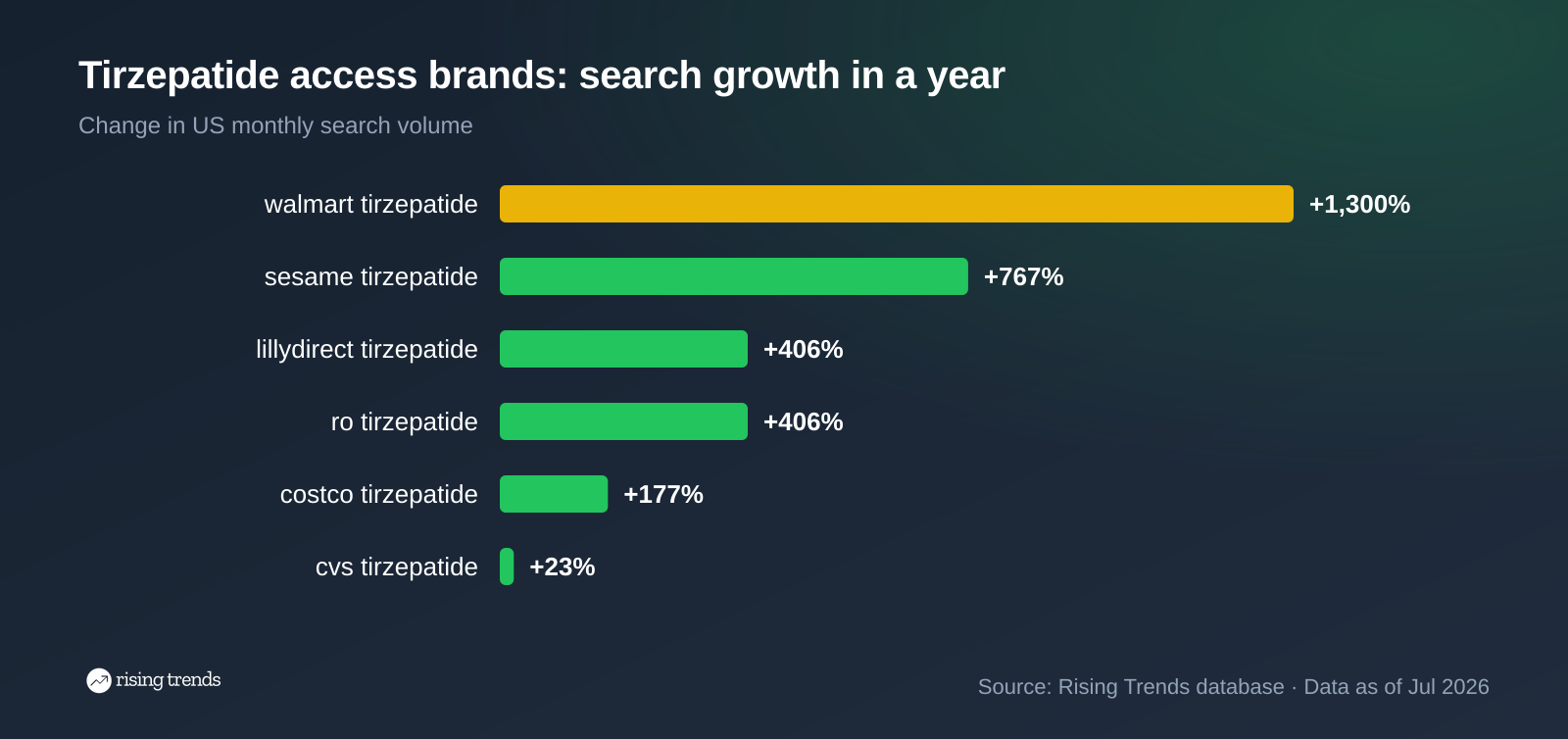
Embody is not on that chart on purpose. Its year-over-year figure is calculated against a zero base, so the percentage is meaningless and would flatten everything else. The useful comparison is the volume chart above: 9,900 against 8,100 and 8,100, with the whole family adding up to 27,400 monthly searches as of July 2026.
What the growth chart does show is where the category is heading. Walmart is up 1,300% and Costco up 177%, which is retail pharmacy absorbing GLP-1 demand. LillyDirect is up 406%, which is the manufacturer cutting out the middle. Both of those are the approved-drug route getting cheaper and easier. Embody is competing on the other axis entirely: a compounded product, no insurance, a Shopify-style checkout, and a price on the landing page that undercuts everything branded.
The company it most resembles is not really Ro. It is whatever brand OpenLoop is powering next. OpenLoop describes itself as "the white-label operating system for virtual care," with the pitch "your brand on the front, OpenLoop powering the back," and claims 400 virtual care brands and 700,000 patients a month. A new GLP-1 storefront no longer needs clinicians, a pharmacy network or a licence in 49 states. It needs a domain and a media budget.
Brand is now the cheapest part of the stack. The reason "embody tirzepatide" can outrank LillyDirect in five months is that everything expensive about running a telehealth company has been turned into a service someone else provides. That collapses the cost of entry and it collapses the moat. It also means a search spike tells you very little about the size of a business, which is exactly why the curve is worth watching rather than trusting.
The compounded market has an oversight problem, not a demand problem. As of May 31, 2026, the FDA had logged 990 adverse event reports tied to compounded semaglutide and more than 730 tied to compounded tirzepatide, and says both are probably undercounted because state-licensed pharmacies are not required to report. Set that next to Yale's 45 out of 49 and the picture is a category where getting the drug is easy and the safety rails are inconsistent. We saw the same pattern from a different angle when we looked at the parallel injection economy behind the peptide boom.
Regulators are now policing the storefront, not just the pharmacy. The FDA's standing guidance for telehealth firms, updated June 15, 2026, lists five things these companies must not do, and the first is branding that implies the telehealth company is the compounder. Embody discloses that it is not, which is the right side of that line. Not every brand in this category does.
Watch whether the curve holds without the promo. A term that goes 170, 480, 880, 1,900, 9,900 is either a business or a media buy. The tell is what happens when the discount cycle ends. The live embody tirzepatide trend page will show a plateau or a give-back before any press release does.
Watch the "is it legit" queries. Google is already surfacing them next to the brand. In this category those searches are the churn signal: they track people who have paid and are looking for reassurance. If they climb faster than the brand term, the reviews are winning.
Watch the approved-drug price. The single biggest threat to a compounded storefront is not enforcement, it is Eli Lilly making the real thing affordable enough that the discount stops being worth the trade. LillyDirect growing 406% in a year is that pressure showing up in the search data, and it is the same squeeze we described when we wrote about the drug nobody can legally buy yet, where the FDA has already ruled that retatrutide cannot lawfully be used in compounding at all.
The wider read is simple. A year ago, a GLP-1 brand needed a clinic, a supply chain and a reason to exist. Embody shows that in 2026 it needs a checkout page and five months. Whether that is a company or a campaign is a question the search curve will answer before anyone else does.
This article is about search demand and public company disclosures, not medical advice. Compounded tirzepatide is not FDA approved, and any decision about GLP-1 medication belongs with a licensed clinician who knows your history. Want to spot the next breakout brand before the affiliate reviews arrive? Read our guide on how to identify market trends, follow the live embody tirzepatide dashboard, or browse what is breaking out right now on the Rising Trends dashboard.
Thousands of Emerging Trends
Thousands of Breakout Apps
Mega Trends
Trend Analysis Tool