Trends


Two years ago, 140 people a month searched for "chatgpt ads". By August 2026 it was 22,200, a 158x jump, and "chatgpt ads manager" went from zero to 2,900 searches in eight months (Rising Trends data as of Aug 2026). Those searchers are marketers, and a growing share of them sell hotel rooms. Hotel advertising used to mean three things: Google search ads, metasearch and Meta. In 2026 it also means ads inside ChatGPT and inside Google's AI Mode, where a traveler can now book a hotel without ever reaching the hotel's website.
Most articles about AI in the hotel industry are lists of chatbots and pricing tools. This one looks at the money side: where the AI search demand is going, which ad products appeared to catch it, what the travel giants say about it in their own filings, and what an independent hotel should actually change. We pulled the curves from our database and checked every launch against the company's own announcement.
Key takeaways:
Let's get into it.
Here is the monthly US search volume for "chatgpt ads" over the last two years, straight from our database. It is the clearest single signal that the ad industry has found a new place to spend.
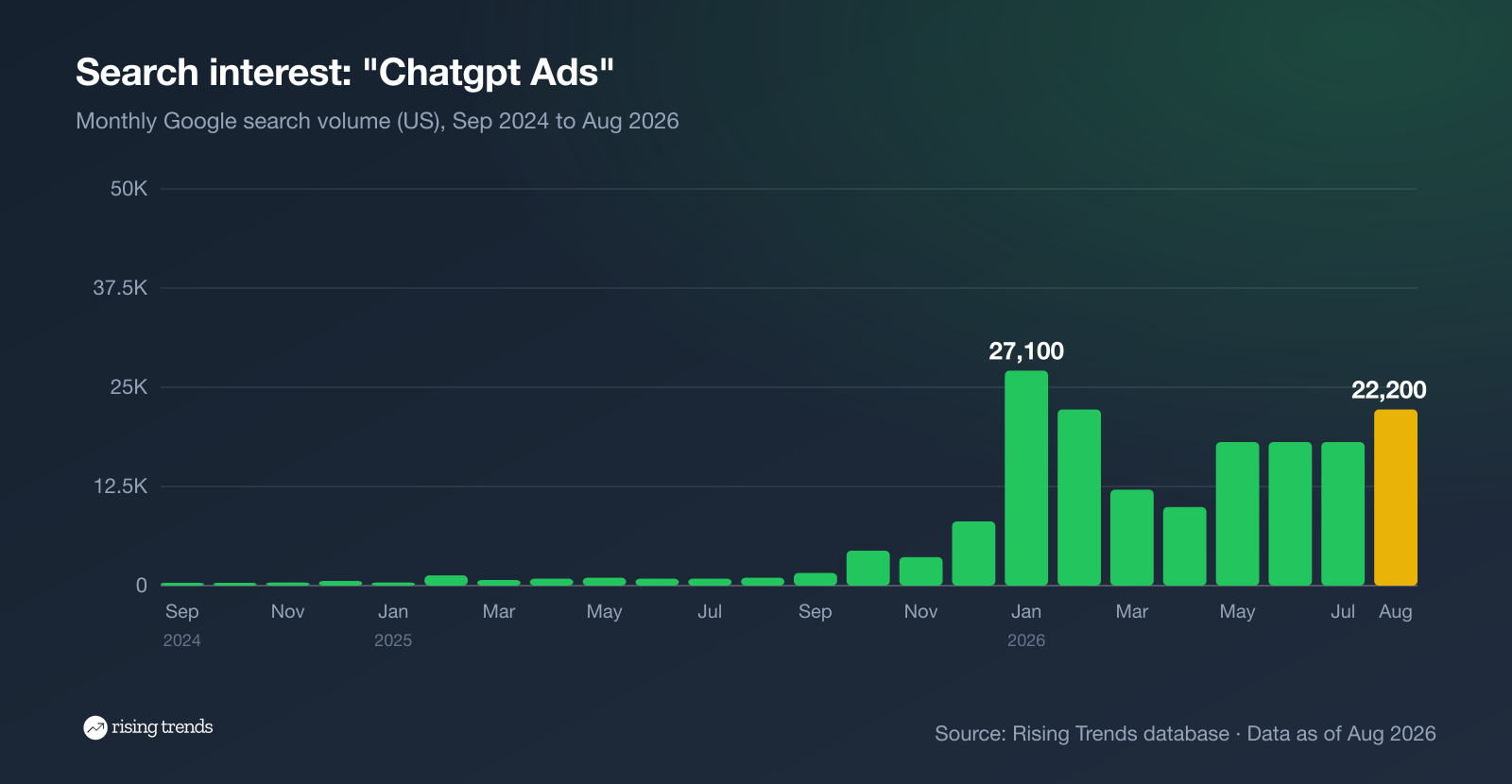
The curve has two steps. The first came in January 2026, when the term hit 27,100 searches as news of ads in ChatGPT broke. The second is the spring climb back to 22,200, which lines up with OpenAI opening self-serve buying in May. That second step matters more. A news spike is curiosity. A rebuilt plateau is people logging in to spend money. The sister term "openai ads" tells the same story: up 3,015% in a year to 8,100 searches.
Now look at the traveler side. We pulled the AI search and AI travel terms from our database and ranked them by one-year growth.
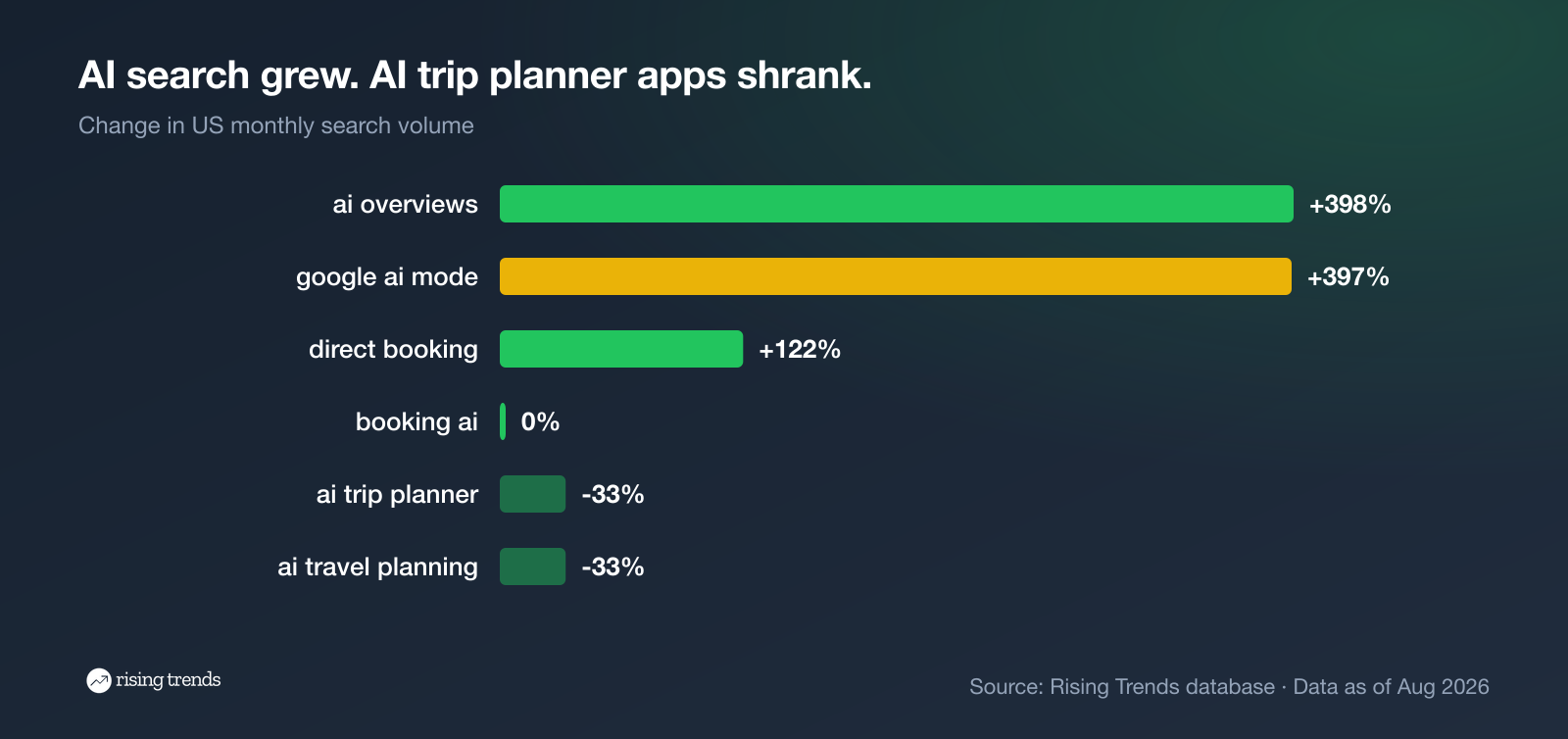
The chart splits in two. "google ai mode" is at 450,000 monthly searches, up 397%, after peaking at a million in June 2026. "ai overviews" is up 398% to 165,000. At the bottom, the dedicated travel tools are shrinking. "ai trip planner" fell from 3,600 searches in mid-2024 to 1,600, and "ai travel planning" is down 33% in a year. "booking ai" sits flat at 8,100.
That is the finding. Travelers did not adopt a new travel app. They started planning trips inside the general assistant they already use for everything else. So the ad money is following them there, not into the trip-planner startups.
The odd one out is "direct booking". It sat between 590 and 880 searches a month for two years, then jumped to 1,300 in July and 1,600 in August 2026. Those are mostly hoteliers, and they are asking the obvious question: if the assistant books the room, whose booking is it?
Three launches in 2026 turned AI assistants from a place travelers ask questions into a place advertisers can buy and hotels can be booked.
ChatGPT became an ad channel. OpenAI began testing ads in ChatGPT on 9 February 2026 for logged-in adults in the US on the Free and Go plans. Paid plans stay ad-free. The rules are stricter than search: ads are labeled and kept apart from the answer, they never appear near health, mental health or politics, and advertisers only see aggregate results, never the chat. On 5 May OpenAI opened a self-serve Ads Manager in beta and added cost-per-click bidding. On 31 August it said ChatGPT Ads had reached a $1 billion annualized run rate in under 200 days, across tens of thousands of advertisers in more than 40 countries.
Google moved travel ads into its AI campaigns. On 30 April 2026 Google launched Search campaigns for travel, which bring travel feeds and formats into standard Search campaigns with AI Max switched on. Google's own pitch for AI Max, from its May 2025 launch, is that advertisers typically see 14% more conversions at a similar cost. Then a second change hit the people running hotel ads. Google's help center says the rates it used to source for hotels from third parties are unavailable after 30 September 2026. A hotel ad without its own price feed now loses the Hotel Ads slot.
AI Mode started taking bookings. On 27 August 2026 Google announced that hotel booking in AI Mode had started rolling out in the US. A traveler describes the trip, compares rooms in the answer and pays with Google Pay, while the hotel or booking site stays the merchant of record.
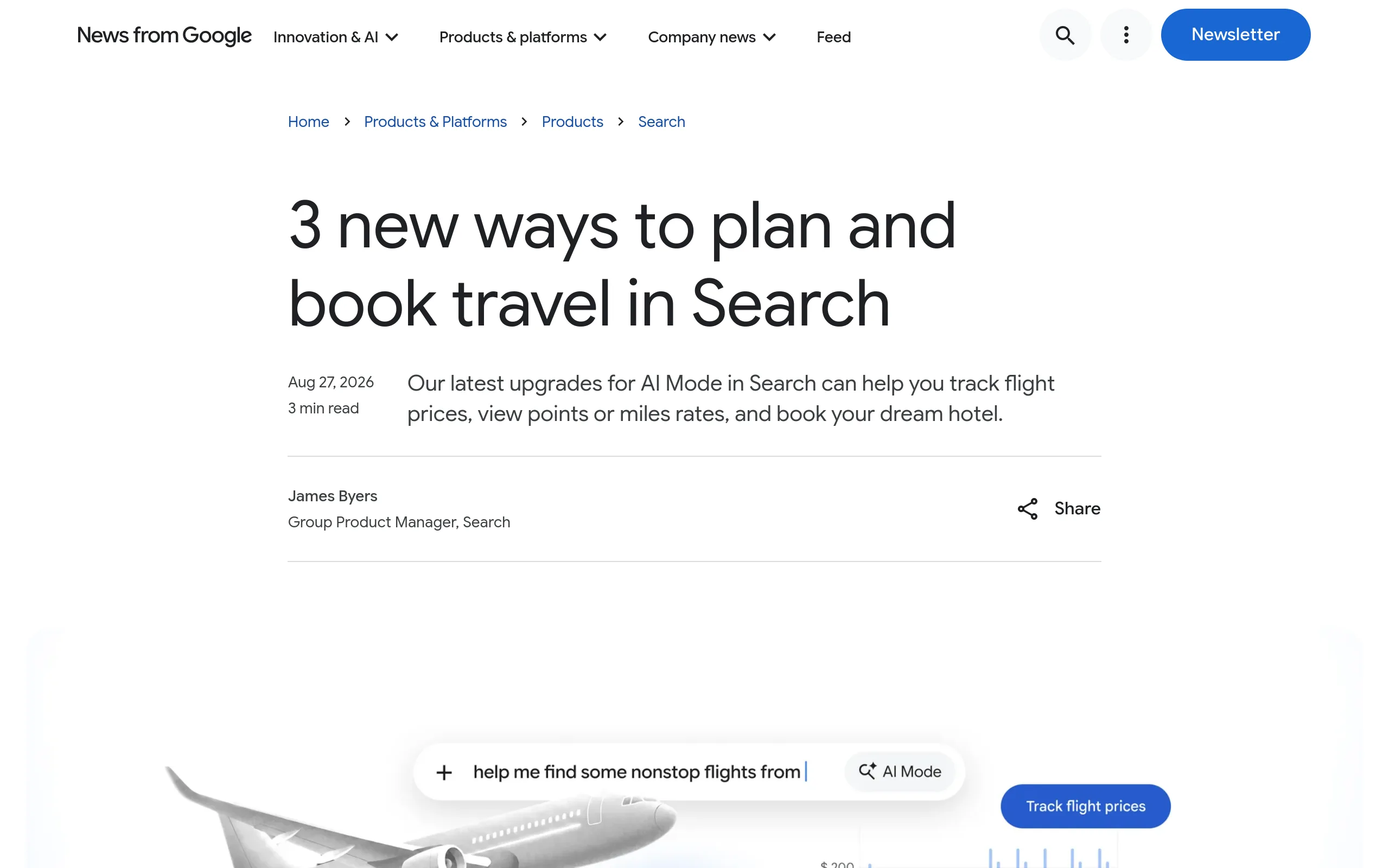
Read the partner list on that page carefully. It names Booking.com, Choice, Expedia, Hilton, Hotels.com, IHG, Marriott, Priceline, Trip.com and Wyndham. Every one of them is a chain or an online travel agency. This short walk-through, published 21 August by Victoria Ludemann, shows what the flow looks like from the traveler's side.
The clip makes the point better than any diagram. Search, comparison and checkout all happen in one answer. The hotel's website, its photos and its booking engine never load.
The surveys disagree on how many people use AI to plan trips, and the gap tells you something.
Put together, the pattern is clear. People use AI to research and shortlist. Far fewer let it close the deal yet. A UK study of 41 travel websites published by ABTA found language models sent just 0.37% of their traffic in early 2026. The influence is large and the clicks are small, which is exactly the situation where advertising inside the answer becomes valuable.
What travelers ask for is changing too. These are the hotel types moving fastest in our database.
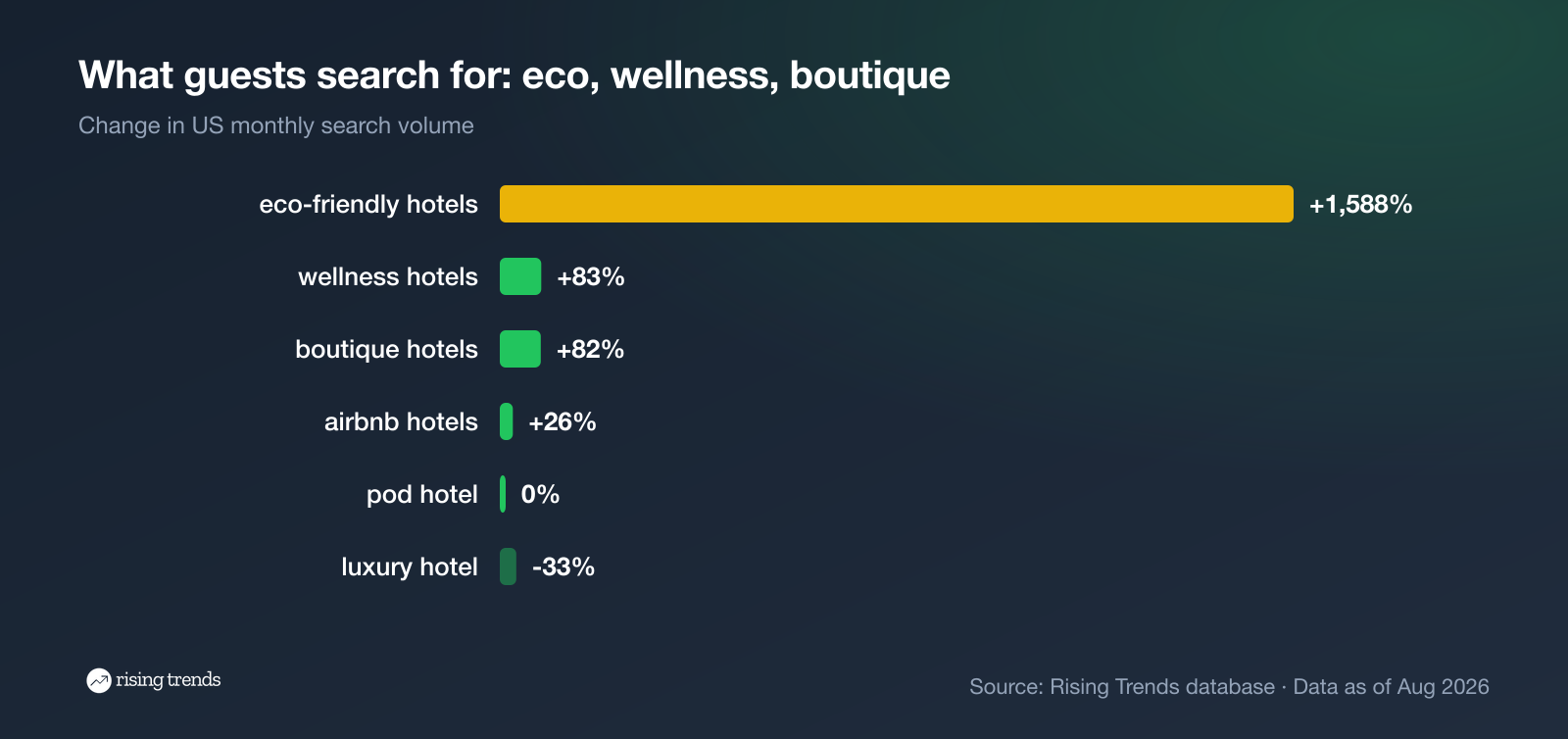
Eco-friendly hotels went from 480 to 8,100 monthly searches in a year, a 17x jump, peaking at 12,100 in July 2026. Wellness hotels are up 83% and boutique hotels are up 82% to 110,000. Plain "luxury hotel" is down 33%. These are the words travelers type into an assistant: "a quiet eco hotel near Lisbon with a spa". The AI matches ads to the meaning of the conversation, not just a keyword. A hotel whose ads and landing pages say clearly what kind of stay it offers gives the system something to match. A hotel that only says "luxury" gets lost. The same shift shows up across the travel trends we track for 2026, where wellness and nature escapes are among the strongest movements.
OpenAI is moving fastest. Beyond the Ads Manager, it began testing Sponsored Agents with select US advertisers on 16 September: click an ad and you chat with the business's own agent. Travel brands are already inside ChatGPT through apps. The Expedia app in ChatGPT launched in October 2025 with live hotel prices and maps, and Booking.com was one of the first apps too.
Google owns both ends. It sells the ads through AI Max and the newer travel campaigns, and it now runs the booking flow too. Its older AI campaign type for hotels, Performance Max for travel goals, came with first-party case studies: Minor Hotels reported 51% lower cost per acquisition and 86% more bookings. At Google Marketing Live in May 2026, Google said Direct Offers would let travel partners like Booking and Expedia show special offers inside AI answers.
Meta is automating the whole ad. Mark Zuckerberg described the goal on the Q1 2025 earnings call: the advertiser sets the objective and budget, and Meta does the rest. By July 2026 its Advantage+ automated campaigns had passed a $75 billion annual revenue run rate, and 9 million small businesses were using at least one of its AI creative tools.
The OTAs are the biggest buyers, and they are nervous. Booking Holdings spent $8.19 billion on marketing in 2025, mostly on search engines, and lists AI agents as a risk because they "may further evolve into full-service booking platforms". Expedia Group's 2025 annual report puts its advertising expense at $3.9 billion and warns of higher marketing costs as it competes for visibility in AI platforms.
The chains are using AI to win back direct bookings. IHG's half-year report from 11 August 2026 says it is in Google's agentic booking pilot, and that bookings made inside AI Mode are still processed as direct bookings for IHG. It also runs a ChatGPT plug-in that sends guests to its own booking channels.
The independent hotel starts from behind. The HOTREC European Hotel Distribution Study 2026, which surveyed 2,713 hotels, found that direct bookings fell to 51.3% while OTAs rose to 29.9%. Booking Holdings and Expedia together control 85.4% of OTA bookings. Only 26% of the hotels use AI at all. The chains negotiated their way into AI Mode. A 40-room hotel did not.
Your price feed is now your entry ticket. With Google's third-party rates gone, a hotel needs its own rate feed, through its booking engine or channel manager, to appear in Hotel Ads and in the travel formats inside Search campaigns. HOTREC found that 83% of hotels connected to metasearch use Google Hotel Ads. If your rates are not in the feed, the AI cannot show them, and the OTA's rates fill the gap.
Bid on what a booking is worth. AI bidding optimizes toward whatever you tell it is valuable. Tell it a room night, with real revenue and ideally net of cancellations, not a click or a newsletter sign-up. Keep brand search in its own campaign and budget, or the AI will happily spend prospecting money on people who were already typing your name.
Someone still has to run the machine. AI Max, Advantage+ and ChatGPT's Ads Manager all generate copy, pick audiences and move budget on their own. That saves hours. It also means a wrong rate, a closed wing or a holiday weekend can burn a month's budget before anyone notices. Hotels without an in-house performance team usually hand this to an advertising agency for hotels that runs paid search, metasearch, paid social and the new AI formats against direct-revenue targets. Whoever runs it, the checklist is the same.
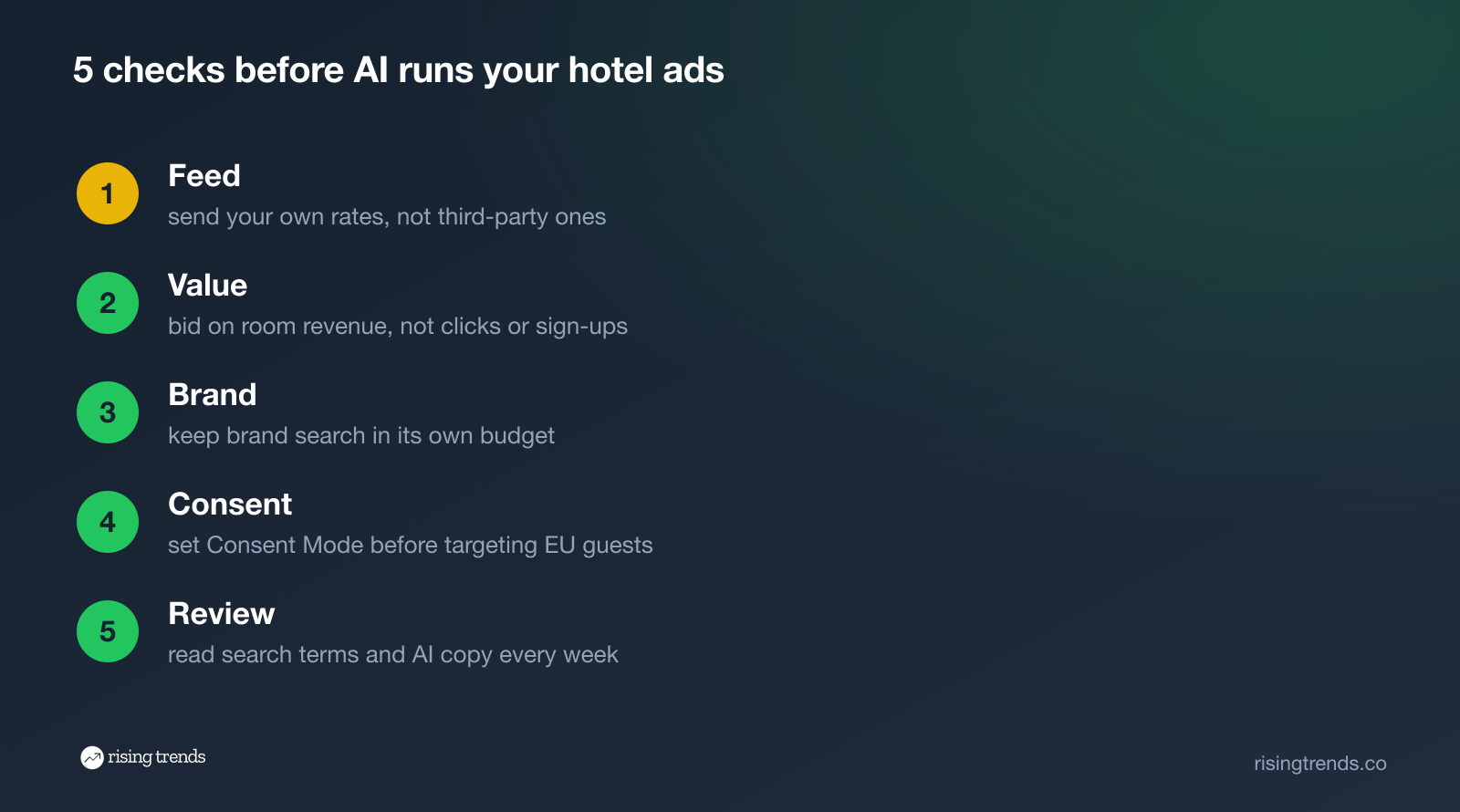
The fourth check matters for anyone selling rooms to Europeans. Google's EU rules require consent before personalizing ads for users in the EEA, the UK and Switzerland, and in Consent Mode both ad_user_data and ad_personalization have to be granted. Third-party cookies are not the problem many expected: Google confirmed in April 2025 that Chrome is keeping them. Consent is the real constraint, and AI targeting does not get around it.
The search box is splitting in two. Marketers have noticed. In our data, "ai search agency" is up 700% in a year and "ai seo agencies" up 392%. For a broader view of how this is reshaping the whole industry, see our digital marketing trends for 2026 and the wider advertising trends for 2026, which cover AI Overviews and automated campaigns across every category.
ChatGPT becomes a line item in hotel budgets. A $1 billion run rate in under 200 days means the inventory exists and the tools now work for small advertisers. Watch "chatgpt ads manager": it went from 10 searches in December 2025 to 2,900 in August 2026. When it plateaus, the early-mover window for cheap clicks has closed.
Booking moves into the answer, and "direct" gets redefined. IHG already counts AI Mode bookings as direct. Expect independent hotels to reach AI Mode the same way they reach Google Hotel Ads today: through their booking engine or channel manager, and only if their feed is clean. Watch "direct booking": it more than doubled this summer, and if it keeps climbing, hoteliers are still looking for an answer.
Creative shifts from keywords to stay types. Assistants match ads to the meaning of a conversation, so the hotels that say clearly what kind of stay they sell will match more often. The phrases rising fastest in our data are eco-friendly, wellness and boutique. Watch "eco-friendly hotels" and "wellness hotels" as the signals for which stay types to put in ad copy next season. The same pattern runs through the AI agent trends we track, where the assistant increasingly takes the action, not just answers.
AI now sets bids, writes ad variations, picks audiences and moves budget between campaigns in Google Ads (AI Max, Performance Max), Meta (Advantage+) and ChatGPT's Ads Manager. Hotels supply the goal, the budget, the rate feed and the creative. The system does the targeting.
Yes. ChatGPT ads have been self-serve in beta since May 2026, with cost-per-click bidding. They show to logged-in adults on the Free and Go plans in the US and a growing list of countries. They are labeled as sponsored and kept separate from the answer.
Yes, in the US, in English, since late August 2026. The launch partners are large chains and OTAs. The hotel or booking site stays the merchant of record and handles customer service.
No. It replaces manual bidding and copy variations. It does not know that a wing is closed, that a rate is wrong or that a festival weekend sold out. Hotels that get results pair automation with a weekly human review.
The short version is in the data. Travelers moved their planning into general AI assistants, and the ad platforms followed within months. The hotels that come out ahead in 2026 will not be the ones with the most AI tools. They will be the ones whose rates, offers and stay types are clear enough for a machine to show to the right traveler, with a person checking the bill.
Want to catch shifts like this while they are still at 140 searches a month? Read our guide on how to identify market trends, browse the AI trends we track for 2026, or see what is breaking out right now in trending topics.
Join 5,000+ founders · Free