Trends


Let's cut through the email marketing noise.
Every year the same recycled takes flood your feed: "personalize your subject lines," "segment your list," "optimize for mobile." You already know that. What you need is the real picture — what's actually moving the needle in 2026, backed by hard numbers from the organizations that track this space for a living.
So here's what I did: pulled primary research from Litmus's State of Email 2025, Salesforce's 10th State of Marketing Report, HubSpot's 2026 State of Marketing Report, Omnisend's 2025 Ecommerce Marketing Report, Beehiiv's State of Newsletters 2026, Validity's 2025 Email Deliverability Benchmark, and the DMA's Email Benchmarking Report 2025. Every stat in this article traces back to one of those sources.
Top email marketing trends going into 2026:
Let's get into it.
Here's the stat that reframes everything else in this list: according to Litmus's State of Email 2025 — based on nearly 500 marketing professionals — 70% of marketers predict up to half of their email operations will be AI-driven by 2026, and a further 18% expect AI to handle 50–75% of their email tasks. Generative AI usage for email image creation jumped 340% year-over-year.
And the production speed data tells the story of what's already happening: only 6% of teams now need more than two weeks to produce a single email, down from 62% just two years prior.
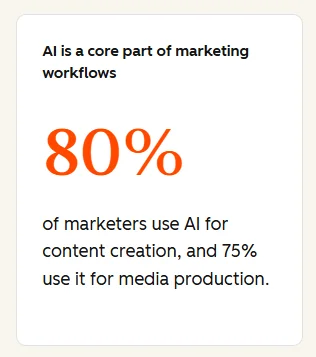
The enterprise-level shift is documented in Salesforce's 10th State of Marketing Report, which surveyed thousands of marketers worldwide: 76% of marketers now use at least one form of AI, but only 13% currently deploy agentic AI — which makes it the single highest-upside adoption gap in marketing right now. Of those already using or planning to use agents, 82% expect major or moderate improvements in ROI.
The performance data backs that up: high performers using AI agents reclaimed 8 hours per week and recorded a 20% average bump in ROI compared to non-agent programs.
What separates 2026 from prior AI hype cycles is the scope of what agents now handle autonomously. It's no longer AI suggesting a subject line. It's AI agents managing entire campaign cycles: audience segmentation, copy generation, A/B variant creation, send-time optimization, live performance monitoring, and iteration — without a human making individual decisions in the loop.
Klaviyo launched its AI Email Agent enabling merchants to describe a campaign goal in plain language and have the agent generate segmentation logic, copy, send-time optimization, and A/B variants autonomously — with DTC brands running full programs without a dedicated email operator.
HubSpot released Breeze AI — its autonomous marketing agent suite that creates, schedules, and optimizes email sequences based on CRM behavior signals without manual workflow configuration. HubSpot holds approximately 38% of global marketing automation market share, making Breeze the most widely distributed AI email agent in the industry.
Salesforce deployed Agentforce for Marketing, enabling enterprise teams to set campaign objectives and have the agent manage the full execution loop — segment selection, send, performance monitoring, and follow-up sequence triggering — with the 20% ROI uplift documented in their own benchmark data.
The email marketer's role is being restructured. Execution — writing, segmenting, scheduling, testing — is increasingly absorbed by AI agents. What remains: strategy, brand judgment, audience insight, and the creative briefs that direct the agents.
HubSpot's 2026 State of Marketing report found 47.38% of marketers now cite leveraging automation as a top-two priority — second only to AI-powered personalization. The brands that build AI agent competency now will be compounding that advantage while competitors are still debating whether to start.
This one still surprises people. You've invested years perfecting polished HTML templates. Now the data says a clean, unformatted text email is outperforming them. Here's the evidence.
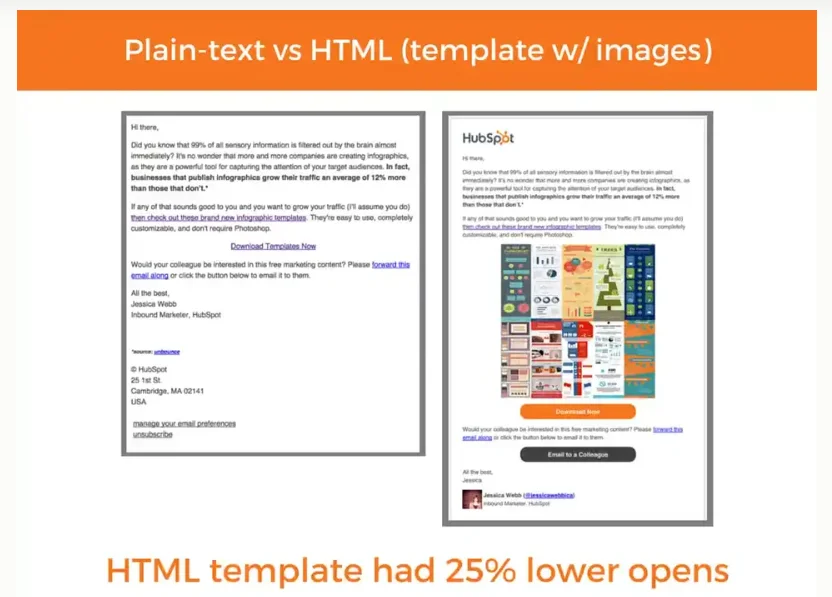
HubSpot analyzed over half a billion marketing emails and found a direct inverse correlation between HTML complexity and email performance. HTML templates decreased open rates by 25%. Additional HTML elements reduced open rates by 23%. GIFs cut open rates by 37%.
On clicks: the plain-text version of an email got 42% more clicks than its GIF equivalent, and 51% more clicks than the full HTML template version — because the lower open rate and lower CTR of HTML emails compound against each other.
The deliverability dimension reinforces the performance story. Gmail's machine-learning spam filters are increasingly sophisticated at detecting "broadcast" email patterns — complex HTML, multiple tracked links, image-heavy layouts — and routing them away from the Primary inbox. A clean plain-text message pattern-matches to genuine human correspondence.
The DMA's Email Benchmarking Report 2025 — analyzing 400+ billion emails across seven major ESPs — noted that Gmail and Yahoo's 2024 authentication enforcement requirements drove measurable deliverability gains for senders who aligned their sending practices with what inbox providers reward. Plain text is part of that alignment. The report also found, for the first time in six years, all four key email metrics trending upward simultaneously — delivery rate, open rate, click rate, and click-to-open rate — a signal that the industry's quality-over-volume shift is working.
Basecamp has long documented its plain-text-first email philosophy, with co-founder Jason Fried demonstrating that subscriber communications look like emails from a real person — no logo header, no branded footer, no button-heavy template. Their service, HEY, was built on the philosophy of prioritizing the recipient's control and reducing "broadcast" noise. Basecamp's engagement metrics consistently outperform industry averages.
Kit (formerly ConvertKit) built its entire platform around the plain-text philosophy, positioning "email that looks like it came from a human" as its core product differentiator — a positioning that resonates precisely because the performance data backs it up.
Substack made plain text the default and only format and built a platform now generating ~$450 million in annualized gross writer revenue on that constraint. The format's simplicity is a feature, not a limitation.
Plain text won't replace designed email for product showcases, e-commerce promotions, or visual brand campaigns — but it's the dominant format for relationship-building email: founder updates, newsletter content, nurture sequences, and re-engagement. The smartest programs in 2026 are running both deliberately: HTML for transactional and visual sends, plain text for everything that's supposed to feel like a conversation.
Open rate had a good run. It's over — and the sooner you stop optimizing for it, the better your program will perform.
Litmus data from December 2025 shows Apple Mail now accounts for 60.6% of all tracked email opens. Apple's Mail Privacy Protection pre-fetches email content — including tracking pixels — regardless of whether the subscriber actually opens the email. The practical consequence: a newsletter sitting at a historically reliable 28% open rate can suddenly show 55% overnight, not because more people are reading it, but because Apple's privacy proxy is firing the pixel.
Yet despite this well-documented distortion, 15% of email marketers still cite open rate as their primary success metric — optimizing for a number that includes a significant share of phantom opens.
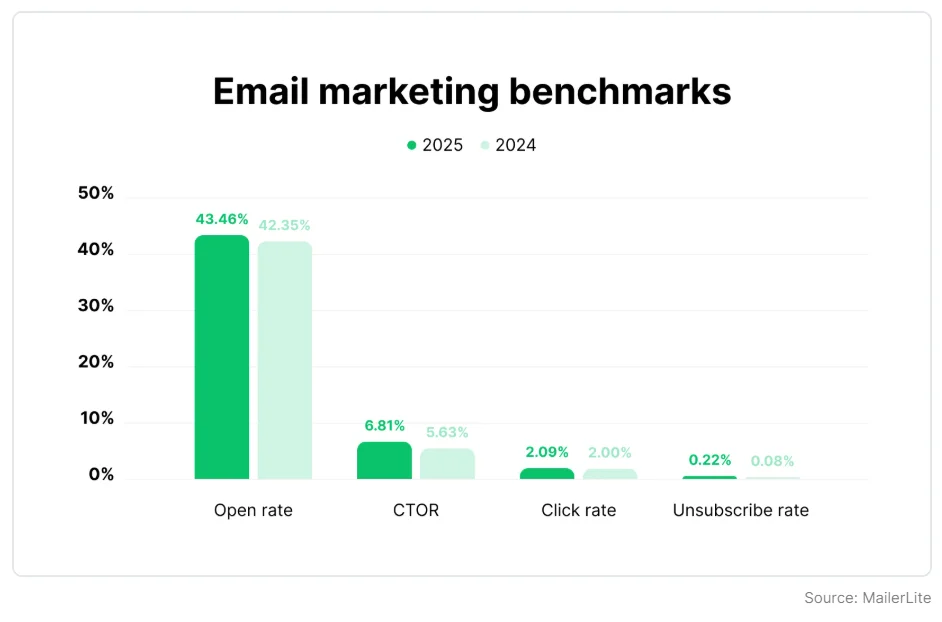
The metrics replacing open rate are more meaningful because they can't be faked by privacy proxies. MailerLite's 2025 Benchmarking Report documented the industry's shift: click-to-open rate (CTOR) rose to 6.81% in 2025, up from 5.63% in 2024 — a 21% year-over-year increase representing genuine human engagement.
Omnisend's 2025 Ecommerce data shows click-to-conversion rates grew 27.6% year-over-year in 2024 and surged a further 53% in 2025 — the metric that actually connects email activity to revenue. Revenue per email sent, subscriber lifetime value, and reply rate are the metrics defining high-performance programs in 2026.
Klaviyo rebuilt its core analytics dashboard to prioritize revenue attribution over engagement metrics — explicitly moving open rate out of the headline position in response to Apple MPP, making revenue-per-send the primary performance indicator in brand reporting.
Mailchimp updated its industry benchmarking methodology to flag Apple MPP-inflated open rates, providing adjusted baselines that give marketers realistic comparisons against peers who face the same measurement distortion.
Iterable published a widely-adopted post-open-rate measurement framework that introduced "engaged subscriber rate" — the percentage of subscribers taking a trackable action (click, purchase, reply) in the past 90 days — as the new primary list health metric for enterprise programs.
Brands still optimizing for open rate in 2026 are measuring website success by page views while ignoring conversion rate. The DMA's finding that all four key metrics are trending upward simultaneously — for the first time in six years — suggests the industry is finally aligning around quality signals.
Expect every major ESP to restructure default dashboards around revenue attribution in the next 12 months. The brands that made the switch early are already operating with a fundamentally clearer picture of what email is worth to their business.
Google rolled out AI-generated email summaries in Gmail in late 2024, and by 2025 they were surfacing across mobile and desktop — displaying an AI-written abstract of your email directly in the inbox before the subscriber decides whether to open. For most marketers, this is invisible in their analytics. For subscribers, it's already changing how they consume email content.
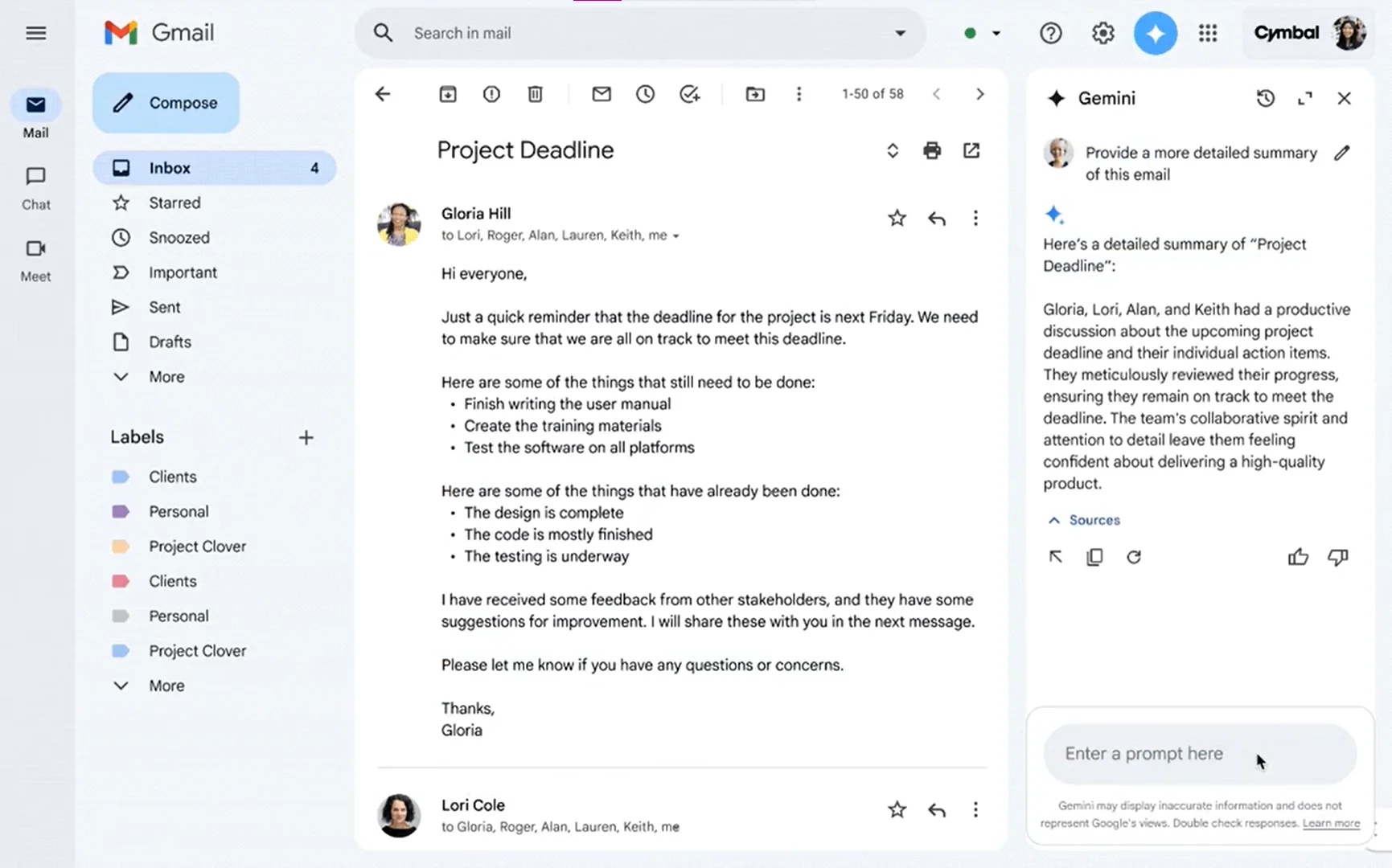
The core disruption: a compelling subject line gets your email's AI summary read, but the subscriber may never open. Your open rate records a non-open while the subscriber has already consumed your core message. Email copy built around narrative tension or a slow reveal summarizes poorly — and a poor summary kills the open before it starts.
The fix is structural. Emails with a clear, front-loaded value proposition — the main offer, insight, or CTA in the first one to two sentences — generate better summaries, which drive better opens, which drive better downstream conversion. Dense, multi-topic emails bury the most relevant content under secondary material.
In 2026, "copy optimized for AI summarization" is becoming a genuine craft distinction between average and high-performing programs.
Litmus published analysis on how Gmail's AI summaries affect inbox behavior at scale, noting that preview text and the first sentence of body copy now serve a dual function: competing for the human open decision and seeding the AI summary that appears before that decision is made. Their guidance: treat the first sentence as the AI summary candidate — write it as if it's the only thing the subscriber will read.
Klaviyo updated its email copywriting best practices in response to AI summarization, explicitly recommending that brands front-load their primary value proposition rather than relying on narrative build-ups — driven entirely by how Gmail's summary algorithm weights early content over body copy.
Beehiiv — whose 2026 State of Newsletters report covers 28 billion sent emails — noted that AI summaries represent an emerging "partial engagement" behavior where subscribers absorb newsletter content without triggering an open event, further accelerating the industry's shift from open rate to click-through and conversion as the primary performance signal for creator-led email programs.
Superhuman, Spark, and Apple Mail are all deploying AI inbox summarization in parallel with Gmail — making AI-mediated reading not a Gmail-specific edge case but the default experience for high-engagement subscribers. The audience most programs most want to reach is already reading summaries instead of full emails.
Gmail's AI summarization is the leading edge of a broader shift: email content will increasingly be filtered and prioritized by AI intermediaries before the subscriber makes an engagement decision.
What AI summaries reward and what deliverability rewards are the same thing — front-loaded, single-topic, high-clarity emails that communicate value in a summary also pattern-match most reliably to genuine human correspondence in Gmail's spam filters. Brands optimizing for AI summarization get cleaner summaries and better inbox placement as a compounding effect.
Expect "AI summary preview" testing to emerge as a standard QA step within 12–18 months — alongside subject line and mobile preview checks. The brands building this discipline now will have a structural copy advantage before it becomes table stakes.
The math finally caught up with social media dependency — and the pivot back to email-as-primary-channel is accelerating faster than most brands anticipated.
Here's the core ROI comparison, from primary research: the DMA's Email Benchmarking Report 2025 puts email marketing ROI at $38 for every $1 spent — up from $30:$1 five years ago, meaning the ROI advantage of email has grown as social media returns have declined. This is a cross-industry median: B2B email programs in professional services and SaaS consistently benchmark $40–$80 per dollar, while high-volume promotional B2C programs tend toward the lower end of the range.
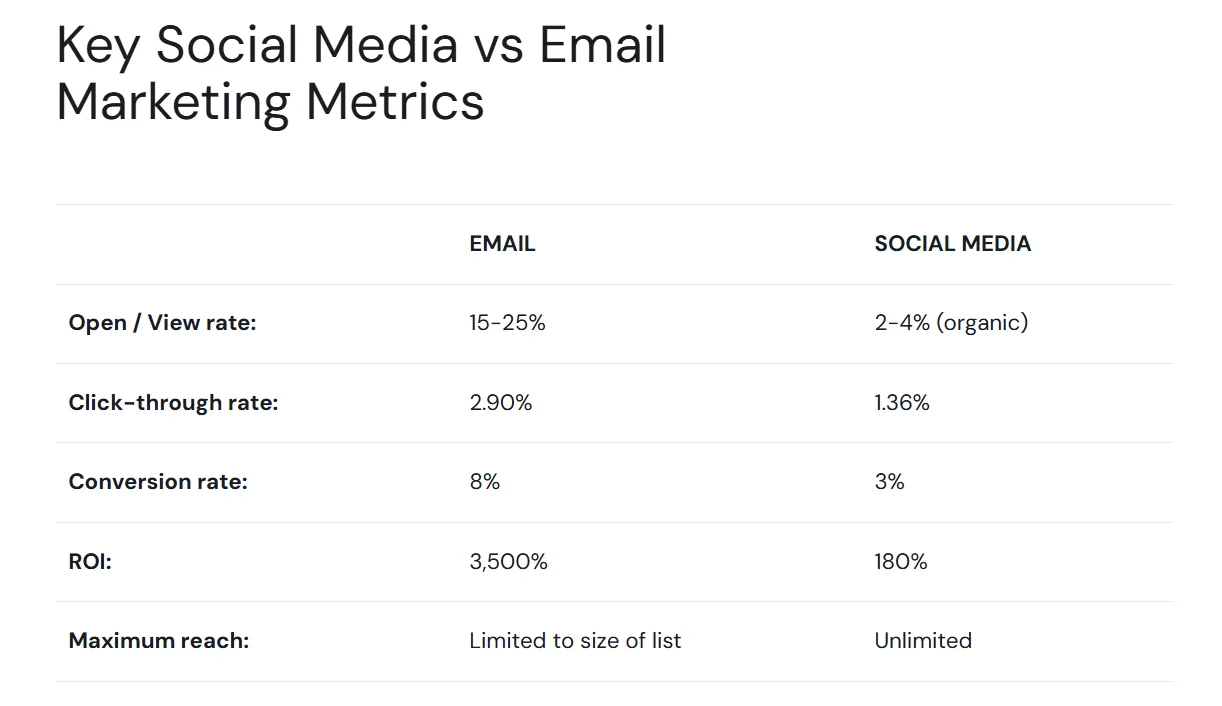
High-performing ecommerce brands on Omnisend's platform achieve $79 per $1 spent when combining email automation with SMS — a combined-channel premium so significant it warrants its own trend later in this piece. Compare that to paid social: Facebook and Instagram ads average a 2.5:1 to 3:1 return for ecommerce — roughly 12–15x less efficient than email, according to Omnisend's channel ROI comparison data. (For a complete picture of where advertising budgets are moving as social ROI declines, see our advertising trends for 2026.)
The organic reach story on social is equally damaging: platforms show content to just 2–10% of followers due to algorithmic filtering. A brand with 100,000 Instagram followers reaches 2,000–10,000 people per post — and pays for the privilege with attention and content resources. With email, you reach 100% of subscribers' inboxes every send.
Omnisend's 2025 Ecommerce study found that US ecommerce orders jumped 147% in 2025 among their merchant base — with the top performers being brands that had built robust owned-channel programs (email + SMS) as primary revenue infrastructure rather than relying on paid social.
Glossier rebuilt its marketing strategy around owned channels after experiencing the volatility of social algorithm changes — investing in email list growth through referral programs and in-person activations, and citing owned audience development as a strategic priority in its brand recovery.
Athletic Greens (AG1) runs an email-first acquisition funnel where every paid social ad and influencer partnership is optimized for email capture — not direct purchase — with the actual conversion happening via a high-value nurture sequence. Their email list is a primary business asset, not a support channel.
Beehiiv documented the migration wave explicitly in its 2026 State of Newsletters report, noting that social platform volatility is one of the primary structural drivers of newsletter growth — brands and creators moving audience-building investment from rented social platforms to owned email infrastructure.
Email list size is becoming a formal due diligence metric in startup funding and M&A processes — evaluated alongside ARR and MAUs. Investors increasingly recognize owned audience data as a durable competitive moat that can't be disrupted by platform algorithm changes.
The DMA's findings that email ROI has grown from $30:$1 to $38:$1 over five years while social returns have declined tells you which direction this gap is heading.
The most effective B2B lead generation motion of 2026 didn't emerge from a new platform. It came from combining two existing channels in a smarter sequence.
The playbook: build a LinkedIn audience through consistent thought-leadership content. Drive that audience to a high-value lead magnet in exchange for an email address. Deliver a deep, algorithm-free email nurture sequence that builds genuine relationship. Circle back to LinkedIn to reinforce the relationship there.
The data on why this works: LinkedIn generates 80% of all B2B leads from social media, with nearly 96% of B2B marketers leveraging the platform for content distribution, citing it as the most reliable social channel for high-quality lead conversion. Email then converts that attention into owned, durable relationships that no platform can suppress. The combination is measurably more powerful than either channel alone.
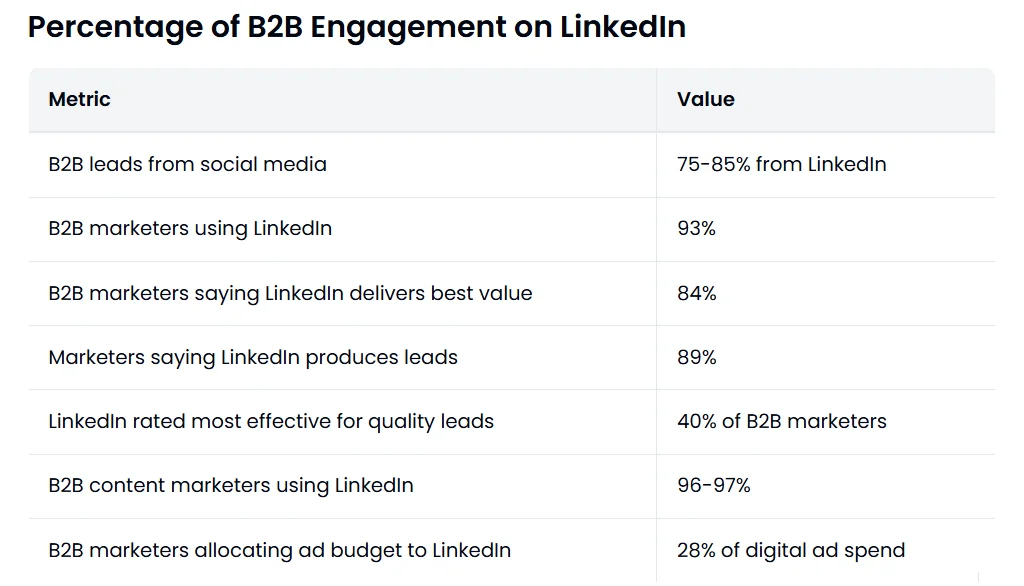
The critical number from Omnisend's research: omnichannel sequences combining email + LinkedIn + phone boost results by over 287% compared to single-channel email outreach.
The "dark social" framing captures something important — a significant portion of this engagement (DM referrals, direct email opens from word-of-mouth, article shares) goes untracked by standard attribution tools, which is exactly why it delivers such high-quality pipeline when someone converts. They've been genuinely warming to your thinking, not just clicking an ad.
Codie Sanchez built a multi-million-dollar media business using the LinkedIn-to-email flywheel — LinkedIn content builds awareness, her "Contrarian Thinking" newsletter converts attention into owned subscribers, and the email list drives course, community, and consulting revenue without a sales team or paid acquisition.
Justin Welsh publicly documented how his LinkedIn + email strategy has generated over $10 million in revenue as a solo operator — using LinkedIn for top-of-funnel awareness and email to convert that awareness into commercial relationships with no cold outreach.
Gong runs a B2B-scaled version of this playbook, with executive LinkedIn thought leadership driving traffic to gated research reports, feeding a high-value email nurture sequence that positions their platform as the natural solution to the problems the content surfaces.
Apollo.io built the LinkedIn + email convergence into its core product infrastructure, positioning multichannel sequences — LinkedIn connection request → email → LinkedIn message → phone — as the platform's primary revenue generation workflow. Apollo's own benchmark data shows the combined-channel approach delivers 3–4x higher reply rates than cold email alone, and the company's growth to $1B+ valuation reflects in part the intense market demand for tooling that orchestrates this exact motion at enterprise scale.
The LinkedIn + email combination is becoming the default go-to-market motion for B2B SaaS, consulting, and professional services companies — replacing cold outreach and paid LinkedIn Lead Gen Forms as the primary pipeline strategy.
The 287% performance uplift from coordinated omnichannel sequences is the number that's making enterprise B2B marketing teams restructure their entire outbound approach around this model. (For the broader context of how B2B buying has shifted to digital-first channels — and why the LinkedIn + email motion fits into that shift — see our B2B ecommerce trends for 2026.)
An email that lands in spam is worth exactly nothing. And the data shows roughly 1 in 6 emails sent by the average marketer is worth exactly nothing.
Validity's 2025 Email Deliverability Benchmark Report — drawn from trillions of global inbox data points — puts the global average inbox placement rate at 83.5%. By provider: Gmail dropped from 89.8% in early 2024 to 87.2% by Q4, following enforcement of new bulk-sender requirements. Microsoft/Outlook sits at just 75.6%, with spam rates exceeding 14% — the lowest placement rate of any major provider. Europe performs best regionally at 91% inbox placement; Asia Pacific the worst at 78%.
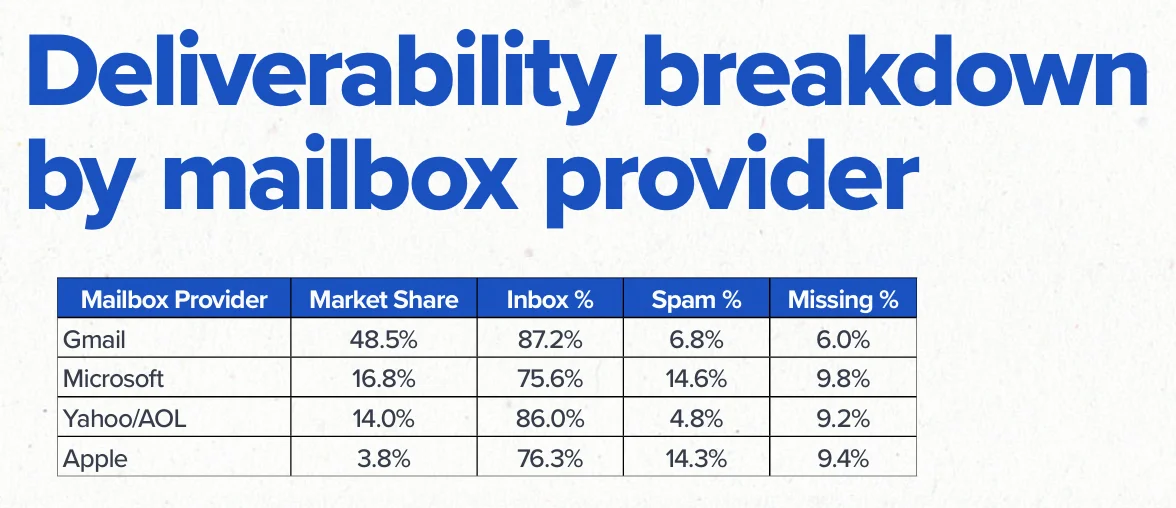
The authentication gap is stark: fully DMARC-authenticated domains are 2.7x more likely to reach the inbox versus unauthenticated domains — yet only 7.6% of domains currently enforce DMARC. That means the vast majority of email senders are leaving a 2.7x deliverability advantage on the table.
BIMI adoption is surging — up 28% year-over-year among qualifying domains — with research showing open rate increases of up to 39% for BIMI-enabled senders, because the visual brand indicator in Gmail and Apple Mail creates a trust signal that unauthenticated senders simply cannot replicate.
The DMA's 2025 Benchmarking data attributed measurable delivery improvements to Google and Yahoo's 2024 authentication enforcement — confirming that brands who meet authentication requirements gain a concrete inbox placement advantage over those who don't.
Twilio SendGrid published comprehensive deliverability engineering guidelines for high-volume senders, documenting how proactive reputation management — automated bounce processing, spam complaint monitoring, and IP warm-up protocols — consistently achieves inbox placement above 95% for senders who implement the full framework.
Valimail documented 40% growth in retail-sector BIMI implementation over 2024, with forward-thinking brands treating the visual authentication mark as a competitive inbox presence tool rather than a compliance item.
Klaviyo built Deliverability Hub directly into its platform in 2025 — giving brands real-time domain reputation scoring, engagement-based list suppression recommendations, and sender score benchmarking against industry peers, making advanced deliverability accessible without a dedicated deliverability engineer.
The gap between high-deliverability senders (95%+ inbox placement) and unmanaged senders (75–80%) is one of the most significant — and most invisible — competitive advantages in email. Microsoft/Outlook's 75.6% placement rate means brands without strong authentication and list hygiene are losing nearly 1 in 4 emails to Outlook's spam folder alone.
Two developments define 2026 deliverability. Google Postmaster Tools and Gmail's spam filtering.
Google Postmaster Tools — free domain-level reputation and spam rate data direct from Gmail — is the standard first-line monitoring tool, yet adoption remains low among mid-market senders. Any brand sending more than 5,000 emails per month to Gmail addresses and not using it is flying blind.
On the other hand, Gmail's spam filtering is now behavioral at the recipient level: AI models personalize inbox placement based on each recipient's engagement history with your domain, meaning disengaged segments can damage delivery for your most engaged subscribers. Engagement-based suppression (Trend #9) is the direct technical response.
Expect inbox placement rate to become a standard dashboard KPI alongside revenue and engagement in 2026. Authentication infrastructure and engagement-based suppression now compound as inbox AI continues raising the bar.
The batch-and-blast model isn't just underperforming in 2026 — it's being replaced by a fundamentally different revenue architecture.
Here's the headline number from Omnisend's 2025 Ecommerce Marketing Report, analyzing 27 billion emails across 150,000 brands: automated behavioral emails represent just 2% of total email send volume but generate 37% of all email-attributed revenue.
The revenue-per-send economics are dramatic: automated emails generate $2.87 per send versus $0.18 for broadcast campaigns — a 16x revenue-per-send advantage. And conversion behavior is equally different: 1 in 3 people who click an automated email make a purchase, compared to just 1 in 18 for a scheduled broadcast campaign.
The specifics from Klaviyo's Ecommerce Benchmarks add further precision: abandoned cart emails generate $7.01 revenue per recipient for stores with $100–200 average order value, and $14.14 per recipient for higher-AOV stores. The five core automated flows — welcome series, abandoned cart, browse abandonment, post-purchase follow-up, and win-back — represent 80% of potential automated revenue for most ecommerce brands.
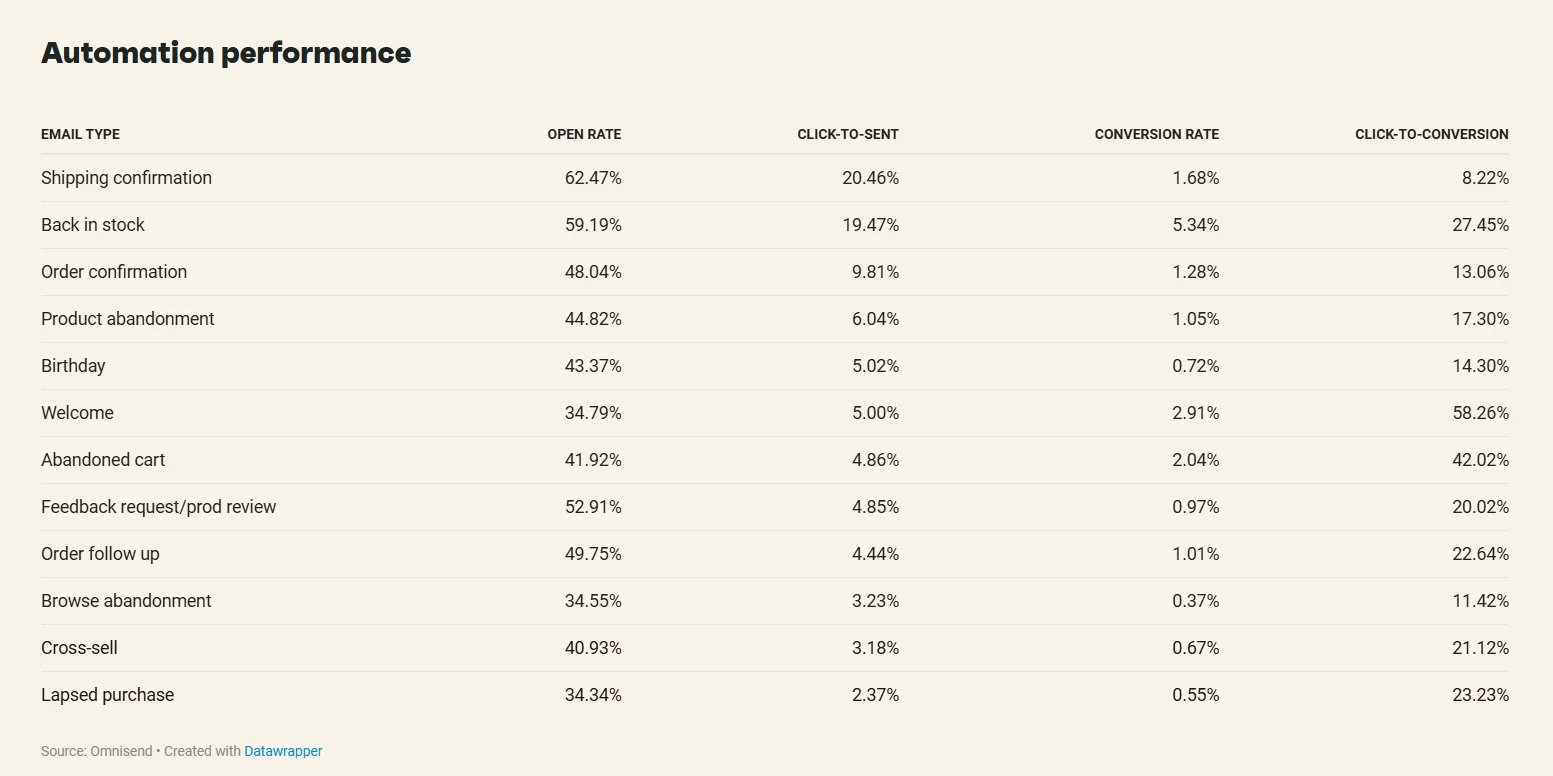
Back-in-stock emails on Omnisend's platform achieve a 59.19% open rate with a 5.34% conversion rate — among the highest-performing trigger types in the entire automated email stack. Campaigns targeted to less than 25% of a contact list outperform broad broadcasts across every metric simultaneously.
Chewy runs one of the most sophisticated behavioral trigger programs in ecommerce, including replenishment reminders based on purchase history and predicted consumption rates for pet food and medications — achieving some of the highest customer retention rates in the subscription pet supply category precisely because the triggers feel like helpful reminders, not marketing.
Duolingo uses behavioral trigger sequences throughout its email program, including streak-restoration sequences, lesson-completion nudges, and win-back campaigns that activate on specific learning behavior signals — contributing to one of the most effective email programs in consumer tech.
Warby Parker leverages purchase and browse-triggered sequences including lens prescription renewal reminders based on purchase date and industry-standard replacement windows — a predictive lifecycle trigger that activates before the customer starts looking elsewhere, not after they've already left.
The benchmark for a "complete" behavioral trigger library is moving from the current median of 5–10 flows to 50–100 flows, which is where the top 10% of programs already operate. As AI agents make it faster to build and test triggers, that median will shift significantly over the next 12–18 months.
The 16x revenue-per-send advantage of automated email versus broadcast is the clearest single number in this entire piece. Brands investing in behavioral architecture now are generating automated revenue from sequences their competitors haven't thought to build yet.
The counterintuitive finding that defines high-performance programs in 2026: deliberately sending less email to fewer subscribers produces measurably better deliverability, engagement, and revenue outcomes than maximizing send volume. Inbox algorithms are technically enforcing this now.
The data is unambiguous. The 2024 Advertising Preferences Survey by GetApp - a Gartner-owned research platform, reveals that 56% of consumers will unsubscribe if they receive more than one email per week from a brand. Furthermore, 81% of users state that 'content relevance' is the deciding factor in staying subscribed, with nearly 1 in 3 marking irrelevant emails as spam rather than simply unsubscribing.
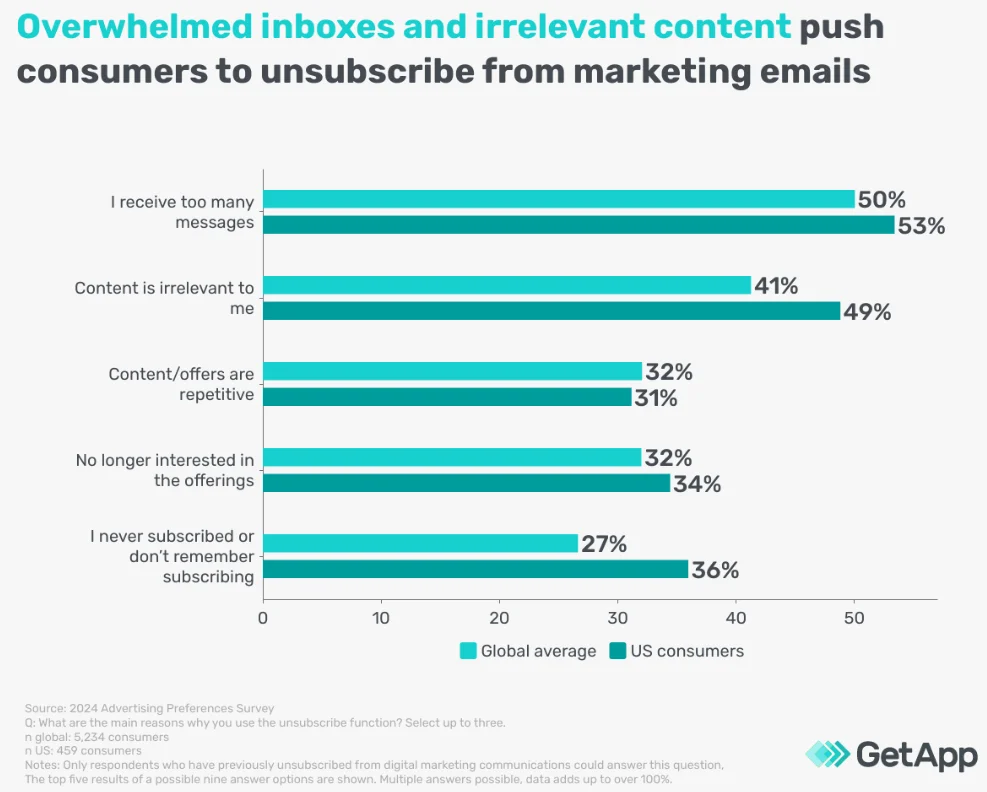
Each unsubscribe signals poor volume judgment to inbox providers; each spam complaint is a direct domain reputation hit that degrades delivery across your entire list — including engaged subscribers.
The mechanism high-performing programs deploy is engagement-based suppression: automatically suppressing subscribers who haven't clicked, purchased, or replied within 60–90 days. Klaviyo recommends this as a deliverability best practice, not optional hygiene.
The payoff: smaller engaged lists generate higher inbox placement, lower spam rates, and higher revenue-per-send simultaneously. Consumer trust research adds the revenue angle: trust influences 88% of buying decisions. Brands that feel spammy destroy purchase intent before the message is read.
Klaviyo publishes explicit engagement-based suppression guidelines recommending brands suppress contacts inactive for 90 days before large sends — with platform data showing 5–10 point inbox placement improvements within 60 days of activation.
Patagonia runs a mission-aligned email program at controlled frequency — fewer, more substantive emails rather than maximizing promotional volume. Unsubscribe rates consistently below industry average; list engagement significantly exceeds outdoor/apparel benchmarks.
Ghost built precision sending into its platform design — double opt-in flows, transparent data policies, and frictionless list management as defaults — positioning itself as the infrastructure choice for creator-led newsletters that treat subscriber trust as the business foundation.
Gmail's AI filtering now personalizes inbox placement per recipient based on engagement history with your domain — disengaged segments actively damage deliverability for your best subscribers. EU GDPR enforcement is intensifying against dark-pattern unsubscribe flows, and Gen Z subscribers have the lowest tolerance for over-sending of any cohort.
Brands that adopted engagement-based suppression in 2024–2025 are already running 8–12 points higher inbox placement than peers optimizing for volume. Precision sending is now the technically correct and commercially superior approach.
The most significant channel development in direct marketing over the past two years isn't a new platform — it's the disciplined pairing of two established ones. The email + SMS combination has moved from "nice to have" to the structural foundation of high-performing ecommerce marketing programs, and the performance delta is large enough to justify treating it as its own strategic discipline rather than a footnote in the email ROI conversation.
Omnisend's 2025 Ecommerce Marketing Report — drawing from 27 billion emails and equivalent SMS data across 150,000 brands — quantifies the advantage precisely: brands combining email and SMS automation achieve $79 per $1 spent, more than double the $38:$1 return for email alone.
The operational logic is straightforward: email handles depth and nurture (long-form content, visual product storytelling, sequential automation), while SMS handles urgency and immediacy (flash sale windows, cart expiry alerts, back-in-stock notifications that need to land within minutes). Each channel amplifies the other when sequenced correctly — they're not duplicating messages, they're handling categorically different jobs.
The specific mechanics matter. Omnisend's data shows the highest-performing sequences use SMS not to duplicate email messages but to do what email structurally cannot: a 2-hour cart expiry SMS fires when the email abandoned cart sequence is already in progress, creating a coordinated urgency moment the subscriber receives across two channels simultaneously.
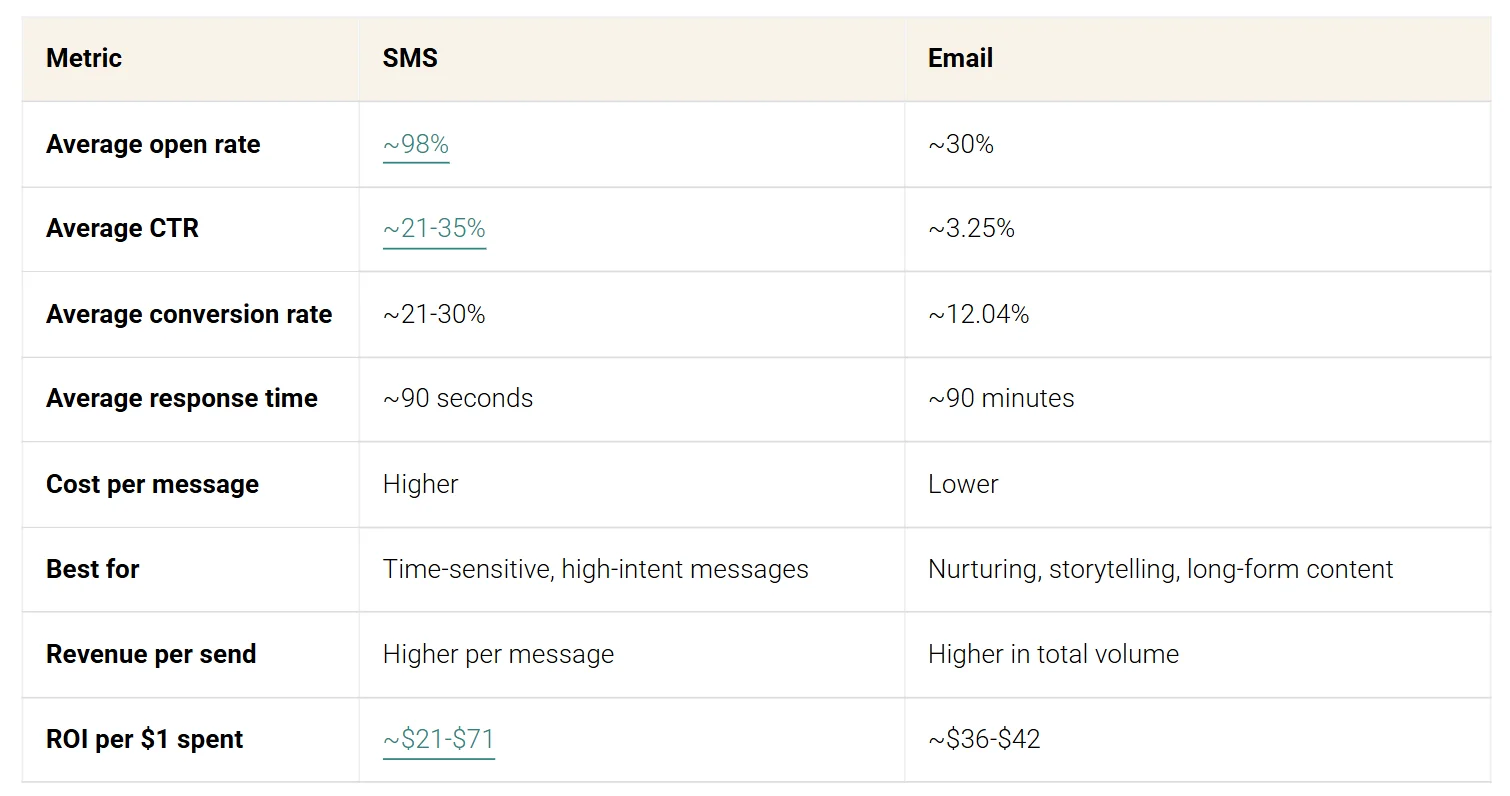
Order confirmation flows that include both email and SMS record 25% higher reorder rates than email-only equivalents. And the list-building feedback loop is real: SMS subscribers acquired via email capture flows have measurably higher engagement on both channels than SMS subscribers acquired through other acquisition methods.
Omnisend's data adds further precision on store-level performance: stores using both email and SMS automations generate 3x higher conversion rates than stores using email automation alone. The combined channel doesn't just add the SMS conversion rate to email — it creates a multiplier effect, because urgency-layer messages from SMS increase the conversion rate of the email sequences they're paired with.
Klaviyo unified email and SMS into a single flow builder in 2024, allowing brands to orchestrate cross-channel sequences from one workflow — the cart abandonment flow now triggers email at Hour 1, SMS at Hour 2, and a follow-up email at Hour 24 without leaving the platform. This integration collapsed a significant technical barrier that had kept email and SMS as separate programs at most brands, often managed by different teams on different tools.
Omnisend built its entire product thesis around the combined-channel advantage, with platform benchmarks showing stores that activate SMS alongside existing email automations see average revenue per subscriber increase within 90 days — driven primarily by the urgency layer that SMS adds to campaigns email alone struggles to make time-sensitive.
Attentive documented that brands adding SMS to existing email programs record a measurable lift in email engagement as well as SMS conversion — confirming the cross-channel amplification effect rather than channel cannibalization. The combined subscriber (opted into both) consistently shows higher LTV than subscribers on either channel alone.
The "email-only" marketing stack is becoming structurally incomplete for ecommerce in 2026. As SMS unit economics improve with bulk carrier rates and platform maturity, the $79:$1 combined ROI will become the default benchmark high-performing brands are measured against.
The operational question isn't whether to add SMS — it's how to sequence the two channels with enough precision to maximize urgency conversion without creating fatigue. Brands building combined orchestration competency now will be running optimization experiments that single-channel competitors haven't started yet.
Third-party cookies are gone. iOS privacy changes degraded behavioral tracking. Apple MPP made open-pixel data unreliable. Gmail's AI summarization lets subscribers consume your message without triggering an open.
The industry's response is a move toward zero-party data: information subscribers intentionally share, rather than information inferred from their behavior.
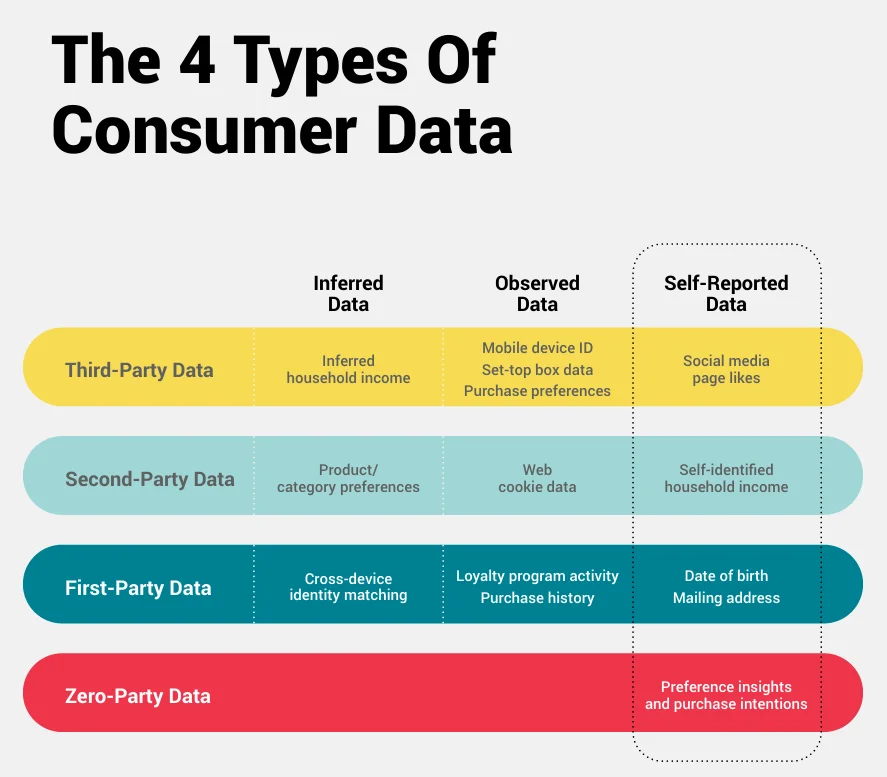
Zero-party data doesn't decay the way behavioral signals do, and it eliminates the false-positive problem of inference-based personalization. A subscriber who tells you they prefer weekly cadence and are interested in case studies gives you information click-stream data can't reliably replicate — and gives it willingly, so acting on it doesn't feel intrusive. Forrester research shows zero-party data segments generate 40–60% higher subscriber LTV than behaviorally-inferred segments.
The preference center is the operational tool that makes this scalable. Modern versions — far beyond legacy frequency selectors — capture content interests, purchase intent, and channel preferences. Klaviyo's 2025 benchmark data shows brands with active preference centers record 32% lower unsubscribe rates and 28% higher click-to-purchase rates compared to brands without them.
Klaviyo built native preference center infrastructure that integrates into welcome flows, allowing new subscribers to declare their interests before behavioral data exists — significantly lowering 30-day unsubscribe rates during the highest-risk window for new list additions.
Typeform and Jotform have seen substantial growth in preference survey use cases — brands embedding structured surveys in Day 1 welcome emails to immediately segment subscribers into content tracks and cadence tiers, converting the welcome email from a brand introduction into a data exchange.
The New York Times runs one of the most sophisticated email preference systems in media, letting subscribers choose from dozens of newsletter topics and frequency options. Subscribers who customize their preferences show substantially higher retention than those who don't — validating that the act of personalization itself increases subscriber investment in the relationship.
GDPR enforcement is making demonstrated subscriber consent — not just compliance checkboxes — the new standard. Preference centers that create genuine value exchanges are simultaneously the best compliance posture and the best revenue strategy.
Brands building zero-party data infrastructure now will compound a data advantage as inference signals continue to degrade. Expect preference center completion rate to become a standard list quality metric alongside engagement scores and domain reputation within the next 12 months.
Look across all 11 of these trends and one thesis emerges with striking clarity: the inbox is becoming a premium channel, and mediocrity is now being algorithmically punished.
Gmail dropping to 87.2% inbox placement after tightening bulk-sender requirements. Outlook at 75.6%. Open rate data distorted by Apple MPP and now further disrupted by Gmail's AI summaries. Subscribers unsubscribing in the millions from brands that over-send. AI agents capable of running campaigns that out-perform human-managed programs. Plain text beating polished HTML in a 500-million-email study. Automated emails generating 16x more revenue per send than broadcasts. Email + SMS delivering $79:$1 vs $38:$1 for email alone. Zero-party data segments generating 40–60% higher LTV than behavioral inference.
Every data point in this piece points the same direction: volume-based, undifferentiated email is becoming structurally less viable, while precision, quality, genuine value, and owned data infrastructure are being rewarded both by inbox algorithms and by subscribers themselves.
The good news is that the economics for brands who get this right have never been stronger. The DMA's 2025 Benchmark shows email ROI has grown from $30:$1 to $38:$1 over the past five years — rising as social media returns have declined. Omnisend's data across 150,000 brands shows email driving 37% of all revenue from just 2% of sends when automation is done right.
The combined email + SMS stack pushes that ROI to $79:$1 for the brands that have built both channels. And Forrester's zero-party data research shows that the brands building declared-preference infrastructure now are compounding a data advantage that behavioral tracking can no longer provide.
The question for 2026 isn't whether email marketing is worth investing in. It's whether your program is sophisticated enough to capture what the data says is available.
Want to spot emerging digital marketing trends before they hit mainstream? Check out our guide on how to identify market trends or explore what's gaining traction across industries on our trends dashboard. You might also find our deep-dives on digital marketing trends 2026 and AI agents trends 2026 useful context for where email fits in the broader marketing evolution.
Thousands of Emerging Trends
Thousands of Breakout Apps
Mega Trends
Trend Analysis Tool