Trends


In March 2026, 50 people a month searched Google for "omnivoice". In April it was 2,900. Nothing in our database for the open text-to-speech category moved like that, before or since: the term is up 3,329% in a year and 53.3x over two years, as of Aug 2026, while every other open TTS name we track is shrinking.
What they are searching for is a 0.6 billion parameter model from the Next-gen Kaldi team inside Xiaomi that clones a voice from a three second clip and speaks it back in any of 646 languages, free to download. What almost nobody searching has read is the two sentence licence note on the model card, or the thread where the lead author was asked point blank whether you can use it in a product and answered no. That gap between what the repo advertises and what the weights permit is the part of this story nothing ranking for the term will tell you.
Key takeaways:
Let's get into it.
Here is the monthly curve for "omnivoice" over the last two years, from our database. It is not a staircase like most product launches. It is a wall.
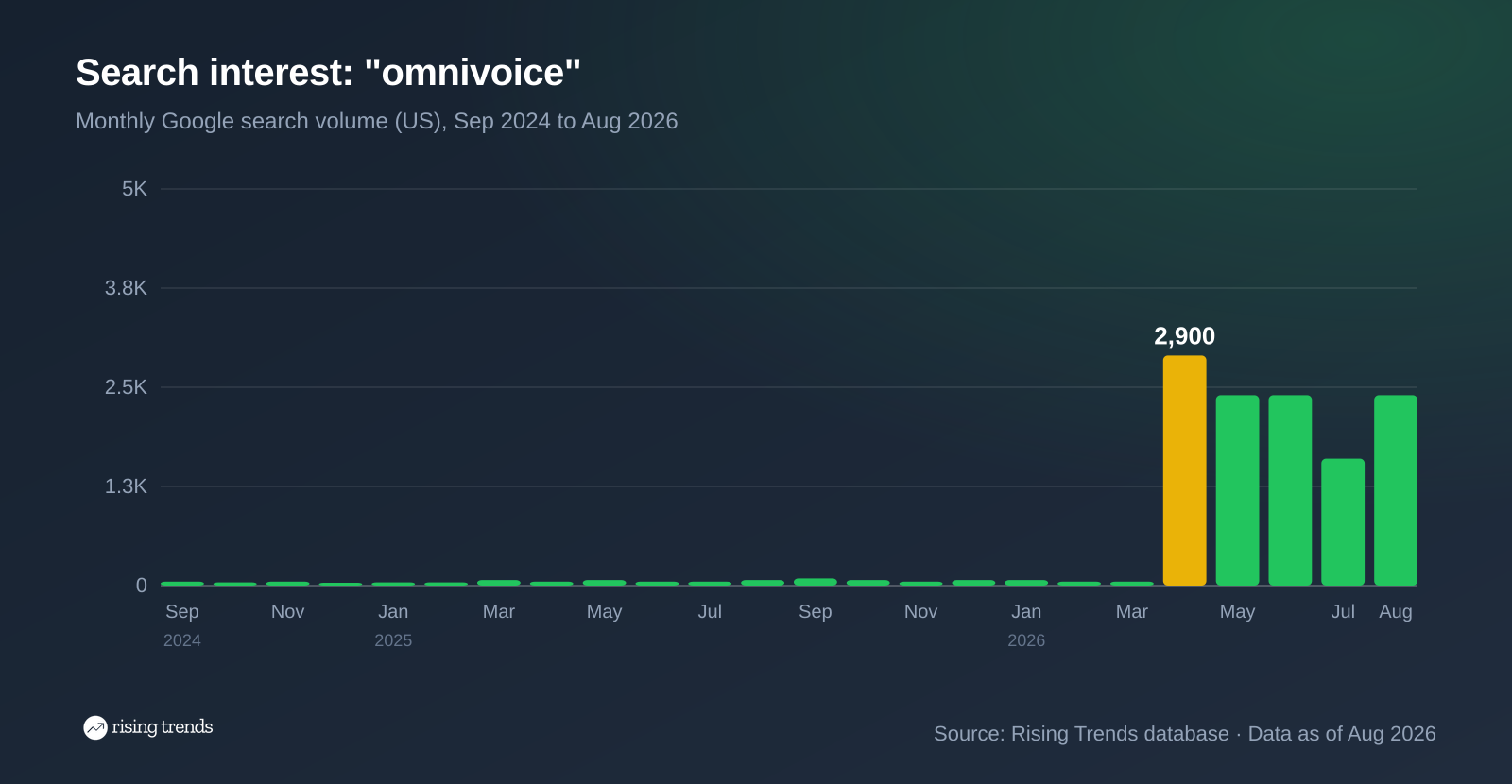
For nineteen months the term sat between 40 and 90 searches a month. Then April 2026 took it to 2,900 in a single step. Six months later it has given back almost nothing: 2,400 in May, 2,400 in June, 1,600 in July, 2,400 again in Aug 2026. A spike that holds for five months is not a news cycle. It is a tool people kept using.
The more interesting comparison is sideways. Put omnivoice next to the other open text-to-speech terms we track and it is now the largest of them.
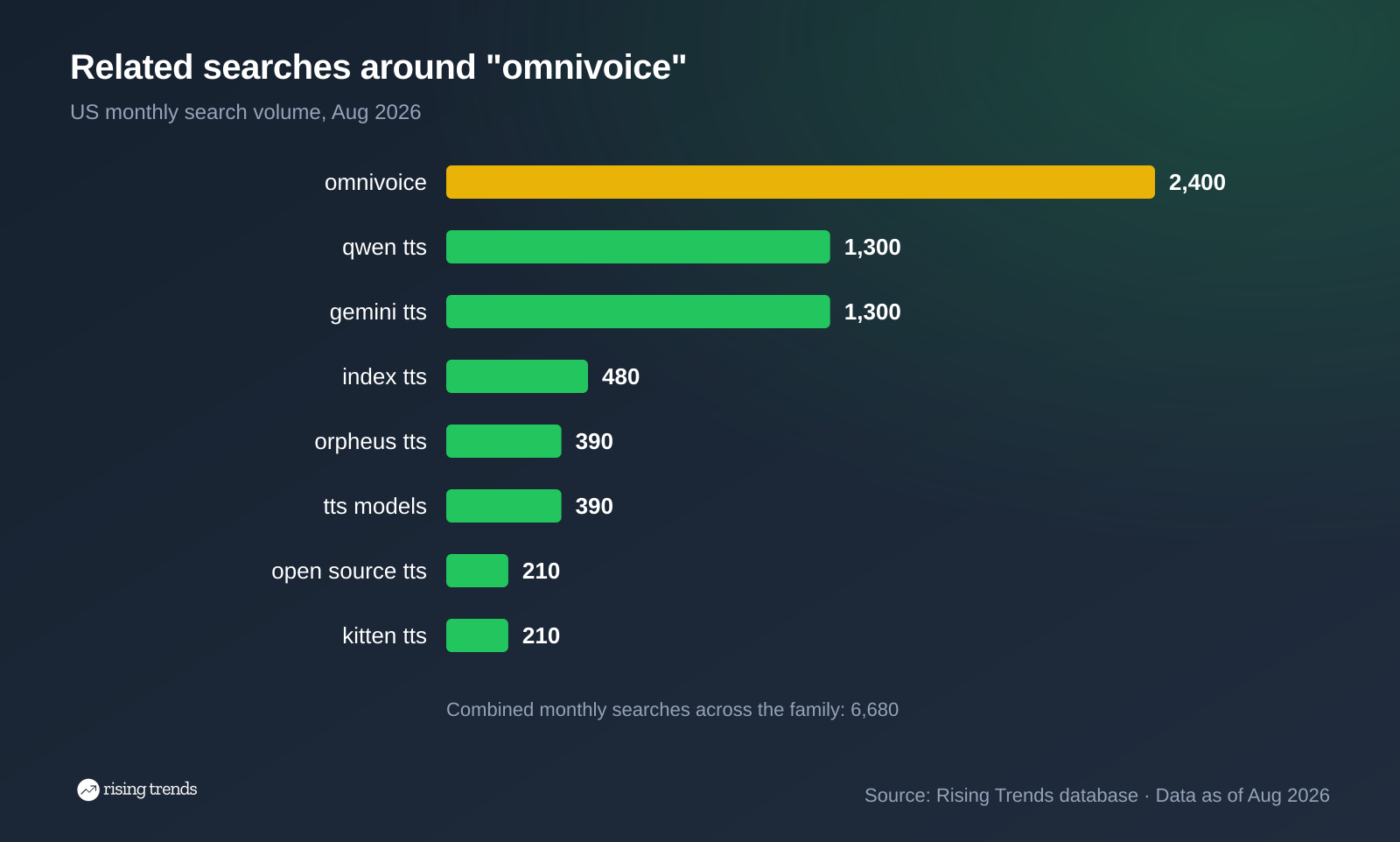
Those eight terms are 6,680 combined monthly searches as of Aug 2026, and omnivoice is 36% of the total. For scale, "elevenlabs" is 368,000 a month and up 22% in a year, so the open side of this category is still roughly one search in every 150. The generic terms are the ones to watch, though: "open source tts" is 210 a month, "voice clone" is 5,400, and neither is growing.
It is a model, not a company and not a product you buy. The official repository describes it as a massively multilingual zero-shot text-to-speech model supporting over 600 languages, and the Hugging Face card tags it with 646. Zero-shot is the important word: you hand it three to ten seconds of someone talking, with no fine-tuning and no training run, and it speaks your text in that voice.
The fastest way to understand it is the hosted demo, which is a box for your text, a box for a reference clip, and a button.
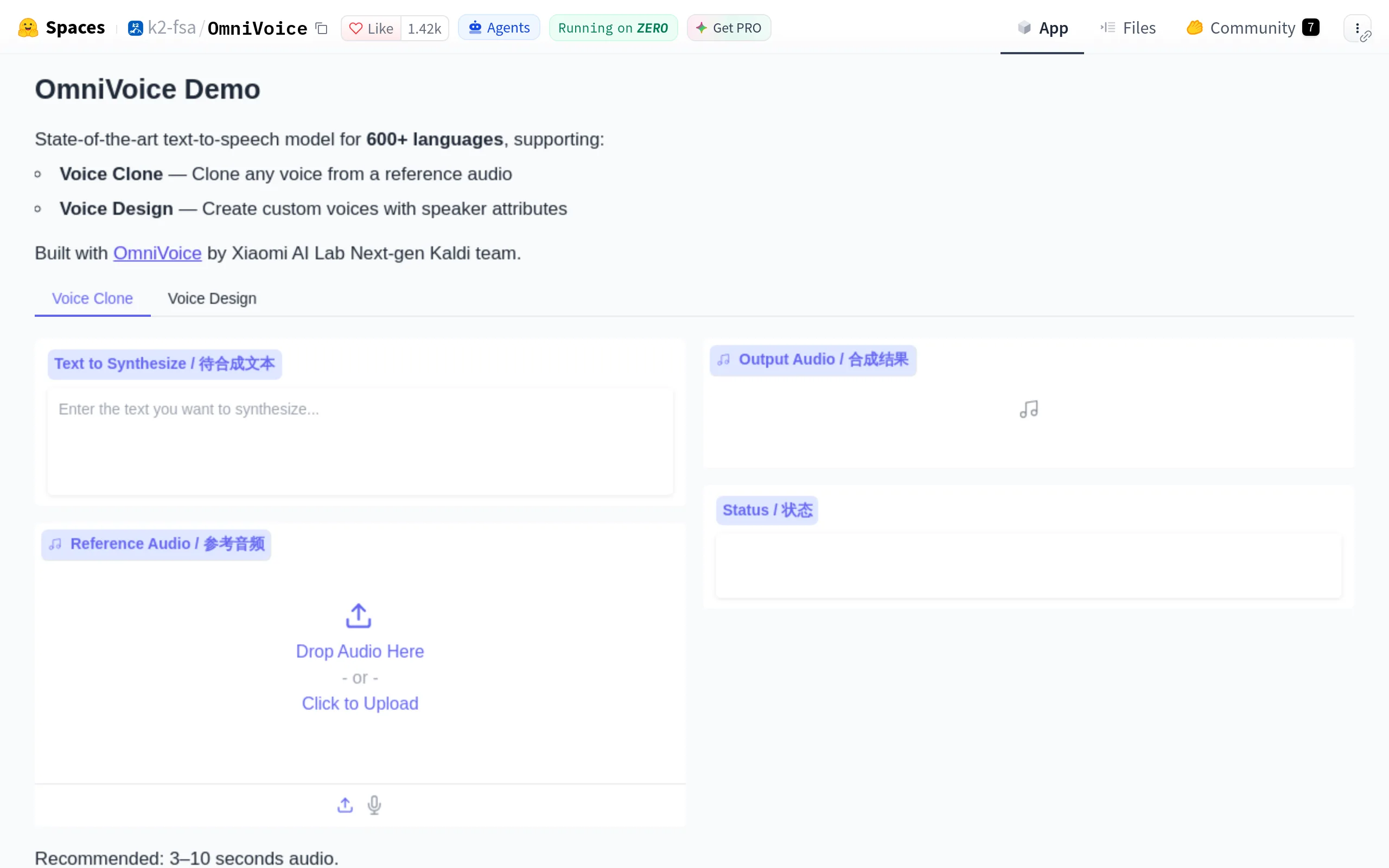
There is a second mode, Voice Design, where you skip the reference audio and describe the voice you want instead: "female, low pitch, british accent". You can drop tags like [laughter] and [sigh] inline, and override English pronunciation with CMU dictionary spellings, so the model reads "[B EY1 S] guitar" as bass and not base.
The engineering is unusual enough to explain the attention. The paper, by a team at Xiaomi that includes Daniel Povey, the creator of Kaldi, describes a single-stage diffusion language model that maps text straight to multi-codebook acoustic tokens instead of going through a semantic stage first. The backbone is initialised from Qwen3-0.6B, which is why a text LLM shows up inside a speech model, and the whole thing was trained on 581,000 hours of audio assembled from 50 open datasets, on eight H800 GPUs in 9.66 days. You can hear the output on the team's samples page, which covers everything from Mandarin to Luganda.
Speed is the other claim. The repo reports a real-time factor as low as 0.025, meaning roughly 40 seconds of audio per second of compute, and the paper measures 0.0319 at 16 diffusion steps and batch size one against ZipVoice at 0.0557.
The trigger is one date. The paper landed on arXiv on 1 April 2026 and the model card went up the same day, and that is the month searches jumped from 50 to 2,900. There was no launch event, no funding round and no pricing page, which is unusual for a term that moves this fast. What there was instead was a free download that did something the paid APIs did not.
Within a week the walkthroughs started: a ComfyUI node on 4 April, an installation showcase on 19 April, and a stream of "forget your voice subscription" videos. Six months on they are still being made. This short from September 2026 is a fair sample of what people are actually doing with it.
That clip is from the Next Horizon channel, published 17 September 2026, and it points straight at the GitHub repo. The demand behind it is the same demand driving auto dubbing and the rest of the synthetic voice stack: people want one voice across every language they publish in, and they want to stop paying per character for it.
This is where the open model is genuinely different, and where the numbers get awkward. Here are three ways to get a cloned voice saying something, priced as of October 2026.
| Option | Price | What you get | Commercial use |
|---|---|---|---|
| ElevenLabs Creator | $11 a month | 121,000 credits, 1 credit per character on Multilingual v2 | Yes, from the Starter tier up |
| omnivoice.app Basic | $9.90 once | 800 credits, about 80,000 characters or 1.8 hours | Claimed, but see below |
| OmniVoice on your own GPU | $0 plus electricity | Unlimited characters, 646 languages, runs offline | No, the weights are CC-BY-NC |
ElevenLabs pricing is the benchmark everyone measures against, and at the Creator tier it works out at roughly nine cents per thousand characters. Our own breakdown of Gemini TTS put Google's Flash model at $0.81 per hour of generated speech. Against either, a model that runs on a 16GB consumer GPU with no per-character meter is a different category of cost.
Quality is no longer the excuse for paying, either. On the 24-language MiniMax-Multilingual-24 benchmark in the paper, OmniVoice averaged a 2.850 word error rate against 10.950 for ElevenLabs Multilingual v2 and 3.774 for MiniMax-Speech, with speaker similarity of 0.830 against 0.655 and 0.766. Two caveats matter. These are the model authors' own measurements, not a third party's. And the ElevenLabs average is dragged down by two catastrophic rows, Thai at 73.936 and Vietnamese at 73.415, which look like a language the system simply does not handle rather than a quality gap across the board.
Real-world numbers are softer than the lab ones. A user running an int8 build posted a five-language test in the model's discussions in July 2026 and reported "0.707 mean speaker cosine across all five languages, 0.0% ASR error, and mean RTF 0.45". That last figure is fourteen times slower than the paper's best case, which is the usual distance between a benchmark rig and somebody's desktop.
Here is the part that is not on any page currently ranking for this term.
The GitHub repository carries an Apache-2.0 badge, which is the licence most developers check and the one that permits commercial use. The Hugging Face model card says something different, in one sentence near the bottom: the code is Apache 2.0, but the pre-trained model is licensed under CC-BY-NC, because of constraints from its training data.
In September 2026 a company evaluating the model for its own platform asked the team to settle it, writing that the mismatch "creates uncertainty about the actual licensing terms applicable to the pre-trained model weights, as opposed to the source code". The first author replied the same day, in the licence thread, with one line: "Hi, the model weights are non-commercial and can't be used commercially."
Pushed on which dataset was responsible, he was specific: "Emilia has two parts: one under CC-BY-4.0, the other under CC BY-NC 4.0. Many other datasets in our training set, such as WenetSpeech-Yue, also use non-commercial licenses." A second developer added a complication nobody had raised: the Higgs-audio v2 tokenizer the model depends on carries its own terms, which "requires additional permissions for any product with more than 100k annual users".
Three separate threads about commercial use have now been opened on the model repo, in roughly August, September and October 2026. The question keeps coming back because the answer is buried and the badge on the repo says otherwise.
Meanwhile a site at omnivoice.app sells hosted generation using the name, from $9.90 for about 80,000 characters up to $29.90 for 300,000. Its pricing page promises "commercial rights", its FAQ states that "Apache 2.0 explicitly permits commercial use", and its "View on GitHub" button points at a repository that is not the official one. Its own footer says it "is an independent service and is not affiliated with, endorsed by, or sponsored by any third-party AI model providers". It also describes the paper's benchmark table as an "independent" benchmark. If you are buying voice generation for a business, that stack of claims is worth reading twice.
The quality moat is gone, and the licence moat replaced it. For three years the argument for paying ElevenLabs was that open models sounded worse. A 0.6B model trained on public data for under ten GPU-days now beats the commercial baseline on the multilingual benchmark its own rival published. What still protects the incumbents is not audio quality. It is that a startup's lawyer will not sign off on CC-BY-NC weights, and that the clean-data licensing ElevenLabs can buy is the actual product.
Language coverage is the new axis. Thirty-two polished languages used to be enough. A model that handles 646, including 82 languages at under 5% character error rate on the FLEURS benchmark, changes who can be served at all. That is the same widening we track across AI trends: the frontier stops being "better English" and becomes "everyone else".
Open weights keep absorbing the category. The pattern here matches what we saw in the open-source AI agent gold rush: one project arrives, the generic category term flatlines, and the project's own name becomes the search. "open source tts" is down 46% in a year while omnivoice is up 3,329%, as of Aug 2026. People are not shopping for a category any more. They are downloading a specific thing.
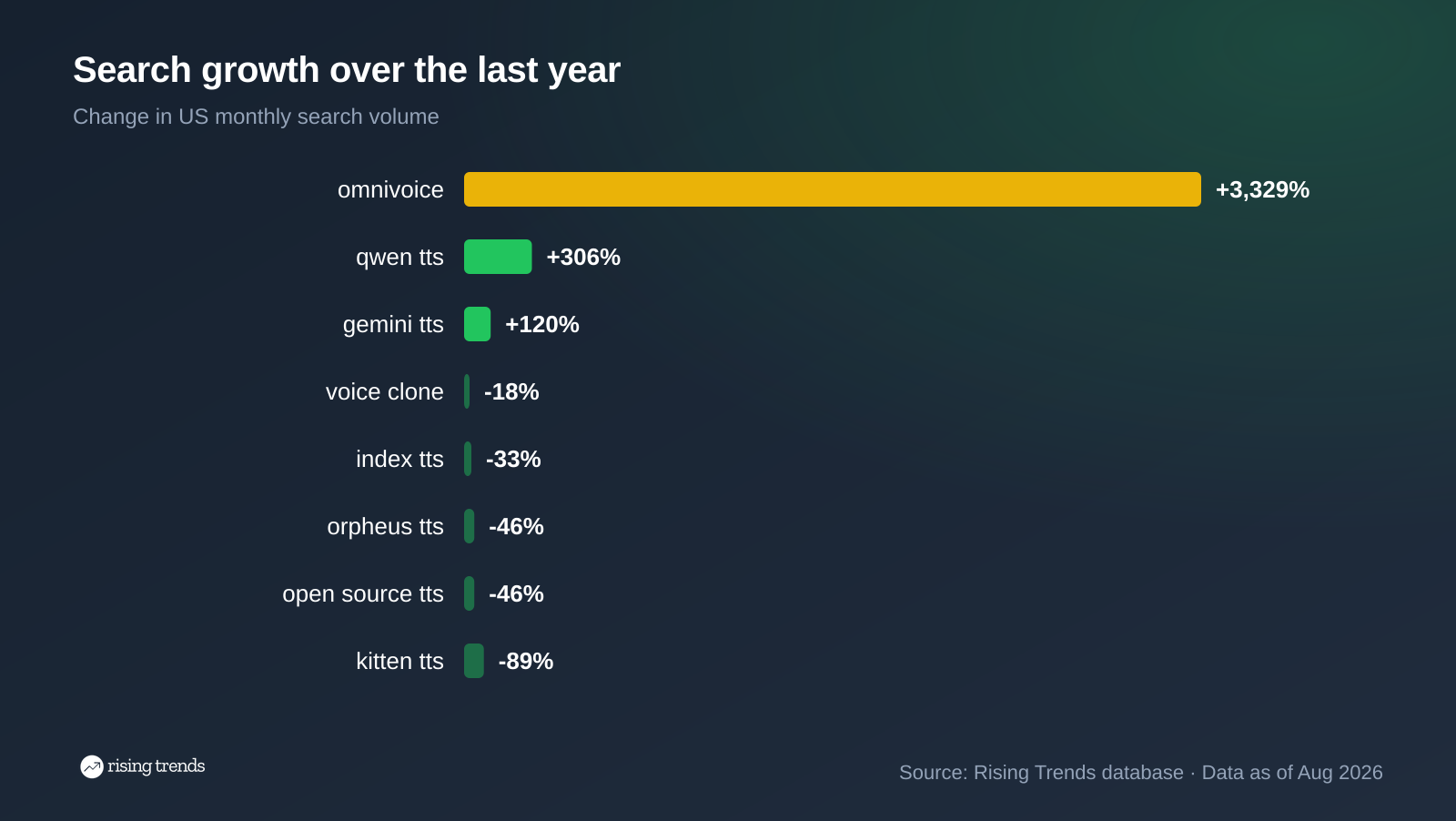
That chart is the whole argument in one frame. Only three terms in this family grew at all last year, and the other two are both backed by trillion dollar companies. Everything independent is in decline except the one model people actually downloaded.
The impersonation problem got cheaper. The repo's own disclaimer bans unauthorised cloning, impersonation and fraud, which is the only control a downloadable model has. Three seconds of someone's voice is now enough, offline, with no account and no audit trail. That is a detection problem rather than a prevention one, and it belongs in the same conversation as the provenance work we covered in AI text watermarking.
A commercially licensed re-release. The authors know the licence is costing them adoption; it is the most-asked question on their own repo. The fix is retraining on commercially clean data, which at 9.66 GPU-days is not an expensive fix. If it lands, watch "omnivoice" break past its 2,900 peak rather than holding at 2,400.
Whether "voice clone" ever recovers. The generic term is 5,400 searches a month and down 18% in a year, as of Aug 2026. Named models are taking that demand. If "voice clone" keeps sliding while model names rise, the shopping behaviour in voice AI has permanently moved from category to brand, the way it already has for generative AI tools.
The commercial lookalikes. Terms like omnivoice.app exist because the model is free and the name is not trademarked. Watch for search queries that pair the name with "pricing", "free" or "login": those are people looking for a product that the research team never built, and they are the ones most likely to buy commercial rights nobody can actually grant.
The underlying signal is simple enough. A research team inside a phone company published a model in April, did not sell anything, and now owns a third of the search demand in its category, as of Aug 2026. The download counter says 1.7 million people took it last month. The licence says most of them should not ship it. Both of those things are true at once, and that is the most interesting thing happening in voice AI right now.
Want to catch a model like this in the month it breaks out instead of six months later? Read our guide on how to identify market trends, or browse what is breaking out right now in our trending topics list.
Join 5,000+ founders · Free